The ghost of a woman i white has been spotted in the haunted Prince Gong’s Mansion in Beijing. It is said it is the ghost of a grieving mother that never recovered after the death of her son.
Prince Gong’s Mansion (恭王府) is today a tourist attraction in Beijing, but it used to be a grand mansion for some of the most powerful people in China, and also the home to one of the richest ghost.
The mansion is considered one of the most exquisite Chinese imperial mansions, representing the elegant lifestyle of Qing Dynasty royalty.
Read More: Check out all of the ghost stories from China
The mansion is also known to be one of the more haunted places in the country, and there are several reports going on for centuries about a woman in white walking the grounds as a ghost, still crying and mourning the loss of her lost son.
Prince Gong’s Mansion
Prince Gong’s Mansion is a true testament to the siheyuan-style that characterized this period in history and named after a Manchu prince, Yixin or better known as Prince Gong that was an important statesman during the 1800s.
The Manchus are a Tungusic East Asian ethnic group from Manchuria in Northeast Asia and led the Qing Dynasty from the 1600s until the imperial rule ended in 1912.
But the haunted rumors started long before Prince Gong moved into it.
The Richest and most Corrupt Man in China
Before the mansion was given to Prince Gong it belonged to another. Prince Gong’s Mansion was originally built in 1777 during the reign of the Qianlong Emperor for his favorite adviser, Heshen (和珅).
As one of the most powerful court officials during the Qing Dynasty, Heshen was remembered for his lavish lifestyle and incredible influence over imperial politics. He was also remembered to be one of the most corrupt officials in Chinese history and one of the richest as well.
The Death of Feng Jiwen
He lived together with his family and loved his wife, Feng Jiwen who he loved more than anything and they had a loving relationship even before he got into all the money. It is worth noting he had around 80 concubines as well in the house, but historical writings actually say his wife even encouraged it.
No matter how much money and gold a person has though, it isn’t enough and Feng Jiwen didn’t get to live out her loving family life until the very end though and got her heart broken to bits when her youngest son died in a battle fighting rebels.
Heshen, who was prepared to do anything for his beloved wife, hired monks to care for his wife and was hoping to pray for her to come back to her senses and health. His efforts were in vain though and it’s said she died of a broken heart.
She certainly fell ill and Heshen even offered 500 000 silver to the one able to cure her illness. After her death he was distraught, didn’t show up to work for months and wrote 6 poems about her to mourn her.
The Fall of Heshen
And even Heshen ended in tragedy as he was eventually apprehended when the throne got a new emperor that didn’t look at him as favorably when the Qianlong Emperor abdicated in 1796. They made him hang himself and had all of his belongings, as well as the mansion confiscated.
After her death she stayed on in her afterlife unable to move on. She and several of former escorts for Heshen have been seen around the palace, and the guards working there have claimed to have seen a woman in white walking the premises. You can hear the cries of a mother echo through the old mansion.
Discover the secrets and legends of Abbaye De Mortemer, an infamous haunted abbey in rural France. Explore its haunting history from Dames Blanches, ghost monks, werewolves and a goblin cat guarding a treasure.
Hidden deep within the French countryside lies the Abbaye De Mortemer, an ancient structure with a chilling past. The former Cistercian Monastery in the Forest of Lyons is the home to eerie sightings and ghostly apparitions.
Origins of the Abbaye De Mortemer
Established in 1134, the Abbaye De Mortemer was an ancient abbey that was a gift to the Cistercians by Henry I of England.
Read Also: There are many supposedly haunted abbeys and monasteries around the world. Check them out: Here
The name comes from the stagnant water of the lake that was dug out by the monks. It was called the Dead Pond which in French is Morte Mare.
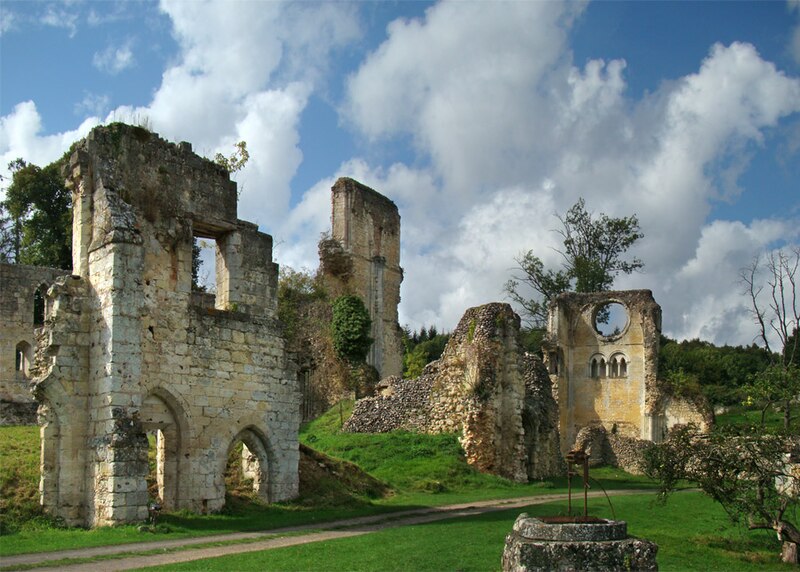
Abbaye De Mortemer Ruins: Most of the once grand abbay in France is now only ruins and is said to be haunted by more than one ghost. //Source//Wikimedia/Tango7174
Who owned the abbey depended on who owned the land from year to year. It was founded by the English king, but ended up under the French crown after the Hundred Year War ended in 1453.
It held out despite it falling into disrepair until 1790 when it was dissolved under the French Revolution. Only 4 monks remained alive living in the abbey. They would end up remaining there, even in their afterlife.
Dame Blanches of Mathilde I’Emperesse
The one thought to be haunting the place is the daughter of Abbaye De Mortemer founder, Mathilde I’Emperesse or Matilda of England.
Her father was King Henry I of England and she was one of those with a claim to the English throne in the civil war between England and Normandy between 1138 and 1153 which was known as The Anarchy.
Why she is haunting this abbey is unclear as she died at an old age far away. She had close ties to this abbey as it was said she was a very spiritual woman and the order of the Cisterican monks because of the importance of the Virgin Mary, a saint of great importance to her.
A picture supposedly depicting her ghost got well known in 1999, however French television has since debunked the image as lighting trickery.
According to legend she walks by the ancient pools and mist is created on them. By local lore you do best to look away if you spot her. If she wears black gloves it means bad luck and misfortune. If she is wearing white, there is a happy event in the coming year. If you see her twice though you are condemned to death.
The Helpful Ghost Monks
People have reported a number of sinister legends and stories about the Abbaye De Mortemer. One popular story involves sightings of the infamous Black Monks, which are said to appear on dark nights in the abbey’s ruins.
This is believed to be the ghosts of four monks who were murdered during the French Revolution in 1789 when the churches and abbeys were robbed for their wealth to fund the revolution and the monks were hunted down and dragged to the old cellar were the last brothers of the orders were massacred.
Other visitors have experienced ghostly apparitions, chills, strange voices, and other forms of supernatural activity. Both the Delarue family that were going to move into the former abbey reported about seeing the monks as well as an English paratrooper in the second world war.
He said that he was spotted by the enemy and was running around in the forest to hide. A monk came forward and guided him to safety before disappearing. The people at The Resistant Cell the paratrooper found, knew it had to be a monk from the Abbey.
The Goblin Cat Haunting the Treasure
The haunted abbey is also said to be the home to a certain Goblin cat you can meet in the ruins in the form of a black cat.
According to the legend, the cat is guarding a certain treasure of the abbey said to be so grand it could restore the abbey to its former glory.
The She-Werewolf
One of the most famous legends concerning the Abbaye de Mortemer is the story of a werewolf haunting its grounds. According to legend, a cursed woman transformed into a wolf every night and terrorized all who crossed her path.
This was thought to be a female werewolf known as the Garache in French Folklore with yellow eyes. This is the only tale of a Garache in Normandy apparently, a weird thing perhaps as French Folklore is filled with legends of shape shifting werewolves.
A man named Roger Saboureau was out poaching in the forest in 1884 when he encountered this werewolf and he shot it dead without hesitation.
When the Garache died though it returned to its human form and he saw it was his own wife.
The Demonic Pink Room
In 1863 the building, restored somewhat and made into a family home, was bought by a rich Parisian named M.Delarue. He moved into the place with his wife and two children, but they soon found that it wasn’t without its history.
One of the most notorious stories revolves around Abbaye De Mortemer’s so-called “Pink Room.” The room is mentioned by some of the owners who experienced so much hauntings it even broke an engagement.
A young girl who was the fiance of the son, Charles Delarue, the owner of the building and living there came to stay with them once. She was given the pink room as it was the only one available. She was found in the morning, terrified of all the paranormal activity that had happened during the night. She announced she would never live there, broke off the engagement and hurried back to Paris.
M.Delarue’s daughter had been a nurse during the First World War and told her father she had never been afraid in the trenches and would not be afraid of the pink room either. She made it her own and lived in it, but said that she always felt observed, but not threatened in the same way the former fiance of the family had.
The Exorcism of the Abbey
The Delarue family stayed in the former abbey for quite some time, but in 1921 they thought it was about time with an exorcism. Not the first one though, and they called once again upon Abbé Humbolt who had done the previous ones also.
They ordered another exorcism of the Pink Room and the Abbey and it did become quiet for some time. But then it started again. How is it today?
Château de Trécesson, the ancient castle in Brittany has more than one ghost haunting the place. Perhaps it’s not too strange to be haunted by the mysterious Dames Blanches when the location of the castle is in an enchanted forest.
Château de Trécesson is an ancient castle tucked away in the French countryside that has been the source of fascination and speculation among locals for centuries.
The castle in Brittany has a mysterious past and its origin is lost in the mists of time, replete with tales of hauntings and supernatural phenomena, has attracted visitors far and wide hoping to get a glimpse into its paranormal secrets.
History of Château de Trécesson?
Château de Trécesson is an ancient castle situated in the French countryside, and it dates all the way back to 810 AD. The castle is built on the foot of the Buttes de Tiot and has stood for more than two millennia and endured the passing of time, but its rich history and ghostly lore still remain a mystery.
It’s rumored to be haunted by ghosts, and visitors have reported having odd experiences while visiting the castle grounds.
Legends and Ghost stories of Château de Trécesson?
There are many rumors and tales about Château de Trécesson that have been passed down through generations. One of them is of several guests at the castle that have seen a group of ghosts playing cards. Who the winner will be in the eternal game they are playing or what game of cards they have been on for ages are uncertain.
There is also talk of an unknown monk wandering nearby close to the meadow by the castle and on the roadside leading up to it. He is sometimes described as headless. Perhaps not so surprising as the Château de Trécesson is built in the The Enchanted Forest of Brocéliande, a place of wonder and supernatural in every tree stem.
The Enchanted Forest of Brocéliande
The Castle is close to a part of the mythological forest known as Brocéliande. The real forest connected to this is the The Paimpont Forest. It is located around the village of Paimpont in Brittany.
It contains the castles Château de Comper and Château de Trécesson as well as the Forges of Paimpont, a national historic site. It has been associated with the forest of Brocéliande and many locations from Arthurian legend, including the Val sans retour, the tomb of Merlin, and the fountain of Barenton as well as The Lady of the Lake.
Dames Blanches French Folklore
There’s also a long-standing local legend involving the castle’s ‘Dames Blanches’, or ‘White Ladies’. According to folklore, these female ghosts are said to inhabit the castle and torment its inhabitants with misfortune, calamity, and sometimes even death in many stories in French folklore.
This castle has also been said to have one of these Lady’s in white or Dames Blanches in residence from the time the castle was in the hands of Monsieur de Trécesson.
People tell stories of hearing strange whispers in the walls, feeling cold chills running through the rooms, and seeing shadowy figures of beautiful women in a muddy white dress with a flower crown roaming around in the night air.
It is said it was her brothers who murdered her in 1750 that buried her alive on her wedding day as they felt they had accepted a wedding that dishonored the family.
The whole event was spotted by a couple of poachers that saw the carriage with the woman was out in the woods and the men started digging the grave they sealed her in before driving away. Why they didn’t have the decency to kill her before burying her is unclear.
The poachers found the courage to tell the people in the nearby village about it, and they came for her rescue. They were too late and she died, but didn’t really leave. It is said she is seen close to the castle, and floating on the waters still wearing her wedding dress.
Her name or where she came from was never discovered.
The Heartbroken Lovers
Another popular tale tells of two lovers being separated due to their families’ objections. The man was forced by his father to go fight in the crusade of 1249. He was killed in battle and his young wife died of grief only a few months after the news reached her.
The spirit of the two lovers have been spotted replaying their final farewell scene close to the castle’s gateway.
Stories about white ladies are plentiful in Europe, especially in Germany, and this particular The White Lady In Freihung ended up winning against the U.S Army.
The main town in Freihung has a long history of Bavarian culture and the industry of mining lead. There is also a ghost said to be haunting the quaint little Bavarian town.
This The White Lady In Freihung who is supposedly haunting the city center is said to be a middle aged woman who used the old mining tunnels to glide through, scaring people so much that in the end they destroyed the tunnels altogether. One hotel was greatly bothered by it and ended up taking matters into their own hands to rid themselves of the ghost.
The Noble White Lady In Freihung
Who The White Lady In Freihung was is not certain, but there are tales that there used to be a castle at this place were it now was a hotel, although there are no direct historical proof of it.
According to the legend, there lived a noble woman in this mysterious castle who died tragically, although her name and manner of death is not known as with the rest of the facts of the legend.
According to reports, there are tales about seeing The White Lady In Freihung since 1625. Ghosts that are reported on wearing white are very common in ghost stories from Germany, especially if the ghost is linked to a noble house. This is the case with the haunting of the house of Hohenzollern as well as an example.
The noble family of Hohenzollern of Germany has been haunted for centuries. The White Lady follows them, wherever they go. Who is she? And what does she want with the life of the nobles?
She is said to haunt the grounds where the castle once stood. Archaeological findings of a castle named Freihung Castle, exist, but in another place than where the hotel is today, and it is unclear whether that has any connection at all.
Today, most reports come from The Gasthaus Alte Post Hotel that they built over the underground mining tunnels.
Weiße Frauen in Germanic Folklore
Why exactley is germanic ghost stories riddled with stories about the lady in white or as they are called in german, Weiße Frauen
In German legends and folklore the stories of the Weiße Frauen or White Women used to be a name meant to the elven-spirits and the stories of the light elves from pagan times and has probably evolved to refer to the female ghosts said to haunt castles, forests, homes and everywhere women have met a deadly end.
The Missing Castle: could the ghost of the Lady in White come from the remains of a supposed castle that used to stand in Freihung? Did the castle even exist?
Now the name is also used on women dying in grief, of sorrow or with an urge of revenge. It has spread throughout Europe and is an image with strong connotations, even today.
Even outside of Europe, there are tales about female ghosts clad in all white, from the Korean Virgin Ghosts to the vengeful spirit on the Onryo in Japan.
The U.S Army on Ghost Hunt
The terror of The White Lady In Freihung got so bad that the local owners of the hotel called in the U.S troops to the The Gasthaus Alte Post Hotel where most sightseeings of her were reported.
From 1945, the American army had a training center in Grafenwoehr, not far from Freihung. Elvis Presley was once stationed there. It is still used today as a training area by the army.
The hotel owners were desperate by the 1970s and asked for their help and help they received. The army from the base came and used explosives to seal off all the tunnels under the hotel, hoping it would silence the ghost that supposedly walked underneath inside of the tunnels.
The Haunting Continues
This was not enough to stop The White Lady In Freihung however, as she just finds new ways to move among the locals to scare them. And if we are to believe the stories, she is still wandering the streets in the city center of Freihung and showing herself in the rearview mirror of passing cars.
In the ruins of Lyse Abbey there are rumors about the ghost monks haunting the ruins as well as a white lady roaming the roads around it.
Lyse Abbey or Lyseklosteret is a former cistercian monastery that was built in Os, right outside of Bergen in Norway. There are only ruins of it today, as many of the monasteries were destroyed during the reformation from catholicism to protestantism in 1536.
In 1578 stones were removed from the monastery and shipped to Denmark and used in Kronborg Castle, as Norway at the time was a colony in Denmark. The stones were also used to build the Rosenkrantz tower in Bergen.
Ghost Monks
The monastery called Coenobium Vallis Lucidae ( The Monastery in the Valley of Light) in Latin and named after the fjord, Lysefjorden (The Light Fjord) was founded by English monks in From Fountain Abbey in North Yorkshire 1146 and the building was built over the next hundreds of years. They also brought fruits like apples to Hardanger, a place now renowned for its tasty apples.
Lyse Abbey: The ruins of the old monastary is said to be haunted by ghost monks// source
It is said that the monks that first built the monastery never left and haunts the location even to this day. Many have reported about seeing cloaked silhouettes walking about as if they are working on the building.
There have also been heard moans from the ruins of the once great monastery, especially on foggy nights, making people believe that the old ruins are haunted by Ghost Monks.
The ghost monks are however not the only ones that are rumored to haunt the place. Apparently there are stories about a “white lady” that walks around in the ruins of the monastery at night time and in the evening. According to legend there was a terrible accident involving a tractor in 1960 when she was bicycling along the road nearby and a tractor ran her over.
It is unclear if it actually was an accident since it was her neighbor driving the tractor. Anyway, since then, there have been multiple reports about a woman in white around the weeks leading up to Christmas, often described as a white morning robe, wandering restless around the monastery, just looking straight ahead.
Explore Palavas-les-Flots, the haunted coastal city of France and learn about its mysterious supernatural phenomena of the ghost of a hitchhiking woman in white.
Palavas-les-Flots is a coastal city in France with a mysterious history. It has been the site of many supernatural experiences, including ghost sightings and numerous unexplained phenomena. Discover the spooky secrets behind this haunted city today!
Palavas-les-Flots is located within the historic Camargue region of France. A walk through the narrow, cobblestoned streets of Palavas-les-Flots will bring you past some of the city’s most mysterious and supernatural sites.
Dame Blanches in French Folklore
One of the most pervasive supernatural mythologies associated with Palavas-les-Flots is that of the Dames blanches, or White Ladies. These mysterious figures are said to wander through fields and forests near the city, bringing with them both luck and misfortune to those who encounter them.
They are known way back from myths and folklore as well and quite well spread in European ghost stories. Tales of these enigmatic creatures have been told for centuries, inspiring many artistic interpretations and offering a glimpse into a fantastic world beyond our own.
Today however they are most often told about in the deepest and oldest castles as ghost of ladies that died gruesome deaths, or along the road as women who died in a road accident of some sort. Very often they are mixed in with the urban legend of the hitchhiker.
Dame Blanches in Palavas-les-Flots in 1981
Many people from the town claimed to have seen one of these mysterious White Ladies late at night near the water. They described the figure as incredibly tall, with flowing white robes and an otherworldly presence.
There was one occurrence that became more famous than others. One night on May 20th, 1981 a group of four people aged 17 to 25 were taking their car for a trip to the sea. After a couple of drinks and a walk in the city they were headed back home around midnight.
The people picked up a female hitchhiker in Palavas-les-Flots right before the Pont des Quatre Canals.
She was dressed in a white raincoat and a scarf and looked to be in her fifties. She refused to speak and sat in the back of the car. Suddenly she would scream: Mind the turn, mind the turn , and the driver slows down and drives safely past the bend.
Suddenly, the two passengers in the back scream out as the hitchhiker disappears into thin air. What exactly happened that night on the road in Palavas-les-Flots remains a mystery.
All the Woman in White Ghosts
While the White Ladies like the one told about from Palavas-les-Flots remain some of France’s most famous supernatural figures, and are hardly the only ones. Across the country, similar legends exist about white women in traditional northern French clothing lurking near places like cemeteries and abandoned houses at night. Whether or not these sightings actually occur is up to debate, but one thing remains certain: The mysterious stories will continue to captivate people for years to come.
An old fortress of protection turned into a prison of a mistress who died and started haunting Zitadelle Spandau where she met her end. And the ghost of the mistress Anna Sydow are said to haunt both the place and the family who caused her death.
One of the best preserved Renaissance military structures in Europe is the citadel in today’s Berlin, in German called Zitadelle Spandau. It was built in 1559 on top of another fort and designed to protect the Spandau town which is now a part of modern day Berlin.
Many castles in Germany have stories about a certain Lady in White haunting it, and in Spandau Citadel there is the ghost of Anna Sydow.
Anna Sydow was the mistress of the Brandenburg Elector Joachim II. Joachim II was a part of the Hohenzollern who has been rumored to be plagued by the ghosts of a Lady in White. Anna Sydow is just one of the many rumored to be at least one of them.
Read more about the curse of the House of Hohenzollern: Here
Anna Sydow: Portrait of the mistress Anna Sydow who are believed to be the Lady in White that haunts Zitadelle Spandau after she was imprisoned by the son of her lover.
In 1549, the wife of Elector Joachim II suffered an accident which left her walking on crutches. She fell down the floor and impaled herself on a couple of antlers that hung in the room below. Something that the elector thought ruined the marriage and the enjoyment of hunting. He chose then to take a mistress and he chose Anna Sydow.
During her life as his mistress, Anna Sydow bore him two children and lived in the Grunewald Hunting Lodge for two decades and is also said to haunt the grounds of that place. This was also the place where the wife of Joachim II got impaled and ended up on crutches.
Imprisoned in Zitadelle Spandau
Johann Georg was the heir and son to Joachim II, and had explicitly promised his father on numerous occasions that he would spare and protect Anna Sydow after he died. But when the elector died in 1571, she was imprisoned in the Zitadelle Spandau until her death in 1575.
The Zitadelle Spandau was often used to house prisoners of the state for a long time, and Anna Sydow was one of the first. She was arrested under false pretenses though and saw no trial. Although the arrest was unjust, she at least didn’t end up being executed like many others of his fathers old court did. Or according to some of the legends, she was actually murdered.
In any case, Johann Georg felt haunted by her after her death. On January 1st in 1598, Johann Georg saw the specter of a Lady in White that he thought had to be Anna Sydow and died eight days later.
In 1709, there was a skeleton of a woman found buried inside of the Zitadelle Spandau during renovation, and everyone thought it had to belong to the Lady in White that was plaguing the fortress as well as the Hohenzollern family. They gave her a proper burial in hopes of ending the hauntings, but according to reports, there is still something haunting within the Zitadelle Spandau walls.
Immured in the Hunting Lodge
There is also this rumor that it wasn’t in the fortress Anna Sydow met her end but in the Grunewald Hunting Lodge. So she is thought to haunt both places as well as members of the Hohenzollern family.
It is a legend that she was immured alive in the small spiral staircase in the western corner wing. Since then she has been haunting the castle around midnight.
Thes old and noble family House of Hohenzollern in Germany seems to forever be haunted by a Lady in White. Both the ancient family homes of the family, and also the family members, however far they go away, the curse of the house will follow.
In December 1628, the Palace in Berlin can’t keep the cold out, not completely. A hereditary haunting of the ruling family of Prussia sits in the walls of their castles — a bad omen. Most often the bad omen of the curse is seen as a woman dressed in white. You can hear her sometimes, the clanking of the large keys around her waist. A young prince is next this time. She appears to a him and says: – ‘Veni, judica vivos et mortuos’ which means ‘Come, I judge the living and the dead’. The day after, he dies of an illness.
But who is it that haunts this old and noble family? Even the young princes? Years before the young person died, she was also spotted by three young pages in 1619. In one of Hohenzollern Castle halls, it doesn’t need to be the one in Berlin. As long as it is one of the ruling Hohenzollerns. The young pages thought she was a living human being, and approached her. When he asked what she was doing here she turned to him and hit him with her keys, killing him. The two pages ran away, terrified.
The House of Hohenzollerns was growing restless when they heard about the sighting of the woman. She had been spotted again, it was a bad omen. Something was about to happen. Three weeks later, John Sigismund Prince-Elector of the Margraviate of Brandenburg from the House of Hohenzollern, died.
House of Hohenzollern in Germany
The family is an old one. The House of Hohenzollern once ruled what is now known as Germany as a dynasty being princes, electors, kings and emperors. They ruled the lands of Brandenburg, Prussia, The German Empire and as far as to Romania.
Read More: Check out all of our ghost stories from Germany
They began their ruling dynasty in Swabia, in a town called Hechingen during the 11th century and took their name from their ancestral Hohenzollern Castle. The first ancestors of the House of Hohenzollerns were mentioned in 1061.
Burg Hohenzollern on the Hill: The ancestral home in Swabia, Germany, constructed in the early 11th century to the House of Hohenzollern. The haunting may have started here, but the sightings of the White Lady Haunting the family has been spotted everywhere were a member of the family has been residing.
They were the rulers of the lands, growing in power until 18 71 with the unification of the German Empire with the Hohenzollerns as hereditary German Emperors and Kings of Prussia. This title they held until Germany’s defeat in World War I in 1918 led to the German Revolution. The House of Hohenzollerns were overthrown and the Weimar Republic was established, thus bringing an end to the German monarchy.
Sure, they were powerful, and powerful families makes powerful enemies. Blue blood attracts bad blood. But who was so intent on following the family, haunting them for centuries? There have been many claims as to who exactly is the woman behind the hauntings. And this here, is one of the more famed ones.
The Noble Killer Nun Haunting the House of Hohenzollern
Kunigunde von Orlamünde is a ghostly reminder of the ancient past. She was born in 1303 as the first child of Ulrich I, Landgrave of Leuchtenberg, and part of their Bavarian dynasty in the middle-ages.
According to legend, Kunigunde von Orlamünde fell in love in a man called Albrecht the fair, the fourth son of Frederick IV, Burgrave of Nuremberg. A man of the House of Hohenzollern.
The Abbess: Tombstone of Kunigunde von Orlamünde at Himmelskron, is rumored to be behind the curse of the House of Hohenzollern.
Albrecht had expressed that he would marry Kunigunde von Orlamünde, hadn’t it been for that “four eyes did not stand in the way”. Kunigunde thought he meant her son and daughter. Therefore, she stabbed their eyes out with a needle, and they died, freeing her to marry the man she loved.
Johann Löer made a verse about this in 1559:
And thought, those small children I wanted Will certainly be the eyes that Robs me of my love! And if the woman even did That murdered her own children That misery robbed their life That stabbed them with pins Tender and soft all over
This is not what Albrecht meant though, as he was talking about his parents as they disapproved of their match. He refused to marry her after her actions. He married a woman named Sophie von Henneberg and got two daughters on his own.
Kunigunde von Orlamünde was devastated and full of regret. She had murdered her own children for a man that didn’t even want her. Therefore she started on a pilgrimage to the Vatican to get absolution for her sins from the Pope himself. He ordered her to build a monastery and become a nun. She joined the Kloster Himmelkron.
In some version she she was sentenced to life in prison for the murders, other tell of how she died on the way to the Vatican, not being able to beg of forgiveness. She is one of the origin stories of the curse over the House of Hohenzollern and she has been haunting the family ever since.
Weiße Frauen Haunting the House of Hohenzollern
Could Kunigunde von Orlamünde be the lady following the haunted House of Hohenzollern? Lurking along the walls with her keys, paying close attention on every male descendant in the family that she never got to be a part of? A family growing bigger by every generation while she cut down her own? In any case, the legend of the Lady in White is old. Perhaps so old that even not history keeps it in its records?
Basking in the sunlight, hiding in the shadows, her dress is always white. In German legends and folklore the stories of the Weiße Frauen, meaning White Women used to be a name meant to the elven-spirits and the stories of the light elves from pagan times. Many of the ghost stories seems to be based on these old folklore types of myths and legends, even to this day.
The White Lady Haunting Germany: Illustration from the opera, The White Lady. The White women or the Weiße Frauen has been a part of the German mythology for ages. It has know been a part of German ghost stories as well for centuries.
The legend of the Weiße Frauen or white woman has, as everything does, evolved from its elven origins. Now the name is also used on women dying in grief, of sorrow or with a urge of revenge. It has spread throughout Europe and is an image with strong connotations, even today.
The Family Curse Over the House of Hohenzollern
Some call her the White Lady, some call her ‘The Harbinger’. She brings bad luck to those seeing her, and reports of her sightings has been going on for centuries.
In 1667, Louise Henrietta of Orange, the wife of Elector Friedrich Wilhelm of Brandenburg, was lying ill. A few days before she passed away, she saw the White Lady, sitting by her desk almost as an omen that warned the family that death was approaching.
The family members started to learn to spot the signs, but was unable to do anything after her sightings. In 1678, the Margrave Erdmann Philip of Brandenburg saw the White Lady in his armchair as he entered his chamber in Baireuth. He left the room, shocked and terrified. The next day he rode his horse out in the court and there was something weird going on. The horse was uneasy, as if seeing something that scared it and he threw the prince off. The Prince stood up, seemingly fine and he retired to his chamber. But after two hours, he was dead.
Weiße Frauen Curse of the House of Hohenzollern: The White lady, also known as the Harbinger, has been haunting the family for centuries, acting as an omen when someone is about to day, and even as a warning. Is it really a curse, or actually someone watching over them, trying to warn them when danger is afoot?
Even the dead ones seems to warn about the White Lady that haunts the House of Hohenzollern. The White Lady was supposedly absent during Frederick the Great’s reign, but in his death, he came back to warn them about her. In 1792 in Paris, his nephew Frederick William the Second was camped outside the city with his troops, ready to attack the next day. That night his dead uncle appeared before him, warning him about the seeing the White Lady if he didn’t call off the attack. His nephew listened and left France, avoiding the harbinger and according to the legend, a certain death.
Even Napoleon tried to spend a night in one of Hohenzollern castles but left bothered by the ghost haunting the place. In 1806 he had defeated Prussia and claimed some of its land as a French province. He left the next day, never to returned, calling it le maudit chateau, ‘the cursed castle’.
But today? Were is she? Just before World War I in 1914, she was last reported. Just before the Archduke Franz Ferdinand was assassinated. After they lost the war Kaiser Wilhelm the Second was the last ruling Hohenzollern, and he later abdicated the throne.
And it is said as long as there is no Hohenzollern that rules, the White Lady will stay in the shadows, and hopefully, outside of the Hohenzollern castles.
What is the Truth Behind the Curse?
Such a dramatic story, but does it ring any truth? What is true is that Kunigunde married Otto VI, Count of Weimar-Orlamünde. Historians refute the legend as according to record, their marriage produced no children. It is true that she and her husband adopted a daughter, Podika von Schaumburg, but she grew up and married Poske Ritter von Schweritz in 1341.
There are also records of her dying in 29th of April in 1382. And if she really was born in 1303 she would have been close to 80 and most likely in a comfortable home, not on the road to Rome or in prison.
Kinigunde’s husband died in 1340, leaving her with a vast inheritance. She spent it on the monastery she herself would join as a nun. Funnily enough, sources tells he actually bought the monastery from Albrecht.
The Harbinger of Death
For a story as old as this one, there is now difficult to separate facts from fiction and the story of the curse that allegedly looms over the House of Hohenzollern seems to still be there, even if no one has reported about the White Lady for a while.
But what about The House of Hohenzollern and their sightings of the White Lady over the centuries? All of their stories? Were they just that? Stories? Or is it that some details of the past is not for us to know. Not the living.
Could it be something else than a woman with a flare for eternal vengeance? Perhaps something even older like the German myths and legends have been telling for ages?
Chute de la Dame Blanche or the White Lady Waterfall is a legend of a grieving bride to be in the midst of the battle of Canada. She now haunts the waterfall still wearing her wedding dress were she ended her life, still grieving the loss of her lover.
Taller than the Niagara Falls, the Montmorency falls towers 83 m over the city of Québec. It flows downstream from the city and into St. Lawrence. It is a majestic sight, the veil gushing and all sound but the masses of water is heard when standing close to it. But next to it, another lesser known waterfall falls. From ground water it connects with the Montmorency River along the way as water does. When the waterfall hits the river below the water spreads out, like a wedding veil. This particular waterfall is called Chute de la Dame Blanche or the White Lady Waterfall.
Stories from waterfalls have always been connected with grief, love and death. At least in European folklore. Tales like the Banshee is steeped in water imagery and female ghost stories, and many waterfalls tells a sad tale of a bride to be that died too soon. And this one about the Chute de la Dame Blanche, is just that.
The Bride to Be of the Chute de la Dame Blanche Legend
But who is this woman in the waterfall that came to be known as The White Lady Waterfall more than her original name? A banshee? According to legend, it is the spirit of a young Canadienne woman. An ethnic group of French colonists who settled in Canada from the 17th century. Or as they were known back then, French.
The veil: The waterfall of Montmorency, 1900, just next to Chute de la Dame Blanche.
In a time when Québec was called Nouvelle-France, or, New-France, the state was in an unrest and in the middle of a war that was going to last for seven years against the British empire.
The story tells about Matilde Robin, living near either Côte-de-Beaupré or Île d’Orléans, close to Québec. At the end of the summer in 1759, she was meant to marry her beloved Louis Tessier. Through the summer, she tailored her own white wedding gown, in anticipation of her wedding.
But the unrest in the country was creeping in and about to disrupt the romantic notion of a happily forever after. Canada, being under French government was in a state of unrest as the British wanted a piece of the land and there were whispers about them going to attack soon.
On the night of 8th or 9 July, British forces landed on the north shore, some 1.2 km (1 mi) east of the Montmorency Falls, east of where the French west-east defense line ended, at the mouth of the Montmorency River. They met no opposition from the French for the landing, but the armed forces prepared for battle.
The Bloody Battle of Beauport
The 31th of July, at the cusp of fall, the British attacked. In what was going to be known as the Battle of Beauport or the Battle of Montmorency. The British had been mostly successful in their attacks with their aggressive battle strategy, sending 40,000 soldiers to New-France. For the campaign against Québec, General James Wolfe was given command of an army of about 7,000 men.
At war over Canada: This is a map depicting the troop arrangements at the 1759 Siege of Quebec. It was after this battle that the ghost legend of the Chute de la Dame Blanche is said to have started.
The women and children took cover from the battle in the forest to hide from the bloody battle that raged on. And according to legend, so did Mathilde. The French army, as well as soldiers was volunteers in a militia as well as around 500 natives. Louis was one of the militia men and assisted the French in the following days the battle raged on.
The attack was a fail for the British. Wet air from the falls nearby and a sudden storm ruined the English gun power. The British troops were forced to retreat and admit defeat for the time being. Wolfe recorded 210-deaths in this journal. The French leader, Louis-Joseph de Montcalm, recorded 60.
The White Lady Waterfall
It was a French victory though, and they returned to their loved ones in the forest. Mathilde also waited for her Louis in anticipation. But he was one of those that were never going to return from the battlefield. He died in the battles according to the legend. The deaths of the soldiers during this battle were mostly attributed to the fire coming from the great battery of the Montmorency camp of the British. Perhaps that’s how it also happened for Louis.
In some version of the story of the Chute de la Dame Blanche, it is Mathilde that finds his dead body, floating on the shores of the river banks after the battle. Perhaps she did, perhaps it just makes a better story.
Chute de la Dame Blanche: The White Lady Waterfall has been pictured many times in both books, stamps and postcards. This shows just how much a part of the culture and history this ghost story has become.
No matter of the manner she learned about the death of Louis, it was more than Mathilde could live with, and she ran home, grieving while the rest was celebrating French victory. In some version the houses was on fire after the battles, although it seems unlikely, given of the summer rain storm that ended the attacks.
In either case, she ran to save her one beloved item, the wedding dress. She put on her gown as well as the veil even though she knew there would be no wedding. She went to the Montmorency Falls were she and Louis used to go to be alone before the war. She threw herself from the cliff into the water, her white bridal veil becoming one with the gushing waterfall, becoming Chute de la Dame Blanche or the White Lady Waterfall.
Only a couple of months later, the French were defeated on the Plains of Abraham, and the dream of a New France died as it ended under the British crown.
Today, especially during the summer and early fall, reports of seeing the young girl in her wedding dress lives on around the Montmorency Falls. And the small sister waterfall, Chute de la Dame Blanche, is all hers.
The Truth of the Legend of the Chute de la Dame Blanche
The legend of the Chute de la Dame Blanche has definitely gone through some changes over the years. It is nevertheless a persistent one, and it even made the cut to be put on Canadian post stamps, making Chute de la Dame Blanche or the White Lady Waterfall somewhat of a national treasure.
The Bride in the Waterfall: Many waterfalls like Chute de la Dame Blanche tells a sad story about a bride dying to soon.
A female ghost in the waterfalls is a common enough myth, especially with the dramatic flare of a wedding veil, fitting the aesthetic of a waterfall and across the world there are countless of brides to be’s that are supposedly haunting the waterfalls.
But looking at the timestamp of the legend, such a white veil as the foaming waterfall is unlikely as brides didn’t wear white until after Queen Victoria’s wedding in 1840. Could it just be the details of the wedding dress that were embellished over the years, or is the whole legend just that, a classic ghost story?
One thing that actually is true, is the battles, and it is definitely true that the Battle over Beauport happened, and that young men died and that women were left, longing after their lost ones. But was a man named Louis Tessier one of them?
According to a database of the French and British army soldiers in Québec in 1759 and 1760, there were no French volunteered named Lois. According to them there are no official military documents clearly identifying Canadian Militia members. And if our Louis did exist, he probably would have been one of them. However, some combat participants have been identified using historical and genealogical research. Biographical information will be posted as it becomes available.
From the French army, on the possibility he could have been one of those, there were not many Tessier. We found a Jean Tessier, born in France and part of the French army. Only 26 years old, he was Mortally wounded in the battle of the Plains of Abraham 13 September 1759, not in the Battle of Beauport.
On the account of Louis, there were a lot of them. Most of the Louis that showed on record they died in 1759, died in the battle of Plains of Abraham or the days leading up to it. The only ones dying up to French victory of Beauport were:
Both of these particular people were French born and in the French army, not in the militia. And therefore unlikely of being the Louis marked up in the legend of the Chute de la Dame Blanche.
As for Mathilde Robin, no such name has come up in the research in and around the time of the battle. Considering there is no certain sources as to their names, we have to consider the research and their story, inconclusive.
Chute de la Dame Blanche Illuminating the Country
However the legend of the Chute de la Dame Blanche, be it true or not, the waterfall runs as it has always done. The water keeps flowing, the veil creates the mist everything can hide in, perhaps even ghosts. But it isn’t all doom and gloom around the waterfall of the Chute de la Dame Blanche, but rather, the first source of light.
In 1885 on the 29th of September at eight o’clock, a crowd is gathered on the Dufferin terrace in the city, 12 km away from the gushing waterfall. For the first time in Canada at that distance, electrical light is powered from the power of the waterfall, bringing light again to the country and bringing Canada into the modern world.
The legend of the Lady of the Lake in Rochester has been around the Durand Eastman Park in the state of New York for centuries, haunting the lakes and park, in search for her daughter – and possible revenge.
Between the cities of Rochester and Irondequoit in the state of New York, the Durand Eastman Park has been a place for a nice park and a cozy picnic since the turn of the century. According to the legend though, the park is not always sunny sundays as the Durand Eastman Park is allegedly haunted by the ghost of a woman named The Woman of the Lake.
This type of ghosts takes on numerous names: The Lady in White, The White Lady, Lady of the Lake. She becomes a different entity with those names, one of many, a ghostly transparent figure of folklore. She loses her humanity and such, gains her legacy that lasts longer than a human lifetime. But who were this lady down by the lake when she was alive? Does she have a name?
Read Also: Check out the rest of our ghost stories from the USA
According The Rochester Candlelight ghost walk, the legend of the Lady of the Lake in Rochester have been told as far back as when the Durand Eastman Park was used as a vacation destination. And when a Boy Scout Camp was set up in the park, the legend grew around the campfire when they started to whisper about who the one in the deep lake could be and what she was after.
The Legend of Lady of the Lake in Rochester
Before the 1900’s, the area surrounding the Durand Eastman Park was a swampy place and not the nice and curated park we see today. It was farmland and small farms was around the lake with a few families living in the area. The lady that has been roaming the place since the early 1800’s is said to have been the wife of one of those farmers, farming this swampy land.
A walk in the park: During the day, the Durand Eastman Parkis a pleasant place for a walk. But at night though remember there is a ghost story about Lady of the Lake in Rochester// Photo: DanielPenfield
Lady of the Lake in Rochester’s name, according to written accounts and oral storytelling, her name was Eelissa. She appeared in different shapes and forms. Sometimes she was told to be an old and ugly woman. In other variants of the legend, she is a youthful spirit of the lake, almost more like the mythical fairy from the stories than a real woman.
Through the generations the story has been passed down through the locals, the story about this Lady in White or Lady of the Lake that has been haunting the park since the early 1800s has taken some different roads along the way. But the main overview remains the same.
In one of the variations of this ghost story, Eelissa had an abusive husband that left her for another woman when he got tired from her. In her jealous rage, she killed them both when she realised she would be alone. It is said that this is why she is haunting the Durand Eastman Park, mistaking young couples for her husband and mistress.
Legend has it that she is a dangerous ghosts, still blinding by rage and keeps slaying them, again and again for revenge. This variant of the legend about the scorned woman turned deadly is a classic take on a ghost story to tell around the campfire, but it is certainly not the most famous take on this legend.
The variation retold the most about the Lady of the Lake in Rochester, is that the Lady of the Lake is a grieving mother more than a scorned woman. The ghost of her is seen around the beach of the park, looking for her daughter she lost. In some variation, the daughter ran away with a lover and away from her overprotective mother to live their life in peace. Left all alone she haunts the place waiting for the return of her daughter.
In other versions the daughter was brutally raped and murdered close to the lake. The mother was unable to go on after this when the culprits got away without punishment. The grieving mother looks for remains of her daughter to this day, as well as those who did her harm. In some variations of the story, she is accompanied by two ghost dogs, helping her in the search.
No matter how the story is told, one thing is a binding link: She still have an enormous mistrust in men, even in the afterlife. Perhaps because of the abusive husband, perhaps because of the man stealing her daughter away or because of the rapist and murderers that took the life of her daughter. Who knows really, perhaps it could be all of them?
She is therefore rumored to attack men that in some ways are: ‘hindering’ her mission and interrupting her search. So if you are a man taking a stroll in the Durand Eastman Park, beware so to not be hindering anyone.
The Castle Housing the Lady of the Lake in Durand Eastman Park
In the Durand Eastman Park, the ruins of a stone wall is hidden among the trees. It is called, the castle. The Castle is a common place to gather for parties and retelling of the legend of Lady of the Lake in Rochester. It has over the years also become a part of it. Whispers that it is actually a part of the Lady of the Lake’s house when she was alive, or that it used to be an insane asylum or even a cannon wall.
Read Also: Check out all of our ghost stories about Haunted Castles.
But in reality the castle is just the remains of a dining hall that used to be there. Before the Great Depression this was a place people in the Durand Eastman Park could get some refreshments while strolling among the trees after it was built in 1911. But over the years after vandalism, even arson and the passing of time, this wall is all there remains of the building.
The Castle in the Park: In Durand eastman park, there is something that look like a castle that has become a part of the woman in white in Rochester.
Investigation The Lady of the Lake in Rochester
The blogger for The Rochester Subway, spoke to a Jenni Lynn that owns the Rochester Candlelight Ghost Walks that includes the ghost story about the Lady of the Lake in Rochester. She told that they had teamed up with local physic, Shelly Phillips to investigate the Lady of the Lake in Rochester once to get to the bottom of the matter. Could they possible find out anything about the ghost supposedly haunting Durand Eastman Park?
They had used several different equipment, including divining rods, EMF-detectors, temperature readers as well as noise monitors. According to Lynn, Phillips was able to stand behind the legend that Eelissa’s daughter ran away together with a local farm boy and that this was the true origin story of the legend.
Lynn also says she spoke with the local police, The Irondequoit Police Department to try to get some hard facts that could perhaps shed some light on the matter. According to her, there have been many reports to the police regarding the Lady of the Lake in Rochester and that people claimed to have seen her. These reports is maybe including even the police officers themselves when they have been patrolling the Durand Eastman Park.
Lady of the Lake: In Durand Eastman Park there are rumours about the ghost of a lady in white walking around the lake in search of her lost daughter.
It is worth noting though, the police department themselves have not confirmed this, and the stories about the Lady of the Lake in Rochester is for now just that, stories.
But then, there must be some historical records of this, right? Eelissa is such an uncommon name, and the place is well documented. But according to town historian Patricia Wayne, there are no such records, documents or proof that can verify the story. Even so, every year, reports of sightings every year comes in of people claiming to have seen the Lady of the Lake in Rochester.
The Lady in the Tree in Rochester
Telling of these ghost stories varies throughout the time, and sometimes there’s things that happens that gives new life into old stories. One thing that literary blew some new life into the story of The Lady of the Lake in Rochester though, happened in 2017. A forceful wind was storming around the Rochester area, awakening the ghost once more.
According to Democrat and Chronicle this storm seems to be the first that broke the story online when the wind ripped apart a chunk of wood from a tree in the Durand Eastman Park. It left in splintered in the form of a skull like female, that many believed to be the ghost of the Lady of the Lake in Rochester, centuries after the legend was born, reminding everyone that she was still here.
An online magazine about the paranormal, haunted and macabre. We collect the ghost stories from all around the world as well as review horror and gothic media.