Along the road in the English town, the ghost of a lady on the run haunts the area, allegedly causing accidents, and even deaths. This is the legend of the running lady of Beeford.
Beeford, East Yorkshire in England doesn’t sound like the most haunted place on earth. With the red bricked houses it looks like a classical quaint English town, never changing, dormant. Perhaps like the set of Midsummer Murders or the location of an Agatha Christie novel. Perhaps it indeed look a bit haunted, after all. Truth is, this place has been there even before England came to be. Mention in the Domesday Book, it has been there for a thousand years. Perhaps it will last a thousand more?
And everyone knows that old towns must have their own local ghosts. And here, they have the legend of the running lady of Beeford that is haunting the roads leading in and out of the town.
Causing Accidents and Deaths
This particular ghost is a ghost on the road. On a stretch of road between Beeford and Brandenburton, a ghost of a lady has been seen roaming around late at night. The ghost lady is also called the Running Lady as she is seen running across the Beeford Straight toward the North Frodingham junction.
Tales of her ghost causing accidents have been told over the years in the more modern area, as it’s usually involves cars. Not only is the ghost reported on being seen, but the running lady of Beeford has also been the one to blame for several accidents on this particular road.
The Running Lady of Beeford: There is a local legend that people have seen the Runnin Lady of Beeford, haunting the road. Some of the stories about her, even hints that she was the cause of a deadly car crash.
One of these stories details the curse she has supposedly put on this place made a car crash into a three, killing six people. What made the crash? An accident caused by witnessing the running lady of Beeford, or something more sinister as some of the version of the legend hints at?
There is also an anecdote about a motorcyclist picking up a female on the stretch on that road, only to find her gone when he turned around after a few miles. This story collides a bit with her habit of being on the run, but falls in line of the urban legend of a hitchhiker wanting a lift, but disappearing.
The Vanishing Hitchhiker is a well known urban legend throughout the world. Here is a Moonmausoleum original writings based on the Urban Legend – The Vanishing Hitchhiker
What’s the Truth Behind the Running Lady of Beeford?
This ghost story falls right into the White Lady legend from Europe we can read about in so many of the classic ghost stories. Also, stories about ghosts along the road is also a well documented phenomenon across the world by now. But what about this particular legend of the running lady of Beeford? How much does it ring true?
Considering that Beeford is such a small place there would be more documented that six people actually died in a car crash around that area. But as per now, we have found no such proof.
And the description of her appearance is so vague and non existing that it’s hard to make out what type of lady we are seeing. Well that is, if we see anything at all.
There is a ghost story that a Lady in White is haunting Haapsalu Castle in Estonia. According to the legend, she was walled up alive inside of the walls when the Bishop discovered her true identity. Her crime? She fell in love.
The ghost of the Lady in White is a wide spread thing in Europe. Every country and even region have their own local version on it. Many are haunting the old castles, cathedrals and mansions scattered across the universe. Some are haunting the waterfalls, some haunts whole families. Estonia is no exception and according to legend, their White Lady is found in Haapsalu Castle.
Sitting in the midst at the cusp of the eastern Europe Baltic heritage as well as so far north, the culture of Estonia is somewhat of a mix of the two. Many consider themselves more Nordic than Baltic, being so influenced by both Sweden and Finland, they have a rich and varied lore still alive and well today.
The Haunted Haapsalu Castle
On the western shore, the sleepy seaside town of Haapsalu is best known for its warm seawater, curative mud and peaceful atmosphere facing the Vaiinameri Sea. Salt mud spas frequented by the Russian Romanov family still operate. Everything is made for a relaxing weekend and a nice holiday for sunny days. Just don’t go to the Haapsalu Castle, it’s haunted.
Read More: Check out all of our ghost stories from Haunted Castles around the world
In the 13th century in the coastal city of Haapsalu, a castle and a cathedral was built from 1279 and it’s the only one of its kind preserved today. It was also known as Haapsalu piiskopilinnus, or more simply Bishop’s Castle. It was to be the new seat of the Bishopric of Ösel-Wiek, were God’s law was the lands law. So it was a sort of royal as well as godly position, and the design of the castle was as well.
The HaapsaluCastle by night: The castle in Haapsalu is said to be haunted by a lady in white that still lingers long after her death. She is perhaps the most well known ghost in Estonia. Here is a picture from Haapsalu Castle in the dark, or, at least what is left, is still there. Photo:Sergei Gussev/
It was not a particular popular way of ruling as the last seat they had ruled from in Perona, where the Lithuanians burned his home down to the ground. Although he needed the place quick as his previous residence had been burned down, the whole castle took around 300 years to complete with the attached cathedral and monastery to it.
The position of Bishopric of Ösel-Wiek changed hands all up to the 1500s, and in 1279, the Bishopric of Ösel-Wiek was Hermann of Buxhoeveden. It was also then he founded the castle and probably the bishop who is talked about in the legend of the Lady in White in Haapsalu Castle.
The life there, especially in the episcopal castle, was a strict one. Every canon working and living there in the monasteries were meant to live a chaste and virtuous life according to the monastery rules.
Read Also: Check out our ghost stories from all of the churches and monasteries from around the world.
Meeting women in the Haapsalu Castle was therefore strictly forbidden and punishable by death. The castle forbade all access for women and the monks rarely ventured outside to test their vows. But all of these rules is useless, love will always find a way.
The Maiden and the Canon in Love
The Forbidden Love inside of the Castle Walls: One of the monks was on a walk outside of the castle walls when he fell in love with a woman he brought back to the castle with him.
As legend of the White Lady Haapsalu Castle tells, one of the canon working there fell in love with a girl when he was outside of the castle walls. When it was clear they had to be together no matter what, he brought her with him to the Haapsalu Castle.
As there was a strict no women allowed policy, they had to disguise her so that no one would now her true identity. She went undercover and was working as a choirboy for a while to be able to meet and have a relationship with him.
They were then able to meet and talk and be in each others lives as long as they were able to pass her off as a boy to the rest of the men living there. They had no other choice if they wanted to be together. He had taken a vow to god that couldn’t be broken, and she had no way of following him with being herself.
Their little scheme worked for a while. That is, until the bishop came back to the castle and their whole world came crashing down.
The bishop had been away for some time while this was going on and when he returned, a young choirboy caught his eye. Something was off, and even though they had been able to fool the rest he caught on to the deceit.
Perhaps he wasn’t the only one who knew, but everyone else had left them in peace as long as it was discreet. These details we’ll never know for sure. The bishop however couldn’t be fooled and he ordered an investigation, finding out the singer’s gender and found her to be a woman.
Starving to Death inside of Haapsalu Castle Walls
Sightings of the White Lady: The ghost of the Lady in White in Haapsalu Castle has been spotted in the chapel for a long time. Photo: Sander Säde
When the girl was found out, the bishop summoned his council to decide on their punishment. The boy was sentenced to prison were he was going to starve to death. But the girl got the worst end of the deal according to some.
She was to be put immured inside of the walls of Haapsalu Castle. The chapel was under construction at the time and they made a space where they could wall her up. They gave her a single piece of bread and mug of water before they closed up the wall with her inside and left her to die.
For several days her cries for help, her banging on the walls rung throughout the castle. No one came to her aid and everyone just passed the wall in silence, ignoring the screams that grew fainter and fainter.
Who know what she must have been thinking. She probably didn’t know she would die the way that she had been living since she arrived at Haapsalu castle, hidden inside of the castle walls.
Eventually, she died. But her soul, according to legend, remained and came back as a ghost.
Haunting the Chapel During Full Moon
Now the White Lady can move through the walls. In Haapsalu Castle there was built a chapel still standing today, and this girl is always seen at the inner wall of it, or standing by the Baptistery window around the place she is said to have been walled up.
Whether some have actually done some digging and looked if there actually is a walled up skeleton inside of the chapel wall, is unknown.
The sightseeing of this Lady in White are always around full moons, particularly in August, when it is said is when the Bishop returned to Haapsalu Castle and she was walled up inside of the walls. Why full moon? Did it all happen during a full moon? Perhaps because of the legends that strange things happen during full moons? Or perhaps it was the imagination of the writer Carl Russwurn who popularized the legend, or perhaps even made it up?
Full Moon Haunting: It is said that the ghost of the Lady in White comes out and shows herself during the hot August full moons. Photo by Ben Mack on Pexels.com
The Lady in White is not said to do anything in particular other than to mourn her lost love and life that were taken from her because of the verdic of one man.
Coincidentally, the sightings of her in Haapsalu Castle happens during full moon in the hot August nights. This sightings is also said to happen when a music festival is held in her honor, called: The White Lady Days.
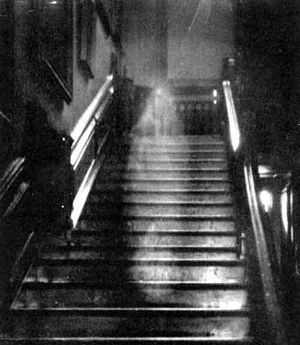
The Brown Lady of Raynham Hall is probably one of the most iconic ghost pictures out there. But what is the story behind it? And who is that ghostly figure?
Is it real? Was it just a double exposure? The picture of The Brown Lady of Raynham Hall has been viral since 1936. A photographer that year took the infamous picture, forever putting it in the mystery box for people to wonder about ever since.
It was just another day in the upper class England, with their old and haunted mansions and stories. Up in Norfolk lays the old Raynham Hall, that were about to become one of the most famous hauntings in Great Britain.
Brown Lady of Raynham Hall: This is the picture taken in the staircase that is now perhaps one of the most famous ghost photos.
Captain Hubert C. Provand, was a working in London as an photographer for the Country Life magazine. On September 19th, 1936, he and his assistant, Indre Shira were taking photographs of the Raynham Hall for an article.
Inside the 300 year old mansion, they were setting up the cameras to take another of the old Hall’s main staircase. Suddenly, Shira saw a ” vapoury form gradually assuming the appearance of a woman” The figure was “moving down the stairs towards them.” Shira directed Provand to take the cap of the lens while Shira pressed the trigger to take the picture.
After the negative was developed for the article, they saw more clear what they had gotten on camera that day. And the famous legendary photo of the Brown Lady of Raynham Hall was born. And after the photo, so was the legend.
So who was this lady? According to legend, the Brown Lady of Raynham Hall is the lost ghost of Dorothy Walpole. She was born in 1686 and according to gossip, the prettiest sister of Robert Walpole, seen as the first prime minister of Great Britain.
Walpole was neighbour with Charles Townshend, 2nd Viscount Townsend in Norfolk. And it just so happened that his sister Dorothy married Townshend in 1713. Although they were good neighbours, and even brother-in-laws, there was bad blood between the men. Especially in politics and when Walpole built his own mansion, Houghton Hall. Did this affect poor Dorothy at all?
What we know is that it wasn’t a particularly happy marriage. Dorothy was Charles second wife. He looked upon the Hall as his pride, as a Lord Hervey said: “Lord Townshend looked upon his own seat at Raynham as the metropolis of Norfolk, and considered every stone that augmented the splendor of Houghton, as a diminution of the grandeur of Raynham.”
Lady Dorothy Walpole: The Brown Lady of Raynham Hall is believed to be the ghost of Lady Dorothy Walpole who died in 1726.
Charles was also well known for his violent temper. Dorothy Walpole was rumored to have been a mistress of a Lord Wharton, a well known womanizer, and that no woman could be twenty four hours under his roof and walk out with her reputation intact.
When Charles discovered his wife and her affair with Lord Wharton, the story says he punished her by locking her in her rooms in the family, Raynham Hall. To make matters worse, there are still rumours that she was in fact entrapped by the Countess of Warton, inviting Dorothy to stay a few days, knowing full well, her husband wouldn’t let her walk out with her reputation intact.
After this, Dorothy Walpole remained at Raynham Hall until her death in 1726. She died of smallpox. But did she really leave the Halls? Is she still roaming the place, still locked up, still trying to get out and are forever trapped as The Brown Lady of Raynham Hall?
Sightings of the Brown Lady at Raynham Hall
Raynham Hall was thought to have been haunted long before the picture was taken. People that stayed in the mansion, experienced visitation and paranormal activity that most believed to be the ghost of The Brown Lady of Raynham Hall.
1835
Whatever the truth is, the legend was there to stay. And the first recorded sighting of the The Brown Lady of Raynham Hall was in 1835. One Christmas the new Lord Charles Townshend invited some guest to the Hall for celebrations. Among the guest were Colonel Loftus and another guest named Hawkins. One night night as they approached their bedrooms, they saw the Brown Lady, noticing the dated and brown dress she wore.
The following night, Loftus claimed he saw The Brown Lady of Raynham Hall again. he said he was drawn to the spectre’s empty eye-sockets, dark in the glowing face, the once so pretty Dorothy Walpole. After Loftus reported what he saw it ended with some of the staff permanently left Raynham Hall. It was all recorded by another guest, Lucia C. Stone.
Just a year after, the The Brown Lady of Raynham Hall was seen again. This time it was Captain Frederick Marryat, a friend of Charles Dickens. He originally wanted to prove a theory of his that the hauntings was caused by local smugglers. According to him, the smugglers spread the story to keep people away from the area. That night hi requested that he spent the night in the haunted room at Raynham Hall.
Marryat’s daughter, Florence wrote about her father’s experience in 1891:
…he took possession of the room in which the portrait of the apparition hung, and in which she had been often seen, and slept each night with a loaded revolver under his pillow. For two days, however, he saw nothing, and the third was to be the limit of his stay. On the third night, however, two young men (nephews of the baronet), knocked at his door as he was undressing to go to bed, and asked him to step over to their room (which was at the other end of the corridor), and give them his opinion on a new gun just arrived from London. My father was in his shirt and trousers, but as the hour was late, and everybody had retired to rest except themselves, he prepared to accompany them as he was. As they were leaving the room, he caught up his revolver, “in case you meet the Brown Lady,” he said, laughing. When the inspection of the gun was over, the young men in the same spirit declared they would accompany my father back again, “in case you meet the Brown Lady,” they repeated, laughing also. The three gentlemen therefore returned in company.
The corridor was long and dark, for the lights had been extinguished, but as they reached the middle of it, they saw the glimmer of a lamp coming towards them from the other end. “One of the ladies going to visit the nurseries,” whispered the young Townshends to my father. Now the bedroom doors in that corridor faced each other, and each room had a double door with a space between, as is the case in many old-fashioned houses. My father, as I have said, was in shirt and trousers only, and his native modesty made him feel uncomfortable, so he slipped within one of the outer doors (his friends following his example), in order to conceal himself until the lady should have passed by.
I have heard him describe how he watched her approaching nearer and nearer, through the chink of the door, until, as she was close enough for him to distinguish the colors and style of her costume, he recognised the figure as the facsimile of the portrait of “The Brown Lady”. He had his finger on the trigger of his revolver, and was about to demand it to stop and give the reason for its presence there, when the figure halted of its own accord before the door behind which he stood, and holding the lighted lamp she carried to her features, grinned in a malicious and diabolical manner at him. This act so infuriated my father, who was anything but lamb-like in disposition, that he sprang into the corridor with a bound, and discharged the revolver right in her face. The figure instantly disappeared – the figure at which for several minutes three men had been looking together – and the bullet passed through the outer door of the room on the opposite side of the corridor, and lodged in the panel of the inner one. My father never attempted again to interfere with “The Brown Lady of Raynham”.
1926
When the son of Lady Townshend and his friend saw the ghost next, they knew who The Brown Lady of Raynham Hall was. They saw her on the staircase, and identified the ghost with the portrait, hanging on the wall in the haunted room. Of course, the portrait of Lady Dorothy Walpole.
Raynham Hall: The haunted hall is a country house in Norfolk and was for 400 years the seat of the Townshend family. The hall is reported to be haunted, providing the scene for possibly the most famous ghost photo of all time, The Brown Lady of Raynham Hall descending the staircase.//Source: Wikimedia
What is the truth?
After Provand and Shira took the picture of The Brown Lady of Raynham Hall, they published their experience in Country life magazine, December 26th, 1936. They were published again in Life magazine on January 4th, 1937. So all in all, they did profit on this. But could it be that they just took a picture?
After the picture was taken, a paranormal investigator, Harry Price interviewed both Provand and Shira. He said: “I will say at once I was impressed. I was told a perfectly simple story: Mr. Indre Shira saw the apparition descending the stairs at the precise moment when Captain Provand’s head was under the black cloth. A shout – and the cap was off and the flashbulb fired, with the results which we now see. I could not shake their story, and I had no right to disbelieve them. Only collusion between the two men would account for the ghost if it is a fake. The negative is entirely innocent of any faking.”
But there have been numerous attempts of debunking the picture of The Brown Lady of Raynham Hall and its status of “proof”. Some claim Shira faked the image by putting grease or something in the lense in shape of a lady, maybe moved down the stairs himself during an exposure? Or maybe it is as simple as an accidental double exposure or light somehow got in the camera. Some even claim that the figure looks eerily like the Virgin Mary statue, and that the image is of her in the staircase, the statue that is, not the Virgin Mary.
Among the examiners trying to debunk the validity of the picture of The Brown Lady of Raynham Hall is Joe Nickell’s detailed writings that the photograph is nothing more than double exposure. And the magician John Booth wrote that the photograph could be easily made. Booth had the magician Ron Wilson cover himself in a bed sheet and walk down the staircase at the Magic Castle in Hollywood. It apparently turned out very similar to the photograph.
An online magazine about the paranormal, haunted and macabre. We collect the ghost stories from all around the world as well as review horror and gothic media.