Tag Archives: france

Spiritism and the Religion of Spirit Communication

Advertisements

Spiritism or Kardecism is a philosophy and religion of spirit communication. After being inspired by the Spiritualist movement, the French Allan Kardec developed the loose movement of seances, mediums and communicating with the dead into something people still practice today. 

There is a debate about whether or not we should call the spiritism movement a religion or not, but it certainly was a movement together with Spiritualism that impacted the western world and how they view death, the afterlife and ghosts and the paranormal.

The Spiritism Movement was started by the French author and teacher Allan Kardec and is also called Kardecist spiritism or Kardecism. A simple way of explaining the difference between Spiritualism that grew in popularity in North America was that Spiritism was mainly in Europe and although much alike was much more organized and had a stricter doctrine. Today, the word spiritism is used for most of the religious and doctrines believing that the spirits go on after the body dies. 

He believed in physical reality and that alongside that, there was another spirit world. This world, he believed, could be accessed through mediums and that spirits exist separately from human bodies. 

Most of the practice of Spiritism is around the mediumship and communicating with the dead. It can manifest in automatic writing or drawing among other psychographic ways. 

Read More: Spiritualism and the Occult: Automatic Writing and When Ghosts Slide Into Your DMs 

The spiritists also believe in reincarnation and that the spirit is constantly trying to achieve intellectual and moral perfection. 

The Spiritism Movement as we know it today started in Europe in the 1850s, but soon spread, becoming very popular in the USA, Brazil and in the French colonies. 

Allan Kardec and the Founding of Spiritism

Allan Kardec’s real name was Léon-Dénizarth-Hippolyte Rivail and was really the one that organized the loose movement in Europe to a path with a certain doctrine and way of thinking. He was born in 1804 in Lyon in France and studied in Switzerland. When coming back to Paris he purchased a school for boys in 1928 and was a teacher.

Read More: Check out the story of the haunted Paris’ Haunted Père Lachaise Cemetery, were Kardec is buried.

He was in his 50s when he became interested in séances and started researching them and compiling the consistent things the mediums talked about into a philosophy he called Spiritism. The name Allan Kardec was a name picked out by a spirit called Truth. 

Table Tipping and Communicating with the Dead

A very popular pastime in Europe at the time was animal magnetism, mesmerising and what would eventually be called Table Tipping. This was equally seen as pure fun as well as a séance. Although a skeptic at first, Kardec became interested in the phenomenon and started to explore it as well. 

Table Tipping: Table levitates during Palladino’s séance at home of astronomer Camille Flammarion, France, 25 November 1898. There are two women seated at the table. Palladino sits at the far short end.

Kardec studied the phenomenon and concluded in The Book on Mediums that some communications were caused by an outside intelligence, as the message contained information that was not known to the group.

Read More: Table Turning: When Spirits Spill the Tea Through Furniture

Skeptics and those exposing the truth behind the table turning chucks it up to the ideomotor effect, not ghosts trying to communicate through furniture. The movement experienced in the seances was due to involuntary and unconscious muscular reactions. This scientific explanation was published in the Medical Times and Gazette in 1853, but that didn’t stop its popularity or people believing in it, it only made the hoaxes more elaborate. 

Spiritualism and the Fox Sisters

In addition to European dabbling in the occult already, Kardec became increasingly more interested in Spiritualism from the USA. It was a popular movement that had started with communication with the dead’s spirits. This movement is often connected with the popularity of Margaret and Catherine Fox who kicked off the Spiritualism movement in the USA with their table rapping. 

The Fox sisters: Kate (1838–92), Leah (1814–90) and Margaret (or Maggie) (1836–93). They were famous mediums in Rochester, New York. Taken around 1852

Since childhood they had been famous ever since they communicated with spirits in 1848 with the spirit haunting their home in New York. They later came to Europe to hold public séances.

Read More: The Spiritualist Movement: The Fox Sisters Who Started a Ghostly Revolution as a Prank

Allan Kardec was definitely directly inspired by this, but narrowed the belief system down to one doctrine. For example, Spiritualists do not necessarily believe in reincarnation but this part was important for the Spiritists. He worked to distance himself from fortune-tellers, mediums and magicians from the movement of the time, many of those often ending in trouble when discovered as a fraud.

The Spiritist Codification

Kardec’s first of five foundational Spiritist texts was 1857’s The Spirits’ Book. More than a book on ghosts, it’s a collection of philosophical questions Kardec asked mediums around in Europe. This was also an effort to bridge both religion, science and philosophy to one thing that he himself called a “Positive Faith”. More books followed and collectively, they are called the Spiritist Codification. 

Spiritists believe all humans are spirits, and the body is only a temporary vessel. After you die, the spirit crosses into the spirit world where it resided around the same time it was alive last before being reincarnated. 

It also adheres a lot to the Christian belief in one god as well as the rules science dictates. When Kardec developed his idea, it was definitely through the lens of a christian. Spiritists often cite biblical events to make their claim of how spirits exist, like how Moses consulted the dead, how Saul heard the spirit of Samuel. 

After Kardec died in 1869, medium and writer Léon Denis who had met Kardec many times, continued with his legacy and furthered its popularity. 

Backlash Against the Movement of Spiritism

Although the Spiritism Movement became popular and came from a place of Christianity, it wasn’t without controversy. Critics saw the movement as evil and devil worship. Many of the mediums were also accused of being frauds and charlatans, profiting on people’s grief and fear of the afterworld. 

Read More: Spiritualism and the Occult: The History of Ectoplasm and Gooey Ghosts

In Europe, this type of mediating and communication with spirits have been prosecuted since the middle ages, mostly because it was seen as blasphemous behavior. British witchcraft laws used against mediums were not repealed until the 1950s when the last woman was convicted for witchcraft.

Helen Duncan: Born in Scotland in 1898. In 1926 Duncan claimed to have developed her mediumistic powers. She was around 29 years old at the time. But long before that she had scared her fellow pupils at with her dire prophecies and hysterical behavior. Eventually, Duncan claimed to be able to produced fully-formed physical materialization of spirits by emitting them as ectoplasm through her mouth.

Also scientists attacked the movement, calling it madness, hysteria and fanciful without root in science and the real world. The Roman church condemned it, Brazil even banned it. Counter-movement to expose mediums, like Harry Houdini did for years, started as well. 

What Happened to Spiritism?

Freud: Although said to not believe in the paranormal, Freud once wrote: “Though I am a man of science, I cannot dismiss the idea that ghosts might embody our suppressed desires and unfulfilled wishes.”

With so much hype and popularity that only seemed to be growing at the turn of the century, it begs the question of why Spiritism isn’t a bigger movement today as before. The answer to that might be as boring as timing. 

Two big factors happened at the time that fought against the Spiritism Movement of Spiritualism. One of them was the discipline of psychology that started to take hold of people, especially modern and well read people in Europe. The very same group that a couple of decades ago would probably have turned to Spiritism or some sort of Spiritualism.

Sigmund Freud, who denied all existence of ghosts, was a leading voice going forward, and although some of the earlier psychologists played around with the idea of a spirit world, their voices weren’t strong enough. Although his official stance on ghosts have been to not believe in them, he had some interesting musings and discussions of the concept of ghosts and the supernatural.

The other thing happening in Europe at the time was World War 1 and had a big impact on culture. The war and fear of war stopped a lot of new ideas and thinking that flourished in more peaceful times. Who knows how the movement would have progressed if not for the European wars that century?

Were are the Spiritists Today?

But did Spiritism completely die? Through French colonialism the texts and ideas spread to the colonies in the 19th century to the mid-20th century, especially in Vietnam. Here, the movement and idea was crucial for the Cao Dai religion that started in Vietnam in 1926. The age-old traditions was a mix of Asian divination and mediumship from Vietnamese folk religion with ancestor worship, Confucianism, occult practices from Taoism, theories of karma and rebirth from Buddhism.

Caodaism: Cao Dai monks inside Cao Dai Holy See, Tây Ninh, Vietnam. Priests are dressed in red, blue and yellow, followers in white. The full name of the religion is Đại Đạo Tam Kỳ Phổ Độ (大道三期普度) ‘The Great Faith for the Third Universal Redemption’.

French Spiritists Mediums travelled to Saigon, which today is Ho Chi Minh City and interacted with the Cao Dai mediums. They then began to mix with the new traditions of European Spiritism with the old. Some of them even claimed they had been visited by the spirit of Kardec. 

In addition to the French Colonies, the Spiritism Movement spread to Latin America as well, where it had a big impact on Brazil, even though they banned it in 1890. Today it is the third most popular religion in Brazil. 

The mediums also channel spirits for healing purposes and in Brazil they had around 13000 Spiritists centers that are a sort of physical or mental aid facility in 2022. This can be various ways, often a “laying of hands” much like they do with Reiki to heal energy.

Laying of the Hand: In Christian churches, chirotony or “Laying of the Hand”, is used as both a symbolic and formal method of invoking the Holy Spirit primarily during baptisms and confirmations, healing services, blessings, and ordination of priests, ministers, elders, deacons, and other church officers.

Although the Spiritism Movement didn’t have the hold of people as it used to, there are definitely still practitioners today throughout the world. Today, the International Spiritist Council claim that they have over 13 million followers in 36 countries.

More like this

Newest Posts

References:

Allan Kardec – Wikipedia

Séance | Spiritualism, Mediumship & Clairvoyance | Britannica

The Dark Side of Christmas: Hans Trapp — The Child Eating Scarecrow

Advertisements

The children of Alsace are often reminded to watch out for Hans Trapp, a cursed Baron now dressing as a scarecrow, waiting for passing by children. Today now also said to be one of Santa’s helpers, punishing the bad children.

When the festive season rolls around, most of us are filled with joy, anticipation, and warmth as we prepare for Christmas. However, lurking in the shadows of holiday cheer, some tales remind us of the darker side of this time of year. Among these is the chilling legend of Hans Trapp, a figure from Alsatian folklore whose story is steeped in terror and moral warning. 

“Hans Trapp is coming for Christmas” parents in the Lorraine and Alsace regions on the German and French border can say. But he is not there to give presents, but beatings and is said to be a cannibal dressed up as a scarecrow, hungry for children.

The Christ child and Hans Trapp: The Christ Child is one of the good helpers to Santa Claus. Parts of Europea white-skinned, fresh-faced version of Jesus does the job of delivering presents. He often appears dressed in white—sometimes with wings. The Christ child can be anywhere from age two to twenty-two, and pretty much always blonde. Sometimes he’s not even the actual Jesus, but a young angel , heralding the arrival of Jesus. Here he is distributed gifts while Hans Trapp stuffed the naughties into a sack to eat later.

The Origins of Hans Trapp

The legend of Hans Trapp originates from the region of Alsace, which straddles the border between France and Germany. This area has a rich tapestry of folklore, where the lines between the real and the supernatural often blur. Hans Trapp is one such figure, deeply rooted in the region’s history and culture.

All the way north in the region you will find Wissembourg, now a border area, but back then, part of the Holy Roman Empire.

Hans Trapp, or Hans von Trotha, which was his actual name, was once a wealthy and powerful man, known for his insatiable greed and cruelty living at Berwartstein Castle, born in the mid 1400s. His riches were acquired through ruthless means, and he was feared and despised by those who lived in his dominion. According to legend, his malevolence grew so great that he dabbled in black magic and made a pact with the Devil to increase his wealth and power.

There are many stories, but what we do know is that he came into a fight with the Abbot of Wissembourg about land, and Hans Trapp decided to cut off their water supply in retaliation. He built a dam on top of the Wieslauter to stop its flow down to Wissembourg, flooding the abbot’s land. 

When they demanded he stop though, he destroyed the dam, causing a flooding, gushing down the mountain, flooding the town. 

Hans Trapp’s actions did not go unnoticed. But the Holy Roman Emperor did nothing to stop him. His heinous deeds and dark practices eventually drew the attention of the Church. The pope summoned him, but he refused. Instead he called the pope all sorts of immoral things. He was excommunicated by the church and banished from society, a punishment he hated. He was sent to French court instead during the Italian wars, dying in 1503 at his castle and his lineage died out around 40 years after his death.

The Burg Berwartstein: Berwartstein is a castle in Rhineland-Palatinate, Germany, and where Hans von Trotha lived, the one that would mostly be remembered as Hans Trapp, scarecrow and child eater.

The Legacy of Hans Trapp

People started in the following years after his death to attribute horrible things to him, even changing his name to Tapp, where trappen is to make a noise while walking in order to chase away spirits. Soon he was turned into a devilish figure, a demon and a spook, always after revenge on those who wronged him. 

In the legend he is mostly talked about as a hermit, excommunicated to the woods, not to court. They tell about him living in the forest and building a shelter on the mountain of Geisberg in Bavaria in Germany, turning less and less human, living by luring children into his lair to eat them. One story tells that God himself turned him into a scarecrow because he devoured a young shepherd. 

Another version claimed it was Trapp who dressed up as a scarecrow to lure the children, stuffing his clothes with straw and hiding among the fields. As time went by after his exile, he turned mad, bitter and hungry for both revenge and flesh. With a grim visage and a sinister air, he would wait for his next victim.

One day, Hans Trapp set his sights on a young boy from a nearby village, only ten years old. He captured the child and took him back to his lair in the woods. As he prepared to cook and eat the boy, cooking him over the open fire, a divine intervention occurred. A bolt of lightning struck Hans Trapp down, killing him instantly and saving the child from a gruesome fate.

Le Hans Trapp: Man dressed up as the scarecrow man with the sack Christmas of 1953 in Wintzenheim (Alsace, France)

D’r Hans Trapp
Schoi, do kummt d’r Hans Trapp.
Ar het a scheni Zepfelkapp’
Un a Bart wiss wie a Schimmel.
Ar kummt vum schena Starnehimmel
Un bringt da Kinder a Ruada,
Wu net dien singe un bata.
Schoi, Hans Trapp, mir sin so klein
Un brav un folje d’heim.
Müesch net kumme mit dim Stacka,
Denn mir kenne singe un oi bata.

English Translation

The Hans Trapp
Look, there’s Hans Trapp.
He’s got a nice pointed hood
And a beard as white as a white horse.
He comes from the starry sky
He brings a rod to the children
Who neither sing nor pray.
Look, Hans Trapp, we are so small
We are wise and we follow the house.
You don’t need to come with your rod,
For we know how to sing and pray.

The Haunting of Christmas

Though Hans Trapp was destroyed, his evil spirit was not at rest. According to legend, he continues to roam the region, especially during the Christmas season as he became the helper of St. Nicholas to punish children. Some claim that St. Nicholas happened to walk past as Trapp was struck by lightning. He came with him and has since tried to redeem himself for his sins. Another version for why he is involved in the Christmas season is, well… Misbehaving children need a story. 

Read More: Check out all haunted legends from the Christmas Season

Much like Krampus, Hans Trapp is said to visit misbehaving children, but his presence is far more sinister. It is said he is riding his black horse on the countryside of northern Alsace looking for vengeance. On St. Nicholas’ Eve he takes part in the parade of the holy man in the region. He embodies the fearsome consequences of moral corruption and the dangers that lurk in the darkness.

Parents in Alsace would tell their children the story of Hans Trapp to instill good behavior and to keep them from wandering too far from home. The tale serves as a chilling reminder that while Christmas is a time of joy and celebration, it also has its shadows.

More like this

Newest Posts

References:

The Child-Eating Scarecrow Of Christmas | Mat Auryn 

Hans von Trotha – Wikipedia 

Folklore’s Scariest Creatures: Hans Trapp – Writing Werewolf 

Hans Trapp, the terror of the children of Alsace – French Moments 

10 Most Haunted Places in Paris

Advertisements

A list of the ten most haunted places in Paris, from haunted houses on cobbled streets, catacombs, and marbled and golden palaces.

Haunted places in Paris are said to be, well, very French. The ghost stories we find in this city are tales of jilted lovers in romantic date sites, fleeting shadows under the canopy trees in picturesque parks to royal ghosts inside of the historic buildings close to the whole world have heard of.

But just like the pitch dark of the underground necropolis of the catacombs under the rose colored city above, the ghost stories found in this city are just as dark. This is by no way a complete list of what tales you can find in Paris, and for a more extensive list, head over to the archives of France. But for now, let’s have a look at some of the most haunted places in Paris.

No. 1 on Avenue Frochot | Quartier Saint-Georges | Paris — The cursed haunted house behind the iron fences

Most Haunted Places in Paris: Avenue Frochot, from number 1 to number 7, picture taken between 1915 and 1925.

Avenue Frochot in Paris harbors the infamous Haunted House, shrouded in mystery and dark secrets that have intrigued locals and visitors alike for centuries. This historic avenue, once home to Paris’ elite, including renowned figures like Alexandre Dumas and Victor Hugo, hides a chilling tale within its iron-fenced properties.

At the heart of this enigma is the Haunted House, where a chambermaid met a tragic end at the hands of an unknown assailant in the early 1900s. Despite her killer evading capture, her spirit is said to linger within the mansion’s walls, perpetually haunting the premises.

Eerie tales abound of ghostly footsteps echoing through the empty corridors and shadowy figures glimpsed through the windows, even in the dead of night. The house, steeped in a sinister aura, carries a curse that has plagued its occupants over the years. Theater critic Mathieu Galey met his demise within its confines, mirroring the fate of composer Victor Massé a century prior. Even renowned singer Sylvie Vartan, who acquired the property in the 1970s, hastily departed mere days after moving in, purportedly due to the spectral presence haunting the house.

Read the whole story: The Mystery of the Haunted House on Avenue Frochot

Jardin Tuileries | L’Homme Rouge | Paris — The red man haunting the garden as an omen

Most Haunted Places in Paris: Said to house the red man, the ghost of a former servant has now become a national symbol and an omen.

The Tuileries Palace, once a grand royal residence adjacent to the Louvre Palace in Paris, holds within its storied history a chilling tale of revenge from beyond the grave and is perhaps one of the most haunted places in Paris. Constructed in the 16th century by Queen Catherine de Medici, this opulent palace was tragically destroyed by fire in 1871 during the tumultuous period of the Paris Commune. However, amidst the ruins lies a lingering specter, known as The Red Man, whose vengeful spirit haunts the nearby Tuileries Gardens to this day.

Legend has it that The Red Man is the restless soul of Jean l’Ecorcheur, a loyal servant turned assassin in service to Queen Catherine. Jean, also known as Jean the Skinner, earned his grisly nickname through his dual roles as a butcher and a clandestine operative for the queen. However, his intimate knowledge of the royal family’s secrets proved to be his undoing. Fearful that he would betray her, Queen Catherine ordered his demise, resulting in a brutal murder within the confines of the Tuileries Gardens.

In death, Jean’s spirit is said to have risen from the grave, cursing all those who dwelled within the palace walls. The Red Man became a harbinger of doom, appearing before significant events that befell the French royals. From the assassination of King Henry IV to the execution of Louis XVI during the French Revolution, sightings of The Red Man preceded these tragic events like a sinister omen.

Read the whole story: The Red Man haunting the Jardin Tuileries in Paris

Notre Dame Cathedral | Île de la Cité — The haunted cathedral made by the help of the devil

Most Haunted Places in Paris: Perhaps one of the most well known buildings in Paris are also one of the most haunted?

The Notre Dame Cathedral in Paris stands as an iconic symbol of Gothic architecture and spiritual significance, drawing visitors from around the globe to marvel at its breathtaking beauty and delve into its rich history. However, alongside its awe-inspiring features, the cathedral is also steeped in tales of mystery and the supernatural.

Dating back to its construction in 1163, Notre Dame has amassed a wealth of stories, some of which hint at ghostly encounters within its hallowed halls. Among these legends is the chilling tale of an ironworker named Biscornet, who purportedly struck a deal with the devil to complete the cathedral’s metalwork in time for its inauguration. Despite his successful craftsmanship, the doors he fashioned remained mysteriously sealed shut until holy water was applied, revealing a note hinting at his demonic pact.

But tales of spectral encounters don’t end there. Legends speak of two ghostly women haunting the cathedral’s roof, their ethereal figures glimpsed among the stone gargoyles and gothic sculptures. Witnesses claim to have seen these apparitions walking the roof before inexplicably vanishing into thin air or plunging to their demise.

Read the whole story: The Haunted Halls of Paris’ Notre Dame Cathedral 

Père Lachaise Cemetery | Boulevard de Ménilmontant — The haunted cemetery of bloody revolutions and celebrities

Most Haunted Places in Paris: Looking almost like a city itself, this graveyard houses any celebrities as their final resting place. Although, some are said to haunt the place.

The Père Lachaise Cemetery in Paris, France, renowned for its historic significance and famous inhabitants like Jim Morrison and Marcel Proust, has long been shrouded in mystery and ghostly tales and thought to be one of the most haunted places in Paris as well. Established in 1804 by Emperor Napoleon, this sprawling necropolis covers over 110 acres and attracts visitors from around the globe.

Despite its solemn purpose, the cemetery has witnessed its share of turmoil, including the execution of Communards during the Bloody Week of 1871. Reports of ghostly encounters abound, with visitors and cemetery workers alike recounting eerie experiences among the graves and mausoleums. Additionally, tales of restless spirits, like those of fallen soldiers from past battles, contribute to its haunted reputation.

The cemetery’s most peculiar legend revolves around Baroness Elisabeth Stroganova, whose mausoleum is rumored to hold dark secrets. According to lore, Stroganova offered a substantial inheritance to anyone who could endure spending a full year inside her tomb. Despite several attempts, no one has successfully completed the challenge, leading to speculation about the baroness’s motives and the eerie atmosphere surrounding her grave.

Read the whole story: Paris’ Haunted Père Lachaise Cemetery

Parc Montsouris | Arrondissement de l’Observatoire — The headless ghost in the park

Most Haunted Places in Paris: A good place for a picnic as well as a place to see ghosts. source

Parc Montsouris, nestled in the 14th arrondissement of Paris, stands as a lush oasis steeped in both beauty and mystery. Its verdant landscapes and serene lake belie a history fraught with tales of the supernatural, where strange occurrences and hauntings have left an indelible mark on its tranquil ambiance.

One chilling legend recounts an incident during the park’s official opening, where a tragic mistake led to the accidental draining of the artificial lake, purportedly driving the park engineer to take his own life. Although historical records confirm the lake’s sudden drainage in 1878, there is scant evidence of the alleged suicide.

Parc Montsouris also bears witness to darker chapters in history, notably serving as a testing ground for the guillotine during the French Revolution. Echoes of this gruesome past linger, with some visitors reporting eerie sensations reminiscent of the blade’s swift descent.

Among the park’s most infamous legends is the tale of Isaure de Montsouris, whose grisly murder by bandits allegedly left his restless spirit to roam the grounds.

Read the whole story: The Headless Hauntings of Parc Montsouris

Eiffel Tower | le septième — The haunted and deadly romance at the top of the most romantic place on earth

Most Haunted Places in Paris: Perhaps one of the worlds most romantic coded places in the world. Also the most haunted?

The Eiffel Tower, affectionately known as La dame de fer (the Iron Lady), stands as an iconic symbol of romance and modernity in Paris. Constructed for the 1889 World’s Fair, this architectural marvel has since become a magnet for urban legends, mysterious events, and ghostly sightings.

Despite initial criticism for its design, the tower captivated audiences with its grandeur and size, remaining the world’s tallest structure for over four decades. Today, it continues to draw millions of visitors, contributing to Paris’ reputation as a city of romance and intrigue.

Amidst marriage proposals and picturesque views, the Eiffel Tower harbors darker tales, including stories of jilted lovers and tragic endings. One legend tells of a heartbroken couple meeting at the tower in the 1920s, where a rejected proposal led to a fatal fall. Some claim to have encountered the spirit of the jilted lover or his scorned partner, perpetuating the tower’s haunted reputation and of being one of the most haunted places in Paris.

Read the whole story: Exploring the Ghost Stories on top of Paris’ Eiffel Tower

Château de Versailles | Yvelines — The time travelling ghost in the royal palace

Most Haunted Places in Paris: The Apollo Fontain outside in the gardens of Château de Versailles

Constructed under the reign of King Louis XIV, Château de Versailles began as a modest hunting lodge in 1623 before blossoming into the lavish palace known today. With its dark history and tales of ghostly apparitions, the palace has become a focal point for paranormal enthusiasts and curious visitors alike.

Among the spectral residents said to roam the palace is the ghost of Louis XIV himself, the Sun King whose undying affection for Versailles lingers beyond the grave. Witnesses claim to have glimpsed his regal figure traversing his favored chambers and garden pathways, accompanied by the phantom echoes of midnight horse gallops, evoking his funeral procession.

Marie Antoinette, the ill-fated queen of France, is another prominent specter said to wander the palace grounds, her ghostly visage often sighted near the Grand Trianon or within the palace walls. Some recount hearing her mournful sobs echoing through empty corridors, while others claim to have seen her clad in her iconic white gown, clutching a white rose as she roams the estate.

Even in the quiet of the night, whispers of unseen spirits pervade the dimly lit hallways and gardens of Château de Versailles. Visitors have reported eerie noises and chilling sensations, with some claiming to have glimpsed shadowy figures lurking in the shadows, adding to the palace’s mystique and allure as a haunted destination.

Read the whole story: The Time Travelling Ghost Haunting Château de Versailles

The Catacombs | Place Denfert-Rochereau | Paris — The mysterious underground necropolis

Most Haunted Places in Paris

Beneath the bustling streets of Paris lies a realm shrouded in darkness and mystery: the Catacombs. Originally an ancient quarry, this network of tunnels now houses the bones of millions of Parisians, relocated from overcrowded cemeteries in the late 1700s.

One infamous story revolves around Philibert Aspairt, a hospital worker who vanished in the catacombs during the French Revolution. Despite efforts to find him, his fate remained unknown until his body was discovered years later. Legend has it that his ghost still roams the labyrinthine corridors, a haunting reminder of the catacombs’ dark past.

But the mysteries of the catacombs extend beyond mere ghost stories. Legends speak of hidden chambers and strange creatures lurking in the shadows, making it perhaps one of the most haunted places in Paris.

Read the whole story: Scary Tales of The Catacombs of Paris

Opéra Garnier| Le Fantôme de l’Opéra | Opéra — The home and haunting of the Phantom of the Opera

Most Haunted Places in Paris

Opéra Garnier Paris, a pinnacle of French culture and architectural marvel, is steeped in a history rich with mysterious tales and eerie legends, with perhaps none more infamous than the story of the Phantom of the Opera.

Built during the Second Empire of France under the visionary architect Charles Garnier, Opéra Garnier’s labyrinthine design and grandeur have long captivated visitors. Yet, beneath its ornate façade lies a realm of secrets, from hidden passages to unexplored depths, where whispers of the supernatural echo through its hallowed halls.

Central to the opera house’s mystique is the legend of the Phantom, an enigmatic figure said to haunt its auditorium, grand staircase, and darkened corridors.

Some attribute the Phantom’s existence to the tragic tale of Ernest, a piano prodigy scarred by a fire at the Le Peletier Opera House in 1873. Seeking refuge within Opéra Garnier’s labyrinthine confines, Ernest is said to have dwelled in the underground lake beneath the building, consumed by grief and rage.

The opera’s eerie reputation is further enhanced by a series of inexplicable deaths and accidents, including the infamous incident of a falling crystal chandelier during a performance of Faust. Linked to seat number 13, this tragedy, immortalized in Gaston Leroux’s novel, adds to the aura of mystery surrounding Opéra Garnier.

Read the whole story: The Legend of the Phantom of Opéra Garnier

Rue Des Chantres | Paris — The lost children haunting the streets of Paris

Most Haunted Places in Paris

Rue des Chantres, near the Seine in Paris, is shrouded in eerie tales of forgotten tragedies and spectral encounters. This small street, close to Notre Dame, holds whispered accounts of agony, death, and haunted houses, painting a sinister picture of its history and is maybe one of the most haunted places in Paris?.

Île de la Cité, one of Paris’s oldest areas, is steeped in legends of paranormal phenomena. Once home to a convent, castle, and numerous haunted houses, this district is rumored to be inhabited by ghosts of the past. Famed figures like Heloise, from the tragic tale of Heloise and Abelard, once resided in this enigmatic locale.

The chilling legend of the Lost Children on Rue des Chantres stems from a devastating event in 1910. During a severe flood, children from a hospital, housed in the Hotel-Dieu, were trapped and drowned in their rooms. Despite efforts to conceal their bodies, many believe these souls still haunt the street, forever denied peace in death.

Since the tragic flood, witnesses have reported hearing children’s screams and laughter echoing from Rue des Chantres. Strange lights and shadowy figures have also been sighted, attributed to the Lost Children who roam the street, leaving an indelible mark on those who dare to venture into their realm.

Read the whole story: The Story of the Lost Children on Rue Des Chantres

Most Haunted Places in Paris

As mentioned, this list is only a small list of the most haunted places in Paris, but far from everyone. Head over to the France archives for more ghost stories from there.

More like this

Newest Posts

References:

For links and sources, check out the respective articles about the subjects.

10 Most Haunted Places in France

Advertisements

A list of ten of the most haunted places in France from enchanted forests, dark châteaus to dark graveyards, the country is filled with ghost stories still haunting from beyond their graves.

France is a country steeped in history, art, and culture, but it is also home to a darker side. From ancient castles filled of rattling of chains and the mysterious ghost dressed in white known as Dame Blanche to deep necropolises and hidden places by the Knight Templar, France boasts an array of haunted locations that have captured the imagination of locals and visitors alike.

This is a list of only ten of the most haunted places in France we have written about here, but it is far from everyone that exist. For a more extensive list, head over to the archives at Moonmausoleum filled with ghost stories and legends about all of the most haunted places in France.

Brocéliande | Paimpont forest | Brittany — The enchanted and legendary forest of Arthurian legends

Most Haunted Places in France: From the Paimpont Forest in Brittany said to be the real place of the legendary Brocéliande forest.

The legendary Forest of Brocéliande, steeped in myth and mystery, holds tales of both curse and enchantment. Shrouded in Arthurian legends and French folklore, this mythical woodland is said to be home to fairies, spirits, and magical objects like Excalibur.

Dating back to Arthurian tales, the forest is intertwined with the stories of Merlin, King Arthur’s advisor, and the Lady of the Lake, Viviane, who imparted magic and secrets of the spirit world. Legends tell of hidden treasures like Excalibur and the Holy Grail within its depths, captivating adventurers for centuries.

While some regard Brocéliande as purely mythical, many identify the Paimpont Forest in Brittany as its real location. The forest harbors sites like the Vale of No Return, where Morgan le Fay imprisoned unfaithful knights, and the Tombeau de Merlin, where Merlin is said to be entombed.

Brocéliande is inhabited by a variety of mythical creatures, including fairies and protectors of the forest, as well as ghosts and revenants. Perhaps Brocéliande or Paimont Forest is one of the most haunted places in France even? At least the most magical one.

Read the whole story: The Enchanted Forest of Brocéliande

Jardin Tuileries | L’Homme Rouge | Paris — The red man haunting the garden as an omen

Most Haunted Places in France: The Jardin Tuileries used to belong to a castle that is now gone in the middle of Paris. According to the stories, it is haunted by a man in red that is said to be a bad omen.

The Tuileries Palace, once a grand royal residence adjacent to the Louvre Palace in Paris, holds within its storied history a chilling tale of revenge from beyond the grave and is perhaps one of the most haunted places in France. Constructed in the 16th century by Queen Catherine de Medici, this opulent palace was tragically destroyed by fire in 1871 during the tumultuous period of the Paris Commune. However, amidst the ruins lies a lingering specter, known as The Red Man, whose vengeful spirit haunts the nearby Tuileries Gardens to this day.

Legend has it that The Red Man is the restless soul of Jean l’Ecorcheur, a loyal servant turned assassin in service to Queen Catherine. Jean, also known as Jean the Skinner, earned his grisly nickname through his dual roles as a butcher and a clandestine operative for the queen. However, his intimate knowledge of the royal family’s secrets proved to be his undoing. Fearful that he would betray her, Queen Catherine ordered his demise, resulting in a brutal murder within the confines of the Tuileries Gardens.

In death, Jean’s spirit is said to have risen from the grave, cursing all those who dwelled within the palace walls. The Red Man became a harbinger of doom, appearing before significant events that befell the French royals. From the assassination of King Henry IV to the execution of Louis XVI during the French Revolution, sightings of The Red Man preceded these tragic events like a sinister omen.

Read the whole story: The Red Man haunting the Jardin Tuileries in Paris

Mont Saint-Michel | Normandy — The haunted tidal island and a pilgrimage destination

Most Haunted Places in France: The iconic island in Normandy is an old pilgrimage as well as believed to be haunted.

Mont Saint-Michel, an enigmatic island off the coast of France, has inspired centuries of mysterious tales. Initially a monastery, it has transformed into a small village with a rich history of battles and even served as a formidable prison known as the Bastille of the Sea.

The island’s steep cliffs and remote location made it a significant pilgrimage site, marked by its perilous tides, varying up to 14 meters. These natural phenomena have led to its nickname “St. Michael in peril of the sea,” cautioning pilgrims.

Legends abound, including stories of ghost monks haunting the abbey as their graves were desecrated during the French Revolution, their eternal rest being disrupted.

Mont Saint-Michel’s dark history is intertwined with the Hundred Years’ War, where battles for its control ensued. English attempts to seize the island were thwarted, resulting in legends of soldiers’ ghosts haunting its shores. Captain Louis d’Estouteville, a prominent figure in these battles together with his soldiers, is said to protect the abbey to this day, his ghost still guarding against intruders.

Read the whole story: The Haunted and Holy Mont Saint-Michel

Père Lachaise Cemetery | Paris — The haunted cemetery of bloody revolutions and celebrities

Most Haunted Places in France: The cemetery is almost like a city with its walled up mausoleums and streets. Here, the grave of the famous composer, Fred Chopin.

The Père Lachaise Cemetery in Paris, France, renowned for its historic significance and famous inhabitants like Jim Morrison and Marcel Proust, has long been shrouded in mystery and ghostly tales and thought to be one of the most haunted places in France as well. Established in 1804 by Emperor Napoleon, this sprawling necropolis covers over 110 acres and attracts visitors from around the globe.

Despite its solemn purpose, the cemetery has witnessed its share of turmoil, including the execution of Communards during the Bloody Week of 1871. Reports of ghostly encounters abound, with visitors and cemetery workers alike recounting eerie experiences among the graves and mausoleums. Additionally, tales of restless spirits, like those of fallen soldiers from past battles, contribute to its haunted reputation.

Read More: There are no shortages of haunted cemeteries in the world.

The cemetery’s most peculiar legend revolves around Baroness Elisabeth Stroganova, whose mausoleum is rumored to hold dark secrets. According to lore, Stroganova offered a substantial inheritance to anyone who could endure spending a full year inside her tomb. Despite several attempts, no one has successfully completed the challenge, leading to speculation about the baroness’s motives and the eerie atmosphere surrounding her grave.

Read the whole story: Paris’ Haunted Père Lachaise Cemetery

Gouffre de Padirac Caves | Padirac Chasm | Lot, Occitanie — The cave made by Lucifer himself

Most Haunted Places in France: This natural wonder was thought by many to have been created by the devil himself.

The Gouffre de Padirac, a colossal cave in Southern France with breathtaking rock formations and subterranean rivers, while also shrouding itself in eerie tales of ghosts and mysteries.

Discovered in 1889 by Edouard-Alfred Martel, the cave’s history dates back to the 3rd century, with evidence of habitation in the 1400s and 1500s. Locals speculated about its connection to hell, using it as shelter during wars like the Hundred Years War.

Today, the cave attracts over 400,000 tourists annually, offering awe-inspiring sights like limestone walls adorned with colorful formations and an underground river creating a mystical ambiance.

Legends abound, suggesting Lucifer’s hand in creating the chasm, with tales of Saint Martin’s challenge to cross it to save souls. Rumors persist of hidden treasures guarded by flames, possibly remnants of the Hundred Years War.

Read the whole story: The Mysterious Gouffre de Padirac Caves

Eiffel Tower | Paris — The haunted and deadly romance at the top of the most romantic place on earth

Most Haunted Places in France: Perhaps one of the most iconic landmarks for romance. Could the same be said for it being haunted?

The Eiffel Tower, affectionately known as La dame de fer (the Iron Lady), stands as an iconic symbol of romance and modernity in Paris. Constructed for the 1889 World’s Fair, this architectural marvel has since become a magnet for urban legends, mysterious events, and ghostly sightings.

Despite initial criticism for its design, the tower captivated audiences with its grandeur and size, remaining the world’s tallest structure for over four decades. Today, it continues to draw millions of visitors, contributing to Paris’ reputation as a city of romance and intrigue.

Amidst marriage proposals and picturesque views, the Eiffel Tower harbors darker tales, including stories of jilted lovers and tragic endings. One legend tells of a heartbroken couple meeting at the tower in the 1920s, where a rejected proposal led to a fatal fall. Some claim to have encountered the spirit of the jilted lover or his scorned partner, perpetuating the tower’s haunted reputation and of being one of the most haunted places in France.

Read the whole story: Exploring the Ghost Stories on top of Paris’ Eiffel Tower

Château de Brissac | La Dame Verte | Loire Valley — The lady in green haunting

Most Haunted Places in France

There are no shortages of haunted castles and manors in France. Château de Blandy-les-Tours, Château de Châteaubriant and the Château de Trécesson just being a couple of them. But perhaps one of the more well known and most haunted one being, Château de Brissac, a grand castle in the Loire Valley, holds centuries of ghostly secrets, notably that of the Lady in Green. Built in the 11th century and renovated in the 16th century, it stands as a monument to France’s past, surrounded by seven towers and rich history.

The Green Lady, or La Dame Verte, is rumored to be Charlotte de Brézé, murdered by her husband Jacques de Breze in 1477. Suspected of infidelity, Charlotte was killed alongside her alleged lover, Pierre de Lavergne. Her spirit is said to roam the castle’s tower room, seeking vengeance.

Jacques, tormented by her ghost, eventually left the castle. Yet, visitors still report eerie occurrences, perpetuating the legend of Château de Brissac as one of the most haunted places in France, where the past continues to haunt its halls.

Read the whole story: The Lady in Green Haunting Château de Brissac

The Catacombs | Place Denfert-Rochereau | Paris — The mysterious underground necropolis

Most Haunted Places in France: Deep under the city of Paris, you will find the city of the dead, the catacombs.

Beneath the bustling streets of Paris lies a realm shrouded in darkness and mystery: the Catacombs. Originally an ancient quarry, this network of tunnels now houses the bones of millions of Parisians, relocated from overcrowded cemeteries in the late 1700s.

One infamous story revolves around Philibert Aspairt, a hospital worker who vanished in the catacombs during the French Revolution. Despite efforts to find him, his fate remained unknown until his body was discovered years later. Legend has it that his ghost still roams the labyrinthine corridors, a haunting reminder of the catacombs’ dark past.

But the mysteries of the catacombs extend beyond mere ghost stories. Legends speak of hidden chambers and strange creatures lurking in the shadows, making it perhaps one of the most haunted places in France.

Read the whole story: Scary Tales of The Catacombs of Paris

Château de Bonaguil | Dame Blanche | Saint-Front-sur-Lémance — The November haunting by the lady in white

Most Haunted Places in France: Image Source: Josep Renalias: Inside of the old castles in France, there are often tales of a particular ghost known as Dame Blanches or the Lady in White.

Château de Bonaguil, a 12th-century fortress in Saint-Front-sur-Lémance, France, sits atop a rocky outcrop near the Lot and Dordogne rivers. Its name, meaning “good needle,” refers to its pointy rock foundation.

Originally constructed by knight Arnaud de la Tour of Fumel in the 12th century, the castle saw significant modifications during the Hundred Years War and later by the House of Bérenger de Roquefeuil family in the late 15th century. Renovations transformed it into a formidable fortress, making it one of France’s last fortified castles from the Middle Ages.

Despite its storied past, Château de Bonaguil is rumored to be haunted, attracting paranormal investigators who have reported strange phenomena and captured ghostly images that claim the old castle is one of the most haunted places in France. Legends speak of the Dame Blanche, or White Lady, said to wander the castle’s grounds, particularly in November.

The legend of the Dame Blanche is intertwined with the story of Marguerite de Fumel, daughter of Béranger de Roquefeuil. She allegedly fled her tyrant father and a forced marriage, only to meet a tragic end.

Read the whole story: The November Ghost in Château de Bonaguil

Rue Des Chantres | Paris — The lost children haunting the streets of Paris

Most Haunted Places in France: Picture of the haunted street taken sometime between 1885 and 1925.

Rue des Chantres, near the Seine in Paris, is shrouded in eerie tales of forgotten tragedies and spectral encounters. This small street, close to Notre Dame, holds whispered accounts of agony, death, and haunted houses, painting a sinister picture of its history and is maybe one of the most haunted places in France?.

Île de la Cité, one of Paris’s oldest areas, is steeped in legends of paranormal phenomena. Once home to a convent, castle, and numerous haunted houses, this district is rumored to be inhabited by ghosts of the past. Famed figures like Heloise, from the tragic tale of Heloise and Abelard, once resided in this enigmatic locale.

The chilling legend of the Lost Children on Rue des Chantres stems from a devastating event in 1910. During a severe flood, children from a hospital, housed in the Hotel-Dieu, were trapped and drowned in their rooms. Despite efforts to conceal their bodies, many believe these souls still haunt the street, forever denied peace in death.

Since the tragic flood, witnesses have reported hearing children’s screams and laughter echoing from Rue des Chantres. Strange lights and shadowy figures have also been sighted, attributed to the Lost Children who roam the street, leaving an indelible mark on those who dare to venture into their realm.

Read the whole story: The Story of the Lost Children on Rue Des Chantres

Most Haunted Places in France

So this was a little list of the most haunted places in France according to Moonmausoleum, but it is far from every ghost story from the enchanted country filled of dark Châteaus and legendary tales from folklore. For a complete list of all ghost stories from France, check out the archives here.

More like this

Newest Posts

References:

References and links to sources used in this article about the most haunted places in France are to be found in their respective articles.

The November Ghost in Château de Bonaguil

Advertisements

Explore the breathtaking Château de Bonaguil in south-western France. Take a journey through history as you uncover this majestic 12th century fortified castle where a Woman in White is said to haunt the castle every November. 

Marvel at the majestic 12th-century fortress of Château de Bonaguil in Saint-Front-sur-Lémance in south-western France! Located near the Lot and Dordogne rivers, this spectacular castle is filled with tales and secrets of centuries past. 

The name comes from bonne aiguille (good needle), referring to the pointy rock it is built upon. From its impressive architecture to the stunning views of its surrounding landscape, Château de Bonaguil offers an unforgettable adventure into history and culture.

Read about more Haunted Châteaus in France.

A Brief History of the Château de Bonaguil

Château de Bonaguil was first built in the 12th century by knight Arnaud de la Tour of Fumel, who later became Lord of Bonaguil. During the Hundred Years War, the Lords of Bonaguil sided with the English and was a location that saw a lot of battle as the castle was taken and retaken by the fighting sides. 

The castle underwent renovations and reconstructions throughout its rich history – most notably, in the late 15th century by the House of Bérenger de Roquefeuil family, it was modified to become an impressive fortress with formidable defenses and it is one of the last fortified castles in France from the Middle Ages. 

Over the last century, the castle’s many towers and bastions have been restored and reinforced, giving visitors a chance to experience the castle’s fascinating heritage firsthand.

Paranormal Investigation of the Haunted Castle

The castle is old, has a bloody history as well as being riddled in centuries of ghost stories and legends. Haunted rumors were so many that a paranormal team once went to do a thorough investigation. People have reported about a burning sensation as well as pressures on their shoulders and temperature drops. 

They have also reported strange sounds around the castle grounds as well as there are photographs people mean captured the ghost on camera. Who can it be that is haunting the old castle?

Dame Blanche of Bonaguil

Château de Bonaguil is said to have its own unsettling paranormal story, in the form of the White Lady or the Dame Blanche in french. It is claimed that a ghostly figure appears both around the grounds of the castle, as well as wandering along its courts and galleries. 

The story of Dame Blanche is plentiful in French folklore and as a sight in old castles especially. In French mythology or folklore, Dames Blanches were female spirits or supernatural beings, comparable to the Weiße Frauen of both Dutch and German mythology.

November Hauntings

Legend has it that there’s a mysterious white lady haunting the Château de Bonaguil known as the Dame Blanch or Dame de Bonaguil. She is thought to be the ghost of Marguerite de Fumel who spent much time in the Château de Bonaguil to fix it up and keep it. 

Dame Blanche de Château de Bonaguil: Local scholar Max Pons has entrusted a photo of his wedding to the Chateau de Bonaguil and claims that a ghost appeared (outlined in red) at the time the photo was developed. © Photo credit: source

For unknown reasons she is said to return in the middle of the night during November month to haunt the castle. Can it be that the castle she spent so much time on were looted and robbed during the French Revolution?   

The Legend of Marguerite de Fumel

It is said that Dame Blanche once was a noble lady and daughter of Béranger de Roquefeuil, a cruel and vicious man that took great pleasure in executing people during the peasant rebellion. 

Marguerite de Fumel was sick of her tyrant father and wished to run away with her lover. But her father set her up for marriage with a wealthy and old count. The legend goes that she fled tearfully from the castle never to be seen alive again, only as the ghost haunting the grounds. 

We do know however that Marguerite de Fumel died in Paris after years of marriage in 1699. But the ghost story about the White Lady haunting the castle in November continues to persist. 

More like this

Newest Posts

References

Featured Image: Josep Renalias

Château de Bonaguil – Wikipedia 

Lot-et-Garonne. En novembre, la Dame blanche revient hanter le château de Bonaguil

Lot-et-Garonne : France 2 consacre un sujet sur les mystères du château de Bonaguil

The All Saint Day Hauntings at Château de Blandy-les-Tours

Advertisements

Step back in time and visit the historic Château de Blandy-les-Tours which is said to be one of the many haunted castles in France. It is said that the castle is especially busy on All Saint Day were the dead are walking the halls.

Nestled in the Loire Valley, France’s Château de Blandy-les-Tours is a true gem of history famous for its towers. Dating back to the 13th to 14th century, this castle is full of charm and allure, with intricate details and stunning architecture. Tour the grounds and explore its fascinating history to uncover its secrets with our guide.

The fortified Château de Blandy-les-Tours that stands today was a keep built for the Hundred Year War and was home to some of the most prominent families in France before it fell into obscurity for years. 

Merovingian Necropolis Cemetery

Before it was a castle, it used to be a cemetery for one of the most powerful rulers of Europe during their time. Which maybe can help explain why Château de Blandy-les-Tours is considered to be one of France’s most haunted places. 

The Merovingian dynasty was the ruling family of the Franks from the middle of the 5th century until 751. By 509 they had united all the Franks and northern Gaulish Romans under their rule The 7th-century Chronicle of Fredegar implies that the Merovingians were descended from a sea-beast called a quinotaur:

It is said that while Chlodio was staying at the seaside with his wife one summer, his wife went into the sea at midday to bathe, and a beast of Neptune rather like a Quinotaur found her. In the event she was made pregnant, either by the beast or by her husband, and she gave birth to a son called Merovech, from whom the kings of the Franks have subsequently been called Merovingians.

In the past, this tale was regarded as an authentic piece of Germanic mythology and was often taken as evidence that the Merovingian kingship was sacral and the royal dynasty of supernatural origin. 

Exploring the Inside of the Château de Blandy-les-Tours

Visitors to the Château de Blandy-les-Tours can explore its vast corridors, halls, and chambers that they spent years restoring from 1992 to 2007 when they opened the Château for the public again. Wander through rooms filled with centuries-old artifacts and furniture that tell stories of past inhabitants where you can enjoy open-air cinema nights, circus shows and concerts. 

Discover grand fireplaces decorating lush salons, wooden ceilings from the fifteenth century in its numerous bedrooms, as well as other hidden gems revealed by a team of archaeologists that have been working for years to restore the castle’s structure.

All Saint Day Haunting

All saints day is also known as All Hallows Day, a prelude to the modern Halloween we celebrate today. It’s a Christian day to celebrate and honor all the saints of the church and usually celebrated on November 1st. In France it is known as La Toussaint and usually flowers like chrysanthemums or wreaths are placed on tombs and graves. 

All Saint Day Haunting: November 1st is All Saint Day and is supposedly when the Château de Blandy-les-Tours is most haunted if we are to believe local lore.

One of the château’s most interesting stories is that it may be haunted on this holy day. There have been reports of strange noises, shadows, and ghostly figure sightings throughout its history. Whether you believe in ghosts or not, this castle definitely has a mysterious and fascinating past!

This Château has a peculiar haunting as it isn’t necessarily connected to one specific ghost. It is said that on All Saint Day the hallways of the Château de Blandy-les-Tours are taken over by ghosts and spirits trapped inside. You can hear them screaming and rattling their chains the entire night. 

The Murderous Ghost Lord

One ghost we have a certain amount of control over is the ghost of a feudal lord from the 10th or 11th century. He is said to walk around with a dagger wearing a bloody shroud walking from room to room in the Château de Blandy-les-Tours, perhaps looking for another victim as he was quite notorious for his crimes when he was alive? It is said that when he was alive, he used to be a murderer, and forever cursed to haunt his castle in his afterlife. 

More like this

Newest Posts

References

Featured Image: P.poschadel Wikimedia

https://www.chateau-blandy.fr/fr/history

https://en.wikipedia.org/wiki/Merovingian_dynasty

Unraveling the Mysteries of the Haunted Château de Châteaubriant

Advertisements

Step into an ancient castle filled with darkness and stories that will send shivers up your spine of murder and ghosts. Inside the old Château de Châteaubriant there are tales of ghost processions on October 16.

Step into the eerie and mysterious Château de Châteaubriant, a magnificent 15th century castle and one of France’s most haunted sites. Enter its dark and imposing halls originally constructed as a defense against Anjou and the Kingdom of France, laden with dark secrets, to experience an unforgettable journey through time. Learn about its chilling legends, hidden secrets, and unsettling specters that linger in the shadows.

History of the Château de Châteaubriant

The Château de Châteaubriant was first constructed in the 11th century, but was heavily modified during the Renaissance which the architecture bears marks of. 

It was taken over by the French during the Mad War after a siege. Over the centuries, it changed hands many times – from its aristocratic owners, to prisoners of war during the revolution, and back again. 

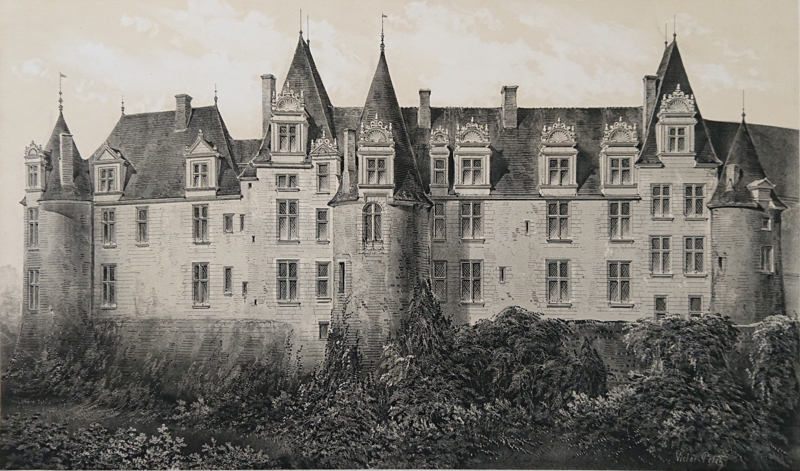
Château de Châteaubriant: drawn by artist Victor Petit in 1871. Already at this point the history of Château de Châteaubriant was old and steeped in legend . It is also said that ghost are walking the halls of the castle every year on October 16th.

Sybille the Shocked Ghost

One of the most famous legends behind the Château de Châteaubriant’s rumored hauntings is that of Sybille, wife of Geoffroy IV. 

Geoffroy IV of Châteaubriant went on crusade to the holy land in the 1250s with King Saint Louis where he was jailed in Egypt after the battle of Mansourah and the entire French army was destroyed by the plague. His death was announced to the Châteaubriant and his wife. 

Sybille, often named Sibylle de la Guerche de Candé started to mourn the death of her dead husband. He wasn’t dead however, and was released from prison and returned to his home and wife a couple of months later. When Sybille saw him again, she fell into his arms and died of the shock. 

She is said to haunt the Château de Châteaubriant at times, but the real haunting is said to be done by the infamous Françoise de Foix, the main mistress of the King of France that did not bear the same loyalty to her husband as Sybille.

The Ghost of Françoise de Foix

In addition to Sybille and other ghosts that are said to haunt Châteaubriant, many also believe in the spirit of Françoise de Foix. She was a tall and dark haired woman that spoke both Latin and Italian as well as writing her own poetry. All of her attributes made her a well sought after woman, and even the King wanted her. 

She was engaged to Jean de Laval, count of  Châteaubriant in 1505 with support of the king and queen Anne de Bretagne and Louis XII. They formally married in 1509 and lived at Château de Châteaubriant.There was a shift in the royals and the new king, Francis I, summoned Jean de Laval to court for his help in 1516. 

Françoise de Foix followed him and became the lady in waiting for Queen Claude de France as well as becoming the chief mistress to King Francis I. At official events she was placed near to the royal princesses, signifying that she was La mye du roi, or the Sweetheart of the King to the rest of the court.

Jean de Laval was sent to fight in the Italian Wars and became Governor of Brittany in 1531. He was aware of the affair but seemed unaffected by it all when his wife remained the King’s mistress for over a decade.

Françoise de Foix was rejected from court in 1525 when the young and blonde Anne de Pisseleu d’Heilly caught the King’s attention and affection. Because of this, she returned to Châteaubriant to live with her husband. 

Killed by her husband Jean de Laval

She died on 16th of October in 1537, most likely of sickness are we to believe some. There is however a different theory. It is said that her husband killed her. 

Read also: This is not the only story of a ghost haunting a French castle after a woman was killed by her husband: The Prisoner of Château de Puymartin

Jean de Laval, also known as John III of Laval-Châteaubriant was according to legend, an incredibly bloodthirsty baron who killed anyone who opposed him and ruthlessly tortured his enemies. 

It is said that he shut his wife in a dark and padded cell and had her killed because of her relationship with the king or something else entirely. Some even think that he locked her up and poisoned her or bled her to death slowly.

The Assassination of Françoise de Foix: The legend of her death are widespread and depicted in art. Here from a book from 1816 by Augustine Gottis.

Ghost Procession at Midnight

Some say they can still hear her weeping within the walls of Châteaubriant and others have even seen her standing near windows or atop towers in traditional 16th-century dress, but perhaps she is best known to appear in the ghost procession on her death anniversary.

Ever since then, there have been a ghost procession in the Château de Châteaubriant in honor of her death on October 16 of monks and knights slowly ascending the main stairs before vanishing. Her ghost is said to come back for this night as the procession begins at the stroke of midnight. 

More like this

Newest Posts

References

Featured Image: source

Françoise de Foix — Wikipédia 

Château de Châteaubriant – Wikipedia

Les fantômes sont des choses qui arrivent – chateau-chateaubriant

Le château de Châteaubriant et la légende de Sibylle

The Haunted Halls of Paris’ Notre Dame Cathedral

Advertisements

Notre Dame Cathedral in Paris has been a site of intrigue and mystery for centuries— its haunted halls filled with stories that spark the imagination with ghosts on the roof and an ironworker that sold his soul to the Devil.

The Notre Dame Cathedral in Paris has captivated visitors for centuries with its stunning architecture, stirring religious artifacts, and gripping tales of mystery. People come to hear the bells ring to remind us about the hunchback of Notre Dame and see the frightening gargoyles along the roof.

Rumors of hauntings have further cemented the cathedral’s reputation as a supernatural hot-spot, leaving its visitors to ponder whether these rumors are just urban legends or based on fact.

History of the Notre Dame Cathedral

Noted by visitors from all across the world, the Notre Dame Cathedral’s captivating architecture has inspired many throughout the ages. Built of limestone and characterized by its two towers flanking its main entrance, it has stood tall for centuries as a testament to Gothic style. Its intricate carvings, majestic details, and mesmerizing sculptures carve a path for learning about the history that lies within its walls and contributes more to the speculation of paranormal activity.

From its construction in 1163 to its destruction by fire in 2019, the iconic cathedral has served as a beacon of faith for thousands of years and amassed tales that might never be fully unraveled. 

The Devil and the Ironworker

One of the most enduring tales of hauntings in Notre Dame is that of a mysterious ironworker who sold his soul to the devil in exchange for mastery over his craft. According to legend, the best ironworker, Biscornet was commissioned by the church to create the metal for the cathedrals door at the inauguration in 1345. 

The work was too much and he was in danger of not being done in time. But at the inauguration the metal work was done, there was only one problem. No matter how hard they tried, they were unable to open the door. 

Read also: The Bell Tower Goddess of Beijing

When they went to Biscornet to ask him about it, they found him hanged with a note warning them to spay holy water on the door to make them open. 

It was then believed that the ironworker had made a pact with the devil and sold his soul to get the work done in time for the opening day. 

The Women on the Notre Dame Roof

The creepy story about the demonic front door is not the only legend about the old cathedral. According to legend, there are also spotted some ghosts as well.

Two female ghosts haunt the roof of Notre-Dame cathedral were they can be seen between the grey gargoyles and gothic carved stone. Apparently you can see them walking on the cathedrals roof before either jumping off the roof or disappearing as soon as you see them. 

More like this

Newest Posts

References

The Mystery of the Haunted House on Avenue Frochot

Advertisements

Something strange is lurking in the shadows at Avenue Frochot’s notorious Haunted House in Paris. After a Chambermaid was supposedly killed inside of the house, there have been strange things going on according to the neighbors as well as some of the owners.

Enter at your own risk, as the mysterious Haunted House on Avenue Frochot in Paris is filled with secrets and dark forces just waiting to be discovered. Prepare yourself for a spine-tingling adventure that could lead you to discover a hidden world of terror or uncover the truth about what lies deep within the walls of this haunted abode.

Avenue Frochot, Home to Paris’ rich and famous

Avenue Frochot is home to some of Paris’ most affluent and powerful citizens where they live behind the iron fences. It’s also the home of a centuries old mystery – the Haunted House on Avenue Frochot. 

Famous writers and artists of Paris’ bustling art scene have a history of passing through this beautiful avenue. The writers Alexandre Dumas and Victor Hugo lived here at one time and so did the painter Toulouse-Lautrec who had a studio at no. 15 . 

People like Théodore Chassériau was neighbors to Gustave Moreau and movie director Jean Renoir and jazz guitarist Django Reinhardt also spent time in the avenue. There were also people like the composer Victor Masse, who died inside number 1, and this place are now remembered to be very haunted. 

The Murdered Chambermaid

Although the whole avenue can look a little haunted with their glass stained windows, gargoyles on the front, there is one that is remembered as the most haunted mansion in Paris. 

But it isn’t one of the powerful, rich and famous men that owned the houses that are said to be haunting it. The ghost is said to be the ghost of a chambermaid who was brutally murdered inside of the house at the beginning of the 1900s. While she was working for the director of the Folies Bergère. One day, she was walking up the stairs when she was stabbed with a poker. Her killer was never caught, and she is haunting the place now even after death. 

It’s rumored that in the dead of night, eerie footsteps can be heard echoing off the walls of the Haunted House, even when it’s supposed to stand vacant. Some claim to have seen shadowy figures moving through the windows or even heard disembodied voices coming from within the walls. 

The Curse of Number 1

From then on, there is said to be a curse of the house that was built in 1839. Mathieu Galey was a theater critic that died in the house, paralyzed on his bed, the same place and same position that the composer Victor Massé was a hundred years before. 

Sylvie Vartan bought it in the 1970s, but fled from the house only a few days after moving in. Why? Well, many say it was because of the ghost haunting it. 

Today, there is a professor of medicine living there, refusing any paranormal claims the house has. So perhaps, the curse somehow got broken, and the chambermaid finally moved on. 

More like this

Newest Posts

References

La maison maléfique de Paris – Paris ZigZag | Insolite & Secret

The Story of the Lost Children on Rue Des Chantres

Advertisements

The Lost Children on Rue Des Chantres is still remembered, and sometimes even heard and seen on what is known as the most haunted street in Paris. 

Step onto the mysterious Rue des Chantres, just a couple of meters from the Seine in Paris and you will find yourself surrounded by spine-tingling tales of forgotten tragedies, haunted houses, and long-lost children.

This narrow and small street so close to Notre Dame has a long history and there are whispered rumors about lost souls to true accounts of agony and death. Learn about the sinister side of Rue des Chantres.

The Île de la Cité District in Paris

As one of the oldest parts of Paris, Île de la Cité is a place of legends about spooky happenings. This part of the city was once home to a convent, a castle, and hundreds of haunted houses that are said to be brimming with ghosts from the past. 

Tales have been passed down for centuries about the mysterious happenings between Rue des Chantres and Île de la Cité and people like Heloise from the Romeo and Juliet tale of Heloise and Abelard used to live in this area.

Uncover the History of The Lost Children

The terrifying legend of the Lost Children on Rue des Chantres is based on a true story. In 1910, the water level in Paris rose to an all time high level and flooded the city. Apparently it rose over one and a half meters. 

The city was at the time riddled with sickness, poverty and many suffered from tuberculosis. The hospitals had to rent extra rooms, and it is said they rented them at a hotel called Hotel-Dieu where the children stayed on the first floor. 

The children were allowed to be outside and play during the day and locked up for their safety during the night in their rooms. At the night of the flood they were trapped, helpless and drowned without a chance of escaping. 

The hospital tried to remove the body of the dead children in the night so no one could see, but they were discovered and to this day, many people believe that these poor souls still haunt the street as lost spirits – never having found peace in death.

The Ghost Children on Rue Des Chantres

Ever since that tragic night of the flood, visitors and locals alike have heard the sound of children’s screams coming out of the street as well as laughter from them playing. Some also report strange lights and shadowy figures walking in and out of doorways. Many attribute these sightings to the Lost Children on Rue des Chantres – but whatever their origin, they have certainly left a lasting impression on those brave enough to witness them.

More like this

Newest Posts

References

Rue des Chantres: A Little-Known Lane on Île de la Cité | solosophie

City of Fright | Peacock Plume