Canada’s iconic Fairmont Banff Springs Hotel is known for its legendary haunted stories about the tragic end of a bride to be and a helpful staff, even after their deaths.
Two elderly women checked into the hotel and called the bell desk for assistance after their keys wouldn’t work. The bellman on duty had other things to do and wasn’t able to help them for another 15 minutes.
Another bellman in plaid jacked came and helped the two ladies inside, and when the bellman on duty finally managed to get to the two ladies, they had already unlocked the door. He asked them how they managed and the two ladies said that an old Scotsman in plaid had helped them. The bellman turned white as that description fit perfectly with Sam McCauley, the former head bellman in the sixties and seventies. Problem was though, he had been dead since 1975.
Step into the storied halls of The Fairmont Banff Springs Hotel and experience its mysterious history. The iconic establishment has been tantalizing travelers with tales of hauntings and long-forgotten ghost stories since 1888, making it one of Canada’s most interesting haunted hotspots.
Introducing the Fairmont Banff Springs Hotel
The Fairmont Banff Springs Hotel is a historic hotel located in the Banff National Park in Alberta, Canada. Built in 1888 by railway magnate William Cornelius Van Horne and designed by architect Walter S. Painter, the grand chateau-style building has been a Canadian landmark for more than 130 years.
Its picturesque setting in the Canadian Rockies at 1414 meters altitude makes it perfect for an unforgettable stay.
History of the Hotel
With its long and fascinating history, it’s no surprise the Fairmont Banff Springs Hotel is rumored to be haunted. Built in 1888 for pioneering Canadian Railway chief William Cornelius Van Horne, the hotel was originally used as a grand chateau-style residence for railway employees before becoming a popular tourist destination.
The hotel has seen many events over the years, from royal visits to mysterious disappearances – all of which have contributed to its reputation as one of Canada’s top haunted locations.
There are more than one ghosts supposedly haunting the hotel, like Sam the bellman who is mostly spotted at the 9th floor, helping guests, but vanishing into thin air if you try to strike up a conversation or try to tip him.
The Bride of The Hotel
The most famous ghost of the hotel is the story of the Ghosts Bride. She even dates back to the 1920s and got so famous she even appeared on her own stamp and coin.
According to the legend, she was walking down the hotel’s marbled staircases on her wedding day. She was dressed up in her wedding gown, a long ting that dragged along the staircases. Some say she got her heel on the dress and slipped, some say she brushed up against a candle and burst into flames.
No matter what caused it, it ended in the same way, she died on those step before she were able to get married.
After her death, guests have claimed to have seen a ghostly figure ascending from the stairs, still trying to reach the last step. Others have claimed to have seen a woman wearing a wedding dress in the ballroom upstairs, dancing alone while she is still waiting for the first dance with her husband.
Watch Out for Room 873 – The Haunted Suite
The Fairmont Banff Springs is home to many haunted stories, but none quite as spine-tingling and mysterious as that of Room 873. According to local folklore and anecdotes from guests, the room’s occupants often experience strange noises, sudden temperature drops, and even the feeling of being touched in the night.
Some have reported seeing apparitions walking up and down the halls outside – though no one knows what the specter could be. Despite these eerie tales, visitors still flock to the hotel each year for a chance to encounter its legendary hauntings.
One of the theories about who is haunting the premise is the old legend that once an entire family was murdered inside.
Today the door is bricked up and looks like the rest of the wall in the hallway, but according to the stories, the ghosts of the murdered family still get out late at night.
Known as Canada’s most haunted object, the antique doll that follows the museums visitors with her glass eyes and cries in the night.
The haunted doll known as Mandy was donated to the Quesnel & District Museum in British Columbia, Canada in 1991 by a woman called Lisa Sorensen. The doll was from her grandmother that she found when cleaning out the house. She had just had a baby of her own, but didn’t want her daughter near the doll as she had noticed strange things about it.
Advertisements
She told the museum when she donated the doll that it kept her up during the nights. In the night she would wake up in the night to the sound of a crying baby in the basement. But when she checked there was nothing there. The doll started to scare the owner and she decided to give it away. After she had given away Mandy to the museum, she no longer heard the cries of a baby.
The only connection the family now has with the doll is the name, which she gave after her own daughter: Mereanda, or Mandy.
Night at the Museum
Now Mandy the doll sits in a locked cabinet, her eyes reportedly following the visitors with her cracked porcelain face as well as the staff at the museum.
The staff remembers well when Mandy first came to them. They left her in the lab overnight when taking her pictures to add to the collection. When they came into work the next morning, they found the lab trashed, almost like a temper tantrum to a child. And since then, strange occurrences have only kept on happening.
Small stuff would start vanishing without a trace and even the staff’s lunches would start disappearing from the fridge and appear in random drawers.
Electronic devices are said to malfunction in the doll’s presence, especially when trying to get her picture your camera light will go off and on.
The museum gave Mandy a stuffed lamb to keep her company, but would the next day find the lamb tossed outside of Mandy’s locked cabinet. Although many of the practical people would dismiss these happenings as purely coincidental with a perfectly logical explanation, the legend of the haunted doll kept growing.
Haunted by the Grief of a Bereaved Mother
The doll is supposedly around a century old and even got to meet up with a medium to examine her past on a show. The medium was Silvia Brown and she meant that the doll had once belonged to twins that died of polio. And the energy that the doll gave off was that of the mother to the twins and her sorrow she somehow implanted the doll.
This porcelain doll named Ruby will give the people playing with her an instant sorrow and sense of sickness, just by holding her. Family legend has it that the doll is haunted by a little girl that died with Ruby in her arms.
Ruby the Doll had a special talent when she was living with her family. That talent was moving from room to room, all on her own. No wonder her owners didn’t want to play with her as she was so cursed that she made the people holding her feeling sick, sad and sometimes, even nauseous.
Even with the cutesy blue eyes and golden locks, she is definitely not the scariest looking doll there is out there, but there is still something about the way she watches you with her porcelain eyes. The family that originally owned her certainly seemed to think so and thus kept her hidden away.
Advertisements
Instead the doll was passed down from generation to generation and put away in attics and basements, but they would constantly find her in other rooms than they put her in.
Haunted Porcelain
She is a porcelain doll from the early 1900s from Southern Ontario in Canada and belonged to a young girl of the same family that always had her in their possession, who passed away while she was holding Ruby in her arms allegedly.
The family even contacted a psychic medium once to get rid of the spirit that seemed to have attached itself to the doll. But it seemed to have failed as the strange occurrences around the doll kept happening.
Ruby The Haunted Doll: This little doll is said to be of the haunted and cursed kind. Visitors claim they feel unwell and get a sense of overwhelmingly sadness when being close to the doll. // Photo: Traveling Museum of the Paranormal and Occult
Since then she’s been creeping out every generation that inherited her. Not only by disappearing and appearing in different rooms, but also because of the strange sounds that seem to be coming from the doll.
Traveling Occult Objects
She is currently traveling with the Traveling Museum of the Paranormal and Occult that collects strange, occult and haunted objects, just like Ruby. Together they travel to places curious about the rarities of the occult. Thank God Ruby seems to always have enjoyed traveling.
She was given to the museum from a friend whose family had Ruby hidden away in a cardboard box.
And according to the owners, Greg Newkirk and Dana Mathew, visitors often get a feeling of sorrow from the doll, but also a sense of maternity and an urge to rock the little doll back and forth for comfort.
Ghost light over the Chaleur Bay in Quebec has spurned many ghost stories about a burning ship that still haunts the water. From Portugues enslavers to indigenous curses, the Chaleur Phantom covers it all.
Strange is the tale that the fishermen tell: They say that a ball of fire fell Straight from the sky, with a crash and a roar, Lighting the ship from shore to shore. That was the end of the pirate crew. But many a night a black flag flew From the mast of a specter vessel, sailed By a specter band that wept and wailed.
– The Phantom Light of the Baie des Chaleurs”, 1891 Arthur W.H Eaton
Right before storms in Chaleur Bay in Canada, a ghostly light can appear that no one can really explain. Those studying The Chaleur Phantom with a telescope say that there are no more details to examine, even up close and a definitive explanation of it all, still remains a mystery.
But those watching the lights with their naked eye claim that it looks more like a ship on fire and from there, the stories about it took form. The Chaleur Bay or Baie des Chaleurs is French and means Bay of Warmth because of the high temperatures. Perhaps a fitting name as the bay is reportedly haunted by a burning ghost ship that cruises the bay between New Brunswick’s north shore and Quebec’s Gaspé.
The Many Ghosts of the Bay
The lights are claimed by many stories around these parts. West of Caraquet, the ship is known as the Marquis de Malauze, a French ship that were sunk by the British in 1760. To the east it is known as John Craig, the name of a barque that sank outside of Shippigan Island around 1800. Only a cabin boy survived a drowning fate, but later died of exhaustion.
Another source of the The Chaleur Phantom is the haunting of Lady Colbourne, a schooner that went down in 1838 with its valuable cargo. On her last voyage, she was loaded with gold, silver, spices and wine that not all were recovered after the wreck. The passengers were also very wealthy people that drowned in their finest clothes. When she went down, 43 people were reported to have drowned.
Advertisements
But that is not the earliest explanation for these lights known as The Chaleur Phantom. The most told and perhaps most tragic story is of the Portuguese explorers that ended their days in the bay after enslaving the indigenous people.
The Portuguese Captain
One summer’s evening in 1878, Mrs. Pettigrew sat on her veranda late at dusk at Heron Island. Suddenly, a man stood in front of her, asking for her help. He was badly burned and she turned away to run inside. He brushed by her and she noticed that he had no legs. But before she could find out more, he disappeared.
On many occasions before and later this incident, the Pettigrew family noticed strange things out on the bay. They reported about a ghost ship that was most often seen on the north side of the island during the full moon.
One of the tales that have been spun is about the Portuguese Captain in the 1500s that ravaged and pillaged the area before disappearing without a trace.
The Curse of the Burning Ship: The burning ship people of this area reports of seeing is often attributed to the disappeared ship the Portuguese explorer Gaspar Cort-Real and his brother Miguel that never returned after sailing to this area. // Photo: Destruction of the Turkish Fleet in the Bay of Chesma by Jacob Philipp Hackert.
The captain, believed to be the real Portuguese explorer, Gaspar Cort-Real, arrived at Heron Island in 1501 to kidnap the natives of the place known as Mi’Kmaq to sell them as slaves. It is reported that he captured as many as 57 indigenous people that were taken back to Portugal as slaves.
But when he came back for his second visit, the Mi’kmaq took him first. Rembering what had happened to their people last time he came, they tortured and killed him before he could do any more damage to their people.
A year later the Captain’s brother, Miguel came to look for him, and the locals attacked him as well. Their ship was set on fire and they jumped in the waters, promising they would haunt the bay for the next 1000 years as The Chaleur Phantom.
It is said that the corpses of both the Portuguese as well as the Mi’kmaq washed ashore on the island and that they were buried in a low lying area at the west tip of the island called French Woods. And that their graves were shallow and their souls not yet at rest.
The Pirate Killing
Another origin tale to the lights is told from Restigouche. According to this tale, it was a group of pirates nead Port Daniel that killed a woman there. She was a native in most stories and was kidnapped by the pirates. With her dying breath she cursed her killers.
“For as long as the world is, may you burn on the bay.”
And according to the phantom lights in the bay, they still burn.
Advertisements
The Murder of a Sailor
A third explanation of The Chaleur Phantom that are told is of the murder of one of the sailors that worked on a ship. They encountered bad weather that drove the crew desperate. The superstitious sailor feared that they would die and that they were followed by bad luck. They attributed this bad luck to one of the sailors and ended up murdering him to reverse the bad luck.
Then the ship caught fire though, and it was told that it was Catholic blood way of seeking revenge.
Other Scientific Explanations
There have been many tales to try to find the origin of the lights, scientific as well as paranormal. There have been several research papers that have tested and concluded different explanations that don’t involve evil Captains from Europe, cursed pirates and catholic blood.
There are also very few pictures of the phenomenon of The Chaleur Phantom to test and further examine it with as well as some factual inaccuracies in the stories told to give credit to the ghost stories.
Other more natural causes that can explain this strange phenomenon could be something as trivial as rotten vegetation and a sort of marsh gas that has drifted over water, or an undersea release of natural gas or St. Elmo’s Fire.
St. Elmo’s Fire: This weather phenomenon is typically seen during thunderstorms when the ground below the storm is electrically charged, and there is high voltage in the air between the cloud and the ground. // Source
Although many scientists reject that this phenomenon can be St. Elmos Fire, which is electricity slowly discharged from the atmosphere to the earth—ordinarily shows itself as a tip of light on a pointed object, such as a church steeple or a mast. In addition, it is accompanied by a crackling noise.
No matter the real reason behind its light of The Chaleur Phantom, the existence of them is something that can’t be denied. What also can’t be denied is the victims to the bay and the harrowing stories that can be retold as countless ghost stories.
Rowing in the lifeboats of the wrecked ship SS Valencia, the skeleton remains of the passengers that died are doomed to row the sea for eternity.
The Valencia was headed out from San Francisco towards Seattle with clear weather with both seasoned crewmembers as well as passengers not necessarily used to the sea. The iron hulled passenger steamer was not a well liked ship to sail with along the Pacific Coast as it was too small and also, too open to the elements that made her difficult to handle in the winter.
This was in January and the weather was cold. And soon it was going to become another tragedy in the area that is known as ‘The Graveyard of the Pacific’ where almost 70 ships have wrecked in these parts.
The Wreckage of SS Valencia
When they reached Cape Mendocino outside of San Francisco on the 22. January in 1906, they encountered dense fog and had to slow the speed and sound the whistle as they battled against the fog with the danger of a wind that had turned on them. The ship got off course because of the wind, the current and the fog. Then they ran into rocks right before midnight on the 22 January and the disaster unfolded.
Advertisements
The passengers of the ship panicked and rushed to the lifeboats that were so ill handled in all the chaos that few made it to the water and even fewer made it safely. Some of the lifeboats were smashed to the side of the ship, some were lowered too soon, or too late. Several of the lifeboats were never seen again.
They were so close to land, only around 50 meters from the shore, but they couldn’t reach it at all. Stranded at the railing on deck were hundred people with the captain and the remaining crew.
“Screams of women and children mingled in an awful chorus with the shrieking of the wind, the dash of rain, and the roar of the breakers. As the passengers rushed on deck they were carried away in bunches by the huge waves that seemed as high as the ship’s mastheads. The ship began to break up almost at once and the women and children were lashed to the rigging above the reach of the sea. It was a pitiful sight to see frail women, wearing only night dresses, with bare feet on the freezing ratlines, trying to shield children in their arms from the icy wind and rain.”
– Survivor Chief Freight Clerk Frank Lehn
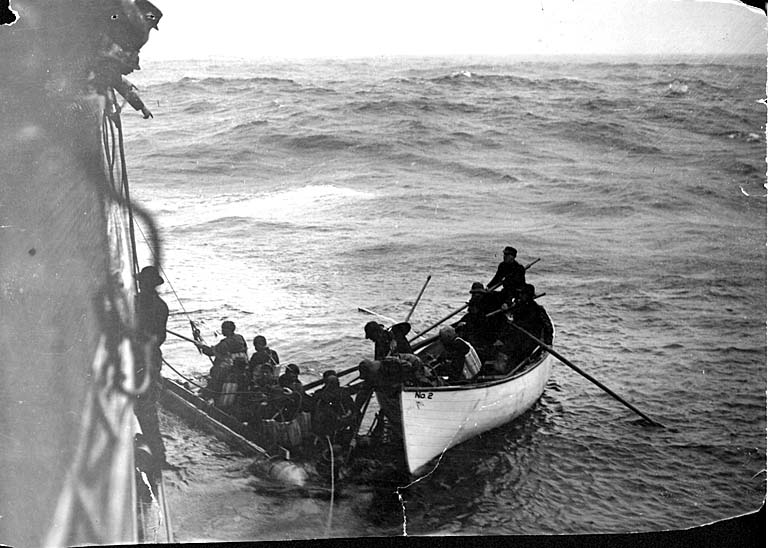
The Tragedy: Wreck of the en:SS Valencia, seen from one of the rescuing ships on January 23, 1906. So close were they to salvation, both to shore and to the rescue ships, but they never made it home again. // Source: BC Archives
No Hope for Rescue
The remaining people hoped to get rescued, but when the rescue fleet finally arrived, they realized that it was too dangerous to get close to the impaled ship on the rocks with water flooding in the strong current and wind.
The rest of the night, the ships Salvador, Queen and Topeka could only watch as the ship went down together with the rest of the people onboard. They all either drowned, were killed by getting hit by something on the ship or dying of hypothermia when they landed in the water.
The Lifeboats: Not many were picked up from the waters that day. Since then, lifeboat manned by skeletons have been reported on from this area. Here are a pictures of the survivors from the SS Valencia being picked up by the SS City of Topeka on January 24, 1906.//Source: University of Washington Digital Collections
Of all the passengers and crew on board, only 37 men survived this tragedy with every woman and child onboard dying. The complete death toll varies, but at least 117 up to 181 people died and it is known to be one of the more tragic wreckage in maritim history.
The Rowing Skeletons
The remains of the ship was never recovered, but left to its own devices. Some of the remains drifted to shore, finally, and the remains have been left mostly untouched. Outside of the Pachena Beach you can still see it, clinging to the coastline. Not long after the tragedy of the ship, the rumors, the tales and stories started to come from the wreckage.
The Ghost Ship: Not only the lifeboats, but also the entire ship has been reported on being spotted, years after it sunk to the bottom of the sea. Here are SS Valencia, circa 1905. // Source: BC Archives
When they were transporting the few survivors they found from the wreckage to Seattle, the crew of the ship City of Topeka spotted something unexplained. They stopped to pass the news of Valencia to a passing vessel that came towards them. When it passed them by, they saw that it was in fact the Valencia, the ship that had just sunk to the bottom of the sea.
The people that observed this, told that the crew were all skeletons and were heading towards the rocks as the Valencia had already hit and sunk on. When passing the City of Topeka, the Valencia signaled to it like it would have if they really met. After this, the Topeka continued back to Seattle without further incidents, but it was not the last one that were reported on.
Six months after the sinking of the ship, a local Nuu-chah-nulth fisherman named Clanewah Tom spotted a lifeboat together with his wife in a nearby sea cane in Pachena Bay at the southern end of Vancouver Island in British Columbia, Canada. But there was something deeply wrong with the lifeboat. In it sat not eight people, but eight skeletons. Although having survived the initial wreckage, it looked like they had starved to death. There was no way of recovering the lifeboat however and it was a mystery of even how it got into the cave.
Since then local fishermen reported of lifeboats with skeletons rowing in the area. In 1910, the Seattle Times reported that sailors claimed to have seen the ship that looked eerily like the Valencia, near Pachena Point. What looked like human figures held onto the ship like it was about life or death as the waves washed over the ship.
In 1933 they found one of the lifeboats drifting in Barkley Sound. The boat was in excellent condition and the paint looked almost fresh. No skeletons onboard this time, and perhaps never again?
Chute de la Dame Blanche or the White Lady Waterfall is a legend of a grieving bride to be in the midst of the battle of Canada. She now haunts the waterfall still wearing her wedding dress were she ended her life, still grieving the loss of her lover.
Taller than the Niagara Falls, the Montmorency falls towers 83 m over the city of Québec. It flows downstream from the city and into St. Lawrence. It is a majestic sight, the veil gushing and all sound but the masses of water is heard when standing close to it. But next to it, another lesser known waterfall falls. From ground water it connects with the Montmorency River along the way as water does. When the waterfall hits the river below the water spreads out, like a wedding veil. This particular waterfall is called Chute de la Dame Blanche or the White Lady Waterfall.
Stories from waterfalls have always been connected with grief, love and death. At least in European folklore. Tales like the Banshee is steeped in water imagery and female ghost stories, and many waterfalls tells a sad tale of a bride to be that died too soon. And this one about the Chute de la Dame Blanche, is just that.
The Bride to Be of the Chute de la Dame Blanche Legend
But who is this woman in the waterfall that came to be known as The White Lady Waterfall more than her original name? A banshee? According to legend, it is the spirit of a young Canadienne woman. An ethnic group of French colonists who settled in Canada from the 17th century. Or as they were known back then, French.
The veil: The waterfall of Montmorency, 1900, just next to Chute de la Dame Blanche.
In a time when Québec was called Nouvelle-France, or, New-France, the state was in an unrest and in the middle of a war that was going to last for seven years against the British empire.
The story tells about Matilde Robin, living near either Côte-de-Beaupré or Île d’Orléans, close to Québec. At the end of the summer in 1759, she was meant to marry her beloved Louis Tessier. Through the summer, she tailored her own white wedding gown, in anticipation of her wedding.
But the unrest in the country was creeping in and about to disrupt the romantic notion of a happily forever after. Canada, being under French government was in a state of unrest as the British wanted a piece of the land and there were whispers about them going to attack soon.
On the night of 8th or 9 July, British forces landed on the north shore, some 1.2 km (1 mi) east of the Montmorency Falls, east of where the French west-east defense line ended, at the mouth of the Montmorency River. They met no opposition from the French for the landing, but the armed forces prepared for battle.
The Bloody Battle of Beauport
The 31th of July, at the cusp of fall, the British attacked. In what was going to be known as the Battle of Beauport or the Battle of Montmorency. The British had been mostly successful in their attacks with their aggressive battle strategy, sending 40,000 soldiers to New-France. For the campaign against Québec, General James Wolfe was given command of an army of about 7,000 men.
At war over Canada: This is a map depicting the troop arrangements at the 1759 Siege of Quebec. It was after this battle that the ghost legend of the Chute de la Dame Blanche is said to have started.
The women and children took cover from the battle in the forest to hide from the bloody battle that raged on. And according to legend, so did Mathilde. The French army, as well as soldiers was volunteers in a militia as well as around 500 natives. Louis was one of the militia men and assisted the French in the following days the battle raged on.
The attack was a fail for the British. Wet air from the falls nearby and a sudden storm ruined the English gun power. The British troops were forced to retreat and admit defeat for the time being. Wolfe recorded 210-deaths in this journal. The French leader, Louis-Joseph de Montcalm, recorded 60.
The White Lady Waterfall
It was a French victory though, and they returned to their loved ones in the forest. Mathilde also waited for her Louis in anticipation. But he was one of those that were never going to return from the battlefield. He died in the battles according to the legend. The deaths of the soldiers during this battle were mostly attributed to the fire coming from the great battery of the Montmorency camp of the British. Perhaps that’s how it also happened for Louis.
In some version of the story of the Chute de la Dame Blanche, it is Mathilde that finds his dead body, floating on the shores of the river banks after the battle. Perhaps she did, perhaps it just makes a better story.
Chute de la Dame Blanche: The White Lady Waterfall has been pictured many times in both books, stamps and postcards. This shows just how much a part of the culture and history this ghost story has become.
No matter of the manner she learned about the death of Louis, it was more than Mathilde could live with, and she ran home, grieving while the rest was celebrating French victory. In some version the houses was on fire after the battles, although it seems unlikely, given of the summer rain storm that ended the attacks.
In either case, she ran to save her one beloved item, the wedding dress. She put on her gown as well as the veil even though she knew there would be no wedding. She went to the Montmorency Falls were she and Louis used to go to be alone before the war. She threw herself from the cliff into the water, her white bridal veil becoming one with the gushing waterfall, becoming Chute de la Dame Blanche or the White Lady Waterfall.
Only a couple of months later, the French were defeated on the Plains of Abraham, and the dream of a New France died as it ended under the British crown.
Today, especially during the summer and early fall, reports of seeing the young girl in her wedding dress lives on around the Montmorency Falls. And the small sister waterfall, Chute de la Dame Blanche, is all hers.
The Truth of the Legend of the Chute de la Dame Blanche
The legend of the Chute de la Dame Blanche has definitely gone through some changes over the years. It is nevertheless a persistent one, and it even made the cut to be put on Canadian post stamps, making Chute de la Dame Blanche or the White Lady Waterfall somewhat of a national treasure.
The Bride in the Waterfall: Many waterfalls like Chute de la Dame Blanche tells a sad story about a bride dying to soon.
A female ghost in the waterfalls is a common enough myth, especially with the dramatic flare of a wedding veil, fitting the aesthetic of a waterfall and across the world there are countless of brides to be’s that are supposedly haunting the waterfalls.
But looking at the timestamp of the legend, such a white veil as the foaming waterfall is unlikely as brides didn’t wear white until after Queen Victoria’s wedding in 1840. Could it just be the details of the wedding dress that were embellished over the years, or is the whole legend just that, a classic ghost story?
One thing that actually is true, is the battles, and it is definitely true that the Battle over Beauport happened, and that young men died and that women were left, longing after their lost ones. But was a man named Louis Tessier one of them?
According to a database of the French and British army soldiers in Québec in 1759 and 1760, there were no French volunteered named Lois. According to them there are no official military documents clearly identifying Canadian Militia members. And if our Louis did exist, he probably would have been one of them. However, some combat participants have been identified using historical and genealogical research. Biographical information will be posted as it becomes available.
From the French army, on the possibility he could have been one of those, there were not many Tessier. We found a Jean Tessier, born in France and part of the French army. Only 26 years old, he was Mortally wounded in the battle of the Plains of Abraham 13 September 1759, not in the Battle of Beauport.
On the account of Louis, there were a lot of them. Most of the Louis that showed on record they died in 1759, died in the battle of Plains of Abraham or the days leading up to it. The only ones dying up to French victory of Beauport were:
Both of these particular people were French born and in the French army, not in the militia. And therefore unlikely of being the Louis marked up in the legend of the Chute de la Dame Blanche.
As for Mathilde Robin, no such name has come up in the research in and around the time of the battle. Considering there is no certain sources as to their names, we have to consider the research and their story, inconclusive.
Chute de la Dame Blanche Illuminating the Country
However the legend of the Chute de la Dame Blanche, be it true or not, the waterfall runs as it has always done. The water keeps flowing, the veil creates the mist everything can hide in, perhaps even ghosts. But it isn’t all doom and gloom around the waterfall of the Chute de la Dame Blanche, but rather, the first source of light.
In 1885 on the 29th of September at eight o’clock, a crowd is gathered on the Dufferin terrace in the city, 12 km away from the gushing waterfall. For the first time in Canada at that distance, electrical light is powered from the power of the waterfall, bringing light again to the country and bringing Canada into the modern world.
An online magazine about the paranormal, haunted and macabre. We collect the ghost stories from all around the world as well as review horror and gothic media.