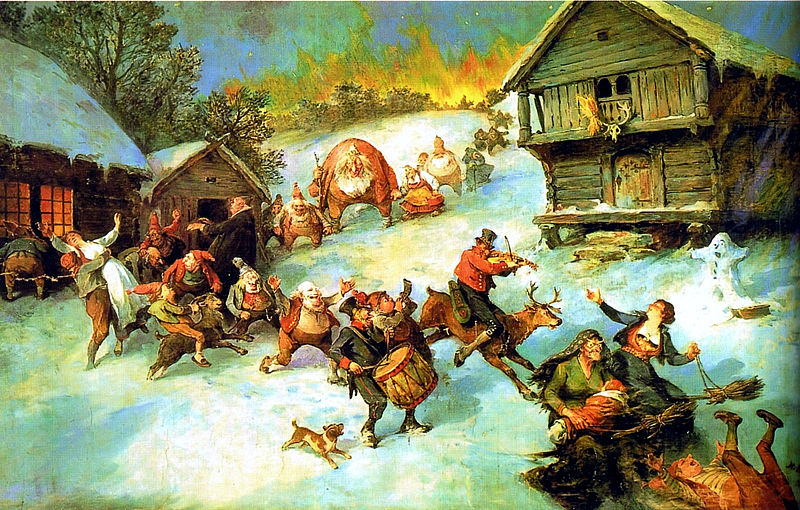
Horror: A True Tale is a short story written by John Berwick Harwood in 1861 for Blackwood’s Edinburgh Magazine and is a perfect example for a classic Christmas Ghost Story from Victorian times.
I WAS but nineteen years of age when the incident occurred which has thrown a shadow over my life: and, ah me! how many and many a weary year has dragged by since then! Young, happy, and beloved I was in those long-departed days. They said that I was beautiful. The mirror now reflects a haggard old woman, with ashen lips and face of deadly pallor. But do not fancy that you are listening to a mere puling lament. It is not the flight of years that has brought me to be this wreck of my former self: had it been so, I could have borne the loss cheerfully, patiently, as the common lot of all; but it was no natural progress of decay which has robbed me of bloom? of youth, of the hopes and joys that belong to youth, snapped the link that bound my heart to another’s, and doomed me to a lone old age. I try to be patient, but my cross has been heavy, and my heart is empty and weary, and I long for the death that comes so slowly to those who pray to die. I will try and relate, exactly as it happened, the event which blighted my life. Though it occurred many years ago, there is no fear that I should have forgotten any of the minutest circumstances: they were stamped on my brain too clearly and burningly, like the brand of a red-hot iron. I see them written in the wrinkles of my brow, in the dead whiteness of my hair, which was a glossy brown once, and has known no gradual change from dark to grey, from grey to white, as with those happy ones who were the companions of my girlhood, and whose honoured age is soothed by the love of children and grand-children. But I must not envy them. I only meant to say that the difficulty of my task has no connection with want of memory–I remember but too well. But as I take the pen, by hand trembles, my head swims, the old rushing faintness and Horror comes over me again, and the well-remembered fear is upon me. Yet I will go on. This, briefly, is my story: I was a great heiress, I believe, though I cared little for the fact, but so it was. My father had great possessions, and no son to inherit after him. His three daughters, of whom I was the youngest, were to share the broad acres among them. I have said, and truly, that I cared little for this circumstance; and, indeed, I was so rich then in health and youth and love, that I felt myself quite indifferent to all else. The possession of all the treasures of earth could never have made up for what I then had–and lost? as I am about to relate. Of course, we girls knew that we were heiresses, but I do not think Lucy and Minnie were any the prouder or the happier on that account. I know I was not. Reginald did not court me for my money. Of that I felt assured. He proved it, Heaven be praised! when he shrank from my side after the change. Yes, in all my lonely age, I can still be thankful that he did not keep his word, as some would have done, did not clasp at the altar a hand he had learned to loathe and shudder at, because it was full of gold–much gold! At least, he spared me that. And I know that I was loved, and the knowledge has kept me from going mad through many a weary day and restless night, when my hot eyeballs had not a tear to shed and even to weep was a luxury denied me. Our house was an old Tudor mansion. My father was very particular in keeping the smallest peculiarities of his home unaltered. Thus the many peaks and gables, the numerous turrets, and the mullioned windows with their quaint lozenge panes set in lead, remained very nearly as they had been three centuries back. Over and above the quaint melancholy of our dwelling, with the deep woods of its park and the sullen waters of the mere, our neighbourhood was thinly peopled and primitive, and the people round us were ignorant, and tenacious of ancient ideas and traditions. Thus it was a superstitious atmosphere that we children were reared in, and we heard, from our infancy, countless tales of horror, some mere fables doubtless, others legends of dark deeds of the olden time exaggerated by credulity and the love of the marvellous. Our mother had died when we were young, and our other parent being, though a kind father, much absorbed in affairs of various kinds, as an active magistrate and landlord, there was no one to check the unwholesome stream of tradition with which our plastic minds were inundated in the company of nurses and servants. As years went on, however, the old ghostly tales partially lost their effects, and our undisciplined minds were turned more towards balls dress, and partners, and other matters airy and trivial, more welcome to our riper age. It was at a county assembly that Reginald and I first met–met and loved. Yes, I am sure that he loved me with all his heart. It was not as deep a heart as some, I have thought in my grief and anger; but I never doubted its truth and honesty. Reginald’s father and mine approved of our growing attachment; and as for myself, I know I was so happy then, that I look back upon those fleeting moments as on some delicious dream. I now come to the change. I have lingered on my childish reminiscences, my bright and happy youth, and now I must tell the rest–the blight and the sorrow. It was Christmas, always a joyful and a hospitable time in the country, especially in such an old hall as our home, where quaint customs and frolics were much clung to, as part and parcel of the very dwelling itself. The hall was full of guests–so full, indeed, that there was great difficulty in providing sleeping accommodation for all. Several narrow and dark chambers in the turrets–mere pigeon-holes, as we irreverently called what had been thought good enough for the stately gentlemen of Elizabeth’s reign–were now allotted to bachelor visitors, after having been empty for a century. All the spare rooms in the body and wings of the hall were occupied, of course; and the servants who had been brought down were lodged at the farm and at the keeper’s, so great was the demand for space. At last the unexpected arrival of an elderly relative, who had been asked months before, but scarcely expected, caused great commotion. My aunts went about wringing their hands distractedly. Lady Speldhurst was a personage of some consequence; she was a distant cousin, and had been for years on cool terms with us all, on account of some fancied affront or slight when she had paid her last visit, about the time of my christening. She was seventy years old; she was infirm, rich, and testy; moreover, she was my godmother, though I had forgotten the fact, but it seems that though I had formed no expectations of a legacy in my favour, my aunts had done so for me. Aunt Margaret was especially eloquent on the subject. “There isn’t a room left,” she said; “was ever anything so unfortunate? We cannot put Lady Speldhurst into the turrets, and yet where is she to sleep? And Rosa’s godmother, too! poor dear child! how dreadful! After all these years of estrangement, and with a hundred thousand in the funds, and no comfortable warm room at her own unlimited disposal–and Christmas, of all times in the year!” What was to be done? My aunts could not resign their own chambers to Lady Speldhurst, because they had already given them up to some of the married guests. My father was the most hospitable of men, but he was rheumatic, gouty, and methodical. His sisters-in-law dared not propose to shift his quarters, and indeed he would have far sooner dined on prison fare than have been translated to a strange bed. The matter ended in my giving up my room. I had a strange reluctance to making the offer, which surprised myself. Was it a boding of evil to come? I cannot say. We are strangely and wonderfully made. It may have been. At any rate, I do not think it was any selfish unwillingness to make an old and infirm lady comfortable by a trifling sacrifice. I was perfectly healthy and strong. The weather was not cold for the time of year. It was a dark moist Yule–not a snowy one, though snow brooded overhead in the darkling clouds. I did make the offer, which became me, I said with a laugh, as youngest. My sisters laughed too, and made a jest of my evident wish to propitiate my godmother. “She is a fairy godmother, Rosa,” said Minnie; “and you know she was affronted at your christening, and went away muttering vengeance. Here she is coming back to see you; I hope she brings golden gifts with her.” I thought little of Lady Speldhurst and her possible golden gifts. I cared nothing for the wonderful fortune in the funds that my aunts whispered and nodded about so mysteriously. But, since then, I have wondered whether, had I then shown myself peevish or obstinate, had I refused to give up my room for the expected kinswoman, it would not have altered the whole of my life? But then Lucy or Minnie would have offered in my stead, and been sacrificed–what do I say?–better that the blow should have fallen as it did, than on those dear ones. The chamber to which I removed was a dim little triangular room in the western wing, and was only to be reached by traversing the picture-gallery, or by mounting a little flight of stone stairs which led directly upwards from the low-browed arch of a door that opened into the garden. There was one more room on the same landing-place, and this was a mere receptacle for broken furniture, shattered toys, and all the lumber that will accumulate in a country-house. The room I was to inhabit for a few nights was a tapestry-hung apartment, with faded green curt ins of some costly stuff, contrasting oddly with a new carpet and the bright fresh hangings of the bed, which had been hurriedly erected. The furniture was half old, half new, and on the dressing-table stood a very quaint oval mirror, in a frame of black wood–unpolished ebony, I think. I can remember the very pattern of the carpet, the number of chairs, the situation of the bed, the figures on the tapestry. Nay, I can recollect not only the colour of the dress I wore on that fatal evening, but the arrangement of every scrap of lace and ribbon, of every flower, every jewel, with a memory but too perfect. Scarcely had my maid finished spreading out my various articles of attire for the evening (when there was to be a great dinner-party), when the rumble of a carriage announced that Lady Speldhurst had arrived. The short winter’s day drew to a close, and a large number of guests were gathered together in the ample drawing-room, around the blaze of the wood fire, after dinner. My father, I recollect, was not with us at first. There were some squires of the old hard-riding, hard-drinking stamp still lingering over their port in the dining-room, and the host, of course, could not leave them. But the ladies and all the younger gentlemen–both those who slept under our roof, and those who would have a dozen miles of fog and mire to encounter on their road home–were all together. Need I say that Reginald was there? He sat near me–my accepted lover, my plighted future husband. We were to be married in the spring. My sisters were not far off; they, too, had found eyes that sparkled and softened in meeting theirs, had found hearts that beat responsive to their own. And, in their cases, no rude frost nipped the blossom ere it became the fruit; there was no canker in their flowerets of young hope, no cloud in their sky. Innocent and loving, they were beloved by men worthy their esteem.
The room, a large and lofty one, with an arched roof, had somewhat of a sombre character from being wainscoted and ceiled with polished black oak of a great age. There were mirrors, and there were pictures on the walls, and handsome furniture, and marble chimney-pieces, and a gay Tournay carpet; but these merely appeared as bright spots on the dark background of the Elizabethan woodwork. Many lights were burning, but the blackness of the walls and roof seemed absolutely to swallow up their rays, like the mouth of a cavern. A hundred candles could not have given that apartment the cheerful lightness of a modern drawing-room. But the gloomy richness of the panels matched well with the ruddy gleam from the enormous wood fire, in which, crackling and glowing, now lay the mighty Yule log. Quite a blood-red lustre poured forth from the fire, and quivered on the walls and the groined roof. We had gathered round the vast antique hearth in a wide circle. The quivering light of the fire and candles fell upon us all, but not equally, for some were in shadow. I remember still how tall and manly and handsome Reginald looked that night, taller by the head than any there, and full of high spirits and gaiety. I, too, was in the highest spirits; never had my bosom felt lighter, and I believe it was my mirth which gradually gained the rest, for I recollect what a blithe, joyous company we seemed. All save one. Lady Speldhurst, dressed in grey silk and wearing a quaint head-dress, sat in her armchair, facing the fire, very silent, with her hands and her sharp chin propped on a sort of ivory-handled crutch that she walked with (for she was lame), peering at me with half-shut eyes. She was a little spare old woman, with very keen delicate features of the French type. Her grey silk dress, her spotless lace, old-fashioned jewels, and prim neatness of array, were well suited to the intelligence of her face, with its thin lips, and eyes of a piercing black, undimmed by age. Those eyes made me uncomfortable, in spite of my gaiety, as they followed my every movement with curious scrutiny. Still I was very merry and gay; my sisters even wondered at my ever-ready mirth, which was almost wild in its excess. I have heard since then of the Scottish belief that those doomed to some great calamity become fey, and are never so disposed for merriment and laughter as just before the blow falls. If ever mortal was fey, then, I was so on that evening. Still, though I strove to shake it off, the pertinacious observation of old Lady Speldhurst’s eyes did make an impression on me of a vaguely disagreeable nature. Others, too, noticed her scrutiny of me, but set it down as a mere eccentricity of a person always reputed whimsical, to say the least of it.
However, this disagreeable sensation lasted but a few moments. After a short pause my aunt took her part in the conversation, and we found ourselves listening to a weird legend which the old lady told exceedingly well. One tale led to another. Every one was called on in turn to contribute to the public entertainment, and story after story, always relating to demonology and witchcraft, succeeded. It was Christmas, the season for such tales; and the old room, with its dusky walls and pictures, and vaulted roof, drinking up the light so greedily, seemed just fitted to give effect to such legendary lore. The huge logs crackled and burnt with glowing warmth; the blood-red glare of the Yule log flashed on the faces of the listeners and narrator, on the portraits, and the holly wreathed about their frames, and the upright old dame in her antiquated dress and trinkets, like one of the originals of the pictures stepped from the canvas to join our circle. It threw a shimmering lustre of an ominously ruddy hue upon the oaken panels. No wonder that the ghost and goblin stories had a new zest. No wonder that the blood of the more timid grew chilI and curdled, that their flesh crept, and their hearts beat irregularly, and the girls peeped fearfully over their shoulders, and huddled close together like frightened sheep, and half-fancied they beheld some impish and malignant face gibbering at them from the darkling corners of the old room. By degrees my high spirits died out, and I felt the childish tremors, long latent, long forgotten, coming over me. I followed each story with painful interest; I did not ask myself if I believed the dismal tales. I listened, and fear grew upon me–the blind, irrational fear of our nursery days. I am sure most of the other ladies present, young or middle-aged, were affected by the circumstances under which these traditions were heard, no less than by the wild and fantastic character of them. But with them the impression would die out next morning, when the bright sun should shine on the frosted boughs, and the rime on the grass, and the scarlet berries and green spikelets of the holly; and with me–but, ah! what was to happen ere another day dawn? Before we had made an end of this talk, my father and the other squires came in, and we ceased our ghost stories, ashamed to speak of such matters before these newcomers–hard-headed, unimaginative men, who had no sympathy with idle legends. There was now a stir and bustle.
Servants were handing round tea and coffee, and other refreshments. Then there was a little music and singing. I sang a duet with Reginald, who had a fine voice and good musical skill. I remember that my singing was much praised, and indeed I was surprised at the power and pathos of my own voice, doubtless due to my excited nerves and mind. Then I heard some one say to another that I was by far the cleverest of the Squire’s daughters, as well as the prettiest. It did not make me vain. I had no rivalry with Lucy and Minnie. But Reginald whispered some soft fond words in my ear, a little before he mounted his horse to set off homewards, which did make me happy and proud. And to think that the next time we met–but I forgave him long ago. Poor Reginald! And now shawls and cloaks were in request, and carriages rolled up to the porch, and the guests gradually departed. At last no one was left but those visitors staying in the house. Then my father, who had been called out to speak with the bailiff of the estate, came back with a look of annoyance on his face. “A strange story I have just been told,” said he; “here has been my bailiff to inform me of the loss of four of the choicest ewes out of that little flock of Southdowns I set such store by, and which arrived in the north but two months since. And the poor creatures have been destroyed in so strange a manner, for their carcasses are horribly mangled.” Most of us uttered some expression of pity or surprise, and some suggested that a vicious dog was probably the culprit. “It would seem so,” said my father; “it certainly seems the work of a dog; and yet all the men agree that no dog of such habits exists near us, where, indeed, dogs are scarce, excepting the shepherds’ collies and the sporting dogs secured in yards. Yet the sheep are gnawed and bitten, for they show the marks of teeth. Something has done this, and has torn their bodies wolfishly; but apparently it has been only to suck the blood, for little or no flesh is gone.” “How strange!” cried several voices. Then some of the gentlemen remembered to have heard of cases when dogs addicted to sheep-killing had destroyed whole flocks, as if in sheer wantonness, scarcely deigning to taste a morsel of each slain wether. My father shook his head. “I have heard of such cases, too?” he said; “but in this instance I am tempted to think the malice of some unknown enemy has been at work. The teeth of a dog have been busy no doubt, but the poor sheep have been mutilated in a fantastic manner, as strange as horrible; their hearts, in especial, have been torn out, and left at some paces off, half-gnawed. Also, the men persist that they found the print of a naked human foot in the soft mud of the ditch, and near it–this.” And he held up what seemed a broken link of a rusted iron chain. Many were the ejaculations of wonder and alarm, and many and shrewd the conjectures, but none seemed exactly to suit the bearings of the case. And when my father went on to say that two lambs of the same valuable breed had perished in the same singular manner three days previously, and that they also were found mangled and gore-stained, the amazement reached a higher pitch. Old Lady Speldhurst listened with calm intelligent attention, but joined in none of our exclamations. At length she said to my father, “Try and recollect–have you no enemy among your neighbours?” My father started, and knit his brows. “Not one that I know of,” he replied; and indeed he was a popular man and a kind landlord. “The more lucky you,” said the old dame, with one of her grim smiles. It was now late, and we retired to rest before long. One by one the guests dropped off. I was the member of the family selected to escort old Lady Speldhurst to her room–the room I had vacated in her favour. I did not much like the office. I felt a remarkable repugnance to my godmother, but my worthy aunts insisted so much that I should ingratiate myself with one who had so much to leave, that I could not but comply. The visitor hobbled up the broad oaken stairs actively enough, propped on my arm and her ivory crutch. The room never had looked more genial and pretty, with its brisk fire, modern furniture, and the gay French paper on the walls. “A nice room, my dear, and I ought to be much obliged to you for it, since my maid tells me it is yours,” said her ladyship; “but I am pretty sure you repent your generosity to me, after all those ghost stories, and tremble to think of a strange bed and chamber, eh?” I made some commonplace reply. The old lady arched her eyebrows. “Where have they put you, child?” she asked; “in some cockloft of the turrets, eh? or in a lumber-room–a regular ghost-trap? I can hear your heart beating with fear this moment. You are not fit to be alone.” I tried to call up my pride, and laugh off the accusation against my courage, all the more, perhaps, because I felt its truth. “Do you want anything more that I can get you, Lady Speldhurst?” I asked, trying to feign a yawn of sleepiness. The old dame’s keen eyes were upon me. “I rather like you, my dear,” she said, “and I liked your mamma well enough before she treated me so shamefully about the christening dinner. Now, I know you are frightened and fearful, and if an owl should but flap your window tonight, it might drive you into fits. There is a nice little sofa-bed in this dressing-closet–call your maid to arrange it for you, and you can sleep there snugly, under the old witch’s protection, and then no goblin dare harm you, and nobody will be a bit the wiser, or quiz you for being afraid.” How little I knew what hung in the balance of my refusal or acceptance of that trivial proffer! Had the veil of the future been lifted for one instant! but that veil is impenetrable to our gaze. Yet, perhaps, she had a glimpse of the dim vista beyond, she who made the offer; for when I declined, with an affected laugh, she said, in a thoughtful, half abstracted manner, “Well, well! we must all take our own way through life. Good night, child–pleasant dreams!” And I softly closed the door. As I did so, she looked round at me rapidly, with a glance I have never forgotten, half malicious, half sad, as if she had divined the yawning gulf that was to devour my young hopes. It may have been mere eccentricity, the odd phantasy of a crooked mind, the whimsical conduct of a cynical person, triumphant in the power of affrighting youth and beauty. Or, I have since thought, it may have been that this singular guest possessed some such gift as the Highland “second-sight”, a gift vague, sad, and useless to the possessor, but still sufficient to convey a dim sense of coming evil and boding doom. And yet, had she really known what was in store for me, what lurked behind the veil of the future, not even that arid heart could have remained impassive to the cry of humanity. She would, she must have snatched me back, even from the edge of the black pit of misery. But, doubtless, she had not the power. Doubtless she had but a shadowy presentiment, at any rate of some harm to happen, and could not see, save darkly, into the viewless void where the wisest stumble. I left her door. As I crossed the landing a bright gleam came from another room, whose door was left ajar; it (the light) fell like a bar of golden sheen across my path. As I approached, the door opened, and my sister Lucy who had been watching for me came out. She was already in a white cashmere wrapper, over which her loosened hair hung darkly and heavily, like tangles of silk. “Rosa, love,” she whispered, “Minnie and I can’t bear the idea of your sleeping out there, all alone, in that solitary room–the very room, too, nurse Sherrard used to talk about! So, as you know Minnie has given up her room, and come to sleep in mine, still we should so wish you to stop with us tonight at any rate, and I could make up a bed on the sofa for myself, or you–and–” I stopped Lucy’s mouth with a kiss. I declined her offer. I would not listen to it. In fact, my pride was up in arms, and I felt I would rather pass the night in the churchyard itself than accept a proposal dictated, I felt sure, by the notion that my nerves were shaken by the ghostly lore we had been raking up, that I was a weak, superstitious creature, unable to pass a night in a strange chamber. So I would not listen to Lucy, but kissed her, bad her good night, and went on my way laughing, to show my light heart. Yet, as I looked back in the dark corridor, and saw the friendly door still ajar, the yellow bar of light still crossing from wall to wall, the sweet kind face still peering after me from amid its clustering curls, I felt a thrill of sympathy, a wish to return, a yearning after human love and companionship. False shame was strongest, and conquered. I waved a gay adieu. I turned the corner, and, peeping over my shoulder, I saw the door close; the bar of yellow light was there no longer in the darkness of the passage. I thought, at that instant, that I heard a heavy sigh. I looked sharply round. No one was there. No door was open, yet I fancied, and fancied with a wonderful vividness, that I did hear an actual sigh breathed not far off, and plainly distinguishable from the groan of the sycamore branches, as the wind tossed them to and fro in the outer blackness. If ever a mortal’s good angel had cause to sigh for sorrow, not sin, mine had cause to mourn that night. But imagination plays us strange tricks, and my nervous system was not over-composed, or very fitted for judicial analysis. I had to go through the picture-gallery. I had never entered this apartment by candle-light before, and I was struck by the gloomy array of the tall portraits, gazing moodily from the canvas on the lozenge-paned or painted windows, which rattled to the blast as it swept howling by. Many of the faces looked stern, and very different from their daylight expression. In others, a furtive flickering smile seemed to mock me, as my candle illumined them; and in all, the eyes, as usual with artistic portraits, seemed to follow my motions with a scrutiny and an interest the more marked for the apathetic immovability of the other features. I felt ill at ease under this stony gaze, though conscious how absurd were my apprehensions, and I called up a smile and an air of mirth, more as if acting a part under the eyes of human beings, than of their mere shadows on the wall. I even laughed as I confronted them. No echo had my short-lived laughter but from the hollow armour and arching roof, and I continued on my way in silence. I have spoken of the armour. Indeed, there was a fine collection of plate and mail, for my father was an enthusiastic antiquary, In especial there were two suits of black armour, erect, and surmounted by helmets with closed visors, which stood as if two mailed champions were guarding the gallery and its treasures. I had often seen these, of course, but never by night, and never when my whole organization was so over wrought and tremulous as it then was. As I approached the Black Knights, as we had dubbed them, a wild notion seized on me that the figures moved, that men were concealed in the hollow shells which had once been borne in battle and tourney. I knew the idea was childish, yet I approached in irrational alarm, and fancied I absolutely beheld eyes glaring on me from the eyelet-holes in the visors. I passed them by, and then my excited fancy told me that the figures were following me with stealthy strides. I heard a clatter of steel, caused, I am sure, by some more violent gust of wind sweeping the gallery through the crevices of the old windows, and with a smothered shriek I rushed to the door, opened it, darted out, and clapped it to with a bang that re-echoed through the whole wing of the house. Then by a sudden and not uncommon revulsion of feeling, I shook off my aimless terrors, blushed at my weakness, and sought my chamber only too glad that I had been the only witness of my late tremors. As I entered my chamber, I thought I heard some thing stir in the neglected lumber-room, which was the only neighbouring apartment. But I was determined to have no more panics, and resolutely shut my ears to this slight and transient noise, which had nothing unnatural in it; for surely, between rats and wind, an old manor-house on a stormy night needs no sprites to disturb it. So I entered my room, and rang for my maid. As I did so, I looked around me, and a most unaccountable repugnance to my temporary abode came over me, in spite of my efforts. It was no more to be shaken off than a chill is to be shaken off when we enter some damp cave. And, rely upon it, the feeling of dislike and apprehension with which we regard, at first sight, certain places and people, was not implanted in us without some wholesome purpose. I grant it is irrational–mere animal instinct–but is not instinct God’s gift, and is it for us to despise it? It is by instinct that children know their friends from their enemies–that they distinguish with such unerring accuracy between those who like them and those who only flatter and hate them. Dogs do the same; they will fawn on one person, they slink snarling from another. Show me a man whom children and dogs shrink from, and I will show you a false, bad man–lies on his lips, and murder at his heart. No, let none despise the heaven-sent gift of innate antipathy, which makes the horse quail when the lion crouches in the thicket–which makes the cattle scent the shambles from afar, and low in terror and disgust as their nostrils snuff the blood-polluted air. I felt this antipathy strongly as I looked around me in my new sleeping-room, and yet I could find no reasonable pretext for my dislike. A very good room it was, after all, now that the green damask curtains were drawn, the fire burning bright and clear, candles burning on the mantelpiece, and the various familiar articles of toilet arranged as usual. The bed, too, looked peaceful and inviting–a pretty little white bed, not at all the gaunt funereal sort of couch which haunted apartments generally contain. My maid entered, and assisted me to lay aside the dress and ornaments I had worn, and arranged my hair, as usual, prattling the while, in Abigail fashion. I seldom cared to converse with servants; but on that night a sort of dread of being left alone–a longing to keep some human being near me–possessed me, and I encouraged the girl to gossip, so that her duties took her half an hour longer to get through than usual. At last, however, she had done all that could be done, and all my questions were answered, and my orders for the morrow reiterated and vowed obedience to, and the clock on the turret struck one. Then Mary, yawning to answer No, for very shame’s sake; and she went. The shutting of the door, gently as it was closed, affected me unpleasantly. I took a dislike to the curtains, the tapestry, the dingy pictures–everything. I hated the room. I felt a temptation to put on a cloak, run, half-dressed, to my sisters’ chamber, and say I had changed my mind, and come for shelter. But they must be asleep, I thought, and I could not be so unkind as to wake them. I said my prayers with unusual earnestness and a heavy heart. I extinguished the candles, and was just about to lay my head on my pillow, when the idea seized me that I would fasten the door. The candles were extinguished, but the fire-light was amply sufficient to guide me. I gained the door. There was a lock, but it was rusty or hampered; my utmost strength could not turn the key. The bolt was broken and worthless. Baulked of my intention, I consoled myself by remembering that I had never had need of fastenings yet, and returned to my bed. I lay awake for a good while, watching the red glow of the burning coals in the grate. I was quiet now, and more composed. Even the light gossip of the maid, full of petty human cares and joys, had done me good–diverted my thoughts from brooding. I was on the point of dropping asleep, when I was twice disturbed. Once, by an owl, hooting in the ivy outside–no unaccustomed sound, but harsh and melancholy; once, by a long and mournful howling set up by the mastiff, chained in the yard beyond the wing. I occupied. A long-drawn lugubrious howling, was this latter, and much such a note as the vulgar declare to herald a death in the family. This was a fancy I had never shared; but yet I could not help feeling that the dog’s mournful moans were sad, and expressive of terror, not at all like his fierce, honest bark of anger, but rather as if something evil and unwonted were abroad. But soon I fell asleep. How long I slept, I never knew. I awoke at once, with that abrupt start which we all know well and which carries us in a second from utter unconsciousness to the full use of our faculties. The fire was still burning but was very low, and half the room or more was in deep shadow. I knew, I felt, that some person or thing was in the room, although nothing unusual was to be seen by the feeble light. Yet it was a sense of danger that had aroused me from slumber. I experienced, while yet asleep, the chill and shock of sudden alarm, and I knew, even in the act of throwing off sleep like a mantle, why I awoke, and that some intruder was present. Yet, though I listened intently, no sound was audible, except the faint murmur of the fire,–the dropping of a cinder from the bars–the loud irregular beatings of my own heart. Notwithstanding this silence, by some intuition I knew that I had not been deceived by a dream, and felt certain that I was not alone. I waited. My heart beat on; quicker, more sudden grew its pulsations, as a bird in a cage might flutter in presence of the hawk. And then I heard a sound, faint, but quite distinct, the clank of iron, the rattling of a chain! I ventured to lift my head from the pillow. Dim and uncertain as the light was, I saw the curtains of my bed shake, and caught a glimpse of something beyond, a darker spot in the darkness. This confirmation of my fears did not surprise me so much as it shocked me. I strove to cry aloud, but could not utter a word. The chain rattled again, and this time the noise was louder and clearer. But though I strained my eyes, they could not penetrate the obscurity that shrouded the other end of the chamber, whence came the sullen clanking. In a moment several distinct trains of thought, like many-coloured strands of thread twining into one, became palpable to my mental vision. Was it a robber? could it be a supernatural visitant? or was I the victim of a cruel trick, such as I had heard of, and which some thoughtless persons love to practise on the timid, reckless of its dangerous results? And then a new idea, with some ray of comfort in it, suggested itself. There was a fine young dog of the Newfoundland breed, a favourite of my father’s, which was usually chained by night in an outhouse. Neptune might have broken loose, found his way to my room, and, finding the door imperfectly closed, have pushed it open and entered. I breathed more freely as this harmless interpretation of the noise forced itself upon me. It was–it must be–the dog, and I was distressing myself uselessly. I resolved to call to him; I strove to utter his name–“Neptune, Neptune!” but a secret apprehension restrained me, and I was mute. Then the chain clanked nearer and nearer to the bed, and presently I saw a dusky shapeless mass appear between the curtains on the opposite side to where I was lying. How I longed to hear the whine of the poor animal that I hoped might be the cause of my alarm. But no; I heard no sound save the rustle of the curtains and the clash of the iron chain. Just then the dying flame of the fire leaped up, and with one sweeping hurried glance I saw that the door was shut, and, horror! it is not the dog! it is the semblance of a human form that now throws itself heavily on the bed, outside the clothes, and lies there, huge and swart, in the red gleam that treacherously dies away after showing so much to affright, and sinks into dull darkness. There was now no light left, though the red cinders yet glowed with a ruddy gleam, like the eyes of wild beasts. The chain rattled no more. I tried to speak, to scream wildly for help; my mouth was parched, my tongue refused to obey. I could not utter a cry, and indeed, who could have heard me, alone as I was in that solitary chamber, with no living neighbour, and the picture-gallery between me and any aid that even the loudest, most piercing shriek could summon. And the storm that howled without would have drowned my voice, even if help had been at hand. To call aloud–to demand who was there–alas! how useless, how perilous! If the intruder were a robber, my outcries would but goad him to fury; but what robber would act thus? As for a trick, that seemed impossible. And yet, what lay by my side, now wholly unseen? I strove to pray aloud, as there rushed on my memory a flood of weird legends–the dreaded yet fascinating lore of my childhood. I had heard and read of the spirits of wicked men forced to revisit the scenes of their earthly crimes—of demons that lurked in certain accursed spots–of the ghoul and vampire of the East, stealing amid the graves they rifled for their ghostly banquets; and I shuddered as I gazed on the blank darkness where I knew it lay. It stirred–it moaned hoarsely; and again I heard the chain clank close beside me–so close that it must almost have touched me. I drew myself from it, shrinking away in loathing and terror of the evil thing–what, I knew not, but felt that something malignant was near. And yet, in the extremity of my fear, I dared not speak; I was strangely cautious to be silent, even in moving farther off; for I had a wild hope that it–the phantom, the creature, whichever it was–had not discovered my presence in the room. And then I remembered all the events of the night–Lady Speldhurst’s ill-omened vaticinations, her half-warnings, her singular look as we parted, my sister’s persuasions, my terror in the gallery, the remark that “this was the room nurse Sherrard used to talk of”. And then memory stimulated by fear, recalled the long forgotten past, the ill-repute of this disused chamber, the sins it had witnessed, the blood spilled, the poison administered by unnatural hate within its walls, and the tradition which called it haunted. The green room–I remembered now how fearfully the servants avoided it–how it was mentioned rarely, and in whispers, when we were children, and how we had regarded it as a mysterious region, unfit for mortal habitation. Was It–the dark form with the chain–a creature of this world, or a spectre? And again–more dreadful still–could it be that the corpses of wicked men were forced to rise, and haunt in the body the places when they had wrought their evil deeds? And was such as these my grisly neighbour? The chain faintly rattled. My hair bristled; my eyeballs seemed starting from their sockets; the damps of a great anguish were on my brow. My heart laboured as if I were crushed beneath some vast weight. Sometimes it appeared to stop its frenzied beatings, sometimes its pulsations were fierce and hurried; my breath came short and with extreme difficulty, and I shivered as if with cold; yet I feared to stir. It moved, it moaned, its fetters clanked dismally, the couch creaked and shook. This was no phantom, then–no air-drawn spectre. But its very solidity, its palpable presence, were a thousand times more terrible. I felt that I was in the very grasp of what could not only affright, but harm; of something whose contact sickened the soul with deathly fear. I made a desperate resolve: I glided from the bed, I seized a warm wrapper, threw it around me, and tried to grope, with extended hands, my way to the door. My heart beat high at the hope of escape. But I had scarcely taken one step, before the moaning was renewed, it changed into a threatening growl that would have suited a wolf’s throat, and a hand clutched at my sleeve. I stood motionless. The muttering growl sank to a moan again, the chain sounded no more, but still the hand held its grip of my garment, and I feared to move. It knew of my presence, then. My brain reeled, the blood boiled in my ears, and my knees lost all strength, while my heart panted like that of a deer in the wolf’s jaws. I sank back, and the benumbing influence of excessive terror reduced me to a state of stupor. When my full consciousness returned, I was sitting on the edge of the bed, shivering with cold, and bare-footed. All was silent, but I felt that my sleeve was still clutched by my unearthly visitant. The silence lasted a long time. Then followed a chuckling laugh, that froze my very marrow, and the gnashing of teeth as in demoniac frenzy; and then a wailing moan, and this was succeeded by silence. Hours may have passed–nay, though the tumult of my own heart prevented my hearing the clock strike, must have passed–but they seemed ages to me. And how were they spent? Hideous visions passed before the aching eyes that I dared not close, but which gazed ever into the dumb darkness where It lay–my dread companion through the watches of the night. I pictured It in every abhorrent form which an excited fancy could summon up: now as a skeleton, with hollow eye-holes and grinning fleshless jaws; now as a vampire, with livid face and bloated form, and dripping mouth wet with blood. Would it never be light! And yet, when day should dawn, I should be forced to see It face to face. I had heard that spectre and fiend are compelled to fade as morning brightened, but this creature was too real, too foul a thing of earth, to vanish at cock-crow. No! I should see it–the horror–face to face! And then the cold prevailed, and my teeth chattered, and shiverings ran through me, and yet there was the damp of agony on my bursting brow. Some instinct made me snatch at a shawl or cloak that lay on a chair within reach, and wrap it round me. The moan was renewed, and the chain just stirred. Then I sank into apathy, like an Indian at the stake, in the intervals of torture. Hours fled by, and I remained like a statue of ice, rigid and mute. I even slept, for I remember that I started to find the cold grey light of an early winter’s day was on my face, and stealing around the room from between the heavy curtains of the window. Shuddering, but urged by the impulse that rivets the gaze of the bird upon the snake, I turned to see the Horror of the night. Yes, it was no fevered dream, no hallucination of sickness, no airy phantom unable to face the dawn. In the sickly light I saw it lying on the bed, with its grim head on the pillow. A man? Or a corpse arisen from its unhallowed grave, and awaiting the demon that animated it? There it lay–a gaunt gigantic form, wasted to a skeleton, half clad, foul with dust and clotted gore, its huge limbs flung upon the couch as if at random, its shaggy hair streaming over the pillows like a lion’s mane. Its face was towards me. Oh, the wild hideousness of that face, even in sleep! In features it was human, even through its horrid mask of mud and half-dried bloody gouts, but the expression was brutish and savagely fierce; the white teeth were visible between the parted lips, in a malignant grin; the tangled hair and beard were mixed in leonine confusion, and there were scars disfiguring the brow. Round the creature’s waist was a ring of iron, to which was attached a heavy but broken chain–the chain I had heard clanking. With a second glance I noted that part of the chain was wrapped in straw, to prevent its galling the wearer. The creature–I cannot call it a man–had the marks of fetters on its wrists, the bony arm that protruded through one tattered sleeve was scarred and bruised, the feet were bare, and lacerated by pebbles and briers, and one of them was wounded, and wrapped in a morsel of rag. And the lean hands, one of which held my sleeve, were armed with talons like an eagle’s. In an instant the horrid truth flashed upon me–I was in the grasp of a madman. Better the phantom that scares the sight than the wild beast that rends and tears the quivering flesh–the pitiless human brute that has no heart to be softened, no reason at whose bar to plead, no compassion, nought of man save the form and the cunning. I gasped in terror. Ah! the mystery of those ensanguined fingers, those gory wolfish jaws! that face, all besmeared with blackening blood, is revealed!
The slain sheep, so mangled and rent-the fantastic butchery–the print of the naked foot–all, all were explained; and the chain the broken link of which was found near the slaughtered animals–it came from his broken chain–the chain he had snapped, doubtless, in his escape from the asylum where his raging frenzy had been fettered and bound. In vain! in vain! Ah, me! how had this grisly Samson broken manacles and prison bars–how had he eluded guardian and keeper and a hostile world, and come hither on his wild way, hunted like a beast of prey, and snatching his hideous banquet like a beast of prey, too? Yet, through the tatters of his mean and ragged garb I could see the marks of the severities, cruel and foolish, with which men in that time tried to tame the might of madness. The scourge–its marks were there; and the scars of the hard iron fetters, and many a cicatrice and welt, that told a dismal tale of harsh usage. But now he was loose, free to play the brute–the baited, tortured brute that they had made him–now without the cage, and ready to gloat over the victims his strength should overpower. Horror! Horror! I was the prey–the victim–already in the tiger’s clutch; and a deadly sickness came over me, and the iron entered into my soul, and I longed to scream, and was dumb! I died a thousand deaths as that awful morning wore on. I dared not faint. But words cannot paint what I suffered as I waited–waited till the moment when he should open his eyes and be aware of my presence; for I was assured he knew it not. He had entered the chamber as a lair, when weary and gorged with his horrid orgie; and he had flung himself down to sleep without a suspicion that he was not alone. Even his grasping my sleeve was doubtless an act done betwixt sleeping and waking, like his unconscious moans and laughter, in some frightful dream. Hours went on; then I trembled as I thought that soon the house would be astir, that my maid would come to call me as usual, and awake that ghastly sleeper. And might he not have time to tear me, as he tore the sheep, before any aid could arrive? At last what I dreaded came to pass–a light footstep on the landing–there is a tap at the door. A pause succeeds, and then the tapping is renewed, and this time more loudly. Then the madman stretched his limbs and uttered his moaning cry, and his eyes slowly opened–very slowly opened, and met mine. The girl waited awhile ere she knocked for the third time. I trembled lest she should open the door unbidden–see that grim thing, and by her idle screams and terror bring about the worst. Long before strong men could arrive I knew that I should be dead–and what a death! The maid waited, no doubt surprised at my unusually sound slumbers, for I was in general a light sleeper and an early riser, but reluctant to deviate from habit by entering without permission. I was still alone with the thing in man’s shape, but he was awake now. I saw the wondering surprise in his haggard bloodshot eyes; I saw him stare at me half vacantly, then with a crafty yet wondering look; and then I saw the devil of murder begin to peep forth from those hideous eyes, and the lips to part as in a sneer, and the wolfish teeth to bare themselves. But I was not what I had been. Fear gave me a new and a desperate composure–a courage foreign to my nature. I had heard of the best method of managing the insane; I could but try; I did try. Calmly, wondering at my own feigned calm, I fronted the glare of those terrible eyes. Steady and undaunted was my gaze–motionless my attitude. I marvelled at myself, but in that agony of sickening terror I was outwardly firm. They sink, they quail abashed, those dreadful eyes, before the gaze of a helpless girl; and the shame that is never absent from insanity bears down the pride of strength, the bloody cravings of the wild beast. The lunatic moaned and drooped his shaggy head between his gaunt squalid hands. I lost not an instant. I rose, and with one spring reached the door, tore it open, and, with a shriek, rushed through, caught the wondering girl by the arm, and, crying to her to run for her life, rushed like the wind along the gallery, down the corridor, down the stairs. Mary’s screams filled the house as she fled beside me. I heard a long-drawn, raging cry, the roar of a wild animal mocked of its prey, and I knew what was behind me. I never turned my head–I flew rather than ran. I was in the hall already; there was a rush of many feet, an outcry of many voices, a sound of scuffling feet, and brutal yells, and oaths, and heavy blows, and I fell to the ground, crying, “Save me!” and lay in a swoon. I awoke from a delirious trance. Kind faces were around my bed, loving looks were bent on me by all, by my dear father and dear sisters, but I scarcely saw them before I swooned again…. When I recovered from that long illness, through which I had been nursed so tenderly, the pitying looks I met made me tremble. I asked for a looking-glass. It was long denied me, but my importunity prevailed at last–a mirror was brought. My youth was gone at one fell swoop. The glass showed me a livid and haggard face, blanched and bloodless as of one who sees a spectre; and in the ashen lips, and wrinkled brow, and dim eyes, I could trace nothing of my old self. The hair, too, jetty and rich before, was now as white as snow, and in one night the ravages of half a century had passed over my face. Nor have my nerves ever recovered their tone after that dire shock. Can you wonder that my life was blighted, that my lover shrank from me, so sad a wreck was I? I am old now–old and alone. My sisters would have had me to live with them, but I chose not to sadden their genial homes with my phantom face and dead eyes. Reginald married another. He has been dead many years. I never ceased to pray for him, though he left me when I was bereft of all. The sad weird is nearly over now. I am old, and near the end, and wishful for it. I have not been bitter or hard, but I cannot bear to see many people, and am best alone. I try to do what good I can with the worthless wealth Lady Speldhurst left me, for at my wish my portion was shared between my sisters. What need had I of inheritances?–I, the shattered wreck made by that one night of horror!
More like this
Newest Posts
- Teresa Prieto The Witch of Jove and Spain’s First Vampire Case

 Advertisements Teresa Prieto, known as the Witch of Jove, has captivated the imaginations of many through the centuries as the first recorded case of a vampire in Spain that reached the court. What was she? A witch? A vampire? Or was she one of many innocent women accused of something supernatural. Long before the vampire … Continue reading Teresa Prieto The Witch of Jove and Spain’s First Vampire Case
 - Utne Hotel and the Watchful Spirit of “Mor Utne”
 In one of the oldest hotels in Norway in the serene Hardangerfjord, Mother Utne is said to still be running things. After working 70 years at Hotel Utne, management at the hotel claims that she is still the one in charge.
 - Brogans Bar: The Secret Passage to the Past
 Said to house both piles of Guinness, the Brogan’s Bar in Dublin is also said to house a few ghosts. Visitors and staff have long talked about the strange things that go down at the pub after the final call has been rung.
 - The Watchful Spirits of Bårdshaug Manor
 The old manor house at Bårdshaug in Norway is said to be haunted by some mysterious women that sometimes appear in the house, now operating as a hotel. Who are these female spirits lingering, and what do they want?
 - The Beautiful Queen Lamia Who Became a Vampire Monster Ghost Stories
 The Lamia was a feared bloodsucking monster that worked as the boogeyman of ancient Greece. Many will say that her tale has helped shape the vampire legends in Europe, but before that, she was said to have been the beautiful Queen of Libya.
 - Sennentuntschi: The Terrifying Swiss Legend of the Shepherd’s Doll Come to Life
 One of the horrid creatures from the alps is the seemingly innocent Sennentuntschi doll. Being made by male herders alone in the mountains, she has to endure their abuse and use until she comes to life and comes for revenge.
 - Bull and Castle Pub: The Melancholy Ghost of James Clarence Mangan
 Said to haunt his former childhood home that is now the Bull and Castle Pub in Dublin, the ghost of the melancholic writer James Clarence Mangan is said to linger.
 - The Haunted Legends of Stenberg Gård, Hoff Church and Toten Legends
 Deep in the farmland of Norway, Toten has a lot of ghost stories lingering on the old farms and buildings. Who were the priests said to haunt the Hoff Church and rectory, and who are the ghosts said to linger at the old Stenberg Manor?
 - Estries: Vampiric Spirits the Ashkenazi Jewish Folklore
 Although few written sources, the fear of the Estries Vampires from the Jewish community in Europe in the middle ages still lingers.
 - The Lady of the Stairs Haunting Ardgillan Castle
 Outside of Dublin overlooking the Irish sea, a white lady is said to be haunting the premise. Seen coming up from the beach and wandering on the castle grounds, the ghost that is called the Lady of the Stairs is just one of the ghosts said to linger at Ardgillan Castle.
 - The Church of San Giuseppe: A Sacred Place Where Rain Still Falls
 In the woodlands on the Hill of the Dead, the Sanctuary of Somazzo or Church of San Giuseppe has been the place of a strange pilgrimage for ages. According to legend, praying to the three girls said to be entombed alive in the church is said to bring rain in times of drought.
 - The White Lady of Duino Castle: A Haunting Beneath the Cliffs by the Castle Ruins
 Frozen in all eternity as a stone below the old castle of Duino on the cliffs. It is said to be haunted by the Lady in White, the former lady of the castle, thrown off the cliffs by her jealous husband. Now she returns to the castle to watch over her child she left behind.