This porcelain doll named Ruby will give the people playing with her an instant sorrow and sense of sickness, just by holding her. Family legend has it that the doll is haunted by a little girl that died with Ruby in her arms.
Ruby the Doll had a special talent when she was living with her family. That talent was moving from room to room, all on her own. No wonder her owners didn’t want to play with her as she was so cursed that she made the people holding her feeling sick, sad and sometimes, even nauseous.
Even with the cutesy blue eyes and golden locks, she is definitely not the scariest looking doll there is out there, but there is still something about the way she watches you with her porcelain eyes. The family that originally owned her certainly seemed to think so and thus kept her hidden away.
Advertisements
Instead the doll was passed down from generation to generation and put away in attics and basements, but they would constantly find her in other rooms than they put her in.
Haunted Porcelain
She is a porcelain doll from the early 1900s from Southern Ontario in Canada and belonged to a young girl of the same family that always had her in their possession, who passed away while she was holding Ruby in her arms allegedly.
The family even contacted a psychic medium once to get rid of the spirit that seemed to have attached itself to the doll. But it seemed to have failed as the strange occurrences around the doll kept happening.
Ruby The Haunted Doll: This little doll is said to be of the haunted and cursed kind. Visitors claim they feel unwell and get a sense of overwhelmingly sadness when being close to the doll. // Photo: Traveling Museum of the Paranormal and Occult
Since then she’s been creeping out every generation that inherited her. Not only by disappearing and appearing in different rooms, but also because of the strange sounds that seem to be coming from the doll.
Traveling Occult Objects
She is currently traveling with the Traveling Museum of the Paranormal and Occult that collects strange, occult and haunted objects, just like Ruby. Together they travel to places curious about the rarities of the occult. Thank God Ruby seems to always have enjoyed traveling.
She was given to the museum from a friend whose family had Ruby hidden away in a cardboard box.
And according to the owners, Greg Newkirk and Dana Mathew, visitors often get a feeling of sorrow from the doll, but also a sense of maternity and an urge to rock the little doll back and forth for comfort.
From beyond the veil, some mediums claimed that ghosts and spirits guided them to paint and draw. One of them was Georgiana Houghton and her spirit drawings.
Now mainly referred to Spiritualist art, spirit art, mediumistic art or psychic painting, this was and to a certain extent, still is a form of painting or drawing highly influenced by spiritualism. Spiritualism was a movement where connecting with the spirit world was both a performative and at times lucrative business. And the mediums that held these seances had different ways of reaching out to the spirits. One of the ways was by the pen.
Advertisements
Although perhaps not the psychic or spiritual part of the art is put much weight in today, the movement had a huge impact on modern art as part of the abstract art department. There are perhaps more famous men behind this genre of abstract art known today, like Piet Mondrian, Vasily Kandinsku, Kasimir Malevish and František Kupka.
Often overlooked goes the women that may have been the pioneers within this type of paintings and drawings, decades before the textbook pioneers. One of them is Georgiana Houghton (1814–1884)
The Artist and the Medium
The Spiritualist painter: Georgiana Houghton was both a medium and a trained artist.
She was a British artist and medium born on Las Palmas de Gran Canaria, but moved and lived in London. She was remembered more like an eccentric amateur artist that was more known for her medium role than of an artist. And she gave more credit to the spirits that guided her paintings than to herself as their creator.
This is also where she produced her first abstract work, or as they called it then, spirit drawings. Many of the pieces remind more of 196 or 1970 psychedelic art then Victorian from the 1860s and 70s. In 1859 she started having these private seances where she allegedly were guided to paint by different spirits and celestial beings.
Precipitated Paintings
Often, these particular paintings would come during a seance where the medium claimed that it was in fact spirits that guided the artist to produce the paintings.
When spiritism was at its peak of popularity, it was very common for the mediums to sketch a portrait of the spirit they were in contact with during their seances. Another form of this was by automatic drawing where mediums and other practitioners controlled the body of the artist.
Georgiana Houghton started her spirit art career first by drawing and then with watercolors. She was one of those relying on an automatic process where she told she was directed by spirits. First she drew flowers and fruits, and was somewhat of a floral artist. This was the one way of painting that was looked at as more of a respectable practice for Victorian artists. But then her style turned to something else entirely.
Advertisements
The floral pictures evolved to project the spiritual experience more than objects of the natural world. She had complex pictures with several layers, colors and details. She described the abstract shapes she found in her and colors as sacred symbolism
Not only was spiritualism on the edge of what was perceived as ordinary, at this time, the abstract way of painting was still not a concept, so the reception of the paintings was received more as a curious rarity than art.
In the beginning, Houghton claimed that it was her dead family members like her sister Zilla that guided her, but as her work evolved, so did her artist spirit guides. And she would later claim that it was the likes of Renaissance artists Titian and Correggio that led her brush.
The Frauds and the Performers
Spirit photographs: She was not only a painter that drew her seances. Here she is posing for a photograph, also used a lot within the spiritism movement.
She started gaining quite the notoriety for her paintings and even held an exhibition at the New British Gallery in Bond Street in London in 1871. Although it perplexed the visitors and was an eye opener for many of those watching the exhibition, it was not a commercial success at all. It almost bankrupted Houghton.
Despite this, she spent every day for around three months talking about her paintings to visitors and discussing the meaning behind her sacred symbols and what they could have meant.
In 1882 she published the book: ‘Chronicles of the Photographs of Spiritual Beings and Phenomena Invisible to the Material Eye’. This book featured spirit photographs from many well known spirit photographers that were active in the 1870s like Agnes Guppy-Volckman, Stainton Moses and spiritualists Alfred Russel Wallace and William Howitt.
There were also pictures from Frederick Hudson, well known for being the first spirit photographer in Britain, but also a well known fraudulent one that was exposed already in the 1870s. The book itself was heavily criticized for featuring dubious pictures where the pictures themselves were unconvincing and could be replicated with double exposure and .
Her Legacy as the Artist and not the Eccentric
Now, the collection is missing many of her works. Because it is not the museums, galleries or art historians that kept her legacy intact. Most of her works were kept by the Victorian Spiritualists Union in Melbourne. Like so many other women’s achievements they are kept hidden in their diaries, botanical albums and embroideries that not often are looked at as real art. And the irony that she attributes her work to the likes of ghost men speaks echoes with a bitter aftertaste today.
Although more known for her medium role than that of an artist, her work speaks for itself. Especially when we look at the way the art movement moved in the modern world, and her art were so ahead of its time. In 2016, the The Courtauld Gallery held an exhibition of her paintings where they acknowledged, not only the curious and peculiar origin story behind the paintings, but her craftsmanship and artistry as well. Because no matter how we feel about the spiritualism part, we cannot ignore how in modern art, the pieces we watch in a gallery, can help us see past the realism of the world and our thinking and reach a place in our sub consciousness we otherwise couldn’t see.
Put on the lists of most haunted places of South Korea, the once abandoned building of Neulbom Garden Restaurant, saw its fair share of ghosts according to the legends of this place.
The Neulbom Garden Restaurant (늘봄가든) building is located in Jecheon in North Chungcheong Province in South Korea. The restaurant is one of the most haunted places in South Korea according to most lists, blogs, youtube channels and articles. Often grouped together with the Gonjiam Psychiatric Hospital and Yeongdeok Haunted House.
Arguably the most famous haunted place in South Korea is the Gonjiam Psychiatric Hospital. When it was still standing it attracted a lot of ghost hunters, curious tourists and urban explorers. What was it behind the place that drew all these people?
Named one of the most haunted houses in South Korea, this house has attracted its fair share of ghost tourists. But is the Yeongdeok Haunted House really haunted by the death of Korean soldiers during the war, or is it simply the decaying look of the house that made the legend?
The story behind the haunted place of Neulbom Garden goes that the restaurant was once a very successful one that was run by a married couple. They had a young daughter with a physical disability in most versions of the legend. In some versions however, she was fine until the accident happened and turned their restaurant into Korea’s most haunted.
The Legend of the Haunted Restaurant
One day, the daughter of the restaurant owners was by the road right in front of the restaurant when she was run over by a car and she died. In some versions she survived the accident, but this is when her physical disability happened as her neck was snapped and left her brain dead.
Her father never recovered from this and ended up committed suicide by hanging himself in his grief. Her mother was also sick with grief and died not long after and the Neulbom Garden Restaurant was sold off.
After this tragedy, there were several attempts at running Neulbom Garden restaurant by other people, but strange things started happening all the time and the people working there started blaming it on some paranormal reasons.
The staff would take orders they forgot about, and when they realized it, they hurried over to the table with the forgotten orders. But when they came to the table, they found that someone had already served their guests.
They would also sometimes go home without cleaning the tables, but when they came back, the next morning, they found the whole restaurant tidied and clean.
The Abandoned Restaurant: Put on the lists of most haunted places of South Korea, the once abandoned building of Neulbom Garden Restaurant got a reputation of being haunted. //photo:
Not only the staff noticed strange things happening in the restaurants. Although perhaps a helpful ghost for the staff, the neighbors were less than pleased and constantly complained of loud noises from the haunted restaurant.
But although the ghosts seemed to have been eager to help with the restaurant, sometimes it would create chaos as well. Guests would sometimes order food by a female staff member, but the food would never arrive at their table. When the guests asked the male staff what happened to their order taken by the female staff, they could only answer: “We don’t have any females working here.”
The next owners that took over the restaurant finally gave up on running the restaurant one by one and left the building to decay, further fuelling the rumors of it being haunted. Rumors about the place is that a priest bought Neulbom Garden to let it rest in peace.
Although renewed as an art district in downtown Memphis, the buildings on South Main like Earnestine & Hazel’s Bar hold old history within its walls as well as hauntings of their ghosts.
There are so many conflicted theories about the restaurant and if we look at the earlier korean sources according to namu.wiki it was in 2009 an article of the hauntings of the Neulbom Garden Restaurant was written online. Here in this article it was the parents who died in both a car accident and by suicide by turning the gas stove on in the kitchen.
So what version could be the truth behind the many legends? More likely is that they closed down the Neulbom Garden Restaurant because the Jungang Expressway opened in 2001 and sales plummeted. It looks like it was purchased in 2012 by Buddhists that used it as a temple and cafe, but the business failed as well and it was closed again in 2015.
It was later run as a cafe by a group of christians it seems, and as far as research goes it looks like the building is still being used as a restaurant or cafe under a different name than Neulbom Garden Restaurant under the expressway. If the guests are still being served by ghosts is undisclosed.
In an old cemetery in Vienna for the victims of the Donau river, these nameless dead ones rest in one of the most haunted places in Friedhof der Namenlosen.
Tourism in graveyards is not an uncommon thing. Most people seek out the gravestones of famous names we still remember. And in Vienna, tourists seek out names like Beethoven, Brahm and Strauss. But there is a place to visit for those who bear no name on their black iron crosses. The inscription says only Namenlos (nameless). Because in the Friedhof Der Namenlosen, the cemetery of the nameless, the people put in the ground there have no names.
Advertisements
It is frequently cited as one of the more haunted places in Europe, which is saying a lot and several paranormal investigators insist that the place is indeed haunted. However, the story behind the cemetery is more than not a sad one rather than a scary one.
The Drowned in Danube
Namenlos: The crosses in this cemetery bare no names and the graves are marked with ‘Nameless’.//Photo: Rokun
Hidden away from the classy and timeless city of Vienna, an industrial site with Silos and warehouses surrounding the place, there is a graveyard of the victims claimed by the Danube river that bares no name, and those killed by their own hand and therefore turned away from the catholic burial grounds like the Vienna’s Central Cemetery, Zentralfriedhof.
The cemetery opened in 1840 to be a place for the dead that had no family claiming their bodies to give them a final resting place. Before building around the river changed its current, drowned people used to wash ashore near this cemetery. Up until 1900, no less than 478 nameless bodies were buried in this place. Most drowned in the Danube or by suicide.
Today, the nameless are buried together with the people in the Central Cemetery, but the graves that are already there are taken care of and remembered. Tourists and passersby leave small gifts and flowers for the graves that would otherwise be left alone with no family and friends to visit them.
Remembering the Nameless
Every year on All Saint’s Day there is a small ceremony by the local fishermen to the unknown dead. They float a raft down the Danube, decorated with flowers, wreaths and with a commemorative writing both in German, Hungarian and Slovak.
The raft drifts down the river to bands playing and follows the current of the river, just like the nameless first came to the place. And on the raft it is written with a request to gently push the raft onwards if it gets stuck on the riverbank.
Ghost light over the Chaleur Bay in Quebec has spurned many ghost stories about a burning ship that still haunts the water. From Portugues enslavers to indigenous curses, the Chaleur Phantom covers it all.
Strange is the tale that the fishermen tell: They say that a ball of fire fell Straight from the sky, with a crash and a roar, Lighting the ship from shore to shore. That was the end of the pirate crew. But many a night a black flag flew From the mast of a specter vessel, sailed By a specter band that wept and wailed.
– The Phantom Light of the Baie des Chaleurs”, 1891 Arthur W.H Eaton
Right before storms in Chaleur Bay in Canada, a ghostly light can appear that no one can really explain. Those studying The Chaleur Phantom with a telescope say that there are no more details to examine, even up close and a definitive explanation of it all, still remains a mystery.
But those watching the lights with their naked eye claim that it looks more like a ship on fire and from there, the stories about it took form. The Chaleur Bay or Baie des Chaleurs is French and means Bay of Warmth because of the high temperatures. Perhaps a fitting name as the bay is reportedly haunted by a burning ghost ship that cruises the bay between New Brunswick’s north shore and Quebec’s Gaspé.
The Many Ghosts of the Bay
The lights are claimed by many stories around these parts. West of Caraquet, the ship is known as the Marquis de Malauze, a French ship that were sunk by the British in 1760. To the east it is known as John Craig, the name of a barque that sank outside of Shippigan Island around 1800. Only a cabin boy survived a drowning fate, but later died of exhaustion.
Another source of the The Chaleur Phantom is the haunting of Lady Colbourne, a schooner that went down in 1838 with its valuable cargo. On her last voyage, she was loaded with gold, silver, spices and wine that not all were recovered after the wreck. The passengers were also very wealthy people that drowned in their finest clothes. When she went down, 43 people were reported to have drowned.
Advertisements
But that is not the earliest explanation for these lights known as The Chaleur Phantom. The most told and perhaps most tragic story is of the Portuguese explorers that ended their days in the bay after enslaving the indigenous people.
The Portuguese Captain
One summer’s evening in 1878, Mrs. Pettigrew sat on her veranda late at dusk at Heron Island. Suddenly, a man stood in front of her, asking for her help. He was badly burned and she turned away to run inside. He brushed by her and she noticed that he had no legs. But before she could find out more, he disappeared.
On many occasions before and later this incident, the Pettigrew family noticed strange things out on the bay. They reported about a ghost ship that was most often seen on the north side of the island during the full moon.
One of the tales that have been spun is about the Portuguese Captain in the 1500s that ravaged and pillaged the area before disappearing without a trace.
The Curse of the Burning Ship: The burning ship people of this area reports of seeing is often attributed to the disappeared ship the Portuguese explorer Gaspar Cort-Real and his brother Miguel that never returned after sailing to this area. // Photo: Destruction of the Turkish Fleet in the Bay of Chesma by Jacob Philipp Hackert.
The captain, believed to be the real Portuguese explorer, Gaspar Cort-Real, arrived at Heron Island in 1501 to kidnap the natives of the place known as Mi’Kmaq to sell them as slaves. It is reported that he captured as many as 57 indigenous people that were taken back to Portugal as slaves.
But when he came back for his second visit, the Mi’kmaq took him first. Rembering what had happened to their people last time he came, they tortured and killed him before he could do any more damage to their people.
A year later the Captain’s brother, Miguel came to look for him, and the locals attacked him as well. Their ship was set on fire and they jumped in the waters, promising they would haunt the bay for the next 1000 years as The Chaleur Phantom.
It is said that the corpses of both the Portuguese as well as the Mi’kmaq washed ashore on the island and that they were buried in a low lying area at the west tip of the island called French Woods. And that their graves were shallow and their souls not yet at rest.
The Pirate Killing
Another origin tale to the lights is told from Restigouche. According to this tale, it was a group of pirates nead Port Daniel that killed a woman there. She was a native in most stories and was kidnapped by the pirates. With her dying breath she cursed her killers.
“For as long as the world is, may you burn on the bay.”
And according to the phantom lights in the bay, they still burn.
Advertisements
The Murder of a Sailor
A third explanation of The Chaleur Phantom that are told is of the murder of one of the sailors that worked on a ship. They encountered bad weather that drove the crew desperate. The superstitious sailor feared that they would die and that they were followed by bad luck. They attributed this bad luck to one of the sailors and ended up murdering him to reverse the bad luck.
Then the ship caught fire though, and it was told that it was Catholic blood way of seeking revenge.
Other Scientific Explanations
There have been many tales to try to find the origin of the lights, scientific as well as paranormal. There have been several research papers that have tested and concluded different explanations that don’t involve evil Captains from Europe, cursed pirates and catholic blood.
There are also very few pictures of the phenomenon of The Chaleur Phantom to test and further examine it with as well as some factual inaccuracies in the stories told to give credit to the ghost stories.
Other more natural causes that can explain this strange phenomenon could be something as trivial as rotten vegetation and a sort of marsh gas that has drifted over water, or an undersea release of natural gas or St. Elmo’s Fire.
St. Elmo’s Fire: This weather phenomenon is typically seen during thunderstorms when the ground below the storm is electrically charged, and there is high voltage in the air between the cloud and the ground. // Source
Although many scientists reject that this phenomenon can be St. Elmos Fire, which is electricity slowly discharged from the atmosphere to the earth—ordinarily shows itself as a tip of light on a pointed object, such as a church steeple or a mast. In addition, it is accompanied by a crackling noise.
No matter the real reason behind its light of The Chaleur Phantom, the existence of them is something that can’t be denied. What also can’t be denied is the victims to the bay and the harrowing stories that can be retold as countless ghost stories.
On the cliff overlooking the blinking blue ocean of Portugal, a young blind girl fell to her death while playing by the Castelinho de São João do Estoril. She is now forever haunting the place.
A well tended garden by the bright blue seaside in Portugal looks more like an interior design story than a ghost story. There are the goth-like towers in the new-medieval style of the grand house that can allude to something more than a sunshine story.
The Castelinho de São João do Estoril, in Estoril, is said to be haunted by the ghost of a little blind girl who accidentally fell to her death in a nearby cliff.
The Dancing Girl
The house is called Castelinho Nossa Senhora de Fátima and sits at the edge of the cliffs, overlooking the beautiful Cascais bay and the Atlantic Ocean. This house has gone for as much as 3 million euros. But there are also legends about potential buyers that have turned the house down based on some ghost stories surrounding the place.
Advertisements
Locals tell a story about a girl that was dancing at the edge of the cliff and fell to her death in the sea by the Castelinho de São João do Estoril. They say that ever since, you can sometimes spot a dancing girl at the very edge, always dancing.
But who was this girl? Some say that she was the daughter of the owners of the house. But one story that is told the most, is that she was a blind girl from one of the neighboring houses, and that the parents of the house gave their house as a support center for the blind.
The Truth Behind the Legend
It is true that there was a support center for the blind, however, it wasn’t a house gifted from the parents of a blind girl that fell to her death.
In fact, there was no house there, until 1913 when Instituto de Cegos Branco Rodrigues was built and used until the 70s. First 14 years later, the Castelinho Nossa Senhora de Fátima was built. And a story about a blind ghost, must have been a student at the school for instance if we are to give credit to the paranormal sightings.
By the Sea: The house of Castelinho de São João do Estorilwere the supposed haunting is right by the bright blue sea //Photo: Observador
One of the potential buyers in 1983 was José Castelo Branco, a Portuguese reality star, but when he got to the place, he gave up any plans of buying the place. At arrival he saw a girl playing with other children by the cliff and suddenly felt the urge to throw himself into the sea. Not buying a bad omen, he left without buying.
And although today, the story of the little girl on the cliff is mostly brought up when the house is put up for sale, it still persists to be told, again and again. And reports of a ghost of a little girl with a doll in her hand comes in as she dances on the cliff or goes through the walls of the house.
It the cold North Sea, there is a ghost ship where the crew plays for your soul with dice. That is what happened to Baron Falkenberg.
In the seas outside the shores of Germany, there is also a Captain of a ghost ship, haunting the dark waters, collecting souls and trapping them there. It goes into the European tradition of ghost ships and a cursed crew, just like The Flying Dutchman. That is the base of the legend of the story of Baron Falkenberg.
Baron Falkenberg
The Baron was invited to a wedding to his long lost brother who had just come back home as a new man. When the brother returned, he was a very wealthy man, unlike the Baron, who had very little money to his name.
Advertisements
The Baron had long had his eyes set on a girl he wanted to marry from the village, but hadn’t dared to declare his love for. But to his horror, he found that the wedding of this girl and his brother he was going to attend. Not only was his brother now a much richer man than the Baron himself, he was going to marry the love of his life.
Still, the Baron thought they should live in peace. It was after all her choice, and he had no real money to offer her, so he shouldn’t hold a grudge.
The Wedding Violence
The wedding went as smoothly as one could expect and there were lots of champagne, songs and festivities that night. It all was well until his brother touched the Baron the wrong place or way as it says in the legend. The Baron went mad after this and grabbed a champagne bottle and smashed it into his brother’s head.
The brother fell dead to the ground and the bride fled screaming away as she had seen it all. The Baron chased her to explain himself. He declared his love and tried to persuade her to escape with him, but she told him that she would rather die than be with him. The Baron took her word for it and stabbed her with a knife, also killing the girl he loved.
The sound of the fighting didn’t go unnoticed by the rest of the guests and they came to investigate and soon found the tragedy that had unfolded to the newlyweds. The Baron fled the scene and went for a walk, trying to clear his head and figure out what to do next. He found himself at the beach nearby and found a man was sitting there, almost like he was waiting for the Baron.
“The Captain expects you, Baron,” the boatman said to the Baron and extended his hand to help him into the boat right next to them. The Baron had nowhere to go, no one to go to and accepted and got into the boat rowed further out to sea where a ship was waiting.
And when the Baron first entered the ship, he didn’t get off for the next 600 years. The ship can sometimes be seen on wild winter nights in the North Sea going north. The ship is painted gray and sailed under a yellow flag. You can see the Baron sitting there with the devil, playing dice for his soul and cursed to sail the ship forever.
Sitting on the railing in her red dress, the ghost waves her victims closer, urging them to jump to their death. This is the tale of the Lady in Red of Bang Pakong River.
Over the river, there is the bridge Saphan Bang Pakong. Over the years, this has been a place where a lot of jumpers have tried to kill themselves according to legends as well as the local police force. And local police reckon that there has been over 60 suicides since 1992, at least that they have record on.
The legend is believed to be of a spirit who drowned in the Bang Pakong River which is situated in east Thailand. Who she can be and if she is real at all, is still speculated on by people crossing the bridge in the dead of the night.
The Wave to Their Death
The legend of the Lady in Red drew attention from the media when the story of a 25 year old lady who was pulled from jumping from the bridge in 2018 was published in the local papers. Afterwards, the lady claimed that although feeling stressed, she had no intention of killing herself that day. So what happened then? Why did we then find her at the edge of the railing?
According to the woman herself, she was driving home when she noticed someone sitting on the railing of the bridge. She parked the car and followed the person, as it was something that drew her towards it and the bridge. A waving motion, a feeling of despair growing. At the same time the woman had this vision, another man came by on his motorcycle and saw the young woman approaching the railings of the bridge. He stopped and came to her rescue. He called out to her, but she wouldn’t answer and he knew immediately something wasn’t right.
Both the woman herself and her rescuer o n the bike talked about seeing a middle aged woman with shoulder length hair, waving at her trying to make her jump before she herself threw herself in the water.
The Many Victims
Advertisements
This was however not the first report on the matter, and might not be the last. Over the years iI i is often from the bridge witnesses claim to have seen her spirit at night. Many of these legends also tell of a middle aged woman, often seated on the railing, waving the people towards them, urging them to jump. The victims often describe a sense of blackout or a trance like state until they hopefully are helped by a person that can pull them back from the railing.
Rescue teams have also told stories about people they have helped that told the story of a lady in red they tried to help when she jumped from the bridge. All with the same story, either waving at them from afar or looking like she is jumping to her death.
Who is the Lady in Red?
The legend of the Lady in Red is a fairly new one. Many connect her to a case from 2006, where a body of a woman was found floating in the river on November 23rd. She was wrapped in a green sheet, with her hands and feet tied up and her mouth covered with a rope around her neck. After this it is said that her spirit is seen sitting on the rails of the bridge, or hitchhiking underneath it, waving before jumping in the Bang Pakong river. To this day her death is still not cleared, and the mystery surrounding it all is just as when she was first found.
The Lady in Red in History
She is sometimes said to be dressed in white, but most often, it is the stories of the red clad lady that are mostly reported on. Something that quite often pop up in ghost stories.
When talking of ghosts that are described as a woman clad in red, it is often in the same street as a lady in white or lady in black. The one difference is that often, the lady in red has a story of a jilted lover, being a prostitute, often killed in a fit of passion or a vain woman. All in all, a woman victim to objectification. Especially in western ghost stories.
However, in Asian legends particularly, the lady in red is sometimes connected to jumpers. Just like this story, as well as in the Malayan legend of the red woman on the ninth floor in an apartment building in Little India in Malacca, an area known for jumpers. Can this be a trend of the ghost stories itself or the nature of the ghosts? Only the Lady in Red has the answers, and it looks like she doesn’t want to share.
A Scary Ghost or Cry for Help?
In the case of the lady in red on the bridge over Bang Pakong river, we can only speculate what the truth is. About the origin of the story, or if the countless cleansing rituals that have been done to purify the bridge has helped at all. Or if the ghost story is more of a solemn reminder of the importance of an open conversation of mental health, not only in Thailand, but everywhere a legend of ladies in red is told.
Rowing in the lifeboats of the wrecked ship SS Valencia, the skeleton remains of the passengers that died are doomed to row the sea for eternity.
The Valencia was headed out from San Francisco towards Seattle with clear weather with both seasoned crewmembers as well as passengers not necessarily used to the sea. The iron hulled passenger steamer was not a well liked ship to sail with along the Pacific Coast as it was too small and also, too open to the elements that made her difficult to handle in the winter.
This was in January and the weather was cold. And soon it was going to become another tragedy in the area that is known as ‘The Graveyard of the Pacific’ where almost 70 ships have wrecked in these parts.
The Wreckage of SS Valencia
When they reached Cape Mendocino outside of San Francisco on the 22. January in 1906, they encountered dense fog and had to slow the speed and sound the whistle as they battled against the fog with the danger of a wind that had turned on them. The ship got off course because of the wind, the current and the fog. Then they ran into rocks right before midnight on the 22 January and the disaster unfolded.
Advertisements
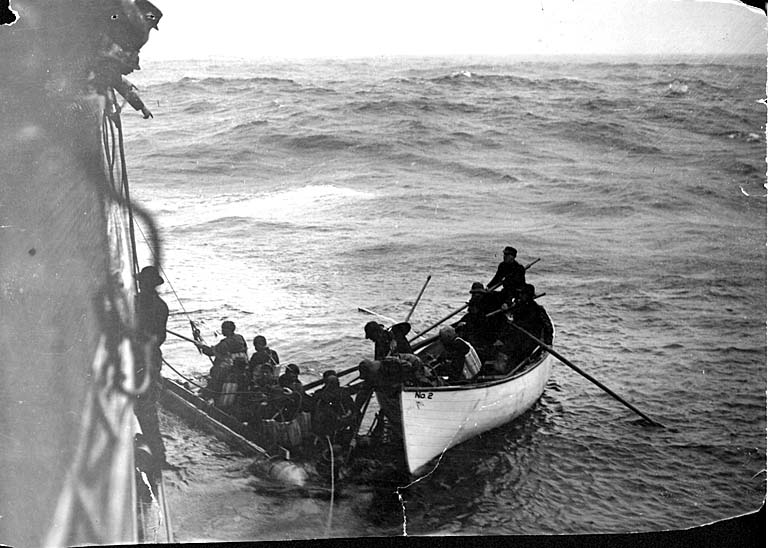
The passengers of the ship panicked and rushed to the lifeboats that were so ill handled in all the chaos that few made it to the water and even fewer made it safely. Some of the lifeboats were smashed to the side of the ship, some were lowered too soon, or too late. Several of the lifeboats were never seen again.
They were so close to land, only around 50 meters from the shore, but they couldn’t reach it at all. Stranded at the railing on deck were hundred people with the captain and the remaining crew.
“Screams of women and children mingled in an awful chorus with the shrieking of the wind, the dash of rain, and the roar of the breakers. As the passengers rushed on deck they were carried away in bunches by the huge waves that seemed as high as the ship’s mastheads. The ship began to break up almost at once and the women and children were lashed to the rigging above the reach of the sea. It was a pitiful sight to see frail women, wearing only night dresses, with bare feet on the freezing ratlines, trying to shield children in their arms from the icy wind and rain.”
– Survivor Chief Freight Clerk Frank Lehn
The Tragedy: Wreck of the en:SS Valencia, seen from one of the rescuing ships on January 23, 1906. So close were they to salvation, both to shore and to the rescue ships, but they never made it home again. // Source: BC Archives
No Hope for Rescue
The remaining people hoped to get rescued, but when the rescue fleet finally arrived, they realized that it was too dangerous to get close to the impaled ship on the rocks with water flooding in the strong current and wind.
The rest of the night, the ships Salvador, Queen and Topeka could only watch as the ship went down together with the rest of the people onboard. They all either drowned, were killed by getting hit by something on the ship or dying of hypothermia when they landed in the water.
The Lifeboats: Not many were picked up from the waters that day. Since then, lifeboat manned by skeletons have been reported on from this area. Here are a pictures of the survivors from the SS Valencia being picked up by the SS City of Topeka on January 24, 1906.//Source: University of Washington Digital Collections
Of all the passengers and crew on board, only 37 men survived this tragedy with every woman and child onboard dying. The complete death toll varies, but at least 117 up to 181 people died and it is known to be one of the more tragic wreckage in maritim history.
The Rowing Skeletons
The remains of the ship was never recovered, but left to its own devices. Some of the remains drifted to shore, finally, and the remains have been left mostly untouched. Outside of the Pachena Beach you can still see it, clinging to the coastline. Not long after the tragedy of the ship, the rumors, the tales and stories started to come from the wreckage.
The Ghost Ship: Not only the lifeboats, but also the entire ship has been reported on being spotted, years after it sunk to the bottom of the sea. Here are SS Valencia, circa 1905. // Source: BC Archives
When they were transporting the few survivors they found from the wreckage to Seattle, the crew of the ship City of Topeka spotted something unexplained. They stopped to pass the news of Valencia to a passing vessel that came towards them. When it passed them by, they saw that it was in fact the Valencia, the ship that had just sunk to the bottom of the sea.
The people that observed this, told that the crew were all skeletons and were heading towards the rocks as the Valencia had already hit and sunk on. When passing the City of Topeka, the Valencia signaled to it like it would have if they really met. After this, the Topeka continued back to Seattle without further incidents, but it was not the last one that were reported on.
Six months after the sinking of the ship, a local Nuu-chah-nulth fisherman named Clanewah Tom spotted a lifeboat together with his wife in a nearby sea cane in Pachena Bay at the southern end of Vancouver Island in British Columbia, Canada. But there was something deeply wrong with the lifeboat. In it sat not eight people, but eight skeletons. Although having survived the initial wreckage, it looked like they had starved to death. There was no way of recovering the lifeboat however and it was a mystery of even how it got into the cave.
Since then local fishermen reported of lifeboats with skeletons rowing in the area. In 1910, the Seattle Times reported that sailors claimed to have seen the ship that looked eerily like the Valencia, near Pachena Point. What looked like human figures held onto the ship like it was about life or death as the waves washed over the ship.
In 1933 they found one of the lifeboats drifting in Barkley Sound. The boat was in excellent condition and the paint looked almost fresh. No skeletons onboard this time, and perhaps never again?
On the night of the solstice, the sound of a little girl is echoes through the old castle. A little girl with blue hair.
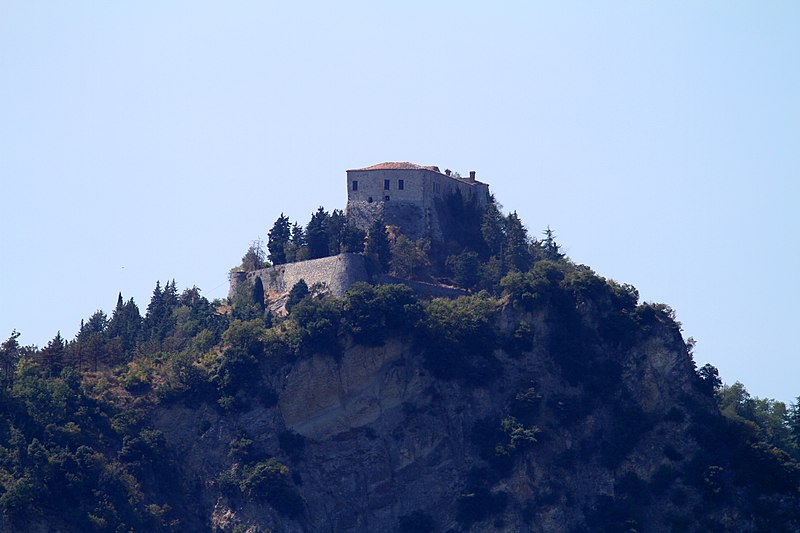
Castle on a Hill: The ghost of Azzurina of Romagna is supposedly haunting the castle Montebello di Torriana. Attribution: Carlo Pelagalli
The sun lingered for a long time over the mountain area where the castle of Montebello di Torriana was. The castle stands in what was known as Romagna, a historical part of northern Italy that no longer exists. It was a stormy June day, in 1375 with thunder going on all around the castle grounds. Towering 400 meters above the ocean, the castle looks out over the valleys of Marecchia and Uso when it was still under the Papal rule. The earliest name of this castle was Mons Belli, or War Mountain in English.
That day was the day of the solstice. The lord of the house’s daughter, Azzurina was playing with a ball, being watched over by her bodyguards Domenico and Ruggero. She was around five years old and running around in the castle with her ball made out of rags. They were distracted for just a moment, and when they turned around, the child was gone. A scream was heard from the castle icehouse and the bodyguards rushed over. Perhaps she had chased the ball and fell? But no trace was left and they were never able to find the child — at least not alive.
The Blue Haired Girl
Centuries later, around 1600 a priest put the legend to paper for the first time as we know of, although the writing itself is lost. The title of the story was Mons Belli ed Deline, hinting that the name was Deline or Adelina, but to most people hearing the legend, her name was Guendalina.
Advertisements
Guendalina was a normal girl wanting to play around the castle grounds. But to the people in the castle, she was more of a secret. She was born as albino, which at the time was connected to persons of a diabolical nature. Her mother tried again and again to color her hair darker with pigments from plants. But the black color wouldn’t stay, and the color faded, leaving only a blue tint of it. This is where her nickname, Azzurrina, meaning blue comes from. So instead she was hidden away from the public eye. This is also why her father ordered her two bodyguards to always watch over her every move as he was worried about the superstitions and rumours surrounding his daughter’s affliction.
The Mystery of the Solstice
Solstice: When the sun is on the sky the longest is the summer solstice. A lot of paranormal rumours surrounds this day, and this is the supposed day the little girl went missing.
What happened to the girl is still debated to this day. Perhaps only a tragic accident? The most gruesome theory is that of her father, Ugolinonuccio, that he himself ordered the death of his daughter because of her being an albino and therefore a problem for him, his reputation and his career. At the time he was supposed to be far away fighting in a war. Even her mere existence is debated as the records of the past are far and few between.
Now, every five year, or to be more exact, on every summer solstice ,strange occurrences have been reported from the castle. Paranormal researchers flock to the place then, to hear “the sound”.
Since the museum opened in the 90s, visitors have heard stories about a child crying or laughing. She is sometimes seen, looking a bit different than the others, running around and disappears in the castle like smoke.
The Claim of the Supernatural
The sound of a child is what the paranormal researchers find over and over again together with strange images. Shame about the manuscript from the priest that could have given more details, which by the way is more of a claim of existence than a trace of it. However, the first real recording we have of the legend actually dates back to 1989, so quite recent, and very in line with the commercial museum that opened up the next year.
But as they say on their web site, they welcome all to have a listen for themselves. Have a look and open your ears. Maybe you as well are able to hear the sound of a faint child’s laughter through the old halls of the castle’s basement?
An online magazine about the paranormal, haunted and macabre. We collect the ghost stories from all around the world as well as review horror and gothic media.