A once glorious and state of the art hotel in the Black Forest in Germany, the Schlosshotel Waldlust is now an empty shell of what it used to be. Old and abandoned, the place is now known as a haunted hotel after the manager was killed in one of the rooms.
Schlosshotel Waldlust is a haunted and abandoned hotel in Freudenstadt in the middle of the Black Forest in Germany. It certainly looks like a dark fairy tale building now, all dusty with decaying wallpaper and rustling in the old pipes.
But it used to be a state of the art hotel of 140 rooms where celebrity guests, writers, actors and royals alike came to spend time in the fresh mountain air. It opened in 1902 with Art Nouveau decor specialized for spa and relaxing atmospheres and entertained guests for decades.
The Murder in the Hotel
The one running the show at Schlosshotel Waldlust was Adele, or known as Adi who brought the guests to the hotel by throwing lavish and exclusive events. She is also a victim of the hotel and thought to haunt the place.
After the war the family run hotel of Schlosshotel Waldlust saw a rapid decline in guests and revenue. The hotel had already fallen from its heyday earlier in the century.
Grand Hotel: When it opened it was a luxury hotel. Now there is only ruins and damp empty rooms of it left.
The exact details about what happened to Adi is unclear as there never were a record of an Adele as a hotel owner or as a guest, but she was brutally murdered in the world famous hotel in 1949, and the hotel was never the same as she would never check out and leave.
The Haunted Hotel
After Adi died, the Schlosshotel Waldlust was used as a military hospital for years and many met their end in the former hotel. In the 1960s they tried to open the hotel again as a guesthouse with all the former glory, but something had changed.
The hotel staff started to notice strange things, the glass was shaking as if it was an earthquake, and they saw a woman with a white veil wandering the halls. They also heard a baby crying in the night, even though there was no one there.
Schlosshotel Waldlust finally closed in 2005, and is now almost only used for those that want to take a peek at what a haunted and abandoned hotel looks like.
Probably the closest thing Iceland has to a gothic romance tale, the ghost story of Miklabæjar-Solveig was the story of a real woman that was said to haunt the village she killed herself in after an unrequited love for a priest.
The story about Miklabæjar-Solveig turned into a mystery and there have been many legends about what really happened to her.
She is perhaps best known in connection to a priest that disappeared that she used to work for and may have had an affair with before he cast her aside to marry another. Some even think she came from beyond the grave and took him with her as he was never seen again.
Miklabæjar-Solveig and her Tragic Death
Not much about Miklabæjar-Solveig’s life is known and even her full name is disputed and could have been Solveig Þorleifsdóttir, but we simply don’t know. She could have been from Hrolleifsdal, a valley on the eastern side of Skagafjörður on the northern side of Iceland.
According to the stories, she was a housekeeper or maid for Odd Gíslason, the local priest in the village, before he got married. It is said that Miklabæjar-Solveig fell in love with Odd as a one sided crush, or was even his mistress for some time. But her feelings would have an unhappy end and he married Guðrúna Jónsdóttir in 1777, although he continued to have her working in his house.
Read More: Check out all of our ghost stories from Iceland.
This was too much for Solveig and it is said that she went insane, or at least fell into a deep depression and constantly tried to take her own life. The other workers in the house were put on watch to watch over her and prevent her from harming herself, one of them was Guðlaug Björnsdóttir, the sister of Sir Snorri á Húsafell, who slept by her side at night. It was also to prevent her from going upstairs to the reverend.
Although they tried to keep her away from doing anything, she managed to slip away one night. On April 11th in 1778 she jumped out the window onto the grass and ran off. A worker named Þorsteinn saw her and ran after her, but it was too late. She was too quick, and when he finally reached her, she had already cut her throat and died.
It is said that Þorsteinn said to her something of the likes of that the devil would take her. Miklabæjar-Solveig didn’t have an opportunity to answer, and died that night in 1778.
Þorsteinn came back with the news, her body and said that her final wish had been to be buried in the cemetery. They wrote to their superiors about this, but were denied.
Miklabæjar-Solveig was buried outside of the cemetery, and her death was not recorded in the church book. This was the custom with people that took their own life, but her grave was there, just north of the cemetery.
The Ghost of Miklabæjar-Solveig Returns
Then the rumors started and people started to whisper among themselves that her corpse was not lying still in the grave and that she was angry about not burying her in a consecrated ground.
It is said that the priest had dreams about her and about how angry was with him. She said to him that since he had refused to bury her in holy ground, he too would meet the same fate.
People referred to her now as Miklabæjar-Solveig and talked about seeing her around the cemetery, the village as well as their dreams with blood gushing from her throat, angry at them.
Miklabæjar-Solveig: According to the legend, Miklabæjar-Solveig continued to haunt the village after they refused to bury her on holy ground. She came back as a vengeful ghost that are said to have even dragged people down to her grave.
The Disappearance of the Priest
8 years went past and the ghost stories about Solveig were told among the locals. Then on October 1st in 1786 Odd Gíslason went to Silfrastaðir for mass not far from his home. He never returned from the trip. It is known that he did stop at Víðivellir to speak with the county commissioner Vigfús Scheving
From there it was only a kilometer to Miklabær and he was riding home alone in the dark, possibly very drunk. He usually rode with a companion because of how badly Solveig haunted him, but for some reason, this night he was alone.
It is said that the locals of Miklabær heard someone coming to their windows knocking. But there was a sinister sound to it and they became afraid and didn’t want to check it out. It is said that the youngest son was sent to the door to greet his father. When he opened it though there was no one there.
When they woke up the next day they found his horse not far from the town, but the priest had vanished into thin air. They searched for him for many days, but not a single trace of him was found.
Miklabæjar-Solveig took him to her Grave
Soon the stories about Solveig and that she had something to do with his disappearance started to form. They thought that she had come out from her grave and dragged him with her and that his body was now in her coffin.
Þorsteinn was not satisfied with leaving what happened as a mystery and made a resolution to continue to look for his master.
Þorsteinn shared a room with Guðlaug, the one who had shared a bed with Solveig before she took her own life. Guðlaug was a clairvoyant and kept seeing the ghost of her former colleague.
As an experiment, Þorsteinn put the priest’s clothes under his pillow and went to sleep. Guðlaug saw Solveig come into the room and towards them. Solveig reaches out her hand towards Þorsteinn’s throat. Afraid of what Solveig is doing, she wakes Þorsteinn and sees that Solveig has left a cut along his throat.
In his sleep, Þorsteinn dreamt that he met Solveig were she told him that he would never find out what happened to his master and then motioned as if once again trying to cut her throat which she still blamed them for. When he woke up, Þorsteinn decided to end his quest and would let it all remain a mystery.
The Truth About the Missing Priest
What really happened to the priest? The truth is up for debate now as there are many conflicting versions. For the longest time the villagers were left without a clue to where he had gone to and what happened to him, except from the rumors about Miklabæjar-Solveig.
One letter that is found about this is from Ragnheiður Þórarinsdóttir that was written in 1789. She was the wife of the assistant bailiff, Jón Skúlason. In her letter she stated that they actually did find his body in the Gegni stream that ran below the village. This is also written up in Vatnsfjarðarannál the youngest.
So why all the mystery surrounding his death? It seems that his burial was kept a secret from most of them. Everything indicated that he had passed away, and by his own hand, something that would make his property go to the king and that he would be refused a cemetery burial. Therefore his death and burial was kept a secret, although the talk about the ghost of Solveig had something to do with it wouldn’t let go and perhaps even fuel to cover up the truth.
The Legend about Miklabæjar-Solveig Continues
Decades later most believed that his body was never found and was most likely in Solveig’s grave. Ghost stories about her rising from her grave with blood dripping from her throat were still told.
From the Grave: In the grave they dug up they found these jewelry, that could possible have been hers.//Source: From bygdasafn skagafjordur.
A story told about Hannes Bjarnason met Miklabæjar-Solveig in Djúpadal where she haunted the hill and stopped him from getting up to the town until someone came and helped him. Going into the 19th century though, the legend about Miklabæjar-Solveig died down until 1910.
In 1910 they expanded the cemetery and suddenly Solveig’s grave was inside of it. They dug up one of the graves in 1914 and found that the coffin was buried towards the south, the opposite of the customs and people believed that this was her coffin. When they moved the coffin it was destroyed and the bones buried next to the burial site. There was nothing unusual when they reburied her.
Miklabæjar-Solveig was laid to rest like this until 1937 when she once again was exhumed and buried inside of the Glaumbær cemetery and not a whole lot has been heard from her ghost since then. Perhaps she finally was able to rest in peace?
Explore the breathtaking Château de Bonaguil in south-western France. Take a journey through history as you uncover this majestic 12th century fortified castle where a Woman in White is said to haunt the castle every November.
Marvel at the majestic 12th-century fortress of Château de Bonaguil in Saint-Front-sur-Lémance in south-western France! Located near the Lot and Dordogne rivers, this spectacular castle is filled with tales and secrets of centuries past.
The name comes from bonne aiguille (good needle), referring to the pointy rock it is built upon. From its impressive architecture to the stunning views of its surrounding landscape, Château de Bonaguil offers an unforgettable adventure into history and culture.
Château de Bonaguil was first built in the 12th century by knight Arnaud de la Tour of Fumel, who later became Lord of Bonaguil. During the Hundred Years War, the Lords of Bonaguil sided with the English and was a location that saw a lot of battle as the castle was taken and retaken by the fighting sides.
The castle underwent renovations and reconstructions throughout its rich history – most notably, in the late 15th century by the House of Bérenger de Roquefeuil family, it was modified to become an impressive fortress with formidable defenses and it is one of the last fortified castles in France from the Middle Ages.
Over the last century, the castle’s many towers and bastions have been restored and reinforced, giving visitors a chance to experience the castle’s fascinating heritage firsthand.
Paranormal Investigation of the Haunted Castle
The castle is old, has a bloody history as well as being riddled in centuries of ghost stories and legends. Haunted rumors were so many that a paranormal team once went to do a thorough investigation. People have reported about a burning sensation as well as pressures on their shoulders and temperature drops.
They have also reported strange sounds around the castle grounds as well as there are photographs people mean captured the ghost on camera. Who can it be that is haunting the old castle?
Dame Blanche of Bonaguil
Château de Bonaguil is said to have its own unsettling paranormal story, in the form of the White Lady or the Dame Blanche in french. It is claimed that a ghostly figure appears both around the grounds of the castle, as well as wandering along its courts and galleries.
The story of Dame Blanche is plentiful in French folklore and as a sight in old castles especially. In French mythology or folklore, Dames Blanches were female spirits or supernatural beings, comparable to the Weiße Frauen of both Dutch and German mythology.
November Hauntings
Legend has it that there’s a mysterious white lady haunting the Château de Bonaguil known as the Dame Blanch or Dame de Bonaguil. She is thought to be the ghost of Marguerite de Fumel who spent much time in the Château de Bonaguil to fix it up and keep it.
For unknown reasons she is said to return in the middle of the night during November month to haunt the castle. Can it be that the castle she spent so much time on were looted and robbed during the French Revolution?
The Legend of Marguerite de Fumel
It is said that Dame Blanche once was a noble lady and daughter of Béranger de Roquefeuil, a cruel and vicious man that took great pleasure in executing people during the peasant rebellion.
Marguerite de Fumel was sick of her tyrant father and wished to run away with her lover. But her father set her up for marriage with a wealthy and old count. The legend goes that she fled tearfully from the castle never to be seen alive again, only as the ghost haunting the grounds.
We do know however that Marguerite de Fumel died in Paris after years of marriage in 1699. But the ghost story about the White Lady haunting the castle in November continues to persist.
Following her husband Marco Polo back to Venice from the Mongolian court, the princess never felt at home in this strange land. And today it is said the Mongolian Princess is still haunting the place, wishing for home.
Many of the places in Venice have rememberancing to their hero and legend, the merchant Marco Polo. He is most known for his travels to the silk route to the east where he released the book ‘The Travels of Marco Polo’. There he spent time at court at the powerful Kublai-Khan of Mongolia and Northern China in the late 1200s.
After several decades on his travels, he finally returned home to Venice where he was from. However, he didn’t return alone. One of the houses in Corte del Milion used to belong to him and he lived there with his wife he brought back from the east.
The Mongolian Princess Wife
According to the legend, Marco Polo married the daughter of Kublai-Khan’s and she followed her husband back to Venice, but never felt that the Venetians embraced her as their own.
Marco Polo’s wife was alone in a foreign country with a foreign customs and language. And then her husband disappeared as well when he was imprisoned.
The Mongolian Princess: Did Marco Polo marry one of the Khan’s daughters? According to the legend she followed him back to Venice, although she suffered a tragic fate and is supposedly haunting their former mansion.
In 1298, Marco Polo was imprisoned in Genoa for a period of time. He returned to Venice in 1295 with his wealth converted into gemstones. Venice was at war with the Republic of Genoa at that time. Marco Polo joined the war by equipping a galley with a trebuchet.
He spent several months in prison dictating his travels to a fellow inmate named Rustichello da Pisa. The detailed account, which included tales from China, was spread throughout Europe in manuscript form and became known as “The Travels of Marco Polo”. Marco Polo was released from captivity in August 1299 and returned to Venice, where his family had purchased a large palace.
According to this legend, the Mongolian Princess sister in law was jealous of her and lied to the princess and told that Marco Polo had died in prison. This was the last straw for Marco Polo’s wife as she was both alone and homesick and she ended up committing suicide. Some say she set her clothes on fire and jumped into the canal.
They say that she was a good singer, and to this day, you can sometimes hear a soft and sweet song, singing in her native language. If you pass through the Milion courtyard where Polo’s houses stood you may even spot a ghostly figure holding a small candle, looking back to her homeland in the east she never returned to.
Marco Polo’s Real Venetian Wife
If the legend is true or not is difficult to say, as little of his life is known or how much of his writings were actually true, and we know even less about his supposed Mongolian Princess wife from the east. Did she even exist?
We actually have documented that Marco Polo married a Venetian lady named Donata Badoer. They married after he got out from prison in 1300 and together they had three daughters together and were married for 24 years.
The Real Princess Kököchin Khatun
So where did the rumor about the Mongolian princess come from then? It is true that Marco Polo’s father and uncle were given a last mission before returning to Venice to escort the 17-year old Mongolian princess called Kököchin Khatun (阔阔真). They were chosen as escorts for her to her wedding where the Mongolian Princess was marrying a Persian ruler in the Mongol Empire.
In some version of the story, she had died when they arrived, and from there rumors about Marco Polo marrying her started. Did she even die though? They did set out from what is today Beijing in 1291, and started travelling. Most accounts tell about the Polo’s leaving her at the wedding in 1293 before continuing on their way back to Venice. In the meantime her would be husband had died though, and she married his son instead and died herself in 1296.
The Ghost of the Mongolian Princess in Venice
As the sun set over the picturesque canals of Venice, a soft breeze rustled through the ancient alleyways. In the heart of the city, the ghostly figure of the Mongolian Princess still roamed, her luminous presence illuminating the darkness. And so, as the Venetians ventured through the Milion courtyard, they would occasionally catch a glimpse of the spectral figure.
A huge theater was built on top of the old family house and is today known as Malibran Theatre. There has been excavation done that uncovered pieces of information about the time Marco Polo and his family lived there. If that included something relating to an Mongolian princess is unclear though.
The story of the ghost of Agnes Sampson, known as The Wise Wife of Keith in Scotland is a story where a simple midwife was accused of witchcraft so powerful she caused a storm trying to kill her own queen.
Agnes Sampson was a Scottish healer and a purported witch. Sampson was born in the village of Kirktoun, East Lothian in Scotland and worked as a midwife. She was believed to have healing powers long before she was accused of being a witch.
She became known as the Wise Wife of Keith and was involved in the North Berwick trials that happened during the 16th century, one of Scotland’s most notorious witchcraft trials. Agnes Sampson is also known for being one of the main accused at this trial.
There were and still are many tales about who Agnes Sampson really was. Some of them are true tales, some tall tales. She is said to have been married three times, once to William Keith with whom she had two children. She is also said to have been married to two other men and had 14 children with each man.
So how did this simple midwife become the center of a conspiracy of witches trying to sink the ships belonging to their new queen and threatening her own King? To find out we have to travel across the pond to the court in Denmark-Norway and their fear of black magic and a series of unfortunate events on the sea.
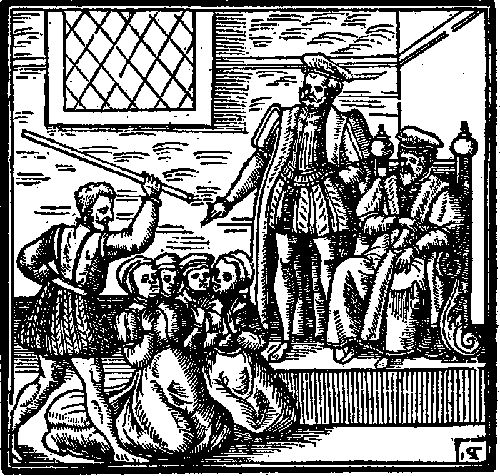
The King as the Judge: Suspected witches with Agnes Sampson kneeling before King James VI from the book Daemonologie (1597). He himself oversaw the trial and ended up sentencing many to be burnt as witches.
The Storm of Contrary Winds
By the autumn of 1590, Scotland was deep into witch hunts, and many of those sent to trial were questioned by the King himself. Today, the city of Edinburgh and the rest of the country is riddled with the memory of those who were burnt at the stake as a witch. King James VI, the son of Mary, Queen of Scots had just returned from Denmark-Norway where he had married Anne of Denmark who was only 14 at their wedding.
Witches, dragons and ghosts, Edinburgh castle are said to have it all. The sound of bagpipe and drummers can be heard without anyone playing, and those accused for witchcraft as well as prisoners of wars are said to haunt the old castle.
The Danish court at this time was extremely wary of all things black magic and witchcraft. The fear of demons and witches had tightened the European continent and it was probably a fear that the Scottish King James adapted and brought back as well after spending time there.
The King of Scotland was impatient awaiting his bride from Denmark to cross the seas after the wedding to stay by his side, but on her voyage to Scotland the fleet experienced heavy storms and ended up starting not only one, but two major witch trials that ended in several executions.
A Series of Unfortunate Events
So how did a simple midwife like Agnes Sampson get accused of something that happened all the way over in Denmark? To this we have to go through the Danish court and the witch trials that happened there before it started in Scotland.
Peder Munk of Estvadgård was a Danish navigator, politician and ambassador and in charge of carrying the fleet of 18 ships with Anne of Denmark to Scotland to bring her to her throne by her King. They set out on their voyage in 1589 from Copenhagen and were riddled with bad fortune, taking years to reach their final destination.
First they had to stop in a port in Norway to repair a leaking ship and had to stay there for a very long time, on their way to a very impatient king. When they reached The River Forth in central Scotland a ferry boat collided with one of the vessels in a storm and all of the passengers drowned. This was all attributed to witchcraft.
Back in Denmark, the navigator Peder Munk blamed it all on witchcraft, especially on a certain woman whom he had insulted and believed to be the main witch behind the storms. This became the beginning of the Copenhagen witch trials, which ended in executing 17 people by burning.
This inspired the King to hold his own trials, and it would be known as the North Berwick Witch Trials, and Agnes SAmpson was one of the main accused.
Accused of Witchcraft
More than a hundred suspects were arrested in North Berwick, several of them confessed during torture and named other people. Agnes Sampson was accused by Gillis Duncan, another one of the accused.
Duncan was really the one that linked the other accused of causing the storms that ended up sinking the Queens ships. She worked as a servant and confessed after torture that she was a witch and there were several more. The reason she was accused herself was that she was far too skilled of a healer in her master David Seton’s mind who also thought that Duncan had been sneaking out at night.
Agnes Sampson ended up being one of the more significant accused persons, as an elderly and respected woman that had healed more than one in the local area. Many attributed their good health to her good work. Now, they all turned on her because of the rumors and her unfortunate circumstances. The fact that she was a widow with children and acted as an independent woman and educated midwife was a part of the indictment against her. She had also been accused of witchcraft and investigated before.
Witches Sabbath: According to the accusers, Agnes Keith and the rest of her witch coven had met up and created a storm to keep a ship from Denmark arriving to Scotland, carrying Anne of Denmark.
The Wise Wife of Keith was imprisoned and put to torture for a long time before saying anything. She started off refusing to confess at first, but after a long time in the dark and in pain, she as the rest of the accused gave up.
In the end she was brought before King James VI himself and a council of nobles at the Palace of Holyroodhouse. Sampson denied all the charges, but they kept torturing her until she said otherwise. Her head and body hair were shaved and she was pinned to the wall of her cell with a witches bridle. This was a torture instrument with four sharp prongs pressed into the mouth, meant to humiliate as well as hurt the ones wearing them.
She was forced to stay awake with no sleep in her cell with a rope around her head, always reminded just how close to death she really was. And in the end, how freeing that prospect must have seen compared to the torture she went through.
Finally, after all that torture, Agnes Sampson confessed to whatever they asked of her in front of her own king who oversaw the trial. In all she confessed to 53 indictments against her, including attending a Sabbat she led and that she was indeed a witch with supernatural power she used to harm others with.
According to her testimony, she ended up saying she made a charm that caused a storm that ended up drowning Jane Kennedy. She sank a dead cat with parts of a dead man into the sea near Leith. The same charm she used to threaten the King and his wife on her voyage.
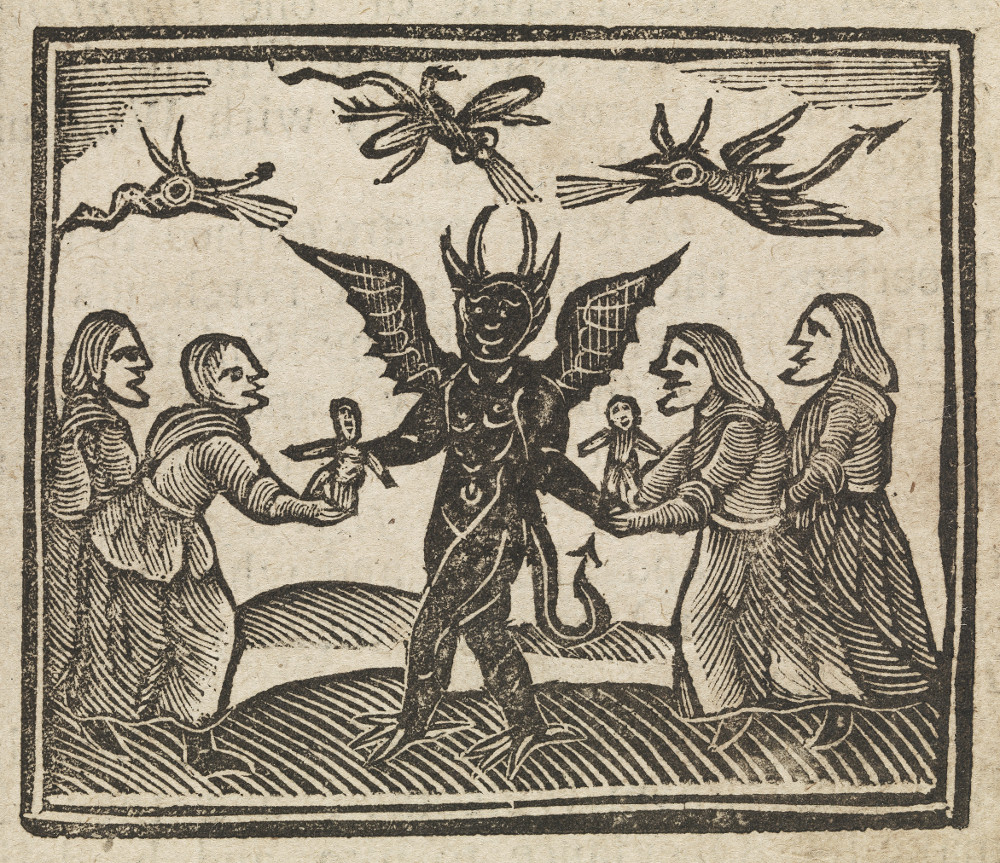
In League with the Devil: Depiction of the Devil giving magic puppets to witches, from Agnes Sampson trial and North Berwick Witch Trials where she and many others ended up being burnt as witches in 1591.
It was her last testimony that was her downfall in the King’s eyes. In it, she disclosed things he and his wife had on their wedding night in Oslo. A conversation she had no way of knowing:
“Item, the said Agnes Sampson confessed before the Kings Majesty sundry things which were so miraculous and strange, as that his Majesty said they were all extreme liars, whereat she answered, she would not wish his Majesty to suppose her words to be false, but rather to believe them, in that she would discover such matter unto him as his majesty should not any way doubt of. And thereupon taking his Majesty a little aside, she declared unto him the very words which passed between the Kings Majesty and his Queen at Oslo in Norway the first night of their marriage, with their answer each to other: whereat the Kings Majesty wondered greatly, and swore by the living God, that he believed that all the Devils in hell could not have discovered the same: acknowledging her words to be most true, and therefore gave the more credit to the rest which is before declared.”
— News from Scotland
Execution and Haunting
King James was allegedly not completely convinced of Agnes Sampson guilt until her last confession. After it however he changed his mind and sent her to be burned. On 28th of January 1591 she was taken to the scaffold on Castlehill where she was garroted before being burnt at the stake.
Although the exact numbers of the executions are hard to be certain of, it is estimated that around 1500 people were killed as witches by the state of Scotland during this time.
Agnes Sampson’s naked ghost is said to roam the castle grounds, bald headed roaming around the Palace of Holyroodhouse.
Step into an ancient castle filled with darkness and stories that will send shivers up your spine of murder and ghosts. Inside the old Château de Châteaubriant there are tales of ghost processions on October 16.
Step into the eerie and mysterious Château de Châteaubriant, a magnificent 15th century castle and one of France’s most haunted sites. Enter its dark and imposing halls originally constructed as a defense against Anjou and the Kingdom of France, laden with dark secrets, to experience an unforgettable journey through time. Learn about its chilling legends, hidden secrets, and unsettling specters that linger in the shadows.
History of the Château de Châteaubriant
The Château de Châteaubriant was first constructed in the 11th century, but was heavily modified during the Renaissance which the architecture bears marks of.
It was taken over by the French during the Mad War after a siege. Over the centuries, it changed hands many times – from its aristocratic owners, to prisoners of war during the revolution, and back again.
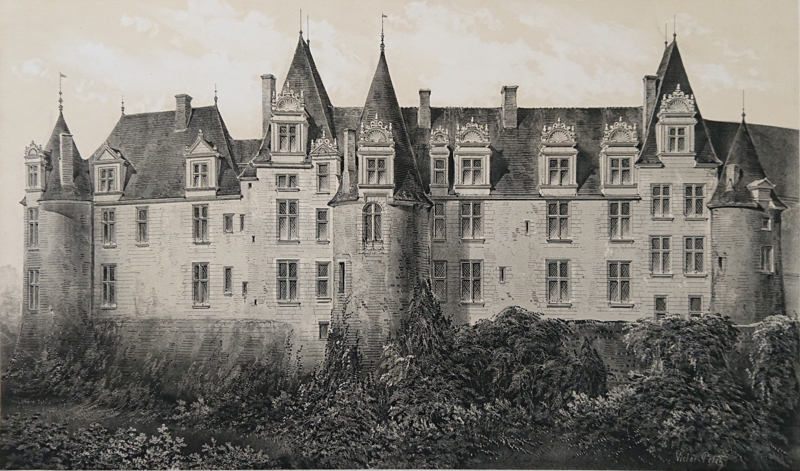
Château de Châteaubriant: drawn by artist Victor Petit in 1871. Already at this point the history of Château de Châteaubriant was old and steeped in legend . It is also said that ghost are walking the halls of the castle every year on October 16th.
Sybille the Shocked Ghost
One of the most famous legends behind the Château de Châteaubriant’s rumored hauntings is that of Sybille, wife of Geoffroy IV.
Geoffroy IV of Châteaubriant went on crusade to the holy land in the 1250s with King Saint Louis where he was jailed in Egypt after the battle of Mansourah and the entire French army was destroyed by the plague. His death was announced to the Châteaubriant and his wife.
Sybille, often named Sibylle de la Guerche de Candé started to mourn the death of her dead husband. He wasn’t dead however, and was released from prison and returned to his home and wife a couple of months later. When Sybille saw him again, she fell into his arms and died of the shock.
She is said to haunt the Château de Châteaubriant at times, but the real haunting is said to be done by the infamous Françoise de Foix, the main mistress of the King of France that did not bear the same loyalty to her husband as Sybille.
The Ghost of Françoise de Foix
In addition to Sybille and other ghosts that are said to haunt Châteaubriant, many also believe in the spirit of Françoise de Foix. She was a tall and dark haired woman that spoke both Latin and Italian as well as writing her own poetry. All of her attributes made her a well sought after woman, and even the King wanted her.
She was engaged to Jean de Laval, count of Châteaubriant in 1505 with support of the king and queen Anne de Bretagne and Louis XII. They formally married in 1509 and lived at Château de Châteaubriant.There was a shift in the royals and the new king, Francis I, summoned Jean de Laval to court for his help in 1516.
Françoise de Foix followed him and became the lady in waiting for Queen Claude de France as well as becoming the chief mistress to King Francis I. At official events she was placed near to the royal princesses, signifying that she was La mye du roi, or the Sweetheart of the King to the rest of the court.
Jean de Laval was sent to fight in the Italian Wars and became Governor of Brittany in 1531. He was aware of the affair but seemed unaffected by it all when his wife remained the King’s mistress for over a decade.
Françoise de Foix was rejected from court in 1525 when the young and blonde Anne de Pisseleu d’Heilly caught the King’s attention and affection. Because of this, she returned to Châteaubriant to live with her husband.
Killed by her husband Jean de Laval
She died on 16th of October in 1537, most likely of sickness are we to believe some. There is however a different theory. It is said that her husband killed her.
Read also: This is not the only story of a ghost haunting a French castle after a woman was killed by her husband: The Prisoner of Château de Puymartin
Jean de Laval, also known as John III of Laval-Châteaubriant was according to legend, an incredibly bloodthirsty baron who killed anyone who opposed him and ruthlessly tortured his enemies.
It is said that he shut his wife in a dark and padded cell and had her killed because of her relationship with the king or something else entirely. Some even think that he locked her up and poisoned her or bled her to death slowly.
The Assassination of Françoise de Foix: The legend of her death are widespread and depicted in art. Here from a book from 1816 by Augustine Gottis.
Ghost Procession at Midnight
Some say they can still hear her weeping within the walls of Châteaubriant and others have even seen her standing near windows or atop towers in traditional 16th-century dress, but perhaps she is best known to appear in the ghost procession on her death anniversary.
Ever since then, there have been a ghost procession in the Château de Châteaubriant in honor of her death on October 16 of monks and knights slowly ascending the main stairs before vanishing. Her ghost is said to come back for this night as the procession begins at the stroke of midnight.
In a cute medieval town in Germany, there is a dark and haunted cemetery. The cemetery in Bernkastel-Kues is said to be haunted by a woman in white. And this particular woman in white is also said to be deadly dangerous.
The city of Bernkastel-Kues is a quaint little town in the Moselle valley known for its sweet Riesling wine, a state recognized health resort and a medieval marketplace. But just outside the city, where the graves and the dead reside, a Woman in White is said to haunt the place.
There are more stories about haunted cemeteries to dive into in the Moonmausoleum. Read them here: Haunted Cemeteries
The Lady In White
At Bernkastel-Kues Cemetery there are several stories floating around. The biggest one is of the White Lady og Bernkastel-Kues, a Lady in White that is often told about in German ghost stories.
The woman in white of this cemetery is said to be wearing a long flowy white dress as she is floating from one grave to another. Many reports tell about her crying.
The Haunted Hunter
One story involving the Lady in White was when a hunter encountered her, possibly at Bernkastel-Kues Cemetery. He was terrified of seeing her and fell ill. The very next day he was taken to Koblenz, which was a military hospital.
When he was put into the hospital he had swollen legs and a high fever, but he didn’t make any sense to the people around him. He kept on rambling about a woman in white that had attacked him. He died after his injuries, and no one ever found out what really happened there.
In the outskirts of the moors in Cornwall with a dark history of smugglers and gothic romances. The Jamaica Inn is a perfect setting for a british ghost story, and according to the legends, it has many.
“Dead men tell no tales, Mary.” ― Daphne duMaurier, Jamaica Inn
Located in the rugged landscape of Cornwall, England, Jamaica Inn is said to be one of the most haunted places in Britain. Its walls are steeped with stories of ghosts, dust and deep secrets of smugglers and stolen goods and murdered guests – it’s a place that has enticed many looking for paranormal activity.
The Jamaica inn is said to be haunted by small children being mischievous, old smugglers lurking in the corners, blacksmiths that burned to death but are still handsy with the female guests and mysterious Victorian women in the dark shadows. So let’s put on our tricorn hat and bring our smuggled rum for a stay at the haunted Jamaica Inn.
History of Jamaica Inn
Jamaica Inn was built in 1750 as a coaching inn and has a long history of being a hideout for smugglers during the 19th century. It was originally known as The Jamaica Arms, but underwent many changes over time, including the addition of drunkards’ dens and clandestine accommodation for smugglers.
Over the years, it has served several purposes, most notably a coaching inn for local travelers. But what really sets it apart is its mysterious stories of hauntings by spirits that lurk in its passageways and hidden doorways.
Jamaica Inn lies upon the ancient Bodmin Moor – a wild and untamed landscape which has held a certain allure for centuries. The moor is full of legends, myths, and stories from both ancient Britain and more recent times. It was once home to people living in remote settlements and Iron Age Hillforts, as well as a hideout for smugglers and pirates.
Jamaica Inn The Novel
Jamaica Inn is perhaps best known for its namesake novel, written by Daphne du Maurier in 1936. She was inspired by the real Inn when she was staying there in 1930. It is also a song by Tori Amos which she wrote when she was driving along the cliffs in Cornwall and was inspired by all the legends she had heard of at the inn.
The book is a classic example of gothic romance, and tells the story of a young woman called Mary Yellen, who moves to the Cornish inn and becomes involved in the murderous activities of its inhabitants.
While some argue that Jamaica Inn is purely a work of fiction, many locals have cited uncanny similarities between their own experiences at the inn, and Daphne’s descriptions of unexplained events and hauntings in her novel.
The Ghosts of Jamaica Inn
Many believe that Jamaica Inn still remains haunted, with multiple unexplained occurrences taking place in the inn over the years. There have been countless investigations, even TV shows about the Inn. Especially an episode of the TV show Most Haunted in 2004 sparked a new interest in the old inn.
Most of the ghosts and paranormal things that have been spotted have been at The Smugglers Bar, The Stable Bar, which now is a museum, in the old bedrooms upstairs as well as in the restaurant and gift shop area.
Some claim to have seen faceless figures wandering through the corridors, while others have heard strange noises coming from empty rooms. Staff and visitors have many times heard conversations in a completely different language than English, some speculating that it could be old Cornish, meaning that these spirits can be really old as the language became extinct for a long time at the end of 18th century.
Ghost Hunting at the Jamaica Inn
Now the Jamaica Inn has opened up for its own weekends and late nights for ghost hunting at the inn. Perhaps you as well can experience seeing the highwayman in the traditional three cornered hat often seen passing through the doors before vanishing into thin air. Or perhaps the young mother in distress with her crying baby that also has been seen.
One thing the ghost hunters got on tape was a strange thing that happened on a Sunday on October 23rd in 2017, when the CCTV camera picked up something strange when the wall phone hanging by the bar looked like it was lifted before dropping to the floor. The staff member April was startled, and had earlier heard the bar door open without anyone entering. Nobody alive at least.
Have a look at the footage and see for yourself. What do you think?
The Mother with her Crying Baby
As mentioned, one of many possible ghosts at the inn is the many reports about people having heard a baby crying at the inn. This has apparently mostly been close to room 3 and 7, and the baby has been heard even if it has been confirmed that no baby has been staying at the inn at the time.
Most often this ghost is linked to the tragic story of Mary Downing. She was young and single, but had an illegitimate son. In 1934 she sued the landlord at the time, Thomas Dunn to make him recognise their son. Thomas Dunn was a married man, but the son ended up being christened Thomas Downing Dunn at Altarnun Church.
Hannah the Child Ghost
The baby crying is not the only child haunting the inn if we are to believe the rumors. There is the ghost of a small girl that has been dubbed Hanna that is said to roam the inn barefoot. One guest that stayed in room 5 once woke up and saw her wet footprints in the carpet that led to the wardrobe where there used to be a bathroom.
People have heard her running around their bedrooms at night and even claim that their feet have been touched in their sleep as they see her transparent figure by the side of their bed. There is a story about a service man that was so frightened that he fled his room and spent the rest of the night in his car.
In the later years there seems to be a bigger interest for the ghost of Hannah and people have started to write her letters and send her toys. And even these toys are said to sometimes move on their own.
The Murdered Stranger
Perhaps the most talked about ghost is the stranger that ended up murdered in the moors by the inn. His apparition around 1911 were especially noticeable as many reported about seeing someone who shouldn’t be there on the walls by the inn.
The inn has become shrouded in myths and legends over the centuries, with tales of apparitions seen near hidden staircases and secret rooms, eerie noises coming from the old stables even though no horses were ever kept there, ghostly figures roaming the grounds at night, and strange sightings in each of its many otherworldly locations.
One of the tales is the ghost of the murdered stranger that passed through the inn. Once a man was in the bar having an ale before someone called him to come outside. The stranger didn’t even finish his drink, but went into the night and was never seen again.
The next morning they found his dead body in the moors, but how he died and murderer was never found.
There have been reports of a stranger by the wall outside the Inn that neither moved or responded when people greeted him. Sometimes when the bar is closed and the inn is empty, there have been footsteps heard towards the bar, but no one reaching it, and some have speculated that it is the man returning to finish his ale.
Lady Janet Douglas is said to haunt the Glamis Castle in Scotland after being burned at the stake after being entangled in court politics and being an enemy of the King.
Glamis Castle is said to have inspired one of Shakespeare’s most famous plays, Macbeth, a play so haunted you are not supposed to say the title out loud inside of a theater. The old castle is located in Angus, Scotland, not far from Edinburgh and is considered one of Scotland’s most haunted castles.
There are many mysteries surrounding this place, from the monster of Glamis, the ghost playing cards for the rest of the eternity and many more apparitions and legends. One of the ghosts residing in Glamis Castle is that of Lady Janet Douglas, also called Lady Glamis.
Lady of the Castle
The story behind Lady Janet Douglas and her death is rooted in the bloody battle for power and revenge in 1500s Scotland. King James V was remembered as the vindictive king and of his paranoid fear of his nobility, leading to the death of many of them, Lady Glamis being one of them.
King James V had Lady Janet Douglas accused of treason against him, although it was clear that the accusations were false. Her only crime was that she was the sister to the King’s stepfather, Archibal Douglas, Earl of Angus, which the king hated after having been imprisoned by him for years before escaping.
Lady Janet Douglas: A portrait of the Lady Glamis as she was seen as a great beauty when she lived.
The Douglas and Stewart families had been battling for power in Scotland for generations. When King James V’s mother, Margaret Tudor became a widow, Archibald Douglas married her and took control over the kingdom as King James was just a child.
Living as Archibald’s prisoner for years and having taken the power away from him, the hatred King James V had for the Douglases grew. His hatred for Angus extended to the whole family and he wanted them gone when he finally escaped.
Charged for Murder and Treason
In 1528, upon the death of Lady Glamis first husband, John Lyon, 6th Lord of Glamis, Lady Janet Douglas was immediately summoned for treason, accused of supporting the civil war against the King and of poisoning Lyon who died on 17th of September 1528.
Her being unwed left her vulnerable and a target for the King’s vengeance against her brother. Lady Glamis brother, the king’s stepfather was already exiled and King James had seized all his land and property he was once a prisoner in. Now he sought revenge on the one he could get his hands in.
Charges were eventually dropped, and Lady Glamis were free to go back to Glamis Castle. She went on to marry Archibald Campbell in 1532, having ceased all communication with her brother and the rest of the Douglas clan to prove her innocence in any plot against the King.
Her Final Arrest
Lady Janet Douglas’ reprieve was short-lived, however, as in 1537, she was once again summoned away from Glamis Castle for treason, and this time the King was going to have her punished. There were several reasons as to why she was picked out, one of the reasons was because of her beauty. She was seen as a unique and one of a kind beauty among the nobles and when her first husband died, she had several suitors.
One of them was William Lyon, a close friend of her first husband. His obsession for her only grew and when she married Campbell, it turned sour. He started whispering in the king’s ear about her plans to poison him, and the king, looking for any excuse to get back at the Douglases, listened intently.
Lady Janet Douglas was imprisoned with her husband and her son John in a dungeon of Edinburgh Castle, a castle riddled with rumored ghosts as well. Her husband managed to escape from prison, but was later killed when he was found.
This time, the charges brought against Lady Glamis included being in secret talks with the Douglas clan, attempting to poison the King. To capture Lady Janet Douglas was easy enough, but to convict her for being a witch was more difficult as Lady Glamis reputation was impeccable and a loved character.
The Lady Burnt at the Stake
To gather enough evidence for a conviction, King James had Lady Janet Douglas family members and servants imprisoned and tortured until they gave answers that he wanted.
In later years she has been remembered as being an accused witch, but nowhere in her files does it say she was ever accused of witchcraft as well. Perhaps it would have been better for her, as those accused of witchcraft were often strangled before being burned. Traitors didn’t have that luxury.
In the end they all talked and Lady Janet Douglas was convicted. When they led her out from the dungeon, she was nearly blind after being kept behind bars in the dark for so long. Lady Glamis was burned at the stake on 17 July 1537 by Edinburgh Castle and It is said King James forced her young son, John from her first marriage to watch her agonizing death before letting him go.
Lady Glamis’ son was also sentenced to death, but because of his young age, he was not to be executed until he reached eighteen. Luckily for John, the king died before then and was pardoned, reclaiming his property of Glamis Castle and becoming the seventh Lord Glamis.
The Haunted Glamis Castle
Not many years after Lady Glamis’ execution, reports about a gray lady started to appear around the Glamis Castle grounds and people kept seeing this ghost, believing it to be her. The castle is not the only place her ghost is said to have been seen though. In Edinburgh Castle, were she was held captive and at last burned alive, there have been reports about a ghost reminding them about the Lady Glamis as well.
The Haunted Castle: There are many mysteries if you delve into the legends surrounding Glamis Castle, from the monster of Glamis, the ghost playing cards for the rest of the eternity and many more apparitions and legends.
Back at Glamis Castle, she has been reported around the Clock Tower as well as in the chapel of the castle. People report an atmosphere of great sadness when they have seen her kneeling at the altar. For a long time one seat in the chapel was reserved for her and no one was allowed to sit in that seat.
Once, The James the old pretender, during the Jacobite Rising in 1716, a direct descendant of her killer saw her sitting there, still haunted by his forefathers actions.
The B215 otherwise known as Bundesstraße 215 is a stretch of roads that are haunted in Germany. It has more deadly accidents than other roads in the country according to the stories, and is also haunted by a Woman in White.
Germany is famous for its comfortable long stretches of highway that cuts through the country in no time. There are some roads though who have a rather dark reputation surrounding the dark concrete.
Read about all the ghost stories about haunted roads in the Moonmausoleum: Here
The B215 is a road in Germany where they say strange things happen. The federal highway runs between Hanover and Hamburg in Lower Saxony. It is an old road and the stretch between Nienurg and Verden was built already in 1849.
Supposedly it has more accidents than any other road in Germany, and in particular close to the city of Verden, they are supposedly more dangerous to drive than other places in the country.
The White Lady Along the Road
There are also stories about a white lady that can be spotted along the Bundesstraße 215. Stories about these White Women are plentiful in Germany and they have long standing in ghost stories. In German legends and folklore the stories of the Weiße Frauen, meaning White Women used to be a name meant to the elven-spirits and the stories of the light elves from pagan times. Today she is known for haunting old castles, families and other places where women died full of regret.
This particular Lady in White is someone you can see out of the corner of your eyes along the haunted Bundesstraße 215 when you are driving down Bundesstraße 215 in the dark. She is said to appear between 2 and 3 am in the night if you are driving too fast. It is unsure if she is a warning to the reckless drivers or if she is the one behind causing the accidents.
An online magazine about the paranormal, haunted and macabre. We collect the ghost stories from all around the world as well as review horror and gothic media.