Every 25th year on the night of Bhoot Chaturdashi, it is said that the ghost haunting the water of Dub Pukur comes back from beyond. You can hear wailing screams from the ghost thought to be a witch over the dark water.
Hidden amidst the modern buildings of Haldia Township lies a seemingly innocuous pond known as Dub Pukur (ডুব পুকুর). Beneath its calm surface lurks a sinister secret—a tale of witchcraft, murder, and restless spirits that continues to instill fear among the local people to this day.
Read more: Check out all of the ghost stories from India
Haldia is today an industrial port city in West Bengal by Haldi River, coming from Ganges. The surrounding area of the Zamindari used to be ruled by the Mahishadal Raj family and it is in connection to these royals, the ghost story comes from.
The Haunted Pond: Nabaratna Gopaljiu temple inside Mahishadal Rajbari complex at Purba Medinipur district in West Bengal. Is this the haunted Dub Pukur? //Photo by: Amitabha Gupta/wikimedia
The Midwife Witch Haunting Dub Pukur
Legend has it that in the early 18th century, during the peak of the reign of the Royals of Mahishadal Rajbari, a midwife accused of witchcraft and child-devouring faced a grim fate at the hands of a vengeful mob.
The details of this story are sparse, and there is not a lot to go on to dig deeper into the legend of when it started to be told. Some of the few sources claim that the midwife was attacked by witches and they were the one that devoured the child when the Queen gave birth.
Daayans, or witches in Indian folklore are often thought to be a sort of succubi with vampiric traits as they often are said to feed on their victims for power. And as in the rest of the world, old or widowed women were often the subjects of witch hunts. As well as women in certain professions like being a midwife that are often accused of being witches.
In any case, the midwife was blamed and a mob formed. Tied and dragged far from Mahishadal into the depths of the forest along the banks of the Haldi River, she met her untimely end in the murky waters of Dub Pukur on a moonless night.
Dayan Hunts in Modern Day India: Although a creature from folklore, witch hunts still have deadly outcomes in India: “According to the National Crime Bureau records, as many as 1,157 women were branded as witch and killed in Jharkhand between 1991 and 2010. Here pictured in the Star Plus show, Nazar played by Monalisa aka Antara Biswas,
The Bhoot Chaturdashi Haunting
Since that fateful night, Dub Pukur has become a place of dread and superstition, shrouded in eerie tales of paranormal activity. Every 25 years, on the night of Bhoot Chaturdashi, the 14th day of Krishna Paksha, locals report hearing a blood-curdling scream emanating from the depths of the pond—a chilling reminder of the midwife’s tragic demise.
In West Bengal It is believed on the eve of this dark night, the souls of the deceased come down to earth to visit their dear ones. On this night they are also performing rituals to chase away the evil spirits.
But the horror does not end there. In the morning light of Diwali, the Festival of Lights, the lifeless body of a missing person is often discovered floating ominously in the murky waters of Dub Pukur—a grim testament to the vengeful spirit that still haunts its depths.
During one of the biggest witch trials in Spain, there was one place that was thought to be more filled with witchcraft than others. In the so-called Witch Caves of Zugarramurdi in the Basque country, it was said that witches gathered for sabbaths and akellares.
The witch hunt hit Europe hard, and Spain was no different. The Inquisition in Spain was brutal and perhaps one of the darkest chapters in the history of the country. The church and its helpers took everyone that the catholic deemed inappropriate, witches, heretics alike.
In Navarre, north in the country close to the French border, the forest of the Pyrenees grew thick and legends, strange rites and rumors of witches were especially strong there.
Read more: Check out all of our ghost stories from Spain
Especially in the deep darkness of the caves of Zugarramurdi the haunted legends from the past echoes throughout the walls of the cave. You can find them just 400 meters from the village through the woods.
The Witch Caves of Zugarramurdi: These caves in Zugarramurdi in northern, Spain were long thought to be a popular place for witches to meet and conduct witchcraft and demonic sabbaths.
Inside of the 120 meters long cave that towers over 10 meters is the stream called Oblabidea that runs through it. The stream was also known as Infernuko Erreka, or the stream of hell and was a perfect place for the witches to hold their sabbats.
The Magical and Mysterious Basque Country
Already in the 1100s, the Basque country was described as barbaric and mysterious from southern Spain’s perspective. The place was also a misty and heavily wooded terrain with few people that spoke a foreign and as they describe it, harsh sounding language.
Belief in witches were actually quite low compared to the rest of Europe at that time, and the educated Spaniards saw witchcraft as a protestant superstition as well as something only the “uneducated” northerners believed in. Still, being accused as a witch was a very deadly thing as the people of Zugarramurdi would soon find out.
The Tribunal of the Spanish Inquisition in Logrono received intel that there were witches and wizards in Zugarramurdi and became involved in one of the most brutal and biggest witch hunts in Spanish history with over 7000 investigated for witchcraft.
In 1610 take came to Zugarramurdi that means the hill of elm trees to investigate the suspicions. The people of Zugarramurdi had long traditions of making creams and herbal medicine that were unknown to the rest of the country. There were also more women as the men were at sea for months on whaling boats, something that the authorities saw as unfortunate and suspicious with villagers filled with women going on about their days with the men away.
There were also the strange things that the number of stillborns were abnormally higher than the rest of Spain. This has turned out to be because the Basques have a very high percentage of Rhesus Negative blood. Although we today have a scientific explanation on it, they used to think they were cursed.
The Witch Trials of Zugarramurdi
It all started when a 20-year old girl came back to the town after living many years in France. For some reason she started to tell everyone that she had been one of those participating in Akelarres, or the witch sabbaths.
Then she started to involve more people and claimed that a woman named Maria de Jureteguis had been involved as well. This is when things escalated and more and more of the locals started to accuse each other for witchcraft.
Over 300 became involved in the investigation, almost the whole village. The witch hunters rounded up over 40 women and men that the neighbors had accused and brought them back to Logorno to await trial.
Many of them repented and were let go in the end, but some of them were tortured for months and five died in prison. There were 7 that were burned at the stake.
When the trial had ended all of them were dragged through the streets with no hair and big wax candles in their hands. A lot of them were wearing a tunic called sanbenitos to show people that they had sinned. Some had a rope around their necks to show they were about to be flogged. The remains of those that died were carried to the pyre and four women and two men were burned as they kept denying they were witches.
Their names were Domingo de Subildegui, María de Echachute, Graciana Xarra, Maria Baztan de Borda, Maria de Arburu and Petri de Joangorena. Not all of them were from Zugarramurdi town, but were all condemned for participating in the witch sabbath there.
It was the notorious Inquisitor Valle-Alvardo who came to town and rounded up everyone they thought looked and seemed out of sorts as a last effort to root out evil from Navarre in what became known as the Basque Witch Trials.
A madness and witch fever because of what happened were getting out of hand and thousands upon thousands were accused of witchcraft all across the country. A man went back to Zugarramurdi and spent 18 months talking with them. It turned out that most of the accusations were false, but alas, for many it was already too late.
Akelarre – the Spanish Witch Sabbath
Akelarre literally means the pasture of the he-goat in Basque, and according to the tribunal it was where the witches met up with Satan. Today the word is synonymous with Witch Sabbath in Spain.
The Akelarre and the witch sabbath lore seems to have been the pagan remains of the rituals from before christianity. This type of female worship in groups has been done since the classical Greece times when worshiping Dionysus, perhaps even before.
Witch Sabbaths: The painting Akelarre from 1798, by Francisco Goya.
People over Europe were accused of these types of gatherings, but if there was actually anyone doing it is highly uncertain, even though pagan remains of the past have lasted for a much longer time in remote places than the church would have liked it to.
Read more: Check out all of our ghost stories about: Witches
Some of the things the accused witches of Zugarramurdi werre thought to do was demonic possession, vampirism, celebrating black masses and causing storms, as well as cursing the fields and animals among other things.
The Witches in the Caves
Why was it that there were so many accused of witchcraft right here in this quaint little village? Some of it had to do with the rumors of the caves nearby where people claimed to have seen big bonfires and pagan festivities by the locals, the witches.
According to legend, the rest of the witches of Zugarramurdi went into hiding in some caves outside of the town after their time on trial. To get away from the town that wanted them dead and gone. Perhaps it was to practice their rites and witchcraft in peace, far from the deadly hands of the inquisition?
The story goes that you can still hear the echoes of their magical chanting and dancing around the fires.
Inside of it they have a throne room, where the devil himself would join the witches during the sabbath.
The Witch Caves of Zugarramurdi Today
Today it is still an important place for the modern-day witches in Spain and they honor the reputation and the magical place of Zugarramurdi and the caves people once thought were a place for devil worship. The town of Zugarramurdi also established the witch museum to remember the town’s dark past and holds yearly fests in the famous cave.
The story of the Drummer of Tedworth has often been called the first poltergeist in England that has been reported on in writing and the mystery surrounding it stands to this day.
In March 1661 a man named John Mompesson sued a drummer called William Drury whom he meant made money under false pretenses. Drury was a traveling showman, drumming, juggling, dancing and other forms of “hocus pocus” up and down the entire country.
Mompesson visited Ludgershall in Wiltshire when he met Drury who banged his drums and begged for money, annoying the people in the town so much that Mompesson took the case into his own hands and turned him in.
He accused Drury for having false documents that allowed him to drum for cash and decided to sue him. Mompesson won the trial and Drury got his drum confiscated, something that Mompesson would regret dearly after.
Drury was believed to be a sketchy type of man according to the finer folks in town. He was thought to be hanging out with a group of gypsies and there were rumors that he was involved in witchcraft. Something he would be forever remembered as, long after the drumming ended.
The Haunted Drumming
Mompesson traveled back home and something strange awaited him there. The drum that were confiscated from Drury, ended up at his doorsteps the following April that year. It was then the strange banging noise started to haunt him. During the night he kept hearing the sound of drums and Mompesson was certain it was witchcraft from Drury.
The drumming came from everywhere, from the walls, the ground, even from the roof. One night, Mompesson drew his pistol, chasing the sound like a madman, sleep deprived and scared of the haunting of his house.
“The noise of thumping and drumming was very frequent, usually five nights together, and then it would intermit three. It was on the outside of the house, which is most of it board. It constantly came as they were going to sleep, whether early or late. After a month’s disturbance without, it came into the room where the drum lay, four or five nights in seven, within half an hour after they were in bed, continuing almost two. The sign of it, just before it came was … an hurling in the air above the house, and at its going off, the beating of a drum like that at the breaking up of a guard….”
A month passed and the sound of drums seemed to move from the room where the drum was placed into the childrens bedroom. The bedframes of the childrens bed were beaten, and they kept hearing a scratching sound from under their beds, leaving them shaken and frightened in their beds.
The Drummer of Tedworth: The devil and the drum, from the frontispiece to the third edition of Saducismus Triumphatus (1700).
The only break the family got from the alleged poltergeist was when Monpessons wife was in labor and the house stopped its drumming beat as she gave birth. But afterwards it came back, even more than before.
It wasn’t just the drumming sound that haunted the house. Lights kept moving around without anybody touching them, staff and family members alike were lifted from their beds, and weird smells of sulfur came from everywhere and nowhere. And it wasn’t even only at nighttime the hauntings occurred either, but even in broad daylight.
One time a servant claimed to have seen a moving board in the room. He asked the spirit to pass it to him, and the spirit listened. Then, they continued to throw it between them, back and forward around 20 times until the servant stopped after his master ordered him to.
This continued for the next two years and the sound of drumming grew louder, not only confined to the house, but nearby villagers were woken from the spectacle from the house as well. And even visits from a priest didn’t help with the hauntings in the long run.
The Drummer William Drury
So what happened to the original drummer, William Drury? He was arrested and sentenced to deportation in 1662. He confessed to the crimes of tormenting Mompesson and his family and being behind the paranormal stuff happening. But before he was deported and could be charged for any more, he escaped deportation and fled.
But in 1604, he was brought back to court, this time because of witchcraft were he would once again be trialed as The Drummer of Tedworth. He was acquitted because of the lack of evidence, but because of a prior pig stealing debacle he was sentenced for theft and sent to the American colonies, never to be heard of again.
The Book of Witchcraft
It was not only Mompesson himself that heard these drumming noises, but also his visitors claimed to have been bothered by the sounds.
Joseph Glanvil published in 1681 a book of witchcraft after his death called Saducismus Triumphatus where the story of the Drummer of Tedworth is detailed. This was a book where he affirmed the existence of witches and dark magic and looked at any skepticism of this like blasphemy. It is also said that this particular book was a big inspiration and influenced the people during the Salem witch trials.
In 1661 he visited Mompesson’s house in Tedworth in Wiltshire, England and heard the sounds himself. He also claimed to have heard additional scratching noises under a bed in the children’s room.
Speculations of Fraud
There have been countless people that have tried to debunk the story of The Drummer of Tedworth since it was first heard of. Charles Mackay wrote about it all being a trick of the mind in Extraordinary Popular Delusions and the Madness of Crowds in 1841. Instead of it being a poltergeist at work it was simply Mompesson who was easily deceived by someone holding a grudge, something Drury himself confessed to.
In 1881 the American skeptic Amos Norton Craft said this about The Drummer of Tedworth:
We are to remember also, that the house of Mr. Mompesson contained several servants who doubtless possessed a good degree of human nature; Mr. Mompesson had caused the arrest and imprisonment of a member of a band of gypsies, who were intensely enraged at him
Even Mompesson’s own children were believed to be behind the drumming noises and the culprit of The Drummer of Tedworth, especially his ten year old daughter as much of the mysterious sound came from her bedroom.
“Mr. Mompesson perceiving that it so much persecuted the little children, he lodged them at a neighbor’s house, taking his eldest daughter, who was about ten years of age, into his own chamber, where it had not been a month before. As soon as she was in bed, the disturbance began there again, continuing three weeks drumming, and making other noises, and it was observed that it would exactly answer in drumming anything that was beaten or called for. After this, the house where the children were lodged out, happening to be full of strangers, they were taken home, and no disturbance having been known in the parlor, they were lodged there, where also their persecutor found them, but then only plucked them by the hair and night clothes without any other disturbance….
The Last Drumming Sound
So how did it all end for the family? Apparently it ended after Drury was sent away to the colonies and the drum burnt to a crisp. And the house, after two years of intense drumming by whoever the The Drummer of Tedworth was, go quiet again.
The story of the ghost of Agnes Sampson, known as The Wise Wife of Keith in Scotland is a story where a simple midwife was accused of witchcraft so powerful she caused a storm trying to kill her own queen.
Agnes Sampson was a Scottish healer and a purported witch. Sampson was born in the village of Kirktoun, East Lothian in Scotland and worked as a midwife. She was believed to have healing powers long before she was accused of being a witch.
She became known as the Wise Wife of Keith and was involved in the North Berwick trials that happened during the 16th century, one of Scotland’s most notorious witchcraft trials. Agnes Sampson is also known for being one of the main accused at this trial.
There were and still are many tales about who Agnes Sampson really was. Some of them are true tales, some tall tales. She is said to have been married three times, once to William Keith with whom she had two children. She is also said to have been married to two other men and had 14 children with each man.
So how did this simple midwife become the center of a conspiracy of witches trying to sink the ships belonging to their new queen and threatening her own King? To find out we have to travel across the pond to the court in Denmark-Norway and their fear of black magic and a series of unfortunate events on the sea.
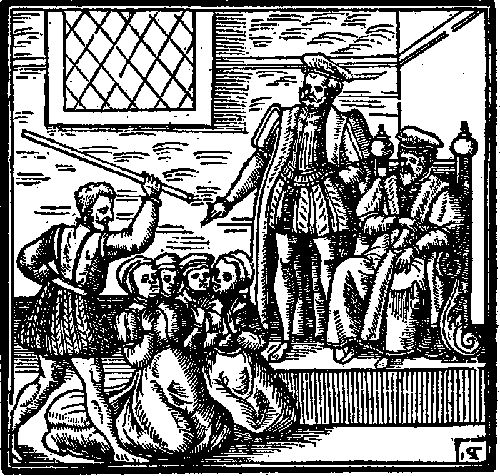
The King as the Judge: Suspected witches with Agnes Sampson kneeling before King James VI from the book Daemonologie (1597). He himself oversaw the trial and ended up sentencing many to be burnt as witches.
The Storm of Contrary Winds
By the autumn of 1590, Scotland was deep into witch hunts, and many of those sent to trial were questioned by the King himself. Today, the city of Edinburgh and the rest of the country is riddled with the memory of those who were burnt at the stake as a witch. King James VI, the son of Mary, Queen of Scots had just returned from Denmark-Norway where he had married Anne of Denmark who was only 14 at their wedding.
Witches, dragons and ghosts, Edinburgh castle are said to have it all. The sound of bagpipe and drummers can be heard without anyone playing, and those accused for witchcraft as well as prisoners of wars are said to haunt the old castle.
The Danish court at this time was extremely wary of all things black magic and witchcraft. The fear of demons and witches had tightened the European continent and it was probably a fear that the Scottish King James adapted and brought back as well after spending time there.
The King of Scotland was impatient awaiting his bride from Denmark to cross the seas after the wedding to stay by his side, but on her voyage to Scotland the fleet experienced heavy storms and ended up starting not only one, but two major witch trials that ended in several executions.
A Series of Unfortunate Events
So how did a simple midwife like Agnes Sampson get accused of something that happened all the way over in Denmark? To this we have to go through the Danish court and the witch trials that happened there before it started in Scotland.
Peder Munk of Estvadgård was a Danish navigator, politician and ambassador and in charge of carrying the fleet of 18 ships with Anne of Denmark to Scotland to bring her to her throne by her King. They set out on their voyage in 1589 from Copenhagen and were riddled with bad fortune, taking years to reach their final destination.
First they had to stop in a port in Norway to repair a leaking ship and had to stay there for a very long time, on their way to a very impatient king. When they reached The River Forth in central Scotland a ferry boat collided with one of the vessels in a storm and all of the passengers drowned. This was all attributed to witchcraft.
Back in Denmark, the navigator Peder Munk blamed it all on witchcraft, especially on a certain woman whom he had insulted and believed to be the main witch behind the storms. This became the beginning of the Copenhagen witch trials, which ended in executing 17 people by burning.
This inspired the King to hold his own trials, and it would be known as the North Berwick Witch Trials, and Agnes SAmpson was one of the main accused.
Accused of Witchcraft
More than a hundred suspects were arrested in North Berwick, several of them confessed during torture and named other people. Agnes Sampson was accused by Gillis Duncan, another one of the accused.
Duncan was really the one that linked the other accused of causing the storms that ended up sinking the Queens ships. She worked as a servant and confessed after torture that she was a witch and there were several more. The reason she was accused herself was that she was far too skilled of a healer in her master David Seton’s mind who also thought that Duncan had been sneaking out at night.
Agnes Sampson ended up being one of the more significant accused persons, as an elderly and respected woman that had healed more than one in the local area. Many attributed their good health to her good work. Now, they all turned on her because of the rumors and her unfortunate circumstances. The fact that she was a widow with children and acted as an independent woman and educated midwife was a part of the indictment against her. She had also been accused of witchcraft and investigated before.
Witches Sabbath: According to the accusers, Agnes Keith and the rest of her witch coven had met up and created a storm to keep a ship from Denmark arriving to Scotland, carrying Anne of Denmark.
The Wise Wife of Keith was imprisoned and put to torture for a long time before saying anything. She started off refusing to confess at first, but after a long time in the dark and in pain, she as the rest of the accused gave up.
In the end she was brought before King James VI himself and a council of nobles at the Palace of Holyroodhouse. Sampson denied all the charges, but they kept torturing her until she said otherwise. Her head and body hair were shaved and she was pinned to the wall of her cell with a witches bridle. This was a torture instrument with four sharp prongs pressed into the mouth, meant to humiliate as well as hurt the ones wearing them.
She was forced to stay awake with no sleep in her cell with a rope around her head, always reminded just how close to death she really was. And in the end, how freeing that prospect must have seen compared to the torture she went through.
Finally, after all that torture, Agnes Sampson confessed to whatever they asked of her in front of her own king who oversaw the trial. In all she confessed to 53 indictments against her, including attending a Sabbat she led and that she was indeed a witch with supernatural power she used to harm others with.
According to her testimony, she ended up saying she made a charm that caused a storm that ended up drowning Jane Kennedy. She sank a dead cat with parts of a dead man into the sea near Leith. The same charm she used to threaten the King and his wife on her voyage.
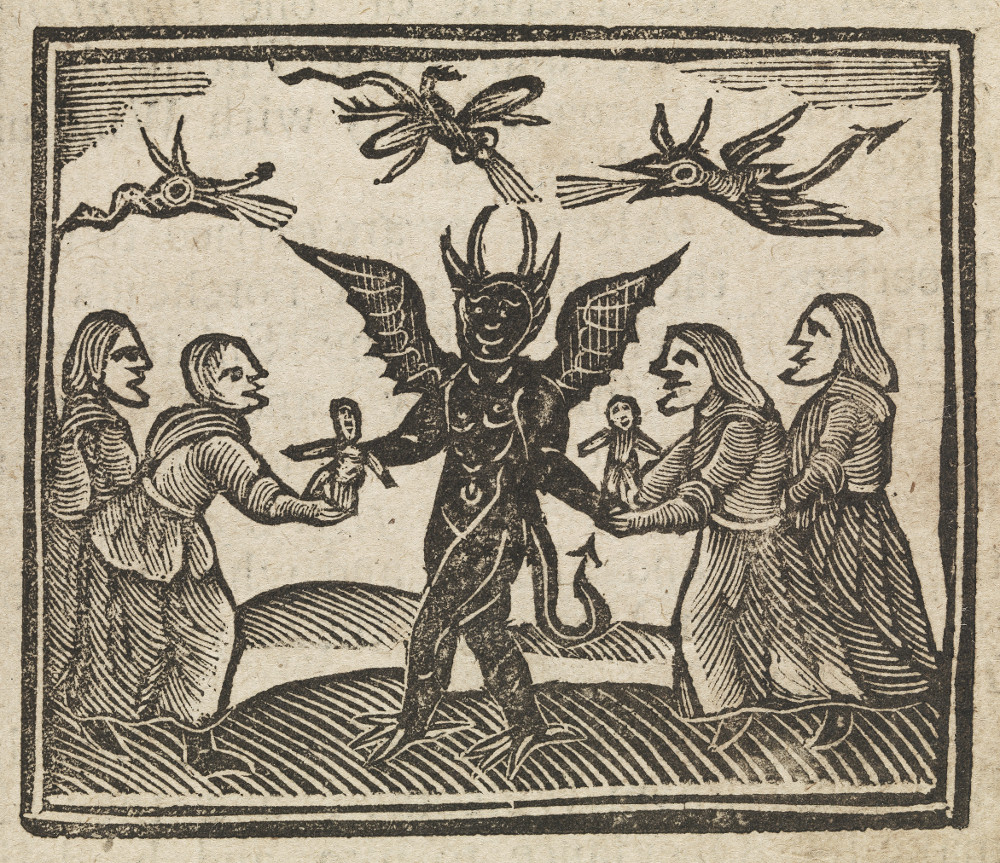
In League with the Devil: Depiction of the Devil giving magic puppets to witches, from Agnes Sampson trial and North Berwick Witch Trials where she and many others ended up being burnt as witches in 1591.
It was her last testimony that was her downfall in the King’s eyes. In it, she disclosed things he and his wife had on their wedding night in Oslo. A conversation she had no way of knowing:
“Item, the said Agnes Sampson confessed before the Kings Majesty sundry things which were so miraculous and strange, as that his Majesty said they were all extreme liars, whereat she answered, she would not wish his Majesty to suppose her words to be false, but rather to believe them, in that she would discover such matter unto him as his majesty should not any way doubt of. And thereupon taking his Majesty a little aside, she declared unto him the very words which passed between the Kings Majesty and his Queen at Oslo in Norway the first night of their marriage, with their answer each to other: whereat the Kings Majesty wondered greatly, and swore by the living God, that he believed that all the Devils in hell could not have discovered the same: acknowledging her words to be most true, and therefore gave the more credit to the rest which is before declared.”
— News from Scotland
Execution and Haunting
King James was allegedly not completely convinced of Agnes Sampson guilt until her last confession. After it however he changed his mind and sent her to be burned. On 28th of January 1591 she was taken to the scaffold on Castlehill where she was garroted before being burnt at the stake.
Although the exact numbers of the executions are hard to be certain of, it is estimated that around 1500 people were killed as witches by the state of Scotland during this time.
Agnes Sampson’s naked ghost is said to roam the castle grounds, bald headed roaming around the Palace of Holyroodhouse.
In the narrow street of Carrer de la Neu de Sant Cugat in Barcelona it is said that there was once a renowned school of witchcraft. Its existence is disputed, but the legends of the strange things that still linger in the street are still talked about today.
Barcelona has long been a city steeped in mysticism and folklore. Throughout its rich history, tales of witches and sorcery have woven their way into the fabric of the city’s narrative. From ancient rituals to clandestine gatherings, the city has served as a hub for those seeking to harness the powers of the supernatural.
Read more: Check out all of our ghost stories from Spain
One of the most infamous periods in Barcelona’s history was the era of the Spanish Inquisition. During this time, the Catholic Church sought to eliminate any perceived threats to its authority, including those accused of practicing witchcraft. The Inquisition was known for its brutal methods of interrogation and punishment, leading to the persecution and execution of countless individuals.
Carrer de la Neu de Sant Cugat in La Ribera
Nestled in the heart of the vibrant La Ribera neighborhood, Carrer de la Neu de Sant Cugat is a seemingly unassuming street that holds a dark secret. According to local legends, this narrow cobblestone pathway was once home to the most renowned school of witchcraft in Barcelona.
Read more: Check out all of our ghost stories about: Witches
Carrer de la Neu de Sant Cugat: In a street in Barcelona, it is believed that a school of witchcraft was for years for powerful witches.
It is said that aspiring witches from all corners of the city flocked to this clandestine institution to learn the ancient arts of spellcasting and divination.
The School Supposedly Run by a Famous Disciple Named Seca
Central to the legends surrounding the school is the figure of Seca, a notorious disciple of the Devil himself. According to popular belief, Seca was not only a master of the dark arts but also a charismatic leader who attracted a devoted following. It is said that he possessed an uncanny ability to manipulate the forces of nature and harness their powers for his own nefarious purposes.
One particularly chilling rumor that surrounded the School of Witchcraft was its alleged practice of obtaining bones from individuals condemned to the gallows. It was believed that these macabre relics were used in the school’s rituals and spells, imbuing them with a sinister potency.
Whether this was simply a tale born out of fear and speculation or if there was indeed a grain of truth to it remains a subject of debate among historians and occult enthusiasts.
The Tragic End of the School’s Students
Unfortunately, the tale of the school of witchcraft in Barcelona does not have a happy ending. As the Inquisition tightened its grip on the city, suspicion and paranoia ran rampant. The authorities became increasingly vigilant in their hunt for suspected witches, and it wasn’t long before they set their sights on the students of the infamous school. Many were captured, subjected to brutal interrogations, and ultimately sentenced to death by burning at the stake as many of those condemned for witchcraft were on the continent at this time.
The Spanish Inquisition: It was a judicial institution that lasted between 1478 and 1834. Its ostensible purpose was to combat heresy in Spain, but, in practice, it resulted in consolidating power in the monarchy of the newly unified Spanish kingdom. Its brutal methods led to widespread death and suffering. It was a dominant force for more than 200 years, resulting in some 32,000 executions
Was There Really a School of Witchcraft in Barcelona?
The legends and stories surrounding the school of witchcraft in Barcelona continue to fascinate and intrigue to this day. While it is difficult to separate fact from fiction, there is no denying the impact that these tales have had on the city’s cultural identity. Whether the school truly existed or not, its legacy lives on in the hearts and minds of those who are drawn to the mystical allure of Barcelona.
In conclusion, the school of witchcraft in Barcelona remains an enigma, shrouded in legends and rumors. Its existence may forever be a subject of speculation, but its impact on the city’s history and folklore is undeniable. Whether you believe in magic or not, there is no denying the allure and enchantment that continues to surround this captivating tale from Barcelona’s past.
On the beautiful island known as Pfaueninsel in Berlin, there are rumours about the soul of an alchemist doing black magic still remains.
The Pfaueninsel or Peacock Island is a little island in the River Havel In Berlin. The island is a part of the UNESCO World Heritage Site because of the impressive Prussian architecture. The Pfaueninsel castle looks like something out of a fairy tale, and the island is a heaven for nature and animal lovers.
In the late 1600s the island was called Kaninchenwerder, or rabbit island after they set up a rabbit breeding station by Elector Frederick William I of Brandenburg of the Hohenzollern dynasty.
Did you know: The Hohenzollern family has a long history of being a cursed family, and many have claimed to have been haunted by the Lady in White. Read more
The Alchemist on the Island
Peacock Island: The whole island is adorned with prussian architecture//Source: Sebastian Rittau/wikimedia
The island was also a place where alchemist Johann Kunckel built a glass foundry where he produced artificial rubies known as gold ruby glass. The elector who he produced the red colored glass was so pleased with him that he gifted him the island.
Entering and leaving the island was made a punishale offens except for Kunckel himself, and the whole place became shrouded in secrecy. The black smoke and smell of chemicals from the islands made the farmers around the island suspicious and they started to believe it was witchcraft going on out there.
After he lost financial support after his patron, the Great Elector died, the foundry went up in flames and he took off to work for the Swedish king. It was very possible that the fire was arson.
It is here the dark rumors of the island starts as it is said that Johann Kunckel played with black magic as well as chemistry in his laboratory before he set it aflame, making the island an inhospitable place to be after dark.
It is said that the spirit of him is still wandering restless around as a black ghost with red glowing eyes.
The Exotic Animals
After this the island was abandoned until the Prussian king Fredrick William II got the island and built the Pfaueninsel castle for his mistress.
From then on they started putting excotic animals like alligators, buffalos, kangaroos, monkeys, lions and peacocks on the island. At its peak there were over 900 animals there of over 100 species. They stayed on the island until 1842 when they were transferred to the Berlin Zoo.
Today the remains are a mixture of exotic birds, great architecture and legends about the black soul of a sorcery after witchcraft tainted the very earth.
The Ghost of Nan Tuck is the haunted legend about an accused witch from England still haunting the woods; she, according to legend, was killed by the villagers chasing her down.Now she is haunting the place she was killed on.
The parish of Buxted in southeast England looks quaint and peaceful enough today if you don’t know its bloody history. The rural parish is green with farmland and woodlands stretching out to the coast. But between the green trees, there is a haunted legend from darker times still haunting the woods.
Nan Tuck is a ghost that is said to haunt the village of Rotherfield in Buxted, England. The story goes that she was a woman who lived in the 17th or possibly 18th century and was accused of poisoning her husband.
The Witch Hunting in England
Nan Tuck was sentenced to death by hanging as the punishment for murder as well as witchcraft was in England. But before she could be executed, she escaped and fled into the woods to escape punishment. Whether she actually did murdered her husband or not is never really discussed or how the trial was. In any case, she was guilty in the public eye and fair game to all.
The public not only believed she was a murderer, but a witch on top of it. This was a time were the fear of witches was at an all time high in Europe and it is estimated that as many as 30 000 – 60 000 people were executed between the 13th to 18th century. In England there is estimated that around 500 were convicted as witches, 90 percent of them women. In England they didn’t burn the witches, but they hanged them.
Many of these deaths had no records of them, and we can see this with this story, that has no written records of it whatsoever, and solely relays on oral tales throughout times. This is what the legend of the Ghost of Nan Tuck tells us.
Nan Tuck’s Escape Into the Woods
Nan Tucks Lane: Heading through Solomon’s Wood. Named after the Ghost of Nan Tuck who was chased down this lane by the irate villagers of Buxted who believed she was a witch. // source
The whole village rallied and started to chase the wicked witch and murderer down in the woods. For days Nan Tuck evaded them by hiding in haystacks, climbing hedges and sneaking around in the woods to escape certain death.
It is said that she was attempting to take sanctuary in Buxted Parish Church known as St Margaret’s Church– according to the right of asylum, fugitives were allowed to escape punishment by touching the altar of a church if they were able to reach it – when local officials who were in pursuit forced her into the woods, and she never reached sanctuary.
Nan Tuck disappeared that night and was never seen again – alive. According to some versions of the tale she was caught up by the angry villagers and it was them who murdered her. In some versions she was killed in the woods, in others, she was taken back and they held a trial by water.
The trial by water was a highly deadly method of finding out whether or not someone was a witch by dunking them in water to see if they floated or sank. And with so many other women accused of witchcraft, she drowned during the trial, which ironically meant she was not a witch as the holy water didn’t repel her, causing her to float like a witch.
The Ghost of Nan Tucks Lane
The legend of Nan Tuck is one that has been told ever since. Sometimes the Ghost of Nan Tuck is depicted as a young woman, sometimes as an old one. It is said that her ghost can be seen wandering the woods near Rotherfield at night.
Legend holds that a circular patch of land in the woods near Nan Tucks Lane, were she supposedly tried to escape through, stays infertile and no vegetation will grow there. And the question if the Ghost of Nan Tuck really was a witch, still remains to this day.
So if you are walking down Nan Tucks Lane late at night and meet someone, perhaps hide and duck as it might very well be the Ghost of Nan Tuck coming for you.
The Nan Tucks Lane poem by Roy Carnon
Whether there really was a woman behind the legend is also a bit uncertain. But the legend of the Ghost of Nan Tuck haunting the woods has made into songs and poems, like this by Roy Carnon:
The new moon older by a memory threw this sinuous line down and round Poundsley way. Following feet that trod the centuries across the weald – deepening contoured tracks unknowing. The way imprinted to Hadlow, Framfield, Buxted, – on to Blackboys, cruciform neeting, pointing the fingerpost of death. Following feet – feet following years crushed harsh in grass; tearing the flowers wond – gaping raped petals laid cold on the lane. Congealing tar concealing blood, the shape of your agony lays still on bruised grass still on earth maimed by you fall. Tear-blurred, memory retreats beneath track-patterned clay but a Sussex lane remembers.
In the eerie mansion in Salem of The Haunted House of the Seven Gables, also known as the Turner-Ingersoll Mansion, discover what lurks in darkness and uncover secrets behind its perpetual terror.
Step inside The Haunted House of the Seven Gables and explore its halls of perpetual terror and darkness. The house is a 1668 colonial mansion in Salem Massachusetts, a place known for being a place of mystery and witchcraft.
From ghostly figures roaming the corridors to mysterious tales of hauntings, prepare to discover what lurks in this fascinating haunted house.
“But as for the old structure of our story, its white-oak frame, and its boards, shingles, and crumbling plaster, and even the huge, clustered chimney in the midst, seemed to constitute only the least and meanest part of its reality. So much of mankind’s varied experience had passed there,—so much had been suffered, and something, too, enjoyed,—that the very timbers were oozy, as with the moisture of a heart. It was itself like a great human heart, with a life of its own, and full of rich and sombre reminiscences.” ― Nathaniel Hawthorne, The House of the Seven Gables
Nathaniel Hawthorne’s Novel
The House of the Seven Gables is a real house that was known as The Turner House or the Turner-Ingersoll Mansion before the novel inspired by it came out. The thing that made it famous was the American author Nathaniel Hawthorne when he wrote a gothic novel inspired by the house in the 1850s.
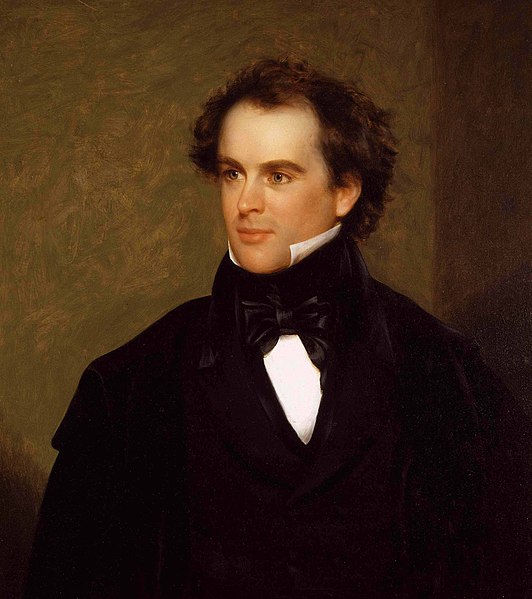
Nathaniel Hawthorne: (July 4, 1804 – May 19, 1864) was an American novelist and short story writer. His works often focus on history, morality, and religion. He wrote the novel The House of the Seven Gables inspired by the house in Salem Massachusetts he used to visit.
The novel follows a New England family and their home where he explores guilt, retribution and atonement. The story is filled with hints at the supernatural and witchcraft and influenced horror writers like H.P Lovecraft.
Read Also: Find some novels about witchcraft like The House of the Seven Gables: Here
Hawthorne, most known for the novel The Scarlet Letter, was himself born in Salem and grew up hearing stories about the house. His great-great-great grandfather was one of the judges in the Salem Witch Trials which the house also had a connection to.
Explore the Legends of The Haunted House
From legendary tales of cursed spirits trapping guests to mysterious hauntings that have been reported through the ages, explore the legends that make The Haunted House of the Seven Gables one of the most haunted locations in the world. Learn about the curses that lurk in its dark corners, and find out about the secrets this house has been concealing for centuries.
The house was built as a place for peace and quiet, but ended up being in the center of one of the most notorious witchcraft trials in 1692 to 1693 were over 200 people in the puritan New England town were accused of witchcraft.
John Turner Jr. lived in the house at the time with his sisters and wanted to protect them from the hysteria of the locals that accused their neighbors, their friends and family for being witches and in league with the devil. A part of the protection was to build a hidden staircase with the fireplace.
In later years there were also uncovered a hidden dining room and accounting room to hide if any in the family were ever accused of witchcraft.
The Salem Witch Trials
The Salem Witch Trials was a product of mass hysteria that happened in the British Colonies as well as in Europe at the time. It all started when two small girls started having these fits of contorting bodies, making strange noises and speaking gibberish.
TheSalem Witch Trials: A series of hearings and prosecutions of people accused of witchcraft in 1692 and 1693. More than 200 people were accused. Thirty people were found guilty, 19 of whom were executed by hanging (14 women and five men). One other man, Giles Corey, was pressed to death after refusing to enter a plea, and at least five people died in jail.
This type of affliction seemed to spread to other girls and they were all diagnosed with witchcraft. And when the girls were interrogated, they started naming names about who cursed them, and a witch hunt began.
A total of 14 women and 6 men were executed in the witch trials by hanging, one by being pressed to death. Another 5 died while in prison.
Although the Turner family remained safe during those trials, the imprint and trauma of the witch hunt remained in all of Salem and ringed back for generations, something Hawthorne also discusses in his book.
The Ingersoll’s and Hawthorns Ancestral Sins
After being in the Turner family for 3 generations it was sold to Captain Samuel Ingersoll as there were no remaining heirs. He had a daughter named Susannah, a cousin of Nathaniel Hawthorne who knew well and would come to hang out with.
When inside the house, Hawthorne was inspired by the house and its quirky features and old history. There they also talked about their families involvement in a dark past. Hawthornes involvement in the Salem Witch Trials and Ingersoll’s involvement in slavery as an example.
Susannah even advised him to put a W in his last name, which originally was Hathorne, to remove himself from his ancestral sin. Hawthorne often wrote about his guilt for his family’s involvement and in his most famed work, The Scarlet Letter, he even opens up with an analogy for it all.
Is the House of The Seven Gables Haunted?
Mystery and terror await you as you attempt to uncover the secrets of The Haunted House of the Seven Gables. If you ask many of the tour guides, they will be quick to reply with a no. However, there are many who tell about another side of the story.
One of the ghostly silhouettes that are reported to be seen is that of Susannah Ingersoll. There are not only one, but many paranormal activities that are said to take place within the old house.
Today the dark wooden house is made into a museum and gets plenty of visitors that are looking for something paranormal, and many claim to have found it. A psychic visiting the house claimed to see a young boy play near the gables as well. Little footsteps can be heard from the attic followed by giggles and laughs.
A man can be seen climbing up and down the infamous staircase and lights are turning on and off and even the water faucets have a habit of turning on and on on their own.
so, would you like to visit and see for yourself whether or not the house is haunted?
Ghosts of nazi soldiers and witches haunt this old barracks in Hesse Germany. In the Babenhausen Kaserne there are stories about everything from soldier clad uniforms floating around as well as phone calls from a woman talking backwards.
In Hesse Germany there is a medieval town called Babenhausen at the mountain range of the Odenwald where a lot of the old buildings and parts of the old city wall still remain. The old city has seen most of human tragedies, everything from world wars and tragedies like the witch hunts.
Today Babenhausen Kaserne serves as a museum, but earlier, the Babenhausen Kaserne otherwise called DP-Lager Babenhausen was home to both German and American soldiers over the years. It was first used to house soldiers all the way back in the early 1900s throughout the both world wars. After the Americans took over as they did with many of the former German military bases after World War 2, it was the American soldiers that got to experience the hauntings said to happen at Babenhausen Kaserne.
The Ghost Phone: According to the legends, there is a phone that keeps ringing in the dead of night. It is a woman that sounds like she is talking backwards.
Read more: Check out all of the ghost stories from Germany
It is said that ghosts from the second world war are still haunting the barracks of Babenhausen Kaserne and according to reports they have been seen still wearing their uniforms. Wars were raging across Europe at the time, and soldiers from both World War 1 and World War 2 were stationed at these barracks.
There are many things that happens after dark at the barracks that makes ghost stories circulate about it. Lights at the old barracks turn on and off when no one is suppose to be inside of it, and if you listen, you can hear the sound of footsteps and voices shouting commands in the middle of the night coming from the basement.
There is also a strange rumor about strange phone calls the soldiers got during their stay from the time of landlines. What is extra strange is that the voice on the other side of the line is not the ghosts of male soldiers of the past. According to them, they only heard the voice of a woman, sounding as if she was talking backwards.
Who is this female voice in a place mainly haunted by men? What could she possible be saying? It turns out that the grounds the barracks is built upon has a much older history, and goes back all the way to the witch hunts in Germany many centuries ago.
The Witch Tower by the Barracks
In the old town of Babenhausen, there is a Witch Tower which is the landmark of the town. A witch tower, or Hexenturrn as it is in German, is a term used for a tower that was part of a town fort or castle that served as a prison in the past. The name was given from the time of the witch hunts, were they put up the suspected witches and kept them prisoners as they went through torture before being burned at the stake.
The Witch Tower: In the town by the barracks there is an old witch tower they used a prison back in the day. It is here they supposedly imprisoned over 50 women before burning them at the stake. Who knows, maybe it was more?//Source: wikimedia/Lumpeseggl
This witch tower in Babenhausen can have a connection to the other strange paranormal rumor that goes around in the old barracks. According to legend, there was in the 17th century over 50 women imprisoned in this witch tower suspected of being witches, all being burned alive on the marketplace in the city.
One of these witches burned at the stake were according to the stories, a certain Mrs. Mueller who was thought to be behind the death of 3 men that she supposedly killed with sorcery.
Fast forward to 1843, there was another woman related to Mrs. Mueller who were stoned to death on the account of them believing she was a witch.
This particular Mrs. Mueller allegedly seduced and killed at least 5 German soldiers when the barracks first were built. According to this legend their bodies were found in the Babenhausen Kaserne attic and their death remained a mystery.
The Ghost of Mrs. Mueller in Babenhausen Kaserne
Or could it be the other version of the legend, where there is also a Mrs. Mueller, who is said to be haunting the HQ building in Babenhausen Kaserne? She was a young woman engaged to one of the soldiers at Babenhausen Kaserne. This was in the early days of world war 1 when people thought it would be over in a matter of months.
Mrs. Mueller’s fiance and 3 of his friends didn’t want to be sent to war in France and hid in the attic with her help. They stayed there for a couple of days, but were found when Mrs. Mueller tried to sneak some food and drink up to them. They were arrested and shot by a firing squad all 4 deserters and it was too much for Mrs. Mueller.
The very same day they were shot, Mrs Mueller jumped from the HQ building and the fall killed her instantly. And according to the legend, just at that moment, the clocks to the officers clock tower stopped the very moment she died. It is said that she is one of those that is haunting the barracks.
The Haunted Barracks of Babenhausen Kaserne
In conclusion, the Babenhausen Kaserne in Hesse, Germany holds a fascinating mix of history and paranormal legends. From the ghosts of Nazi soldiers to the haunting calls of a woman speaking backwards, this old barracks is steeped in eerie tales.
Whether it’s the sightings of soldiers adorned in their uniform, lights flickering on and off, or the echoes of distant footsteps and commanding voices, the presence of the past lingers within the walls of Babenhausen Kaserne. These ghostly apparitions serve as a reminder of the turbulent times and the sacrifices made during World War II.
The Ghosts of War: Some of the hauntings going on in the Barracks of Babenhausen Kaserne is thought to be the ghosts of the soldiers that were stationed there during the wars.
Additionally, the connection between the Witch Tower in the town and the strange phenomena reported in the barracks adds another layer of intrigue. The imprisonment and tragic fate of over 50 women accused of witchcraft in the Witch Tower fuels speculation about their involvement in the paranormal occurrences. Could their restless spirits be seeking justice or revenge?
As the years pass, these ghostly tales continue to captivate the imaginations of visitors and locals alike, ensuring that the legacy of the barracks and the spirits that call it home will be remembered for generations. Whether one believes in the supernatural or not, the stories of the Babenhausen Kaserne serve as a chilling reminder of the tumultuous history that unfolded within its walls.
In what is now a place of religious worship there once stood a house plagued by demonic and haunted activity. And the legend from The Wizard of West Bow and his horror house in Edinburgh.
‘It is certain that no story of witchcraft or necromancy, so many of which occurred near and in Edinburgh, made such a lasting impression on the public as that of Major Weir. – Sir Walter Scott ‘Letters on Demonology and Witchcraft’, 1830
The West Bow House of horror is one of the houses that was known as one of Edinburgh’s most haunted. For a long time everyone thought the house was demolished, but traces of it can still be found on the jolly streets in Edinburgh’s Victoria Terrace.
Advertisements
It used to be the home of Major Thomas Weir, also known as the Wizard of West Bow after his death. He lived with his unmarried sister, Jean, mostly known by Grizel, in their house in Old Town. Originally from Lanarkshire, their mother had a reputation for having The Second Sight, but they were mostly known as devoted Christians.
He used to be seen as an upstanding citizen as a Covenanter soldier with a good career in the army behind him. He was also a very strict presbyterian who would lead big groups of christians in prayer. In 1650 he was even appointed commander of the Edinburgh Town Guard. To everyone else, he was nicknamed as one of the Bowhead Saints. But look can be deceiving, and he hid some dark secret underneath the polished exterior. He has even been seen as someone that could have inspired the character of Dr. Jekyll and Mr. Hyde.
Demonic Confessions
Around 1670 people started to notice a shift in Weir’s behavior. At one of their prayer meetings, he stood up and started to speak. He was then around 70 and people noticed that he seemed ill. He didn’t pray that day though, but started confessing to heinous acts instead. This included everything from bestiality, incest, witchcraft and communicating with the dead.
House of Horror: The house of the Weir siblings at number 10 at West Bow.
In some versions however it was after Weir’s retirement after he fell sick these confessions started. And according to this version it was from the sickbed, not during a prayer meeting he confessed to his crimes.
They called a doctor, but his confessions kept coming, insisting that it was all true. Even the Lord Provost would not believe in the confessions at first as they all came as a big surprise. They wanted to dismiss it all as him being mentally disturbed instead, but he kept repeating his sins, refusing to back down.
Even his sister, Grizel, known as a quiet spinster, confirmed it all when they went to question her. Not even did she confirm what he had already said, but continued to confess more demonic activities giving testimonies of even more vile and exaggerating things.
According to her he had once been taken away by a demonic stranger in a coach on fire and taken to Dalkeith, a town bordering Edinburgh. Exactly why Dalkeith would be a place a satanic coach would drive were never really explained. She even showed a mark on her forehead that looked like the shape of a horseshoe. She apparently proudly said it was a gift from the Devil himself.
There he supposedly was given supernatural intelligence in the form of a walking stick by a servant of Satan. This walking stick had a carved human head on the top and was supposedly a gift from Satan himself and was the one he usually used when leading their prayers.
Advertisements
Most cases of witches and wizards happened after someone else accused someone of sorcery. This case is a very different matter as they accused themselves. Why on earth would they further worsen the case for them, even Jean to the point of implicating herself in that manner?
They were then taken away to the Edinburgh Tolbooth by the baileys where they were interrogated and found guilty. They both received death sentences.
Executed for their crimes
Scotland was not a good place to be if you were condemned for witchcraft. Only Germany had more witch trials in Scotland during this time. Estimates reckon around 4400 witches were executed. And unlike England who hanged the witches, Scotland followed a more barbaric and continental law of burning them all.
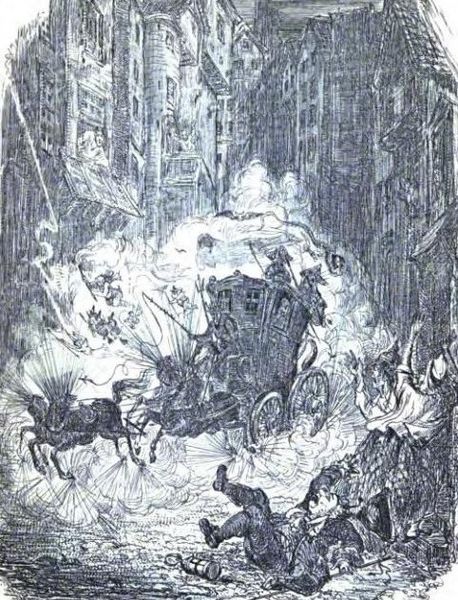
Taken by Satan: Depiction of Thomas Weir in his fiery coach.
While they both were waiting for their execution they were held in a former leper colony below Calton Hill. Major Thomas Weir was executed in 1670 at the Gallowlee that literally means gallows field. He was garrotted and burned together with his demonic walking stick. It was said that both took an exceptionally long time to burn. He was asked for his last words, but chose to not beg for forgiveness. He reportedly said:
“Let me alone—I will not—I have lived as a beast, and I must die as a beast”
Grizel also died, but was hanged in the Grassmarket. According to reports her hanging was also dramatic and unrepentant. She supposedly tried to take off all her clothes in front of the crowd and refused to beg for mercy for her crimes.
Their bodies were buried at the base of the gallows at Shrubhill according to custom of that time. But their death apparently wasn’t enough to cleanse their house for paranormal activity.
Today we can only speculate about why he made those confessions. And even if some of them were actually true, why would he speak them out loud, and why would his sister also get implicated in it?
Was it to clear their conscience? Or perhaps a fit of madness or some sort of illness? Did it have anything to do with their mother, Lady Jean Somerville, who was a reputed clairvoyant? Or did the two actually dabble in the occult?
The Haunted House at West Bow
After their execution the house became abandoned and known as a haunted place where the locals reported seeing light in the windows although no one lived there as well as shadows moving around. There are also tales about music coming from the abandoned house. It stayed like that for over a century and legends surrounding the house continued to grow.
For example they told a story about a ghostly coach that was pulled by 6 horses spotted outside the abandoned building.
Advertisements
A couple bought and tried to move into the house in 1780 by an ex-soldier named William Patullo and his wife, but according to stories, they never stayed there for more than one night. They claimed to have seen ghostly apparition of demonic entities in the appearance of a calf staring at them in their bed.
The house as it was was demolished in 1878 and the locals thought for a long time that they were done with the hauntings from the cursed Major.
The Rediscovering of the Haunted House
However, it was discovered that a new house was built on top of it, today used as the Quaker Meeting House on Victoria Terrace. This wasn’t known before 2014. Apparently, the part of the house that still remains is now the toilet area of the Quaker Meeting House area.
Today it is one of the more colorful streets of Edinburgh, with picturesque boutiques and cafes along the cobbled street. But the haunted rumors have still not died down. One of the staff working there claims to have seen the Major walking right through the walls.
An online magazine about the paranormal, haunted and macabre. We collect the ghost stories from all around the world as well as review horror and gothic media.