Dressed impeccably in a fancy dress and high heels, this vengeful spirit known as La Taconuda haunts the roads and old haciendas of Nicaragua to get revenge on those who took her beauty.
This Nicaraguan legend tells the story of a young woman that was very beautiful, tall with thin and long hair. It is told that she was dressed fabulous in a nice dress with high heels. According to some sources, her name was Ana, but she is today remembered as La Taconuda.
She was the daughter of a Creole Spaniard named Sanches owning all the haciendas to Masaya. After her father died, she inherited everything as she was his only daughter. After this she lived alone except for her male suitors that visited and gifted her beautiful things.
One day, two men that had grown tired of her indifference to them barged into her home and smashed her mauled her face with broken glass bottles.
Ana survived the attack, continued to dress well, but cried every time she looked at herself in the mirror, feeling ugly and defeated, wishing she could get her revenge.
It is many variations as to how she became a vengeful spirit of La Taconuda after she died. Perhaps she finally felt powerful to take revenge of those who attacked her? I some variations she made a pact with the devil to restore her beauty in exchange of giving him a new soul of a man every weekend.
Today you can still spot La Taconuda, often along the road, or out in the coffee plantations, often you can hear it by the clicking of her heels. She looks fine from a distance, but if you come close enough, you will see that she is nothing but a skeleton with the means to kill you.
The tale of the two sisters, Janghwa and Hongryeon that turned into virgin ghosts, is a classic Korean ghost story that continues to inspire and scare those who hear it and are trying to look down upon the seemingly innocent and helpless.
The Korean Folktale and ghost legend of Janghwa Hongryeon jeon is one of Korea’s most well known ghost stories. The story means The Story of Janghwa and Hongryeon (장화홍련전) and originate in the Joseon-era, a five century lasting kingdom from the 1300s all the way to 1897 in Korea. When and who wrote the tale is unknown.
Read Also: Check out all of our ghost stories from Korea
The tale of Janghwa and Hongryeon is a classic tale of an evil stepmother like in fairy tales like Cinderella, Snow White etc. But this Korean ghost story does not ending in the two sisters becoming princesses in any way, but how they died and became ghosts. The story is also a story about wrongly accused looking to set things straight, and that karma always will get you in the end.
A Tale of Two Sisters Movie Adaptation
A lot of the reason why the ghost story is well known today, at least on a global scale is the critically acclaimed movie A Tale of Two Sisters.
Famous Story Turned Critically Acclaimed Movie: Many adaptation of the Korean ghost storyabout Janghwa and Hongryeon has been made over the years, showing that the story is an enduring and timeless one. // Screenshot from the movie, ‘A Tale of Two Sisters’.
The legend of Janghwa and Hongryeon has been remade to both k-dramas and movies many times with a new movie adaptation of the legend coming out almost once a decade. The most famous adaptation of this Korean ghost story is perhaps ‘A Tale of Two Sisters’ from 2003 by Kim Jee-Woon.
Although it is based on the legend of Janghwa Hongryeon jeon, it is a very different story and situation with a more psychological emphasis on the story than the haunting elements. This also got an American remake in 2009 by The Guard Brothers called ‘The Uninvited’.
But let us now have a look at the origin story about the two sisters from the classical folktale dating back to the Joseon area.
The Legend of Janghwa Hongryeon jeon
The Story of Janghwa and Hongryeon starts with a classical once upon a time. There once was a man named Bae Mu Ryong that lived in Chul-San-Gun in the Pyong-An province. This province is found in today’s North Korea. Bae Mu Ryong was a man of means and his business was going well. The only thorn in his side was that there were no children to pass his name onto.
Bae Mu Ryong wife, Jang, once had a dream where she was given a beautiful flower by some form of celestial being. The wind blew and the flower turned into a beautiful girl. That is why she named her first born daughter, Janghwa, meaning Rose flower. Two years later they had another daughter they named Hongryeon, meaning red Lotus. And although the parents desperately wanted a son, they loved their daughter all the same.
The mother died, however, of an illness when Hongryeon was only five years old without giving birth to a son. Their father chose to remarry to continue the family line. According to most versions, the new stepmother was both ugly and extremely mean to the two girls. She hated them, but hid her feelings away and pretended in front of the father that she loved the girls like her own children. That was until she had given birth to three sons and now had the upper hand in the household. Having sons gave her a great deal of power and she started to torment and abuse the daughters.
Joseon Family: During the Josean period, the clan structure became stricter and bloodline was very important. Family life was regulated by law and the most important possession for a Korean family was the firstborn son, or jangja (장자). It had always been the case, but neo-Confucianism strengthened the idea even further. It was so important that no man could die without having a male heir. If they were unable to produce one, they had to adopt as daughters like Janghwa and Hongryeon couldn’t inherit. Most of the wealth and land of the family was inherited by the firstborn son, with the other sons getting small portions; girls were denied any such rights.// Here a family portrait of a Korean family from ca. 1910.
Janghwa and Hongryeon never told their father about the abuse because they didn’t want him to worry, and the years went by under this torture and they constantly being in the shadows of their brothers. And like their mother, the sons followed in her evil steps and treated Janghwa and Hongryeon horribly.
The Wedding Plans and the Evil Plan
The torture of Janghwa and Hongryeon continued until Janghwa came of age and she got engaged to be married. She was told to be a great beauty, inside and out. She had fallen in love in her betrothed and she was thinking of planning the wedding soon. The stepmother was instructed to help her plan the wedding ceremony, which was something she refused to go through with. She couldn’t bear the idea that the family money that she considered her son’s future to be spent on those girls as their dowry.
That is why the stepmother made her eldest son and confidant put a skinned and bloody rat in Janghwas bed while she was asleep. The eldest son was eager to help as it was he who was to inherit the money and felt as his mother, that they were wasted on his sisters. And the less that went to his sister, the more for himself.
Strict Rules:The rights of women in the Joseon area were reduced compared to previously areas. Women had to conform to Confucian ideals of purity and obedience. They were obliged to listen to their fathers, husbands, fathers-in-law and firstborn sons and couldn’t inherit. The reason was that marrying daughters off required expensive dowry and daughters were called dodungnyeo (도둑녀), “thieves”.
The next morning the stepmother brought the father to Janghwas room and showed the bloody mess to him. Without knowing the truth, the sight could have seen like a bloody miscarriage and that Janghwa wasn’t as pure as she perhaps seemed. The stepmother accused Janghwa for becoming pregnant out of wedlock and leading a sinful life. The father believed this no matter how much Janghwa tried to explain and took the stepmothers side.
The stepmother showed the so-called fetus to the whole village so they could see what kind of woman Janghwa truly was. Without knowing what to do after being confused and humiliated, Janghwa ran out of the house to a small pond in the woods to calm down. The eldest son followed per the stepmother’s orders to push her into the pond to drown her. But as the brother was watching his little sister drown, suddenly a tiger attacked him, taking both a leg and an arm in the attack.
So the stepmother got what she wanted, the death of her stepdaughter, but at the cost of her son’s well being. So she was far from pleased and turned her anger to Hongryeon, and the abuse got worse than ever. The little sister couldn’t bear the torment, especially without her sister and drowned herself in the same pond to join her sister and escape her hell.
The Ghosts of Janghwa and Hongryeon
Strange happenings started to befall on the village after the death of Janghwa and Hongryeon. Whenever a new mayor was appointed to Chul-San-Gun to uphold justice, he was found dead soon after. Often even the following day after his arrival.
The virgin ghosts: Poster from the 1972 movie adaptation of the Korean ghost story, Janghwa Hongryeon jeon of the two sisters Janghwa and Hongryeon
These strange and mysterious deaths kept happening and although no one knew for sure about what was happening to the mayors of the town. Rumours started to spread throughout the village and most of the rumours were about Janghwa and Hongryeon that drowned in the pond and they were sure the sisters were the cause of it all.
But things were about to change when the young mayor came to the village of Chul-San-Gun. The young mayor was well aware of the deaths of Janghwa and Hongryeon that had occured, but had no fear for his own life.
Sitting in his room at night, the candle was suddenly blown out, even though there was no windows or doors open. Horrible noises and screams from nowhere filled the room and the door flung open. The air itself became damp and a smell of moss slithered in like he was in the bottom of the pond himself.
First he couldn’t see anyone in the darkness, but then the mayor saw two girls as the ghosts they were in front of him. He thought Janghwa and Hongryeon looked just like living human beings at first, but realised soon it had to be them haunting the place.
When the mayor asked them why Janghwa and Hongryeon had killed his predecessors, they started weeping, sick of people spreading false rumours about them, even after their death.
Janghwa told about the lies the stepmother had told about her and that all she wanted was the truth to be known. She had not been an unchaste woman that committed suicide out of shame, but that she had in fact been killed. The mayor asked for evidence and Janghwa told him to examine the fetus of the supposed miscarriage.
The Truth of Janghwa and Hongryeon comes out
The very next morning the new mayor did just this and followed Janghwa and Hongryeon’s advice. When examined more closely, it was revealed that the supposed human fetus was in fact a rat. Both the stepmother and the eldest son that had played a part in her evil plan was sentenced to death. The father on the other side was let go as they thought he had also been deceived. And the tale of Janghwa and Hongryeon ended with justice, even though they had to die before it happened.
Read Also: Another Korean ghost story about a woman trying to solve her murder in her after life is in The Legend of Arang
Many years later, the father of Janghwa and Hongryeon remarried again, still not giving up on family life. In a dream he had on his wedding night, he saw his two daughters and they told him that everything was alright and as it should be, that they missed him and wanted to come back to him very soon. The wife of the third wife delivered twin girls and the father named them Janghwa and Hongryeon, and according to legend of Janghwa Hongryeon jeon, they lived happily ever after.
The Korean Virgin Ghost of Janghwa Hongryeon jeon
The Tale of the two sisters Janghwa and Hongryeon is one of the most well known tales of the quintessential virgin ghost in Korean folktales. It is when unmarried women die before their wedding and the remorse of it all makes them into a vengeful ghost. Read more about them here:
The Korean virgin ghost may be based on the ideals that all a woman needs is a husband, but the anger of these spirits tells of a woman with another purpose. And that is mostly vengeance.
The ghost itself has gone through many changes throughout the ages since Janghwa Hongryeon jeon, and if anything, become more violent and bloody than in this classical Korean ghost story.
But nonetheless, the tale of the two sisters in Janghwa Hongryeon jeon keep on lingering in the back of Korean culture as an undying story with the two sister as a reminder that the truth will come out no matter what.
The blinking paper lantern hides a vengeful ghost in one of the most famous Japanese ghost stories. From a local legend about a real woman to the stage, the myth of the ghost of Oiwacontinues to inspire horror.
Many of the more well known stories of ghost and horror from Japan is about the Onryō, meaning a vengeful spirit. A ghost so full of regret and rage, they are posing a threat to living humans. And sometimes, they can come in the form as a Japanese Paper Lantern Ghost. This is the case of the ghost of Oiwa.
In many cultures, ghosts are put in different categories. Such is the case with Onryō (怨霊 onryō,) It basically means “vengeful spirit” or “wrathful spirit” in Japanese and is a mythological spirit of vengeance from Japanese folklore. They also have ghosts, called yurei, but these differ in the will of the ghost. As opposed to…
There are many movies, books and popular culture that feeds on the old legend of the vengeful spirit. Today in modern time we have The Ring and The Grudge series that makes use of this old legend, and in many instances, they are both also inspired by the most iconic Onryō throughout time, the ghost of Oiwa.
Yotsuya Kaidan — The Tale of Oiwa and Tamiya Iemon
The ghost of Oiwa is a vengeful spirit that we first learned of through the kabuki play called Yotsuya Kaidan (四谷怪談) or Ghost Story of Yotsuya from 1825. It was written by the writer Tsuruya Namboku IV, known for his plays with supernatural themes and macabre and grotesque characters.
She is an easy recognisable character on stage with her droopy eye and hair falling out or as the iconic Paper Lantern Ghost. She is also often seen as a Japanese ghost lantern in art.
Read Also: Check out all of the ghost stories from Japan
Kabuki Theatre
The Kabuki theatre is a traditional Japanese style plays originating in the Edo period. It is well known for its characteristics wigs, costumes, makeup and masks. It is exclusively theatre troops of men playing all roles. The distinct styled stage performances is the origin of many iconic looks in modern pop culture, like the distinct style of the Onryō with the white dress, white makeup and long black hair.
Yotsuya Kaidan is not the first and original written account of the legend, but certainly the most famous one. The first written manuscript about the ghost of Oiwa is dated to 1727 called Yotsuya zōtan 四谷雑談. It was an underground publication, most likely of the scandalous rumour of the true rumours of a noble family and lady that acted as an Onryō after her death.
Yotsuya Kaidan tells the story of Oiwa and Tamiya Iemon and in this play it tells the story of a woman scorned by her man and coming back from the dead for revenge. Throughout the years, there have been many adaptation and versions of the story and it was a popular story to tell as a part of a samurai parlor game.
It is considered to be one of Nihon san dai kaidan — Japan’s Big Three Ghost Stories. It is arguably the most famous Japanese ghost story of all time and has spurned a couple of local legends of its own.
Read about the Nihon san dai kaidan—Japan’s Big Three Ghost Stories:
The Botan Dōrō or Tales of the Peony Lantern is a ghost story told since the Ming dynasty in China to today. Most popular through the Kaidan theater plays, it is now one of Japan’s most well known ghost stories.
The tale of Banchō Sarayashiki (番町皿屋敷, The Dish Mansion at Banchō) is a well known Japanese ghost story (kaidan). It was popularized in the kabuki theater tradition, and lives on in popular culture and folklore alike.
Yotsuya Kaidan starts out as a classical romantic tale. Oiwa was said to be a loving and devoted wife that risked everything for her husband, Tamiya Iemon. They married in secret, without her father’s consent. Tamiya Iemon was a wandering samurai, a poor rōnin and not suited to marry his daughter according to the father.
The ghost of Oiwa From the ”Thirty-six Ghosts” series by Tsukioka Yoshitoshi, ”The Yotsuya Ghost Story”, 1892.
Oiwa’s father whoever, was not as pleased with her marrying this man without honor and no money. When he found out the rōnin’s misdeeds, he confronted him. After a heated argument, the father was killed by the son in law when he threatened to make them stay apart from each other, and he did not bless their marriage.
After his death, Oiwa mourned her father. Iemon comforted Oiwa, claiming they would find her father’s killer.
To earn money he had to take up work as an umbrella maker to care for his pregnant wife. The old samurai grew bored doing the tedious work and turned resentful towards his wife, Oiwa. A woman he once loved and done horrible things to stay with. But in the end, there was no love left.
Next door they had a neighbor with a granddaughter that loved Iemon. The neighbor himself wanted his granddaughter and Iemon to get married. They were wealthy neighbors, and Iemon wanted to be that as well. So they planned how to get rid of Oiwa together.
Unbeknownst to Oiwa they sent her either an ointment or face cream laced with poison. But the poison didn’t kill her and only left her disfigured with one eye drooping and her hair falling off as she tried to brush through it, making Iemon so disgusted by her, he came up with a plan to rid himself of her. He hired one of his friends to rape her so that he would have grounds for a divorce.
His friend however is unable to go through with the plan and shows her a mirror instead. When she sees herself she understands what has happen and how she has been deceived. She takes a sword and accidently kills herself with it, and on her last breath, she curses Iemons name. In some versions there is actually Iemon that kills her.
Iemon threw her in the river to rot and went on to plan the wedding to the neighbors granddaughter. That night, the night before his wedding, he had terrible night terrors, and he saw his dead wife manifesting. In a burning paper lantern she comes out as a ghost, frightening him as a warning of the hauntings that are about to come.
The Chōchin obake
In Japanese legends, they have this concept of Tsukumogami (付喪神, “Kami of tool). This is the belief that inanimate objects, when they ‘serve’ their owners for a hundred years, they are granted life and a soul. When the Japanese lantern, or Chōchin reaches this age, it can become Chōchin obake, a Japanese lantern ghost, a mostly harmless ghost that laughs and lightly scares humans. But they could also be inhabited by a powerful onryō.
The Lantern: The print depicts a Kamiya Iantern haunted by the ghost of Oiwa as the Paper Lantern Ghost in Yotsuya Kaidan Kuniyoshi Utagawa, ”The Ghost in the Lantern”, 1852.
But he is not frightened enough as he still goes on with the wedding the next day. When he lifted the veil of his bride though, it was the ghost of Oiwas disfigured face staring back at him. He beheaded her, and therefore, his new bride as well. There is all in all a lot of killing going on.
He was then pursued by the ghost of Oiwa, not wanting him to escape. She was turned into a vengeful ghost, pursuing him into madness, making him suffer. He dies in the end, after suffering horrible.
It changes in the different adaptations of Yotsuya Kaidan how he dies though. Sometimes he is killed by Oiwa’s brother, or brother in law and in other versions it’s the haunting of the ghost of Oiwa that drives him out of his mind and into death. Sometimes it’s Oiwa herself, that pulls him down from the height with her. Either way her revenge is complete.
Advertisements
The Deaths Behind The Play of the Paper Lantern Ghost
The success of the Yotsuya Kaidan play was so big that they had to reschedule more performances to meet the demands. It was mostly believed that the popularity of the play was because it tapped into the zeitgeist of the society at the time.
Oiwa as the lantern: The ghost of Oiwa manifesting herself as a Japanese Paper Lantern Ghost. From the series One Hundred Tales (Hyaku monogatari). Print by Katsushika Hokusai. 1830
The theme of repressed women was something that reflected the Bunsei era that was also a time of great unrest. And the story of the victim taking her revenge of her oppressor was something the audience revelled in.
But where did the story come from? Was it just from the imagination to Nanboku when he wrote the play?
In most blogs it is said the legend created the play. But was it actually the play that created the legend? Yes, it is based on the terrifying vengeful ghost, something older than the kabuki play. But were did Nanboku really get his story from?
According to some sources Nanboku’s play was based of an actual murder of the wife of a samurai that went insane after her husband got another woman pregnant. She wandered off from her home, never to be seen again.
It is also claimed that Nanboku based his play from to separate murders. One of the murders was that of two servants who had murdered their masters. They were caught and executed on the same day. The second murder that inspired the play was a samurai that nailed his wife and her lover to a wooden board and threw them into the Kanda River for being faithless.
In any case what source the play was created from, the play itself became something that created more legend. It has adapted for film over 30 times, and continues to be an influence on Japanese horror today.
The Real Oiwa and her Rocks
But who was the real Oiwa behind the manuscript? Both the play and the written account from 1727 from the underground publication that claimed a dead wife had turned into an onryo. Wether this account really refers to this Oiwa, is a bit uncertaint though.
We can find an Oiwa Tamiya in the real life that had something mysterious happening to her. Living in the 17th century, she was born into a powerful family, but she and her husband had financial difficulties.
One day Oiwa came over two very large rocks she felt was something special and put them both in her garden. She prayed to these rocks for good luck and prosperity for her family to overcome their financial difficulties.
And over time, the things she prayed for to the rocks really happened for the family and everyone believed it was because of the magic rocks that she had prayed to. The rocks became famous, and was called Oiwa Inari or Yotsuya Inary. In the end, a shrine was built for it, and this is the shrine people flock to pray to.
Even the Tokyo Metropolitan Board of Education found it necessary to distinguish the real life Oiwa and the play and they have put this message:
Tamiya Inari Shrine, commonly known as Oiwa Inari, used to be i the premises of Tamiya family of Osakitegumi doshin (military officer in the Edo period). An old story is passed down that Oiwa (died in 1636), a daughter of Tamiya Matazaemon, worshipped at the shrine and restored her family with Iemon, her husband. Therefore, the shrine was gradually worshipped as ‘Oiwa Inari* by people. There was yet another story to attract further worshippers, the ghost story ‘Tokaido Yotsuya Kaidan’, written by Tsuruya Nanbuko and was staged in 1825 and was very popular.
However, it was written after 200 years of time when Oiwa and Iemon actually lived. Unlike the famous ghost story, their marriage in reality was enjoyable. After Inari shrine was lost by a fire in 1879, it moved to Shinkawa in Chuo Ward. The present shrine was rebuilt here at Yotsuya in 1952.
— Tokyo Metropolitan Board of Education
Although not like in the play, there were rumours about Oiwa being a vengeful ghost, long before the Kabuki actors entered the stage for the first time. Something we can read about in the manuscript from 1727 that also hinted to this fate for her.
A more sinister legend of this lady though is the curse she apparently set on three houses had been disrupted, rumour saying it was the grudge of Tamiya’s wife, Oiwa that killed them. They were both victims of the reforming rule of the eight Tokugawa Shōgun, Yoshimune Kō. In some accounts she disappeared, in others she commited suicide, vowing to revenge those who wronged her. In all she was blamed for the deaths of at least fifteen people.
The Shrine in Oiwa’s Honor
Already in 1717, there was a shrine erected in her honor, something they sometimes did to appease the wrath of an Onryō, long before the publication that were written ten years after. This is a list of some of the shrines that were built to restore her honor and protect from the harmful ghost, or at least connected to the Oiwa legend:
They say that when visiting her grave, there is a statue of Oiwa inside the main building in some of her shrines, although not accessible to visitors. you can wish upon it as it is said she grants the wishes of her worshippers. This is also the rumours about her grave.
The Curse of Oiwa’s Grave and The Curse on the Play
The revenge of Oiwa: The ghost of Oiwacoming out from the Japanese lantern in Yotsuya Kaidan as a ghost with her son in her arms. Artist:Kuniyoshi
It is said her body is buried at Myogo-ji temple in Sugamo, Tokyo. Her death is listed in February 22. 1636 and the grave has been rumoured to have been haunted for ages.
After the play started, there have been reports of accidents, injuries and deaths around the production of the play or even TV or movie adaptions of the story. This has been blamed on the ghost of Oiwa and her wish for revenge. Therefore it has become a tradition to visit and pay respect for the people involved in a production of Yotsuya Kaidan just to be safe.
I you go straight through the graveyard, there is suppose to be a red torii (a Shinto shrine archway) by a tree. Under the tree, her grave is supposed to be. But don’t run off to check it out just because you are curious and nothing more. According to legend, if you visit the grave just because of curiosity, your right eye will swell up, just like hers did with the poison.
It is said to be a curse over it all. And very much like the Macbeth curse, the people involved in productions of the legend of Yotsuya Kaidan, still honors it. Before retelling the story there is a tradition to go to her grave, to ask her permission, asking for her blessing to tell her story again. So… will you?
Thes old and noble family House of Hohenzollern in Germany seems to forever be haunted by a Lady in White. Both the ancient family homes of the family, and also the family members, however far they go away, the curse of the house will follow.
In December 1628, the Palace in Berlin can’t keep the cold out, not completely. A hereditary haunting of the ruling family of Prussia sits in the walls of their castles — a bad omen. Most often the bad omen of the curse is seen as a woman dressed in white. You can hear her sometimes, the clanking of the large keys around her waist. A young prince is next this time. She appears to a him and says: – ‘Veni, judica vivos et mortuos’ which means ‘Come, I judge the living and the dead’. The day after, he dies of an illness.
But who is it that haunts this old and noble family? Even the young princes? Years before the young person died, she was also spotted by three young pages in 1619. In one of Hohenzollern Castle halls, it doesn’t need to be the one in Berlin. As long as it is one of the ruling Hohenzollerns. The young pages thought she was a living human being, and approached her. When he asked what she was doing here she turned to him and hit him with her keys, killing him. The two pages ran away, terrified.
The House of Hohenzollerns was growing restless when they heard about the sighting of the woman. She had been spotted again, it was a bad omen. Something was about to happen. Three weeks later, John Sigismund Prince-Elector of the Margraviate of Brandenburg from the House of Hohenzollern, died.
House of Hohenzollern in Germany
The family is an old one. The House of Hohenzollern once ruled what is now known as Germany as a dynasty being princes, electors, kings and emperors. They ruled the lands of Brandenburg, Prussia, The German Empire and as far as to Romania.
Read More: Check out all of our ghost stories from Germany
They began their ruling dynasty in Swabia, in a town called Hechingen during the 11th century and took their name from their ancestral Hohenzollern Castle. The first ancestors of the House of Hohenzollerns were mentioned in 1061.
Burg Hohenzollern on the Hill: The ancestral home in Swabia, Germany, constructed in the early 11th century to the House of Hohenzollern. The haunting may have started here, but the sightings of the White Lady Haunting the family has been spotted everywhere were a member of the family has been residing.
They were the rulers of the lands, growing in power until 18 71 with the unification of the German Empire with the Hohenzollerns as hereditary German Emperors and Kings of Prussia. This title they held until Germany’s defeat in World War I in 1918 led to the German Revolution. The House of Hohenzollerns were overthrown and the Weimar Republic was established, thus bringing an end to the German monarchy.
Sure, they were powerful, and powerful families makes powerful enemies. Blue blood attracts bad blood. But who was so intent on following the family, haunting them for centuries? There have been many claims as to who exactly is the woman behind the hauntings. And this here, is one of the more famed ones.
The Noble Killer Nun Haunting the House of Hohenzollern
Kunigunde von Orlamünde is a ghostly reminder of the ancient past. She was born in 1303 as the first child of Ulrich I, Landgrave of Leuchtenberg, and part of their Bavarian dynasty in the middle-ages.
According to legend, Kunigunde von Orlamünde fell in love in a man called Albrecht the fair, the fourth son of Frederick IV, Burgrave of Nuremberg. A man of the House of Hohenzollern.
The Abbess: Tombstone of Kunigunde von Orlamünde at Himmelskron, is rumored to be behind the curse of the House of Hohenzollern.
Albrecht had expressed that he would marry Kunigunde von Orlamünde, hadn’t it been for that “four eyes did not stand in the way”. Kunigunde thought he meant her son and daughter. Therefore, she stabbed their eyes out with a needle, and they died, freeing her to marry the man she loved.
Johann Löer made a verse about this in 1559:
And thought, those small children I wanted Will certainly be the eyes that Robs me of my love! And if the woman even did That murdered her own children That misery robbed their life That stabbed them with pins Tender and soft all over
This is not what Albrecht meant though, as he was talking about his parents as they disapproved of their match. He refused to marry her after her actions. He married a woman named Sophie von Henneberg and got two daughters on his own.
Kunigunde von Orlamünde was devastated and full of regret. She had murdered her own children for a man that didn’t even want her. Therefore she started on a pilgrimage to the Vatican to get absolution for her sins from the Pope himself. He ordered her to build a monastery and become a nun. She joined the Kloster Himmelkron.
In some version she she was sentenced to life in prison for the murders, other tell of how she died on the way to the Vatican, not being able to beg of forgiveness. She is one of the origin stories of the curse over the House of Hohenzollern and she has been haunting the family ever since.
Weiße Frauen Haunting the House of Hohenzollern
Could Kunigunde von Orlamünde be the lady following the haunted House of Hohenzollern? Lurking along the walls with her keys, paying close attention on every male descendant in the family that she never got to be a part of? A family growing bigger by every generation while she cut down her own? In any case, the legend of the Lady in White is old. Perhaps so old that even not history keeps it in its records?
Basking in the sunlight, hiding in the shadows, her dress is always white. In German legends and folklore the stories of the Weiße Frauen, meaning White Women used to be a name meant to the elven-spirits and the stories of the light elves from pagan times. Many of the ghost stories seems to be based on these old folklore types of myths and legends, even to this day.
The White Lady Haunting Germany: Illustration from the opera, The White Lady. The White women or the Weiße Frauen has been a part of the German mythology for ages. It has know been a part of German ghost stories as well for centuries.
The legend of the Weiße Frauen or white woman has, as everything does, evolved from its elven origins. Now the name is also used on women dying in grief, of sorrow or with a urge of revenge. It has spread throughout Europe and is an image with strong connotations, even today.
The Family Curse Over the House of Hohenzollern
Some call her the White Lady, some call her ‘The Harbinger’. She brings bad luck to those seeing her, and reports of her sightings has been going on for centuries.
In 1667, Louise Henrietta of Orange, the wife of Elector Friedrich Wilhelm of Brandenburg, was lying ill. A few days before she passed away, she saw the White Lady, sitting by her desk almost as an omen that warned the family that death was approaching.
The family members started to learn to spot the signs, but was unable to do anything after her sightings. In 1678, the Margrave Erdmann Philip of Brandenburg saw the White Lady in his armchair as he entered his chamber in Baireuth. He left the room, shocked and terrified. The next day he rode his horse out in the court and there was something weird going on. The horse was uneasy, as if seeing something that scared it and he threw the prince off. The Prince stood up, seemingly fine and he retired to his chamber. But after two hours, he was dead.
Weiße Frauen Curse of the House of Hohenzollern: The White lady, also known as the Harbinger, has been haunting the family for centuries, acting as an omen when someone is about to day, and even as a warning. Is it really a curse, or actually someone watching over them, trying to warn them when danger is afoot?
Even the dead ones seems to warn about the White Lady that haunts the House of Hohenzollern. The White Lady was supposedly absent during Frederick the Great’s reign, but in his death, he came back to warn them about her. In 1792 in Paris, his nephew Frederick William the Second was camped outside the city with his troops, ready to attack the next day. That night his dead uncle appeared before him, warning him about the seeing the White Lady if he didn’t call off the attack. His nephew listened and left France, avoiding the harbinger and according to the legend, a certain death.
Even Napoleon tried to spend a night in one of Hohenzollern castles but left bothered by the ghost haunting the place. In 1806 he had defeated Prussia and claimed some of its land as a French province. He left the next day, never to returned, calling it le maudit chateau, ‘the cursed castle’.
But today? Were is she? Just before World War I in 1914, she was last reported. Just before the Archduke Franz Ferdinand was assassinated. After they lost the war Kaiser Wilhelm the Second was the last ruling Hohenzollern, and he later abdicated the throne.
And it is said as long as there is no Hohenzollern that rules, the White Lady will stay in the shadows, and hopefully, outside of the Hohenzollern castles.
What is the Truth Behind the Curse?
Such a dramatic story, but does it ring any truth? What is true is that Kunigunde married Otto VI, Count of Weimar-Orlamünde. Historians refute the legend as according to record, their marriage produced no children. It is true that she and her husband adopted a daughter, Podika von Schaumburg, but she grew up and married Poske Ritter von Schweritz in 1341.
There are also records of her dying in 29th of April in 1382. And if she really was born in 1303 she would have been close to 80 and most likely in a comfortable home, not on the road to Rome or in prison.
Kinigunde’s husband died in 1340, leaving her with a vast inheritance. She spent it on the monastery she herself would join as a nun. Funnily enough, sources tells he actually bought the monastery from Albrecht.
The Harbinger of Death
For a story as old as this one, there is now difficult to separate facts from fiction and the story of the curse that allegedly looms over the House of Hohenzollern seems to still be there, even if no one has reported about the White Lady for a while.
But what about The House of Hohenzollern and their sightings of the White Lady over the centuries? All of their stories? Were they just that? Stories? Or is it that some details of the past is not for us to know. Not the living.
Could it be something else than a woman with a flare for eternal vengeance? Perhaps something even older like the German myths and legends have been telling for ages?
From a classical folklore motif to the black haired lady dressed in white in Kabuki Theatre and Japanese horror movies, this ghost called Onryō is still haunting Japan. Clad in her distinct white kimono and long black hair, she will stop at nothing to get her revenge.
In many cultures, ghosts are put in different categories such as the case with Onryō (怨霊), basically means “vengeful spirit” or “wrathful spirit” in Japanese. It is a mythological spirit of vengeance from Japanese folklore. The Onryō is a type of yūrei, meaning ghosts. But these are ghosts with a purpose and as opposed to the yūrei, these ghosts doesn’t just get over their revenge thoughts.
Even though the modern world reject things like ghosts i most cases, Japanese reverence for onryō spirits endures, notably illustrated by the case of Taira no Masakado’s head mound, Masakado-zuka. Even though urban redevelopment projects relocated it several times, each move resulted in accidents and a construction worker’s death. The mound, situated amidst Tokyo’s skyscrapers, remains intact while surrounding buildings have undergone frequent reconstruction. It continues to be meticulously maintained in respect for onryō spirits.
Let us have a closer look to the famous ghost that has a long and varied history from being the main antagonist in movies to women with a tragic fate.
The Origins Of The Onryō
The origins of the Onryō is a bit unclear but can be traced back in written records since the 7th or 8th century in Japan in the late Yamato period when Buddhism were introduced to Japan and the vengeful spirit of an Onryō reminds quite a bit about the hungry ghosts from Buddhism or Preta as it was known as in Sanskrit.
The Ghost: The Onryō has long roots in Japanese ghost mythology. // Photo: Sawaki Suushi (佐脇嵩之,)
The vengeful spirit manifests when someone is either killed or driven to their death. The person died so filled of rage over the ones that either killed or betrayed them in some way, they will stop at nothing to avenge themselves.
Mostly, the spirit never starts out as evil, and wasn’t an evil person when alive. But the circumstances around their life and particularly around their death made them bit by bit as time went on and anger built up. This type of vengeful spirit are sometimes created from the basis of love, but the jealousy perverted the love so much, it turned to hatred. In both cases, their soul are unable to pass on to be reborn and lingers in the realm of between the living and dead.
In traditional beliefs and literature in Japan and similar spirits across Asia, they causes harm to the living, killing its enemies or in some cases, been blamed for causing natural disaster to get revenge. It feels it was wronged in life and now they have a change to correct that in their afterlife.
Usually it was a victim when alive, but in death, it doesn’t discriminate passing judgment to others, making them their victims.
It is said that the Onryō don’t know how to differentiate between the guilty and the innocent victims, making them dangerous for the living. They also have a tendency to make their victims suffer for as long as possible before murdering them as the torture itself seems to be the goal.
The Female Onryō and the Male Goryō
The term Onryō is almost exclusively a title that refers to a female ghost today although some of the first example of this type of vengeful spirits were male. There are also cases of the male Onryō told today, but they mainly focus on the topic of restoring their honor after death than the revenge the female spirit often are after.
The term Onryō overlaps somewhat with Goryō (御霊), another type of yūrei, except that goryō is not necessarily a wrathful spirit and is often an upper-class nobleman. The Kanji 御 (go) actually means honorable while 霊 (ryō) means some sort of soul or spirit.
In broad strokes we can generalize the female spirit is an Onryō in most ghost stories and literature, and is after revenge because of a betrayal, while the male spirit, the Goryō, is after revenge because of his honor and he wants to restore it.
Similar Spirits Around the World
As mentioned, the Onryō is similar to many vengeful spirits, especially from Buddhism, but this type of ghost is filtered through Japan’s indigenous nature religion, Shinto. It is not only in Asia we can find ghost stories about a woman dressed in white that comes back after death to haunt the place she died or the people that wronged her.
This type of vengeful ghost is also similar to the Poltergeist in the English and Germanic language that are highly dangerous and can cause physical harm to the living people according to some ghost stories. It is also somewhat similar to the Lady in White we can hear stories from all across Europe and also South America (See La Llorona).
In Asia as a whole the vengeful spirit like the Japanese Onryō is found in many lores, both Chinese, Korean and Thai for example. Most notably perhaps is the Asian Hungry Ghost particular from Chinese folklore and the Korean Virgin Ghost that over the years seems to be merging more and more towards the Onryō.
After the Chinese nobleman Tu Po was betrayed by his own king and fellow nobles, he became a vengeful ghost, or Hungry Ghost as it is known as in Buddhism. Even in his afterlife he sought revenge on those who betrayed him and fought to restore his honor.
The Korean virgin ghost may be based on the ideals that all a woman needs is a husband, but the anger of these spirits tells of a woman with another purpose. And that is mostly vengeance.
When unexplained deaths of seemingly healthy and young men occur around the same time and same place there are many Thai people who believe it is the Widow Ghost who is after their men, and they have their own way of holding the seemingly paranormal death at bay.
The Onryō is not only dangerous to individuals, but are also believed to be capable of causing extreme havoc. Many plagues, earthquakes, famins, fires, storms and the likes have been connected to the vengeful ghosts. This type of revenge with natural forces are called tatari (祟り) Something that we see in the story of Nagaya’s curse.
Nagaya was a prince that died wrongfully. A ghost most called a Goryō, because of his stature and gender. He died in 729, and is one of the earliest records of this type of vengeful spirit.
This was also the earliest case were a cult was formed to show respect and reverence to the dead and to help appease the vengeful spirits. And also, perhaps a bit out of fear that they would feel the wrath of the vengeful spirit. There are several instances were cults for the Onryō were made.
This is not to be confused with the ghosts that comes after a big natural disaster though, as with the case of the Ghosts of the Tsunami for instance, where the ghosts are mostly just trying to get home.
You also have the case of Okiku that died in the well on the property and was said to haunt it and her vengeful spirit was the cause of some natural disasters that affected the wells.
The haunting of Okiku’s ghost told in the Banchō Sarayashiki story, have been widely reported on for centuries. All back in 1795 the old wells in Japan got a larvae infestation that were blamed on the ghost of Okiku.
The larvae infestation on the wells was later known as the “Okiku insect” (お菊虫, okiku mushi). They long thought that the infestation was a reincarnation of Okiku and the cause of the infestation. It is not uncommon that disasters and accidents were the works of vengeful ghosts throughout Asia.
The Kabuki Onryō from the Japanese Theatre
Many of the Japanese ghost stories are built upon the legend of the onryō. From the early ghost stories to pop culture movies and books. What most people today think of when thinking of the Onryō is the scorned woman, much like the Lady in White type of ghost in western lore. This is very prominent in the Myth of Oiwa, who was left by her husband or in the case with Banchō Sarayashiki — the Ghost of Okiku who were wronged by her master she was working for.
Today, the image of the onryō is a quite specific one, clad in all white with loose black hair. This image came with the rise of the dance theater Kabuki in the Edo period in the 1600s, and a specific costume was developed for the onryō to make it recognizable on the stage. Before this time, the ghosts had no particular look. After however, it is a well known sight:
A white burial kimono known as shiroshōzoku (白装束),
Long, loose and messy hair.
Powdered white face with dark eyes
The Onryō look: The Kabuki theatre formed the visual we know today with the long black hair and the long white dress. Here from the movie The Ring that shows the iconic Onryō Sadako from The Ring (リング) (1998), that reinvented the vengeful ghost on TV for the modern audience.
The Modern J-Horror Onryō
Today the Onryō is mostly known from the modern Japanese horror films as a next step from the Kabuki theatre from the edo period. Perhaps in today’s society the Onryō is mostly known for its appearance in Japanese horror films and books that built upon the lore that was already there.
Most known is the Onryō spirit of Sadako and Kayako from the Ring and The Grudge franchises. So populare are they in fact that they even have their Hollywood remakes from the source material. This goes to show that the story of the scorned woman dressed in white works globally.
And although based on centuries old legends, the fear of this special vengeful spirit still goes on. And with the visuals from the Kabuki make-up department, they also incorporated the specific jarring movement of the crawling out from the TV and twisting inside the cracks of a house.
Ringu Japanese Horror Movie: One of the more famous Onryō today is found in iconic horror movies like in Ringu from 1998.
How To Exorcise an Onryō
So how do you get rid of an Onryō when one is created according to traditional belief? After all, not all ghost stories can end with the ghost just lingering in the living world forever.
Many theories about how you get rid of a vengeful ghost exists. Since it is such a prominent figure in the Shinto religion, the native spiritual religion of Japan, much of the rituals comes from there. Unlike Buddhism’s thoughts that deceased will be reincarnated within 49 days, the Japanese mix of both Buddhism and Shinto, is slightly different. Often certain measures is needed to get rid of an Onryō.
Can you get rid of an Onryō: According to legend it is very difficult to appease the vengeful spirit and most ghost stories need some religious intervention to get rid of the spirit. //Source: Anela/flickr
They are said to be very hard to get rid of though. While most yūrei only haunt a person or place until they are exorcised or placated, an Onryō’s grudge-curse continues to infect a location long after the ghost itself is gone. So can one ever get rid of them according to folklore?
Mostly though the trick is just about to find a way to please the spirit. Such was the case with Sugawara no Michizane. He was a vengeful spirit that didn’t leave the capital alone before they built a shrine in his honor. But like the case with Okiku, most measurements are taken to just get out of the Onryōs way alive rather than get rid of the ghost for good.
The Vengeful Spirit of the Onryō
The Onryō continues to haunt Japan’s folklore, literature, and pop culture, captivating audiences with its vengeful spirit and chilling presence. From its mysterious origins in ancient Japanese records to its portrayal in Kabuki theater and modern J-horror films, the Onryō has become an iconic figure in the realm of ghosts.
Although categorized as a specific type of yūrei, the Onryō stands out due to its relentless pursuit of revenge. Born from a tragic fate and consumed by rage, these spirits stop at nothing to avenge themselves against those who wronged them in life. Their vengeful nature transcends boundaries, making them dangerous to both the guilty and the innocent.
The Onryō’s legacy continues to fascinate and frighten, serving as a reminder of the power and intensity of human emotions and the lingering impact they can have beyond the grave. As long as there are tales to be told and fear to be felt, the Onryō will forever haunt the imagination of those who dare to delve into the realm of the vengeful spirits.
So, tread carefully in the darkness, for you never know when the vengeful spirit of the Onryō might appear, driven by an insatiable thirst for revenge that transcends time and space.
Articles on Moon Mausoleum about the Onryō and some similar ghosts:
Explore the supernatural stories of Japan’s Magnificent Haunted Himeji Fortress and find out why this iconic castle is said to be haunted by both monsters and tragic ghosts.
In the dimly lit alleys in urban Japan, a woman wearing a mask is terrorizing the children walking home from late school. When she reveals her carved up mouth, it’s over. Kuchisake-onna, or The Slit-Mouthed Woman will get her revenge.
On the foundation of old land with a lot of history, a new park was built called Pasir Ris Park. But the legends surrounding the mangrove forest followed into the modern day busy Singapore.
The new Netflix TV-series Ju-On: Origins gives a new spin on the franchise. From going from classical jump-scares to an actual social commentary installment.
In Japan, the ghosts are called Yūrei (幽霊). The word means faint or dim and soul or spirit. And as well as language and cultures divides different types of ghost in different categories, so does the Japanese. Here are some of the ghosts of Japan.
From the ancient writings of Plutarch, we can find a greek ghost story of the ghost of a young orphaned boy named Damon haunted a bathhouse in Chaeronea in Greece. According to the legend, the ghost haunted the place for centuries, perhaps even to this day?
Many of the oldest ghost stories sounds eerily alike to those of today, showing that the concept of ghost have been fairly consistent across time and place. Although most ghost stories from the ancient world is found in mythology and fairy tales, there are those ghost stories that comes from more historical records. Like this greek ghost story about a haunted bathhouse from the writings of Plutarch.
Plutarch (AD 46–after 119), was a Greek Middle Platonist philosopher, biographer, essayist, and priest at the Temple of Apollo. He also served his last thirty years a priest in Delphi. He also was a part of The Eleusinian Mysteries for the cult of Demeter and Persephone based at Eleusis in ancient Greece. They are the “most famous of the secret religious rites of ancient Greece“. So a man of the spirits, to say the least.
Temple of Delphi: This area of Greece have always been steeped in mystery and this greek ghost story happened not far from the mystical temple of Delphi.
Plutarch is known primarily for his Parallel Lives, a series of biographies of famous men from that time. Although the writings is mostly about vices and virtues and about philosophy about moral, he managed to put in a couple of ghost stories here and there as well.
Ghosts in Ancient Greece
So how did the typical ghost in ancient Greece look like? Back then it was closely linked to Greek mythology as it was the go to for explaining the unexplainable.
In ancient Greece there was two underworld goddesses the restless spirits belonged to: Melinoe and Hecate. Both were associated by wandering at night, with a trail of ghosts behind them, striking fear in anyone who saw them and their train of restless spirits following them to the underworld as their hounds barked with them. The two goddesses were also the ones that oversaw the burial rituals, something that was very important for the Greek and their ghost stories.
The Spirits of the Underworld: This greek ghost story and most other stories was deep rooted in the Greek mythology. Here depicted in: Souls on the Banks of the Acheron by Adolf Hirémy-Hirschlin 1898.
There were three main categories of ghosts in ancient Greece that restless spirits could be divided into: the ataphoi, the aoroi and the biaiothanatoi.
The ataphoi was the spirit of those who had not had a proper burial and their mission haunting was to get the living to bury them properly so they would be able to move on. This was mostly an easy fix as long as you could find the body, and after they had a properly burial they would mostly just disappear to the afterlife.
The aoroi was ghost of those that died too young and had led an incomplete life and was a bit more tricky to deal with. This type of ghost could possible become vengeful after death because of the regret of dying before its time.
The biaiothanatos however was the ghost that died a violent death, either murdered or in war. Like the two other categories it was highly important with the proper funeral rites for the dead so they would not awake as ghosts and haunt the place and possible harm the living.
A Greek Ghost Story
One of the ghost stories we find in the biography is about Cimon (510-450 BC). The ghost story is set in Chaeronea in Boeotia in Central Greece, just east of Delphi. It was also the birth town of Plutarch and it is said this was a ghost story he personally knew off as the ghost was still about in his day and age.
This greek ghost story tells the story about Damon Peripoltas, an orphan boy, living in Chaeronea. At this time, the city was ravaged by war and poverty, making it a breeding ground for violence like this story turned out to be.
Damon was said to be a beautiful boy, more so than the rest. He was a descendant of Peripoltas, the ancient seer that led his people to Boeotia. The descendants of the seer were held in high esteem, but it all changed after Damon though.
Although he was deemed to be a beautiful boy, he was also regarded as a dangerous one. He was poor, untrained and filled with rage and had no problems with violence. Something the whole city was about to know the hard way.
The Roman Commander’s Advances
A Roman commander was wintering in Chaeronea with his unit. One day, the young Damon, just past his childhood, caught the commander’s eyes and the commander decided he wanted him. The Roman commander claimed he fell in love with the beautiful orphan boy and made a pass on him. He tried to shower Damon in presents and gifts to woo him over, but Damon refused and was offended by the grown man’s advances.
This made the commander angry and his approach towards Damon changed. He threatened the boy with violence and said he would send Damon into obscurity and poverty if he did not give into him.
Damon got afraid of the repercussions he would suffer at the hands of the Roman commander and fearing exactly this, as he had seen what poverty could do to a man, Damon plotted against the man before he was the one suffering. But he had no intention of giving into the commander.
Smeared With Soot and Drunk on Wine
Damon had grown up in the rough city on the streets and a violent end was all he knew off. He gathered sixteen of his friends to help him see the plot towards the Roman through. They smeared their face with soot one night and got drunk on wine to gather the courage to get on with it.
Just before the break of dawn they attacked the Roman commander as he was sacrificing to his gods in the marketplace. The crew of youngsters killed the Roman then and there, and together they left the city before getting caught.
A Tragic Greek Ghost Story: This story ended in blood as almost everyone in the story ended up murdered. Here a depiction of the assassination of the Roman emperor, Julius Caesar who also were murdered by a group in a public place.
According to Roman law presiding in the city, this was punished by death, and this was the sentence the counsel of Chaeronea gave them. So, as the council sat to supper in the evening, Damon and his men broke into the town-hall were they were dining and slew them all. And yet again, they flew the city.
Hunted by the Romans
An investigation was done and they asked Damon to return, noticing the city also had been wrong. Damon was ravaging and pillaging the countryside with his accomplices, having fallen to poverty as he desperately didn’t want to. He was even making threats to the city that had cast him out. They lured him back by appointing him gymnasiarch, a high honor as an official, that would lead to respect and riches. He couldn’t refuse.
But when he came, he was having a vapor bath in the bathhouse and was slain. But they would never silence him as it was said that the ghost of Damon haunted the bathhouse.
His ghost roamed the bathhouse and the phantom of him appeared in it, sighing and groaning of his life that was cut short and from the betrayal.
The Haunted Bathhouse
Because of the ruckus from the ghost in the bathhouse, the citizens walled the bathhouse shut, trying to keep him inside, trying to put a lid on the past and their deeds. And it was said that still in Plutarch’s time, neighbors could still hear him inside, trying to get out again, to flew the city once more and finally be free.
Haunted Bathhouse: The greek were famous of their advanced public bathhouses. In this greek ghost story, the locals had to close up the bathhouse as the ghost of the murdered Damon kept crying and trying to escape.
Descendants of Damon’s family still lived at that time, near Stiris in Phocis. They are called Asbolomeni, or Besooted because of how Damon smeared himself with soot before committing his crimes.
What happened with the bathhouse and this greek ghost story if the place ever got quiet is uncertain, as ghost that met a violent end had a habit of holding a grudge for a long time.
After the Chinese nobleman Tu Po was betrayed by his own king and fellow nobles, he became a vengeful ghost, or Hungry Ghost as it is known as in Buddhism. Even in his afterlife he sought revenge on those who betrayed him and fought to restore his honor.
The concept of a ghost with unfinished business is found around the globe. In the eastern part of the world they are often known as Hungry Ghosts and they are deadly.
China has such a varied an long history, diverse culture, with different regions, religions and traditions as most ancient countries has. The tales and beliefs changes according to the ebb and flow of time and the legends of the hungry ghosts are many and varied.
Before delving into the legend about Tu Po and how he was betrayed by his own king, let us have a closer look at exactly what a Hungry Ghost is.
As much of Chinese folklore and mythology comes from Buddhism, there are many similarities to other Buddhist countries. In any case it has been believed that every living person will become a ghost when we die known as a guǐ 鬼. It will then weaken, and fade away, dying again for a second time.
As mentioned earlier, the Hungry Ghost is not only a Chinese phenomenon, but a Buddhist as well as Asian one. Ghost stories of vengeful ghost can be found also in Japan with the Onryo or Korea with the Virgin Ghost for example.
This concept of the spirit of the deceased weakening before disappearing is seen as only natural and how it is supposed to be. The ancestors are honored, given sacrifices and held in esteem, thinking they have a part in the world as much as the living. Ancestral worship is the original basic of Chinese religions, and it is a core belief there is an existence after death. A deceased person’s soul is made up of yin and yang parts called hun and po. They are not immortal, and need offerings before going to the underworld for eternal rest.
When Revenge is more Important than Peace
The trouble with ghosts however is when that spirit is driven by anger and malice rather than a peaceful afterlife. This is called a Hungry Ghost (餓鬼 èguǐ and quỷ đói) and only happens on rare occasions as most spirits only wants to be at peace.
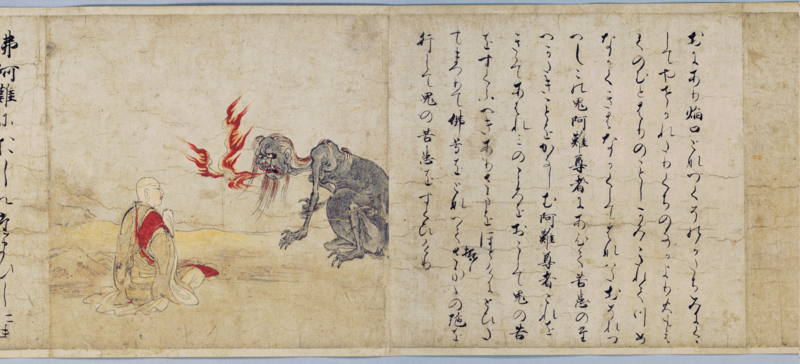
The Hungry Ghost: The concept of hungry ghost is found throughout Buddhist traditions. This is from the Sixth section of the Japanese Hungry Ghosts Scroll located at the Kyoto National Museum. The scroll depicts the world of the hungry ghosts, one of the six realms of Buddhism and contains tales of salvation of the hungry ghosts. This particular section shows Ananda, a disciple of Shakyamuni, teaching an incantation to achieve salvation to a hungry ghost who continuously belches flames from his mouth.
The creation of a Hungry Ghost happens when a person’s death has been exceptionally violent or unhappy. The ghosts are often given quite animalistic traits in the ghost stories and records. Although there are different categories and types of hungry ghosts, one common trait among them are that they are seeking a type of revenge of those who wronged them, or simply those who got in the way.
Although most accounts of Tu Po doesn’t give him animalistic traits like a monster, he definitely sought his revenge on those who wronged him like most vengeful ghosts are looking for, and therefore given the title of a Hungry Ghost.
Before becoming a Ghost – Tu-Po the Emperor’s Minister
Before becoming an ancient ghost, Tu Po used to be an important man in ancient China. The nobleman Tu Po 杜伯 is sometimes translated as Du Bo and he was the Duke of Tangdu. This was a Dukedom situated west of State of Yi Lin around were the Shaanxi province in northwest of China is today.
According to legend, the Tangdu people were descendants of the people living in the State of Tang, a Dukedom destroyed by Zhou Gong Dan that now ruled the empire. They were allowed to form a new State of Du, and became known as Tangdu or Du shi (杜氏).
Tu-Po was not always remembered as a hungry ghost, but was a prominent minister to King Xuan of Zhou (also known as Emperor Hsuan) who reigned from 827-783 B.C. Emperor Hsuan was the eleventh king of the Chinese Zhou Dynasty in a time were the kings words were the law and his minister Tu Po had to pay the ultimate price.
The empire:Map over the Jin (Tang) state during the late Spring and Autumn period as it was called, around the time of Tu-Po’s death and after. This is were he, and his ancestors resided and ruled.//Photo: Hugo Lopez – Wikimedia Commons user: Yug
The king is mostly remembered for fighting the ‘Western Barbarians‘, most probably Xianyun, an ancient nomadic tribe that invaded the Zhou empire on the Huai River. He also meddled in debacles of successions in States of Lu, Wey an Qi and was, according to history, not a popular one. Sima Qian, considered father of Chinese historiography, said: “From this time on, the many lords mostly rebelled against royal commands.” And the way the king ended his reign, is rumoured to be the work of the hungry ghost of Tu Po.
So Tu Po was from a stately and very powerful family and not afraid to speak up for what he believed in, even to the most powerful man in the dynasty. And this would cost him his life and make him a hungry ghost, haunting the earth and seeking revenge.
The Fall From Grace and Becoming a Vengeful Ghost
There are not very many sources detailing what happened before the haunting of Tu Po’s hauntings started. But according to one account, this is what happened.
The King:King Xuan of Zhou (827-783 B.C). Formerly known as Emperor Hsuan or King Suan.
On the ninth year as King, King Xuan of Zhou called all the lords of his empire into a meeting that would seal the fate of Tu Po to discuss an oncoming attack.
A rumor was out that a woman was about to become a danger of the town of Jiangshan for some reason, and the King ordered a mass execution of women. Exactly how this one woman could be considered a danger to an entire town is not really explained.
No matter what the reason behind this mass execution of women, it was seen as a truly horrible act that Tu Po disagreed with. Tu-Po publicly opposed to the order he was given and he spoke against his king in a time when the kings word was the law and anything else considered treason.
This final act of opposition would cost him his life as King Xuan ordered his execution for this as he saw this act of opposition as treason.
Before Tu Po was executed however, King Xuan of Zhou was warned that Tu Po’s ghost would stay in this world even in his afterlife to haunt him as Tu-Po himself said:
“If my majesty kills me without reason, the dead may not know, well that’s it. However, on the other hand, I will avenge myself on him, within three years.”
But despise the warnings, King Xuan went through the execution. Even though he was considered innocent of treason by most, Tu-Po was executed around 786 B.C. But this would not be the last time he was seen.
The Revenge of the Hungry Ghost
Weather Tu Po’s final words were taken seriously, is not mentioned. Three years after the execution however, the King brought his dukes to hunt on his own hunting grounds. There were hundreds of chariots, thousands of escorts following them as well as a ghost that promised he would return for revenge.
Ghost festival: Lotus-shaped lanterns are lit and set afloat in rivers and out onto seas to symbolically guide the lost souls to the afterlife.
At noon, Tu-Po appeared as a ghost, riding a white horse and a cart, wearing a red coat with a red bow and arrow in hand. He took up the chase of King Xuan and shot the king in the heart and broke the king’s spine. At the time, it is reported that no one saw the killing and no one heard it. No matter what the real situation was like, The king fell and Tu Po got his revenge.
If King Xuan really died of an arrow is today a bit unclear. In some accounts it is said that King Xuan died of something else after dreaming that Tu Po shot him to death with an arrow.
In both cases, the innocent and wronged minister got his revenge and King Xuan’s son, was the last of the western Zhou to lead.
The story has gone down in traditional legends, ever since. The Chinese philosopher, Mo Zi (470-391 B.C), said this about ghosts and about Tu-Po’s revenge:
“If from antiquity to the present, and since the beginning of man, there are men who have seen the bodies of ghosts and spirits and heard their voices, how can we say that they do not exist?
If none have heard them and none have seen them, then how can we say they do? But those who deny the existence of the spirits say: “Many in the world have heard and seen something of ghosts and spirits. Since they vary in testimony, who are to be accepted as really having heard and seen them?”
As we are to rely on what many have jointly seen and what many have jointly heard, the case of Tu Po is to be accepted.”
An online magazine about the paranormal, haunted and macabre. We collect the ghost stories from all around the world as well as review horror and gothic media.