The tragic story of Château de Brissac and the murder of Charlotte de Brézé is a haunting one, but not a rare one as it houses the ghost of a woman murdered by her own husband and is forced to remain as a ghost.
It’s no secret that the Château de Brissac holds centuries of ghostly secrets in the Loire Valley. As one of the highest, grandest and oldest castles in France, it has been home to some of the most mysterious occurrences in all of Europe, including that of the Lady in Green. Unearth the tales about its ghosts, spirits and supernatural activity inside!
Discover the History of Château de Brissac
Château de Brissac has a long, colorful history that provides a backdrop for its resident spirits. Built in the 11th century by the Counts of Anjou but renovated in the 16th century, it stands as an impressive monument to France’s past. Its past inhabitants have left behind a tale of murder and misfortune – one that still haunts the castle today.
Rebuilt in 1611 after the French Wars of Religion, the architecture of the Château de Brissac is unlike any other in France. It features a unique combination of early Renaissance and classic Renaissance styles. It’s surrounded by seven towers and many turrets, windows, and balconies.
Its main reception hall is one of the largest in Europe, measuring an impressive 80 feet long by 30 feet wide. The walls are actually double-walled to prevent fires and its design includes a mezzanine for extra storage space. Even its natural environment acts as a defensive wall against intruders since it’s located deep in dark forests!
The Ghost of the Green Lady or La Dame Verte
Many ghosts in French ghost story lore are said to be Dame Blanches or Ladies in White. And although the ghost of the Château de Brissac follows in the same pattern, the ghost is remembered and rumored to be a Lady in Green or La Dame Verte.
The spirits of Château de Brissac are said to still linger in its walls, though sightings of them have become rarer over the years.
Legends of La Dame Verte, the Green Lady, are some of the most popular tales told about the Château de Brissac. It is said that she was murdered by her own husband and now wanders the halls in search of vengeance. Some believe these stories are real, while others think they’re far-fetched.
The Murder of Charlotte de Brézé
One of the reasons why Château de Brissac is so famously haunted is due to a tragic event that took place there. Charlotte de Brézé, the wife of Jacques de Breze and mistress of the castle, was mysteriously murdered inside one of its rooms.
She was the illegitimate daughter of King Charles VII and his mistress, Agnes Sorel. She married Jacques de Breze, the lord of Château de Brissac in 1462 and had 5 children with him. The match was not a success however and Charlotte found the boring country life too much.
Jacques de Breze suspected her of having an affair with another man, one of his huntsmen, Pierre de Lavergne. On the night of May 31 in 1477 she was murdered by her husband when he ran his sword through her as well as her lover because of his jealousy.
She is said to haunt the tower room of the chapel of Château de Brissac, wearing her green dress and it is said that Jacques de Breze had to move out from the castle as he was tormented by her ghost. Years later, visitors still report hearing cries in the night at Château de Brissac, perhaps forever labeling it as one of France’s most haunted places!
Château de Versailles in France is known for being the peak of decadence, royalty and luxury. But it is also known for being one of the more haunted places in France, and even has a potential time traveling story.
Château de Versailles, the stately French palace on the outskirts of Paris, is said to be one of the most haunted places in France.
The Palace is a formal residence to the royal family of France that was built by King Louis XIV about 19 km west of Paris. It started out as a small hunting lodge in 1623, but it kept expanding until it was the luxurious palace we know of today.
With Château de Versailles’ dark history and numerous reports of mysterious sightings and eerie phenomena, this magnificent building has become a haven for paranormal investigators and ghost hunters alike.
The Story of Louis XIV’s Ghost
It’s rumored that the ghost of Louis XIV, the Sun King who oversaw much of Château de Versailles’ construction, still haunts the halls. He loved this palace so much that he even moved the French Court and Government into it in 1682 from the Louvre Palace.
Witnesses say that his specter can be seen in his favorite chambers and garden pathways, wearing a traditional robe de chambre and capotain hat. The sound of horses galloping on unseen paths have been heard too, dead silent at midnight – a ghostly reminder of Louis’ presence in the form of what some believe to be his funeral procession.
Mysterious Sightings of Marie Antoinette’s Ghost
One of the more famous ghosts in the world must be that of Marie Antoinette, who in her afterlife, also has a lot of rumors around her. She is mostly known for quoting that the people should eat cake instead as they didn’t have any bread. This is false as she never said this. It is also said she is haunting the rooms of the Versailles palace. But can this also be false?
It is widely believed that the ghostly figure of former Queen Marie Antoinette can often be spotted walking near the Grand Trianon and inside of the palace. Even more chilling, some have heard her sobs echoing throughout the empty halls in the dead of night.
Others claim to have seen a woman wearing her famous white dress, complete with a white rose in her hand, sauntering along the grounds of Château de Versailles.
The Ghost of the Petit Trianon
The most famous haunting is of the Petit Trianon, the grounds outside the palace. Or is it really a ghost story as one of the theories is that it was actually a time slip. The story was written down and published in 1911 that fueled the rumors that a ghost was haunting the Château de Versailles.
Two English women visited the palace as they traveled through France on a hot August day in 1901. Miss Moberly was a headmistress of St Hugh’s College for women in Oxford while Miss Jourdain was a former student of hers who was now her assistant.
As they were having a pleasant trip through the gardens they asked for directions from two men they met dressed in green coats and three cornered hats with spades in their hands. Strange, but perhaps not too strange at an old palace. But the two women suddenly started to feel a strange sensation and growing distress as it was something they couldn’t quite pinpoint. They also passed a Chinese kiosk on their way.
They then encountered a woman wearing an old dress and a white hat while she was drawing in the garden. The women were overwhelmed by the experience, and they returned to Paris, agreeing that the place was definitely haunted.
Another theory was that they had experienced some sort of time slip or time travel. One of the proofs they presented was their own ignorance over the palace and garden at their visit. But when they looked at plans for the Trianon, they found that there indeed had been a Chinese kiosk there in 1774.
Unseen Spirits in the Hallways at Night
In the darkness of the night, some visitors have reported hearing strange noises and feeling a mysterious presence when walking along the Château de Versailles dimly lit hallways. One such story is about an unseen spirit that supposedly haunts the palace’s famous Hall of Mirrors or in the gardens of Petit Trianon. Witnesses like cleaners, guides and visitors have claimed to see dark shadows lurking in the corner of their eyes or feel a chill whenever they step foot into this eerie place.
Discover the secrets and legends of Abbaye De Mortemer, an infamous haunted abbey in rural France. Explore its haunting history from Dames Blanches, ghost monks, werewolves and a goblin cat guarding a treasure.
Hidden deep within the French countryside lies the Abbaye De Mortemer, an ancient structure with a chilling past. The former Cistercian Monastery in the Forest of Lyons is the home to eerie sightings and ghostly apparitions.
Origins of the Abbaye De Mortemer
Established in 1134, the Abbaye De Mortemer was an ancient abbey that was a gift to the Cistercians by Henry I of England.
Read Also: There are many supposedly haunted abbeys and monasteries around the world. Check them out: Here
The name comes from the stagnant water of the lake that was dug out by the monks. It was called the Dead Pond which in French is Morte Mare.
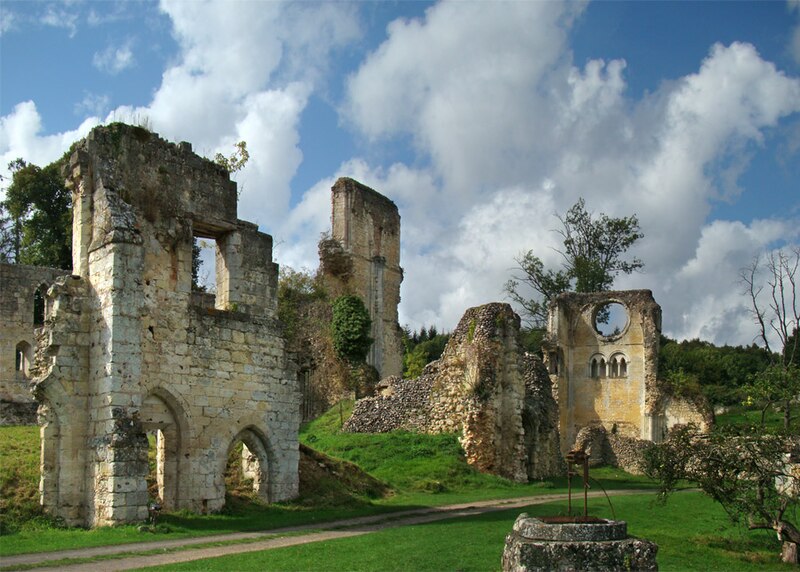
Abbaye De Mortemer Ruins: Most of the once grand abbay in France is now only ruins and is said to be haunted by more than one ghost. //Source//Wikimedia/Tango7174
Who owned the abbey depended on who owned the land from year to year. It was founded by the English king, but ended up under the French crown after the Hundred Year War ended in 1453.
It held out despite it falling into disrepair until 1790 when it was dissolved under the French Revolution. Only 4 monks remained alive living in the abbey. They would end up remaining there, even in their afterlife.
Dame Blanches of Mathilde I’Emperesse
The one thought to be haunting the place is the daughter of Abbaye De Mortemer founder, Mathilde I’Emperesse or Matilda of England.
Her father was King Henry I of England and she was one of those with a claim to the English throne in the civil war between England and Normandy between 1138 and 1153 which was known as The Anarchy.
Why she is haunting this abbey is unclear as she died at an old age far away. She had close ties to this abbey as it was said she was a very spiritual woman and the order of the Cisterican monks because of the importance of the Virgin Mary, a saint of great importance to her.
A picture supposedly depicting her ghost got well known in 1999, however French television has since debunked the image as lighting trickery.
According to legend she walks by the ancient pools and mist is created on them. By local lore you do best to look away if you spot her. If she wears black gloves it means bad luck and misfortune. If she is wearing white, there is a happy event in the coming year. If you see her twice though you are condemned to death.
The Helpful Ghost Monks
People have reported a number of sinister legends and stories about the Abbaye De Mortemer. One popular story involves sightings of the infamous Black Monks, which are said to appear on dark nights in the abbey’s ruins.
This is believed to be the ghosts of four monks who were murdered during the French Revolution in 1789 when the churches and abbeys were robbed for their wealth to fund the revolution and the monks were hunted down and dragged to the old cellar were the last brothers of the orders were massacred.
Other visitors have experienced ghostly apparitions, chills, strange voices, and other forms of supernatural activity. Both the Delarue family that were going to move into the former abbey reported about seeing the monks as well as an English paratrooper in the second world war.
He said that he was spotted by the enemy and was running around in the forest to hide. A monk came forward and guided him to safety before disappearing. The people at The Resistant Cell the paratrooper found, knew it had to be a monk from the Abbey.
The Goblin Cat Haunting the Treasure
The haunted abbey is also said to be the home to a certain Goblin cat you can meet in the ruins in the form of a black cat.
According to the legend, the cat is guarding a certain treasure of the abbey said to be so grand it could restore the abbey to its former glory.
The She-Werewolf
One of the most famous legends concerning the Abbaye de Mortemer is the story of a werewolf haunting its grounds. According to legend, a cursed woman transformed into a wolf every night and terrorized all who crossed her path.
This was thought to be a female werewolf known as the Garache in French Folklore with yellow eyes. This is the only tale of a Garache in Normandy apparently, a weird thing perhaps as French Folklore is filled with legends of shape shifting werewolves.
A man named Roger Saboureau was out poaching in the forest in 1884 when he encountered this werewolf and he shot it dead without hesitation.
When the Garache died though it returned to its human form and he saw it was his own wife.
The Demonic Pink Room
In 1863 the building, restored somewhat and made into a family home, was bought by a rich Parisian named M.Delarue. He moved into the place with his wife and two children, but they soon found that it wasn’t without its history.
One of the most notorious stories revolves around Abbaye De Mortemer’s so-called “Pink Room.” The room is mentioned by some of the owners who experienced so much hauntings it even broke an engagement.
A young girl who was the fiance of the son, Charles Delarue, the owner of the building and living there came to stay with them once. She was given the pink room as it was the only one available. She was found in the morning, terrified of all the paranormal activity that had happened during the night. She announced she would never live there, broke off the engagement and hurried back to Paris.
M.Delarue’s daughter had been a nurse during the First World War and told her father she had never been afraid in the trenches and would not be afraid of the pink room either. She made it her own and lived in it, but said that she always felt observed, but not threatened in the same way the former fiance of the family had.
The Exorcism of the Abbey
The Delarue family stayed in the former abbey for quite some time, but in 1921 they thought it was about time with an exorcism. Not the first one though, and they called once again upon Abbé Humbolt who had done the previous ones also.
They ordered another exorcism of the Pink Room and the Abbey and it did become quiet for some time. But then it started again. How is it today?
Stories about white ladies are plentiful in Europe, especially in Germany, and this particular The White Lady In Freihung ended up winning against the U.S Army.
The main town in Freihung has a long history of Bavarian culture and the industry of mining lead. There is also a ghost said to be haunting the quaint little Bavarian town.
This The White Lady In Freihung who is supposedly haunting the city center is said to be a middle aged woman who used the old mining tunnels to glide through, scaring people so much that in the end they destroyed the tunnels altogether. One hotel was greatly bothered by it and ended up taking matters into their own hands to rid themselves of the ghost.
The Noble White Lady In Freihung
Who The White Lady In Freihung was is not certain, but there are tales that there used to be a castle at this place were it now was a hotel, although there are no direct historical proof of it.
According to the legend, there lived a noble woman in this mysterious castle who died tragically, although her name and manner of death is not known as with the rest of the facts of the legend.
According to reports, there are tales about seeing The White Lady In Freihung since 1625. Ghosts that are reported on wearing white are very common in ghost stories from Germany, especially if the ghost is linked to a noble house. This is the case with the haunting of the house of Hohenzollern as well as an example.
The noble family of Hohenzollern of Germany has been haunted for centuries. The White Lady follows them, wherever they go. Who is she? And what does she want with the life of the nobles?
She is said to haunt the grounds where the castle once stood. Archaeological findings of a castle named Freihung Castle, exist, but in another place than where the hotel is today, and it is unclear whether that has any connection at all.
Today, most reports come from The Gasthaus Alte Post Hotel that they built over the underground mining tunnels.
Weiße Frauen in Germanic Folklore
Why exactley is germanic ghost stories riddled with stories about the lady in white or as they are called in german, Weiße Frauen
In German legends and folklore the stories of the Weiße Frauen or White Women used to be a name meant to the elven-spirits and the stories of the light elves from pagan times and has probably evolved to refer to the female ghosts said to haunt castles, forests, homes and everywhere women have met a deadly end.
The Missing Castle: could the ghost of the Lady in White come from the remains of a supposed castle that used to stand in Freihung? Did the castle even exist?
Now the name is also used on women dying in grief, of sorrow or with an urge of revenge. It has spread throughout Europe and is an image with strong connotations, even today.
Even outside of Europe, there are tales about female ghosts clad in all white, from the Korean Virgin Ghosts to the vengeful spirit on the Onryo in Japan.
The U.S Army on Ghost Hunt
The terror of The White Lady In Freihung got so bad that the local owners of the hotel called in the U.S troops to the The Gasthaus Alte Post Hotel where most sightseeings of her were reported.
From 1945, the American army had a training center in Grafenwoehr, not far from Freihung. Elvis Presley was once stationed there. It is still used today as a training area by the army.
The hotel owners were desperate by the 1970s and asked for their help and help they received. The army from the base came and used explosives to seal off all the tunnels under the hotel, hoping it would silence the ghost that supposedly walked underneath inside of the tunnels.
The Haunting Continues
This was not enough to stop The White Lady In Freihung however, as she just finds new ways to move among the locals to scare them. And if we are to believe the stories, she is still wandering the streets in the city center of Freihung and showing herself in the rearview mirror of passing cars.
Uncover the hidden shadows of England’s majestic Tower of London, home to stories of more than one ghost haunting the rooms, the hallways and the prison cells from many dark parts of England’s history.
Shrouded in centuries of fear and mystery, the ancient walls of the Tower of London on the north bank of the River Thames, hide within them a plethora of ghost stories that have been passed down through generations.
From secret passageways to encounters with mysterious apparitions, visit the legendary Haunted Ghosts Tower to uncover its dark history and uncover its spine-tingling tales of beheaded royals, tortured prisoners and missing princes as well as menacing forces following the guards.
The History of the Tower of London
Since its inception in 1066, the Tower of London has served as a royal residence, prison, armory and execution site. The White Tower gave the castle its name and was built by William the Conqueror in 1078. It was a symbol of the oppression over London after the new Norman ruling class.
Over the centuries it has seen kings and queens come and go, watched prisoners be tortured and witnessed countless executions within its walls. It ended up being a symbol of royal power and one of the most secure fortresses in the country. It is not only a stronghold of history but also an enduring source of horror stories that continue to haunt us today.
The Tower of London is known for its grisly past, having been the home to many famous and infamous prisoners until 1952. These included some of England’s most treasured monarchs, such as Anne Boleyn who was beheaded on May 19th 1536 and Sir Walter Raleigh, imprisoned in 1603 by King James I.
Other more notorious prisoners held at the tower were Guy Fawkes and conspirators involved in the Gunpowder Plot, who were later hung, drawn and quartered.
Ghosts in the Tower of London
The Tower of London is reportedly one of the most haunted places in England, possibly due to its long and dark history. Ghostly figures are said to wander the dungeons, some even claiming to have seen Anne Boleyn’s headless ghost roaming its corridors.
Lady Jane Grey
One of the most recorded ghost sightings is that of Lady Jane Grey, a young girl who was crowned Queen for nine days before she was imprisoned and eventually beheaded at the ripe age of 17.
The Execution of Lady Jane Grey: An often spotted ghost in Tower of London is Lady Jane Grey. This is an oil painting by Paul Delaroche, completed in 1833, which is now in the National Gallery in London. It was enormously popular in the decades after it was painted
She was originally put as a queen to prevent the Catholic Mary Tudor from sitting on the throne. She first came to the Tower for her coronation, but was soon back as a prisoner. Mary I was ready to spare both her and her husband’s lives if they converted to catholicism. Lady Jane, a devout protestant refused. She was executed on 12 February in 1554 on Tower Green.
She is seen as a lonely ghost, wandering the battlements of the Tower. Her husband, Lord Guildford Dudley is also supposedly haunting the place. He can be seen in Beauchamp Tower, sitting in his cell and crying in the middle of the night.
Ghost of Henry VI
Henry IV was the only English monarch to have been crowned King of France as well and he inherited the Hundred Years War from his uncle. He was crowned king of England at only nine months, the youngest person to have succeeded the English throne.
This was also the start of The War of Roses, a series of civil wars and Henry VI was imprisoned in the Tower of London in 1465, reinstated as king in 1470, but then imprisoned again in 1471.
Henry VI died that year, possibly killed on orders from King Edvard IV who took his crown.
Henry VI: Depiction of Henry enthroned, from the Talbot Shrewsbury Book, 1444–45. Although the official death was that he died of melancholia, however, many think he was assassinated in The Tower of London.
Strange legends started to form around the late king after his death and he was hailed as a martyr and a saint that had done plenty of miracles. It is also said that he is one of the ghosts still haunting the tower.
It is said that he is seen at the last stroke of midnight in the Wakefield Tower, where some say he was praying when he was stabbed to death.
Margaret Pole
Margaret Plantagenet, Countess of Salisbury was a powerful woman who was one of the few of the House of Plantagenet to have survived the Wars of the Roses.
She was tried and sentenced to death to be executed whenever the king wanted. She spent two and a half years in the Tower of London as a prisoner before her execution happened in 1541.
Margaret Pole claimed her innocence until her last hour. This poem was found carved on the wall of her cell:
For traitors on the block should die; I am no traitor, no, not I! My faithfulness stands fast and so, Towards the block I shall not go! Nor make one step, as you shall see; Christ in Thy Mercy, save Thou me!
Margaret Pole: This is an Unknown woman, formerly known as Margaret Pole, Countess of Salisbury, by unknown artist, given to the National Portrait Gallery, London in 1931. Margaret Pole led an especially bloody execution in the Tower of London.
The execution is said to have been bloody and grisly and the proud lady refused to kneel on the scaffold as that was for traitors, and she was none. The executioner had to chase her around as she tried to run and hacked her to death. She is now thought to be one of the many nobles that are haunting the Tower of London with her screams echoing on the Tower Green.
The Many Ghosts of Anne Boleyn
Many believe that the ghost of Anne Boleyn haunts the Tower of London due to her untimely demise. She married Henry VIII and altered the British church forever when she did so as the king had to divorce his original queen and wife for it. They were only married for three years though and she was unable to give him any sons. What she did though was give birth to what would be Queen Elizabeth I that would be one of the longest regents in the country.
During King Henry VIII’s reign, she was famously arrested, accused of treason and beheaded in 1536 at the Tower and has since become one of the most famous people in England’s history.
Haunted: The ghost of Anne Boleyn are said to be haunting, not only the Tower of London, but have been seen on several locations. Here is a painting depicting Anne Boleyn imprisoned in the Tower.
Anne Boleyn is supposedly a very busy ghost and she is said to haunt not only the tower but Hever Castle, Blickling Hall, Salle Church as well as Marwell Hall.
In the Tower of London she supposedly haunts the chapel of Church of St Peter ad Vincula in the tower where she is buried. She is also said to walk around the White Tower and on the Tower Green where she was held captive until her execution.
Her ghost is often spotted wearing a gray dress and walking with her head tucked under her arm—mirroring how she was killed. According to legend, if you see her apparition it means that death is soon to come.
The Mystery of the Missing Princes
One of the greatest mysteries in English history remains unsolved—the fate of the two young princes whose uncle, Richard III, had them sent to the Tower of London in 1943 where they were never seen again.
The Murder Mystery of the Tower of London: King Edward V and the Duke of York (Richard) in the Tower of London by Paul Delaroche. The theme of innocent children awaiting an uncertain fate was popular amongst 19th-century painters.
They were the sons of the late King Edward IV and were 9 and 12 years old when their father died and they were sent to the Tower of London. They grew up in great political turmoil during the Wars of the Roses, a series of civil wars of two branches of a family were fighting for the seat of the throne.
During their disappearance many assumed that Richard III was responsible for their murder, although this has since been disproven, or at least, bare little hard evidence to. But the most talked about theory is still that they died or were murdered pretty soon after they disappeared. To this day no one knows what happened to them, giving rise to a host of different theories about the missing princes.
Many of the paranormal activity and ghost sightings have been connected to the two missing princes, and many believe they are some of the ghosts that never left the tower at all. They are seen holding hands and wearing nightshirts in the White Tower as well as playing and giggling on the battlements.
Sir Walter Raleigh
Other ghosts that are said to haunt the Tower is that of Sir Walter Raleigh who were imprisoned in the tower once for a secret marriage and the second time for treason. The second imprisonment ended in an execution and his ghost is said to haunt the Bloody Tower where he was held.
The Ghost in the Bloody Tower: Many of the prisoners were political prisoners, often charged of being traitors. Sir Raleigh just before he was beheaded – an illustration from circa 1860.
The Ghost of Sir Walter Raleigh is also said to be seen along the battlements who is now known as Raleigh’s Walk
Arabella Stuart and the Unknown Ghosts
The Gray Lady is an unidentified ghost as well, but she is haunting the Queen’s House of the Tower and her presence is only seen by female visitors. This place is also where the ghost of Arbella Stuart is seen after she was either murdered or refused to eat at all.
Lady Arabella Stuart: She was at one time considered heir to the English and Scottish thrones, though she did not aspire to them. She died of self-inflicted starvation in the Tower of London, in 1615.
Other unnamed ghosts that have been reported on are the White Lady whose presence is made known by the smell of cheap perfume that has made visitors sick.
The Legendary Guy Fawkes
Remember, remember the Fifth of November, The Gunpowder Treason and Plot, I know of no reason Why the Gunpowder Treason Should ever be forgot.
Fawkes led the infamous Gunpowder Plot with a group of English Catholics that planned to kill the Protestant King James by blowing up the parliament. They were found out though and the plot failed and Fawke was arrested and sent to the Tower.
After torture, possible “on the rack” a famous torture instrument in the Tower, he gave in and told them all about their plan and named his accomplices as well.
Interrogated and Tortured: Guy Fawkes 1570-1606 interrogated by James I 1566-1625 and his council in the King’s bedchamber, from Illustrations of English and Scottish History Volume I (1884).
For his execution in 1606 he was dragged from the Tower to Westminster to have the last sight be the building he tried to destroy. He was the last to die and had to watch his accomplices be hanged. He begged forgiveness of the King and the state as he walked to the scaffold. He was hanged and his body parts were distributed to the four corners of the kingdom as a warning sign to others that had their mind on treason.
Guy Fawkes are also one that are said to haunt the grounds and some claim to hear his screams from where he supposedly was tortured. .
The Animal Ghosts
Can animals become ghosts? According to the lore in the Tower of London, there are plenty of them. Having exotic animals like lions, pumas, tigers and elephants were something the rich often were gifted and a popular thing to have in your home to show off your wealth and power.
The most famous animal ghost in the Tower was a grizzly bear that supposedly charged at a guard around the Jewel Room who died of a fever two days later. There have also been spotted a Black Bear near the Martin Tower in 1816.
In the beautiful Gardens of Tuileries outside of the Louvre in Paris there is sometimes spotted a Red Man. This is thought to be the ghost of Jean l’Ecorcheur, an assassin to Catherine de Medici who ended up being assassinated himself.
The Tuileries Palace was a royal palace directly in front of the Louvre Palace before it was burnt down in 1871 by the Paris Commune, a French revolutionary government that seized power between March to May that year.
It was built by Queen of France, Catherine de Medici in the 1500s after her husband died to have space for a large garden. Today, the only thing that remains of it is the Tuileries gardens that covers the ground around the Louvre until the Seine and the Place de la Concorde, and if we are to believe the legend, the ghost of the The Red Man.
Read More: Check out all ghost stories from France
It is in this stately garden that reports that go over centuries tell about the ghost of a red clothed man appearing throughout history to the visitors. And if we are to believe the legend, the ghost belongs to one of the assassins to the Queen of France.
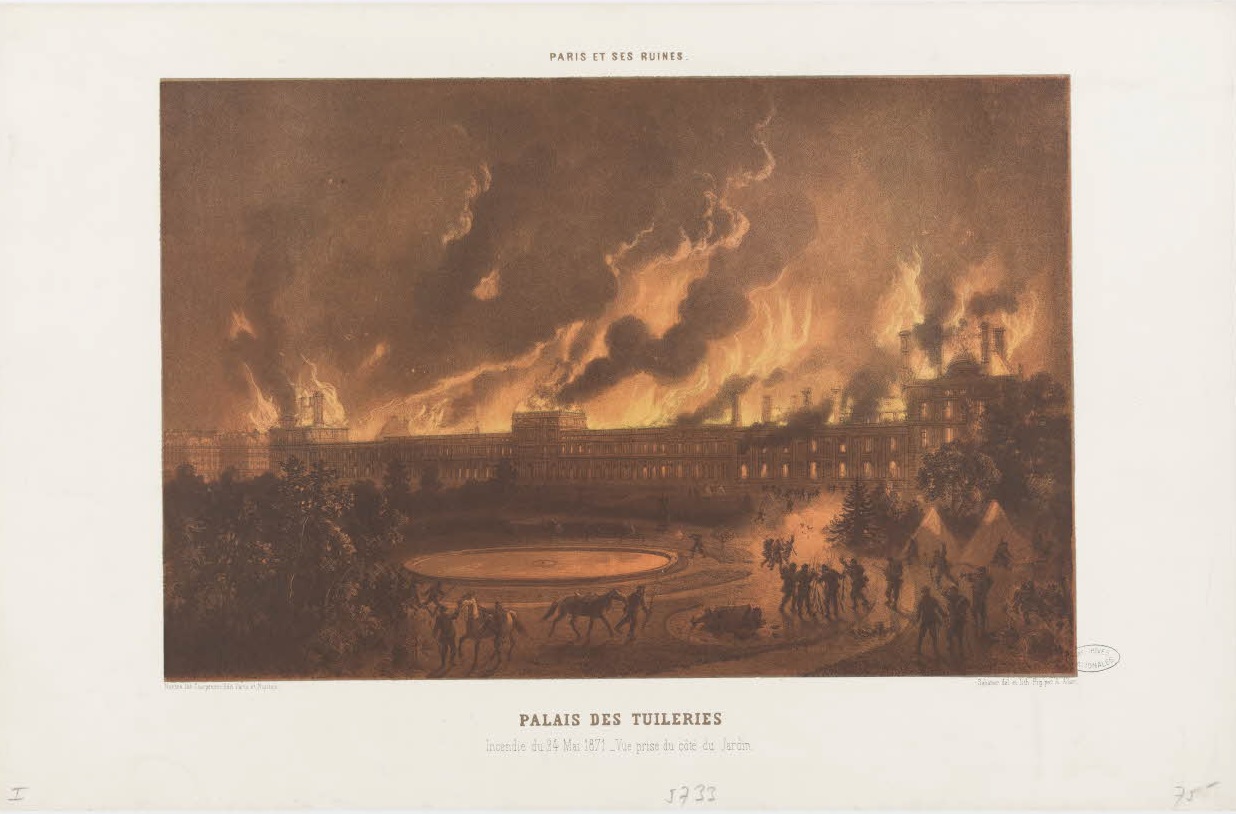
The Tuileries Palace: Was a royal palace the royal family lived in next to the Louvre Palace. It was burned down by revolutionaries and legend has it that one of those working for the royal court cursed those living inside of the palace as long as it existed. Here the burning of the palace is depicted.
Queen of France Catherine de Medici
One of the people who are supposedly haunting the Louvre was one of the henchmen belonging to Queen Catherine de Medicis who ruled as queen in France from 1547 to 1559 at a time when the country was at constant edge because of brewing civil and religious wars.
Although her husband, Henry allowed her almost no political power or influence as his queen, she found her own way and is regarded as one of the most powerful and influential women in Europe.
Catherine De Medici: The Queen of France were a highly controversial queen during her reign, but managed to be a strong political figure in a time of unrest. Portrait by Germain Le Mannier.
She was also known for being interested in the occult, especially because she had problems conceiving in the start, something people attributed to witches among other things people found “unnatural” in a woman. She was also linked to being the creator of the Satanic Black Mass, teaching her son in the Dark Arts as well as being Italian.
The Butcher Jean the Skinner
Who can this The Red Man be? What we know is true however, was that Catherine had a political agenda and needed people to put that agenda into life. But to act on the Queen’s behest came with great danger.
The most famed legend of the identity of the The Red Man is about a man named Jean. Jean l’Ecorcheur was a butcher living in the palace and Catherine de Medici’s hired assassin to kill on her demand, both for political as well as various occult reasons according to the legends. Through his work as a butcher as well as assassin, Jean l’Ecorcheur earned his charming nickname, Jean the Skinner or the Flayer.
Acting as the Queen’s henchmen, he also knew about her and the royal family’s secrets, which were plentiful and the Medici family was known to be a scheming family as well and Catherine de Medici had more enemies than most. Because she feared he would spill these dark secrets, she had him murdered before it happened. There are also rumors that she did it because he tried to quit or make her pay up. Nevertheless, he died a bloody death, but it wasn’t the end of him.
He was according to legend killed by a man named Neuville in the Tuileries garden where he lived in a hut. Neuville left the corpse in the garden, but when he returned, he was gone.
The Curse on the Royals of The Tuileries Palace
Catherine de Medici was according to popular belief a spiritual woman with a strong belief in the occult and she went to her astrologist Cosme Ruggieri who had a vision. In the vision the astrologist claimed that Jean would haunt the garden and had cursed all those living there.
Legend has it that The Red Man rose from the dead and cursed all the French Royals who lived in the palace that were the cause of his death. After this they say many of them died under mysterious circumstances they blamed on Jack the Skinner’s ghost and curse and he was reportedly seen before many deaths almost like a dark omen.
After this he became known as the Red Man, or the L’Homme Rouge of the Tuileries and if we are to believe the legends, he is still dressed in red and haunts the Tuileries Garden.
Many claimed to have seen the Red Man before King Henry IV was assassinated on 14th of May in 1610, when Louis XIV died of gangrene in 1715.
The Red Man was also seen before Louis XVI was executed by the guillotine as a traitor in 1739 during the French Revolution.
The Lady in waiting for Marie Antoinette supposedly saw The Red Man a few days before the Tuileries Palace was stormed in 1792 in the Salle des Gardes and there is even a written account of it:
“Marie Antoinette’s women were sitting in the Salle des Gardes, when they became suddenly aware of the presence of a small man clothed from crown to heel in scarlet, who looked at them with such unearthly eyes that they were frozen with terror. They rushed to the apartments of the Madame la Dauphine and related their adventure.”
Fleeing the Palace: The Royal Family saw a lot of unrest over the generation, none greater than the many French Revolutions. Louis Philippe and the French royal family fleeing the Palace of Tuileries during the French revolution of 1848
Even Napoleon Bonaparte claimed to have seen what could have been him several times during his reign as the head of the state in France, before the battle of the Pyramids, the Battle of Wagram at his coronation and lastly at the battle of Waterloo. And although he wasn’t really a part of the royal family, he did reside in the palace as the king of some sort.
However, in many sources they claim that The Red Man was acting more like a warning omen about danger to come than a vengeful spirit after his revenge.
The Last Sightings of the Red Man
Written accounts went on for ages until the Tuileries Palace burned to the ground in 1971. Twelve men were ordered by Jules Bergeret to pour petroleum, tar and turpentine and light the palace on fire, burning it to the ground. And with tearing the once royal palace, did they perhaps succeed in breaking the curse of Jean the Skinner?
At the day of his wife, Elena Grimani’s death anniversary, a the ghost of noble man called Fosco Loredan can be seen carrying his dead wife’s head . The very same head he himself decapitated out of jealousy and had to carry to Rome.
Once upon a time in 16th century Venice, a nobleman called Fosco Loredan fell in love with a woman. Her name was Elena Grimani and was the Doge’s niece and in a very powerful position. They married, but it wasn’t happily ever after.
Not much is known of Loredan’s life except that he was a very well known man. It was also known that he was a horrendously jealous man and kept accusing his wife of cheating on him. He would also regularly spy on his much younger wife as she was always getting much attention because of her beauty. Elena Grimani denied having an affair, but he wouldn’t believe a single word she said.
One night in 1598, Loredan went to Campiello del Remér in the Cannaregio district of Venice to look for his wife. He was sure that she was betraying him with another man. In a fit of rage he chased her from their marital home with a sword in his hand.
The chase ended with Loredan beheading Elena Griman in front of everyone at Campiello del Remér, including the Doge himself, who was the leader of Venice.
According to the legend, the Doge Marino heard the desperate cries of his niece, Elena Grimani and went to her rescue. He placed himself between her and her husband, to no avail. The angry man managed to distract the Doge enough to get past him and behead his wife to everyone’s shock.
Loredan tried immediately to ask the Doge’s forgiveness as it was his right as a husband to punish a cheating wife. The Doge refused though.
Loredan’s punishment for his crime was to carry the body of his dead wife he had decapitated to the pope in Rome to ask forgiveness and mercy. But when he finally arrived there after his long journey, still with his clothes stained with his dead wife’s blood, Pope Clement VIII refused to see him and he wasn’t granted the forgiveness he seeked.
An arrest order was put on him Instead and he had to fight off the guards to escape them and Rome. Loredan walked back to Venice, still holding the decaying body of the woman he murdered in his hands.
It didn’t go well for Loredan after his crime and he didn’t see a way out. He returned to the scene of his crima in Campiello del Remér and in despair he threw himself into the lagoon and drowned.
Today, the local legend says that on the anniversary of Elena’s killing and even on full moon nights, on those night when the northern wind blows, you can still see his ghost along the Grand Canal by Campiello Del Remer, coming out of the water, still carrying his wife’s head.
An old fortress of protection turned into a prison of a mistress who died and started haunting Zitadelle Spandau where she met her end. And the ghost of the mistress Anna Sydow are said to haunt both the place and the family who caused her death.
One of the best preserved Renaissance military structures in Europe is the citadel in today’s Berlin, in German called Zitadelle Spandau. It was built in 1559 on top of another fort and designed to protect the Spandau town which is now a part of modern day Berlin.
Many castles in Germany have stories about a certain Lady in White haunting it, and in Spandau Citadel there is the ghost of Anna Sydow.
Anna Sydow was the mistress of the Brandenburg Elector Joachim II. Joachim II was a part of the Hohenzollern who has been rumored to be plagued by the ghosts of a Lady in White. Anna Sydow is just one of the many rumored to be at least one of them.
Read more about the curse of the House of Hohenzollern: Here
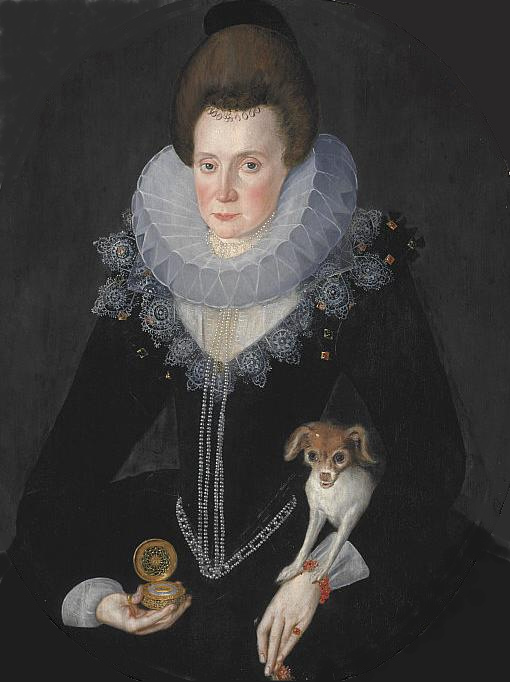
Anna Sydow: Portrait of the mistress Anna Sydow who are believed to be the Lady in White that haunts Zitadelle Spandau after she was imprisoned by the son of her lover.
In 1549, the wife of Elector Joachim II suffered an accident which left her walking on crutches. She fell down the floor and impaled herself on a couple of antlers that hung in the room below. Something that the elector thought ruined the marriage and the enjoyment of hunting. He chose then to take a mistress and he chose Anna Sydow.
During her life as his mistress, Anna Sydow bore him two children and lived in the Grunewald Hunting Lodge for two decades and is also said to haunt the grounds of that place. This was also the place where the wife of Joachim II got impaled and ended up on crutches.
Imprisoned in Zitadelle Spandau
Johann Georg was the heir and son to Joachim II, and had explicitly promised his father on numerous occasions that he would spare and protect Anna Sydow after he died. But when the elector died in 1571, she was imprisoned in the Zitadelle Spandau until her death in 1575.
The Zitadelle Spandau was often used to house prisoners of the state for a long time, and Anna Sydow was one of the first. She was arrested under false pretenses though and saw no trial. Although the arrest was unjust, she at least didn’t end up being executed like many others of his fathers old court did. Or according to some of the legends, she was actually murdered.
In any case, Johann Georg felt haunted by her after her death. On January 1st in 1598, Johann Georg saw the specter of a Lady in White that he thought had to be Anna Sydow and died eight days later.
In 1709, there was a skeleton of a woman found buried inside of the Zitadelle Spandau during renovation, and everyone thought it had to belong to the Lady in White that was plaguing the fortress as well as the Hohenzollern family. They gave her a proper burial in hopes of ending the hauntings, but according to reports, there is still something haunting within the Zitadelle Spandau walls.
Immured in the Hunting Lodge
There is also this rumor that it wasn’t in the fortress Anna Sydow met her end but in the Grunewald Hunting Lodge. So she is thought to haunt both places as well as members of the Hohenzollern family.
It is a legend that she was immured alive in the small spiral staircase in the western corner wing. Since then she has been haunting the castle around midnight.
The mysterious legend about the Blue Lady in Verdala Palace on Malta is shrouded in questions as she is supposedly haunting the beautiful castle. What happened to her and Who is she? Will she ever find peace?
On the height of the Buskett Gardens lies The Verdala Palace. Set in the heart of the idyllic gardens and surrounding forests it gives some breathtaking views of the island. Today it is used as a summer residence for the president of Malta and is an enormous building sitting alone at the hill.
The Verdala Palace is closed off to public except on the annual Moon Ball held every August. And perhaps, sometimes, a woman wearing her blue dress dances among the guests, not being able to escape the palace, even in her death.
The History of Malta and the Verdala Palace
For a time Malta was ruled by a religious order. The Order of Saint John, was a medieval and early modern Catholic military order and the ones that built the Verdala Palace in the 1500s as a hunting lodge. And the island of Malta was ruled by the Order of Saint John as a vassal state of the Kingdom of Sicily from 1530 to 1798 when the legend is said to have taken place.
The Verdala Palace: Majestic as it stands from it was built by the Grandmaster Verdalle in 1586, it is now used as a summer residence for the president of Malta. Local legend has it that the Verdala Palace is supposedly haunted by The Blue Lady, a tragic story about a woman who was imprisoned in one of the towers.//Photo: ERWEH
The order thought self that they turned, “merely a rock of soft sandstone” into a flourishing island with mighty defenses and a capital city among the great powers of Europe during the 268 years they ruled the island.
The native felt otherwise though, as the Knights were French and excluded the native islanders from important positions. They were especially loathed for the way they took advantage of the native women. Perhaps The Blue Lady is an echo of these women?
The Blue Lady in Verdala Palace
The order was ruled by a so called Grand Master. And the last Grand Master of Malta was Emmanuel de Rohan-Polduc. He had a niece according to legend who is said to be The Blue Lady in the Verdala Palace. But as the legend goes, even though the order were eventually expelled by the French from the Island, she remains there as a ghost, haunting the palace she ended up trapped inside of.
The Blue Lady: The Verdala Palace is supposedly haunted by the ghost of a lady wearing a blue dress.
Walking the halls of the Renaissance palace under the intricate frescoes in the ceiling, the bold architecture, grand staircases and passing under the high, arched ceilings, The Blue Lady is unable to find any rest in her castle prison.
The Blue Lady, sometimes referred to as Is-sinjura tal-Verdala, was supposed to marry a man she didn’t love according to legend often told about her. Who this man was varies, but it is often thought he was one of the knights.
She had no say in that matter and was forced to it but kept trying to refuse the man she would be forced to spend the rest of her life with. The man grew angry and impatient at her refusals and imprisoned her in her room in the palace to teach her a lesson and keep her in her place.
Imprisoned and forced to compliance, she had no way of getting out. Unless… the only way she saw an escape was through the windows. The palace was many floors high and it was dangerous, some might even say impossible to escape this way. She slipped and fell to her death.
In some version she just gave up completely and threw herself out from the window to take her own life instead of marrying a man she didn’t love. Today we will never know.
After her tragic death she returned as a ghost. The Blue Lady has been spotted inside of Verdala Palace, walking the halls in her blue dress. The very same dress she wore when she died.
The Moon Ball: Sightings of the Blue Lady in the Verdala Palace is often during the August Moon Ball held in the palace. //Photo: Pablo Torres Flickr.
So why is she haunting the place she felt so trapped in? Many of these so called ghost ladies often found in old castles and mansions is haunting the place because of the tragic way they died. They are perhaps bitter about how it ended, but harmless according to most ghost stories about those ladies in white, grey and black from Europe.
So exactly why she is haunting the place is harder to pinpoint, however, we do have many written accounts of her haunting dating over a century back in time.
One of the written accounts of seeing The Blue Lady is from a Howard Jones in 1917. At this time, Jones worked as a staff member of Admiral Sir Arthur Gough-Calthorpe. He once visited the Verdala Palace and came back with a ghost story. I
n the diary, penned by a Capt. Robert Ingham, the aide-de-camp of the Gouverneur of Malta, he relayed Jones story of him seeing the Lady in Blue at Verdala Palace.
One time, Jones went to the Verdala Palace for a weekend in July, 1917. There, he was given a small room with a window overlooking the ditch. On the second floor there is something that are known as “Blue Lady’s Quarters”.
Today these quarters are almost empty and uninhabited and houses little to no guests. The walls are painted in dark wedgewood blue.
According to the diary, The Blue Lady appeared there before him as a ghost. When Jones was doing his tie in the mirror, a lady dressed in blue walked up behind him, but when he turned around there was no one there.
The Lost Name of the Lady in Blue
Even though the story has persisted for a very long time, little is known about the name of the Lady in Blue in Verdala Palace, even though she is a descendant of a noble family. But she has been embraced by the Malta as part of the history and even the official presidential website mentions her, writing: “This is only a legend, however many people do confirm that she does indeed appear in the palace wearing a blue dress.”
A possible link could be one of the de Rohan Polduc members seemingly being linked as siblings to Emmanuel de Rohan-Polduc, which The Blue Lady is supposedly a niece of. They are:
Another version (a very dramatic one) of the legend behind the The Blue Lady in the Verdala Palace is:
Cecile, a niece of Grand Master de Rohan, who had eloped with a commoner and found herself in her uncle’s care. It is said that after the Grand Master’s death during the French occupation of Malta, her fiancé was tortured in order to make him divulge the whereabouts of a supposed treasure hoard at Verdala Castle. Cecile took hold of the sword belonging to a French soldier, killed her fiancé to end his misery, and then jumped to her death from a castle window.
Whoever The Blue Lady is, at the annual Ball at Verdala Palace in August, when the gates to the palace opens, when it is once filled with people, with life, the guests still, again and again, insist on seeing The Lady in Blue dancing in the halls in her blue dress.
After the Chinese nobleman Tu Po was betrayed by his own king and fellow nobles, he became a vengeful ghost, or Hungry Ghost as it is known as in Buddhism. Even in his afterlife he sought revenge on those who betrayed him and fought to restore his honor.
The concept of a ghost with unfinished business is found around the globe. In the eastern part of the world they are often known as Hungry Ghosts and they are deadly.
China has such a varied an long history, diverse culture, with different regions, religions and traditions as most ancient countries has. The tales and beliefs changes according to the ebb and flow of time and the legends of the hungry ghosts are many and varied.
Before delving into the legend about Tu Po and how he was betrayed by his own king, let us have a closer look at exactly what a Hungry Ghost is.
As much of Chinese folklore and mythology comes from Buddhism, there are many similarities to other Buddhist countries. In any case it has been believed that every living person will become a ghost when we die known as a guǐ 鬼. It will then weaken, and fade away, dying again for a second time.
As mentioned earlier, the Hungry Ghost is not only a Chinese phenomenon, but a Buddhist as well as Asian one. Ghost stories of vengeful ghost can be found also in Japan with the Onryo or Korea with the Virgin Ghost for example.
This concept of the spirit of the deceased weakening before disappearing is seen as only natural and how it is supposed to be. The ancestors are honored, given sacrifices and held in esteem, thinking they have a part in the world as much as the living. Ancestral worship is the original basic of Chinese religions, and it is a core belief there is an existence after death. A deceased person’s soul is made up of yin and yang parts called hun and po. They are not immortal, and need offerings before going to the underworld for eternal rest.
When Revenge is more Important than Peace
The trouble with ghosts however is when that spirit is driven by anger and malice rather than a peaceful afterlife. This is called a Hungry Ghost (餓鬼 èguǐ and quỷ đói) and only happens on rare occasions as most spirits only wants to be at peace.
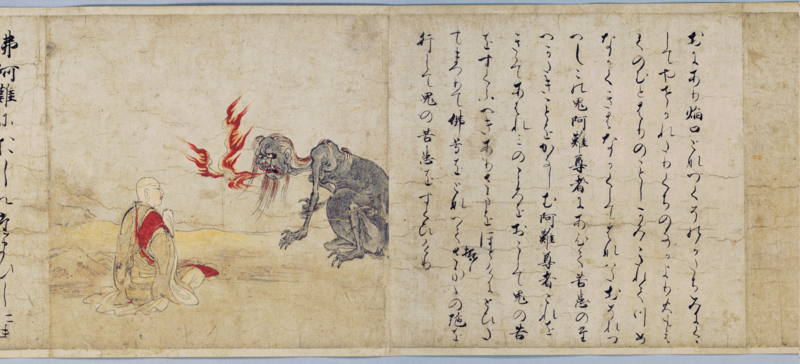
The Hungry Ghost: The concept of hungry ghost is found throughout Buddhist traditions. This is from the Sixth section of the Japanese Hungry Ghosts Scroll located at the Kyoto National Museum. The scroll depicts the world of the hungry ghosts, one of the six realms of Buddhism and contains tales of salvation of the hungry ghosts. This particular section shows Ananda, a disciple of Shakyamuni, teaching an incantation to achieve salvation to a hungry ghost who continuously belches flames from his mouth.
The creation of a Hungry Ghost happens when a person’s death has been exceptionally violent or unhappy. The ghosts are often given quite animalistic traits in the ghost stories and records. Although there are different categories and types of hungry ghosts, one common trait among them are that they are seeking a type of revenge of those who wronged them, or simply those who got in the way.
Although most accounts of Tu Po doesn’t give him animalistic traits like a monster, he definitely sought his revenge on those who wronged him like most vengeful ghosts are looking for, and therefore given the title of a Hungry Ghost.
Before becoming a Ghost – Tu-Po the Emperor’s Minister
Before becoming an ancient ghost, Tu Po used to be an important man in ancient China. The nobleman Tu Po 杜伯 is sometimes translated as Du Bo and he was the Duke of Tangdu. This was a Dukedom situated west of State of Yi Lin around were the Shaanxi province in northwest of China is today.
According to legend, the Tangdu people were descendants of the people living in the State of Tang, a Dukedom destroyed by Zhou Gong Dan that now ruled the empire. They were allowed to form a new State of Du, and became known as Tangdu or Du shi (杜氏).
Tu-Po was not always remembered as a hungry ghost, but was a prominent minister to King Xuan of Zhou (also known as Emperor Hsuan) who reigned from 827-783 B.C. Emperor Hsuan was the eleventh king of the Chinese Zhou Dynasty in a time were the kings words were the law and his minister Tu Po had to pay the ultimate price.
The empire:Map over the Jin (Tang) state during the late Spring and Autumn period as it was called, around the time of Tu-Po’s death and after. This is were he, and his ancestors resided and ruled.//Photo: Hugo Lopez – Wikimedia Commons user: Yug
The king is mostly remembered for fighting the ‘Western Barbarians‘, most probably Xianyun, an ancient nomadic tribe that invaded the Zhou empire on the Huai River. He also meddled in debacles of successions in States of Lu, Wey an Qi and was, according to history, not a popular one. Sima Qian, considered father of Chinese historiography, said: “From this time on, the many lords mostly rebelled against royal commands.” And the way the king ended his reign, is rumoured to be the work of the hungry ghost of Tu Po.
So Tu Po was from a stately and very powerful family and not afraid to speak up for what he believed in, even to the most powerful man in the dynasty. And this would cost him his life and make him a hungry ghost, haunting the earth and seeking revenge.
The Fall From Grace and Becoming a Vengeful Ghost
There are not very many sources detailing what happened before the haunting of Tu Po’s hauntings started. But according to one account, this is what happened.
The King:King Xuan of Zhou (827-783 B.C). Formerly known as Emperor Hsuan or King Suan.
On the ninth year as King, King Xuan of Zhou called all the lords of his empire into a meeting that would seal the fate of Tu Po to discuss an oncoming attack.
A rumor was out that a woman was about to become a danger of the town of Jiangshan for some reason, and the King ordered a mass execution of women. Exactly how this one woman could be considered a danger to an entire town is not really explained.
No matter what the reason behind this mass execution of women, it was seen as a truly horrible act that Tu Po disagreed with. Tu-Po publicly opposed to the order he was given and he spoke against his king in a time when the kings word was the law and anything else considered treason.
This final act of opposition would cost him his life as King Xuan ordered his execution for this as he saw this act of opposition as treason.
Before Tu Po was executed however, King Xuan of Zhou was warned that Tu Po’s ghost would stay in this world even in his afterlife to haunt him as Tu-Po himself said:
“If my majesty kills me without reason, the dead may not know, well that’s it. However, on the other hand, I will avenge myself on him, within three years.”
But despise the warnings, King Xuan went through the execution. Even though he was considered innocent of treason by most, Tu-Po was executed around 786 B.C. But this would not be the last time he was seen.
The Revenge of the Hungry Ghost
Weather Tu Po’s final words were taken seriously, is not mentioned. Three years after the execution however, the King brought his dukes to hunt on his own hunting grounds. There were hundreds of chariots, thousands of escorts following them as well as a ghost that promised he would return for revenge.
Ghost festival: Lotus-shaped lanterns are lit and set afloat in rivers and out onto seas to symbolically guide the lost souls to the afterlife.
At noon, Tu-Po appeared as a ghost, riding a white horse and a cart, wearing a red coat with a red bow and arrow in hand. He took up the chase of King Xuan and shot the king in the heart and broke the king’s spine. At the time, it is reported that no one saw the killing and no one heard it. No matter what the real situation was like, The king fell and Tu Po got his revenge.
If King Xuan really died of an arrow is today a bit unclear. In some accounts it is said that King Xuan died of something else after dreaming that Tu Po shot him to death with an arrow.
In both cases, the innocent and wronged minister got his revenge and King Xuan’s son, was the last of the western Zhou to lead.
The story has gone down in traditional legends, ever since. The Chinese philosopher, Mo Zi (470-391 B.C), said this about ghosts and about Tu-Po’s revenge:
“If from antiquity to the present, and since the beginning of man, there are men who have seen the bodies of ghosts and spirits and heard their voices, how can we say that they do not exist?
If none have heard them and none have seen them, then how can we say they do? But those who deny the existence of the spirits say: “Many in the world have heard and seen something of ghosts and spirits. Since they vary in testimony, who are to be accepted as really having heard and seen them?”
As we are to rely on what many have jointly seen and what many have jointly heard, the case of Tu Po is to be accepted.”
An online magazine about the paranormal, haunted and macabre. We collect the ghost stories from all around the world as well as review horror and gothic media.