Tag Archives: museum

Ghosts of Tagore House – Jorasanko Thakur Bari

Advertisements

In the old house of a famed Bengali poet and philosopher, the ghosts of Tagore House or Jorasanko Thakur Bari are said to linger. Throughout the years, the family of Rabindranath Tagore have told about the haunting said to have happened inside of the mansion. 

North in Kolkata lies Tagore House, an anglicized way of saying Jorasanko Thakur Bari, a grand mansion that once served as the residence of the illustrious Tagore family built in 1785. The stately home of high ceilings, black and white marble floor and arched doorways is today a nod to just how powerful the ancestral home of the Tagore family was. They were one of the leading families in Kolkata and key players in the Bengali Renaissance. 

Read more: Check out all of the ghost stories from India

This sprawling palace stands as a testament to the legacy of Rabindranath Tagore, the Nobel laureate poet and polymath who called it home. In 1913 he became the first non European to win the Nobel Prize in Literature. Now his ancestral home operates as a house museum and has, according to his family, always been haunted. 

Jorasanko Thakur Bari: The Tagore House is the formal house of the nobel prize writer Rabindranath Tagore and his family for generations and also thought to have been or is haunted by his family. // Source

Rabindranath Tagore and his Life of Ghosts and Spirits

Several eerie tales shroud Tagore House in an aura of mystique, adding to its allure as a haunted abode which is said to come to life at night. When he was alive, Rabindranath Tagore had a keen interest in the supernatural as well and had often planchette sessions inside of the building after his father, Debendranath died. 

Even in his writings, like the tale found in Mastermoshai there are haunting tales happening. And one particularly story about a student drive his teacher to suicide is said to have been inspired by something that happened at Jorasanko Thakur Bari, and most ghost stories comes from his era. 

Rabindranath Tagore (রবীন্দ্রনাথ ঠাকুর) was born in Jorasanko Thakur Bari in 1861 and his poetry and writing have been called both spiritual and magical. 

Among the most chilling accounts are those of phantom footsteps echoing through empty corridors and the haunting sound of anklets tinkling in deserted rooms and other strange occurrences inside of the Jorasanko Thakur Bari building. 

These spine-tingling tales have been meticulously documented and shared from the Tagore family over the years, finding their way into writings like ‘Thakurbarir Bhooter Golpo’ (Ghost Stories from Thakurbari), a collection that chronicles the chilling legends of Tagore House. 

Hauntings of Jorasanko Thakur Bari

One of the stories you will find written down is from when Rama, who was Tagore’s granddaughter died. The family was distraught by her death and didn’t want to send the body away. Instead they put her downstairs that evening and waited and grieved. 

Rabindranath Tagore: (7 May 1861 – 7 August 1941), also known by the sobriquet Gurudev, was a Bengali poet, Brahmo Samaj (syncretic Hindu monotheist) philosopher, visual artist, playwright, composer, and novelist whose avant-garde works reshaped Bengali literature and music in the late 19th and early 20th centuries.

Amita Thakur was one of the women in the family who sat in the room next door that evening and told about what happened next. Suddenly the lanterns in the room went off one by one in the row they hung in. Everyone in the room freaked out, not daring to light the lights again.  And when a cold breeze started coming from nowhere, they knew that there was a spirit with them. 

The Ghost Walking in Tagore House

Another story told from the Tagore House was when Tagore’s nephew, Nitish died. In the period right after his death the family claimed that Nitish was seen almost every evening as he was walking down his favorite corridor. Which also says something about just how big this house was. 

There would also be stories about the relatives living in Jorasanko Thakur Bari waking up and seeing a ghostly figure standing and watching them.

The Dead Wife in the Picture

Mrinalini Devi

From the book detailing the haunting of the mansion they also discuss one of the mysterious pictures taken of the family that sparked a debate that yet again a ghost in the family lingered in the Tagore House. 

Mrinalini Devi, the wife of Rabindranarth Tagore, was also a translator and described as a woman with a great personality as they described her. She died in 1902 after a serious illness the doctors never managed to diagnose. She was only 28 and according to legend, her ghosts have shown up from time to time. 

In 1904, the family gathered for a family picture, and as a shadow behind her husband, it is said she sat in the picture, two years after her death. Was this the final haunting from her side? Some say that she is still haunting the place.

The Haunted Jorasanko Thakur Bari House

As dusk descends and the shadows lengthen, Tagore House takes on a hauntingly beautiful aspect, its majestic facade concealing secrets that defy rational explanation. 

Whether fueled by imagination or rooted in reality, the haunted rumors surrounding this historic palace continue to captivate the imaginations of those who dare to delve into its shadowy depths. A story just as good as the fictional stories that were written in the Tagore House. 

More like this

Newest Posts

References:

https://www.boldsky.com/insync/life/2012/ghosts-famous-people-030152.html?story=1

10 haunted places in Kolkata you MUST visit to see what a horror movie really looks like

Jorasanko Thakur Bari – Wikipedia

Transforming the Samsung Galaxy S24 Ultra into a Technological Marvel | – Times of India  

Rabindranath Tagore – Wikipedia 

The Haunted Yongin Folk Village

Advertisements

In a town made up of old houses or replicas of homes from the Joseon Dynasty, Yongin Folk Village has today status as one of the more haunted places in South-Korea. 

Nestled right amid the modern city in Seoul, where high risers, public transportation and life are all from the 21st century, a small place where the traditional ways are allowed to remain in peace. 

The place of Yongin Folk Village perhaps looks a bit familiar to those interested in Korean period dramas, and famous TV series like Kingdom, 100 Days My Prince and The Moon Embracing the Sun for instance. But for many it has also been known in the later years as one of Korea’s most haunted places. 

Read also: Top Korean Horror TV-Series

Top Korean Horror TV-Series

The last few years, K-dramas has certainly taken over much of the media the world consume today. And although it is largely remembered from the overly romantic dramas with umbrellas in the rain and watching over people with a cold like they are on their deathbed, some more darker series has caught on. In fact…

Keep reading

The Traditional Folk Town

Though the town Yongin Folk Village (한국 민속촌)  itself looks real enough it was first opened in 1973 as a response of the rapid westernization as well as the industrialisation of Korea at the time. 

Read More: Check out all of our ghost stories from Korea

This first open air museum in the country was supposed to work as a living museum and a destination to experience Korean culture, not only for foreigners to learn, but for Koreans to remember. 

Traditional houses: Traditional thatched roofed houses from the late Joseon Dynasty are all around the Yongin Folk Village.

Yongin Folk Village is found in the Gyeonggi province right by the capital, and the over 260 houses were relocated from across the country and put together to be a replica of a village and how it would have worked and looked from the late Joseon period. So although the museum is a fairly new and modern thing, the things inside it are old, very old. And believing the many legends about the place, also very haunted. 

The staff working in the folk village are all dressed up in costumes as well, representing characters from the Joseon Dynasty, contributing to the special atmosphere of the place. You can also attend workshops, watch performances or even host a traditional wedding ceremony there.  

Ghost Month of Summer

So where do the tales of the Yongin Folk Village being haunted come from? With the old and mysterious atmosphere there are no wonders legends about the place started to come. The events that are held by the village have perhaps also been a contributing factor to the ghost rumors. 

During the summer months the folk village hosts ghost events to highlight the ghost season which in Asia for most parts is in the late summer months. But also in later years Halloween later in the fall has become much more popular as well, and there are more than one ghost and haunted related events in the village. 

But there are those who claim that the folk village is not only haunted by ghosts or gwisin during ghost month or Halloween, but all year. 

Read also: The Obon Celebration

The Korean Virgin Ghost

Because there are those claiming to have seen actual ghosts around the village and in the supposed haunted old houses. Mainly tales of the Korean Virgin Ghost have been spotted with her dark long hair and wearing traditional burial clothes. 

Performance: Dancers holding a traditional Korean dance performance for the visitors in Yongin Folk Village.

According to legend, virgin ghosts were women that died before being married, and very often held a grudge and power to avenge herself in the afterlife. 

Read also: The Korean Virgin Ghost

The Korean Virgin Ghost

The Korean virgin ghost may be based on the ideals that all a woman needs is a husband, but the anger of these spirits tells of a woman with another purpose. And that is mostly vengeance. 

Keep reading

Question is, could it be nothing more than an actor wearing a costume and being too good at their job in the haunted house section of the village, or could it actually be something supernatural afoot?

The wildest claim though is the rumor that this is the place where the legends of the Virgin Ghost started. Especially since most written notices about ghosts being spotted in the village are vague or connected to the haunted house events.  

But when we look at the history of the Korean Virgin ghost, the legends about them trace back longer than the village itself. Although, perhaps the legend is as old as some of the houses that were relocated?

More like this

Newest Posts

References

Mandy the Haunted Doll

Advertisements

Known as Canada’s most haunted object, the antique doll that follows the museums visitors with her glass eyes and cries in the night.  

The haunted doll known as Mandy was donated to the Quesnel & District Museum in British Columbia, Canada in 1991 by a woman called Lisa Sorensen. The doll was from her grandmother that she found when cleaning out the house. She had just had a baby of her own, but didn’t want her daughter near the doll as she had noticed strange things about it. 

Advertisements

She told the museum when she donated the doll that it kept her up during the nights. In the night she would wake up in the night to the sound of a crying baby in the basement. But when she checked there was nothing there. The doll started to scare the owner and she decided to give it away. After she had given away Mandy to the museum, she no longer heard the cries of a baby. 

The only connection the family now has with the doll is the name, which she gave after her own daughter: Mereanda, or Mandy. 

Night at the Museum

Now Mandy the doll sits in a locked cabinet, her eyes reportedly following the visitors with her cracked porcelain face as well as the staff at the museum. 

The staff remembers well when Mandy first came to them. They left her in the lab overnight when taking her pictures to add to the collection. When they came into work the next morning, they found the lab trashed, almost like a temper tantrum to a child. And since then, strange occurrences have only kept on happening. 

Small stuff would start vanishing without a trace and even the staff’s lunches would start disappearing from the fridge and appear in random drawers. 

Electronic devices are said to malfunction in the doll’s presence, especially when trying to get her picture your camera light will go off and on. 

The museum gave Mandy a stuffed lamb to keep her company, but would the next day find the lamb tossed outside of Mandy’s locked cabinet. Although many of the practical people would dismiss these happenings as purely coincidental with a perfectly logical explanation, the legend of the haunted doll kept growing.

Haunted by the Grief of a Bereaved Mother

The doll is supposedly around a century old and even got to meet up with a medium to examine her past on a show. The medium was Silvia Brown and she meant that the doll had once belonged to twins that died of polio. And the energy that the doll gave off was that of the mother to the twins and her sorrow she somehow implanted the doll. 

Advertisements

More like this

Newest Posts

References

Mandy, ‘supernatural’ doll at Quesnel Museum, gets QR code to share ghostly stories | CBC News

Meet Mandy the Doll, Canada’s Most Evil Antique – Cabinet of Curiosities

https://www.quesnelmuseum.ca/node/264

Canada Is Home To One Of The World’s Most Famous Haunted Dolls | HuffPost null

Ruby the Haunted Doll

Advertisements

This porcelain doll named Ruby will give the people playing with her an instant sorrow and sense of sickness, just by holding her. Family legend has it that the doll is haunted by a little girl that died with Ruby in her arms.

Ruby the Doll had a special talent when she was living with her family. That talent was moving from room to room, all on her own. No wonder her owners didn’t want to play with her as she was so cursed that she made the people holding her feeling sick, sad and sometimes, even nauseous. 

Even with the cutesy blue eyes and golden locks, she is definitely not the scariest looking doll there is out there, but there is still something about the way she watches you with her porcelain eyes. The family that originally owned her certainly seemed to think so and thus kept her hidden away.

Advertisements

Instead the doll was passed down from generation to generation and put away in attics and basements, but they would constantly find her in other rooms than they put her in. 

Haunted Porcelain

She is a porcelain doll from the early 1900s from Southern Ontario in Canada and belonged to a young girl of the same family that always had her in their possession, who passed away while she was holding Ruby in her arms allegedly. 

The family even contacted a psychic medium once to get rid of the spirit that seemed to have attached itself to the doll. But it seemed to have failed as the strange occurrences around the doll kept happening. 

Ruby The Haunted Doll: This little doll is said to be of the haunted and cursed kind. Visitors claim they feel unwell and get a sense of overwhelmingly sadness when being close to the doll. // Photo: Traveling Museum of the Paranormal and Occult

Since then she’s been creeping out every generation that inherited her. Not only by disappearing and appearing in different rooms, but also because of the strange sounds that seem to be coming from the doll. 

Traveling Occult Objects

She is currently traveling with the Traveling Museum of the Paranormal and Occult that collects strange, occult and haunted objects, just like Ruby. Together they travel to places curious about the rarities of the occult. Thank God Ruby seems to always have enjoyed traveling. 

She was given to the museum from a friend whose family had Ruby hidden away in a cardboard box. 

And according to the owners, Greg Newkirk and Dana Mathew, visitors often get a feeling of sorrow from the doll, but also a sense of maternity and an urge to rock the little doll back and forth for comfort. 

Advertisements

More like this

Newest Posts

References

Ruby the Haunted Doll – Traveling Museum of the Paranormal & Occult

9 Scariest Haunted Dolls You Do Not Want in Your Home 

Meet Ruby the haunted doll with a poignant past

The Ghosts From Security Prison 21 in Tuol Sleng Genocide Museum

Advertisements

Cambodia is a land with a lot of hauntings. One of them being in the old prison known as Tuol Sleng or Security Prison 21 where almost 20 000 people were tortured and killed during the Cambodian Genocide. And even today, the building is known for its ghosts. 

In Tuol Sleng Genocide Museum that used to be a prison, some of the prisoners were never really freed. Even in their deaths, their souls lingers in what used to be their own prison cells. However, they have now people taking care of them. 

The people working in the former prison now turned into a museum are well aware of the past and try their best to honor the building’s gruesome history. There are many occurrences that are being reported on that the museum’s staff cannot explain. Objects are being thrown hard to the floor and high pitched screaming has been heard.

Advertisements

The staff working there also leave out food for the ghosts when they go on lunch break as they can’t enjoy their own lunch because of the loud noises the ghosts will make when they don’t leave an offering. 

The Cambodian Genocide

To understand the hauntings of this museum, we must first understand a little bit of Cambodia’s dark past and how so many could die in a place like Tuol Sleng. 

After years of devastating civil war, Cambodia had already seen its fair share of bloodshed. But the worst was still ahead of them and from 1975 to 1979, Cambodia went through a systematic killing, later known as the Cambodian Genocide which killed nearly a quarter of Cambodia’s population at the time. The exact death toll is uncertain, but it ranges from everything from 1.5 to 2 million people. 

The genocide was done by the Khmer Rouge, a popular name given to the communist party called Communist Party of Kampuchea (CPK), led by Pol Pot who wanted to ‘cleanse’ the population in order to establish a pure, self-sufficient communist state. 

Tuol Sleng Genocide Museum: Known as Security Prison 21 or S-21 during its time of torture and killings where thousands of Cambodians died. Here is one of the buildings of Tuol Sleng in 2013 // Photo: Dudva/Wikimedia

The Story of the Prison Turned Museum

Tuol Sleng Genocide Museum (សារមន្ទីរឧក្រិដ្ឋកម្មប្រល័យពូជសាសន៍ទួលស្លែង) literally means, ‘Hill of the Poisonous Trees’. It used to be a secondary school in the capital Phnom Penh until the Khmer Rouge regime took over and used it as a prison during the genocide. 

Prison Cells: The former school turned the classrooms into prison cells the museum has kept intact to this day.// Photo: Gerd Eichmann/Wikimedia

Known as Security Prison 21(មន្ទីរស-២១) or S-21, it converted the classrooms to prison cells and torture chambers in 1976. It is estimated that over 18 000 were killed in the S-21, including children. Of course, this is an estimate since the real numbers are uncertain and could also be much higher. Only 12 former inmates survived from the prison. 

When the prisoners arrived at S-21 they were photographed, forced to undress and had their personal belongings confiscated. Many of the prisoners didn’t even know why they were taken. There would often be nonsensical reasons like wearing glasses or speaking multiple languages, a sign of being an intellectual that could potentially speak against the communist regime.

Also religious, ethnic and political reasons were why you were being singled out as a potential threat to the regime. Often whole families would be taken at the same time so that no one would be able to seek revenge for them. Pol Pot said himself: “if you want to kill the grass, you also have to kill the roots”

After a grueling questioning to make them give up information, they were taken to their cells. Some were shackled to the floor in small prison cells, others were shackled together with others in large rooms. One of the common hauntings people report on is the sound of shackles rattling from the cells. The prisoners were forbidden to talk to each other and had to follow the rest of the rules. Any action, just sitting up or turning over had to be approved by the Khmer Rouge guards, and they would be severely punished if they broke the rules. 

The goal was to get the prisoners to confess before executing them. Either that they themselves were betraying the party and the revolution, or give up names of those that did. They got the prisoners to confess to anything by the use of torture and submersion in water, electric shock or being hanged from the gallows by their hand until unconscious were some of the methods. Once they got a signed confession, they had to face their execution. 

The Killing Fields

The prisoners were killed on site at first, but then they also started to execute at what would be known as the killing field outside of the city known as Choeung Ek. The prisoners often had to dig their own graves before being killed. 

These fields have numerous stories of being haunted themselves. In the field in Choeung Ek, a site with mass graves where many graves are visible above the ground. During rainfalls, bones and clothes surface from the shallow graves.

This relentless killing and torture lasted for many years. The prison closed down in 1979 when the Vietnamese army invaded and ended the rule for the Khmer Rouge. And ever since then, Cambodia has tried to rebuild the country, piece by piece.

Advertisements

Security Prison 21 never returned to being a school for children. It was instead turned into a memorial and a museum that would remember and showcase the atrocities that the people suffered during those years.   

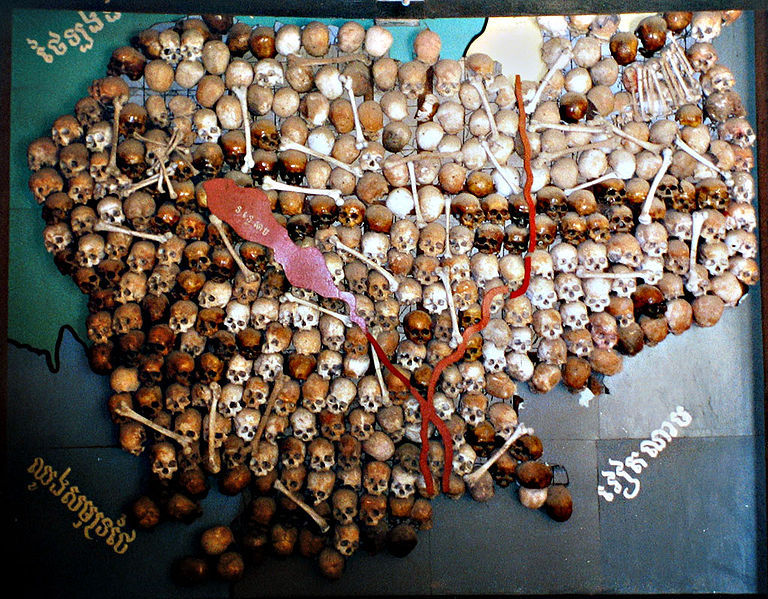
From 1979 until 2002, they displayed a huge map of Cambodia made up of 300 skulls of victims to the regime. It was displayed to show the brutality of the regime until it was dismantled to give the skulls a proper burial at last. 

But did it also bury the rumors of the prison being haunted?

The Haunting at the Museum Today

From the outside rumors about a haunting of ghosts started spreading. Neighbors claimed to hear the rattling of shackles and terrified screams from inside the former prison. Also from within the museum, countless reports of something paranormal going on started to spread. Many of the staff at the museum claim to have witnessed the hauntings, both cleaners, guides and the security guards, especially those working the night shifts. 

Map of Skulls: This is the infamous skull map that was on display in the former S-21 prison camp at Tuol Sleng in January 1997 // Photo

“There was one night that I woke up to go to the bathroom when I saw a black figure bending towards me, and that made my hair stand on end. I was very frightened; I climbed back into my bed and waited until the morning to tell my colleagues,” Nong Saveoun, a security guard who both worked and lived at the genocide museum said to the Phnom Penh Post back in 2016.

There is also a story about a security guard that heard the shower start running after he saw a dark figure opening the toilet door. When he went to investigate, there was no one there. 

Three times a year they hold blessing ceremonies at the Tuol Sleng museum where they invite both government officials and monks to give a prayer to the victims on the Khmer new year, the Pchum Ben festival and on Visak Bochea Day. Perhaps that is the way to appease the soul and finally free the ghostly prisoners from their cells and their shackles to this world. 

Advertisements

More like this

Newest Posts

References

Featured Image: Pete Stewart/Wikimedia

Tuol Sleng Genocide Museum – Wikipedia

History of the Museum

The 10 Most Haunted Places on Earth – Days to Come

NST Region: Five most haunted places in Cambodia

Land prices undaunted by genocide museums’ history and hauntings | Phnom Penh Post

https://www.wired.com/2002/03/skull-map-dismantled/

The Hauntings of Eastern State Penitentiary

Advertisements

If there is one place a haunting is taking place, it is prisons. So much regret, vengeance and the hunt for justice and despair is echoing through the walls. And the ghost of Eastern State Penitentiary is said to haunt the place, even after it closed down as a prison.

The Eastern State Penitentiary is a massive building. All stone, rising from the ground like an old fortress in Philadelphia, built to keep people inside.

The Eastern State Penitentiary has housed some of the most scary criminals, like Al Capone for example. Hard boiled criminals shut away for a long time. The people outside these walls will never know. Perhaps they are happy about it. As long as they are locked away, they say. They deserve it all, they say.

Read Also: Check out all of our ghost stories from Haunted Prisons from all over the world.

In the court system it is said that the punishment is suppose to fit the crime. One can wonder if the criminals got a punishment worse than the crime itself. This is Eastern State Penitentiary, Philadelphia.

The Eastern State Penitentiary is reportedly a haunted prison and the location has made an appearance of many of the paranormal ghost hunting shows like Ghost HuntersGhost Adventures and BuzzFeed Unsolved.

Haunted Isolation in the Early Days of Eastern State Penitentiary

When the Eastern State Penitentiary was built it was the most expensive building in the USA. opened in 1829 they brought isolation to new heights. Not only were they to be separated from people from the outside. In this prison, the idea was that they would be separated from everything.

The Prison of Isolation: the Eastern State Penitentiary practice isolation for the prisoners because they thought it would help reform them and help them spiritually.

The prisoners that were sent there, really did everything in isolation. They lived alone, worked out alone and ate alone. Even when they were transported from place to place they were doing it all alone.

When a prisoner left his cell, an accompanying guard would wrap a hood over his head to prevent him from being recognized by other prisoners. Everything was done in isolation.

Read Also: Another haunted prison known for its horrible conditions is the The Ghosts From Security Prison 21 in Tuol Sleng Genocide Museum

It was all done it good faith at the start as the though of reformation instead of punishment was strong in the initial prison design. The idea was that silent contemplation was meant to be helpful in the prisoners rehabilitation and road to a crime free life. Instead, it ended up as a particular form of torture. The cells were made of concrete with a single glass skylight, representing the “Eye of God”, suggesting to the prisoners that God was always watching them.

But this was a long time ago, right? It was to people in a different time. They wouldn’t do this to people today, right? Well, the prison didn’t close its doors until the seventies. They had to do something with the isolation because of overpopulation from 1913. Too many prisoners to keep them separate. But is wasn’t necessarily to the better and the prison operated all uptil 1971.

Eastern State Penitentiary Famous Inmates

Although it in the earlier days of the prison, it housed mainly petty criminals incarcerated for various robbery and theft charges like muggers and purse-snatchers. first-time offenders often served two years.

But as the prison operated for a long time, the Eastern State Penitentiary housed many of the well known prisoners that had done serious crimes and served long sentences like the bank robber Willie Sutton that served 11 years in the prison and was one of the prisoners that tried to escape after digging an underground tunnel in 1945. or the American gangster Al Capone, also known as Scarface who was known for being Public Enemy No. 1 in his time. They served her after the isolation concept of the prison stopped.

Read Also: Check out perhaps the most famous haunted prison with the most famous ghost prisoners: Unveiling the Dark History of the Tower of London and its Ghosts 

In Al Capone’s case, it can seem like the prison was a haunting experience for him as well. He spent 8 months in the prison from 1929 and had many benefits and even his cell was decorated with luxury of fine furniture, oriental rugs and a personal radio, making it a cozy room almost. Even with all of his privileges, he had trouble sleeping and was heard at night, screaming that the ghost of someone named Jimmy had to leave him alone. The guards also claimed to her him have full conversation with this Jimmy as well.

Scarface in Eastern State Penitentiary: Alphonse “Scarface” Capone got his first taste of prison life in Philadelphia. When he was arrested outside a movie theater for carrying a concealed, unlicensed .38 caliber revolver. Capone’s arrest came at a time of escalating mob violence in Chicago, and he was often accused of hiding in prison intentionally.

Even after he got out from prison he saw this Jimmy and even hired a medium to get rid of it, but according to the story and the rest of his story, it didn’t look like it worked.

It is believed that the Jimmy, Al Capone though he was haunted by was Jimmy Clark, one of the people that Al Capone had killed during the Valentine’s Day Massacre.

In the end he was even committed to a mental hospital because of his visions and mental health. Whether it was because he was really haunted, or rather because of his syphilis is hard to tell.

Place of Torture at Eastern State Penitentiary

One should think that when you get your judgement, that is it. This is your punishment. But no, once inside the prison walls, the punishment for minor offences can get you in a lot of problems, and in a lot of pain. One example of the punishments that were around was to chain the tongue of a prisoners to his wrist.

As well as their habit of isolating the prisoners, a form of torture in itself, the prisoners were also subject of being subdued in freezing water, being strapped to a chair for days and and putting the worst behaved prisoners into a pit called “The Hole”, an underground cellblock dug under cellblock 14 where they would have no light, no human contact, and little food for as long as two weeks.

Torture in the Prison: Although the initial thought of the punishments was to help the prisoners reform and grow spiritually, the fact was that many of the prisoners serving time for petty theft were subjected to harsh torture.

All of these past history and ways of life have helped to form the narrative that some of the former prisoners must surely haunt the place that put them through all of this.

Haunted Places in the Eastern State Penitentiary

There are many location inside of the prison who is said to be more haunted than others and the people that used to serve time there as prisoners or worked there as prisoners have all stories to tell. Even those working there now as staff or visitors claim to have experienced paranormal activity, everything from hearing footsteps, whispers, seeing visions or even hearing wailing from the painful past of the prison. .

On Cellblock 12 it is reported on echoing voices and cackling coming from the walls. Another common story heard from the Eastern State Penitentiary is like the ones from Cellblock 6, a place that is known for reports of people seeing the apparition of shadowy figures that flutters across the halls.

The Hauntings of Eastern State Penitentiary: Many of the locations of the prison is haunted according to old as well as new staff, visitors and prisoners alike. They talk about seeing strange apparitions in the halls and the cells and hearing strange voices and noises coming from places were no one is.

Cellblock 4 has a reputation of being haunted by the apparition of ghostly faces appearing. The most famous story about this haunting comes from the maintenance man, Gary Johnson who worked there in the 1990s. He had just opened an old lock in the block when he felt some sort of force took hold of him, making him unable to move. A horrible negative energy filled the cell and the visions of these tormented ghost faces appeared on the cell walls.

As well as the cell blocks were there were held countless of prisoners over the years, there are also reports of what look like former guards haunting the place. In the towers there have been reports about people have seen something that look like the ghost of a guard. What is strange about seeing a figure here however is that there are no physical way of getting up to those towers for a living person.

On the second floor there used to be a cellblock for women when the prison was in operation. Today there is a sighting of a woman wearing white sitting in the last cell that have been seen so often that she has gotten the name: The Soap Lady.

Eastern State Penitentiary’s History in the Museum of Ghosts

Today it’s more like a museum, were we can walk over the faith of these people on ghost trips to a few coins, capitalism at its best. The museum now also caters to the paranormal atmosphere of Eastern State Penitentiary and offers a haunted house attraction during halloween season. And although many of the prisons like Eastern State Penitentiary have started to rethink prison tourism, this is the sort that sells the tickets.

Read Also: Another haunted prison you can visit is Ghost Stories of The Haunted Prison Alcatraz.

The hauntings however, is said to be there for free as well as Hollywood made and what is an actor and what is an actual ghost is said to have hazy line.

Al Capone’s Cell: Not every prisoners got to have a luxurious cell as the one Al Capone had when he stayed in Eastern State Penitentiary. According to legend though, there was something that seemed to haunt Al Capone when he stayed in his cell at night.

The most normal things we can hear at the Eastern State Penitentiary when the darkness falls is the laughter of some that isn’t there, shadowy figures sneaking over the walls. You can also hear the footsteps that never reaches you. Because even in death, the prisoners in kept in isolation. They are not to see, and not to be seen, ever again.

More like this

Newest Posts

References:

Al Capone – Wikipedia

Eastern State Penitentiary – Wikipedia 

History behind the walls: How Philadelphia’s most famous haunted house began

https://omgfacts.com/article/1202

The Haunted Eastern State Penitentiary