The infamous Lizzie Borden House is said to be one of New England’s most haunted homes after a brutal ax murder happened inside. After the murders, there are tales that ghosts are still haunting it.
Lizzie Borden took an ax and gave her mother forty whacks. When she saw what she had done, She gave her father forty-one.
Step back in time to the home of one of America’s most notorious unsolved crimes – the Lizzie Borden House on Second Street in Fall River. Experience its creepy atmosphere and listen to its spine-tingling tales as you explore this legendary haunted house full of secrets and the occasional supernatural surprise!
Grab a candle, journey upstairs and learn the history of the infamous New England home. Find out how in 1892 Andrew and Abby Borden were discovered brutally murdered in this very house, passing down stories for generations to come.
Who was Lizzie Borden?
Lizzie Andrew Borden was born in 1860 in Fall River Massachusetts and was given the name Andrew as well because her father so wanted a son. She grew up in an affluent family in what would later be known as the Lizzie Borden House. Although a rich family, her father was well known for being frugal and they had a complicated relationship to say the least.
She grew up with her sister, Emma Lenora Borden and was involved in church activities such as Sunday school, the Woman’s Christian Temperance Union as well as the Ladies’ Fruit and Flower Mission.
Two years after her mother died, her father remarried. They didn’t get along and Lizzie believed she had married her father for his wealth. Their live in maid, Sullivan claimed that both Emma and Lizzie rarely ate meals together with their father and stepmother.
Before the murders, tension grew in the family inside of the Lizzie Borden House. Her father kept gifting real estate to her stepmother’s family. Days before the murders the whole family was violently ill, and her stepmother feared poison as her husband was not really a popular man.
Her father had also killed pigeons in the barn with hatches that Lizzie was upset about. She had built a roost for them and after a family argument, she was even sent away to New Bedford and didn’t return until a week before the murders.
The Ax Murders in the Borden House
On August 4, 1892, her stepmother and father were found murdered by an ax in their home in broad daylight. When they questioned Lizzie Borden she made answers that were both strange and contradictory.
The police investigation were later criticized for their lack of diligence as they did not even check her for bloodstains, only search her room superficially and let them stay in the house the following night after the murder. They also had a hatchet they thought could be the murder weapon, but never bothered to take fingerprints even though it was a method the police had started with elsewhere.
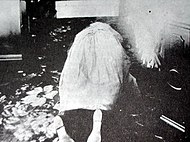
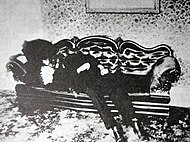
Abby Borden: Lizzie Borden’s stepmother, Abby was found upstairs and had suffered 17 hits on the back of her head. Andrew Borden: Her father, Andrew were found in the couch in the downstair sitting room murdered after being hit 10 or 11 times with a hatchet like weapon.
Lizzie Borden was arrested and put on trial that received a lot of media coverage nationwide. During the trial there was also another ax murder that looked so similar to the Borden house, and many started to take Lizzie Bordens side and claim her innocence.
In the end Lizzie Borden was acquitted on all charges and let off after many had come to her defense, including her maid, her sister and neighbors all testified that she never could have done it.
Life After the Murder Trial
After she was acquitted from the trial of the murders she moved into a house with her sister and they stayed in Fall River. When coming out from the courthouse she said she was ‘The happiest woman in the world.’
But for the remainder of her days, she was an outcast in the Fall River society. Even if she by trial was found innocent, the fact that they never found the killer and the strange rumors about her continued and fuelled the idea that she might have done it after all. Even her maid, Sullivan confessed on her death bed allegedly that she had lied on the stand to protect Lizzie Borden.
No one was ever arrested for the murders, but Lizzie Bordens guilt and motive has ever since been debated without any answers being found.
The Hauntings in the Lizzie Borden House
After the gruesome murders in the Lizzie Borden House, the house itself has drawn attention to itself of being a haunted house where a lot of paranormal activity is going on. The house is preserved as it was and is hosting tours to continue to speculate what really happened that fateful and hot August day.
It is said that the ghost of Lizzie Borden’s father and stepmother, Abby and Andrew is haunting the Lizzie Borden House, still trying to get the truth about their murder out.
One long time guide though has another explanation for the strange sounds many attributes to ghosts. After they put air conditioning in the house, the sound travels in a strange manner as Lizzie Borden House is filled with holes and cracks.
The Lizzie Borden House: The busy street were the murder happened on 92 Second St, Fall River, MA, the home of Lizzie Borden at the time of the murders as it appeared in 1892.
Another haunting that is said to be going on is the death next door of a mother that murdered her children. A woman named Eliza Darling Borden had three children. She murdered two of them before taking her own life in 1848. One of the theories is that she killed herself in the house that would eventually become Andrew Borden’s in 1872.
Even Lizzie herself is rumored to haunt the place. It is not only in the Lizzie Borden House she is said to haunt tough as she is also said to haunt the place known as Maplecroft, the home she lived in on French Street after the trial. For what is she haunting the place for though? Is it because of the grief and trauma after the horrible murders that happened. Or is it perhaps guilt as she herself really was the killer?
At the day of his wife, Elena Grimani’s death anniversary, a the ghost of noble man called Fosco Loredan can be seen carrying his dead wife’s head . The very same head he himself decapitated out of jealousy and had to carry to Rome.
Once upon a time in 16th century Venice, a nobleman called Fosco Loredan fell in love with a woman. Her name was Elena Grimani and was the Doge’s niece and in a very powerful position. They married, but it wasn’t happily ever after.
Not much is known of Loredan’s life except that he was a very well known man. It was also known that he was a horrendously jealous man and kept accusing his wife of cheating on him. He would also regularly spy on his much younger wife as she was always getting much attention because of her beauty. Elena Grimani denied having an affair, but he wouldn’t believe a single word she said.
One night in 1598, Loredan went to Campiello del Remér in the Cannaregio district of Venice to look for his wife. He was sure that she was betraying him with another man. In a fit of rage he chased her from their marital home with a sword in his hand.
The chase ended with Loredan beheading Elena Griman in front of everyone at Campiello del Remér, including the Doge himself, who was the leader of Venice.
According to the legend, the Doge Marino heard the desperate cries of his niece, Elena Grimani and went to her rescue. He placed himself between her and her husband, to no avail. The angry man managed to distract the Doge enough to get past him and behead his wife to everyone’s shock.
Loredan tried immediately to ask the Doge’s forgiveness as it was his right as a husband to punish a cheating wife. The Doge refused though.
Loredan’s punishment for his crime was to carry the body of his dead wife he had decapitated to the pope in Rome to ask forgiveness and mercy. But when he finally arrived there after his long journey, still with his clothes stained with his dead wife’s blood, Pope Clement VIII refused to see him and he wasn’t granted the forgiveness he seeked.
An arrest order was put on him Instead and he had to fight off the guards to escape them and Rome. Loredan walked back to Venice, still holding the decaying body of the woman he murdered in his hands.
It didn’t go well for Loredan after his crime and he didn’t see a way out. He returned to the scene of his crima in Campiello del Remér and in despair he threw himself into the lagoon and drowned.
Today, the local legend says that on the anniversary of Elena’s killing and even on full moon nights, on those night when the northern wind blows, you can still see his ghost along the Grand Canal by Campiello Del Remer, coming out of the water, still carrying his wife’s head.
The abandoned sanatorium in Germany is said to be haunted by all those souls that died inside of it because of its dark history. And in the Beelitz-Heilstätten Hospital, it wasn’t just sick people who ended up dying, but several murders took place in it or around it as well.
Some buildings are just thought to be haunted by the look of them. Especially these old abandoned buildings with a dark and sinister history attached to them. One of these buildings with long ominous corridors and peeling paint is the Beelitz-Heilstätten Hospital not far from Berlin in Germany.
The sanatorium was first built in 1898 as a response to the rapid increase in tuberculosis patients at the time as it was the number one cause of death in Germany at the time for people between 15 to 40.
The Abandoned Sanatorium: The Beelitz-Heilstätten Hospital was originally built in 1898 as a treatment place for tuberculosis. Today it is abandoned with a haunted reputation over it.//source//wikimedia//qbanez
One of the treatments for this was fresh air, so the sanatorium was built in a remote pine forest. The Beelitz-Heilstätten Hospital was a complex of around 60 buildings that in the end, almost served as a small town of itself, with its own bakery, shop, apartments, post office, stables, butcher shop and laundry houses. At the time it was the largest treatment center in the world for lung diseases with at its peak beds for over 1200 patients.
During the first world war Beelitz-Heilstätten Hospital served as a field hospital, and it got famous for treating Adolf Hitler who was wounded in his leg as well as being blinded by a gas attack by the British forces in the Battle of Somme.
When the second world war started it would again be a treatment hospital for the Nazi forces until they lost and ended up being occupied by the Russians from 1945. Beelitz-Heilstätten Hospital stayed like that until 1995 before closing its door for good. At least for treating patients.
The Abandoned Buildings as a Murder Place
Many murders have taken place in this remote area and around it. After the Soviet left, it became a hotspot for satanic and occult people to gather to drink and keep seances. And it was also those with an even more sinister idea.
In March 1991, a mother and her newborn child of three months were brutally murdered right outside the old sanatorium. It was the Beast of Beelitz who had struck again, a notorious serial killer that had started on 24 of October in 1989.
The serial killer Wolfgang Schimdt used to be called Beast of Beelitz or Pink Giant because of his choice of weapon. The killer who legally changed name to Beate and underwent gender reassignment had terrorized the local women for years and his modus operandi was to strangle the victims with pink womens underwear. The Beast of Beelitz is in prison to this day after killing 6 people.
But it wasn’t the only murderer who used this place for his crimes. A photographer and sadist named Michael K brought a 20 year old model named Anja P. to Beelitz-Heilstätten Hospital for pictures, and as he explained it, an erotic photo session that ended with her accidental death.
During the photo session he ended up killing her, but the police found clear evidence that this was not an accident, but a premeditated murder. He beat her with a frying pan and had sex with her corpse after she died.
Dark Tourism of Beelitz-Heilstätten Hospital
Like many of these mysterious and abandoned places there are many people attracted to the eerie beauty of the macabre building and its history. Many visit the place to get a closer look at the building itself or just explore the paranormal rumors that are created by just the haunted atmosphere of the place.
Dark Tourism: Most of the buildings of Beelitz-Heilstätten Hospitalare left to decay and a number of visitors come to experience the eery atmosphere of the abandoned building. But one of the reasons it is fenced off and off limits is because it is dangerous. Several people have had accidents in the unsecured and abandoned building who is falling apart. //source:Wendelin Jacober
Before 2015 it was mostly left to its own devices and people would come and go as they pleased. It was used as a movie location for the 2002 movie “The Pianist”, as well as being the place for horrific crimes.
Today it is more closed off and taken back by the public to renovate and made into a tourist attraction rather than an urbex location for exploration.
A Haunted Hospital
So is Beelitz-Heilstätten Hospital really a haunted place? Considering all the dark stuff that have happened inside of the building complex it is easy to think why people would call this place haunted. But rather than a specific story or encounter that made the place famous, it seems to be the other way around.
This is not the only allegedly haunted hospital either. How about checking out some of the other stories about Haunted Hospitals like Gonjiam Asylum, Weston State or Poveglia Island?
There are however those who enter the place that exit it with tales of something paranormal happening to them. It is the usual stuff of seeing apparition where there are suppose to be none as well as hearing strange sounds and having the feeling of being watched as the room gets colder.
So what do we think? Is Beelitz-Heilstätten Hospital haunted or just plain spooky?
Haunting the iconic Agua Caliente Casino and Hotel in Tijuana, the performer known as La Faraona remains like a ghost from the Golden Age of the Sin City.
During prohibition times in the US in the 1920s, people flocked to the borders to have a drink and a good time. The border towns also become a hot spot for smuggling activity and flourishing establishments that would quench peoples thirst.
Tijuana was one of these border towns that saw a golden age and growth during this time. People came from the whole world to get a drink while gambling at their casino and watch horse racing and bullfighting. For the conservatives, Tijuana became known as a Sin City or was even called Satan’s Playground.
Advertisements
The demand for a good time was profitable however and attracted many people south of the border, and many resorts were established for this particular need. One of these places was Agua Caliente Casino and Hotel that opened in 1928. It was like the American Monte Carlo and Deauville that attracted American celebrities, Mexican politicians, diplomats, gangsters and gamblers alike during the 30s. This is the time that is remembered as Tijuana’s golden age.
The hotel in Tijuana in Mexico in Baja California is said to be haunted now however, and the glamor it once held, is now under the layer of dust and only a footnote in history. It is now a high school and many of the reports of the haunting come from the students themselves. There are many stories, and especially about a woman walking past the student, whose feet don’t even touch the ground. The legend of this ghost has been called La Faraona.
The Dancing Ghost La Faraona
Agua Caliente is a place where performers had the chance of being discovered and making it big. Rita Hayworth was one of those while she was playing a show at the hotel. She went on to be a famous Hollywood star and a cultural icon. But there was not every performer that managed to get out of Tijuana.
Satan’s Playground: The Agua Caliente was a famous tourist spot for a weekend away. It was also a place were many performers were employed and made famous. On the other end it was a place were many illegal activities took place. // Photo: Guy Sensor Landscape Photo, courtesy of San Diego History Center Photo Archive.
It is said that a female performer haunts the former hotel that was built atop of a natural hot spring. In many versions she worked as a singer, but in the most detailed stories, she was a dancer in one of the more popular shows. A flamenco dancer from Spain. The stories told at the school call her La Faraona, apparently her stage name as the star in one of the many shows at the casino at the Agua Caliente.
She was supposedly also known as being somewhat of a good luck charm to keep at your side by the gambling tables at the casino. By her many admirers, she gained a lot of wealth in the form of diamonds and jewelry and there are rumors that she hid her treasures by the minaret which is the place her ghost has been spotted many times.
Crime of Passion
La Faraona: According to the legend, La Faraona laced her lovers drink with poison and they both ended up dead.
She was in a relationship with a man at the resort. Some call him Mr. Patrick, a British gentleman and a dealer that had made money on the alcohol smuggling business. In some accounts, he was even in Al Capone’s mafia. In all accounts however, it ended in tragedy when La Faraona killed him.
Why she did it differs from one version to the next, but it is usually by poison. In some accounts, she only poisons him, but in many versions, she does it to both of them. She supposedly poisoned her lover after stealing his money or after she realized he wasn’t intending to bring her back with him to England. In some versions it was because she saw him with another woman.
Apparently she laughed in his face when she poisoned him and even told him there was an antidote for it that she wouldn’t give him. He ran after her to get the antidote from her but didn’t get it. He then shot and killed her.
This also meant that he would never find the antidote to the poison as well and he too died. Or they both died by the poison she laced their drinks with. Now they both haunt the former hotel where they ended their days.
A Real Murder at the Hotel
When we look at the historical facts, there are only one murder registered at the Agua Caliente, although who knows how many that never made it to the public really happenend, we will never know.
But a dancer working for the past four months at the Agua Caliente was found on 26. March in 1934. Named Esperanza López was found murdered in one of the bungalows at the premise that were kept for the artists at the casino. She had been shot by her husband who also worked at the hotel named Rodrigo Prieto.
The hotel closed down in 1938 when the prohibitions were lifted in the states, and Mexico forbade gambling. Then the building was turned into a private school named Lázaro Cárdenas High School where the stories about the hauntings mostly came from.
And the students at the school keep insisting on seeing her ghost roaming about the place as she is never leaving the Agua Caliente.
Now a quaint Bed and Breakfast, the old Myrtles plantation manor houses more ghosts than living guests.
The old splendor of a plantation in Louisiana, not so far from Baton Rouge, is still quite clear when looking at the Myrtles Plantation. The antebellum mansion was first built in 1796 and is decorated with hand-painted stained glass featuring a French cross to allegedly ward off evil, the walls filled with Aubusson tapestry and from the ceiling, Baccarat crystal chandeliers hang.
But among the Carrara marble mantels and French furnishing there is something more sinister, more primitive than any riches, gold and luxury can cover over — The blood stained history and the legend of ghosts still haunting the place.
The old plantation was handed down from many people and in 1950, the house was sold to Marjorie Munson. It was she who started noticing strange things happening around the Myrtles Plantation and started talking about ghosts, that we still talk about today.
And the tales that are told are many — supposedly, the old plantation is one of the more haunted places in America with reports of at least 12 ghosts inside this Creole cottage style manos sitting on a hill. Although it is only historical records about the murder of William Winter, the number of murders in the house is allegedly 10.
The Legend of Chloe
The most famous ghost on Myrtles Plantation is without a doubt Chloe, or in some records, Cloe. She was supposedly a slave owned by Clark and Sara Woodruff, who took over the plantationin 1817 after Saras father, General David Bradford, who first built the plantation.
Advertisements
In 1992 a picture surfaced after the plantation took some photos of the property to send to the insurance company. When looking closer at the picture, something that looks like a girl can be seen. This is believed to be the ghost of Chloe, who still haunts the Myrtles Plantation with her green turban.
According to the stories, Chloe was one of the slaves that worked in the house rather than out in the field, which was a much more straining work than inside doing the cleaning and cooking. But perhaps it came with other dangers than grueling labor. According to the stories, she was forced by Clark Woodruff to become his mistress.
In some accounts though, Woodruff started having an affair with another girl and Chloe feared she would have to start working in the fields instead of in the house. And she started listening in on conversations to find out her faith or pick up on something that she could use against them.
In any case she was caught listening by the doors and punished by her slave owners. One of her ears was cut off and she wore a green turban to conceal it.
The Revenge
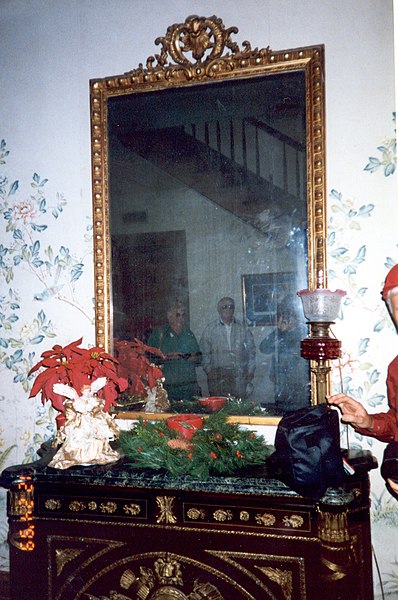
The Haunted Mirror: Where the spirit of Woodruff and her children lingers. Photo: Chris Light/1999
But it wasn’t the end at all, as Chloe planned her revenge on her slave masters. She baked a cake that she had poisoned with oleander leaves, which is extremely poisonous. Even the question of why she poisoned the cake is up for discussion.
Most accounts claim she did it for revenge after cutting off her ear. Another variant saying she was trying to gain favor with the family again as she was planning to cure the family for the poison and come out as a hero instead.
But according to the story, the plan backfired and only Sara Woodruff and the two daughters ate the cake and died from the poison. Chloe was then hanged by the other slaves and thrown in the Mississippi river, as a sort of final punishment for her or to not be punished themselves by Clark Woodruff for harbouring her.
A mirror in the house is supposedly holding the spirit of Sara Woodruff and her children. According to custom at that time, the mirrors were covered by a cloth so the spirit would not disappear into them. But after the poisoning, this particular mirror was forgotten and the ghosts of the victims can be seen in the mirrors and there are reports of handprints being left in the mirror, as their spirits are now trapped in the mirror.
The story about Chloe as a ghost is also told by the previous owner, Frances Kermeen, who also wrote a book on all the strange hauntings that she herself reported about experiencing on her second night in the house:
“I looked up and standing over me was a black lady. Her head was wrapped in a green turban,” I could see her [holding an] old-fashioned tin with the loop in it [through] the candlelight and I lost it. I started screaming…I reached my hand out to touch her, I could tell she was a ghost because she was see-through, but as my hand passed through her, she faded away.”
Do historical records support this though? There is currently not found any records of the Woodruffs owning a slave named either Chloe or Cloe. The legends say that Chloe killed both the wife and the daughters, but one of the daughters, Mary Octavia, survived and grew up to become an adult. And it is said that Sara and the other daughter, Cornelia, were not killed by poison, but by yellow fever in 1823 and 1824.
Either way, despite the historical records refuting the story, the legend about a woman wearing a green turban haunts Myrtles Plantation. Perhaps trying to tell a story that no historical records can?
The Other Ghosts
There are several pictures you can find on the postcards found in the souvenir shop at the plantation, the Chloe postcard being one of them. Another picture that stirred up quite some stories was the picture of a young girl dressed up in classic antebellum clothing that seems to look out from a window. She is now referred to as “The Ghost Girl” on the plantation.
Burial Ground
But the legend of Chloe is not the only claim of ghost sightings at the plantation among the Spanish Moss hanging from the giant oak trees. There is the classic tale that the house itself is built on an Native American burial ground, a trope of American ghost story tales that rarely can be substantiated. But even so, the ghost of a young Natice American woman has been reported.
In this case, the burial ground would be of Tunican tribes in the Mississippi River Valley, and the truth is that the land the manor now stands on used to belong to the Natives before being seized by the Spanish.
Civil War Soldiers
Advertisements
Another legend is about the Civil War and about how the houses were ransacked by union soldiers, and three people were killed. But exactly who was killed? The soldiers or the people living in the mansion? At the time, it was then Ruffin Gray Stirling and his wife Catherine Cobb that lived on the plantation with their slaves. It is true that they were robbed of their fine furniture and luxury items.
According to some of the variations of the legend though, it was the Union soldiers that were shot dead on the premises by the Confederates.
But something that is more up for debate is the supposed blood stain in the doorway, around the size of a human body remains that never will be completley clean after the supposed murders that happened then, no matter how well you scrub it.
The Voodoo Practitioner
The plantation is also the home of the ghost of a young girl that died in 1868, sometimes thought to be the girl in antebellum clothes from the picture. She was treated by a local voodoo practitioner in one of the 22 rooms in the manor, but died. She appears now in the room she died in and has been reported to practice voodoo on people sleeping in the room.
William Drew Winter
One of the other ghosts haunting this place is someone that either staggers or crawls up the stairs. He always stops on the 17th step. This is rumoured to be the ghost of William Drew Winter, the verified murder victim in the house. He was shot on the front porch of the house by a stranger. To get away, he crawled up the stairs but only reached the 17th step before he collapsed and died.
Several guests staying at the now B&B have claimed to hear the crawling coming from the stairs, and believing it could be other guests have gone to check. But when reaching the stairs, they find that no one is there, or worse, the apparition of his ghost, begging for help.
Although here, we have discrepancies in the story as a local newspaper reported that Winter died of a single shot that killed him instantly, and he had no possible way of crawling the stairs after the shot. But did he manage to in his afterlife?
The Plantation
No matter the fact we can now verify, the stories found of plantations from way back cast long shadows. All from the first contact between the natives and Spanish, throughout slavery and a bloody war. The darkest chapters of this plantation, is most likely the stories that we don’t know about.
Now a peaceful place for a road trip, it was once a hot spot for highwaymen and a dangerous place to travel. Sometimes, it was also dangerous for the robbers.
On a chilly Christmas Eve a woman and her father were riding in their carriage down the Road to Hawkhurst Kent. In the eighteenth century highwaymen were notorious and feared in the English countryside. They robbed whoever came their way, and sometimes, the robbery went more violently than necessary. And Hawkhurst housed some of the more notorious gangs and smugglers at the time, making the place feared along the English coast.
Alone With The Highwayman
Dangers on the road: A carriage was a sure sign of wealth and a target for the highwaymen. Photo: Asalto al coche (Robbery of the coach), by Francisco de Goya.
This had been the case of the young woman’s brother, who had been killed on maybe even the same road. But there was one road to take to get anywhere and the same family was again meeting an unfortunate end. The carriage was stopped by the highwayman Gilbert when they were around the village of Marden in Kent. He ordered the father and daughter out of the carriage to strip them of their possessions and valuables. But as soon as the daughter stepped on the ground, the horse bolted, carrying her father away, leaving her all alone with the robberer at the side of the road, seemingly helpless.
But the story comes with a twist seldom seen in other horror stories like these. A horror, not only by being robbed, dawned on her as she laid eyes on the face of the man. She recognised him, Gilbert, as the one who had murdered her brother as well. And she refused to see such a fate befall on herself. Enraged and afraid she drew a knife and stabbed the before he could take more from her by reaching for a hidden knife in her bag and planting it into Gilbert’s side and fled into the bushes.
When the father and the driver managed to calm the horses, they returned to the sight of where they had left her alone. There, all they could find was Gilbert’s dead body that they buried on the side of the road.
The Price of Her Life
It wasn’t until the next day the woman was found by the villagers of Marden, wandering around after having stabbed a man to death. All alone this cold Christmas Eve she had been fleeing from the danger from last night. But although she escaped alive, her body unharmed, it is told that during the night she had gone completely mad.
And every Christmas Eve since, the same scene, the robbery, the murder is repeated by their ghosts, first by Gilbert himself, then later perhaps joined by the woman.
The blinking paper lantern hides a vengeful ghost in one of the most famous Japanese ghost stories. From a local legend about a real woman to the stage, the myth of the ghost of Oiwacontinues to inspire horror.
Many of the more well known stories of ghost and horror from Japan is about the Onryō, meaning a vengeful spirit. A ghost so full of regret and rage, they are posing a threat to living humans. And sometimes, they can come in the form as a Japanese Paper Lantern Ghost. This is the case of the ghost of Oiwa.
In many cultures, ghosts are put in different categories. Such is the case with Onryō (怨霊 onryō,) It basically means “vengeful spirit” or “wrathful spirit” in Japanese and is a mythological spirit of vengeance from Japanese folklore. They also have ghosts, called yurei, but these differ in the will of the ghost. As opposed to…
There are many movies, books and popular culture that feeds on the old legend of the vengeful spirit. Today in modern time we have The Ring and The Grudge series that makes use of this old legend, and in many instances, they are both also inspired by the most iconic Onryō throughout time, the ghost of Oiwa.
Yotsuya Kaidan — The Tale of Oiwa and Tamiya Iemon
The ghost of Oiwa is a vengeful spirit that we first learned of through the kabuki play called Yotsuya Kaidan (四谷怪談) or Ghost Story of Yotsuya from 1825. It was written by the writer Tsuruya Namboku IV, known for his plays with supernatural themes and macabre and grotesque characters.
She is an easy recognisable character on stage with her droopy eye and hair falling out or as the iconic Paper Lantern Ghost. She is also often seen as a Japanese ghost lantern in art.
Read Also: Check out all of the ghost stories from Japan
Kabuki Theatre
The Kabuki theatre is a traditional Japanese style plays originating in the Edo period. It is well known for its characteristics wigs, costumes, makeup and masks. It is exclusively theatre troops of men playing all roles. The distinct styled stage performances is the origin of many iconic looks in modern pop culture, like the distinct style of the Onryō with the white dress, white makeup and long black hair.
Yotsuya Kaidan is not the first and original written account of the legend, but certainly the most famous one. The first written manuscript about the ghost of Oiwa is dated to 1727 called Yotsuya zōtan 四谷雑談. It was an underground publication, most likely of the scandalous rumour of the true rumours of a noble family and lady that acted as an Onryō after her death.
Yotsuya Kaidan tells the story of Oiwa and Tamiya Iemon and in this play it tells the story of a woman scorned by her man and coming back from the dead for revenge. Throughout the years, there have been many adaptation and versions of the story and it was a popular story to tell as a part of a samurai parlor game.
It is considered to be one of Nihon san dai kaidan — Japan’s Big Three Ghost Stories. It is arguably the most famous Japanese ghost story of all time and has spurned a couple of local legends of its own.
Read about the Nihon san dai kaidan—Japan’s Big Three Ghost Stories:
The Botan Dōrō or Tales of the Peony Lantern is a ghost story told since the Ming dynasty in China to today. Most popular through the Kaidan theater plays, it is now one of Japan’s most well known ghost stories.
The tale of Banchō Sarayashiki (番町皿屋敷, The Dish Mansion at Banchō) is a well known Japanese ghost story (kaidan). It was popularized in the kabuki theater tradition, and lives on in popular culture and folklore alike.
Yotsuya Kaidan starts out as a classical romantic tale. Oiwa was said to be a loving and devoted wife that risked everything for her husband, Tamiya Iemon. They married in secret, without her father’s consent. Tamiya Iemon was a wandering samurai, a poor rōnin and not suited to marry his daughter according to the father.
The ghost of Oiwa From the ”Thirty-six Ghosts” series by Tsukioka Yoshitoshi, ”The Yotsuya Ghost Story”, 1892.
Oiwa’s father whoever, was not as pleased with her marrying this man without honor and no money. When he found out the rōnin’s misdeeds, he confronted him. After a heated argument, the father was killed by the son in law when he threatened to make them stay apart from each other, and he did not bless their marriage.
After his death, Oiwa mourned her father. Iemon comforted Oiwa, claiming they would find her father’s killer.
To earn money he had to take up work as an umbrella maker to care for his pregnant wife. The old samurai grew bored doing the tedious work and turned resentful towards his wife, Oiwa. A woman he once loved and done horrible things to stay with. But in the end, there was no love left.
Next door they had a neighbor with a granddaughter that loved Iemon. The neighbor himself wanted his granddaughter and Iemon to get married. They were wealthy neighbors, and Iemon wanted to be that as well. So they planned how to get rid of Oiwa together.
Unbeknownst to Oiwa they sent her either an ointment or face cream laced with poison. But the poison didn’t kill her and only left her disfigured with one eye drooping and her hair falling off as she tried to brush through it, making Iemon so disgusted by her, he came up with a plan to rid himself of her. He hired one of his friends to rape her so that he would have grounds for a divorce.
His friend however is unable to go through with the plan and shows her a mirror instead. When she sees herself she understands what has happen and how she has been deceived. She takes a sword and accidently kills herself with it, and on her last breath, she curses Iemons name. In some versions there is actually Iemon that kills her.
Iemon threw her in the river to rot and went on to plan the wedding to the neighbors granddaughter. That night, the night before his wedding, he had terrible night terrors, and he saw his dead wife manifesting. In a burning paper lantern she comes out as a ghost, frightening him as a warning of the hauntings that are about to come.
The Chōchin obake
In Japanese legends, they have this concept of Tsukumogami (付喪神, “Kami of tool). This is the belief that inanimate objects, when they ‘serve’ their owners for a hundred years, they are granted life and a soul. When the Japanese lantern, or Chōchin reaches this age, it can become Chōchin obake, a Japanese lantern ghost, a mostly harmless ghost that laughs and lightly scares humans. But they could also be inhabited by a powerful onryō.
The Lantern: The print depicts a Kamiya Iantern haunted by the ghost of Oiwa as the Paper Lantern Ghost in Yotsuya Kaidan Kuniyoshi Utagawa, ”The Ghost in the Lantern”, 1852.
But he is not frightened enough as he still goes on with the wedding the next day. When he lifted the veil of his bride though, it was the ghost of Oiwas disfigured face staring back at him. He beheaded her, and therefore, his new bride as well. There is all in all a lot of killing going on.
He was then pursued by the ghost of Oiwa, not wanting him to escape. She was turned into a vengeful ghost, pursuing him into madness, making him suffer. He dies in the end, after suffering horrible.
It changes in the different adaptations of Yotsuya Kaidan how he dies though. Sometimes he is killed by Oiwa’s brother, or brother in law and in other versions it’s the haunting of the ghost of Oiwa that drives him out of his mind and into death. Sometimes it’s Oiwa herself, that pulls him down from the height with her. Either way her revenge is complete.
Advertisements
The Deaths Behind The Play of the Paper Lantern Ghost
The success of the Yotsuya Kaidan play was so big that they had to reschedule more performances to meet the demands. It was mostly believed that the popularity of the play was because it tapped into the zeitgeist of the society at the time.
Oiwa as the lantern: The ghost of Oiwa manifesting herself as a Japanese Paper Lantern Ghost. From the series One Hundred Tales (Hyaku monogatari). Print by Katsushika Hokusai. 1830
The theme of repressed women was something that reflected the Bunsei era that was also a time of great unrest. And the story of the victim taking her revenge of her oppressor was something the audience revelled in.
But where did the story come from? Was it just from the imagination to Nanboku when he wrote the play?
In most blogs it is said the legend created the play. But was it actually the play that created the legend? Yes, it is based on the terrifying vengeful ghost, something older than the kabuki play. But were did Nanboku really get his story from?
According to some sources Nanboku’s play was based of an actual murder of the wife of a samurai that went insane after her husband got another woman pregnant. She wandered off from her home, never to be seen again.
It is also claimed that Nanboku based his play from to separate murders. One of the murders was that of two servants who had murdered their masters. They were caught and executed on the same day. The second murder that inspired the play was a samurai that nailed his wife and her lover to a wooden board and threw them into the Kanda River for being faithless.
In any case what source the play was created from, the play itself became something that created more legend. It has adapted for film over 30 times, and continues to be an influence on Japanese horror today.
The Real Oiwa and her Rocks
But who was the real Oiwa behind the manuscript? Both the play and the written account from 1727 from the underground publication that claimed a dead wife had turned into an onryo. Wether this account really refers to this Oiwa, is a bit uncertaint though.
We can find an Oiwa Tamiya in the real life that had something mysterious happening to her. Living in the 17th century, she was born into a powerful family, but she and her husband had financial difficulties.
One day Oiwa came over two very large rocks she felt was something special and put them both in her garden. She prayed to these rocks for good luck and prosperity for her family to overcome their financial difficulties.
And over time, the things she prayed for to the rocks really happened for the family and everyone believed it was because of the magic rocks that she had prayed to. The rocks became famous, and was called Oiwa Inari or Yotsuya Inary. In the end, a shrine was built for it, and this is the shrine people flock to pray to.
Even the Tokyo Metropolitan Board of Education found it necessary to distinguish the real life Oiwa and the play and they have put this message:
Tamiya Inari Shrine, commonly known as Oiwa Inari, used to be i the premises of Tamiya family of Osakitegumi doshin (military officer in the Edo period). An old story is passed down that Oiwa (died in 1636), a daughter of Tamiya Matazaemon, worshipped at the shrine and restored her family with Iemon, her husband. Therefore, the shrine was gradually worshipped as ‘Oiwa Inari* by people. There was yet another story to attract further worshippers, the ghost story ‘Tokaido Yotsuya Kaidan’, written by Tsuruya Nanbuko and was staged in 1825 and was very popular.
However, it was written after 200 years of time when Oiwa and Iemon actually lived. Unlike the famous ghost story, their marriage in reality was enjoyable. After Inari shrine was lost by a fire in 1879, it moved to Shinkawa in Chuo Ward. The present shrine was rebuilt here at Yotsuya in 1952.
— Tokyo Metropolitan Board of Education
Although not like in the play, there were rumours about Oiwa being a vengeful ghost, long before the Kabuki actors entered the stage for the first time. Something we can read about in the manuscript from 1727 that also hinted to this fate for her.
A more sinister legend of this lady though is the curse she apparently set on three houses had been disrupted, rumour saying it was the grudge of Tamiya’s wife, Oiwa that killed them. They were both victims of the reforming rule of the eight Tokugawa Shōgun, Yoshimune Kō. In some accounts she disappeared, in others she commited suicide, vowing to revenge those who wronged her. In all she was blamed for the deaths of at least fifteen people.
The Shrine in Oiwa’s Honor
Already in 1717, there was a shrine erected in her honor, something they sometimes did to appease the wrath of an Onryō, long before the publication that were written ten years after. This is a list of some of the shrines that were built to restore her honor and protect from the harmful ghost, or at least connected to the Oiwa legend:
They say that when visiting her grave, there is a statue of Oiwa inside the main building in some of her shrines, although not accessible to visitors. you can wish upon it as it is said she grants the wishes of her worshippers. This is also the rumours about her grave.
The Curse of Oiwa’s Grave and The Curse on the Play
The revenge of Oiwa: The ghost of Oiwacoming out from the Japanese lantern in Yotsuya Kaidan as a ghost with her son in her arms. Artist:Kuniyoshi
It is said her body is buried at Myogo-ji temple in Sugamo, Tokyo. Her death is listed in February 22. 1636 and the grave has been rumoured to have been haunted for ages.
After the play started, there have been reports of accidents, injuries and deaths around the production of the play or even TV or movie adaptions of the story. This has been blamed on the ghost of Oiwa and her wish for revenge. Therefore it has become a tradition to visit and pay respect for the people involved in a production of Yotsuya Kaidan just to be safe.
I you go straight through the graveyard, there is suppose to be a red torii (a Shinto shrine archway) by a tree. Under the tree, her grave is supposed to be. But don’t run off to check it out just because you are curious and nothing more. According to legend, if you visit the grave just because of curiosity, your right eye will swell up, just like hers did with the poison.
It is said to be a curse over it all. And very much like the Macbeth curse, the people involved in productions of the legend of Yotsuya Kaidan, still honors it. Before retelling the story there is a tradition to go to her grave, to ask her permission, asking for her blessing to tell her story again. So… will you?
After a husband caught his cheating wife, the punishment for her lasted into the afterlife. After she was discovered, the husband imprisoned her in the tower of Château de Puymartin, and according to legends, the wife is still haunting this French Château as a Dame Blanche, or the Lady in White.
The honey colored towers of this elegant castle in France called Château de Puymartin is like taken out of a fairytale romance. But the tales about this castle in Southwestern France, is by no means fairytale-like, but more of a horror story without a nice ending.
The Château de Puymartin was constructed in the early 1200s and the castle went through a lot of hands throughout history. In 1357, the castle was taken by the british before being bought back by the council of Sarlat. They didn’t stay though and the castle was left abandoned.
Read also: Check out all of our ghost stories from France
The castle was abandoned for a while and it wasn’t until the 1450s Radulphe de Saint-Clar rebuilt the Château de Puymartin and making it bigger that people started living in it. But can anyone really say they lived peacefully in it?
The Prison in the castle: The castle that used to be the Lady in White’s home at Château de Puymartin turned into her prison were she lived her remaining years in the tower and the rest of eternity walled up in the walls of her former prison. Photo: Manfred Heydesource
Dame Blanches in French Folklore
All French Château’s must have its own legend of a Dame Blanche or the ghost of a Lady in White roaming around the castle halls at night. The Château de Puymartin is no exception from this and has it’s own twisted tale of the Lady in White. But really what is this types of ghosts that we always hear of wandering the castle halls?
One of the most pervasive supernatural mythologies associated with haunted castles and Château’s is the Dames blanches, or White Ladies. These mysterious figures are said to wander through fields and forests near the city, bringing with them both luck and misfortune to those who encounter them.
They are known way back from myths and folklore as well and quite well spread in European ghost stories. Tales of these enigmatic creatures have been told for centuries, inspiring many artistic interpretations and offering a glimpse into a fantastic world beyond our own.
There’s also a long-standing local legend involving the castle’s ‘Dames Blanches’, or ‘White Ladies’. According to folklore, these female ghosts are said to inhabit the castle and torment its inhabitants with misfortune, calamity, and sometimes even death in many stories in French folklore.
Lady in White Ghost: The most common ghost you hear about is the ghost of a lady, often described as wearing white. The legends is different from every culture, often described as a sorrowful ghost in European ghost stories and taking a more vengeful spirit take in Asian ghost stories. What they all have in common though is they experienced something unfair in their life and in their death they can’t see past in their afterlife.
What used to be vague figures from old mythology and legends, now tells the tragic ghost stories about real women who died in horrible ways and have unfinished business in their afterlife. Such is the tale of the Dame Blance in Château de Puymartin.
The Legend of the Dame Blanche in the Castle
The legend of la Dame Blanche, or the woman in white that is said to reside inside of Château de Puymartin is said to be the spirit of a woman called Thérèse de Saint-Clar. She was married to Jean de Saint-Clar, the man of the Château de Puymartin in the 1500s. Her name is not set in stone, as the legends most often specify her name at all.
The husband could also have been Raymond de Saint-Clar who fought in the French Wars of Religion, a war between the Catholics and Protestants. He is well known to be the one who managed to get rid of the Huguenots from Sarlat. The timeline with the names in this legend can get a bit messy as we can neither confirm or deny all of the details.
But either way, the story goes that the man of Château de Puymartin was away at war and while he was away, the wife stayed home and took a lover.
But the affair would not stay secret for long at the Château de Puymartin. After distinguishing himself in the battles, the husband was allowed to return home to his home and wife for what he thought would be a happy reunion and he would be recieved by his wife as a war hero.
The homecoming was anything but thought and when he went to her, his wife was found in her lover’s arm.
The husband went mad and ended up killing her lover out of jealousy in a fit of rage. His wife was also punished but in a much slower and torturous death. He ended up imprisoning his cheating wife in a tower in their Château as he no longer could trust her on her own and their marriage was in all sense of the matter over.
Imprisoned at the Tower of Château de Puymartin
For years the wife was trapped in the northern tower of Château de Puymartin, never allowed to leave or go outside, not even after her death. One could almost argue that she is still not allowed out in her afterlife.
Immured: Throughout the years, there have been plenty of stories about women sealed inside of walls for punishments or for religious purposes. Who knows just how many old walls are hiding a secret?
The wife lived trapped inside of the tower until she died in what was called a ‘fifteen long years of repentance’. 15 whole years she stayed in the same little room never allowed to leave.
The door leading into her tower was supposedly walled up to keep her from escaping, only leaving a small trap door for the servants to bring her food while she was alive. She was stripped away from the fine living she was used to being the mistress of this grand castle and they only left a bad mattress for her to sleep on in a corner.
The only view she had was to look out from the window through the barrs they put up for her to prevent her from escaping. There she could see just how close freedom was, past the garden, over the hill and into the forests. This almost seems more cruel than shutting the window off completely.
It doesn’t say if she had any visitors, but over the years it looks like the husband never pitied her and let go of her anger. And if she spent 15 years inside the tower without anyone to talk to, she most likely went mad after the first few years.
According to legend her body was sealed inside the walls of the room when she died, trapping her there, even in her afterlife and she never got a proper burial in the ground, and was laid on the cold stones of the castle walls. Since then, she comes back to haunt the castle at night. At least now she can move outside the tower. She wanders the stairs, her room and on the pathways around the grounds.
Today you can visit the Château de Puymartin for a fee to try to get a glimpse of the sorrowful ghost that have been spotted by its owners and visitors over the centuries.
The Château de Puymartin have in its later years embraced their Dame Blanche legend and it’s a part of the experience when visiting the castle. They have even made the story into an escape room play during Halloween season. Would you like to play?
The haunting of Fisher’s Ghost, a farmer in Australia, is one of the countries most famous ghost stories. It is based on the true events and a murder that happened in Campbelltown in the 1800s. And allegedly, the ghost came back from the afterlife to try to help people catch his killer.
The legend of the farmer Frederick Fisher is one of the most popular ghost stories in Australia and comes from Campbelltown in New South Wales. Today it has grown into a suburb of Sydney, but back in the 1800s the place was mainly for farmers of cattle and sheep. Even to this day the town is most known for the famous ghost story of Fisher’s ghost and Fisher’s Ghost Creek runs through Campbelltown’s parks.
Read Also: Check out all our ghost stories from Australia.
Since the 1950s, there have even been a festival named after Fisher’s Ghost that are hosted every year in his honor to show good spirit and community. The Fisher’s Ghost festival includes a parade through Queen Street, Fisher’s Ghost Art Award, Fun Run, Street Fair, Carnival, Craft Exhibition, music, competitions, fireworks and the Miss Princess Quest. All in the honor of the towns greatest murder mystery were one local murdered his neighbour.
Fisher’s Ghost Bridge: Several of the places in Campbelltown in Australia is named after the ghost story of Fisher’s Ghost. Here is a photo from circa 1945.
But what really happened that day Fisher’s ghost returned from the dead to try to reveal what really happened to him the day he had disappeared?
The Disappearance of Frederick Fisher
From his staring, or wild rolling, eye. Now, stout was the heart of Falconis, and bold ; Nor weak superstition dwelt there ; And hideous that object must be to behold, That could daunt his fierce spirit, his blood curdle cold, Or stamp on his cheek palid fear. And, hideous, in sooth, was the object that scared And turned him from homeward that night; In shuddering amazement his hearers all stared, Whilst, with half-lessened terror, Falconis declared He had met with a murder’d man’s Sprite. – The Sprite of the Creek
On a calm night on June 17th in 1826, the local farmer Frederick Fisher left his house in Campbelltown and never returned. No one knew were he had gone as he was just going out on a few errands that day. Without a trace he was vanished and no one managed to find out why and how he had disappeared.
Fisher was originally from London and was sentenced to go to Australia after forging bank notes in England. His thieving days was not over for him, even after he was sentenced to 14 years in Australia, and he ended up in prison again. It was not long since he had gotten out of prison again before he disappeared. His friend and neighbour George Worrall kept saying that Fisher had just returned to his native country.
Fisher’s Suspicious Friend and Neighbour
Four months went by and with no news about Fisher and what might have happened to him other than what Worrall claimed. Before going to prison, Fisher had given Worrall power of attorney over his farm and belongings until he got out again. Worrall said that Fisher had given him his property to keep forever and said that Fisher intended to stay in England and never return to Australia.
Worrall himself had also been sent to Australia on a prison sentence because of theft. And like Fisher, it seemed like his criminal days was not over. The police arrested Worrall that September because they suspected he had something to do with his disappearance after he had started to sell Fisher’s belongings. Worrall claimed his innocent and said it was 4 other people that had something to do with it who were also arrested.
The Encounter with Fisher’s Ghost
Then, one day a local man bursted into the Campbelltown hotel called Patricks Inn. The man was pale and shook to his bone. He couldn’t believe what he had just witnessed as it was simply out of this world and would change everything.
The local man was named John Farley and he told everyone in the hotel with a shaking voice, that he had just met Frederick Fisher, the one that had been missing without a trace for many months. The problem was that, he was not alive. Not anymore. It was Fisher’s ghost and was back to get his death known to everyone.
Meeting at the Fence: What really happened that night along the country road? Fisher’s Ghost allegedly appeared and showed were his body was buried and helped solve the mystery. What really happened that summer has been up for debate ever since.
According to John Farley’s testimony, Fisher’s ghost had sat on a fence along the way were the local man had walked past on his way home. Fisher’s ghost had pointed on a paddock beyond the creek as if trying to show Farley something. Then Fisher’s ghost had vanished right before the eyes in front of the shaken man.
Fisher’s Ghost and How he Helped Catching his Murderer
First, the tale Farley told to everyone in Patricks Inn was disregarded as just a fanciful tale, but soon, rumours about the sudden disappearance of the farmer and the mystical appearance of Fisher’s ghost got people even more suspicious.
The man who had seen Fisher’s ghost was a wealthy and respected man in the local community. So the police decided they would investigate his claims after enough rumours and retellings had occurred and stirred up enough fuss. They went to the place the guy pointed out, but the officer found nothing by himself. They then got an Aboriginal tracker living in Liverpool, Australia to help them who managed to locate something when they tested the water in the area.
‘White fellow’s fat here!’, the tracker told the officers and to their big surprise, they found the body of Fisher, stashed away, out of sight, buried by the side of the creek. He had never left Australia, and had certainly never left his farm to his good friend and neighbor either.
The Murderer of Fisher was Caught
George Worrall, Fishers neighbour and his close friend was already under suspicion before the body was found as he had started selling Fishers property and told everyone Fisher had gone to England. They thought that Worrall had killed him when Fisher tried to get his farm back after getting out of prison. Worrall admitted to burying him there when the body was found and was hanged in early 1827. He never admitted to actually murdering him.
Fisher could finally rest in peace as he was finally buried in the cemetery at St. Peter’s Anglican Church in the town by his brother Henry.
Iconic Ghost Story: Ever since the murder happened, the story has been retold in poems, short stories, operas and movies. Here is an illustration by British scientist John Henry “Professor” Pepper, who in 1879 created the theatrical production “Fisher’s Ghost”.
So what was the deal with the ghost that suddenly appeared in the murder mystery? There are several theories as to why Farley talked about a ghost and knew were Fisher was buried. One is that he may have known something about where Fisher’s body was buried. Could he have been in on the murder? The details are hazy at this point and this has never been confirmed one way or the other. In fact, the whole story about Farley could be just a story made up after the murder.
Today the official police and court records don’t mention the ghost story at all and some think that the ghost part of this story first came about in the 1832 from James Riley named ‘The Sprite of the Creek’.
Fisher’s Ghost still Haunting Campbelltown
Another theory is of course that Farley did in fact walk past the creek and saw Fisher’s ghost sitting there as he pointed out exactly where he was buried and it helped to solve his murder.
Who can know for sure today exactly what happened? At least Fisher’s ghost found peace in the end after being found and buried properly, not in a shallow grave by the creek. Or did he really find peace? Some reports says Fisher’s ghost still haunts the hotel, to this day. Some even claim that the ghost never really left, and he is still haunting the town.
It is also said that Fisher’s ghost haunts Campbelltown Town Hall, which is built on land where Fred Fisher and George Worrall’s land crossed.
Thes old and noble family House of Hohenzollern in Germany seems to forever be haunted by a Lady in White. Both the ancient family homes of the family, and also the family members, however far they go away, the curse of the house will follow.
In December 1628, the Palace in Berlin can’t keep the cold out, not completely. A hereditary haunting of the ruling family of Prussia sits in the walls of their castles — a bad omen. Most often the bad omen of the curse is seen as a woman dressed in white. You can hear her sometimes, the clanking of the large keys around her waist. A young prince is next this time. She appears to a him and says: – ‘Veni, judica vivos et mortuos’ which means ‘Come, I judge the living and the dead’. The day after, he dies of an illness.
But who is it that haunts this old and noble family? Even the young princes? Years before the young person died, she was also spotted by three young pages in 1619. In one of Hohenzollern Castle halls, it doesn’t need to be the one in Berlin. As long as it is one of the ruling Hohenzollerns. The young pages thought she was a living human being, and approached her. When he asked what she was doing here she turned to him and hit him with her keys, killing him. The two pages ran away, terrified.
The House of Hohenzollerns was growing restless when they heard about the sighting of the woman. She had been spotted again, it was a bad omen. Something was about to happen. Three weeks later, John Sigismund Prince-Elector of the Margraviate of Brandenburg from the House of Hohenzollern, died.
House of Hohenzollern in Germany
The family is an old one. The House of Hohenzollern once ruled what is now known as Germany as a dynasty being princes, electors, kings and emperors. They ruled the lands of Brandenburg, Prussia, The German Empire and as far as to Romania.
Read More: Check out all of our ghost stories from Germany
They began their ruling dynasty in Swabia, in a town called Hechingen during the 11th century and took their name from their ancestral Hohenzollern Castle. The first ancestors of the House of Hohenzollerns were mentioned in 1061.
Burg Hohenzollern on the Hill: The ancestral home in Swabia, Germany, constructed in the early 11th century to the House of Hohenzollern. The haunting may have started here, but the sightings of the White Lady Haunting the family has been spotted everywhere were a member of the family has been residing.
They were the rulers of the lands, growing in power until 18 71 with the unification of the German Empire with the Hohenzollerns as hereditary German Emperors and Kings of Prussia. This title they held until Germany’s defeat in World War I in 1918 led to the German Revolution. The House of Hohenzollerns were overthrown and the Weimar Republic was established, thus bringing an end to the German monarchy.
Sure, they were powerful, and powerful families makes powerful enemies. Blue blood attracts bad blood. But who was so intent on following the family, haunting them for centuries? There have been many claims as to who exactly is the woman behind the hauntings. And this here, is one of the more famed ones.
The Noble Killer Nun Haunting the House of Hohenzollern
Kunigunde von Orlamünde is a ghostly reminder of the ancient past. She was born in 1303 as the first child of Ulrich I, Landgrave of Leuchtenberg, and part of their Bavarian dynasty in the middle-ages.
According to legend, Kunigunde von Orlamünde fell in love in a man called Albrecht the fair, the fourth son of Frederick IV, Burgrave of Nuremberg. A man of the House of Hohenzollern.
The Abbess: Tombstone of Kunigunde von Orlamünde at Himmelskron, is rumored to be behind the curse of the House of Hohenzollern.
Albrecht had expressed that he would marry Kunigunde von Orlamünde, hadn’t it been for that “four eyes did not stand in the way”. Kunigunde thought he meant her son and daughter. Therefore, she stabbed their eyes out with a needle, and they died, freeing her to marry the man she loved.
Johann Löer made a verse about this in 1559:
And thought, those small children I wanted Will certainly be the eyes that Robs me of my love! And if the woman even did That murdered her own children That misery robbed their life That stabbed them with pins Tender and soft all over
This is not what Albrecht meant though, as he was talking about his parents as they disapproved of their match. He refused to marry her after her actions. He married a woman named Sophie von Henneberg and got two daughters on his own.
Kunigunde von Orlamünde was devastated and full of regret. She had murdered her own children for a man that didn’t even want her. Therefore she started on a pilgrimage to the Vatican to get absolution for her sins from the Pope himself. He ordered her to build a monastery and become a nun. She joined the Kloster Himmelkron.
In some version she she was sentenced to life in prison for the murders, other tell of how she died on the way to the Vatican, not being able to beg of forgiveness. She is one of the origin stories of the curse over the House of Hohenzollern and she has been haunting the family ever since.
Weiße Frauen Haunting the House of Hohenzollern
Could Kunigunde von Orlamünde be the lady following the haunted House of Hohenzollern? Lurking along the walls with her keys, paying close attention on every male descendant in the family that she never got to be a part of? A family growing bigger by every generation while she cut down her own? In any case, the legend of the Lady in White is old. Perhaps so old that even not history keeps it in its records?
Basking in the sunlight, hiding in the shadows, her dress is always white. In German legends and folklore the stories of the Weiße Frauen, meaning White Women used to be a name meant to the elven-spirits and the stories of the light elves from pagan times. Many of the ghost stories seems to be based on these old folklore types of myths and legends, even to this day.
The White Lady Haunting Germany: Illustration from the opera, The White Lady. The White women or the Weiße Frauen has been a part of the German mythology for ages. It has know been a part of German ghost stories as well for centuries.
The legend of the Weiße Frauen or white woman has, as everything does, evolved from its elven origins. Now the name is also used on women dying in grief, of sorrow or with a urge of revenge. It has spread throughout Europe and is an image with strong connotations, even today.
The Family Curse Over the House of Hohenzollern
Some call her the White Lady, some call her ‘The Harbinger’. She brings bad luck to those seeing her, and reports of her sightings has been going on for centuries.
In 1667, Louise Henrietta of Orange, the wife of Elector Friedrich Wilhelm of Brandenburg, was lying ill. A few days before she passed away, she saw the White Lady, sitting by her desk almost as an omen that warned the family that death was approaching.
The family members started to learn to spot the signs, but was unable to do anything after her sightings. In 1678, the Margrave Erdmann Philip of Brandenburg saw the White Lady in his armchair as he entered his chamber in Baireuth. He left the room, shocked and terrified. The next day he rode his horse out in the court and there was something weird going on. The horse was uneasy, as if seeing something that scared it and he threw the prince off. The Prince stood up, seemingly fine and he retired to his chamber. But after two hours, he was dead.
Weiße Frauen Curse of the House of Hohenzollern: The White lady, also known as the Harbinger, has been haunting the family for centuries, acting as an omen when someone is about to day, and even as a warning. Is it really a curse, or actually someone watching over them, trying to warn them when danger is afoot?
Even the dead ones seems to warn about the White Lady that haunts the House of Hohenzollern. The White Lady was supposedly absent during Frederick the Great’s reign, but in his death, he came back to warn them about her. In 1792 in Paris, his nephew Frederick William the Second was camped outside the city with his troops, ready to attack the next day. That night his dead uncle appeared before him, warning him about the seeing the White Lady if he didn’t call off the attack. His nephew listened and left France, avoiding the harbinger and according to the legend, a certain death.
Even Napoleon tried to spend a night in one of Hohenzollern castles but left bothered by the ghost haunting the place. In 1806 he had defeated Prussia and claimed some of its land as a French province. He left the next day, never to returned, calling it le maudit chateau, ‘the cursed castle’.
But today? Were is she? Just before World War I in 1914, she was last reported. Just before the Archduke Franz Ferdinand was assassinated. After they lost the war Kaiser Wilhelm the Second was the last ruling Hohenzollern, and he later abdicated the throne.
And it is said as long as there is no Hohenzollern that rules, the White Lady will stay in the shadows, and hopefully, outside of the Hohenzollern castles.
What is the Truth Behind the Curse?
Such a dramatic story, but does it ring any truth? What is true is that Kunigunde married Otto VI, Count of Weimar-Orlamünde. Historians refute the legend as according to record, their marriage produced no children. It is true that she and her husband adopted a daughter, Podika von Schaumburg, but she grew up and married Poske Ritter von Schweritz in 1341.
There are also records of her dying in 29th of April in 1382. And if she really was born in 1303 she would have been close to 80 and most likely in a comfortable home, not on the road to Rome or in prison.
Kinigunde’s husband died in 1340, leaving her with a vast inheritance. She spent it on the monastery she herself would join as a nun. Funnily enough, sources tells he actually bought the monastery from Albrecht.
The Harbinger of Death
For a story as old as this one, there is now difficult to separate facts from fiction and the story of the curse that allegedly looms over the House of Hohenzollern seems to still be there, even if no one has reported about the White Lady for a while.
But what about The House of Hohenzollern and their sightings of the White Lady over the centuries? All of their stories? Were they just that? Stories? Or is it that some details of the past is not for us to know. Not the living.
Could it be something else than a woman with a flare for eternal vengeance? Perhaps something even older like the German myths and legends have been telling for ages?
An online magazine about the paranormal, haunted and macabre. We collect the ghost stories from all around the world as well as review horror and gothic media.