So we all know Dracula. That old fella, the campy movies, the bone chilling books. It was a real table turner, and has this lingering precence in todays culture. And I mean, espeacially in todays culture. Vampires are so mainstream, the mainstream feels it’s too mainstream. So let’s give it to Stoker, he made all of us goths, emos, metal heads, and whatever subculture you subscribe to. Because Dracula is about subculture and about breaking free from your past, time, history and reinvent yourself. Well… In some readings at least. Bloodsucking toxic people is another one. But there was always something that preceded it, something that inspired the Magnum Opus. And here are some examples.
Carmilla
For all the snobby lesbian goths out there, yes, you are right, Carmilla was way ahead of Dracula. And by way ahead I mean by 26 years. It turned the vampire tropes to stone, set the stage and even the cultural analysis of it, yes, Irish vs British problem, I think of you. And so did probably Stoker and Sheridan Le Fanu, the author of the work, as they were both Irish in a time, the Irishmen really needed some literary boost.
Editions
If you want an edition to read that are more academic oriented, i recommend “Carmilla : A Critical Edition” that put weights on its Irish roots.
Because of its length, it is mostly published alone, but if you are interested in the whole short story edition it was originally a part of, In a Glass Darkley, there is also that possibility. But for the cover though, I feel disappointed. It is a bit… boring. The coolest I think, is this hardcover edition by Pushkin press.
Synopsis
But even this, even this wasn’t the so called O.G vampire. Carmilla in turn was most likely inspired by this unfinished poem called Christabel.
Carmilla is the story of a young girl, Laura meeting with the mysterious Carmilla. They live deep in the woods of Styria, in today’s Austria.
Apparently Stoker was working on a new story, set in Styria, Austria with a character called Count Wampyr. So at least he moved the story further east. There is this direct link, I feel, that can’t be ignored. And it isn’t mostly. But to those snobby lesbian goths out there: You go girls, spread the word.
Listen to it here (Both Rose Leslie (Ygritte in GOT) and David Tennant (ALL CAPS LEGEND) is narrating, check it out)
Advertisements
The Vampyre
This is an interesting one. John William Polidori’s short story: The Vampyre has sadly been so left at the side. First, he didn’t get the credit he deserved, as it was published by mistake as Lord Byron’s work. Then he tragically ended his life too soon.
It is based on Lord Byron though. He wrote it on that infamous literary retreat with the Shelley’s, and among other works was the start of Frankenstein. Lord Byron also wrote a similar pice, called “A Fragment“. But even more of a fun fact. The whole idea, Polidori played with the idea that a scourned lover of Byron, Caroline, already had published. It is heavily influenced on her book Glenarvon, that is in essence a diss track of Byron. Damn, those friends!
Among gothic and horror fans alike, his work is well known and has its cannon in the genre, but it hasn’t quite reached the mainstream audience as Dracula and in some regards, Carmilla did.
This is one that I long avoided, because I thought it was a comedy, and my small gothic heart couldn’t take the irony, and I found the name Varney a bit comical. Now I BTW love the vampire comedy and What We Do In The Shadows are my life, all versions, thank you very much!
But in fact, it any just seem like a satire because it in fact, installed many of the campy tropes that comes with gothic fiction and vampire fiction. But at the time, it was a Victorian era serialized gothic horror story variously attributed to James Malcolm Rymer and Thomas Peckett Prest. It first appeared in 1845–1847 as a series of weekly cheap pamphlets of the kind then known as “penny dreadful”, and we simply loves penny dreadful, so much so, that we included it in our merch, check it out here (shameless self promotion, but hey, goths need to eat too).
The author was paid by the typeset line so when the story was published in book form in 1847, it was of epic length: the original edition ran to 876 double-columned pages and 232 chapters. Altogether it totals nearly 667,000 words, and for those of you that ever tried Nanowrimo, you know what I talk about, this is legit a lot.
Listen to this and some other not so well known vampire stories that should be heard, read and repeated to infinity here
Advertisements
Thalaba the Destroyer
Where the main character Thalaba’s deceased beloved Oneiza turns into a vampire, although that occurrence is actually marginal to the story.
OK, but in all seriousness, I do read. Like, a lot. Might just seem like I just subscribe to a niche part of tumblr, but no, this is serious literature. Serious FORGOTTEN literature. Ah. I think I would have been more OK with it, if not the end product (read Dracula) didn’t become so influential and that they give whole subjects to at uni. Also, sorry for my informal tone in talking about these pieces of arts, as my academic is reserved for school and I love to shake that stiff old academic voice off. (my professor highly disapproves though = academic literate reject).
Thalaba the Destroyer is more of an epic-work as in ,literary epics, spanning over time, place, people. It was written by Robert Southey from the Romantic school, as in the literary Romantics. If he really was into romance, I have no way of telling. It is interesting because of the plot. The poem is a twelve-book work with irregular stanzas and lines that are not rhymed. The poem deals with Harun al-Rashid and a group of sorcerers at Domdaniel that live under the sea. It was foretold that Thalaba, a Muslim, would be God’s champion and conquer the sorcerers. Something a bit odd for a British christian guy in the early 1800s to write about, but nonetheless very interesting.
Why does it have to be British tough? It makes sense in the Victorian times, being so sexual represses, something we might read into modern day mormon vampire tales and deep south sexual repression?
But no, it doesn’t always have to be British. In fact, Eastern Europe is steep in vampire lore, literature and culture. Several of those books and the likes though is not translated. But they do exist. For example we have the Serbian story with the most famous Serbian vampire, Sava Savanović from a folklore-inspired novel Ninety Years Later, or as in this translation: After Ninety Years, by Milovan Glišić, first published in 1880.
There are also German, like our emo friend Goethe that wrote the poem The bridge of Corinth. There are a lot of them. What is your favorite forgotten vampire story?
Any of this seem interesting for you? How about getting into the listening train of audio books. Now, get 50% off for the next 3 months. I’ve checked and I am now firmly sure these are the one that can offer most horror titles of the audio book platforms.
“Of such great powers or beings there may be conceivably a survival . . . a survival of a hugely remote period when . . . consciousness was manifested, perhaps, in shapes and forms long since withdrawn before the tide of advancing humanity . . . forms of which poetry and legend alone have caught a flying memory and called them gods, monsters, mythical beings of all sorts and kinds . . .”
—Algernon Blackwood.Found among the papers of the late Francis Wayland Thurston, of Boston.
1. The Horror in Clay.
THE most merciful thing in the world, I think, is the inability of the human mind to correlate all its contents. We live on a placid island of ignorance in the midst of black seas of infinity, and it was not meant that we should voyage far. The sciences, each straining in its own direction, have hitherto harmed us little; but some day the piecing together of dissociated knowledge will open up such terrifying vistas of reality, and of our frightful position therein, that we shall either go mad from the revelation or flee from the deadly light into the peace and safety of a new dark age.
Theosophists have guessed at the awesome grandeur of the cosmic cycle wherein our world and human race form transient incidents. They have hinted at strange survivals in terms which would freeze the blood if not masked by a bland optimism. But it is not from them that there came the single glimpse of forbidden eons which chills me when I think of it and maddens me when I dream of it. That glimpse, like all dread glimpses of truth, flashed out from an accidental piecing together of separated things—in this case an old newspaper item and the notes of a dead professor. I hope that no one else will accomplish this piecing out; certainly, if I live, I shall never knowingly supply a link in so hideous a chain. I think that the professor, too, intended to keep silent regarding the part he knew, and that he would have destroyed his notes had not sudden death seized him.
My knowledge of the thing began in the winter of 1926-27 with the death of my grand-uncle, George Gammell Angell, Professor Emeritus of Semitic languages in Brown University, Providence, Rhode Island. Professor Angell was widely known as an authority on ancient inscriptions, and had frequently been resorted to by the heads of prominent museums; so that his passing at the age of ninety-two may be recalled by many. Locally, interest was intensified by the obscurity of the cause of death. The professor had been stricken whilst returning from the Newport boat; falling suddenly, as witnesses said, after having been jostled by a nautical-looking negro who had come from one of the queer dark courts on the precipitous hillside which formed a short cut from the waterfront to the deceased’s home in Williams Street. Physicians were unable to find any visible disorder, but concluded after perplexed debate that some obscure lesion of the heart, induced by the brisk ascent of so steep a hill by so elderly a man, was responsible for the end. At the time I saw no reason to dissent from this dictum, but latterly I am inclined to wonder—and more than wonder.
Advertisements
As my granduncle’s heir and executor, for he died a childless widower, I was expected to go over his papers with some thoroughness; and for that purpose moved his entire set of files and boxes to my quarters in Boston. Much of the material which I correlated will be later published by the American Archeological Society, but there was one box which I found exceedingly puzzling, and which I felt much averse from showing to other eyes. It had been locked, and I did not find the key till it occurred to me to examine the personal ring which the professor carried always in his pocket. Then, indeed, I succeeded in opening it, but when I did so seemed only to be confronted by a greater and more closely locked barrier. For what could be the meaning of the queer clay bas-relief and the disjointed jottings, ramblings, and cuttings which I found? Had my uncle, in his latter years, become credulous of the most superficial impostures? I resolved to search out the eccentric sculptor responsible for this apparent disturbance of an old man’s peace of mind.
The bas-relief was a rough rectangle less than an inch thick and about five by six inches in area; obviously of modern origin. Its designs, however, were far from modern in atmosphere and suggestion; for, although the vagaries of cubism and futurism are many and wild, they do not often reproduce that cryptic regularity which lurks in prehistoric writing. And writing of some kind the bulk of these designs seemed certainly to be; though my memory, despite much familiarity with the papers and collections of my uncle, failed in any way to identify this particular species, or even hint at its remotest affiliations.
Above these apparent hieroglyphics was a figure of evidently pictorial intent, though its impressionistic execution forbade a very clear idea of its nature. It seemed to be a sort of monster, or symbol representing a monster, of a form which only a diseased fancy could conceive. If I say that my somewhat extravagant imagination yielded simultaneous pictures of an octopus, a dragon, and a human caricature, I shall not be unfaithful to the spirit of the thing. A pulpy, tentacled head surmounted a grotesque and scaly body with rudimentary wings; but it was the general outline of the whole which made it most shockingly frightful. Behind the figure was a vague suggestion of a Cyclopean architectural background.
The writing accompanying this oddity was, aside from a stack of press cuttings, in Professor Angell’s most recent hand; and made no pretense to literary style. What seemed to be the main document was headed “CTHULHU CULT” in characters painstakingly printed to avoid the erroneous reading of a word so unheard-of. This manuscript was divided into two sections, the first of which was headed “1925—Dream and Dream Work of H. A. Wilcox, 7 Thomas St., Providence, R. I.,” and the second, “Narrative of Inspector John R. Legrasse, 121 Bienville St., New Orleans, La., at 1908 A. A. S. Mtg.—Notes on Same, & Prof. Webb’s Acct.” The other manuscript papers were all brief notes, some of them accounts of the queer dreams of different persons, some of them citations from theosophical books and magazines (notably W. Scott-Eliott’s Atlantis and the Lost Lemuria), and the rest comments on long-surviving secret societies and hidden cults, with references to passages in such mythological and anthropological source-books as Frazer’s Golden Bough and Miss Murray’s Witch-Cult in Western Europe. The cuttings largely alluded to outré mental illnesses and outbreaks of group folly or mania in the spring of 1925.
Advertisements
The first half of the principal manuscript told a very peculiar tale. It appears that on March 1st, 1925, a thin, dark young man of neurotic and excited aspect had called upon Professor Angell bearing the singular clay bas-relief, which was then exceedingly damp and fresh. His card bore the name of Henry Anthony Wilcox, and my uncle had recognized him as the youngest son of an excellent family slightly known to him, who had latterly been studying sculpture at the Rhode Island School of Design and living alone at the Fleur-de-Lys Building near that institution. Wilcox was a precocious youth of known genius but great eccentricity, and had from childhood excited attention through the strange stories and odd dreams he was in the habit of relating. He called himself “psychically hypersensitive”, but the staid folk of the ancient commercial city dismissed him as merely “queer”. Never mingling much with his bind, he had dropped gradually from social visibility, and was now known only to a small group of esthetes from other towns. Even the Providence Art Club, anxious to preserve its conservatism, had found him quite hopeless.
On the occasion of the visit, ran the professor’s manuscript, the sculptor abruptly asked for the benefit of his host’s archeological knowledge in identifying the hieroglyphics on the bas-relief. He spoke in a dreamy, stilted manner which suggested pose and alienated sympathy; and my uncle showed some sharpness in replying, for the conspicuous freshness of the tablet implied kinship with anything but archeology. Young Wilcox’s rejoinder, which impressed my uncle enough to make him recall and record it verbatim, was of a fantastically poetic cast which must have typified his whole conversation, and which I have since found highly characteristic of him. He said, “It is new, indeed, for I made it last night in a dream of strange cities; and dreams are older than brooding Tyre, or the contemplative Sphinx, or garden-girdled Babylon.”
It was then that he began that rambling tale which suddenly played upon a sleeping memory and won the fevered interest of my uncle. There had been a slight earthquake tremor the night before, the most considerable felt in New England for some years; and Wilcox’s imagination had been keenly affected. Upon retiring, he had had an unprecedented dream of great Cyclopean cities of Titan blocks and sky-flung monoliths, all dripping with green ooze and sinister with latent horror. Hieroglyphics had covered the walls and pillars, and from some undetermined point below had come a voice that was not a voice; a chaotic sensation which only fancy could transmute into sound, but which he attempted to render by the almost unpronounceable jumble of letters, “Cthulhu fhtagn”.
This verbal jumble was the key to the recollection which excited and disturbed Professor Angell. He questioned the sculptor with scientific minuteness; and studied with almost frantic intensity the bas-relief on which the youth had found himself working, chilled and clad only in his nightclothes, when waking had stolen bewilderingly over him. My uncle blamed his old age, Wilcox afterward said, for his slowness in recognizing both hieroglyphics and pictorial design. Many of his questions seemed highly out of place to his visitor, especially those which tried to connect the latter with strange cults or societies; and Wilcox could not understand the repeated promises of silence which he was offered in exchange for an admission of membership in some widespread mystical or paganly religious body. When Professor Angell became convinced that the sculptor was indeed ignorant of any cult or system of cryptic lore, he besieged his visitor with demands for future reports of dreams. This bore regular fruit, for after the first interview the manuscript records daily calls of the young man, during which he related startling fragments of nocturnal imagery whose burden was always some terrible Cyclopean vista of dark and dripping stone, with a subterrene voice or intelligence shouting monotonously in enigmatical sense-impacts uninscribable save as gibberish. The two sounds most frequently repeated are those rendered by the letters “Cthulhu” and “R’lyeh”.
On March 23rd, the manuscript continued, Wilcox failed to appear; and inquiries at his quarters revealed that he had been stricken with an obscure sort of fever and taken to the home of his family in Waterman Street. He had cried out in the night, arousing several other artists in the building, and had manifested since then only alternations of unconsciousness and delirium. My uncle at once telephoned the family, and from that time forward kept close watch of the case; calling often at the Thayer Street office of Dr. Tobey, whom he learned to be in charge. The youth’s febrile mind, apparently, was dwelling on strange things; and the doctor shuddered now and then as he spoke of them. They included not only a repetition of what he had formerly dreamed, but touched wildly on a gigantic thing “miles high” which walked or lumbered about. He at no time fully described this object, but occasional frantic words, as repeated by Dr. Tobey, convinced the professor that it must be identical with the nameless monstrosity he had sought to depict in his dream-sculpture. Reference to this object, the doctor added, was invariably a prelude to the young man’s subsidence into lethargy. His temperature, oddly enough, was not greatly above normal; but the whole condition was otherwise such as to suggest true fever rather than mental disorder.
Advertisements
On April 2nd at about 3 p. m. every trace of Wilcox’s malady suddenly ceased. He sat upright in bed, astonished to find himself at home and completely ignorant of what had happened in dream or reality since the night of March 22nd. Pronounced well by his physician, he returned to his quarters in three days; but to Professor Angell he was of no further assistance. All traces of strange dreaming had vanished with his recovery, and my uncle kept no record of his night-thoughts after a week of pointless and irrelevant accounts of thoroughly usual visions.
Here the first part of the manuscript ended, but references to certain of the scattered notes gave me much material for thought—so much, in fact, that only the ingrained skepticism then forming my philosophy can account for my continued distrust of the artist. The notes in question were those descriptive of the dreams of various persons covering the same period as that in which young Wilcox had had his strange visitations. My uncle, it seems, had quickly instituted a prodigiously far-flung body of inquiries amongst nearly all the friends whom he could question without impertinence, asking for nightly reports of their dreams, and the dates of any notable visions for some time past. The reception of his request seems to have been varied; but he must, at the very least, have received more responses than any ordinary man could have handled without a secretary. This original correspondence was not preserved, but his notes formed a thorough and really significant digest. Average people in society and business—New England’s traditional “salt of the earth”—gave an almost completely negative result, though scattered cases of uneasy but formless nocturnal impressions appear here and there, always between March 23rd and April 2nd—the period of young Wilcox’s delirium. Scientific men were little more affected, though four cases of vague description suggest fugitive glimpses of strange landscapes, and in one case there is mentioned a dread of something abnormal.
It was from the artists and poets that the pertinent answers came, and I know that panic would have broken loose had they been able to compare notes. As it was, lacking their original letters, I half suspected the compiler of having asked leading questions, or of having edited the correspondence in corroboration of what he had latently resolved to see. That is why I continued to feel that Wilcox, somehow cognizant of the old data which my uncle had possessed, had been imposing on the veteran scientist. These responses from esthetes told a disturbing tale. From February 28th to April 2nd a large proportion of them had dreamed very bizarre things, the intensity of the dreams being immeasurably the stronger during the period of the sculptor’s delirium. Over a fourth of those who reported anything, reported scenes and half-sounds not unlike those which Wilcox had described; and some of the dreamers confessed acute fear of the gigantic nameless thing visible toward the last. One case, which the note describes with emphasis, was very sad. The subject, a widely known architect with leanings toward theosophy and occultism, went violently insane on the date of young Wilcox’s seizure, and expired several months later after incessant screamings to be saved from some escaped denizen of hell. Had my uncle referred to these eases by name instead of merely by number, I should have attempted some corroboration and personal investigation; but as it was, I succeeded in tracing down only a few. All of these, however, bore out the notes in full. I have often wondered if all the objects of the professor’s questioning felt as puzzled as did this fraction. It is well that no explanation shall ever reach them.
The press cuttings, as I have intimated, touched on eases of panic, mania, and eccentricity during the given period. Professor Angell must have employed a cutting bureau, for the number of extracts was tremendous, and the sources scattered throughout the globe. Here was a nocturnal suicide in London, where a lone sleeper had leaped from a window after a shocking cry. Here likewise a rambling letter to the editor of a paper in South America, where a fanatic deduces a dire future from visions he has seen. A dispatch from California describes a theosophist colony as donning white robes en masse for some “glorious fulfilment” which never arrives, whilst items from India speak guardedly of serious native unrest toward the end of March. Voodoo orgies multiply in Haiti, and African outposts report ominous mutterings. American officers in the Philippines find certain tribes bothersome about this time, and New York policemen are mobbed by hysterical Levantines on the night of March 22-23. The west of Ireland, too, is full of wild rumor and legendry, and a fantastic painter named Ardois-Bonnot hangs a blasphemous Dream Landscape in the Paris spring salon of 1926. And so numerous are the recorded troubles in insane asylums that only a miracle can have stopped the medical fraternity from noting strange parallelisms, and drawing mystified conclusions. A weird bunch of cuttings, all told; and I can at this date scarcely envisage the callous rationalism with which I set them aside. But I was then convinced that young Wilcox had known of the older matters mentioned by the professor.
2. The Tale of Inspector Legrasse.
The older matters which had made the sculptor’s dream and bas-relief so significant to my uncle formed the subject of the second half of his long manuscript. Once before, it appears, Professor Angell had seen the hellish outlines of the nameless monstrosity, puzzled over the unknown hieroglyphics, and heard the ominous syllables which can be rendered only as “Cthulhu”; and all this in so stirring and horrible a connection that it is small wonder he pursued young Wilcox with queries and demands for data.
This earlier experience had come in 1908, seventeen years before, when the American Archeological Society held its annual meeting in St. Louis. Professor Angell, as befitted one of his authority and attainments, had had a prominent part in all the deliberations; and was one of the first to be approached by the several outsiders who took advantage of the convocation to offer questions for correct answering and problems for expert solution.
The chief of these outsiders, and in a short time the focus of interest for the entire meeting, was a commonplace-looking middle-aged man who had traveled all the way from New Orleans for certain special information unobtainable from any local source. His name was John Raymond Legrasse, and he was by profession an inspector of police. With him he bore the subject of his visit, a grotesque, repulsive, and apparently very ancient stone statuette whose origin he was at a loss to determine.
It must not be fancied that Inspector Legrasse had the least interest in archeology. On the contrary, his wish for enlightenment was prompted by purely professional considerations. The statuette, idol, fetish, or whatever it was, had been captured some months before in the wooded swamps south of New Orleans during a raid on a supposed voodoo meeting; and so singular and hideous were the rites connected with it, that the police could not but realize that they had stumbled on a dark cult totally unknown to them, and infinitely more diabolic than even the blackest of the African voodoo circles. Of its origin, apart from the erratic and unbelievable tales extorted from the captured members, absolutely nothing was to be discovered; hence the anxiety of the police for any antiquarian lore which might help them to place the frightful symbol, and through it track down the cult to its fountain-head.
Inspector Legrasse was scarcely prepared for the sensation which his offering created. One sight of the thing had been enough to throw the assembled men of science into a state of tense excitement, and they lost no time in crowding around him to gaze at the diminutive figure whose utter strangeness and air of genuinely abysmal antiquity hinted so potently at unopened and archaic vistas. No recognized school of sculpture had animated this terrible object, yet centuries and even thousands of years seemed recorded in its dim and greenish surface of unplaceable stone.
The figure, which was finally passed slowly from man to man for close and careful study, was between seven and eight inches in height, and of exquisitely artistic workmanship. It represented a monster of vaguely anthropoid outline, but with an octopus-like head whose face was a mass of feelers, a scaly, rubbery-looking body, prodigious claws on hind and fore feet, and long, narrow wings behind. This thing, which seemed instinct with a fearsome and unnatural malignancy, was of a somewhat bloated corpulence, and squatted evilly on a rectangular block or pedestal covered with undecipherable characters. The tips of the wings touched the back edge of the block, the seat occupied the center, whilst the long, curved claws of the doubled-up, crouching hind legs gripped the front edge and extended a quarter of the way down toward the bottom of the pedestal. The cephalopod head was bent forward, so that the ends of the facial feelers brushed the backs of huge forepaws which clasped the croucher’s elevated knees. The aspect of the whole was abnormally lifelike, and the more subtly fearful because its source was so totally unknown. Its vast, awesome, and incalculable age was unmistakable; yet not one link did it show with any known type of art belonging to civilization’s youth—or indeed to any other time.
Advertisements
Totally separate and apart, its very material was a mystery; for the soapy, greenish-black stone with its golden or iridescent flecks and striations resembled nothing familiar to geology or mineralogy. The characters along the base were equally baffling; and no member present, despite a representation of half the world’s expert learning in this field, could form the least notion of even their remotest linguistic kinship. They, like the subject and material, belonged to something horribly remote and distinct from mankind as we know it; something frightfully suggestive of old and unhallowed cycles of life in which our world and our conceptions have no part.
And yet, as the members severally shook their heads and confessed defeat at the inspector’s problem, there was one man in that gathering who suspected a touch of bizarre familiarity in the monstrous shape and writing, and who presently told with some diffidence of the odd trifle he knew. This person was the late William Channing Webb, professor of anthropology in Princeton University, and an explorer of no slight note.
Professor Webb had been engaged, forty-eight years before, in a tour of Greenland and Iceland in search of some Runic inscriptions which he failed to unearth; and whilst high up on the West Greenland coast had encountered a singular tribe or cult of degenerate Eskimos whose religion, a curious form of devil-worship, chilled him with its deliberate bloodthirstiness and repulsiveness. It was a faith of which other Eskimos knew little, and which they mentioned only with shudders, saying that it had come down from horribly ancient eons before ever the world was made. Besides nameless rites and human sacrifices there were certain queer hereditary rituals addressed to a supreme elder devil or tornasuk; and of this Professor Webb had taken a careful phonetic copy from an aged angekok or wizard-priest, expressing the sounds in Roman letters as best he knew how. But just now of prime significance was the fetish which this cult had cherished, and around which they danced when the aurora leaped high over the ice cliffs. It was, the professor stated, a very crude bas-relief of stone, comprising a hideous picture and some cryptic writing. And as far as he could tell, it was a rough parallel in all essential features of the bestial thing now lying before the meeting.
These data, received with suspense and astonishment by the assembled members, proved doubly exciting to Inspector Legrasse; and he began at once to ply his informant with questions. Having noted and copied an oral ritual among the swamp cult-worshipers his men had arrested, he besought the professor to remember as best he might the syllables taken down amongst the diabolist Eskimos. There then followed an exhaustive comparison of details, and a moment of really awed silence when both detective and scientist agreed on the virtual identity of the phrase common to two hellish rituals so many worlds of distance apart. What, in substance, both the Eskimo wizards and the Louisiana swamp-priests had chanted to their kindred idols was something very like this—the word-divisions being guessed at from traditional breaks in the phrase as chanted aloud:
Legrasse had one point in advance of Professor Webb, for several among his mongrel prisoners had repeated to him what older celebrants had told them the words meant. This text, as given, ran something like this:
“In his house at R’lyeh dead Cthulhu waits dreaming.”
And now, in response to a general urgent demand, Inspector Legrasse related as fully as possible his experience with the swamp worshipers; telling a story to which I could see my uncle attached profound significance. It savored of the wildest dreams of myth-maker and theosophist, and disclosed an astonishing degree of cosmic imagination among such half-castes and pariahs as might be least expected to possess it.
On November 1st, 1907, there had come to New Orleans police a frantic summons from the swamp and lagoon country to the south. The squatters there, mostly primitive but good-natured descendants of Lafitte’s men, were in the grip of stark terror from an unknown thing which had stolen upon them in the night. It was voodoo, apparently, but voodoo of a more terrible sort than they had ever known; and some of their women and children had disappeared since the malevolent tom-tom had begun its incessant beating far within the black haunted woods where no dweller ventured. There were insane shouts and harrowing screams, soul-chilling chants and dancing devil-flames; and, the frightened messenger added, the people could stand it no more.
So a body of twenty police, filling two carriages and an automobile, had set out in the late afternoon with the shivering squatter as a guide. At the end of the passable road they alighted, and for miles splashed on in silence through the terrible cypress woods where day never came. Ugly roots and malignant hanging nooses of Spanish moss beset them, and now and then a pile of dank stones or fragments of a rotting wall intensified by its hint of morbid habitation a depression which every malformed tree and every fungous islet combined to create. At length the squatter settlement, a miserable huddle of huts, hove in sight; and hysterical dwellers ran out to cluster around the group of bobbing lanterns. The muffled beat of tom-toms was now faintly audible far, far ahead; and a curdling shriek came at infrequent intervals when the wind shifted. A reddish glare, too, seemed to filter through the pale undergrowth beyond endless avenues of forest night. Reluctant even to be left alone again, each one of the cowed squatters refused point-blank to advance another inch toward the scene of unholy worship, so Inspector Legrasse and his nineteen colleagues plunged on unguided into black arcades of horror that none of them had ever trod before.
The region now entered by the police was one of traditionally evil repute, substantially unknown and untraversed by white men. There were legends of a hidden lake unglimpsed by mortal sight, in which dwelt a huge, formless white polypous thing with luminous eyes; and squatters whispered that bat-winged devils flew up out of caverns in inner earth to worship it at midnight They said it had been there before D’Iberville, before La Salle, before the Indians, and before even the wholesome beasts and birds of the woods. It was nightmare itself, and to see it was to die. But it made men dream, and so they knew enough to keep away. The present voodoo orgy was, indeed, on the merest fringe of this abhorred area, but that location was bad enough; hence perhaps the very place of the worship had terrified the squatters more than the shocking sounds and incidents.
Only poetry or madness could do justice to the noises heard by Legrasse’s men as they plowed on through the black morass toward the red glare and the muffled tom-toms. There are vocal qualities peculiar to men, and vocal qualities peculiar to beasts; and it is terrible to hear the one when the source should yield the other. Animal fury and orgiastic license here whipped themselves to demoniac heights by howls and squawking ecstasies that tore and reverberated through those nighted woods like pestilential tempests from the gulfs of hell. Now and then the less organized ululations would cease, and from what seemed a well-drilled chorus of hoarse voices would rise in singsong chant that hideous phrase or ritual:
Then the men, having reached a spot where the trees were thinner, came suddenly in sight of the spectacle itself. Four of them reeled, one fainted, and two were shaken into a frantic cry which the mad cacophony of the orgy fortunately deadened. Legrasse dashed swamp water on the face of the fainting man, and all stood trembling and nearly hypnotized with horror.
In a natural glade of the swamp stood a grassy island of perhaps an acre’s extent, clear of trees and tolerably dry. On this now leaped and twisted a more indescribable horde of human abnormality than any but a Sime or an Angarola could paint. Void of clothing, this hybrid spawn were braying, bellowing and writhing about a monstrous ring-shaped bonfire; in the center of which, revealed by occasional rifts in the curtain of flame, stood a great granite monolith some eight feet in height; on top of which, incongruous in its diminutiveness, rested the noxious carven statuette. From a wide circle of ten scaffolds set up at regular intervals with the flame-girt monolith as a center hung, head downward, the oddly marred bodies of the helpless squatters who had disappeared. It was inside this circle that the ring of worshipers jumped and roared, the general direction of the mass motion being from left to right in endless bacchanals between the ring of bodies and the ring of fire.
It may have been only imagination and it may have been only echoes which induced one of the men, an excitable Spaniard, to fancy he heard antiphonal responses to the ritual from some far and unillumined spot deeper within the wood of ancient legendry and horror. This man, Joseph D. Galvez, I later met and questioned; and he proved distractingly imaginative. He indeed went so far as to hint of the faint beating of great wings, and of a glimpse of shining eyes and a mountainous white bulk beyond the remotest trees—but I suppose he had been hearing too much native superstition.
Actually, the horrified pause of the men was of comparatively brief duration. Duty came first; and although there must have been nearly a hundred mongrel celebrants in the throng, the police relied on their firearms and plunged determinedly into the nauseous rout. For five minutes the resultant din and chaos were beyond description. Wild blows were struck, shots were fired, and escapes were made; but in the end Legrasse was able to count some forty-seven sullen prisoners, whom he forced to dress in haste and fall into line between two rows of policemen. Five of the worshipers lay dead, and two severely wounded ones were carried away on improvised stretchers by their fellow-prisoners. The image on the monolith, of course, was carefully removed and carried back by Legrasse.
Examined at headquarters after a trip of intense strain and weariness, the prisoners all proved to be men of a very low, mixed-blooded, and mentally aberrant type. Most were seamen, and a sprinkling of negroes and mulattoes, largely West Indians or Brava Portuguese from the Cape Verde Islands, gave a coloring of voodooism to the heterogeneous cult. But before many questions were asked, it became manifest that something far deeper and older than negro fetishism was involved. Degraded and ignorant as they were, the creatures held with surprizing consistency to the central idea of their loathsome faith.
They worshiped, so they said, the Great Old Ones who lived ages before there were any men, and who came to the young world out of the sky. Those Old Ones were gone now, inside the earth and under the sea; but their dead bodies had told their secrets in dreams to the first man, who formed a cult which had never died. This was that cult, and the prisoners said it had always existed and always would exist, hidden in distant wastes and dark places all over the world until the time when the great priest Cthulhu, from his dark house in the mighty city of R’lyeh under the waters, should rise and bring the earth again beneath his sway. Some day he would call, when the stars were ready, and the secret cult would always be waiting to liberate him.
Meanwhile no more must be told. There was a secret which even torture could not extract. Mankind was not absolutely alone among the conscious things of earth, for shapes came out of the dark to visit the faithful few. But these were not the Great Old Ones. No man had ever seen the Old Ones. The carven idol was great Cthulhu, but none might say whether or not the others were precisely like him. No one could read the old writing now, but things were told by word of mouth. The chanted ritual was not the secret—that was never spoken aloud, only whispered. The chant meant only this: “In his house at R’lyeh dead Cthulhu waits dreaming.”
Only two of the prisoners were found sane enough to be hanged, and the rest were committed to various institutions. All denied a part in the ritual murders, and averred that the killing had been done by Black-winged Ones which had come to them from their immemorial meeting-place in the haunted wood. But of those mysterious allies no coherent account could ever be gained. What the police did extract came mainly from an immensely aged mestizo named Castro, who claimed to have sailed to strange ports and talked with undying leaders of the cult in the mountains of China.
Old Castro remembered bits of hideous legend that paled the speculations of theosophists and made man and the world seem recent and transient indeed. There had been eons when other Things ruled on the earth, and They had had great cities. Remains of Them, he said the deathless Chinamen had told him, were still to be found as Cyclopean stones on islands in the Pacific. They all died vast epochs of time before man came, but there were arts which could revive Them when the stars had come round again to the right positions in the cycle of eternity. They had, indeed, come themselves from the stars, and brought Their images with Them.
These Great Old Ones, Castro continued, were not composed altogether of flesh and blood. They had shape—for did not this star-fashioned image prove it?—but that shape was not made of matter. When the stars were right, They could plunge from world to world through the sky; but when the stars were wrong, They could not live. But although They no longer lived, They would never really die. They all lay in stone houses in Their great city of R’lyeh, preserved by the spells of mighty Cthulhu for a glorious resurrection when the stars and the earth might once more be ready for Them. But at that time some force from outside must serve to liberate Their bodies. The spells that preserved Them intact likewise prevented Them from making an initial move, and They could only lie awake in the dark and think whilst uncounted millions of years rolled by. They knew all that was occurring in the universe, for Their mode of speech was transmitted thought. Even now They talked in Their tombs. When, after infinities of chaos, the first men came, the Great Old Ones spoke to the sensitive among them by molding their dreams; for only thus could Their language reach the fleshly minds of mammals.
Then, whispered Castro, those first men formed the cult around small idols which the Great Ones showed them; idols brought in dim eras from dark stars. That cult would never die till the stars came right again, and the secret priests would take great Cthulhu from His tomb to revive His subjects and resume His rule of earth. The time would be easy to know, for then mankind would have become as the Great Old Ones; free and wild and beyond good and evil, with laws and morals thrown aside and all men shouting and killing and reveling in joy. Then the liberated Old Ones would teach them new ways to shout and kill and revel and enjoy themselves, and all the earth would flame with a holocaust of ecstasy and freedom. Meanwhile the cult, by appropriate rites, must keep alive the memory of those ancient ways and shadow forth the prophecy of their return.
Advertisements
In the elder time chosen men had talked with the entombed Old Ones in dreams, but then something had happened. The great stone city R’lyeh, with its monoliths and sepulchers, had sunk beneath the waves; and the deep waters, full of the one primal mystery through which not even thought can pass, had cut off the spectral intercourse. But memory never died, and high priests said that the city would rise again when the stars were right. Then came out of the earth the black spirits of earth, moldy and shadowy, and full of dim rumors picked up in caverns beneath forgotten sea-bottoms. But of them old Castro dared not speak much. He cut himself off hurriedly, and no amount of persuasion or subtlety could elicit more in this direction. The size of the Old Ones, too, he curiously declined to mention. Of the cult, he said that he thought the center lay amid the pathless deserts of Arabia, where Irem, the City of Pillars, dreams hidden and untouched. It was not allied to the European witch-cult, and was virtually unknown beyond its members. No book had ever really hinted of it, though the deathless Chinamen said that there were double meanings in the Necronomicon of the mad Arab Abdul Alhazred which the initiated might read as they chose, especially the much-discussed couplet:
“That is not dead which can eternal lie, And with strange eons even death may die.”
Legrasse, deeply impressed and not a little bewildered, had inquired in vain concerning the historic affiliations of the cult. Castro, apparently, had told the truth when he said that it was wholly secret. The authorities at Tulane University could shed no light upon either cult or image, and now the detective had come to the highest authorities in the country and met with no more than the Greenland tale of Professor Webb.
The feverish interest aroused at the meeting by Legrasse’s tale, corroborated as it was by the statuette, is echoed in the subsequent correspondence of those who attended; although scant mention occurs in the formal publication of the society. Caution is the first care of those accustomed to face occasional charlatanry and imposture. Legrasse for some time lent the image to Professor Webb, but at the latter’s death it was returned to him and remains in his possession, where I viewed it not long ago. It is truly a terrible thing, and unmistakably akin to the dream-sculpture of young Wilcox.
That my uncle was excited by the tale of the sculptor I did not wonder, for what thoughts must arise upon hearing, after a knowledge of what Legrasse had learned of the cult, of a sensitive young man who had dreamed not only the the figure and exact hieroglyphics of the swamp-found image and the Greenland devil tablet, but had come in his dreams upon at least three of the precise words of the formula uttered alike by Eskimo diabolists and mongrel Louisianans? Professor Angell’s instant start on an investigation of the utmost thoroughness was eminently natural; though privately I suspected young Wilcox of having heard of the cult in some indirect way, and of having invented a series of dreams to heighten and continue the mystery at my uncle’s expense. The dream-narratives and cuttings collected by the professor were, of course, strong corroboration; but the rationalism of my mind and the extravagance of the whole subject led me to adopt what I thought the most sensible conclusions. So, after thoroughly studying the manuscript again and correlating the theosophical and anthropological notes with the cult narrative of Legrasse, I made a trip to Providence to see the sculptor and give him the rebuke I thought proper for so boldly imposing upon a learned and aged man.
Wilcox still lived alone in the Fleur-de-Lys Building in Thomas Street, a hideous Victorian imitation of Seventeenth Century Breton architecture which flaunts its stuccoed front amidst the lovely Colonial houses on the ancient hill, and under the very shadow of the finest Georgian steeple in America. I found him at work in his rooms, and at once conceded from the specimens scattered about that his genius is indeed profound and authentic. He will, I believe, be heard from sometime as one of the great decadents; for he has crystallized in clay and will one day mirror in marble those nightmares and fantasies which Arthur Machen evokes in prose, and Clark Ashton Smith makes visible in verse and in painting.
Dark, frail, and somewhat unkempt in aspect, he turned languidly at my knock and asked me my business without rising. When I told him who I was, he displayed some interest; for my uncle had excited his curiosity in probing his strange dreams, yet had never explained the reason for the study. I did not enlarge his knowledge in this regard, but sought with some subtlety to draw him out.
In a short time I became convinced of his absolute sincerity, for he spoke of the dreams in a manner none could mistake. They and their subconscious residuum had influenced his art profoundly, and he showed me a morbid statue whose contours almost made me shake with the potency of its black suggestion. He could not recall having seen the original of this thing except in his own dream bas-relief, but the outlines had formed themselves insensibly under his hands. It was, no doubt, the giant shape he had raved of in delirium. That he really knew nothing of the hidden cult, save from what my uncle’s relentless catechism had let fall, he soon made clear; and again I strove to think of some way in which he could possibly have received the weird impressions.
He talked of his dreams in a strangely poetic fashion; making me see with terrible vividness the damp Cyclopean city of slimy green stone—whose geometry, he oddly said, was all wrong—and hear with frightened expectancy the ceaseless, half-mental calling from underground: “Cthulhu fhtagn,” “Cthuthu fhtagn.”
These words had formed part of that dread ritual which told of dead Cthulhu’s dream-vigil in his stone vault at R’lyeh, and I felt deeply moved despite my rational beliefs. Wilcox, I was sure, had heard of the cult in some casual way, and had soon forgotten it amidst the mass of his equally weird reading and imagining. Later, by virtue of its sheer impressiveness, it had found subconscious expression in dreams, in the bas-relief, and in the terrible statue I now beheld; so that his imposture upon my uncle had been a very innocent one. The youth was of a type, at once slightly affected and slightly ill-mannered, which I could never like; but I was willing enough now to admit both his genius and his honesty. I took leave of him amicably, and wish him all the success his talent promises.
The matter of the cult still remained to fascinate me, and at times I had visions of personal fame from researches into its origin and connections. I visited New Orleans, talked with Legrasse and others of that old-time raiding-party, saw the frightful image, and even questioned such of the mongrel prisoners as still survived. Old Castro, unfortunately, had been dead for some years. What I now heard so graphically at first hand, though it was really no more than a detailed confirmation of what my uncle had written, excited me afresh; for I felt sure that I was on the track of a very real, very secret, and very ancient religion whose discovery would make me an anthropologist of note. My attitude was still one of absolute materialism, as I wish it still were, and I discounted with almost inexplicable perversity the coincidence of the dream notes and odd cuttings collected by Professor Angell.
One thing which I began to suspect, and which I now fear I know, is that my uncle’s death was far from natural. He fell on a narrow hill street leading up from an ancient waterfront swarming with foreign mongrels, after a careless push from a negro sailor. I did not forget the mixed blood and marine pursuits of the cult-members in Louisiana, and would not be surprized to learn of secret methods and poison needles as ruthless and as anciently known as the cryptic rites and beliefs. Legrasse and his men, it is true, have been let alone; but in Norway a certain seaman who saw things is dead. Might not the deeper inquiries of my uncle after encountering the sculptor’s data have come to sinister ears? I thing Professor Angell died because he knew too much, or because he was likely to learn too much. Whether I shall go as he did remains to be seen, for I have learned much now.
3. The Madness from the Sea.
If heaven ever wishes to grant me a boon, it will be a total effacing of the results of a mere chance which fixed my eye on a certain stray piece of shelf-paper. It was nothing on which I would naturally have stumbled in the course of my daily round, for it was an old number of an Australian journal, Sydney Bulletin for April 18, 1925. It had escaped even the cutting bureau which had at the time of its issuance been avidly collecting material for my uncle’s research.
I had largely given over my inquiries into what Professor Angell called the “Cthulhu Cult,” and was visiting a learned friend of Paterson, New Jersey; the curator of a local museum and a mineralogist of note. Examining one day the reserve specimens roughly set on the storage shelves in a rear room of the museum, my eye was caught by an odd picture in one of the old papers spread beneath the stones. It was the Sydney Bulletin I have mentioned, for my friend has wide affiliations in all conceivable foreign parts; and the picture was a halftone cut of a hideous stone image almost identical with that which Legrasse had found in the swamp.
Eagerly clearing the sheet of its precious contents, I scanned the item in detail; and was disappointed to find it of only moderate length. What it suggested, however, was of portentous significance to my flagging quest; and I carefully tore it out for immediate action. It read as follows:
MYSTERY DERELICT FOUND AT SEA
Vigilant Arrives With Helpless Armed New Zealand Yacht in Tow. One Survivor and Dead Man Found Aboard. Tale of Desperate Battle and Deaths at Sea. Rescued Seaman Refuses Particulars of Strange Experience. Odd Idol Found in His Possession. Inquiry to Follow.
The Morrison Co.’s freighter Vigilant, bound from Valparaiso, arrived this morning at its wharf in Darling Harbour, having in tow the battled and disabled but heavily armed steam yacht Alert of Dunedin, N. Z., which was sighted April 12th in S. Latitude 34° 21′, W. Longitude 152° 17′, with one living and one dead man aboard.
The Vigilant left Valparaiso March 25th, and on April 2d was driven considerably south of her course by exceptionally heavy storms and monster waves. On April 12th the derelict was sighted; and though apparently deserted, was found upon boarding to contain one survivor in a half-delirious condition and one man who had evidently been dead for more than a week.
The living man was clutching a horrible stone idol of unknown origin, about a foot in height, regarding whose nature authorities at Sydney University, the Royal Society, and the Museum in College Street all profess complete bafflement, and which the survivor says he found in the cabin of the yacht, in a small carved shrine of common pattern.
This man, after recovering his senses, told an exceedingly strange story of piracy and slaughter. He is Gustaf Johansen, a Norwegian of some intelligence, and had been second mate of the two-masted schooner Emma of Auckland, which sailed for Callao February 20th, with a complement of eleven men.
The Emma, he says, was delayed and thrown widely south of her course by the great storm of March 1st, and on March 2nd, in S. Latitude 49° 51′, W. Longitude 128° 34′, encountered the Alert, manned by a queer and evil-looking crew of Kanakas and half-castes. Being ordered peremptorily to turn back, Capt. Collins refused; whereupon the strange crew began to fire savagely and without warning upon the schooner with a peculiarly heavy batter of brass cannon forming part of the yacht’s equipment.
The Emma’s men showed fight, says the survivor, and though the schooner began to sink from shots beneath the waterline they managed to heave alongside their enemy and board her, grappling with the savage crew on the yacht’s deck, and being forced to kill them all, the number being slightly superior, because of their particularly abhorrent and desperate though rather clumsy mode of fighting.
Three of the Emma’s men, including Capt. Collins and First Mate Green, were killed: and the remaining eight under Second Mate Johansen proceeded to navigate the captured yacht, going ahead in their original direction to see if any reason for their ordering back had existed.
The next day, it appears, they raised and landed on a small island, although none is known to exist in that part of the ocean; and six of the men somehow died ashore, though Johansen is queerly reticent about this part of his story and speaks only of their falling into a rock chasm.
Advertisements
Later, it seems, he and one companion boarded the yacht and tried to manage her, but were beaten about by the storm of April 2nd.
From that time till his rescue on the 12th, the man remembers little, and he does not even recall when William Briden, his companion, died. Briden’s death reveals no apparent cause, and was probably due to excitement or exposure.
Cable advices from Dunedin report that the Alert was well known there as an island trader, and bore an evil reputation along the waterfront. It was owned by a curious group of half-castes whose frequent meetings and night trips to the woods attracted no little curiosity; and it had set sail in great haste just after the storm and earth tremors of of March 1st.
Our Auckland correspondent gives the Emma and her crew an excellent reputation, and Johansen is described as a sober and worthy man.
The admiralty will institute an inquiry on the whole matter beginning tomorrow, at which every effort will be made to induce Johansen to speak more freely than he has has done hitherto.
This was all, together with the picture of the hellish image; but what a train of ideas it started in my mind! Here were new treasuries of data on the Cthulhu Cult, and evidence that it had strange interests at sea as well as on land. What motive prompted the hybrid crew to order back the Emma as they sailed about with their hideous idol? What was the unknown island on which six of the Emma’s crew had died, and about which the mate Johansen was so secretive? What had the vice-admiralty’s investigation brought out, and what was known of the noxious cult in Dunedin? And most marvelous of all, what deep and more than natural linkage of dates was this which gave a malign and now undeniable significance to the various turns of events so carefully noted by my uncle.
March 1st—our February 28th according to the International Date Line—the earthquake and storm had come. From Dunedin the Alert and her noisome crew had darted eagerly forth as if imperiously summoned, and on the other side of the earth poets and artists had begun to dream of a strange, dank Cyclopean city whilst a young sculptor had molded in his sleep the form of the dreaded Cthulhu. March 23rd the crew of the Emma landed on an unknown island and left six men dead; and on that date the dreams of sensitive men assumed a heightened vividness and darkened with dread of a giant monster’s malign pursuit, whilst an architect had gone mad and a sculptor had lapsed suddenly into delirium! And what of this storm of April 2nd—the date on which all dreams of the dank city ceased, and Wilcox emerged unharmed from the bondage of strange fever? What of all this—and of those hints of old Castro about the sunken, star-born Old Ones and their coming reign; their faithful cult and their mastery of dreams? Was I tottering on the brink of cosmic horrors beyond man’s power to bear? If so, they must be horrors of the mind alone, for in some way the second of April had put a stop to whatever monstrous menace had begun its siege of mankind’s soul.
That evening, after a day of hurried cabling and arranging, I bade my host adieu and took a train for San Francisco. In less than a month I was in Dunedin; where, however, I found that little was known of the strange cult-members who had lingered in the old sea taverns. Waterfront scum was far too common for special mention; though there was vague talk about one inland trip these mongrels had made, during which faint drumming and red flame were noted on the distant hills.
In Auckland I learned that Johansen had returned with yellow hair turned white after a perfunctory and inconclusive questioning at Sydney, and had thereafter sold his cottage in West Street and sailed with his wife to his old home in Oslo. Of his stirring experience he would tell his friends no more than he had told the admiralty officials, and all they could do was to give me his Oslo address.
After that I went to Sydney and talked profitlessly with seamen and members of the vice-admiralty court. I saw the Alert, now sold and in commercial use, at Circular Quay in Sydney Cove, but gained nothing from its non-committal bulk. The crouching image with its cuttlefish head, dragon body, scaly wings, and hieroglyphed pedestal, was preserved in the Museum at Hyde Park; and I studied it long and well, finding it a thing of balefully exquisite workmanship, and with the same utter mystery, terrible antiquity, and unearthly strangeness of material which I had noted in Legrasse’s smaller specimen. Geologists, the curator told me, had found it a monstrous puzzle; for they vowed that the world held no rock like it. Then I thought with a shudder of what old Castro had told Legrasse about the primal Great Ones: “They had come from the stars, and had brought Their images with Them.”
Shaken with such a mental revolution as I had never before known, I now resolved to visit Mate Johansen in Oslo. Sailing for London, I re-embarked at once for the Norwegian capital; and one autumn day landed at the trim wharves in the shadow of the Egeberg.
Johansen’s address, I discovered, lay in the Old Town of King Harold Haardrada, which kept alive the name of Oslo during all the centuries that the greater city masqueraded as “Christiania.” I made the brief trip by taxicab, and knocked with palpitant heart at the door of a neat and ancient building with plastered front. A sad-faced woman in black answered my summons, and I was stung with disappointment when she told me in halting English that Gustaf Johansen was no more.
He had not long survived his return, said his wife, for the doings at sea in 1925 had broken him. He had told her no more than he had told the public, but had left a long manuscript—of “technical matters” as he said—written in English, evidently in order to safeguard her from the peril of casual perusal. During a walk through a narrow lane near the Gothenburg dock, a bundle of papers falling from an attic window had knocked him down. Two Lascar sailors at once helped him to his feet, but before the ambulance could reach him he was dead. Physicians found no adequate cause for the end, and laid it to heart trouble and a weakened constitution.
I now felt gnawing at my vitals that dark terror which will never leave me till I, too, am at rest; “accidentally” or otherwise. Persuading the widow that my connection with her husband’s “technical matters” was sufficient to entitle me to his manuscript, I bore the document away and began to read it on the London boat.
It was a simple, rambling thing—a naive sailor’s effort at a post-facto diary—and strove to recall day by day that last awful voyage. I can not attempt to transcribe it verbatim in all its cloudiness and redundance, but I will tell its gist enough to show why the sound of the water against the vessel’s sides became so unendurable to me that I stopped my ears with cotton.
Johansen, thank God, did not know quite all, even though he saw the city and the Thing, but I shall never sleep calmly again when I think of the horrors that lurk ceaselessly behind life in time and in space, and of those unhallowed blasphemies from elder stars which dream beneath the sea, known and favored by a nightmare cult ready and eager to loose them on the world whenever another earthquake shall heave their monstrous stone city again to the sun and air.
Johansen’s voyage had begun just as he told it to the vice-admiralty. The Emma, in ballast, had cleared Auckland on February 20th, and had felt the full force of that earthquake-born tempest which must have heaved up from the sea-bottom the horrors that filled men’s dreams. Once more under control, the ship was making good progress when held up by the Alert on March 22nd, and I could feel the mate’s regret as he wrote of her bombardment and sinking. Of the swarthy cult-fiends on the Alert he speaks with significant horror. There was some peculiarly abominable quality about them which made their destruction seem almost a duty, and Johansen shows ingenuous wonder at the charge of ruthlessness brought against his party during the proceedings of the court of inquiry. Then, driven ahead by curiosity in their captured yacht under Johansen’s command, the men sight a great stone pillar sticking out of the sea, and in S. Latitude 47° 9′, W. Longitude 126° 43′ come upon a coastline of mingled mud, ooze, and weedy Cyclopean masonry which can be nothing less than the tangible substance of earth’s supreme terror—the nightmare corpse-city of R’lyeh, that was built in measureless eons behind history by the vast, loathsome shapes that seeped down from the dark stars. There lay great Cthulhu and his hordes, hidden in green slimy vaults and sending out at last, after cycles incalculable, the thoughts that spread fear to the dreams of the sensitive and called imperiously to the faithful to come on a pilgrimage of liberation and restoration. All this Johansen did not suspect, but God knows he soon saw enough!
I suppose that only a single mountain-top, the hideous monolith-crowned citadel whereon great Cthulhu was buried, actually emerged from the waters. When I think of the extent of all that may be brooding down there I almost wish to kill myself forthwith. Johansen and his men were awed by the cosmic majesty of this dripping Babylon of elder demons, and must have guessed without guidance that it was nothing of this or of any sane planet. Awe at the unbelievable size of the greenish stone blocks, at the dizzying height of the great carven monolith, and at the stupefying identity of the colossal statues and bas-reliefs with the queer image found in the shrine on the Alert, is poignantly visible in every line of die mate’s frightened description.
Without knowing what futurism is like, Johansen achieved something very close to it when he spoke of the city; for instead of describing any definite structure or building, he dwells only on the broad impressions of vast angles and stone surfaces—surfaces too great to belong to anything right or proper for this earth, and impious with horrible images and hieroglyphs. I mention his talk about angles because it suggests something Wilcox had told me of his awful dreams. He had said that the geometry of the dream-place he saw was abnormal, non-Euclidean, and loathsomely redolent of spheres and dimensions apart from ours. Now an unlettered seaman felt the same thing whilst gazing at the terrible reality.
Johansen and his men landed at a sloping mud-bank on this monstrous Acropolis, and clambered slipperily up over titan oozy blocks which could have been no mortal staircase. The very sun of heaven seemed distorted when viewed through the polarizing miasma welling out from this sea-soaked perversion, and twisted menace and suspense lurked leeringly in those crazily elusive angles of carven rock where a second glance showed concavity after the first showed convexity.
Advertisements
Something very like fright had come over all the explorers before anything more definite than rock and ooze and weed was seen. Each would have fled had he not feared the scorn of the others, and it was only half-heartedly that they searched—vainly, as it proved—for some portable souvenir to bear away.
It was Bodriguez the Portuguese who climbed up the foot of the monolith and shouted of what he had found. The rest followed him, and looked curiously at the immense carved door with the now familiar squid-dragon bas-relief. It was, Johansen said, like a great barn-door; and they all felt that it was a door because of the ornate lintel, threshold, and jambs around it, though they could not decide whether it lay flat like a trap-door or slantwise like an outside cellar-door. As Wilcox would have said, the geometry of the place was all wrong. One could not be sure that the sea and the ground were horizontal, hence the relative position of everything else seemed fantasmally variable.
Briden pushed at the stone in several places without result. Then Donovan felt over it delicately around the edge, pressing each point separately as he went. He climbed interminably along the grotesque stone molding—that is, one would call it climbing if the thing was not after all horizontal—and the men wondered how any door in the universe could be so vast. Then, very softly and slowly, the acre-great panel began to give inward at the top; and they saw that it was balanced.
Donovan slid or somehow propelled himself down or along the jamb and rejoined his fellows, and everyone watched the queer recession of the monstrously carven portal. In this fantasy of prismatic distortion it moved anomalously in a diagonal way, so that all the rules of matter and perspective seemed upset.
The aperture was black with a darkness almost material. That tenebrousness was indeed a positive quality; for it obscured such parts of the inner walls as ought to have been revealed, and actually burst forth like smoke from its eon-long imprisonment, visibly darkening the sun as it slunk away into the shrunken and gibbous sky on flapping membranous wings. The odor arising from the newly opened depths was intolerable, and at length the quickeared Hawkins thought he heard a nasty, slopping sound down there. Everyone listened, and everyone was listening still when It lumbered slobberingly into sight and gropingly squeezed Its gelatinous green immensity through the black doorway into the tainted outside air of that poison city of madness.
The Madness from the Sea: Artist: Sofyan Syarief /source
Poor Johansen’s handwriting almost gave out when he wrote of this. Of die six men who never reached the ship, he thinks two perished of pure fright in that accursed instant. The Thing can not be described—there is no language for such abysms of shrieking and immemorial lunacy, such eldritch contradictions of all matter, force, and cosmic order. A mountain walked or stumbled. God! What wonder that across the earth a great architect went mad, and poor Wilcox raved with fever in that telepathic instant? The Thing of the idols, the green, sticky spawn of the stars, had awaked to claim his own. The stars were right again, and what an age-old cult had failed to do by design, a band of innocent sailors had done by accident. After vigintillions of years great Cthulhu was loose again, and ravening for delight.
Three men were swept up by the flabby claws before anybody turned. God rest them, if there be any rest in the universe. They were Donovan, Guerrera and Angstrom. Parker slipped as the other three were plunging frenziedly over endless vistas of green-crusted rock to the boat, and Johansen swears he was swallowed up by an angle of masonry which shouldn’t have been there; an angle which was acute, but behaved as if it were obtuse. So only Briden and Johansen reached the boat, and pulled desperately for the Alert as the mountainous monstrosity flopped down the slimy stones and hesitated floundering at the edge of the water.
Steam had not been suffered to go down entirely, despite the departure of all hands for the shore; and it was the work of only a few moments of feverish rushing up and down between wheels and engines to get the Alert under way. Slowly, amidst the distorted horrors of that indescribable scene, she began to churn the lethal waters; whilst on the masonry of that charnel shore that was not of earth the titan Thing from the stars slavered and gibbered like Polypheme cursing the fleeing ship of Odysseus. Then, bolder than the storied Cyclops, great Cthulhu slid greasily into the water and began to pursue with vast wave-raising strokes of cosmic potency. Briden looked back and went mad, laughing shrilly as he kept on laughing at intervals till death found him one night in the cabin whilst Johansen was wandering deliriously.
But Johansen had not given out yet. Knowing that the Thing could surely overtake the Alert until steam was fully up, he resolved on a desperate chance; and, setting the engine for full speed, ran lightning-like on deck and reversed the wheel. There was a mighty eddying and foaming in the noisome brine, and as the steam mounted higher and higher the brave Norwegian drove his vessel head on against the pursuing jelly which rose above the unclean froth like the stem of a demon galleon. The awful squid-head with writhing feelers came nearly up to the bowsprit of the sturdy yacht, but Johansen drove on relentlessly.
There was a bursting as of an exploding bladder, a slushy nastiness as of a cloven sunfish, a stench as of a thousand opened graves, and a sound that the chronicler would not put on paper.
For an instant the ship was befouled by an acrid and blinding green cloud, and then there was only a venomous seething astern; where—God in heaven!—the scattered plasticity of that nameless sky-spawn was nebulously recombining in its hateful original form, whilst its distance widened every second as the Alert gained impetus from its mounting steam.
That was all. After that Johansen only brooded over the idol in the cabin and attended to a few matters of food for himself and the laughing maniac by his side. He did not try to navigate after the first bold flight, for the reaction had taken something out of his soul. Then came the storm of April 2nd, and a gathering of the clouds about his consciousness. There is a sense of spectral whirling through liquid gulfs of infinity, of dizzying rides through reeling universes on a comet’s tail, and of hysterical plunges from the pit to the moon and from the moon back again to the pit, all livened by a cachinnating chorus of the distorted, hilarious elder gods and the green, bat-winged mocking imps of Tartarus.
Out of that dream came rescue—the Vigilant, the vice-admiralty court, the streets of Dunedin, and the long voyage back home to the old house by the Egeberg. He could not tell—they would think him mad. He would write of what he knew before death came, but his wife must not guess. Death would be a boon if only it could blot out the memories.
That was the document I read, and now I have placed it in the tin box beside the bas-relief and the papers of Professor Angell. With it shall go this record of mine—this test of my own sanity, wherein is pieced together that which I hope may never be pieced together again. I have looked upon all that the universe has to hold of horror, and even the skies of spring and the flowers of summer must ever afterward be poison to me. But I do not think my life will be long. As my uncle went, as poor Johansen went, so I shall go. I know too much, and the cult still lives.
Cthulhu still lives, too, I suppose, again in that chasm of stone which has shielded him since the sun was young. His accursed city is sunken once more, for the Vigilant sailed over the spot after the April storm; but his ministers on earth still bellow and prance and slay around idol-capped monoliths in lonely places. He must have been trapped by the sinking whilst within his black abyss, or else the world would by now be screaming with fright and frenzy. Who knows the end? What has risen may sink, and what has sunk may rise. Loathsomeness waits and dreams in the deep, and decay spreads over the tottering cities of men. A time will come—but I must not and can not think! Let me pray that, if I do not survive this manuscript, my executors may put caution before audacity and see that it meets no other eye.
This is a list of games that have been played for a long time, or new. Some are old in its new form. Many of these games are best played in the dark in the middle of the night, far from any other sounds. Some you are tired of, as we do with old games, some are always a welcomed suggestion to do.
This is a very old game. Or rather, more than a game, perhaps we would call it more of a party trick in these days. But it has been played as far back as in 1665, at least! It is still popular today, in modern day, most popularized by the books and HBO series by the same name.
The game is a circle of children (or adults, hey!) that invokes a spirit or something to lift someone lying down in the middle. When it works, it is af the child can lift their friend with only one finger.
Rules
One participant lies flat on the floor, and then the others space themselves around him or her, each placing one or two fingertips underneath the participant’s limbs. The person closest to the head commonly begins by saying, “She’s looking ill,” which is repeated several times, and followed by, “she’s looking worse,” which is also repeated several times. The general direction of the call-and-repeat describes how the prone person is looking worse and worse, followed by saying “she is dying,” and, finally, “she is dead”.
All versions of the game end with the phrase “light as a feather, stiff as a board” chanted by the entire group, as they attempt to lift their companion’s body using only their fingertips. Some versions omit the story entirely and only the “light as a feather…” chant is used. Allegedly, after these repetitions, the person being lifted will seem lighter or even entirely weightless.
Another variation of the game takes place with one person seated in a chair. Four volunteers agree to stand around the sitter, two on the sitter’s left side and the other two on his/her right. Each of the four places two fingers under each corner of the chair’s seat and the four together will attempt to lift the chair and sitter, which generally fails. The volunteers will then perform some small ritual, usually involving rubbing their hands together or circling the chair in various direction (counter-clockwise, walking backwards, etc.) After this ritual, the volunteers hold their hands over the sitter’s head to “transfer” energy into the sitter, which will presumably make him/her weightless. The lifters then retry lifting the sitter the same way as before. Also, it can be that the lifters lift the person sitting in the chair; doing the rest of the ritual as so but holding at the four main points of the body (Under the knees on each side and under the shoulders.)
A classic tale, probably a bit boring if you have played it a million times. But the game is old and have been played in many different times. Perhaps one should try that? Perhaps it would work better then? Or… better not.
Historically, the divination ritual encouraged young women to walk up a flight of stairs backward holding a candle and a hand mirror, in a darkened house. As they gazed into the mirror, they were supposed to be able to catch a view of their future husband’s face. There was, however, a chance that they would see a skull instead, indicating that they were going to die before they would have the chance to marry.
In the ritual of today, Bloody Mary allegedly appears to individuals or groups who ritualistically invoke her name, repeatedly chanting her name into a mirror placed in a dimly-lit or candle-lit room. In some traditions the name must be repeated thirteen times (or some other specified number of times, very often 3 times in movies, probably to save time). The Bloody Mary apparition allegedly appears as a corpse, witch or ghost, can be friendly or evil, and is sometimes “seen” covered in blood. The lore surrounding the ritual states that participants may endure the apparition screaming at them, cursing them, strangling them, stealing their soul, drinking their blood.
Some variations of the ritual call Bloody Mary by a different name—”Hell Mary” and “Mary Worth” are popular examples.
This one is a pretty cool one. Although it excact origins are a bit unclear, it was believed that it was first played among the samurai class as a test of courage in old Japan.
The game was played as night fell upon the region using three separate rooms. In preparation, participants would light 100 lights in the third room and position a single mirror on the surface of a small table. When the sky was at its darkest, guests gathered in the first of the three rooms, taking turns orating tales of ghoulish encounters and reciting folkloric tales passed on by villagers who claimed to have experienced supernatural encounters. These tales soon became known as kaidan. Upon the end of each kaidan, the story-teller would enter the third room and extinguished one light, look in the mirror and make their way back to the first room. With each passing tale, the room slowly grew darker and darker as the participants reached the one hundredth tale, creating a safe haven for the evocation of spirits.
However, as the game reached the ninety-ninth tale, many participants would stop, fearful of invoking the spirits they had been summoning.
This is a rather facinating story of spiritualism, capitalism and a great scam that made people millions, and billions scared of a board game. But that must be another time. The game itself is pretty fun, even though people still swear of its demonic and spiritual powers. The official owner of the official Oujia Board is Hasbro, and this is the official rules from Hasbro (the owner of the patent).
Set up
If desired, set the mood by dimming the lights or turning them off.
Before using the Oujia Board, wipe it with a dry cloth to remove dust and moisture.
Sit opposite another player or gather around the board if more than two are playing.
Set the Ouija board either on the players laps or on a small table between and within reach of the players
Additional players are encouraged to look on and take note of the Oujia Board’s responses.
Set the Planchette in the center of the Oujia Board.
Place two fingers lightly on the Planchette.
Now, concentrate
What now?
Players take turns asking questions and all should agree to the question being asked. Ask only one question at a time. Ask your questions slowly and clearly. And wait to see what the Planchette spells out for you.
If nothing happens, try asking another question. Allow one to five minutes for an answer to come.
Ok, so this one bugs me, and it thrills me. It has been a huge success and got its own movie, but still. Well, anyway, it claims to be a pagan ritual, not specifying though, what pagan religion considering every other religion beside the religion you follow is pagan. But anyway, considering it isn’t any trace of this game from before the 2010s, it is highly unlikely. But fun nonetheless. But there are a hell of lots rules, so we will just post them as they are written on the creepy pasta page so not to make any mistakes.
Instructions
PREREQUISITES:
It must be exactly 12:00 AM when you begin performing the ritual. Otherwise, it will not work.
MATERIALS:
You will need a candle, a piece of paper, a writing implement, matches or a lighter, salt, a wooden door, and at least one drop of your own blood. If you are playing with multiple people, they will need their own of the aforementioned materials and they will have to perform the steps below accordingly.
STEP 1:
Write your full name (first, middle, and last) on the piece of paper. Put at least one drop of blood on the paper. Allow it to soak into the paper.
STEP 2:
Turn off all of the lights in the place you are doing this. Go to your wooden door, and place the paper with your name on it in front of the door. Now, take out the candle and light it. Place it on top of the paper.
STEP 3:
Knock on the door twenty-two times. The hour must be 12:00 AM upon the final knock. Then, open the door, blow out the candle, and close the door. You have just allowed the “Midnight Man” to enter your house.
STEP 4:
Immediately relight your candle. This is where the game begins. You must now lurk around your now completely dark house, with the lit candle in your hand. Your goal is to avoid the Midnight Man at all costs, until 3:33 AM. Should your candle ever go out, that means the Midnight Man is near you. You must relight your candle in the next ten seconds.
If you are not successful in doing this, you must then immediately surround yourself with a circle of salt. If you are unsuccessful in both of your actions, the Midnight Man will create a hallucination of your greatest fear, and rip out your organs one by one. You will feel it, but you will be unable to react.
If you are successful in creating the circle of salt, you must remain in there until 3:33 AM. If you are successful in relighting your candle, you may proceed with the game. You must continue to 3:33 AM, without being attacked by the Midnight Man, or being trapped inside the circle of salt, to win the Midnight Game. The Midnight Man will leave your house at 3:33 AM, and you will be safe to proceed with your morning.
ADDITION:
Indications that you are near the Midnight Man will include sudden drop in temperature, seeing a pure black, humanoid figure through the darkness, and hearing very soft whispering coming from an indiscernible source. If you experience any of these, it is advised that you leave the area to avoid the Midnight Man.
DO NOT turn any of the lights on during the Midnight Game.
DO NOT use a flashlight during the Midnight Game.
DO NOT go to sleep during the Midnight Game.
DO NOT attempt to use another person’s blood on your name.
DO NOT use a lighter as a substitute for a candle. It will not work.
AND DEFINITELY DO NOT attempt to provoke the Midnight Man in ANY WAY.
Even when the game is over, he will always be watching you…
Said to be the location of a hidden treasure, the old nobles from the Devil’s Castle in the Bavarian hills are said to roam the forest, still searching for it.
Inside one of Munich’s landmark churches, something devilish is said to be stamped on the floor. In the middle of the room, a black footprint is clearly seen, named The Devil’s Footprint, as he was said to have left it there.
Once the house of a greedy grain speculator, the haunted house at Promenadeplatz in Munich is said to be haunted by the man in the form of a cat, as penance after a curse drove him to ruin.
At the cusp of a vengeful ghost and a vampiric entity, the Kuntilanak of Indonesia, or the Pontianak as she is called in Malaysia, is after both vengeance and to devour her victims.
How haunted is a city to be named after its ghosts? This is the case of the Indonesian city of Pontianak, said to have been haunted by the fearsome ghosts known as the Pontianak or the Kuntinalak ghosts, thirsting for blood and vengeance.
Said to haunt the area around The Hubertus Chapel in the vast Ebersberg Forest in Bavaria, Germany, the Lady in White is seeking revenge for those refusing her a ride. But is she truly the only thing haunting this old and mystic forest?
Once, a plague ridden Lindworm was said to crawl out from the darkness, and attack the people of Munich. After defeating the dragon, and ridding themselves of the plague, a ceremonial dance has been danced through the city for over 500 years.
Fantastical legends foretelling the Black Plague exist throughout Europe that would leave whole cities without any living. In Munich, Germany, a legend talks about a mysterious black hooded figure at the cemetery of St. Peter’s church being the omen of death.
From the despair of a mother dying in childbirth, a blood thirsty spirit rises in her place. With her alluring appearance and ability to transform into flying entities, she is one of the feared vampires from Malay folklore.
Before their deaths, members of the royal Wittelsbach family claimed to have seen the mystical Lady in Black appearing to them. Although the woman behind the black clothing is a mystery, her message has been clear: in the soon future, you will die.
From within the old city gate, Sendlinger Tor in Munich, it is said that the voice of the ghost is haunting its remains. If you listen carefully, it is said the laments of the man walled up inside of the gate lingers.
I am writing this under an appreciable mental strain, since by tonight I shall be no more. Penniless, and at the end of my supply of the drug which alone makes life endurable, I can bear the torture no longer; and shall cast myself from this garret window into the squalid street below. Do not think from my slavery to morphine that I am a weakling or a degenerate. When you have read these hastily scrawled pages you may guess, though never fully realise, why it is that I must have forgetfulness or death.
It was in one of the most open and least frequented parts of the broad Pacific that the packet of which I was supercargo fell a victim to the German sea-raider. The Great War was then at its very beginning, and the ocean forces of the Hun had not completely sunk to their later degradation; so that our vessel was made legitimate prize, whilst we of her crew were treated with all the fairness and consideration due us as naval prisoners. So liberal, indeed, was the discipline of our captors, that five days after we were taken I managed to escape alone in a small boat with water and provisions for a good length of time.
When I finally found myself adrift and free, I had but little idea of my surroundings. Never a competent navigator, I could only guess vaguely by the sun and stars that I was somewhat south of the equator. Of the longitude I knew nothing, and no island or coast-line was in sight. The weather kept fair, and for uncounted days I drifted aimlessly beneath the scorching sun; waiting either for some passing ship, or to be cast on the shores of some habitable land. But neither ship nor land appeared, and I began to despair in my solitude upon the heaving vastnesses of unbroken blue.
The change happened whilst I slept. Its details I shall never know; for my slumber, though troubled and dream-infested, was continuous. When at last I awaked, it was to discover myself half sucked into a slimy expanse of hellish black mire which extended about me in monotonous undulations as far as I could see, and in which my boat lay grounded some distance away.
Though one might well imagine that my first sensation would be of wonder at so prodigious and unexpected a transformation of scenery, I was in reality more horrified than astonished; for there was in the air and in the rotting soil a sinister quality which chilled me to the very core. The region was putrid with the carcasses of decaying fish, and of other less describable things which I saw protruding from the nasty mud of the unending plain. Perhaps I should not hope to convey in mere words the unutterable hideousness that can dwell in absolute silence and barren immensity. There was nothing within hearing, and nothing in sight save a vast reach of black slime; yet the very completeness of the stillness and homogeneity of the landscape oppressed me with a nauseating fear.
The sun was blazing down from a sky which seemed to me almost black in its cloudless cruelty; as though reflecting the inky marsh beneath my feet. As I crawled into the stranded boat I realised that only one theory could explain my position. Through some unprecedented volcanic upheaval, a portion of the ocean floor must have been thrown to the surface, exposing regions which for innumerable millions of years had lain hidden under unfathomable watery depths. So great was the extent of the new land which had risen beneath me, that I could not detect the faintest noise of the surging ocean, strain my ears as I might. Nor were there any sea-fowl to prey upon the dead things.
For several hours I sat thinking or brooding in the boat, which lay upon its side and afforded a slight shade as the sun moved across the heavens. As the day progressed, the ground lost some of its stickiness, and seemed likely to dry sufficiently for travelling purposes in a short time. That night I slept but little, and the next day I made for myself a pack containing food and water, preparatory to an overland journey in search of the vanished sea and possible rescue.
On the third morning I found the soil dry enough to walk upon with ease. The odour of the fish was maddening; but I was too much concerned with graver things to mind so slight an evil, and set out boldly for an unknown goal. All day I forged steadily westward, guided by a far-away hummock which rose higher than any other elevation on the rolling desert. That night I encamped, and on the following day still travelled toward the hummock, though that object seemed scarcely nearer than when I had first espied it. By the fourth evening I attained the base of the mound which turned out to be much higher than it had appeared from a distance, an intervening valley setting it out in sharper relief from the general surface. Too weary to ascend, I slept in the shadow of the hill.
I know not why my dreams were so wild that night; but ere the waning and fantastically gibbous moon had risen far above the eastern plain, I was awake in a cold perspiration, determined to sleep no more. Such visions as I had experienced were too much for me to endure again. And in the glow of the moon I saw how unwise I had been to travel by day. Without the glare of the parching sun, my journey would have cost me less energy; indeed, I now felt quite able to perform the ascent which had deterred me at sunset. Picking up my pack, I started for the crest of the eminence.
I have said that the unbroken monotony of the rolling plain was a source of vague horror to me; but I think my horror was greater when I gained the summit of the mound and looked down the other side into an immeasurable pit or canyon, whose black recesses the moon had not yet soard high enough to illuminate. I felt myself on the edge of the world; peering over the rim into a fathomless chaos of eternal night. Through my terror ran curious reminiscences of Paradise Lost, and of Satan’s hideous climb through the unfashioned realms of darkness.
As the moon climbed higher in the sky, I began to see that the slopes of the valley were not quite so perpendicular as I had imagined. Ledges and outcroppings of rock afforded fairly easy foot-holds for a descent, whilst after a drop of a few hundred feet, the declivity became very gradual. Urged on by an impulse which I cannot definitely analyse, I scrambled with difficulty down the rocks and stood on the gentler slope beneath, gazing into the Stygian deeps where no light had yet penetrated.
All at once my attention was captured by a vast and singular object on the opposite slope, which rose steeply about an hundred yards ahead of me; an object that gleamed whitely in the newly bestowed rays of the ascending moon. That it was merely a gigantic piece of stone, I soon assured myself; but I was conscious of a distinct impression that its contour and position were not altogether the work of Nature. A closer scrutiny filled me with sensations I cannot express; for despite its enormous magnitude, and its position in an abyss which had yawned at the bottom of the sea since the world was young, I perceived beyond a doubt that the strange object was a well-shaped monolith whose massive bulk had known the workmanship and perhaps the worship of living and thinking creatures.
Dazed and frightened, yet not without a certain thrill of the scientist’s or archaeologist’s delight, I examined my surroundings more closely. The moon, now near the zenith, shone weirdly and vividly above the towering steeps that hemmed in the chasm, and revealed the fact that a far-flung body of water flowed at the bottom, winding out of sight in both directions, and almost lapping my feet as I stood on the slope. Across the chasm, the wavelets washed the base of the Cyclopean monolith; on whose surface I could now trace both inscriptions and crude sculptures. The writing was in a system of hieroglyphics unknown to me, and unlike anything I had ever seen in books; consisting for the most part of conventionalised aquatic symbols such as fishes, eels, octopi, crustaceans, molluscs, whales, and the like. Several characters obviously represented marine things which are unknown to the modern world, but whose decomposing forms I had observed on the ocean-risen plain.
It was the pictorial carving, however, that did most to hold me spellbound. Plainly visible across the intervening water on account of their enormous size, were an array of bas-reliefs whose subjects would have excited the envy of Doré. I think that these things were supposed to depict men—at least, a certain sort of men; though the creatures were shewn disporting like fishes in waters of some marine grotto, or paying homage at some monolithic shrine which appeared to be under the waves as well. Of their faces and forms I dare not speak in detail; for the mere remembrance makes me grow faint. Grotesque beyond the imagination of a Poe or a Bulwer, they were damnably human in general outline despite webbed hands and feet, shockingly wide and flabby lips, glassy, bulging eyes, and other features less pleasant to recall. Curiously enough, they seemed to have been chiselled badly out of proportion with their scenic background; for one of the creatures was shewn in the act of killing a whale represented as but little larger than himself. I remarked, as I say, their grotesqueness and strange size, but in a moment decided that they were merely the imaginary gods of some primitive fishing or seafaring tribe; some tribe whose last descendant had perished eras before the first ancestor of the Piltdown or Neanderthal Man was born. Awestruck at this unexpected glimpse into a past beyond the conception of the most daring anthropologist, I stood musing whilst the moon cast queer reflections on the silent channel before me.
Then suddenly I saw it. With only a slight churning to mark its rise to the surface, the thing slid into view above the dark waters. Vast, Polyphemus-like, and loathsome, it darted like a stupendous monster of nightmares to the monolith, about which it flung its gigantic scaly arms, the while it bowed its hideous head and gave vent to certain measured sounds. I think I went mad then.
Of my frantic ascent of the slope and cliff, and of my delirious journey back to the stranded boat, I remember little. I believe I sang a great deal, and laughed oddly when I was unable to sing. I have indistinct recollections of a great storm some time after I reached the boat; at any rate, I know that I heard peals of thunder and other tones which Nature utters only in her wildest moods.
When I came out of the shadows I was in a San Francisco hospital; brought thither by the captain of the American ship which had picked up my boat in mid-ocean. In my delirium I had said much, but found that my words had been given scant attention. Of any land upheaval in the Pacific, my rescuers knew nothing; nor did I deem it necessary to insist upon a thing which I knew they could not believe. Once I sought out a celebrated ethnologist, and amused him with peculiar questions regarding the ancient Philistine legend of Dagon, the Fish-God; but soon perceiving that he was hopelessly conventional, I did not press my inquiries.
It is at night, especially when the moon is gibbous and waning, that I see the thing. I tried morphine; but the drug has given only transient surcease, and has drawn me into its clutches as a hopeless slave. So now I am to end it all, having written a full account for the information or the contemptuous amusement of my fellow-men. Often I ask myself if it could not all have been a pure phantasm—a mere freak of fever as I lay sun-stricken and raving in the open boat after my escape from the German man-of-war. This I ask myself, but ever does there come before me a hideously vivid vision in reply. I cannot think of the deep sea without shuddering at the nameless things that may at this very moment be crawling and floundering on its slimy bed, worshipping their ancient stone idols and carving their own detestable likenesses on submarine obelisks of water-soaked granite. I dream of a day when they may rise above the billows to drag down in their reeking talons the remnants of puny, war-exhausted mankind—of a day when the land shall sink, and the dark ocean floor shall ascend amidst universal pandemonium.
The end is near. I hear a noise at the door, as of some immense slippery body lumbering against it. It shall not find me. God, that hand! The window! The window!
The creepy stuff on TV is often visual or sound based. Jump scares and scary costumes. It makes me wonder how on earth one can sustain the same type of scare in a book. But then I pick up one of these and I remember. The internal images in my head is pretty messed up as well.
In that regard, let’s have a look at the books that inspired some pretty iconic movies. The links provided are from Audible, and are affiliated links. That means I make a commission from each of the purchases coming off the links. And with that disclaimer out of the way, let’s look at the books and movies.
Rosemary’s Baby by Ira Levin
The movie has now gone on to be this iconic horror movie credited to director Roman Polanski. But did you know that it was originally a book published in 67, only a year before the movie came out. The writer Ira Levin is sort of an iconic figure about writing about seemingly perfect societies. He also wrote the Stepford Wives.
Summary Rosemary Woodhouse and her struggling-actor husband, Guy, move into the Bramford, an old New York City apartment building with an ominous reputation and only elderly residents. Neighbours Roman and Minnie Castavet soon come nosing around to welcome them; despite Rosemary’s reservations about their eccentricity and the weird noises that she keeps hearing, her husband starts spending time with them. Shortly after Guy lands a plum Broadway role, Rosemary becomes pregnant, and the Castavets start taking a special interest in her welfare. As the sickened Rosemary becomes increasingly isolated, she begins to suspect that the Castavets’ circle is not what it seems.
Read it here (Intro by Chuck Palanhiuk, writer of Fight Club)
This was one of those movies that came out in 2007 that I never thought I would like, but then did, because… well, not sure, never mind that. But anyhow. Before it was a movie, it was a comic book published in 2002 by Steve Niles. Since then it has continued to live and grow. Now Audiable have this cool thing where they get a bunch of narrators together.
Summary The isolated town of Barrow, Alaska, is plunged into darkness for a month each year when the sun sinks below the horizon. As the last rays of light fade, the town is attacked by a bloodthirsty gang of vampires bent on an uninterrupted orgy of destruction. Only Barrow’s husband-and-wife sheriff team stand between the survivors and certain destruction. By the time the sun rises, will they pay the ultimate price – or worse?
For those who follows Moonmausoleum, knows our weak spot is the classic Gothic setting. The movies that have been made of this have been alright, as I am extremely biased and just love everything with that setting: a haunted house, stiff British people and scary kids in Victorian clothing. And this is what it promises, a classical ghost story. Susan Hill wrote the book back in 1983, but the story is set at the turn of the century.
Summary As is so often the case with truly well-constructed fiction, this story contains all the exquisitely crafted detail and richness that film adaptations can struggle to encompass. Only enhanced by Paul Ansell’s thoughtful narration, this is Susan Hill at her best. Eel Marsh house stands alone, surveying the windswept salt marshes beyond Nine Lives Causeway. Once, Mrs Alice Drablow lived here as a recluse. Now, Arthur Kipps, a junior solicitor with a London firm, is summoned to attend her funeral, unaware of the tragic and terrible secrets which lie behind the house’s shuttered windows. It is not until he glimpses a young woman with a wasted face, dressed all in black, at the funeral, that a sense of profound unease begins to creep over him and take hold, a feeling deepened by the reluctance of the locals to talk about the woman in black or what happens whenever she is seen.
Do you know when you read a lot, one tends to become somewhat of a snob. This is what happened to me and in my stupid belief I had read everything worth reading and would never find something new I liked. But then, this came out, and it tipped the vampire genre on its head. Even the most snobbish Scandinavian literary critics that hates anything supernatural loved it. And so must you! And if you rather want to watch the movie, choose the Swedish one, as that one actually is pretty good as well.
Summary Oskar and Eli. In very different ways, they were both victims. Which is why, against the odds, they became friends. And how they came to depend on one another, for life itself. Oskar is a 12-year-old boy living with his mother on a dreary housing estate at the city’s edge. He dreams about his absentee father, gets bullied at school, and wets himself when he’s frightened. Eli is the young girl who moves in next door. She doesn’t go to school and never leaves the flat by day. She is a 200-year-old vampire, forever frozen in childhood, and condemned to live on a diet of fresh blood.
Yes Netflix, we have a lot to thank you for, but the movie version of Bird Box is not one. It’s not as it is bad, it is just… meh. And perhaps because it came out just because A Quiet Place came out and they were sort of similar. And by that, I mean very similar. But the book! The book is beautiful!
Summary Most people ignored the outrageous reports on the news. But they became too frequent, they became too real. And soon, they began happening down the street. Then the Internet died. The television and radio went silent. The phones stopped ringing. And we couldn’t look outside anymore. Malorie raises the children the only way she can; indoors. The house is quiet. The doors are locked, the curtains are closed, mattresses are nailed over the windows. They are out there. She might let them in. The children sleep in the bedroom across the hall. Soon she will have to wake them. Soon she will have to blindfold them. Today they must leave the house. Today they will risk everything.
Any of this seem interesting for you? How about getting into the listening train of audio books. Now, get 50% off for the next 3 months. I’ve checked and I am now firmly sure these are the one that can offer most horror titles of the audio book platforms.
FOR the most wild, yet most homely narrative which I am about to pen, I neither expect nor solicit belief. Mad indeed would I be to expect it, in a case where my very senses reject their own evidence. Yet, mad am I not—and very surely do I not dream. But to-morrow I die, and to-day I would unburthen my soul. My immediate purpose is to place before the world, plainly, succinctly, and without comment, a series of mere household events. In their consequences, these events have terrified—have tortured—have destroyed me. Yet I will not attempt to expound them. To me, they have presented little but Horror—to many they will seem less terrible than barroques. Hereafter, perhaps, some intellect may be found which will reduce my phantasm to the common-place—some intellect more calm, more logical, and far less excitable than my own, which will perceive, in the circumstances I detail with awe, nothing more than an ordinary succession of very natural causes and effects.
From my infancy I was noted for the docility and humanity of my disposition. My tenderness of heart was even so conspicuous as to make me the jest of my companions. I was especially fond of animals, and was indulged by my parents with a great variety of pets. With these I spent most of my time, and never was so happy as when feeding and caressing them. This peculiarity of character grew with my growth, and in my manhood, I derived from it one of my principal sources of pleasure. To those who have cherished an affection for a faithful and sagacious dog, I need hardly be at the trouble of explaining the nature or the intensity of the gratification thus derivable. There is something in the unselfish and self-sacrificing love of a brute, which goes directly to the heart of him who has had frequent occasion to test the paltry friendship and gossamer fidelity of mere Man.
I married early, and was happy to find in my wife a disposition not uncongenial with my own. Observing my partiality for domestic pets, she lost no opportunity of procuring those of the most agreeable kind. We had birds, gold-fish, a fine dog, rabbits, a small monkey, and a cat.
This latter was a remarkably large and beautiful animal, entirely black, and sagacious to an astonishing degree. In speaking of his intelligence, my wife, who at heart was not a little tinctured with superstition, made frequent allusion to the ancient popular notion, which regarded all black cats as witches in disguise. Not that she was ever serious upon this point—and I mention the matter at all for no better reason than that it happens, just now, to be remembered.
Advertisements
Pluto—this was the cat’s name—was my favorite pet and playmate. I alone fed him, and he attended me wherever I went about the house. It was even with difficulty that I could prevent him from following me through the streets.
Our friendship lasted, in this manner, for several years, during which my general temperament and character—through the instrumentality of the Fiend Intemperance—had (I blush to confess it) experienced a radical alteration for the worse. I grew, day by day, more moody, more irritable, more regardless of the feelings of others. I suffered myself to use intemperate language to my wife. At length, I even offered her personal violence. My pets, of course, were made to feel the change in my disposition. I not only neglected, but ill-used them. For Pluto, however, I still retained sufficient regard to restrain me from maltreating him, as I made no scruple of maltreating the rabbits, the monkey, or even the dog, when by accident, or through affection, they came in my way. But my disease grew upon me—for what disease is like Alcohol!—and at length even Pluto, who was now becoming old, and consequently somewhat peevish—even Pluto began to experience the effects of my ill temper.
One night, returning home, much intoxicated, from one of my haunts about town, I fancied that the cat avoided my presence. I seized him; when, in his fright at my violence, he inflicted a slight wound upon my hand with his teeth. The fury of a demon instantly possessed me. I knew myself no longer. My original soul seemed, at once, to take its flight from my body and a more than fiendish malevolence, gin-nurtured, thrilled every fibre of my frame. I took from my waistcoat-pocket a pen-knife, opened it, grasped the poor beast by the throat, and deliberately cut one of its eyes from the socket! I blush, I burn, I shudder, while I pen the damnable atrocity.
When reason returned with the morning—when I had slept off the fumes of the night’s debauch—I experienced a sentiment half of horror, half of remorse, for the crime of which I had been guilty; but it was, at best, a feeble and equivocal feeling, and the soul remained untouched. I again plunged into excess, and soon drowned in wine all memory of the deed.
Advertisements
In the meantime the cat slowly recovered. The socket of the lost eye presented, it is true, a frightful appearance, but he no longer appeared to suffer any pain. He went about the house as usual, but, as might be expected, fled in extreme terror at my approach. I had so much of my old heart left, as to be at first grieved by this evident dislike on the part of a creature which had once so loved me. But this feeling soon gave place to irritation. And then came, as if to my final and irrevocable overthrow, the spirit of PERVERSENESS. Of this spirit philosophy takes no account. Yet I am not more sure that my soul lives, than I am that perverseness is one of the primitive impulses of the human heart—one of the indivisible primary faculties, or sentiments, which give direction to the character of Man. Who has not, a hundred times, found himself committing a vile or a silly action, for no other reason than because he knows he should not? Have we not a perpetual inclination, in the teeth of our best judgment, to violate that which is Law, merely because we understand it to be such? This spirit of perverseness, I say, came to my final overthrow. It was this unfathomable longing of the soul to vex itself—to offer violence to its own nature—to do wrong for the wrong’s sake only—that urged me to continue and finally to consummate the injury I had inflicted upon the unoffending brute. One morning, in cool blood, I slipped a noose about its neck and hung it to the limb of a tree;—hung it with the tears streaming from my eyes, and with the bitterest remorse at my heart;—hung it because I knew that it had loved me, and because I felt it had given me no reason of offence;—hung it because I knew that in so doing I was committing a sin—a deadly sin that would so jeopardize my immortal soul as to place it—if such a thing wore possible—even beyond the reach of the infinite mercy of the Most Merciful and Most Terrible God.
On the night of the day on which this cruel deed was done, I was aroused from sleep by the cry of fire. The curtains of my bed were in flames. The whole house was blazing. It was with great difficulty that my wife, a servant, and myself, made our escape from the conflagration. The destruction was complete. My entire worldly wealth was swallowed up, and I resigned myself thenceforward to despair.
Advertisements
I am above the weakness of seeking to establish a sequence of cause and effect, between the disaster and the atrocity. But I am detailing a chain of facts—and wish not to leave even a possible link imperfect. On the day succeeding the fire, I visited the ruins. The walls, with one exception, had fallen in. This exception was found in a compartment wall, not very thick, which stood about the middle of the house, and against which had rested the head of my bed. The plastering had here, in great measure, resisted the action of the fire—a fact which I attributed to its having been recently spread. About this wall a dense crowd were collected, and many persons seemed to be examining a particular portion of it with very minute and eager attention. The words “strange!” “singular!” and other similar expressions, excited my curiosity. I approached and saw, as if graven in bas relief upon the white surface, the figure of a gigantic cat. The impression was given with an accuracy truly marvellous. There was a rope about the animal’s neck.
When I first beheld this apparition—for I could scarcely regard it as less—my wonder and my terror were extreme. But at length reflection came to my aid. The cat, I remembered, had been hung in a garden adjacent to the house. Upon the alarm of fire, this garden had been immediately filled by the crowd—by some one of whom the animal must have been cut from the tree and thrown, through an open window, into my chamber. This had probably been done with the view of arousing me from sleep. The falling of other walls had compressed the victim of my cruelty into the substance of the freshly-spread plaster; the lime of which, with the flames, and the ammonia from the carcass, had then accomplished the portraiture as I saw it.
Although I thus readily accounted to my reason, if not altogether to my conscience, for the startling fact just detailed, it did not the less fail to make a deep impression upon my fancy. For months I could not rid myself of the phantasm of the cat; and, during this period, there came back into my spirit a half-sentiment that seemed, but was not, remorse. I went so far as to regret the loss of the animal, and to look about me, among the vile haunts which I now habitually frequented, for another pet of the same species, and of somewhat similar appearance, with which to supply its place.
Advertisements
One night as I sat, half stupified, in a den of more than infamy, my attention was suddenly drawn to some black object, reposing upon the head of one of the immense hogsheads of Gin, or of Rum, which constituted the chief furniture of the apartment. I had been looking steadily at the top of this hogshead for some minutes, and what now caused me surprise was the fact that I had not sooner perceived the object thereupon. I approached it, and touched it with my hand. It was a black cat—a very large one—fully as large as Pluto, and closely resembling him in every respect but one. Pluto had not a white hair upon any portion of his body; but this cat had a large, although indefinite splotch of white, covering nearly the whole region of the breast. Upon my touching him, he immediately arose, purred loudly, rubbed against my hand, and appeared delighted with my notice. This, then, was the very creature of which I was in search. I at once offered to purchase it of the landlord; but this person made no claim to it—knew nothing of it—had never seen it before.
I continued my caresses, and, when I prepared to go home, the animal evinced a disposition to accompany me. I permitted it to do so; occasionally stooping and patting it as I proceeded. When it reached the house it domesticated itself at once, and became immediately a great favorite with my wife.
For my own part, I soon found a dislike to it arising within me. This was just the reverse of what I had anticipated; but—I know not how or why it was—its evident fondness for myself rather disgusted and annoyed. By slow degrees, these feelings of disgust and annoyance rose into the bitterness of hatred. I avoided the creature; a certain sense of shame, and the remembrance of my former deed of cruelty, preventing me from physically abusing it. I did not, for some weeks, strike, or otherwise violently ill use it; but gradually—very gradually—I came to look upon it with unutterable loathing, and to flee silently from its odious presence, as from the breath of a pestilence.
What added, no doubt, to my hatred of the beast, was the discovery, on the morning after I brought it home, that, like Pluto, it also had been deprived of one of its eyes. This circumstance, however, only endeared it to my wife, who, as I have already said, possessed, in a high degree, that humanity of feeling which had once been my distinguishing trait, and the source of many of my simplest and purest pleasures.
With my aversion to this cat, however, its partiality for myself seemed to increase. It followed my footsteps with a pertinacity which it would be difficult to make the reader comprehend. Whenever I sat, it would crouch beneath my chair, or spring upon my knees, covering me with its loathsome caresses. If I arose to walk it would get between my feet and thus nearly throw me down, or, fastening its long and sharp claws in my dress, clamber, in this manner, to my breast. At such times, although I longed to destroy it with a blow, I was yet withheld from so doing, partly by a memory of my former crime, but chiefly—let me confess it at once—by absolute dread of the beast.
Advertisements
This dread was not exactly a dread of physical evil—and yet I should be at a loss how otherwise to define it. I am almost ashamed to own—yes, even in this felon’s cell, I am almost ashamed to own—that the terror and horror with which the animal inspired me, had been heightened by one of the merest chimaeras it would be possible to conceive. My wife had called my attention, more than once, to the character of the mark of white hair, of which I have spoken, and which constituted the sole visible difference between the strange beast and the one I had destroyed. The reader will remember that this mark, although large, had been originally very indefinite; but, by slow degrees—degrees nearly imperceptible, and which for a long time my Reason struggled to reject as fanciful—it had, at length, assumed a rigorous distinctness of outline. It was now the representation of an object that I shudder to name—and for this, above all, I loathed, and dreaded, and would have rid myself of the monster had I dared—it was now, I say, the image of a hideous—of a ghastly thing—of the GALLOWS!—oh, mournful and terrible engine of Horror and of Crime—of Agony and of Death!
And now was I indeed wretched beyond the wretchedness of mere Humanity. And a brute beast —whose fellow I had contemptuously destroyed—a brute beast to work out for me—for me a man, fashioned in the image of the High God—so much of insufferable wo! Alas! neither by day nor by night knew I the blessing of Rest any more! During the former the creature left me no moment alone; and, in the latter, I started, hourly, from dreams of unutterable fear, to find the hot breath of the thing upon my face, and its vast weight—an incarnate Night-Mare that I had no power to shake off—incumbent eternally upon my heart!
Beneath the pressure of torments such as these, the feeble remnant of the good within me succumbed. Evil thoughts became my sole intimates—the darkest and most evil of thoughts. The moodiness of my usual temper increased to hatred of all things and of all mankind; while, from the sudden, frequent, and ungovernable outbursts of a fury to which I now blindly abandoned myself, my uncomplaining wife, alas! was the most usual and the most patient of sufferers.
One day she accompanied me, upon some household errand, into the cellar of the old building which our poverty compelled us to inhabit. The cat followed me down the steep stairs, and, nearly throwing me headlong, exasperated me to madness. Uplifting an axe, and forgetting, in my wrath, the childish dread which had hitherto stayed my hand, I aimed a blow at the animal which, of course, would have proved instantly fatal had it descended as I wished. But this blow was arrested by the hand of my wife. Goaded, by the interference, into a rage more than demoniacal, I withdrew my arm from her grasp and buried the axe in her brain. She fell dead upon the spot, without a groan.
This hideous murder accomplished, I set myself forthwith, and with entire deliberation, to the task of concealing the body. I knew that I could not remove it from the house, either by day or by night, without the risk of being observed by the neighbors. Many projects entered my mind. At one period I thought of cutting the corpse into minute fragments, and destroying them by fire. At another, I resolved to dig a grave for it in the floor of the cellar. Again, I deliberated about casting it in the well in the yard—about packing it in a box, as if merchandize, with the usual arrangements, and so getting a porter to take it from the house. Finally I hit upon what I considered a far better expedient than either of these. I determined to wall it up in the cellar—as the monks of the middle ages are recorded to have walled up their victims.
Advertisements
For a purpose such as this the cellar was well adapted. Its walls were loosely constructed, and had lately been plastered throughout with a rough plaster, which the dampness of the atmosphere had prevented from hardening. Moreover, in one of the walls was a projection, caused by a false chimney, or fireplace, that had been filled up, and made to resemble the red of the cellar. I made no doubt that I could readily displace the bricks at this point, insert the corpse, and wall the whole up as before, so that no eye could detect any thing suspicious. And in this calculation I was not deceived. By means of a crow-bar I easily dislodged the bricks, and, having carefully deposited the body against the inner wall, I propped it in that position, while, with little trouble, I re-laid the whole structure as it originally stood. Having procured mortar, sand, and hair, with every possible precaution, I prepared a plaster which could not be distinguished from the old, and with this I very carefully went over the new brickwork. When I had finished, I felt satisfied that all was right. The wall did not present the slightest appearance of having been disturbed. The rubbish on the floor was picked up with the minutest care. I looked around triumphantly, and said to myself—“Here at least, then, my labor has not been in vain.”
My next step was to look for the beast which had been the cause of so much wretchedness; for I had, at length, firmly resolved to put it to death. Had I been able to meet with it, at the moment, there could have been no doubt of its fate; but it appeared that the crafty animal had been alarmed at the violence of my previous anger, and forebore to present itself in my present mood. It is impossible to describe, or to imagine, the deep, the blissful sense of relief which the absence of the detested creature occasioned in my bosom. It did not make its appearance during the night—and thus for one night at least, since its introduction into the house, I soundly and tranquilly slept; aye, slept even with the burden of murder upon my soul!
The second and the third day passed, and still my tormentor came not. Once again I breathed as a freeman. The monster, in terror, had fled the premises forever! I should behold it no more! My happiness was supreme! The guilt of my dark deed disturbed me but little. Some few inquiries had been made, but these had been readily answered. Even a search had been instituted—but of course nothing was to be discovered. I looked upon my future felicity as secured.
Upon the fourth day of the assassination, a party of the police came, very unexpectedly, into the house, and proceeded again to make rigorous investigation of the premises. Secure, however, in the inscrutability of my place of concealment, I felt no embarrassment whatever. The officers bade me accompany them in their search. They left no nook or corner unexplored. At length, for the third or fourth time, they descended into the cellar. I quivered not in a muscle. My heart beat calmly as that of one who slumbers in innocence. I walked the cellar from end to end. I folded my arms upon my bosom, and roamed easily to and fro. The police were thoroughly satisfied and prepared to depart. The glee at my heart was too strong to be restrained. I burned to say if but one word, by way of triumph, and to render doubly sure their assurance of my guiltlessness.
“Gentlemen,” I said at last, as the party ascended the steps, “I delight to have allayed your suspicions. I wish you all health, and a little more courtesy. By the bye, gentlemen, this—this is a very well constructed house.” [In the rabid desire to say something easily, I scarcely knew what I uttered at all.]—“I may say an excellently well constructed house. These walls—are you going, gentlemen?—these walls are solidly put together;” and here, through the mere phrenzy of bravado, I rapped heavily, with a cane which I held in my hand, upon that very portion of the brick-work behind which stood the corpse of the wife of my bosom.
But may God shield and deliver me from the fangs of the Arch-Fiend! No sooner had the reverberation of my blows sunk into silence, than I was answered by a voice from within the tomb!—by a cry, at first muffled and broken, like the sobbing of a child, and then quickly swelling into one long, loud, and continuous scream, utterly anomalous and inhuman—a howl—a wailing shriek, half of horror and half of triumph, such as might have arisen only out of hell, conjointly from the throats of the dammed in their agony and of the demons that exult in the damnation.
Of my own thoughts it is folly to speak. Swooning, I staggered to the opposite wall. For one instant the party upon the stairs remained motionless, through extremity of terror and of awe. In the next, a dozen stout arms were toiling at the wall. It fell bodily. The corpse, already greatly decayed and clotted with gore, stood erect before the eyes of the spectators. Upon its head, with red extended mouth and solitary eye of fire, sat the hideous beast whose craft had seduced me into murder, and whose informing voice had consigned me to the hangman. I had walled the monster up within the tomb!
Perhaps this is not the greatest summer to travel, but as the borders are opening up, so do we as well move over greater distances than we have. Perhaps some of these places are even closer to you than you think? Here we have gathered some of the most haunted attractions around the world you can visit for a ticket.
Winchester Mystery House San Jose, California
The Mystery House: Front view of the Winchester Mystery House/Ben Franske
This strange house, built upon the money, wealth and grief of the family fortune, the gun trade, this house is something else. Wind winding staircases going nowhere, doors leading to unknown destination and who know how much else secrets and hauntings the house holds.
The fortress was built in medieval times, withstanding plague, starvation from the cold winters and as a last stand during wars. It is also the location of several ghost the fortress has claimed as its own over the years. Smacked in the middle of the modern city of Oslo, it stands as a stark contrast of old and new, living and dead.
Advertisements
Island of the Dolls, (La Isla de las Muñecas) Mexico City, Mexico
If not for the ghost, go for the creepy decor. Allegedly a man found a dead girl and her doll. He started collecting dolls to appease the girls spirit. Now the island is full of them, hanging from trees, looking at all the tourists taking their holiday at this peculiar place. For around 200 pesos you can get a boat to take you there. On the island, there is also a bar. So, hey, holiday!
The Catacombs Paris, France
Bones: Wall made of skulls, catacombs of Paris/Djtox/wikicommons
A final resting place for some, not so restful for others. The catacombs were created in 1786 and are 500 miles of an underground maze, built of bones of the dead. And for a ticket, you can walk them. It has been held several scary paranormal claims, and it will only probably be more of them.
Yes, the tower, how many ghosts do you have captured? The fortress smacked in the busy streets of Londong have been a infamous spot for death and misery for over 900 years. It also holds some royal ghosts that never found peace, among them Anne Boleyn and Mary, Queen of Scots.
I never knew anyone so keenly alive to a joke as the king was. He seemed to live only for joking. To tell a good story of the joke kind, and to tell it well, was the surest road to his favor. Thus it happened that his seven ministers were all noted for their accomplishments as jokers. They all took after the king, too, in being large, corpulent, oily men, as well as inimitable jokers. Whether people grow fat by joking, or whether there is something in fat itself which predisposes to a joke, I have never been quite able to determine; but certain it is that a lean joker is a rara avis in terris.
About the refinements, or, as he called them, the ‘ghost’ of wit, the king troubled himself very little. He had an especial admiration for breadth in a jest, and would often put up with length, for the sake of it. Over-niceties wearied him. He would have preferred Rabelais’ ‘Gargantua’ to the ‘Zadig’ of Voltaire: and, upon the whole, practical jokes suited his taste far better than verbal ones.
At the date of my narrative, professing jesters had not altogether gone out of fashion at court. Several of the great continental ‘powers’ still retain their ‘fools,’ who wore motley, with caps and bells, and who were expected to be always ready with sharp witticisms, at a moment’s notice, in consideration of the crumbs that fell from the royal table.
Our king, as a matter of course, retained his ‘fool.’ The fact is, he required something in the way of folly—if only to counterbalance the heavy wisdom of the seven wise men who were his ministers—not to mention himself.
Advertisements
His fool, or professional jester, was not only a fool, however. His value was trebled in the eyes of the king, by the fact of his being also a dwarf and a cripple. Dwarfs were as common at court, in those days, as fools; and many monarchs would have found it difficult to get through their days (days are rather longer at court than elsewhere) without both a jester to laugh with, and a dwarf to laugh at. But, as I have already observed, your jesters, in ninety-nine cases out of a hundred, are fat, round, and unwieldy—so that it was no small source of self-gratulation with our king that, in Hop-Frog (this was the fool’s name), he possessed a triplicate treasure in one person.
“Poe’s Tales of Mystery and Imagination” (1935) Illustrated by Arthur Rackham
I believe the name ‘Hop-Frog’ was not that given to the dwarf by his sponsors at baptism, but it was conferred upon him, by general consent of the several ministers, on account of his inability to walk as other men do. In fact, Hop-Frog could only get along by a sort of interjectional gait—something between a leap and a wriggle—a movement that afforded illimitable amusement, and of course consolation, to the king, for (notwithstanding the protuberance of his stomach and a constitutional swelling of the head) the king, by his whole court, was accounted a capital figure.
But although Hop-Frog, through the distortion of his legs, could move only with great pain and difficulty along a road or floor, the prodigious muscular power which nature seemed to have bestowed upon his arms, by way of compensation for deficiency in the lower limbs, enabled him to perform many feats of wonderful dexterity, where trees or ropes were in question, or any thing else to climb. At such exercises he certainly much more resembled a squirrel, or a small monkey, than a frog.
I am not able to say, with precision, from what country Hop-Frog originally came. It was from some barbarous region, however, that no person ever heard of—a vast distance from the court of our king. Hop-Frog, and a young girl very little less dwarfish than himself (although of exquisite proportions, and a marvellous dancer), had been forcibly carried off from their respective homes in adjoining provinces, and sent as presents to the king, by one of his ever-victorious generals.
Under these circumstances, it is not to be wondered at that a close intimacy arose between the two little captives. Indeed, they soon became sworn friends. Hop-Frog, who, although he made a great deal of sport, was by no means popular, had it not in his power to render Trippetta many services; but she, on account of her grace and exquisite beauty (although a dwarf), was universally admired and petted; so she possessed much influence; and never failed to use it, whenever she could, for the benefit of Hop-Frog.
Advertisements
On some grand state occasion—I forgot what—the king determined to have a masquerade, and whenever a masquerade or any thing of that kind, occurred at our court, then the talents, both of Hop-Frog and Trippetta were sure to be called into play. Hop-Frog, in especial, was so inventive in the way of getting up pageants, suggesting novel characters, and arranging costumes, for masked balls, that nothing could be done, it seems, without his assistance.
The night appointed for the fete had arrived. A gorgeous hall had been fitted up, under Trippetta’s eye, with every kind of device which could possibly give eclat to a masquerade. The whole court was in a fever of expectation. As for costumes and characters, it might well be supposed that everybody had come to a decision on such points. Many had made up their minds (as to what roles they should assume) a week, or even a month, in advance; and, in fact, there was not a particle of indecision anywhere—except in the case of the king and his seven minsters. Why they hesitated I never could tell, unless they did it by way of a joke. More probably, they found it difficult, on account of being so fat, to make up their minds. At all events, time flew; and, as a last resort they sent for Trippetta and Hop-Frog.
Advertisements
When the two little friends obeyed the summons of the king they found him sitting at his wine with the seven members of his cabinet council; but the monarch appeared to be in a very ill humor. He knew that Hop-Frog was not fond of wine, for it excited the poor cripple almost to madness; and madness is no comfortable feeling. But the king loved his practical jokes, and took pleasure in forcing Hop-Frog to drink and (as the king called it) ‘to be merry.’
“Come here, Hop-Frog,” said he, as the jester and his friend entered the room; “swallow this bumper to the health of your absent friends, [here Hop-Frog sighed,] and then let us have the benefit of your invention. We want characters—characters, man—something novel—out of the way. We are wearied with this everlasting sameness. Come, drink! the wine will brighten your wits.”
Hop-Frog endeavored, as usual, to get up a jest in reply to these advances from the king; but the effort was too much. It happened to be the poor dwarf’s birthday, and the command to drink to his ‘absent friends’ forced the tears to his eyes. Many large, bitter drops fell into the goblet as he took it, humbly, from the hand of the tyrant.
“Ah! ha! ha!” roared the latter, as the dwarf reluctantly drained the beaker.—“See what a glass of good wine can do! Why, your eyes are shining already!”
Poor fellow! his large eyes gleamed, rather than shone; for the effect of wine on his excitable brain was not more powerful than instantaneous. He placed the goblet nervously on the table, and looked round upon the company with a half—insane stare. They all seemed highly amused at the success of the king’s ‘joke.’
“And now to business,” said the prime minister, a very fat man.
“Yes,” said the King; “Come lend us your assistance. Characters, my fine fellow; we stand in need of characters—all of us—ha! ha! ha!” and as this was seriously meant for a joke, his laugh was chorused by the seven.
Hop-Frog also laughed although feebly and somewhat vacantly.
“Come, come,” said the king, impatiently, “have you nothing to suggest?”
“Poe’s Tales of Mystery and Imagination” (1935) Illustrated by Arthur Rackham
“I am endeavoring to think of something novel,” replied the dwarf, abstractedly, for he was quite bewildered by the wine.
“Endeavoring!” cried the tyrant, fiercely; “what do you mean by that? Ah, I perceive. You are Sulky, and want more wine. Here, drink this!” and he poured out another goblet full and offered it to the cripple, who merely gazed at it, gasping for breath.
“Drink, I say!” shouted the monster, “or by the fiends-”
The dwarf hesitated. The king grew purple with rage. The courtiers smirked. Trippetta, pale as a corpse, advanced to the monarch’s seat, and, falling on her knees before him, implored him to spare her friend.
The tyrant regarded her, for some moments, in evident wonder at her audacity. He seemed quite at a loss what to do or say—how most becomingly to express his indignation. At last, without uttering a syllable, he pushed her violently from him, and threw the contents of the brimming goblet in her face.
The poor girl got up the best she could, and, not daring even to sigh, resumed her position at the foot of the table.
There was a dead silence for about half a minute, during which the falling of a leaf, or of a feather, might have been heard. It was interrupted by a low, but harsh and protracted grating sound which seemed to come at once from every corner of the room.
“What—what—what are you making that noise for?” demanded the king, turning furiously to the dwarf.
The latter seemed to have recovered, in great measure, from his intoxication, and looking fixedly but quietly into the tyrant’s face, merely ejaculated:
“I—I? How could it have been me?”
“The sound appeared to come from without,” observed one of the courtiers. “I fancy it was the parrot at the window, whetting his bill upon his cage-wires.”
“True,” replied the monarch, as if much relieved by the suggestion; “but, on the honor of a knight, I could have sworn that it was the gritting of this vagabond’s teeth.”
Advertisements
Hereupon the dwarf laughed (the king was too confirmed a joker to object to any one’s laughing), and displayed a set of large, powerful, and very repulsive teeth. Moreover, he avowed his perfect willingness to swallow as much wine as desired. The monarch was pacified; and having drained another bumper with no very perceptible ill effect, Hop-Frog entered at once, and with spirit, into the plans for the masquerade.
“I cannot tell what was the association of idea,” observed he, very tranquilly, and as if he had never tasted wine in his life, “but just after your majesty, had struck the girl and thrown the wine in her face—just after your majesty had done this, and while the parrot was making that odd noise outside the window, there came into my mind a capital diversion—one of my own country frolics—often enacted among us, at our masquerades: but here it will be new altogether. Unfortunately, however, it requires a company of eight persons and-”
“Here we are!” cried the king, laughing at his acute discovery of the coincidence; “eight to a fraction—I and my seven ministers. Come! what is the diversion?”
Advertisements
“We call it,” replied the cripple, “the Eight Chained Ourang-Outangs, and it really is excellent sport if well enacted.”
“We will enact it,” remarked the king, drawing himself up, and lowering his eyelids.
“The beauty of the game,” continued Hop-Frog, “lies in the fright it occasions among the women.”
“Capital!” roared in chorus the monarch and his ministry.
“I will equip you as ourang-outangs,” proceeded the dwarf; “leave all that to me. The resemblance shall be so striking, that the company of masqueraders will take you for real beasts—and of course, they will be as much terrified as astonished.”
“Oh, this is exquisite!” exclaimed the king. “Hop-Frog! I will make a man of you.”
“The chains are for the purpose of increasing the confusion by their jangling. You are supposed to have escaped, en masse, from your keepers. Your majesty cannot conceive the effect produced, at a masquerade, by eight chained ourang-outangs, imagined to be real ones by most of the company; and rushing in with savage cries, among the crowd of delicately and gorgeously habited men and women. The contrast is inimitable!”
“It must be,” said the king: and the council arose hurriedly (as it was growing late), to put in execution the scheme of Hop-Frog.
His mode of equipping the party as ourang-outangs was very simple, but effective enough for his purposes. The animals in question had, at the epoch of my story, very rarely been seen in any part of the civilized world; and as the imitations made by the dwarf were sufficiently beast-like and more than sufficiently hideous, their truthfulness to nature was thus thought to be secured.
The king and his ministers were first encased in tight-fitting stockinet shirts and drawers. They were then saturated with tar. At this stage of the process, some one of the party suggested feathers; but the suggestion was at once overruled by the dwarf, who soon convinced the eight, by ocular demonstration, that the hair of such a brute as the ourang-outang was much more efficiently represented by flu. A thick coating of the latter was accordingly plastered upon the coating of tar. A long chain was now procured. First, it was passed about the waist of the king, and tied, then about another of the party, and also tied; then about all successively, in the same manner. When this chaining arrangement was complete, and the party stood as far apart from each other as possible, they formed a circle; and to make all things appear natural, Hop-Frog passed the residue of the chain in two diameters, at right angles, across the circle, after the fashion adopted, at the present day, by those who capture Chimpanzees, or other large apes, in Borneo.
Advertisements
The grand saloon in which the masquerade was to take place, was a circular room, very lofty, and receiving the light of the sun only through a single window at top. At night (the season for which the apartment was especially designed) it was illuminated principally by a large chandelier, depending by a chain from the centre of the sky-light, and lowered, or elevated, by means of a counter-balance as usual; but (in order not to look unsightly) this latter passed outside the cupola and over the roof.
The arrangements of the room had been left to Trippetta’s superintendence; but, in some particulars, it seems, she had been guided by the calmer judgment of her friend the dwarf. At his suggestion it was that, on this occasion, the chandelier was removed. Its waxen drippings (which, in weather so warm, it was quite impossible to prevent) would have been seriously detrimental to the rich dresses of the guests, who, on account of the crowded state of the saloon, could not all be expected to keep from out its centre; that is to say, from under the chandelier. Additional sconces were set in various parts of the hall, out of the war, and a flambeau, emitting sweet odor, was placed in the right hand of each of the Caryaides [Caryatides] that stood against the wall—some fifty or sixty altogether.
“Poe’s Tales of Mystery and Imagination” (1935) Illustrated by Arthur Rackham
The eight ourang-outangs, taking Hop-Frog’s advice, waited patiently until midnight (when the room was thoroughly filled with masqueraders) before making their appearance. No sooner had the clock ceased striking, however, than they rushed, or rather rolled in, all together—for the impediments of their chains caused most of the party to fall, and all to stumble as they entered.
The excitement among the masqueraders was prodigious, and filled the heart of the king with glee. As had been anticipated, there were not a few of the guests who supposed the ferocious-looking creatures to be beasts of some kind in reality, if not precisely ourang-outangs. Many of the women swooned with affright; and had not the king taken the precaution to exclude all weapons from the saloon, his party might soon have expiated their frolic in their blood. As it was, a general rush was made for the doors; but the king had ordered them to be locked immediately upon his entrance; and, at the dwarf’s suggestion, the keys had been deposited with him.
While the tumult was at its height, and each masquerader attentive only to his own safety (for, in fact, there was much real danger from the pressure of the excited crowd), the chain by which the chandelier ordinarily hung, and which had been drawn up on its removal, might have been seen very gradually to descend, until its hooked extremity came within three feet of the floor.
Soon after this, the king and his seven friends having reeled about the hall in all directions, found themselves, at length, in its centre, and, of course, in immediate contact with the chain. While they were thus situated, the dwarf, who had followed noiselessly at their heels, inciting them to keep up the commotion, took hold of their own chain at the intersection of the two portions which crossed the circle diametrically and at right angles. Here, with the rapidity of thought, he inserted the hook from which the chandelier had been wont to depend; and, in an instant, by some unseen agency, the chandelier-chain was drawn so far upward as to take the hook out of reach, and, as an inevitable consequence, to drag the ourang-outangs together in close connection, and face to face.
The masqueraders, by this time, had recovered, in some measure, from their alarm; and, beginning to regard the whole matter as a well-contrived pleasantry, set up a loud shout of laughter at the predicament of the apes.
“Leave them to me!” now screamed Hop-Frog, his shrill voice making itself easily heard through all the din. “Leave them to me. I fancy I know them. If I can only get a good look at them, I can soon tell who they are.”
Here, scrambling over the heads of the crowd, he managed to get to the wall; when, seizing a flambeau from one of the Caryatides, he returned, as he went, to the centre of the room-leaping, with the agility of a monkey, upon the kings head, and thence clambered a few feet up the chain; holding down the torch to examine the group of ourang-outangs, and still screaming: “I shall soon find out who they are!”
Advertisements
And now, while the whole assembly (the apes included) were convulsed with laughter, the jester suddenly uttered a shrill whistle; when the chain flew violently up for about thirty feet—dragging with it the dismayed and struggling ourang-outangs, and leaving them suspended in mid-air between the sky-light and the floor. Hop-Frog, clinging to the chain as it rose, still maintained his relative position in respect to the eight maskers, and still (as if nothing were the matter) continued to thrust his torch down toward them, as though endeavoring to discover who they were.
So thoroughly astonished was the whole company at this ascent, that a dead silence, of about a minute’s duration, ensued. It was broken by just such a low, harsh, grating sound, as had before attracted the attention of the king and his councillors when the former threw the wine in the face of Trippetta. But, on the present occasion, there could be no question as to whence the sound issued. It came from the fang—like teeth of the dwarf, who ground them and gnashed them as he foamed at the mouth, and glared, with an expression of maniacal rage, into the upturned countenances of the king and his seven companions.
Advertisements
“Ah, ha!” said at length the infuriated jester. “Ah, ha! I begin to see who these people are now!” Here, pretending to scrutinize the king more closely, he held the flambeau to the flaxen coat which enveloped him, and which instantly burst into a sheet of vivid flame. In less than half a minute the whole eight ourang-outangs were blazing fiercely, amid the shrieks of the multitude who gazed at them from below, horror-stricken, and without the power to render them the slightest assistance.
At length the flames, suddenly increasing in virulence, forced the jester to climb higher up the chain, to be out of their reach; and, as he made this movement, the crowd again sank, for a brief instant, into silence. The dwarf seized his opportunity, and once more spoke:
“I now see distinctly.” he said, “what manner of people these maskers are. They are a great king and his seven privy-councillors,—a king who does not scruple to strike a defenceless girl and his seven councillors who abet him in the outrage. As for myself, I am simply Hop-Frog, the jester—and this is my last jest.”
Owing to the high combustibility of both the flax and the tar to which it adhered, the dwarf had scarcely made an end of his brief speech before the work of vengeance was complete. The eight corpses swung in their chains, a fetid, blackened, hideous, and indistinguishable mass. The cripple hurled his torch at them, clambered leisurely to the ceiling, and disappeared through the sky-light.
It is supposed that Trippetta, stationed on the roof of the saloon, had been the accomplice of her friend in his fiery revenge, and that, together, they effected their escape to their own country: for neither was seen again.
In the bunkers at one of the Norwegian Royal Family’s residents, Skaugum, there is a rumor of the place being haunted. One of the ghost that haunts the place, is the former Nazi Reichskommissar from the war, Terboven.
Skaugum, Asker, Norway: 1945.
No one has flagged with the Norwegian flag in a long time since the German occupation five years earlier and only the nazi flag with the black swastika on the white disk was allowed. But it is all about to change as the allies are closing in on Berlin and the second world war is coming to an end.
High Ranking Nazi’s:Terboven (seated 2nd from right) with minister president Quisling, SS boss Himmler and von Falkenhorst in 1941. Foto: Deutsches Bundesarchiv
8th of May is approaching, the liberation day and the freeing of the nation are a couple of minutes from being announced. People are gathering in the the streets, ready to celebrate and start anew in a peace.
Read Also: Check out our entire collection of ghost stories from Norway.
But there are some the freedom is nearing its end however. The German Reichskommissar for the occupied Norwegian areas, Josef Terboven have an arrest order on his name and is one of the number one nazi officials the Norwegians are after.
Read More: Check out more ghost stories from the Second World War like The Black Cat of War
Terboven knows the war is over and that it will be showed no mercy from the allied forces, not from the people he spent five years at oppressing. He decided to end his life to avoid capture, but according to the rumours, his spirit never managed to escape.
The Reichskommissar in the Bunker
As Reichskommissar, Terboven was the one giving the orders that would send the people of the nation to the working and death camps. He was responsible for the imprisonment, executions- everything.
When he took office in Norway it was he who brought death penalty back to a country that had made it unlawful. You could end up dead by leaving the country without permission, listen to illegal radio, taken with illegal newspapers and help war prisoners and refugees. He was by the end of the war, one of the most hated men in Norway.
All of this is hanging over his shoulders that day in May when people are celebrating. He sits in his bunker at Skaugum, a farm originally owned by the Royal Family outside of Oslo. He once barged in, chased the royal family away and started living there. Now, he himself is the one that is about to be chased away.
The bunker at Skaugum is only 200 meter from the main house the crown prince of Norway owns of and stays in today. There the next King and Queen of Norway lives together with their children.
On that day in 1945 Terboven realized that all hope for a German victory was out of question and hid in the bunker together with the last of the German officials left.
Wilhelm Redieß, the SS boss in the country had already killed himself by gun. “That was early, he beat me to it”, he commented on the suicide.
But Terboven would follow shortly and he had brought 50 kg of dynamite to his bunker at Skaugum and that is how he ended his days. He blew himself up to avoid being prosecuted for his crimes. At 23:30, he detonated the bomb exploded along with the body of Redieß.
The remaining crew of SS spent the rest of the dynamite the next day when Norwegian police came to burn it all down.
The Ghost in the Bunker
According to the legend, the bunker at Skaugum is also were Terboven will spend his eternity. For a long time after the war, it has been reports about activities that no one has been able to explain close to the bunker where nazi officers ended their days.
Early days of the Nazi Party:Josef Terboven rose quickly in the ranks, here with the national party: NSDAPs paramilitary street troops in 1926 in Germany. Foto: Deutsches Bundesarchiv
His Majesty The King’s Guard; the Royal Guards, a battalion of the Norwegian army are the ones guarding the Royal property and residents, including Skaugum today. And there is also from the soldiers the stories comes from.
They tell they have experience many strange things they believe to have a paranormal origin walking the empty places near the bunker at Skaugum. Strange tracks from or to the bunker is spotted for example by the forest surrounding the estate close to the fence. The soldiers have to patrol there and comes back with stories about strange sounds and apparitions, even during the day. Late at night close to the bunkers, the keep hearing the sound of voices and when they go to check it out, they find that they are alone. At least the only living thing there.
Skaugum Farm: The big farm has been the Norwegian residency for decades and even today the place is the home of the crown prince and princess. Right by the big house there is a bunker that is said to be haunted by the former Nazi officials that took over the place during the war.//Source: wikimedia
There are also placed calls from the outer guard post when no one is placed there to make them.
A common factor for all of this is that it is all happening right by the bunker Terboven blew himself up in. The royal guards working at Skaugum are of the opinion of that it is all contributed to Terboven and his ghost lingering in the bunker forever. He never got peace after his death and roams the property were the next royal heir of Norway resides.
And before you ask – no, I don’t look at Stephen King as a classic. Not yet. What I am talking about are these major players that started it all before they even knew what they were doing. They are not only scary fiction, but an examination of the human darkness before it was OK to talk about it in the open. They are sort of at a junction between classical literature and folklore. They helped to build the bridges of the mythology from our cultures and to the modern horror and scares in daily life. I only wish they could have seen how it impacted the culture, even for those not loving the horror genre. So this a small deep dive into the classics and why they are important.
Disclaimer – Oh look, it’s the affiliate ghost at out side. Yes, these links will take you to the works I’ve written about. If one chooses to purchase anything through these links, we will earn a small commission from it. The opinions are as always, our own. No let’s go!
Let’s get the more obvious out of the picture first. But let me ask you; have you ever heard about Dracula? Do you know a lot about the work? But have you actually read it? Surprisingly many haven’t even if they have an extensive knowledge of the tale. That is how important Dracula has been for later literature and movies. And even, I would say, fashion, culture, language, and interest in the country of Romania. But all good, it is all good, we thank our Lord, Dracula for it. Although it wasn’t really the first modern vampire tale, not even the one that got the vampire genre popular, it was however the one that iconified it for future generation.
The importance of the Other – vampires are often depicted as foreigners, they are of a different race. Stoker himself was writing stuff about the invasion and threat to the British Empire. On a small funny not, he was Irish himself, as Sheridan LaFenu that wrote Carmilla. Was this perhaps something about not feeling as the rest, perhaps they themselves were feeling like an outsider? Surely we can see this is a thing that are still relevant, still as delicate and must sometimes be treated through these codes, the codes of vampires, and vampires as our self. We are them, they are us.
Stoker spent seven years researching European folklore and drew from this when he wrote. It was not an instant bestseller and has meant more to the modern reader than those of Victorian times. Something that is very evident our culture.
Richard Matheson gave us a continuation of vampires as dangerous and the reason why mankind falls
Ann Rice with her books gave the vampires a heart that are very in now. And every time we think the vampire genre is played out, it continues to reinvent itself (read Let the Right one in)
Even what we consider the most silly spins on the vampire tropes (read Twilight), we can sense the important of it when looking at it as a metaphore for teenage angst for their own sexual drives and desires they feel will consume them.
Preface
Dracula comprises journal entries, letters, and telegrams written by the main characters. It begins with Jonathan Harker, a young English lawyer, as he travels to Transylvania. Harker plans to meet with Count Dracula, a client of his firm, in order to finalize a property transaction. When he arrives in Transylvania, the locals react with terror after he discloses his destination: Castle Dracula. Though this unsettles him slightly, he continues onward. The ominous howling of wolves rings through the air as he arrives at the castle.
Where to find it
Books
Luckily, this classic has been in circulation since it came out (me thinks) and it is translated into so many languages, formats and the likes. It is really to pick and choose what you like best. So for this, I have looked at the two things that decides what to go for. Price and cover.
If you care for the cheaper option, go for the Wordsworth Classic. Don’t worry. If you don’t collect the Wordsworth ones, Collins Classics also have one pretty cheap.
If you are more of a collector you got to get to Barnes and Nobles Collectible Classics, Omnibus Edition. Its leather bound cover is just everyone’s dream for a grand library, filled with thick books that you just want to put on display. It also have a couple of other stories, including The Jewel of Seven Stars and The Lair of the White Worm. In also includes a dozen of Stoker’s short tales of the macabre, including “Dracula’s Guest,” a sidebar to his famous novel.
There are a lot of Dracula audio books to listen to, and I mean, a lot. First, start off with two things, do you want to hear the full version or the short one. Because the long one is long, but then again, in an abridged version you will miss out on some details.
For the full version, I recommend the version were Alan Cumming is one of the narrators of several (there are a lot of character so be warned).
The abridged version is a bit altered, a bit cut, but I think overall they managed to keep it in the same feeling. Also, bonus point, In the abridged version, Tom Hiddelston is on of the narrators.
Sort of like Dracula, this has spun its own franchise it has no control over and a people knows a lot about it without ever having read a page of it. At least they think they know the story. I don’t know at how many accounts I’ve corrected when they call the monster for Frankenstein. Yes, I know, I’m that person, and I regret having open my mouth every time, but alas, it has become a reflex – sorry in advance.
What is it about monsters? What made a 19 year old girl write something so profoundly harrowing and deep beyond her years? We love reading about the underdog, but the underdog in fiction we always need to see evolve as a hero and come out on top. This is the way, but not the horror way. This is the only genre that can deal with the failing monster that tries to come out as a hero, but will ever remain as the villain. It is deeply uncomfortable reading the same tales if the monsters, vampires and ghosts were actual living human beings, the stories wouldn’t work because that meant we have to acknowledge something about ourselves, not everyone comes out as the hero, not all underdogs will win. The only way we accept this in horror is that is a thinly veil between us and them that makes us able to leave the moral high ground and preconceived notions at the door.
The Modern Version
Frankenstein is like made for modern area. Every bit of human enhancement, every bit of artificial intelligence, everything that makes us question what is a human, and who has the right to live and in that, what does that entail. That is a pretty powerful question I personally only think will take Frankenstein with its creature on a long journey.
Preface
Frankenstein is written in the form of a frame story that starts with Captain Robert Walton writing letters to his sister. It takes place at an unspecified time in the 18th century, as the letters’ dates are given as “17—”. In the story following the letters by Walton, the readers find that Victor Frankenstein creates a monster that brings tragedy to his life.
Where to find it
Books
If you are looking for a cheap paperback, they got it all over. Collins, Penguin, everyone. I personally collect the Collins ones because I like the size of them. Choose your favorite. If you look for a paperback, but want a more exiting cover, Barnes and Nobles got you covered with their slick Flexibound Collection. Check them out!
If however, you are after a hardcover to look nice in your bookshelve, there are also a bunch of them. I personally like the one from Penguin Classic Hardcover Collection. If you are starting to collect minimalism hardcover books, this is the series you want. Look how cute and creepy it is!
My personal favorite it the edition narrated by Derek Jacobi. Just listen to the sample of the audio and you will see exactly what I mean.
The abridged version is also pretty cool. The director and star of the movie Mary Shelley’s Frankenstein, Kenneth Branagh is the one doing the narration, and knows the story in and out, and it shows, or hears… whatever. That guy must really like Frankenstein.
What happens when complex human beings have to hide their true selves, their other side so to speak, the one not necessarily fun one to bring to dinner parties. This is what Robert Louis Stevenson explored when he wrote the Strange Case of Dr. Jekyll and Mr. Hyde, or at least, that is what we were faced with when reading it.
The Modern Version
All psychological an character driven piece of fiction has certain elements to what makes a whole human, and how does it look if it’s split and let loose. What happens to a person too constrained, what happens to a person too careless.
Perhaps the on the nose and direct character from modern fiction must be the character of Hulk, constantly battling the darker side of himself, in a perhaps self inflicted happening because of his quest of perfection.
Preface
Gabriel John Utterson and his cousin Richard Enfield reach the door of a large house on their weekly walk. Enfield tells Utterson that months ago he saw a sinister-looking man named Edward Hyde trample a young girl after accidentally bumping into her. Enfield forced Hyde to pay £100 to avoid a scandal. Hyde brought them to this door and provided a cheque signed by a reputable gentleman (later revealed to be Doctor Henry Jekyll, a friend and client of Utterson). Utterson is disturbed because Jekyll recently changed his will to make Hyde the sole beneficiary. Utterson fears that Hyde is blackmailing Jekyll. When Utterson tries to discuss Hyde with Jekyll, Jekyll tells Utterson he can be rid of Hyde when he wants and for Utterson to drop the matter. And then the investigation starts.
Where to find it
Book
This is a pretty slim book, and easy to carry around. Me personally like when the classics use old photographs, even if it isn’t hundred percent accurate. Therefore I like this Penguin Classic paperback more than the others. It also includes some bonus stories like: The other stories in this volume also testify to Stevenson’s inventiveness within the Gothic tradition: ‘Olalla’, a tale of vampirism and tainted family blood, and ‘The Body Snatcher’, a gruesome fictionalisation of the exploits of the notorious Burke and Hare.
For the hardcover, I came upon this one right here. Have you ever seen something so beautiful! This edition only have like 100 copies, is cloth-bound book includes a Victorian inspired dust-jacket, and is my librarian wet dream.
The novella is not so long that it needs it’s own abridged version. This one her is narrated by Martin Jarvis. He started out in a career in film and television, but I think he has become particularly noted for his voice acting for radio and audio books. Or perhaps I listen too much, either way:
The story is a masterpiece for those interested in the unreliable narrator. Or is she? I- I don’t really know, but i gets me guessing. What do we know, and what is made up in our minds. How long can we only rely on our own mind when other tell us we’re crazy. It is a question about who we can trust and how far we can go for a job. Jesus, the life of a governess was a tough one.
It is also something about the children. They are cute, innocent and one wants to look after them. But still. There is something there… an eeriness that doesn’t go away. We can’t trust them, and at times, those kids scare us profoundly.
The Modern Version
In the century following its publication, The Turn of the Screw became a cornerstone text of academics who subscribed to New Criticism. The novella has had differing interpretations, often mutually exclusive. Many critics have tried to determine the exact nature of the evil hinted at by the story. However, others have argued that the brilliance of the novella results from its ability to create an intimate sense of confusion and suspense within the reader.
No a days it lives on in the little details. The creepy children, the big house in the dark. Television embraced it for instance with shows like Dark Shadows, the second season of Haunting of Hill House and a constant source for BBC dramas. Keep them coming.
Preface
On Christmas Eve, an unnamed narrator, along with some other unnamed characters, listens to Douglas, a friend, read a manuscript written by a former governess whom Douglas claims to have known and who is now dead. The manuscript tells the story of how the young governess is hired by a man who has become responsible for his young nephew and niece after the deaths of their parents. He lives mainly in London but also has a country house, Bly. He is uninterested in raising the children and she takes on the job. And creepiness ensues.
Where to find it
Book
So, one of the lesser known collection of classics are from Arcturus Publishing. Of some of the more gothic and horror genre classics, they have these cool graphic covers that i enjoy. Other titles they do are from Edgar Allan Poe, Lovefract, The Yellow Wallpaper and many others.
But the beauty of hardcover is back at it again. I mean, the color, the font, the cover and the idea of a limited edition is just the thing I wish dearly for in my heart. And you know it’s legit when the publisher calls themselves Royal Classics
I Personally like this performance with Emma Thomson and Richard Armitage in the introduction. Emma Thomson is such a well read in British literature and it really shows in her work that deals with the written word of a time long forgotten.
I brought this on the list here, because I know of several becoming aware of the concept of The King in Yellow through True Detective’s first season, and I just saw it. So many years behind, but in my defense, I thought is was just a boring cop-show. But then everyone was like: what the fuck is the King in Yellow? And why is so many talking about it?
The King in Yellow is a book of short stories by the American writer Robert W. Chambers, first published by F. Tennyson Neely in 1895. It contains several weird stories easily categorized as supernatural
This is sort of an elusive one, that many doesn’t take the reference to. It is reference by many authors in books, movies, tv-series, but it is never really explained were it is from. Stephen King used it in Thinner, Edgar Allan Poe referenced it in The Masque of the Red Death and Lovecraft referenced it so much it became a part of the Cthulhu mythos and people often mistake Lovecraft as the sole creator.
List of Stories
The stories in the book are:
“The Repairer of Reputations” – A weird story of egotism and paranoia which carries the imagery of the book’s title.
“The Mask” – A dream story of art, love, and uncanny science.
“In the Court of the Dragon” – A man is pursued by a sinister church organist who is after his soul.
“The Yellow Sign” – An artist is troubled by a sinister churchyard watchman who resembles a coffin worm.
“The Demoiselle d’Ys” – A ghost story
“The Prophets’ Paradise” – A sequence of eerie prose poems that develop the style and theme of a quote from the fictional play The King in Yellow which introduces “The Mask”.
“The Street of the Four Winds” – An atmospheric tale of an artist in Paris who is drawn to a neighbor’s room by a cat; the story ends with a macabre touch.
“The Street of the First Shell” – A war story set in the Paris Siege of 1870.
“The Street of Our Lady of the Fields” – Romantic American bohemians in Paris.
“Rue Barrée” – Romantic American bohemians in Paris, with a discordant ending that playfully reflects some of the tone of the first story.
Where to find it
Book
There are many to choose from. For the paperback, Wordsworth Classics have one that is cheap, yellow and totally adequate. But my personal favorite is the graphic novel adaption, with really cool illustration by I. N. J. Culbard it really brings new life into the old story.
For the Hardcover you also must chose between some cool content or a cool cover. For the best cover I think the edition from The Pushkin Press have a nice cover on it. Contains: ‘The Repairer of Reputations’, ‘The Mask’, ‘In the Court of the Dragon’, ‘The Yellow Sign’
Horrorbabble have this great thing were they narrate lesser known horror stories. It is not often a thing that is prioritized so that little fact makes me happy. This is only one of the stories they have at audible, they have a bunch, check them out!
Any of this seem interesting for you? How about getting into the listening train of audio books. Now, get 50% off for the next 3 months. I’ve checked and I am now firmly sure these are the one that can offer most horror titles of the audio book platforms.
An online magazine about the paranormal, haunted and macabre. We collect the ghost stories from all around the world as well as review horror and gothic media.





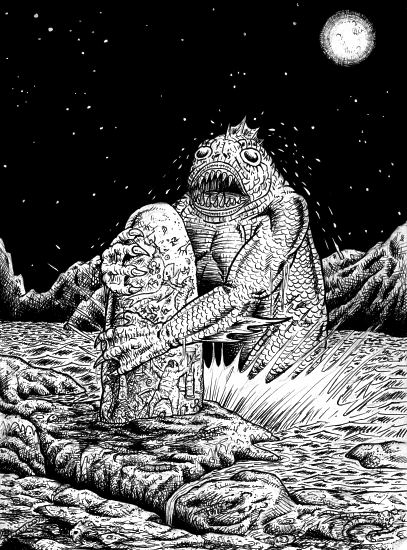




![Dracula [Audible Edition] cover art](https://m.media-amazon.com/images/I/51ef+s6y42L._SL500_.jpg)


