Tag Archives: lantern

The Myth of Oiwa — The Paper Lantern Ghost

Advertisements

The blinking paper lantern hides a vengeful ghost in one of the most famous Japanese ghost stories. From a local legend about a real woman to the stage, the myth of the ghost of Oiwa continues to inspire horror.

Many of the more well known stories of ghost and horror from Japan is about the Onryō, meaning a vengeful spirit. A ghost so full of regret and rage, they are posing a threat to living humans. And sometimes, they can come in the form as a Japanese Paper Lantern Ghost. This is the case of the ghost of Oiwa.

Read more about the Onryō

Onryō — the Vengeful Japanese Spirit

In many cultures, ghosts are put in different categories. Such is the case with Onryō (怨霊 onryō,) It basically means “vengeful spirit” or “wrathful spirit” in Japanese and is a mythological spirit of vengeance from Japanese folklore. They also have ghosts, called yurei, but these differ in the will of the ghost. As opposed to…

There are many movies, books and popular culture that feeds on the old legend of the vengeful spirit. Today in modern time we have The Ring and The Grudge series that makes use of this old legend, and in many instances, they are both also inspired by the most iconic Onryō throughout time, the ghost of Oiwa.

Yotsuya Kaidan — The Tale of Oiwa and Tamiya Iemon

The ghost of Oiwa is a vengeful spirit that we first learned of through the kabuki play called Yotsuya Kaidan (四谷怪談) or Ghost Story of Yotsuya from 1825. It was written by the writer Tsuruya Namboku IV, known for his plays with supernatural themes and macabre and grotesque characters.

She is an easy recognisable character on stage with her droopy eye and hair falling out or as the iconic Paper Lantern Ghost. She is also often seen as a Japanese ghost lantern in art.

Read Also: Check out all of the ghost stories from Japan

Kabuki Theatre

The Kabuki theatre is a traditional Japanese style plays originating in the Edo period. It is well known for its characteristics wigs, costumes, makeup and masks. It is exclusively theatre troops of men playing all roles. The distinct styled stage performances is the origin of many iconic looks in modern pop culture, like the distinct style of the Onryō with the white dress, white makeup and long black hair.

Yotsuya Kaidan is not the first and original written account of the legend, but certainly the most famous one. The first written manuscript about the ghost of Oiwa is dated to 1727 called Yotsuya zōtan 四谷雑談. It was an underground publication, most likely of the scandalous rumour of the true rumours of a noble family and lady that acted as an Onryō after her death.

Yotsuya Kaidan tells the story of Oiwa and Tamiya Iemon and in this play it tells the story of a woman scorned by her man and coming back from the dead for revenge. Throughout the years, there have been many adaptation and versions of the story and it was a popular story to tell as a part of a samurai parlor game.

Read Also: Games to Play in the Dark – including Hyakumonogatari Kaidankai

It is considered to be one of Nihon san dai kaidan — Japan’s Big Three Ghost Stories. It is arguably the most famous Japanese ghost story of all time and has spurned a couple of local legends of its own.

Read about the Nihon san dai kaidan—Japan’s Big Three Ghost Stories:

Banchō Sarayashiki — the Ghost of Okiku

The tale of Banchō Sarayashiki (番町皿屋敷, The Dish Mansion at Banchō) is a well known Japanese ghost story (kaidan). It was popularized in the kabuki theater tradition, and lives on in popular culture and folklore alike.

Keep reading

The Ghost of Oiwa — The Vengeful Spirit

Yotsuya Kaidan starts out as a classical romantic tale. Oiwa was said to be a loving and devoted wife that risked everything for her husband, Tamiya Iemon. They married in secret, without her father’s consent. Tamiya Iemon was a wandering samurai, a poor rōnin and not suited to marry his daughter according to the father.

The ghost of Oiwa
From the ”Thirty-six Ghosts” series by Tsukioka Yoshitoshi, ”The Yotsuya Ghost Story”, 1892.

Oiwa’s father whoever, was not as pleased with her marrying this man without honor and no money. When he found out the rōnin’s misdeeds, he confronted him. After a heated argument, the father was killed by the son in law when he threatened to make them stay apart from each other, and he did not bless their marriage.

After his death, Oiwa mourned her father. Iemon comforted Oiwa, claiming they would find her father’s killer.

To earn money he had to take up work as an umbrella maker to care for his pregnant wife. The old samurai grew bored doing the tedious work and turned resentful towards his wife, Oiwa. A woman he once loved and done horrible things to stay with. But in the end, there was no love left.

Next door they had a neighbor with a granddaughter that loved Iemon. The neighbor himself wanted his granddaughter and Iemon to get married. They were wealthy neighbors, and Iemon wanted to be that as well. So they planned how to get rid of Oiwa together.

Unbeknownst to Oiwa they sent her either an ointment or face cream laced with poison. But the poison didn’t kill her and only left her disfigured with one eye drooping and her hair falling off as she tried to brush through it, making Iemon so disgusted by her, he came up with a plan to rid himself of her. He hired one of his friends to rape her so that he would have grounds for a divorce.

His friend however is unable to go through with the plan and shows her a mirror instead. When she sees herself she understands what has happen and how she has been deceived. She takes a sword and accidently kills herself with it, and on her last breath, she curses Iemons name. In some versions there is actually Iemon that kills her.

Iemon threw her in the river to rot and went on to plan the wedding to the neighbors granddaughter. That night, the night before his wedding, he had terrible night terrors, and he saw his dead wife manifesting. In a burning paper lantern she comes out as a ghost, frightening him as a warning of the hauntings that are about to come.

The Chōchin obake

In Japanese legends, they have this concept of Tsukumogami (付喪神, “Kami of tool). This is the belief that inanimate objects, when they ‘serve’ their owners for a hundred years, they are granted life and a soul. When the Japanese lantern, or Chōchin reaches this age, it can become Chōchin obake, a Japanese lantern ghost, a mostly harmless ghost that laughs and lightly scares humans. But they could also be inhabited by a powerful onryō.

The Lantern: The print depicts a Kamiya Iantern haunted by the ghost of Oiwa as the Paper Lantern Ghost in Yotsuya Kaidan
Kuniyoshi Utagawa, ”The Ghost in the Lantern”, 1852.

But he is not frightened enough as he still goes on with the wedding the next day. When he lifted the veil of his bride though, it was the ghost of Oiwas disfigured face staring back at him. He beheaded her, and therefore, his new bride as well. There is all in all a lot of killing going on.

He was then pursued by the ghost of Oiwa, not wanting him to escape. She was turned into a vengeful ghost, pursuing him into madness, making him suffer. He dies in the end, after suffering horrible.

It changes in the different adaptations of Yotsuya Kaidan how he dies though. Sometimes he is killed by Oiwa’s brother, or brother in law and in other versions it’s the haunting of the ghost of Oiwa that drives him out of his mind and into death. Sometimes it’s Oiwa herself, that pulls him down from the height with her. Either way her revenge is complete.

Advertisements

The Deaths Behind The Play of the Paper Lantern Ghost

The success of the Yotsuya Kaidan play was so big that they had to reschedule more performances to meet the demands. It was mostly believed that the popularity of the play was because it tapped into the zeitgeist of the society at the time.

Oiwa as the lantern: The ghost of Oiwa manifesting herself as a Japanese Paper Lantern Ghost. From the series One Hundred Tales (Hyaku monogatari).
Print by Katsushika Hokusai. 1830

The theme of repressed women was something that reflected the Bunsei era that was also a time of great unrest. And the story of the victim taking her revenge of her oppressor was something the audience revelled in.

But where did the story come from? Was it just from the imagination to Nanboku when he wrote the play?

In most blogs it is said the legend created the play. But was it actually the play that created the legend? Yes, it is based on the terrifying vengeful ghost, something older than the kabuki play. But were did Nanboku really get his story from?

According to some sources Nanboku’s play was based of an actual murder of the wife of a samurai that went insane after her husband got another woman pregnant. She wandered off from her home, never to be seen again.

It is also claimed that Nanboku based his play from to separate murders. One of the murders was that of two servants who had murdered their masters. They were caught and executed on the same day. The second murder that inspired the play was a samurai that nailed his wife and her lover to a wooden board and threw them into the Kanda River for being faithless.

In any case what source the play was created from, the play itself became something that created more legend. It has adapted for film over 30 times, and continues to be an influence on Japanese horror today.

The Real Oiwa and her Rocks

But who was the real Oiwa behind the manuscript? Both the play and the written account from 1727 from the underground publication that claimed a dead wife had turned into an onryo. Wether this account really refers to this Oiwa, is a bit uncertaint though.

We can find an Oiwa Tamiya in the real life that had something mysterious happening to her. Living in the 17th century, she was born into a powerful family, but she and her husband had financial difficulties.

One day Oiwa came over two very large rocks she felt was something special and put them both in her garden. She prayed to these rocks for good luck and prosperity for her family to overcome their financial difficulties.

And over time, the things she prayed for to the rocks really happened for the family and everyone believed it was because of the magic rocks that she had prayed to. The rocks became famous, and was called Oiwa Inari or Yotsuya Inary. In the end, a shrine was built for it, and this is the shrine people flock to pray to.

Even the Tokyo Metropolitan Board of Education found it necessary to distinguish the real life Oiwa and the play and they have put this message:

Tamiya Inari Shrine, commonly known as Oiwa Inari, used to be i the premises of Tamiya family of Osakitegumi doshin (military officer in the Edo period).

An old story is passed down that Oiwa (died in 1636), a daughter of Tamiya Matazaemon, worshipped at the shrine and restored her family with Iemon, her husband. Therefore, the shrine was gradually worshipped as ‘Oiwa Inari* by people. There was yet another story to attract further worshippers, the ghost story ‘Tokaido Yotsuya Kaidan’, written by Tsuruya Nanbuko and was staged in 1825 and was very popular.

However, it was written after 200 years of time when Oiwa and Iemon actually lived. Unlike the famous ghost story, their marriage in reality was enjoyable. After Inari shrine was lost by a fire in 1879, it moved to Shinkawa in Chuo Ward. The present shrine was rebuilt here at Yotsuya in 1952.

— Tokyo Metropolitan Board of Education

Although not like in the play, there were rumours about Oiwa being a vengeful ghost, long before the Kabuki actors entered the stage for the first time. Something we can read about in the manuscript from 1727 that also hinted to this fate for her.

A more sinister legend of this lady though is the curse she apparently set on three houses had been disrupted, rumour saying it was the grudge of Tamiya’s wife, Oiwa that killed them. They were both victims of the reforming rule of the eight Tokugawa Shōgun, Yoshimune Kō. In some accounts she disappeared, in others she commited suicide, vowing to revenge those who wronged her. In all she was blamed for the deaths of at least fifteen people.

The Shrine in Oiwa’s Honor

Already in 1717, there was a shrine erected in her honor, something they sometimes did to appease the wrath of an Onryō, long before the publication that were written ten years after. This is a list of some of the shrines that were built to restore her honor and protect from the harmful ghost, or at least connected to the Oiwa legend:

  1. Yotsuya O’Iwa-inari Tamiya Shrine
    四谷於岩稲荷田宮神社
    新宿区左門町
  2. O’Iwa-inari Yōunji
    於岩稲荷陽雲寺
    新宿区左門町
  3. O’Iwa-inari Tamiya Shrine
    於岩稲荷田宮神社
    中央区荒川
  4. Myōkōji
    妙行寺
    豊島区西巣鴨

They say that when visiting her grave, there is a statue of Oiwa inside the main building in some of her shrines, although not accessible to visitors. you can wish upon it as it is said she grants the wishes of her worshippers. This is also the rumours about her grave.

The Curse of Oiwa’s Grave and The Curse on the Play

The revenge of Oiwa: The ghost of Oiwa coming out from the Japanese lantern in Yotsuya Kaidan as a ghost with her son in her arms.
Artist:Kuniyoshi

It is said her body is buried at Myogo-ji temple in Sugamo, Tokyo. Her death is listed in February 22. 1636 and the grave has been rumoured to have been haunted for ages.

After the play started, there have been reports of accidents, injuries and deaths around the production of the play or even TV or movie adaptions of the story. This has been blamed on the ghost of Oiwa and her wish for revenge. Therefore it has become a tradition to visit and pay respect for the people involved in a production of Yotsuya Kaidan just to be safe.

I you go straight through the graveyard, there is suppose to be a red torii (a Shinto shrine archway) by a tree. Under the tree, her grave is supposed to be. But don’t run off to check it out just because you are curious and nothing more. According to legend, if you visit the grave just because of curiosity, your right eye will swell up, just like hers did with the poison.

It is said to be a curse over it all. And very much like the Macbeth curse, the people involved in productions of the legend of Yotsuya Kaidan, still honors it. Before retelling the story there is a tradition to go to her grave, to ask her permission, asking for her blessing to tell her story again. So… will you?

More like this

Newest Posts

References:

Chōchin obake

Tsukumogami | Yokai Wiki | Fandom

https://www.japan-guide.com/e/e2090.html

Tsuruya Namboku IV | Japanese dramatist | Britannica

Japan’s Three Great Ghost Stories | Japanese Art

O-Iwa’s Curse

https://kokoro-jp.com/culture/1489/

YOTSUYA KAIDAN

YOTSUYA KAIDAN

Oiwa-Inari Tamiya shrine – Shinjuku, Tokyo

Tokyo Ghost Hunting: Visiting Oiwa’s Haunted Shrine in Yotsuya

Minxiong Ghost Mansion

Advertisements

Minxiong haunted house, otherwise known as the Liu Mansion is located In the Taiwanese countryside and the old baroque mansion left abandoned and decayed by weather and time. And after being abandoned by the owners, rumours of ghosts started to be told and the mansion is one of the well known haunted places around.

On the serene countryside of Taiwan, amidst rice fields and forest, a mansion is left abandoned between the Banyan trees that have soon claimed the mansion as its own. The majestic red brick building must have been beautiful when first built, but now, it only holds the mysterious charm that old ruins have with its secrets and signs of the passing of time. 

The Baroque styled house, also known as the old Lui Family Mansion (劉家古宅民雄鬼屋) is located in Chiayi, southwestern Taiwan. It’s a hot and humid climate, but the story surrounding this house is a chilling one. The Minxiong Mansion is an eerie place, so forlorn, but famous as it is considered Taiwan’s most famous haunted place. A fact especially seen during ghost month were visitors flock to the site to catch a glimt of something paranormal going on in the quiet countryside.

Read More: Check out the rest of our ghost stories in haunted houses and mansions here.

The Haunted Minxiong Mansion

So what is it about the house that make people claim it is haunted one? A lot of factors have contributed to its rumour of Minxiong Mansion being haunted. Firstly, It’s located along a road with a graveyard close on either side. This has made drivers vary about driving pass for a long time.

The house is also today in a constant state of decay as no one is really paying any attention to it, and the old and dangerous ruins of the house turns out to be a perfect setting one. Then finally, there is the local legend about the house being haunted and cursed from the start. According to this one legend, the one who built it placed some sort of a charm or spell in the house in secret, making everyone living there hear strange noises, footsteps and unexplainable sounds.  Who built it though and why it was cursed never really makes it into this particular legend though.

Read Also: Check out more haunted abandoned places like Yongma Land Abandoned Theme Park and Hauntingly Beelitz-Heilstätten Hospital

So who used to live there when it was first built? The three storey house was built in 1929 by Liu Rongyu (劉溶裕), a local businessman and landowner. The baroque architecture the house was built in was very in style with the wealthy merchants in Taiwan at that time.

Liu Rongyu had seven children and wanted somewhere peaceful and quiet to enjoy the countryside and the grandchildren that would follow. But not long after the building was complete, the mansion was completely abandoned, and the owners never came back in the 1950s. And so, the legends about it being haunted started creeping into the once beautiful family mansion.

The Maid in the Haunted Well

Local legends have a lot to say about the reasons the family left Minxiong haunted house. Was it just because of the remote location? The building was so far from everything and an inconvenient place to commute back and forth from work that maybe the family would rather relocate to the city? Or is it something about the story that has been told about the maid? 

The Haunted Well: The allegedly haunted well that can still be found on the property of Minxiong haunted house. It reminds a lot of the ghost story of Okiku who was also a maid that drowned herself in the well on the estate.// Photo: Koala0090, source.

One of the legends about the place, we find a more disturbing reason for the abrupt escape from the mansion. In the surrounding garden from the house there is an old well sealed shut that no longer is filled with water. And from this particular well, the legends of this house seeps through the cracks of the dried up well.

It is said one of the maids of the house had an affair with the man of the Minxiong Mansion. When the story came out, she ended up jumping to her death in the well that can be found outside.

Some versions of the story tell that the wife found out about the affair and tormented the maid, both mentally and in some accounts even physically, until she couldn’t take it anymore and ended her life by drowning herself in the well. But the story didn’t end with the tragic death of the young maid though, and the maid came back for revenge against the masters of the house. As a spirit she returned to torment the family who had tormented her. Every night her ghost terrorized the family until they packed up their things and left to never return. 

In the following years the visitors coming at night to the abandoned building were also haunted. And so many have been rumoured to be struck by bad luck or even illness, taking their life as the vengeful ghost still haunts the grounds. Especially the soldiers of more than one army have been allegedly chased away by the ghost. 

For more ghosts haunting the wells, check out some of our other stories in the MoonMausoleum:

You may also like:

Banchō Sarayashiki — the Ghost of Okiku

The tale of Banchō Sarayashiki (番町皿屋敷, The Dish Mansion at Banchō) is a well known Japanese ghost story (kaidan). It was popularized in the kabuki theater tradition, and lives on in popular culture and folklore alike.

Keep reading

The Japanese Army Massacre in Minxiong

The story of the maid has been said to be nothing but gossip and false lies several times, and the Liu family themselves are tired to hear about the strange stories surrounding their old family home. But the following strange happenings after the family left the Minxiong Mansion helps keep the story of the alleged curse of the house. 

During the time the Minxiong haunted house was built and the family lived there, the island of Taiwan was under Japanese rule (1895-1945) that could factor into the story. During this time business flourished after the Japanese built up the city of Chiayi after a devastating earthquake in 1906. At the time, this was the fourth biggest city in all of Taiwan. Perhaps that was not the case after the Japanese left and could that be some of the reasons that the Liu family eventually left the Chiayi countryside?

The more rational explanation would perhaps be that the Liu family simply relocated themselves for business reasons by moving downtown in Chiayi City, something that the family itself have expressed on multiple occasions although it doesn’t fit well with the rumours of the Minxiong Mansion being haunted.  

There also has been stories about the Japanese army opening gunfire around Minxiong haunted house for no apparent reason when the Japanese army temporarily stayed there, ending in killing innocent soldiers in the crossfires. Who or what did they think they saw in the dark and remote old mansion? The story about the killed soldiers in the mansion have not been verified as a historical fact, and is more told as an anecdote. Verified or not, several holes in the walls from what appears to be from gunfire can be seen still to this day, making one wonder who and why they were fired. 

The Strange Deaths of KMT Soldiers

A few years later after the Japanese army also left the mansion was occupied by the KMT (Kuomintang of China) the Chinese nationalist party of Taiwan, which in fact is officially known as Republic of China (ROC) came into power in 1949. By this time, parts of the Minxiong haunted house had already been damaged during bomb raids by the American army during the second world war and the interior of the house had been stripped away to build the nearby schools. You could say that the place already looked a little haunted.

Some soldiers from the KMT were stationed at the house in 1949. At this time there was no electricity and the Minxiong Mansion and the grounds around were completely left in darkness during night time, something the soldiers themselves refused to endure. There were several complaints from the KMT soldiers about seeing a ghost floating outside their window, demanding they had to put up electricity to fight the darkness they thought surrounded them in the house. 

Minxiong Haunted Mansion: Entrance to the Old Liu Family Mansion still have visitors, although no one have lived there for ages. Now, it seems to belong to nature and the wild. It is now mainly visitors that are in search for the paranormal and to try to spook each other that visits.// Source/Flickr

Here, a string of deaths started to give fire to the haunted house rumours. According to the rumours of the deaths it was either that the KMT soldiers residing there got sick and died or on other accounts, thought to be suicides. All of this made the mansion get a reputation as haunted.

But also here, we have some counter intelligence that tells another story and although not haunted it is a tragic one. According to the other version many of the soldiers stationed there suffered badly from homesickness to their mainland China that in turn drove them to kill themselves on this foreign land so far from home. 

Minxiong Haunted House Movie From 2022

In 2022, it was even made a movie about the place and based on the urban legends surrounding the mansion called Minxiong Haunted House (民雄鬼屋). It didn’t really do so well in the box office, but it certainly renewed the interest for the old haunted ghost mansion.

The story is set to the Minxiong Mansion where a mother goes looking for her daughter who goes missing inside the old mansion. They go there during the Qingming Festival to visits the tomb at Chiayi Minxiong Cemetery when her daughter disappears. And on her search for her daughter, she ends up encountering the ghosts within the mansion and has to deal with a haunting past as well.

Minxiong Haunted House: Poster from the 2022 movie called Minxiong Haunted House about the Liu Mansion. The movie is based on the many legends and myths that the ghost mansion has acquired over the years it has been left abandoned. Photo: Disney+

Hauntings During Ghost Month

The story of the Minxiong Mansion continues to inspire and attract visitors, especially during ghost month when people flock to try to see a ghost or two at the old Lui Family Mansion that never seems to rid itself of its haunted reputation.

Read more: The Obon Celebration – The Ghost Festival is around the same time and is also based on the traditions during ghost month.

Ghost Month: Traditionally, that ghosts haunt the island of Taiwan for the entire seventh lunar month, known as Ghost Month. The first day is marked by opening the gate of a temple, symbolizing the gates of hell. On the twelfth day, lamps on the main altar are lit. On the thirteenth day, a procession of lanterns is held. On the fourteenth day, a parade is held for releasing water lanterns. Incense, food and spirit paper money are offered to the spirits to deter them from visiting homes. During the month, people avoid surgery, buying cars, swimming, moving house, marrying, whistling and going out or taking pictures after dark. It is also important that addresses are not revealed to the ghosts.//Photo: mahe haroutinian on Pexels.com

Every year, especially in the seventh month of the lunar calendar, or Ghost Month, the Minxiong haunted house gets plenty of visitors. The floors of the house have long collapsed, and the red bricked walls has started to crumble, soon it will perhaps disappear completely.

Any plans to restore the haunted and decaying house have long been rejected by the Liu family as they want nothing to do with it anymore. The Minxiong Mansion will soon be taken by the forest and swallowed whole, unable to reveal the truth of what actually happened at the manor.

More like this

Newest Posts

References

18 Creepy Haunted House Stories – True Ghost Stories 

Abandoned Taiwan: The Old Liu Family Mansion at Minxiong 

Liu mansion in Chiayi voted top haunted house 

Minxiong Haunted House | A Thrill Seeking Adventure

興中村 

Minxiong Haunted House 民雄鬼屋

民雄鬼屋 

【古蹟探索】台灣四大鬼屋之首–民雄鬼屋名列亞洲十大鬼屋的民雄劉家古宅追追追| 貓大爺| 鳴人堂

The Anson Lights Highway Ghost

Advertisements

In the quiet Texan town of Anson, a local legend has taken form after small lights no one could explain appeared. Is it the lantern of a ghost or is the Anson lights simply the lights from the cars on the highway?

There is something about the highway, especially along those monotone dusty roads that goes on for hours. The highway can make the mind wander, it takes you down a road, not only geographically, but something happens with the mind as well on long stretches of nothingness. Time passes differently when you are behind the wheel. Perhaps that is what happens along the highway in Anson? Where does the ghostly lights come from then?

Near Abilene, Texas is the quaint town of Anson, that may or may not have been the inspiration for the movie Footloose as they too had an actual no dancing law in the 80s. And although living in that movie sounds cool, living in the real town before Kevin Bacon, does not.

The Anson Lights: According to the local legend, If you drive by the cemetery and flick your light, supposedly the Anson lights will flick back. Is it a ghost? Is the strange light phenomenon because it’s a haunted place? Photo: Paul Cameron on Pexels.com

The landscape around this ghost town by the highway is flat and dusty. Nothing in the horizon except blue sky, red if the dust swirls in the air. The few growing things there is sparse, revealing everything in a spartanic landscape.

Read Also: Check out all of our ghost stories from USA

They don’t really like the fuzz down there, and they certainly don’t like the fuzz the legend the highway ghost had provided them with. “For a long time people were embarrassed by the Anson light,” then mayor (2000) Tom Isbell said in a great article in the Texas Monthly. “Anson has stories to tell, but for some reason we just don’t tell them.”

And for the time being, the town of Anson, is known for the Anson lights.

Where to See the Anson Lights?

The Anson lights have attracted many curious spectators, paranormal investigators and mediums to this town. But perhaps mostly, it is high school students with nothing to do in this no dance town on a Saturday evening. It can be a pretty scary sight in the dead of night, with only nearby coyotes howling and screaming.

Read also: Check out The Palatine Light and the Ghost Ship Behind it for another ghost story behind a strange light phenomenon.

To see the Anson lights, you must drive by the local cemetery, Mount Hope, just outside of the town. Then you follow a dirt road along the graveyard until you reach a crossroad. There you turn, facing the road again and stop your car and flash your lights at the end of the road. If you are lucky, you will see them, something will shine a light back. From the other side at an distance a flickering light can be seen.

The Lantern of a Grieving Mother

But what really is the Anson lights? Surely they are there as numerous Youtube videos and pictures have showed us them, so we do know the phenomenon is a real one, but is it a paranormal one as well? One of the most appealing explanation is of course the supernatural ones. Because a ghost town has its ghost stories as well.

The Haunted Lantern: Many of the ghost stories claim that the Anson Lights are actually the light of a ghost carrying a lantern.

One of the local legend behind the strange lights is the story of a grieving mother looking for her son on winter night. According to the story the mother went out looking for her son with a small lantern in her hand. It was a cold night in the snowy Texas winter and the wind was howling, the night grew darker. She never found him. Or… she hasn’t found him, yet.

It is said that even after her death, she kept on looking for her long lost son who disappeared that one cold fateful night.

This is what is told in The Big Book of Texas Ghost Stories by Alan Brown and in this book there is more than one legend of just who is flickering the lights back by the graveyard.

Read Also: Check out all of our stories about Haunted Cemeteries

In another version of the legend, the mother told her two sons to run to the store to pick up a few things. The mother gave them a lantern that they would flash three times with, if they got into trouble. And they did.

According to this story, the two little boys were killed by an oncoming train on their way home. They are now roaming the nearby area as ghosts, still flashing their light, trying to signal their mother for help.

Debunking the Legend of the Haunted Anson Lights

Who is to say that this ghost story didn’t happen? Perhaps no historic records in any case that we have found. And with every unconfirmed record, there is this voice saying, well… doesn’t really prove it didn’t happen though. What is proven though, is that there is a more logical than paranormal explanation to it.

At Abilene Christian University, a professor brought along his students to prove that the lights were actually coming from traffic lights from a nearby highway than from a ghostly mother with a lantern. With GPS trackers and binoculars, his students were able to document that the light were just lights from cars going south on a nearby road. A thing the Southwestern Ghost Hunters Association had already claimed a long time ago as they didn’t find anything paranormal about the Anson lights either.

Read Also: Another ghost story that got debunked was the hauntings in The Haunted H House

So, everyone happy then? Perhaps not the kids of Anson. The professor issued an apology for the reveal and to the locals of the town felt this was the story they could have fun with. What now? What now for fun?

The Anson lights is the approaching car lights from southbound traffic on US-277. Perhaps that is the true haunting, the cars going away. As the little town of Anson is closing up, boarding up their shops and the cars are streaming passed our out of the town, perhaps that is the true ghost of Anson.

More like this

Latest Posts

The Obon Celebration – The Ghost Festival

Advertisements

Light your lanterns, put on your Yukata and get ready for The Ghost festival in Japan called The Obon Celebration. The festival, also known as Bon festival is a three day long festival each year in the late and hot summer to honor the dead.

Why is every Japanese ghost story set during the hot and humid summer nights? It’s not really, but a staggering amount is and there is a reason for it!

Beautiful lanterns: Bon-odori festval at Higashiyama Onsen (Fukushima) 17 August 2009. Photo by: Yoichiro Akiyama/source

In mid July you can hear the sound of wind chimes and there is shaved ice on every corner in the summer heat with people wearing their traditional Yukata. Perhaps coming from or going to one of the big parades? The cicadas sings and the Japanese takes the time to tell their many ghost stories in the hot summer nights.

Fun fact, some says that telling a chilling ghost story in the hot humid summers in Japan, will help cool you down, because of the goose bumps you get from being scared. And because of that, a trend in the Edo period started with telling ghost stories in the theaters in the summer times, called Kaidan.

Read Also: Some of the most famous Kaidan ghost stories is: The Myth of Oiwa — The Paper Lantern Ghost, Botan Dōrō – Tales of the Peony Lantern and Banchō Sarayashiki — the Ghost of Okiku. Check out the full story here.

The Obon Celebration is not only an ancestral celebration from the old days they keep alive. Horror movies takes over the cinema, Kabuki theaters put on their traditional ghost plays and teenagers dares each other to visit the cemeteries at night, making the whole festival seem very similar to the modern Halloween celebration in the west.

The paranormal hunters are also about, visiting well known haunted locations around the country and the belief in spirits reach an all time high. But there are also less sinister traditions that comes with the festival.

The Buddhist Obon Celebration

So what really is the The Obon Celebration other than watching horror movies, telling ghost stories and ghost hunting? Obon (お盆) or just Bon (盆) is a Japanese Buddhist custom to honor the spirits of one’s ancestors that incorporated the Japanese native folk religion Shinto, differentiating it a bit from the other Buddhist Ghost Festivals from other countries.

The Obon Celebration originated from the Indian and Chinese Ghost Festival during ghost month. There are many variant of this ghost festivals across the Asian continent coming from the same buddhist story.

Read Also: Interested in more haunted Japanese tales? Have a look at all our ghost stories from Japan

The Obon Celebration is one of the few events on the Japanese calendar that focuses on the importance of family and is there to give the families in Japan time together. It is not a public holiday, but customary to be given leave to travel to your hometown, back to your family. Both the living, as well as the dead.

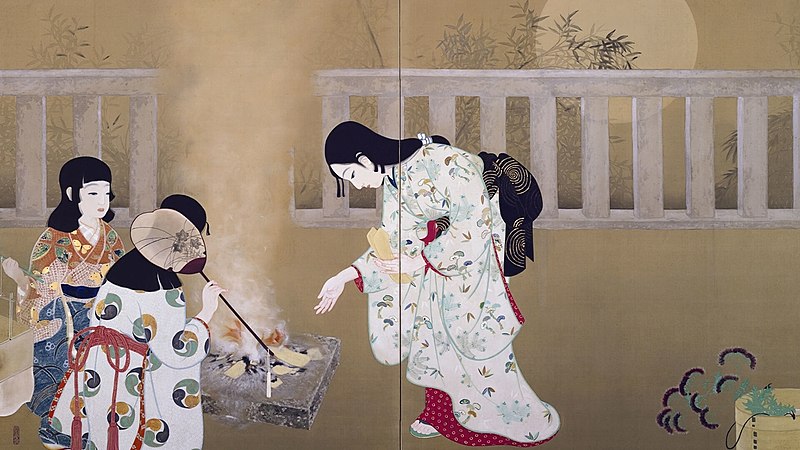
Welcoming the Dead: “Bonfire for the Spirits of the Dead (Okuribi)”, two-panel screen, Color painting on silk from 1916. Showing how the Japanese light fires to welcome the spirits of the dead during Obon in a ritual known as Mukaebi.

When is Obon Celebrated?

The Obon Celebration has been going on every summer for over 500 years. The exact dates changes according to where you live though because the lunar calendar was changed in favor to the Gregorian calendar instead. During these days the employers often grant their workers and the trains, planes and busses are filled with people out in the countryside to celebrate it with their family or into the cities to join the big parades and happenings throughout all big cities.

Read Also: More articles on Paranormal Festivals and Happenings found in the MoonMausoleum.

In eastern Japan, it is held 15th of July, but in the western part it’s held on August 15. However, in Okinawa and the Amami Islands it’s different again and follow the Chinese way to celebrate on the 15th day of the 7th lunar month like their ghost festival. In common though, the festival lasts for three days and the official Obon holiday is from 13-15 July.

Visiting the Grave: A huge part of The Obon Celebration is going home and visiting the graves of your ancestors, clean them and make offerings to them throughout the festival before sending them back to the afterlife.

It is believed that during these three days the ancestors spirits return to the world to visit their relatives. In this time the veil between the spirit world and the world of the living is at its thinnest and therefore the spirit can pass through.

How do the Japanese Celebrate Obon?

To prepare for the return of the ancestors during the The Obon Celebration, the Japanese clean the grave sites in a ritual called Haka Mari. From the newly cleaned graves it gives a path to them back to the house in a ritual called mukae-bon. A spirit altar is put up back at the home and offerings like fruit, flowers and incense is given.

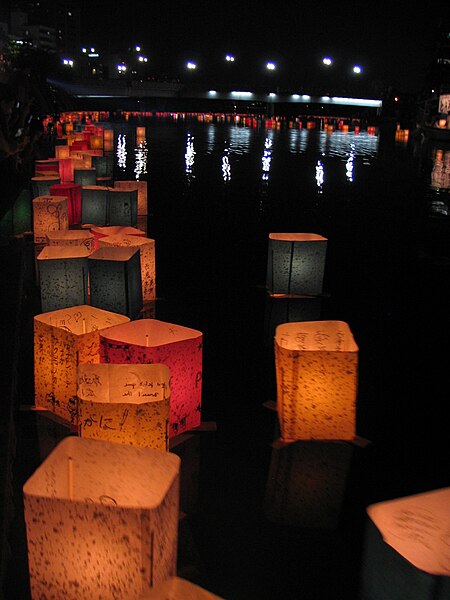
Floating lanterns: Tōrō nagashi float in the river in Hiroshima, as part of the Hiroshima Peace Memorial Ceremony in 2009. Photo: 藤谷良秀(Yoshihide Fujitani) /source

The Obon Celebration begins with Mukaebi, which is a ritual of lightning fires to guide spirits home for the duration of the festival. Often in the form of lanterns hung in front of the houses.

In this way the Obon Celebration reminds much of the western All Saints Days or Halloween celebration as it is believed the veil separating the living and the dead world is thinner and it’s a time for hauntings and ghost roaming the world.

Read Also: Halloween Traditions Across the World

The lanterns most often used is the traditional paper chochin lanterns, but how you use these lanterns and were is very different from region to region.

In some regions of Japan they light up huge fires outside the houses instead of lanterns. Like they do in The Daimonji Festival in Kyoto were they light up series of , 200m-long, character-shaped bonfires built on mountainsides.

When the Obon Celebration ends, the chochin lanterns is often used to guide them back to the spirit world, a ritual called okuri-bon.

On the final evening of the Obon festival it is thought that placing floating lanterns down the rivers will help guide the spirits back to the spirit world if you live close to a river or some sort of water. This tradition has gained a lot of popularity in modern time.

This ceremony is called Tōrō nagashi 灯籠流し, but the custom of sending floating lanterns during the Obon Celebration differs from place to place. The largest floating lanterns event though is in Hiroshima and Nagasaki to commemorate the victims of the atomic bombs during the second world war.

Welcoming and Feeding the Hungry Ghosts

One of the things The Obon Celebration is for, is to ease the suffering of spirits. To do this they have to perform the ritual of segaki 施餓鬼, meaning feeding the hungry ghosts, otherwise known as a vengeful spirit, or in the western tradition: a poltergeist. It is a ritual of Japanese Buddhist tradition.

Read Also: Interested in more ghost stories about the Hungry ghosts? How about reading about the chinese ghost story of: The Story of Tu-Po – The Hungry Ghost or about the Japanese vengeful ghost: Onryo – The Japanese Vengeful Spirit

During the festival, the ritual is performed at Buddhist temples and more offerings are given to the hungry ghosts: Rice and water. This is for the muenbotoke, or the ghosts with no living relatives that have no one to welcome them.

The food served is often vegetarian and a thing eaten much of is sticky rice balls called ohagi and odango.

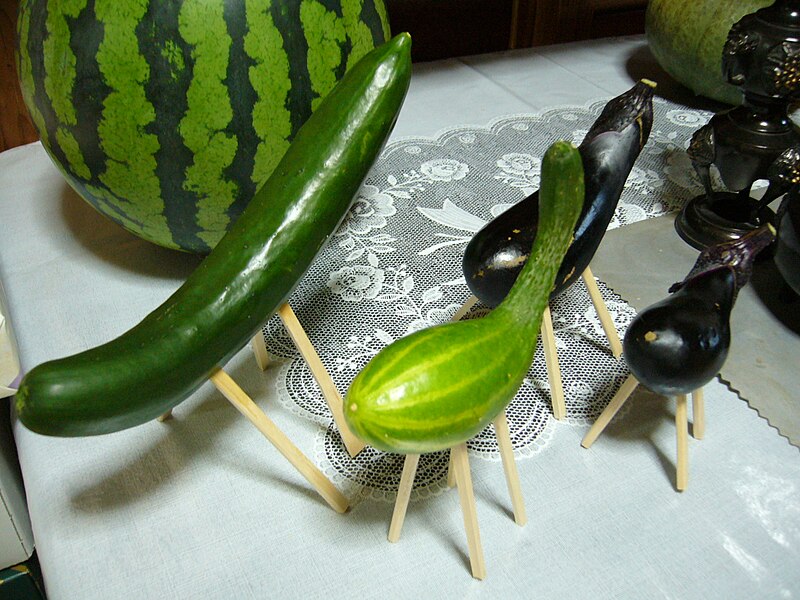
Another significant ritual people do during the Obon festival is to craft a cucumber horse and eggplant cow, known as shōryō uma (精霊馬, “spirit horse”) or ushi uma (牛馬, “cow horse”). This type of carved food works almost as a vessel for the ancestors to come back home when the festival starts and return when it’s over.

Food Offerings at the Alter: Cucumber and Eggplant crafted as a vessel so the spirits can come and go during the Obon Festival //Source: Wikimedia

The Buddhist Dance from the Spirit Realm Bon Odori

But exactly why do the Buddhists and buddhism influenced places celebrate the dead during this time? It is best seen through one of the ways the Japanese celebrate.

The Bon Dori Dance 盆踊りis a dancing style performed during The Obon Celebration. It comes from the story of Maha Maudgalyayana, or simply Mokuren which was the incident that made people celebrate the ghost festival in the first place. He was a disciple of Buddha and used his powers to look into the spirit realm. There he saw his mother, and saw she had become a hungry ghost.

He asked Buddha what to do and Buddha said to give offerings to the monks that completed their summer retreat on the 15th day of the 7th month. Mokuren did it and it worked. His mother was freed from the suffering of being a hungry ghost. He burst out dancing from pure joy.

Bon Odori Dance: This is a scene from one of the dance festival at the Hanazono Shrine, Shinjuku, Tokyo city. They are celebrating The Obon Celebration. Yukata-clad people dance in circles around the yagura as the music plays just as Maha Maudgalyayana did when he saved his mother from the afterlife as a hungry ghost.

The dance has so many variations and each region perform their local dance with their own music, however, the Japanese taiko drum is often used to the melodies of old folk songs.

There are several big parades showcasing the Bon Odori dance during the Obon Celebrations. The Tokushima Awa Festival (阿波踊り) is perhaps the most well known bon odori dance that draws millions of visitors to Tokushima to watch and join the huge parades in the city. There are the also Gujo Odori Festival in Gifu (郡上おどり) and the Akita Bon Odori Nishimonai Festival (西馬音内盆踊り). These are all well known for their Bon Dori during the ghost festival, but it is held smaller Bon Odori dances as well everywhere.

Since the celebration and all its customs is so different from region to region, the dance will look so different as well. But very often it is people lining up in a circle around a wooden scaffold made for the festival called Yagura. The dance can also include the history of the region as well. Like mimicking fishing in fishing areas, dance moves reminding of digging in coal mining areas and the likes. What they have in common though is their intent is to honor their ancestors and those that came before us.

Things to Watch out for During the Ghost Festival

Although mostly a family holiday and a time to spend with your family and religious days of remembrance and folk festivities, there are also several superstition that are said to be remembered during the days.

The first rule during Obon to beware of is to not take pictures during the night so not to capture a ghost. Perhaps a bit difficult because of all the festivities people take a photo of to remember.

It is also said not to swim as it is more likely to be drowned by a ghost. Do not steal the food offering to the hungry ghost of obvious reasons. Do not hang your clothes out to dry in the night as iit believed that the dead will wear them and don’t put the slipper heals towards your bed. Ghost will find your bed and climb into it, causing sleep paralysis.

All in all, do not do anything but being respectful to the dead during the Obon Celebration.

More like this

Newest Posts

References:

https://www.newworldencyclopedia.org/entry/Bon_Festival
https://www.jrailpass.com/blog/obon-festival-in-japan
https://www.tokyocreative.com/articles/18387-chilling-tales-for-hot-nights-ghosts-in-japan
Season of Ghosts: The Japanese Tradition of Scary Summer Stories | Work in Japan for engineers
What is Obon? Japan’s festival for the dead.