Tag Archives: haunted street

The Haunted Liuyin Street in Beijing

Advertisements

There is not only one ghost story haunting the old Liuyin Street in Beijing. Everything from ghosts in the old imperial mansions along the street, a mysterious force in the toilets, the ghost of a hero soldier and a mysterious girl dressed in red are said to haunt this street. 

Some streets are more haunted than others. Some only have one ghost that is well known, others have countless. The Liuyin Street in Xicheng (柳荫街) district in Beijing is one of those streets that have more than one ghost story attached to it. 

Read More: Check out all of our ghost stories from China

The place was known for military generals that lived there and also went under the name of Marshal Street. Today it has some of the old Beijing courtyards preserved. 

The Ghost of Prince Go’s Mansion

Firstly, it is the place you will find the Haunted Prince Go’s Mansion that is adjacent to the street in the east. Inside of the mansion it is said that a woman wearing white has been seen in the courtyard, still mourning her son. 

The mansion is known as one of the more haunted places in the country, but also out on the street there are more than one ghost still roaming about. 

The Little Girl in the Red Dress

One of the stories is that a little girl is haunting the street and the area of the city. According to the legend, she is wearing a full-length red dress. 

The story has evolved into more of an urban legend, and it is said that if you see her, you must just walk past her. She is said to not move at all, only turn as you walk past her 180 degrees. 

The Girl in the Red Dress: The story of a little girl haunting the The Liuyin Street in Xicheng (柳荫街) district in Beijing. The story of a little ghost girl wearing red is not an unknown one, especially in Taiwan.

It is said that the woman who first saw this ghost was so disturbed by the sight that she collapsed and was sent to an institution when she woke up. 

Where this legend comes from is unclear as it is only mentioned in a couple of online English sources with no further source work. The image of a little ghost girl in red is not completely unfamiliar though. There are urban legends from Taiwan especially that deal with the trope of “The Little Girl in Red”.

The Heroic Ghost of Yuan Mantun

The Heroic Ghost of Yuan Mantun: A bust is erected in his honor after sacrificing his life. Source

Down the road of Liuyin Street you’ll find a white bust memorial to a heroic soldier named Yuan Mantun that served in the People’s Liberation Army. According to the legends of the street, he is one of the ghosts said to haunt it.

The young soldier sacrificed his own life by diving into a freezing cold lake to rescue two workers who fell into the water in 1982 when he was on duty.

On February 24th in 1982, he jumped into the water twice to rescue two people and was in the water for over 40 minutes, battling the ice cold temperature as he managed to get both of the people safely to land.

When he finally got help and was rescued up from the icy waters himself, he was already unconscious. He died of hypothermia after his rescue, only 21 years old.  

Today his ghost is said to wander nearby but it’s also said that he’s a friendly sort and not out to scare those passing through. As he himself is said to have written in his diary:

“Only those who bring happiness to most people are the happiest people themselves.”

The Toilet Ghost in No. 2 on Liuyin Street

The last haunted rumor in the streets are from the old toilets in No. 2 in Liuyin Street. The story has made its way around the forum and is supposedly told from a former resident who grew up there in the 90s. 

In the old courtyard there was a toilet the residents all used, with poor sanitary conditions and was a place no one wanted to spend more time in than needed. The grandmother of the original poster said that an old woman went to the toilet and saw something of a specter that looked like something with half-male and half-female face  on the wall of the toilet and a burst of energy hit her. She was so afraid that she didn’t even have time to put on her pants and ran home. A couple of days later the old lady became ill and died in a matter of days. 

According to the poster’s grandmother, this was something that had also happened in the 70s, when a young man passed away after seeing something sinister after using the bathroom. 

Today the toilets on Liuyin Street are locked up and no longer in use. 

A Walk Down the Haunted Street

In conclusion, the old Liuyin Street in Beijing holds a fascinating array of ghost stories that continue to captivate locals and visitors alike. Although these ghostly encounters may send shivers down your spine, there is also a sense of intrigue and wonder that lingers in the air. The rich history and cultural significance of Liuyin Street add an extra layer of fascination to these supernatural tales.

As you wander through the winding streets and ancient courtyards of Liuyin Street, be prepared for the possibility of encountering the unexpected. Whether it’s a glimpse of a grieving mother in the Haunted Prince Go’s Mansion, a girl dressed in red who turns as you pass by, or the friendly presence of Yuan Mantun, the heroic ghost who continues to watch over the street.

More like this

Newest Posts

References:

The Toilet Ghost: 柳荫街2号发生过怎样的灵异事件?

The Girl in the Red Dress: Supernatural Events in Beijing, Ghosts and Hauntings Places in Beijing 

Yuan Mantun’s Memorial: 袁满囤_百度百科 

The Dark History of the Caishikou Execution Grounds

Advertisements

Explore the grim history of the Caishikou Execution Grounds in Beijing where countless executions took place, and some say that is haunted by the people that met their end there.

Caishikou Execution Grounds (菜市口法场), located in Beijing, held a dark and important place in the city’s history. The place was also called the Vegetable Market Execution Ground and was established during the late Ming dynasty when China entered into the Qing Dynasty and continued for centuries.

During the Qing dynasty, execution procedures changed significantly. Executions took on a more formal character, with punishments being imposed according to the severity of the offense and the status of the victim and many well known victims from Chinese history were executed right there. 

Read Also: Check out all of the ghost stories from China

Corpses of the beheaded convicts were often placed outside of Caishikou as an example to discourage others from committing similar crimes, and later, it was even turned into a macabre tourist attraction with the spectacle of death as well as selling postcards with photos of the dead bodies well into the 1900s. 

Caishikou Execution Grounds: A famous photograph, taken at Caishikou crossroad, during the execution of Boxers’ leaders in 1900. It has been later turned into a postcard, colorized, published in books, etc. On the back, pencil, ill-written: “26e year of Koang-hsu” (1900)

Because of its dark history and the blood that was shed on the spot, many claim that this is one of the more haunted places in the city and there have been many reports about people seeing the ghost of the executed convicts in the old vegetable market. 

The History of Caishikou Execution Grounds

Caishikou Execution Grounds were an important part of the Chinese legal system for centurie and served as a centralized execution site and symbolized the ultimate power of justice in the hands of the dynasty. Executions were conducted publicly with little mercy, punishing those found guilty of capital crimes such as treason, theft, counterfeiting, murder, and other offenses, and if it was a famous convict, large crowds would gather to watch. 

The Caishikou Execution Grounds is also known for the many famous people that died here. The House of Zhu that ruled in the Ming Dynasty was purged and executed here when the Manchu led dynasty came into power for example. There were also many people that were a part of the Boxer Rebellion who met their end here. 

The Exact Location of the Caishikou Execution Grounds

The exact location of the execution grounds in modern day urban Beijing has been a matter for debate for some time as it was definitely not the only place in Beijing they held executions. While most people agree that it is located in what is now the Chaoyang District of Beijing, there is disagreement about exactly which area it was located in and its size. 

It was located at the crossroad of Xuanwumen Outer Street and Luomashi Street, but today when looking at photos, it is most likely across from the Heniantang Pharmacy.

The Executions

When a convict was scheduled for an execution it was at 11:30 AM and the convict was escorted in a cart to the Caishikou Execution Grounds from the jail. Before reaching the final stop, the cart stopped at a wine shop called Broken Bowl Tea House on the east side of Xuanwu Gate that was called The Gate of Death. 

This was the last stop before the final stop and  the convict would be offered a last bowl of rice wine. After it was drunk the bowl of rice wine would be smashed and the convict sent to their deaths. It was also the place where the executioners retired after a day’s work to have a drink after. 

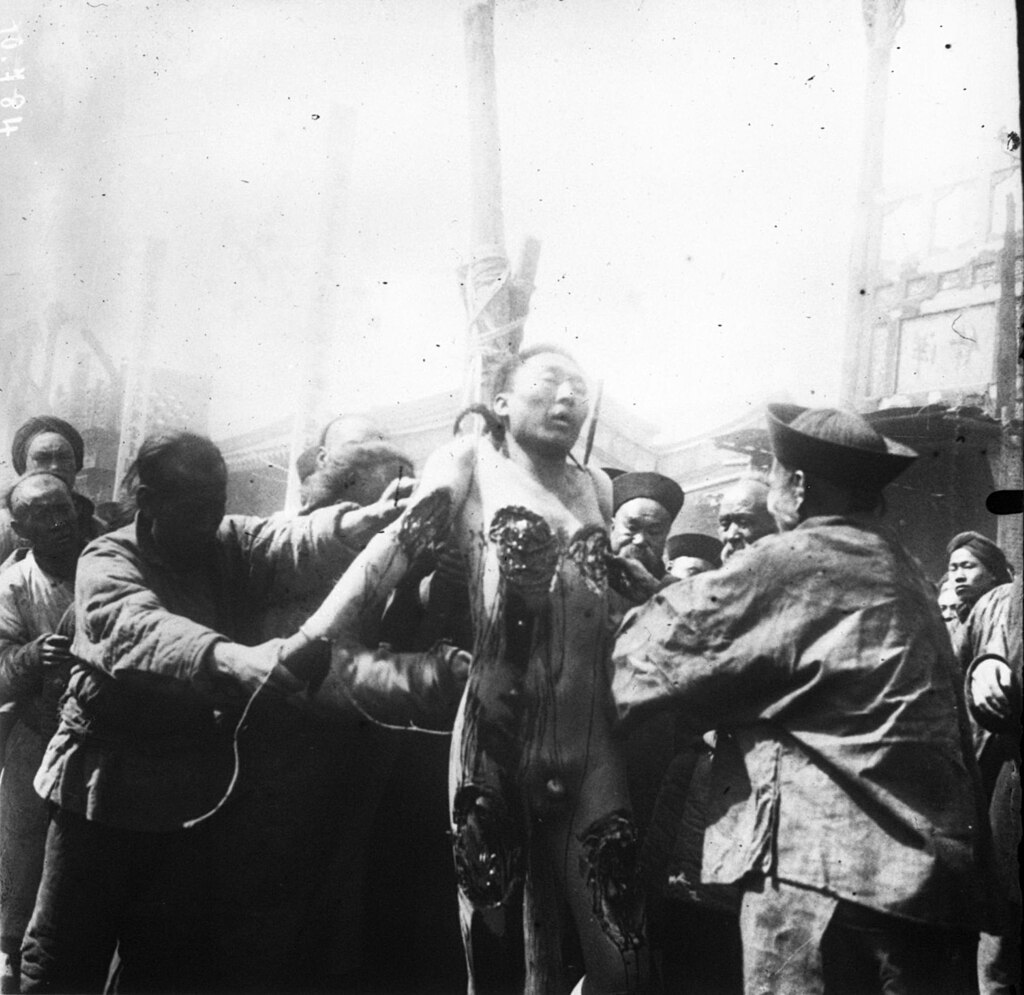
If they were sentenced to death by beheading they were lined up east to west in the autumn before winter solstice when most executions took place. But if you had done a particular horrible crime, you could also be sentenced to Linchi, or slow death where they slice you up, piece by piece. 

Death by a Thousand Cuts

One of the more gruesome methods of execution during the Qing dynasty was death by a thousand cuts or Lingchi (凌遲) as it was known in China. This method typically involved a series of deep cuts being inflicted on the criminal’s body and then left to bleed until the person died from extreme blood loss. 

This form of torture was considered especially cruel and often took over an hour for the prisoner to expire, making it one of the most agonizing executions employed at Caishikou until the method was outlawed by the government of the Qing dynasty in 1905.

Lingchi Penalty in China: Torture victim in China (lingchi torture in Beijing around 1910] otherwise known as Caishikou Execution Grounds : [press photograph] / [Agence Rol]

It was not only because of the torture aspect of the death it was considered particular cruel, but also what it did for the afterlife. The body was important to have whole in Chinese tradition and eunuchs even kept their severed parts in glass jars to have them buried with them so that it wouldn’t affect their afterlife or next life. 

Lingchi was an execution method only given to crimes that were especially bad, like treason. Several well known Chinese figures in history died by this way, like General Yuan Chonghuan, one of the people executed at the place on September the 22nd, 1630. It is said he has his own ghost story where he is haunting his tomb, but the execution ground itself is said to be haunted as well.

The Ghost of the Six Gentlemen of the Hundred Days Reform

The Six Gentlemen of the Hundred Days Reform (戊戌六君子) or the Six Gentlemen of Wuxu was young officials who put forward a preposition to the Guanxu Emperor of reform in the empire after it was met with pushback from the conservatives at court. 

They were arrested by the Empress Dowager Cixi and executed in Caishikou Execution Grounds in 1898 by beheading without having gotten a trial by the Ministry of Justice. 

These executed men are said to be haunting the place as well as Chinese history and the what if of what would have happened to the course of the country if the reforms had been successful. 

More like this

Newest Posts

References:

https://en.wikipedia.org/wiki/Lingchi

https://en.wikipedia.org/wiki/Caishikou_Execution_Grounds

https://www.thebeijinger.com/blog/2022/10/21/horrifying-history-behind-beijings-most-notorious-execution-grounds

City of Heavenly Tranquility – The Globalist 

The Story of the Lost Children on Rue Des Chantres

Advertisements

The Lost Children on Rue Des Chantres is still remembered, and sometimes even heard and seen on what is known as the most haunted street in Paris. 

Step onto the mysterious Rue des Chantres, just a couple of meters from the Seine in Paris and you will find yourself surrounded by spine-tingling tales of forgotten tragedies, haunted houses, and long-lost children.

This narrow and small street so close to Notre Dame has a long history and there are whispered rumors about lost souls to true accounts of agony and death. Learn about the sinister side of Rue des Chantres.

The Île de la Cité District in Paris

As one of the oldest parts of Paris, Île de la Cité is a place of legends about spooky happenings. This part of the city was once home to a convent, a castle, and hundreds of haunted houses that are said to be brimming with ghosts from the past. 

Tales have been passed down for centuries about the mysterious happenings between Rue des Chantres and Île de la Cité and people like Heloise from the Romeo and Juliet tale of Heloise and Abelard used to live in this area.

Uncover the History of The Lost Children

The terrifying legend of the Lost Children on Rue des Chantres is based on a true story. In 1910, the water level in Paris rose to an all time high level and flooded the city. Apparently it rose over one and a half meters. 

The city was at the time riddled with sickness, poverty and many suffered from tuberculosis. The hospitals had to rent extra rooms, and it is said they rented them at a hotel called Hotel-Dieu where the children stayed on the first floor. 

The children were allowed to be outside and play during the day and locked up for their safety during the night in their rooms. At the night of the flood they were trapped, helpless and drowned without a chance of escaping. 

The hospital tried to remove the body of the dead children in the night so no one could see, but they were discovered and to this day, many people believe that these poor souls still haunt the street as lost spirits – never having found peace in death.

The Ghost Children on Rue Des Chantres

Ever since that tragic night of the flood, visitors and locals alike have heard the sound of children’s screams coming out of the street as well as laughter from them playing. Some also report strange lights and shadowy figures walking in and out of doorways. Many attribute these sightings to the Lost Children on Rue des Chantres – but whatever their origin, they have certainly left a lasting impression on those brave enough to witness them.

More like this

Newest Posts

References

Rue des Chantres: A Little-Known Lane on Île de la Cité | solosophie

City of Fright | Peacock Plume