An online magazine about the paranormal, haunted and macabre. We collect the ghost stories from all around the world as well as review horror and gothic media.
A beautiful courtesan became mixed up in the politics that ended and started a dynasty in China. Today it is said she is haunting the Songpo Library in Beijing where she took her own life.
A beautiful courtesan became mixed up in the politics that ended and started a dynasty in China. Today it is said she is haunting the Songpo Library in Beijing where she took her own life.
In that time when the emperor abandoned the human world, Wu crushed the enemy and captured the capital, bearing down from Jade Pass. The six armies, wailing and grieving, were uniformly clad in the white of mourning, One wave of headgear-lifting anger propelled him, all for the sake of the fair-faced one. The fair-faced one, drifting, and fallen, was not what I longed for. The offending bandits, smote by heaven, wallowed in wanton pleasures. Lightning swept the Yellow Turbans, the Black Mountain troops were quelled. Having wailed for ruler and kin, I met her again.
Once upon a time, a girl followed the love of her life to be with him, but it ended in tragedy. He gave up his country to save her, but also gave up on her in the end. A tale as old as time of a love turned cold and sour and the perfect setup for a ghost story in the former Songpo Library.
Read More: Check out all our collection of ghost stories from China
In the former library known as Songpo Library in the Xicheng district in Beijing, China, it is said that a woman haunted the book aisles in the old Hutong. And according to reports, perhaps she is not the only ghost that are haunting the place.
The General’s Mistress
Wu Sangui: (吳三桂). 8 June 1612 – 2 October 1678), a Ming dynasty military officer who played a key role in the fall of the Ming dynasty and the founding of the Qing dynasty in China and thought to be haunting the former Songpo Library..
The story in Songpo Library starts out with a famous general known as Wu Sangui (吳三桂) that lived from 1612-1678. He was originally a Ming Dynasty military officer that played a key part in bringing the Dynasty down and giving rise to the Qing Dynasty. In contemporary China, Wu Sangui has often been regarded as a traitor and an opportunist, due to his betrayal of both the Ming and Qing dynasties. Wu’s name is synonymous with betrayal.
When the great general Wu made this place his home he brought his lover with him, a courtesan named Chen Yuanyuan. Different accounts gives different tales about if Chen Yuanyuan really did live in this place, as it is also said it was to Kunming General Wu brought her, not Beijing.
General Wu Sangui is today known as a big traitor and is said to have betrayed the Ming Dynasty by allowing the Manchu army through the Great Wall he was put to guard, for a position in the Qing Dynasty.
It is also said that he betrayed the country for the love of his life, Chen Yuanyuan. Wu’s romance with and love for his concubine, Chen Yuanyuan, remains one of the classic love stories in Chinese history. A story tells that the Bandit King Li Zicheng kidnapped Chen Yuanyuan and for her freedom, General Wu had to betray his country.
The Eight Beauties of Qinhuai : (秦淮八艳), also called the Eight Beauties of Jinling were eight famous Yiji or Geji during the Ming-Qing transition period who resided along the Qinhuai River in Nankin. As well as possessing great beauty, they were all skilled in literature, poetry, fine arts, dancing and music.
Love Turned Sour in the Songpo Library
Perhaps the demands of the court Chen Yuanyuan (陳圓圓) suddenly became a part of were too much or perhaps the price of their love turned too heavy. Perhaps it even was as simple as he got tired of her, but their love soon started to dwindle.
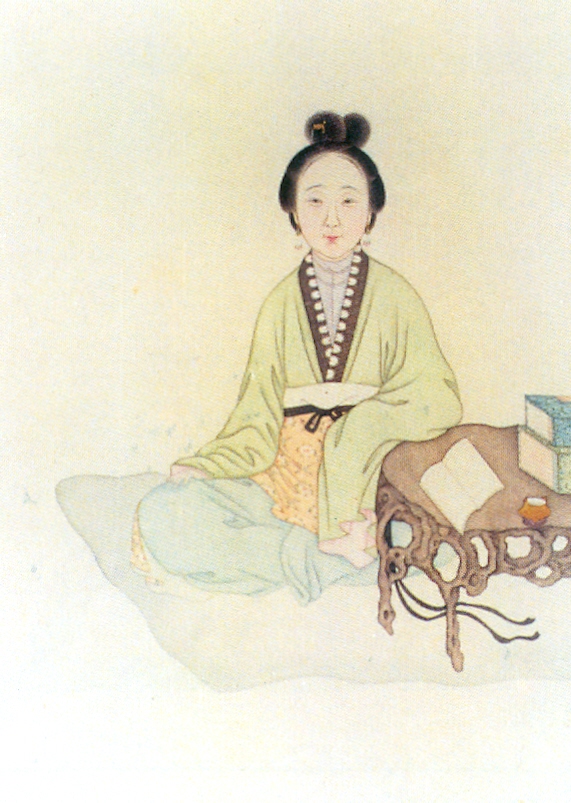
Chen Yuanyuan (陳圓圓) was born to a peasant family in Jiangsu province, and on the death of her father, she became a Yiji. Chen became a leading figure in the Suzhou opera scene and thought to be haunting the former Songpo Library.
It is also said that Chen Yuanyuan had troubles with General Wu’s other wives, especially the one named Lady Zheng who was jealous of her. Terrible rumors tells that Chen Yuanyuan was raped and killed in the fall of Beijing. What happened to her is up for debate, many say that they lived in Kunming and she ran off to become a nun in a temple there. Another side of the story gave rise to the haunted rumors.
In 1642, she became the lover of the scholar and poet Mao Xiang. Subsequently, Chen was bought by the family of Tian Hongyu, father of one of the Chongzhen Emperor’s concubines. She was then either purchased for Wu Sangui by his father, or given to Wu as a gift by Tian.
In April 1644, the rebel army of Li Zicheng captured the Ming capital of Beijing, and the Chongzhen Emperor committed suicide. Knowing that Wu Sangui’s formidable army at Ningyuan posed a serious threat, Li immediately made overtures to gain Wu’s allegiance. Li sent two letters to Wu, including one in the name of Wu’s father, then held captive in Beijing. Before Wu Sangui could respond, he received word that his entire household had been slaughtered. Wu then wrote to the Qing regent, Dorgon, indicating his willingness to combine forces to oust the rebels from Beijing, thus setting the stage for the Qing conquest of China.
She is said to have hanged herself in shame and because of her misfortune of being his concubine and not his wife. This is according to popular legend though. The heartbreak of losing her love caused her to take her life by hanging in their home. It is said that the girl still haunts the Songpo Library in the Shihu Hutong, where Wu once resided.
The Haunting of the Hutong
Today the Songpo Library grounds are open to tourists but the building no longer functions as a library. Observers swear they can feel her presence as she moves among the aisles of books today. Local residents have also reported hearing sounds of music and the unmistakable sound of a woman chanting. Could it be the ghost of Chen Yuanyuan, chanting scripture or something she sang on stage once upon a time?
Songpo Library: An old photo of Songpo Library.[Photo/Cri.cn]
There is also a story about a rickshaw driver that once brought a group of passengers to the Songpo Library on Shihu Hutong, or the Stone Tiger Hutong in the Western City. They paid their driver and suddenly vanished, leaving only a single peacock feather floating in the air. Like those that Qing officials wore in their hats. And the money he had gotten was not the Yuan Shikai coin, but an old copper coin with the name of the Shunzhi Emperor from the 17th century.
Perhaps it’s not only the ghost of Chen Yuanyuan that haunts the former Songpo Library, but the General himself as well? Late Ming dynasty historians left behind records describing Wu Sangui as a valiant and handsome general of medium height, with pale skin, a straight nose, and big ears. However, there was an obvious scar on his nose. He was neither muscular nor particularly strong-looking. However, he demonstrated great courage and physical strength from an early age and possessed excellent skills in horse-riding and archery.
Is this a person you have seen roaming the former Songpo Library lately? Perhaps it is a ghost?




2 Comments »