Tag Archives: Ghost

The Bell-Ringer At St. Mark’s Square

Advertisements

At the famous Bell Tower at St. Mark’s Square in Venice, the ghost of a former Bell-Ringer is haunting the place, trying to sound the bells one more time. 

Walking the narrow streets and alleys of Venice, there are tales of a skeleton still walking among us, rattling his bones and asking for alms. This is said to be along Bressana Court at SS. Giovanni and Paolo. 

It is said it is the skeleton of one of the last The Bell-Ringer at St Mark, or Campanile di San Marco, one of the more popular tourist spots in Venice. The Bell-Ringer was said to be a very tall man, ringing the bell of the St. Mark’s Campanile, a huge bell-tower on St. Mark’s square. The bell tower is one of the standing symbols of the republic and the highest point in the city.

Read More: Check out every ghost story from Italy

From here, Galileo Galilei sat in 1609 and demonstrated his telescope and from here Goethe saw the sea for the first time in 1786. Although the tower has been destroyed many times, the Venetians have always rebuilt it just as it was. 

When the almost 100 meter high tower was changed into a bell tower in the 1100s, it wasn’t just to ring bells. It worked as a watch tower and lighthouse before being turned into just the belltower. This was where The Bell-Ringer was working, ringing the five bells every day at the right time.  

The Bell-Ringer was not a content man though and according to the legend, he was easily led. He allegedly sold his bones out of greed to a scientist. The Bell-Ringer agreed to it and accepted the advanced payment, and started to go out every night drinking himself to an early death.  

After his death, it is believed that The Bell-Ringer regretted taking the offer of giving his skeleton away to a scientist. Because of this he was condemned to wander at night in his skeleton form until he had enough money to buy himself free from the curse he brought on himself. 

To this day you can see the actual skeleton of the bell-ringer in the Venice’s Natural History Museum. According to the legend however, the skeleton leaves the museum at night, trying to do his job, ringing the twelve bells of the St. Mark’s Campanile. 

More like this

Newest Posts

References

Haunted Venice – Legends, Mysteries and Stories

Venice Legends and Ghosts

The Redshirt Soldier in Biennale Gardens

Advertisements

A ghost in a red shirt used to haunt the Biennale Gardens in Venice. The former soldier had to uphold his promise to protect his hero, Garibaldi, even in death. 

In the Castello district in Venice, in the Giardini della Biennale there is a statue of a soldier of Garibaldi, a hero of the Italian Unification. If you look closely though, there is another statue to see. Right behind Garibaldi’s statue there is a bronze statue of a lesser known soldier that is still standing guard, right behind Garibaldi’s back in the garden. 

Garibaldi himself was an Italian general, patriot, revolutionary and republican. He is remembered as a big contributor to the Italian unification and the creation of the Kingdom of Italy in the 19th century. 

The statue of the soldier was once a man named Giuseppe Zolli. He was a local and studied at the University of Padua before joining Italy’s independence war in 1859. He joined what became known as the Camice Rosse, or the Redshirts. These were volunteering men that followed Garibaldi and fought against the Austrian Empire, The kingdom of Two Sicilies and the Papal States among others and were very famous at the time. 

RedShirts: A typical redshirt worn by Garibaldi’s men

The young soldier, Giuseppe Zolli was so dedicated to this man that he swore an oath to always guard him, even in his death. Because he did die in service during the Mille Expedition or the Expedition of the Thousand, a mission to take back Southern Italy from Bourbon rule. 

After he died he was buried on the island of San Michele, which is the cemetery of Venice. 

The statue of Zolli wasn’t placed there until 1921, when people started to notice strange things happening around the war heroes monument. People reported of a ghostly soldier all dressed in a red shirt tripping and tugging at people passing by the monument. An elderly man living close by recognized the soldier as Zolli and told them all about his promise. The city then decided to erect a statue in his honor. 

However, if you are looking for the ghostly soldier, he is probably nowhere to be found. After they placed the statue of the soldier, there were apparently no more sightings of the ghost, as he would be able to always stand guard of his hero, just as he promised. 

Advertisements

More like this

Newest Posts

References

The Bride Missing her Ring Finger in Venice

Advertisements

Killed because of love, the would be bride now walks in the Castello district of Venice, missing her ring finger and her loved one. 

In Campo St. Piero in Castello area of Venice, there is a young woman dressed as a bride walking up and down the streets. It is nothing novel about a bride in Venice as it is quite the romantic place, but for this particular bride you need to take a closer look at something other than her beautiful dress. 

The bride walking the streets in Campo St. Piero is missing a finger, which according to legend was cut off before the wedding. This bride is known as Tosca, once a beautiful but poor girl from Treviso. She was engaged to marry a very wealthy nobleman who was much older than her. It wasn’t love, it was safety. 

She fell in love though, but not with her betrothed. It was with a young hunter and together they escaped to Venice to live out their love. But the love they had, would not last, as the nobleman followed them there and ended it all. 

Toscas betrhothed killed her lover and cut off her finger, swearing that if he couldn’t have her, then no one could. But he could never have her either as she died shortly after. 

On the 22nd of September in 1379 in Campo St. Piero, she took her own life to escape her loveless marriage. But she would never leave Venice, as she came back as a ghost to haunt the place were she tought she would be free to live with her lover. 

Coincidentally, it was her ring finger as well and she is looking for her ring finger, still dressed, walking up and down the Castello district as a bride she never got the chance to become.

Advertisements

More like this

Newest Posts

References

Venice Legends and Ghosts

The Ghost in Húrra Pub

Advertisements

In one of the more popular bars in Reykjavík called Húrra, there is a legend about a ghost that is haunting the pub. It is often believed it is the ghost of a young man that was lost at sea. 

One of the most haunted places in Iceland is a pub in Reykjavík called Húrra. It is a very popular bar and concert venue with live music and if we are to believe the local legends, it is a haunted pub as well. 

It is not the only supposed haunted pub in Reykjavik, that has a population around 130 000 people and perhaps even more ghosts. It is believed to be one of the first permanent settlements from the late 800s, and has a long viking and coastal history. 

The place where Húrra Pub is built is where the city of Reykjavík’s former shoreline hit and if you go down to the basement of the building you can still see some of the city’s original foundation wall from old times. 

The staff that works there claims to have spotted strange shadows on the walls, heard noises after closing time when no one was supposed to be there and felt like they had someone following them, although they were completely alone in the pub. They also tell about a wave of being nauseous in the staircase. 

Who can this ghost be? According to some, it is often believed to be a young man who was lost at sea. 

Advertisements

More like this

Newest Posts

References

The Ghost of Fosco Loredan

Advertisements

At the day of his wife, Elena Grimani’s death anniversary, a the ghost of noble man called Fosco Loredan can be seen carrying his dead wife’s head . The very same head he himself decapitated out of jealousy and had to carry to Rome.

Once upon a time in 16th century Venice, a nobleman called Fosco Loredan fell in love with a woman. Her name was Elena Grimani and was the Doge’s niece and in a very powerful position. They married, but it wasn’t happily ever after. 

Not much is known of Loredan’s life except that he was a very well known man. It was also known that he was a horrendously jealous man and kept accusing his wife of cheating on him. He would also regularly spy on his much younger wife as she was always getting much attention because of her beauty. Elena Grimani denied having an affair, but he wouldn’t believe a single word she said. 

One night in 1598, Loredan went to Campiello del Remér in the Cannaregio district of Venice to look for his wife. He was sure that she was betraying him with another man. In a fit of rage he chased her from their marital home with a sword in his hand. 

The chase ended with Loredan beheading Elena Griman in front of everyone at Campiello del Remér, including the Doge himself, who was the leader of Venice.

According to the legend, the Doge Marino heard the desperate cries of his niece, Elena Grimani and went to her rescue. He placed himself between her and her husband, to no avail. The angry man managed to distract the Doge enough to get past him and behead his wife to everyone’s shock. 

Loredan tried immediately to ask the Doge’s forgiveness as it was his right as a husband to punish a cheating wife. The Doge refused though. 

Loredan’s punishment for his crime was to carry the body of his dead wife he had decapitated to the pope in Rome to ask forgiveness and mercy. But when he finally arrived there after his long journey, still with his clothes stained with his dead wife’s blood, Pope Clement VIII refused to see him and he wasn’t granted the forgiveness he seeked. 

An arrest order was put on him Instead and he had to fight off the guards to escape them and Rome. Loredan walked back to Venice, still holding the decaying body of the woman he murdered in his hands. 

It didn’t go well for Loredan after his crime and he didn’t see a way out. He returned to the scene of his crima in Campiello del Remér and in despair he threw himself into the lagoon and drowned. 

Today, the local legend says that on the anniversary of Elena’s killing and even on full moon nights, on those night when the northern wind blows, you can still see his ghost along the Grand Canal by Campiello Del Remer, coming out of the water, still carrying his wife’s head. 

Advertisements

More like this

Newest Posts

References

The Ghost in Höfði house in Reykjavik

Advertisements

In Reykjavik, Iceland, there is a haunted house called Höfði. According to local legend it is haunted by the ghost of a woman who poisoned herself. 

One of the most haunted houses in Iceland is Höfði. For the outside world it is perhaps best known for being the location where Ronald Reagan and Mikhail Gorbachev met up to talk about ending the cold war in 1986. So it is a pretty well known house in political history, but there is something else living in the house at night.  

For the locals the Höfði house was a well known house long before that meeting. The house in Jugendstil was built in 1909 for the French consul Jean-Paul Brillouin at Félagstún and has since been in the hands of powerful and rich people. But none of them have stayed for a very long time.  

In the memoirs of one of the people living there in the early days tells that the Höfði house is haunted by a young woman. She either drowned or died by suicide, were the latter is the most often told one. 

One of the people living in the house with his family was an entrepreneur as well as a poet named Einar Benediktsson. He was the one that named the house when he moved in in 1914 and had his own theory about who the ghost was. 

He claimed that the ghost was of a woman named Sólborg Jónsdóttir. Benediktsson was once a judge on a famous assault case and when Sólborg Jónsdóttir heard the verdict she poisoned herself and died. According to Benediktsson, he always had to keep the lights on at night as she would appear to him during the night, still distraught over the verdict and haunt Höfði, even to this day. 

Höfði house: According to the legend, the ghost haunting the house is Sólborg Jónsdóttir, a woman that may or may not were poisoned inside of it.

The haunting in the house got so bad that John Greenway that lived in the house in 1952 asked to be moved, that the house should be sold and the British consulate should move elsewhere. He was afraid of what he called: ‘Bumps in the night’, and even filed a special permission from the Foreign office to get out of there as quickly as possible. 

The same year Höfði was sold back to the Icelandic government and the official statement by the Foreign Ministry was: “We do not confirm or deny that the Hofdi has a ghost.”

More like this

Newest Posts

References

From Iceland — Time Capsule: Höfði

Höfði House and the poet Einar Ben | Hit Iceland

The Child Coffin in the Venetian Lagoon

Advertisements

The bright blue water in the Venetian Lagoon turns gray in the night. In the fog you can hardly see anything. But beware, look out for a small child coffin with four little candles lit on it. It is the hauntings of the young girl who drowned and trying to warn people that she is still there. 

Fog crept over the lagoon in Venice. Just off St. Michele Island on the 29th of November in 1904, nighttime and the fog made it dark to be on the water. 

All of the transportation in Venice happened and still happens to be on the water and a water bus known as a vaporetto and a gondola was passing. Francesco Quintavalle was the captain on the vaporetto, or water bus called ‘Pellestrina’, and knew he couldn’t see much. Still, he had his passengers from the Fondamenta Nove he had to transport to the island of Burano, known for its colorful houses across the lagoon. The colorful houses were all gray tonight. 

When passing the cemetery of St. Michele, the captain gave orders to change course. But a gondola was right behind them and had no chance of stopping in time before crashing with the vaporetto. The gondola was wrecked, but some of the passengers managed to cling onto the gondola. However,  five passengers ended up in the dark water and never came up alive. 

All night they searched for the rest of the passengers that disappeared into the lagoon. They were all women. Thosa Mary Bull was the first to be found, dead of hypothermia and it wasn’t looking good for the rest.. In the morning hours the bodies of Lei, Thoso of Borelli and Amalia Padovan Vistosi were found as well. But two of the girls, Teresa Sandon and Giuseppina Gabriel Carmelo were not found for a while. 

It wasn’t until the sister of Teresa Sandon had a dream of her sister in September 1905 another of the bodies were uncovered. The ghost of the drowned woman asked her to pray for her and free her soul. Ten days later two fishermen found the body of Sandon. 

But Giuseppina Gabriel Carmelo, just a little girl, wasn’t as lucky, and she was never found.

Now to this day, just off St Michele, which is one of the big cemeteries in Venice, you can sometimes see a small floating coffin with four burning candles lit on the lid on foggy nights. This is the spirit of Giuseppina, signaling that she is there and to stop other ferrymen and people on boats to never collide with her again. 

Advertisements

More like this

Newest Posts

References

Venice Legends and Ghosts 

Mysterious Venice | FernFlower Group

Apollonia Schwartzkopf the Ghost at Bessastadir

Advertisements

No place is free from a haunting on Iceland, not even the official house for the president known as Bessastadir were the ghost of a woman named Apollonia Schwartzkopf haunts the house after maybe have been the victim of poison.

Believing in ghost is nothing special or weird in Iceland. In fact, surveys shows that at least ten percent believes in the hidden people, otherwise known as elfs or Huldufólk. And no one is immune, not even the president of the country.

In the official residence of the president of Iceland at Bessastadir in Álftanes not long from Reykjavík, there is allegedly a ghost of a woman called Apollonia Schwartzkopf haunting the house, even to this day. 

Apollonia Schwartzkopf was a powerful and rich Norwegian woman who came to Iceland in 1722 after suing the governour of Iceland at the time called Niels Furhman for fraud after he tried to break his promise to marry her after being engaged for 14 years. At the time Iceland was a colony under the Danish crown.

The Danish man working as the governor on Iceland was condemned and had to have Apollonia Schwartzkopf staying with him at Bessastadir until she died under mysterious circumstances. 

Apollonia Schwartzkopf then came to Iceland and the wonderful house of Bessastadir to have Niels Furhman fulfill his promises as her husband as well as making him pay huge expenses for her as she was now lawfully his wife. But was it worth it though?

Poisoned by her Mother In Law?

Many sources of this story states that Apollonia died of a broken heart, although when looking at the details doesn’t seem very likely. The marriage with Niels Furhman at Bessastadir was not a happy one though, and according to all accounts they weren’t a good match in the long run. Sources say they didn’t sleep in the same bed or even dine at the same table together. She started to think that the mother in law was planning to poison her, something she confided in a man named Cornelius Wulff. 

Apollonia Schwartzkopf died not long after though under strange circumstances of an unknown disease after she ate some porridge she herself claimed to be poisonous on Pentecost day, or on 20. June in 1725 in some sources. Her Danish mother in law Karen Holm also lived with them, and it was believed that she had killed Apollonia Schwartzkopf with poison, although nothing was proven during the trial.

Haunting the President at Bessastadir

The ghost at  Bessastadir started to gain some attention when the influential people living in the house started speaking about her.

“I hear her at night, pacing the halls and going from room to room. Sometimes she comes up the stairs and walks in the corridors outside my room. And I say to her: ‘Please, Apollonia dear, be very welcome,’ ” the former president of Iceland and the world’s first elected female president, Vigdis Finnbogadottir, regularly told her visitors when they came to Bessastadir.

Advertisements

More like this

Newest Posts

References

Featured image: Wikimedia/OddurBen

Sjö dauðasyndir: 1. Apollonia Schwarzkopf, glæpasaga frá 18. öld | Hlusta.is

Kross Apolloniu Schwarzkopf | Gripur mánaðarins | Þjóðminjasafn Íslands

Ghosts, Elves Alive and Well : Iceland’s Belief in Supernatural Is No Fairy Tale – Los Angeles Times

Lögberg-Heimskringla – 16. tölublað (28.04.1995) – Tímarit.is 

The Burning Skeleton in Venice

Advertisements

In Cannaregio district in the city of Venice, there is a burning skeleton of a mean man that is cursed to haunt the city around Campo de l’Abazia. 

Walking around the picturesque streets and canals in Venice you might think you are so safe. There are people everywhere and the windows so close to the street are always open. Wandering over the curved bridges and walking over the old cobblestone, you might not even notice other people as you are so preoccupied by the wonderful old architecture in the Cannaregio district. But you should never feel too safe. 

Read More: Check out every ghost story from Italy

According to old Venetian legend, there is a story about the ghost of a man still haunting the streets, especially around Campo de L’Abazia where he made a sin so great, he was cursed to walk around the area for eternity. He comes in the shape of an old man with a big bag on his back, begging for help. According to legend you must never help him, and whatever you do, never look him in the eyes. If you do this, he will turn into the burning skeleton and frighten you, maybe even to death?  

The skeleton is said to be of the usurer or a moneylender known as Bartolomeo Zenni that was so mean that he was condemned to be transformed into the burning skeleton. He lived in the 1400s, a time where Venice and Milan fought off territory in Northern Italy. Venice was at this time one of Europe’s wealthiest and most powerful cities. The Renaissance period which would change the world forever had just begun to take root in Italy and would bring them into a new area. 

Amidst all of these world changing events, everyday life went on in the streets of Venice, for people like Bartolomeo Zenni on Campo de L’Abazia. But tragedy struck the small neighborhood. 

On 13th of May in 1437, a fire broke out at Campo de l’Abazia and several of the houses were engulfed in flames. The neighbors of Bartolomeo Zenni asked him to help them, trying to save their children from the fire that was devouring everything. Bartolomeo Zenni refused to help his neighbors and instead grabbed all of his gold and jewels to save himself. Perhaps he escaped the fire safely, but in the afterlife, he will never escape from the fire as he was cursed to haunt these streets forever without a coin of gold to his name. 

So if you walk these cobbled streets and someone asks for your help, do you offer it?

More like this

Newest Posts

References

Haunted Venice – Legends, Mysteries and Stories

Venice Legends and Ghosts

Ghosts of Mary King’s Close

Advertisements

Scratching sounds from the chimney, plague victims left for dead and floating heads, the haunted underground of alleyways known as Mary King’s Close haunts under the city. 

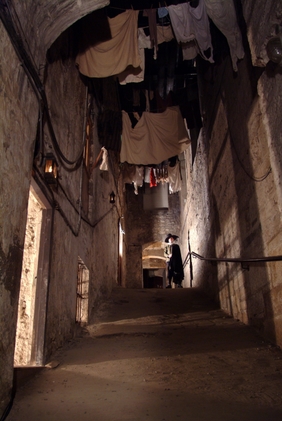
Today much of what you see of Edinburgh is an old town built on top of an even older town. Right opposite St Giles Cathedral you will find The Mary King’s Close or alleyways which are said to be haunted.

It used to be a normal street in the old town by the Royal Mile with narrow alleyways and cobbled streets. It was named after a successful business woman named Mary King working as a fabric merchant in the 1630s. 

Advertisements

So first off, what is a close? A close was a private area that got locked up at night to keep unwelcomed out. The richer lived on the top floors, away from the stench of the sewer and where most light came through the claustrophobic streets. 

The Plague

During the 1645 plague the city became overrun with rodents carrying diseases and it hit the Mary King’s Close pretty hard. They would hang out white sheets to show they were infected and in need of food and a plague doctor. Only the bravest plague doctors, one named Dr George Rae dared to venture into the close filled with plague ridden people.

Victims of the disease were quarantined and left for dead to die in the streets. One by one the residents either died or left the Close and were relocated to Burgh Muir, and they didn’t return until almost 40 years after the plague hit its peak. When they returned however, everything seemed to have changed. Since then there have been reports about strange things going on in the underground narrow streets. 

Plague Doctor: On the 13th of June 1645, Dr George Rae was appointed as Edinburgh’s second Plague Doctor. During the plague he went around to treat the plague victims. He cut open and cleaned out the puss from the swellings caused by the bubonic plague. He would then burn the wound to catheterize it. He was considered to be one of the more successful doctors during the plague.

What was it that made people see ghosts during this time? Was it the plague victims that were left behind? Or could it be the methane gas from the polluted march right by that caused everyone to see things?

Many tell the tale that it was to cover up the corpses of the plague victims that they built another street on top of it. The true story though is that they built the new street on top of the decaying old one in the 17th century to make a place where tradesmen could be. 

Advertisements

Life continued to go on underneath the surface though as not everyone wanted to leave. The last residents didn’t leave Mary King’s Close until 1902. And if we believe the legends, the last resident named Andrew Chesney never truly left as he is said to be one of the ghosts that haunts the place.

The Hauntings of The Colthearts

Back to the aftermath of the plague. Decades had passed since the plague had reached its peak and people started to return to the Mary King’s Close. But as mentioned earlier, the place had started gaining a notorious rumour of being haunted. And that was according to the residents themselves.

Claustrophobic: The narrow streets of Mary King’s close.

In 1685 a well respected lawyer named Thomas Coltheart moved into the close together with his wife. But their stay was not a happy one at all times.

The maidservant ran off claiming the house was haunted. And it was not long until Coltheart and his wife also noticed strange things. According to them when the Mrs. Coltheart sat reading her bible, she saw a head without a body float in the house, causing the wife to faint. 

First, Thomas Coltheart didn’t believe her when she tried to explain. But It returned later that night with the spirit of a child and a floating severed hand beckoning them to come towards them. They tried to pray the spirits away, but to no avail.  

Lastly they saw the spirit of a dog running after a ghost cat, creating a chaos of spectres and noises that night. And according to them, that was not the only time they were bothered by the spirits.

Apparently they claimed that the dog returned again and again, not leaving them in peace,

Surprisingly, the couple chose to never leave the Close and stayed there until their death. Needless to say, it turned them mad according to some sources. Or did the madness create the visions?

Abandoned Annie

One of the ghosts that are suppose to haunt the place is that of Abandoned Annie. She is the ghost of a little girl that is allegedly reaching out to grab your hand in the darkness.

She was named that by the Japanese psychic Aiko Gibo who visited the Mary King’s Close in 1992 and found the child ghost crying in a corner of a room. Aiko claimed that Annie was a plague victim who was abandoned by her parents. According to the psychic Annie wanted a doll to not feel so lonely. 

Today she has her little altar in what is now known as Annie’s Room with thousands of dolls, toys and money left by her visitors. They are all collected by the city council to donate to and help sick children. 

Visit the Underground

The Close was mostly forgotten after the last residents moved out and they didn’t really remember the old place until they once knocked through the walls during construction. 

The place was not opened for the public until 2003, but is now perhaps more busy than it was before they closed it up. Today you can access the underground alleyways from the Royal Mile as a tourist attraction. You can now experience the uniquely preserved cobbled streets as it would have been before the 1800s. 

Advertisements

More like this

Newest Posts

References

The Most Haunted Places in Edinburgh’s Old Town – Dickins

The Story Behind Edinburgh’s Mary King’s Close

Mary King’s Close: Underground Edinburgh’s buried street

The Ghosts of Mary King’s Close, Edinburgh | Haunted Rooms®

Mary Kings Close – Dark Hauntings