On the Venezuelan plains, the vengeful ghost of La Sayona hunts down cheating men that don’t get from it alive. She is cursed to make her revenge on them after she murdered her whole family.
La Sayona is a Venezuelan ghost story about the vengeful spirit of a woman haunting the roads, the jungle as well as the Venezuelan plains. She is after cheating men and appears mostly on the roads, asking men for a ride on the vast Venezuelan plains known as Los Llanos.
Read all of the ghost stories at haunted roads here:
When the man she has chosen as her victim is looking more closely at her, her face is just a skull with terrible teeth. Her name La Sayona is referring to the type of clothes the ghost is supposedly wearing and is a long white dress, and referred to a medieval undergarment. It basically means something along the lines of ‘Sackclothed Woman’.
La Sayona: The ghost has been described as a woman in white haunting the roads in Venezuela. She is like a crossover between the vanishing hitchhiker and the woman in white. But this version is a very dangerous and deadly one.
This is an old legend in Venezuela, similar to many women in white ghost stories from Europe with a hint of The Vanishing Hitchhiker urban legend mixed in with it today. She is also somewhat similar to other vengeful ghosts from across the globe, like the Japanese Onryo or the Korean Virgin Ghost.
Most similar though, will she be of other South American legends about vengeful women on a mission in their afterlife and the story of La Sayona is often mixed with the famous La llorona legend from Mexico. Especially because in these legends, the woman was the violent one. She is also a part of Colombian folklore that has its own spin to it that we will come back to later.
Along the rivers in Mexico a wailing woman wearing white can be see and heard as she comes up drenched from the waters. She is desperately looking for her children she herself drowned. And according to the legends of La Llorona or the wailing woman, you are next.
In the legend of La Sayona there supposedly was a woman named Casilda that lived on the Venezuelan plains in a small town were life was peaceful and without much to worry about. She was the prettiest girl in town and married to a loving husband. Together they had a son and it seemed like she had a perfect life together with her family. But that was all surfaced level though as she had one fault, she was violently jealous.
Once, Casilda was swimming in a river near the village naked where a man from the village spotted her. She told him to get lost and leave her alone, but the man didn’t listen. He would start to follow her and watch her bathing in the river. He then told her that he was there to warn her and said her husband was having an affair with her mother. It was nothing more than a rumor from a random man watching her bathe, but the rumor filled her with an immense rage so she couldn’t think clearly.
Wet Season: La Sayona is known to roam on the Venezuelan plains in search for cheating men she can punish as part of her eternal curse. // Photo: Haroldarmitage
Casilda then ran home to her husband and found him inside the house with their son sleeping in his arms. She was blinded by rage and set the house on fire without asking him for the truth. The villagers heard their screams as both the husband and the son burned to death inside the house.
Meanwhile, Casilda was on her way to her mother’s house that sat on her patio. She would not get the chance to explain either as Casilda attacked her own mother with a machete and stabbed her to death in the stomach.
The mother bled slowly to death, but not before she managed to curse her daughter. She told Casilda that from then on she would avenge all of the women with cheating husbands. And whether her mother and husband really had an affair, she would never get an answer to, driving her mad.
She was from then on known as La Sayona that hunts cheating men by conquering them and then killing them.
The Different Variations of the Legend
There are many variations to this tale today in Venezuela as well as the rest of South America. She sometimes shapeshifts to animals or even monsters or sends out a scream almost like a Banshee that can be heard from a long distance. The variations of the legends have all in common that it is the men who has to pay the ultimate price of her wreath.
The legend of La Sayona is also grouped together with several ghost stories about female spirits haunting the roads and highways after men to take their anger out on. Much like in the case with the story of La Descarnada of the Highway.
On the highway in El Salvador, be vary of who you stop for along the way. Especially beautiful women that asks for a ride to a nearby place. It might very well be the vengeful spirit of La Descarnada.
In some versions of the legend, La Sayona comes out from the jungle where men are working. She comes when the men are talking about sex or about women they left behind. When she appears she either takes form as a beautiful woman or a loved one and manages to lure them into the forest were she has her revenge. There she devours them in an animal-like shape or mangles them, and leaves their body for the rest of them to see as a warning.
In the Colombian version from the plains, they tell that La Sayona was a beautiful woman named Sarona that turned into a monster. In this legend she was not really a violent woman, but a cursed one nonetheless.
She lived as a normal person until she ruined the holy clothes of a priest and was punished for her sin. God condemned her to live an eternity of great hunger because of this. She turned from a beautiful woman to a monster with big teeth and eyes and with an appetite for human flesh.
Sarona’s punishment was something she couldn’t control and she was consumed by it. In her hunger she then devoured her own brother before escaping out on the lonely plains in Columbia where she lives more like beast than man. She comes at dawn and takes drunk men wandering alone she devours.
In the square of Campo dei Mori in Venice there are three stone statues placed in the. Legend has it that the three brother merchants were cursed and turned to stone, together with their camel.
The Cursed Merchant: One of the brothers, Sior Antonio Rioba with his iron nose//Source//Wikimedia/ Doris Antony
In Venetian legends, there are many stories of people being cursed, often by greed, and this is one of them. Around 1100 AD there were 3 rich merchants named Rioba, Afani and Sandi trying to sell fabric by Palazzo Mastelli at Campo dei Mori square.
Sior Antonio Rioba together with his brothers came from Morea which was the Venetian name for the Peloponnese in Greece. They were very rich silk and spice merchants of the Mastelli del Cammello family who built the entire area and had a house nearby named ‘the House of the Camel’. They were called Mastelli because they were known to have ‘Thousands of tubs of gold coins’.
However the fabric they were selling was poor quality compared to the price they tried to sell it for. In some variation of the legend, Sior Antonio Rioba and his brothers were also bankmen that scammed their customers by high priced loans.
They tried to scam this local old lady to buy one of their fabrics one they, or give her a loan, depending on the variant of the legend. They told her that this ordinary fabric was the best yarn in Venice and the Lord could turn them into stone if they didn’t tell her the truth. She was recently a widow and took over a tailoring workshop, and she knew what a good quality fabric was. When she found out their plan, she cursed the money she gave them by praying to Mary Magdalene to help her. This turned the 3 men, along with their camel, into stone and are still standing there to this day.
In the 19th century, one of the statues lost his nose and was replaced with a nose of iron. Venetians believe that if you touch the nose of the statue of Sior Antonio Rioba, you will have good luck in business.
It is said that sometimes at night, you can hear Sior Antonio Rioba lamenting about his grief, and if you put your hand on his stone cold chest, you can still hear a heart beating forever confined to his corner at Campo dei Mori.
It the cold North Sea, there is a ghost ship where the crew plays for your soul with dice. That is what happened to Baron Falkenberg.
In the seas outside the shores of Germany, there is also a Captain of a ghost ship, haunting the dark waters, collecting souls and trapping them there. It goes into the European tradition of ghost ships and a cursed crew, just like The Flying Dutchman. That is the base of the legend of the story of Baron Falkenberg.
Baron Falkenberg
The Baron was invited to a wedding to his long lost brother who had just come back home as a new man. When the brother returned, he was a very wealthy man, unlike the Baron, who had very little money to his name.
Advertisements
The Baron had long had his eyes set on a girl he wanted to marry from the village, but hadn’t dared to declare his love for. But to his horror, he found that the wedding of this girl and his brother he was going to attend. Not only was his brother now a much richer man than the Baron himself, he was going to marry the love of his life.
Still, the Baron thought they should live in peace. It was after all her choice, and he had no real money to offer her, so he shouldn’t hold a grudge.
The Wedding Violence
The wedding went as smoothly as one could expect and there were lots of champagne, songs and festivities that night. It all was well until his brother touched the Baron the wrong place or way as it says in the legend. The Baron went mad after this and grabbed a champagne bottle and smashed it into his brother’s head.
The brother fell dead to the ground and the bride fled screaming away as she had seen it all. The Baron chased her to explain himself. He declared his love and tried to persuade her to escape with him, but she told him that she would rather die than be with him. The Baron took her word for it and stabbed her with a knife, also killing the girl he loved.
The sound of the fighting didn’t go unnoticed by the rest of the guests and they came to investigate and soon found the tragedy that had unfolded to the newlyweds. The Baron fled the scene and went for a walk, trying to clear his head and figure out what to do next. He found himself at the beach nearby and found a man was sitting there, almost like he was waiting for the Baron.
“The Captain expects you, Baron,” the boatman said to the Baron and extended his hand to help him into the boat right next to them. The Baron had nowhere to go, no one to go to and accepted and got into the boat rowed further out to sea where a ship was waiting.
And when the Baron first entered the ship, he didn’t get off for the next 600 years. The ship can sometimes be seen on wild winter nights in the North Sea going north. The ship is painted gray and sailed under a yellow flag. You can see the Baron sitting there with the devil, playing dice for his soul and cursed to sail the ship forever.
The mysterious mountains in Albania is a place known for its myths and legends. Strange tales are told of this place and has been named The Accursed Mountains.
“I could not help feeling that they were evil things– mountains of madness whose farther slopes looked out over some accursed ultimate abyss.” – H. P. Lovecraft: At the Mountains of Madness
The Albanian Alps, officially called Prokletije is a breathtaking sight in the Balkans with glacial features, pointed peaks and weathered landscape, stretching from northern Albania, all the way to Kosovo and Montenegro. The lush green valleys and thick forests filled with wolves, old traditional stone villages makes you feel you really are in a fairy tale like place.
But the beauty of the accursed mountains comes with a bittersweet aftertaste when learning what the translated name of the mountain is. In English Prokletije is roughly translated to the Accursed Mountains and has a legend and myth that rests amongst the mountain peaks. And according to legends, it was the devil himself who created the mountains. As the name suggest, the legends surrounding The Accursed Mountains are more sinister than fairytale like.
It is difficult to understand why such a serene place has been dubbed a cursed one, because how could the devil create such a beautiful thing? Anyway, that is the tale, and that is the mountains origin story.
From then on, the mountain range has been cursed and synonymous with blood feuds and bandits as well as natural disasters like avalanches. From 1946 to 1992, the country was under a harrowing communist regime with closed borders to keep people out as well as in. The Accursed Mountains were used as patrolling spots with buried landmines and bunkers for wars. So it’s not only because of its legends they are known as the accursed mountains, but because of their history as well.
It is a sparsely populated place, home to Albanians as well as Serbs, Bosniaks and montenegrins. It is a secluded place that is cut off from the rest of the world for weeks during the winter months. This is a place where the shepherds take their flock during the summer rather than staying for a the whole years.
The Legend of the Brothers and the Fairy
The legend of it being the devil himself who created these mountains is not the only legend of why this mountain range is supposedly cursed. The other legend is steeped much more in Albanian folklore than Christian religion and really comes out from a fairytale.
The Fairy Myth: According to legend, the name is from that one fairy tale were the mother of hunters cursed a fairy from Albanian folklore.
A long time ago three brothers went out hunting. Up in the mountains they met a fairy. The brothers found her so beautiful and wanted her. This turned into a fight about who saw her first, who she belonged to and escalated to become quite violent. So violent that it ended in their death.
The fairy was watching from afar, but had no way of helping and couldn’t choose for them. She hoped for an agreement, but when her brothers died, she ran and hid behind the peaks of the mountain.
The Accursed Mountains
Days went by for the mother without a word from the sons. When none of the brothers returned from their hunting trip, their mother took up the search. She went up to the mountains and found all of her sons dead. She wailed as she buried her sons, her cries echoing through the mountain range.
The fairy heard her and went to her and told her what happened, that it was because of her that they had argued and died. But the mother didn’t want to hear the reason and only looked at the fairy as the cause of their death. The mother cursed both the fairy and the mountains, blaming them for her son’s deaths. And ever since then, the place has been called the Accursed Mountains and known for its mystery.
The blinking paper lantern hides a vengeful ghost in one of the most famous Japanese ghost stories. From a local legend about a real woman to the stage, the myth of the ghost of Oiwacontinues to inspire horror.
Many of the more well known stories of ghost and horror from Japan is about the Onryō, meaning a vengeful spirit. A ghost so full of regret and rage, they are posing a threat to living humans. And sometimes, they can come in the form as a Japanese Paper Lantern Ghost. This is the case of the ghost of Oiwa.
In many cultures, ghosts are put in different categories. Such is the case with Onryō (怨霊 onryō,) It basically means “vengeful spirit” or “wrathful spirit” in Japanese and is a mythological spirit of vengeance from Japanese folklore. They also have ghosts, called yurei, but these differ in the will of the ghost. As opposed to…
There are many movies, books and popular culture that feeds on the old legend of the vengeful spirit. Today in modern time we have The Ring and The Grudge series that makes use of this old legend, and in many instances, they are both also inspired by the most iconic Onryō throughout time, the ghost of Oiwa.
Yotsuya Kaidan — The Tale of Oiwa and Tamiya Iemon
The ghost of Oiwa is a vengeful spirit that we first learned of through the kabuki play called Yotsuya Kaidan (四谷怪談) or Ghost Story of Yotsuya from 1825. It was written by the writer Tsuruya Namboku IV, known for his plays with supernatural themes and macabre and grotesque characters.
She is an easy recognisable character on stage with her droopy eye and hair falling out or as the iconic Paper Lantern Ghost. She is also often seen as a Japanese ghost lantern in art.
Read Also: Check out all of the ghost stories from Japan
Kabuki Theatre
The Kabuki theatre is a traditional Japanese style plays originating in the Edo period. It is well known for its characteristics wigs, costumes, makeup and masks. It is exclusively theatre troops of men playing all roles. The distinct styled stage performances is the origin of many iconic looks in modern pop culture, like the distinct style of the Onryō with the white dress, white makeup and long black hair.
Yotsuya Kaidan is not the first and original written account of the legend, but certainly the most famous one. The first written manuscript about the ghost of Oiwa is dated to 1727 called Yotsuya zōtan 四谷雑談. It was an underground publication, most likely of the scandalous rumour of the true rumours of a noble family and lady that acted as an Onryō after her death.
Yotsuya Kaidan tells the story of Oiwa and Tamiya Iemon and in this play it tells the story of a woman scorned by her man and coming back from the dead for revenge. Throughout the years, there have been many adaptation and versions of the story and it was a popular story to tell as a part of a samurai parlor game.
It is considered to be one of Nihon san dai kaidan — Japan’s Big Three Ghost Stories. It is arguably the most famous Japanese ghost story of all time and has spurned a couple of local legends of its own.
Read about the Nihon san dai kaidan—Japan’s Big Three Ghost Stories:
The Botan Dōrō or Tales of the Peony Lantern is a ghost story told since the Ming dynasty in China to today. Most popular through the Kaidan theater plays, it is now one of Japan’s most well known ghost stories.
The tale of Banchō Sarayashiki (番町皿屋敷, The Dish Mansion at Banchō) is a well known Japanese ghost story (kaidan). It was popularized in the kabuki theater tradition, and lives on in popular culture and folklore alike.
Yotsuya Kaidan starts out as a classical romantic tale. Oiwa was said to be a loving and devoted wife that risked everything for her husband, Tamiya Iemon. They married in secret, without her father’s consent. Tamiya Iemon was a wandering samurai, a poor rōnin and not suited to marry his daughter according to the father.
The ghost of Oiwa From the ”Thirty-six Ghosts” series by Tsukioka Yoshitoshi, ”The Yotsuya Ghost Story”, 1892.
Oiwa’s father whoever, was not as pleased with her marrying this man without honor and no money. When he found out the rōnin’s misdeeds, he confronted him. After a heated argument, the father was killed by the son in law when he threatened to make them stay apart from each other, and he did not bless their marriage.
After his death, Oiwa mourned her father. Iemon comforted Oiwa, claiming they would find her father’s killer.
To earn money he had to take up work as an umbrella maker to care for his pregnant wife. The old samurai grew bored doing the tedious work and turned resentful towards his wife, Oiwa. A woman he once loved and done horrible things to stay with. But in the end, there was no love left.
Next door they had a neighbor with a granddaughter that loved Iemon. The neighbor himself wanted his granddaughter and Iemon to get married. They were wealthy neighbors, and Iemon wanted to be that as well. So they planned how to get rid of Oiwa together.
Unbeknownst to Oiwa they sent her either an ointment or face cream laced with poison. But the poison didn’t kill her and only left her disfigured with one eye drooping and her hair falling off as she tried to brush through it, making Iemon so disgusted by her, he came up with a plan to rid himself of her. He hired one of his friends to rape her so that he would have grounds for a divorce.
His friend however is unable to go through with the plan and shows her a mirror instead. When she sees herself she understands what has happen and how she has been deceived. She takes a sword and accidently kills herself with it, and on her last breath, she curses Iemons name. In some versions there is actually Iemon that kills her.
Iemon threw her in the river to rot and went on to plan the wedding to the neighbors granddaughter. That night, the night before his wedding, he had terrible night terrors, and he saw his dead wife manifesting. In a burning paper lantern she comes out as a ghost, frightening him as a warning of the hauntings that are about to come.
The Chōchin obake
In Japanese legends, they have this concept of Tsukumogami (付喪神, “Kami of tool). This is the belief that inanimate objects, when they ‘serve’ their owners for a hundred years, they are granted life and a soul. When the Japanese lantern, or Chōchin reaches this age, it can become Chōchin obake, a Japanese lantern ghost, a mostly harmless ghost that laughs and lightly scares humans. But they could also be inhabited by a powerful onryō.
The Lantern: The print depicts a Kamiya Iantern haunted by the ghost of Oiwa as the Paper Lantern Ghost in Yotsuya Kaidan Kuniyoshi Utagawa, ”The Ghost in the Lantern”, 1852.
But he is not frightened enough as he still goes on with the wedding the next day. When he lifted the veil of his bride though, it was the ghost of Oiwas disfigured face staring back at him. He beheaded her, and therefore, his new bride as well. There is all in all a lot of killing going on.
He was then pursued by the ghost of Oiwa, not wanting him to escape. She was turned into a vengeful ghost, pursuing him into madness, making him suffer. He dies in the end, after suffering horrible.
It changes in the different adaptations of Yotsuya Kaidan how he dies though. Sometimes he is killed by Oiwa’s brother, or brother in law and in other versions it’s the haunting of the ghost of Oiwa that drives him out of his mind and into death. Sometimes it’s Oiwa herself, that pulls him down from the height with her. Either way her revenge is complete.
Advertisements
The Deaths Behind The Play of the Paper Lantern Ghost
The success of the Yotsuya Kaidan play was so big that they had to reschedule more performances to meet the demands. It was mostly believed that the popularity of the play was because it tapped into the zeitgeist of the society at the time.
Oiwa as the lantern: The ghost of Oiwa manifesting herself as a Japanese Paper Lantern Ghost. From the series One Hundred Tales (Hyaku monogatari). Print by Katsushika Hokusai. 1830
The theme of repressed women was something that reflected the Bunsei era that was also a time of great unrest. And the story of the victim taking her revenge of her oppressor was something the audience revelled in.
But where did the story come from? Was it just from the imagination to Nanboku when he wrote the play?
In most blogs it is said the legend created the play. But was it actually the play that created the legend? Yes, it is based on the terrifying vengeful ghost, something older than the kabuki play. But were did Nanboku really get his story from?
According to some sources Nanboku’s play was based of an actual murder of the wife of a samurai that went insane after her husband got another woman pregnant. She wandered off from her home, never to be seen again.
It is also claimed that Nanboku based his play from to separate murders. One of the murders was that of two servants who had murdered their masters. They were caught and executed on the same day. The second murder that inspired the play was a samurai that nailed his wife and her lover to a wooden board and threw them into the Kanda River for being faithless.
In any case what source the play was created from, the play itself became something that created more legend. It has adapted for film over 30 times, and continues to be an influence on Japanese horror today.
The Real Oiwa and her Rocks
But who was the real Oiwa behind the manuscript? Both the play and the written account from 1727 from the underground publication that claimed a dead wife had turned into an onryo. Wether this account really refers to this Oiwa, is a bit uncertaint though.
We can find an Oiwa Tamiya in the real life that had something mysterious happening to her. Living in the 17th century, she was born into a powerful family, but she and her husband had financial difficulties.
One day Oiwa came over two very large rocks she felt was something special and put them both in her garden. She prayed to these rocks for good luck and prosperity for her family to overcome their financial difficulties.
And over time, the things she prayed for to the rocks really happened for the family and everyone believed it was because of the magic rocks that she had prayed to. The rocks became famous, and was called Oiwa Inari or Yotsuya Inary. In the end, a shrine was built for it, and this is the shrine people flock to pray to.
Even the Tokyo Metropolitan Board of Education found it necessary to distinguish the real life Oiwa and the play and they have put this message:
Tamiya Inari Shrine, commonly known as Oiwa Inari, used to be i the premises of Tamiya family of Osakitegumi doshin (military officer in the Edo period). An old story is passed down that Oiwa (died in 1636), a daughter of Tamiya Matazaemon, worshipped at the shrine and restored her family with Iemon, her husband. Therefore, the shrine was gradually worshipped as ‘Oiwa Inari* by people. There was yet another story to attract further worshippers, the ghost story ‘Tokaido Yotsuya Kaidan’, written by Tsuruya Nanbuko and was staged in 1825 and was very popular.
However, it was written after 200 years of time when Oiwa and Iemon actually lived. Unlike the famous ghost story, their marriage in reality was enjoyable. After Inari shrine was lost by a fire in 1879, it moved to Shinkawa in Chuo Ward. The present shrine was rebuilt here at Yotsuya in 1952.
— Tokyo Metropolitan Board of Education
Although not like in the play, there were rumours about Oiwa being a vengeful ghost, long before the Kabuki actors entered the stage for the first time. Something we can read about in the manuscript from 1727 that also hinted to this fate for her.
A more sinister legend of this lady though is the curse she apparently set on three houses had been disrupted, rumour saying it was the grudge of Tamiya’s wife, Oiwa that killed them. They were both victims of the reforming rule of the eight Tokugawa Shōgun, Yoshimune Kō. In some accounts she disappeared, in others she commited suicide, vowing to revenge those who wronged her. In all she was blamed for the deaths of at least fifteen people.
The Shrine in Oiwa’s Honor
Already in 1717, there was a shrine erected in her honor, something they sometimes did to appease the wrath of an Onryō, long before the publication that were written ten years after. This is a list of some of the shrines that were built to restore her honor and protect from the harmful ghost, or at least connected to the Oiwa legend:
They say that when visiting her grave, there is a statue of Oiwa inside the main building in some of her shrines, although not accessible to visitors. you can wish upon it as it is said she grants the wishes of her worshippers. This is also the rumours about her grave.
The Curse of Oiwa’s Grave and The Curse on the Play
The revenge of Oiwa: The ghost of Oiwacoming out from the Japanese lantern in Yotsuya Kaidan as a ghost with her son in her arms. Artist:Kuniyoshi
It is said her body is buried at Myogo-ji temple in Sugamo, Tokyo. Her death is listed in February 22. 1636 and the grave has been rumoured to have been haunted for ages.
After the play started, there have been reports of accidents, injuries and deaths around the production of the play or even TV or movie adaptions of the story. This has been blamed on the ghost of Oiwa and her wish for revenge. Therefore it has become a tradition to visit and pay respect for the people involved in a production of Yotsuya Kaidan just to be safe.
I you go straight through the graveyard, there is suppose to be a red torii (a Shinto shrine archway) by a tree. Under the tree, her grave is supposed to be. But don’t run off to check it out just because you are curious and nothing more. According to legend, if you visit the grave just because of curiosity, your right eye will swell up, just like hers did with the poison.
It is said to be a curse over it all. And very much like the Macbeth curse, the people involved in productions of the legend of Yotsuya Kaidan, still honors it. Before retelling the story there is a tradition to go to her grave, to ask her permission, asking for her blessing to tell her story again. So… will you?
Thes old and noble family House of Hohenzollern in Germany seems to forever be haunted by a Lady in White. Both the ancient family homes of the family, and also the family members, however far they go away, the curse of the house will follow.
In December 1628, the Palace in Berlin can’t keep the cold out, not completely. A hereditary haunting of the ruling family of Prussia sits in the walls of their castles — a bad omen. Most often the bad omen of the curse is seen as a woman dressed in white. You can hear her sometimes, the clanking of the large keys around her waist. A young prince is next this time. She appears to a him and says: – ‘Veni, judica vivos et mortuos’ which means ‘Come, I judge the living and the dead’. The day after, he dies of an illness.
But who is it that haunts this old and noble family? Even the young princes? Years before the young person died, she was also spotted by three young pages in 1619. In one of Hohenzollern Castle halls, it doesn’t need to be the one in Berlin. As long as it is one of the ruling Hohenzollerns. The young pages thought she was a living human being, and approached her. When he asked what she was doing here she turned to him and hit him with her keys, killing him. The two pages ran away, terrified.
The House of Hohenzollerns was growing restless when they heard about the sighting of the woman. She had been spotted again, it was a bad omen. Something was about to happen. Three weeks later, John Sigismund Prince-Elector of the Margraviate of Brandenburg from the House of Hohenzollern, died.
House of Hohenzollern in Germany
The family is an old one. The House of Hohenzollern once ruled what is now known as Germany as a dynasty being princes, electors, kings and emperors. They ruled the lands of Brandenburg, Prussia, The German Empire and as far as to Romania.
Read More: Check out all of our ghost stories from Germany
They began their ruling dynasty in Swabia, in a town called Hechingen during the 11th century and took their name from their ancestral Hohenzollern Castle. The first ancestors of the House of Hohenzollerns were mentioned in 1061.
Burg Hohenzollern on the Hill: The ancestral home in Swabia, Germany, constructed in the early 11th century to the House of Hohenzollern. The haunting may have started here, but the sightings of the White Lady Haunting the family has been spotted everywhere were a member of the family has been residing.
They were the rulers of the lands, growing in power until 18 71 with the unification of the German Empire with the Hohenzollerns as hereditary German Emperors and Kings of Prussia. This title they held until Germany’s defeat in World War I in 1918 led to the German Revolution. The House of Hohenzollerns were overthrown and the Weimar Republic was established, thus bringing an end to the German monarchy.
Sure, they were powerful, and powerful families makes powerful enemies. Blue blood attracts bad blood. But who was so intent on following the family, haunting them for centuries? There have been many claims as to who exactly is the woman behind the hauntings. And this here, is one of the more famed ones.
The Noble Killer Nun Haunting the House of Hohenzollern
Kunigunde von Orlamünde is a ghostly reminder of the ancient past. She was born in 1303 as the first child of Ulrich I, Landgrave of Leuchtenberg, and part of their Bavarian dynasty in the middle-ages.
According to legend, Kunigunde von Orlamünde fell in love in a man called Albrecht the fair, the fourth son of Frederick IV, Burgrave of Nuremberg. A man of the House of Hohenzollern.
The Abbess: Tombstone of Kunigunde von Orlamünde at Himmelskron, is rumored to be behind the curse of the House of Hohenzollern.
Albrecht had expressed that he would marry Kunigunde von Orlamünde, hadn’t it been for that “four eyes did not stand in the way”. Kunigunde thought he meant her son and daughter. Therefore, she stabbed their eyes out with a needle, and they died, freeing her to marry the man she loved.
Johann Löer made a verse about this in 1559:
And thought, those small children I wanted Will certainly be the eyes that Robs me of my love! And if the woman even did That murdered her own children That misery robbed their life That stabbed them with pins Tender and soft all over
This is not what Albrecht meant though, as he was talking about his parents as they disapproved of their match. He refused to marry her after her actions. He married a woman named Sophie von Henneberg and got two daughters on his own.
Kunigunde von Orlamünde was devastated and full of regret. She had murdered her own children for a man that didn’t even want her. Therefore she started on a pilgrimage to the Vatican to get absolution for her sins from the Pope himself. He ordered her to build a monastery and become a nun. She joined the Kloster Himmelkron.
In some version she she was sentenced to life in prison for the murders, other tell of how she died on the way to the Vatican, not being able to beg of forgiveness. She is one of the origin stories of the curse over the House of Hohenzollern and she has been haunting the family ever since.
Weiße Frauen Haunting the House of Hohenzollern
Could Kunigunde von Orlamünde be the lady following the haunted House of Hohenzollern? Lurking along the walls with her keys, paying close attention on every male descendant in the family that she never got to be a part of? A family growing bigger by every generation while she cut down her own? In any case, the legend of the Lady in White is old. Perhaps so old that even not history keeps it in its records?
Basking in the sunlight, hiding in the shadows, her dress is always white. In German legends and folklore the stories of the Weiße Frauen, meaning White Women used to be a name meant to the elven-spirits and the stories of the light elves from pagan times. Many of the ghost stories seems to be based on these old folklore types of myths and legends, even to this day.
The White Lady Haunting Germany: Illustration from the opera, The White Lady. The White women or the Weiße Frauen has been a part of the German mythology for ages. It has know been a part of German ghost stories as well for centuries.
The legend of the Weiße Frauen or white woman has, as everything does, evolved from its elven origins. Now the name is also used on women dying in grief, of sorrow or with a urge of revenge. It has spread throughout Europe and is an image with strong connotations, even today.
The Family Curse Over the House of Hohenzollern
Some call her the White Lady, some call her ‘The Harbinger’. She brings bad luck to those seeing her, and reports of her sightings has been going on for centuries.
In 1667, Louise Henrietta of Orange, the wife of Elector Friedrich Wilhelm of Brandenburg, was lying ill. A few days before she passed away, she saw the White Lady, sitting by her desk almost as an omen that warned the family that death was approaching.
The family members started to learn to spot the signs, but was unable to do anything after her sightings. In 1678, the Margrave Erdmann Philip of Brandenburg saw the White Lady in his armchair as he entered his chamber in Baireuth. He left the room, shocked and terrified. The next day he rode his horse out in the court and there was something weird going on. The horse was uneasy, as if seeing something that scared it and he threw the prince off. The Prince stood up, seemingly fine and he retired to his chamber. But after two hours, he was dead.
Weiße Frauen Curse of the House of Hohenzollern: The White lady, also known as the Harbinger, has been haunting the family for centuries, acting as an omen when someone is about to day, and even as a warning. Is it really a curse, or actually someone watching over them, trying to warn them when danger is afoot?
Even the dead ones seems to warn about the White Lady that haunts the House of Hohenzollern. The White Lady was supposedly absent during Frederick the Great’s reign, but in his death, he came back to warn them about her. In 1792 in Paris, his nephew Frederick William the Second was camped outside the city with his troops, ready to attack the next day. That night his dead uncle appeared before him, warning him about the seeing the White Lady if he didn’t call off the attack. His nephew listened and left France, avoiding the harbinger and according to the legend, a certain death.
Even Napoleon tried to spend a night in one of Hohenzollern castles but left bothered by the ghost haunting the place. In 1806 he had defeated Prussia and claimed some of its land as a French province. He left the next day, never to returned, calling it le maudit chateau, ‘the cursed castle’.
But today? Were is she? Just before World War I in 1914, she was last reported. Just before the Archduke Franz Ferdinand was assassinated. After they lost the war Kaiser Wilhelm the Second was the last ruling Hohenzollern, and he later abdicated the throne.
And it is said as long as there is no Hohenzollern that rules, the White Lady will stay in the shadows, and hopefully, outside of the Hohenzollern castles.
What is the Truth Behind the Curse?
Such a dramatic story, but does it ring any truth? What is true is that Kunigunde married Otto VI, Count of Weimar-Orlamünde. Historians refute the legend as according to record, their marriage produced no children. It is true that she and her husband adopted a daughter, Podika von Schaumburg, but she grew up and married Poske Ritter von Schweritz in 1341.
There are also records of her dying in 29th of April in 1382. And if she really was born in 1303 she would have been close to 80 and most likely in a comfortable home, not on the road to Rome or in prison.
Kinigunde’s husband died in 1340, leaving her with a vast inheritance. She spent it on the monastery she herself would join as a nun. Funnily enough, sources tells he actually bought the monastery from Albrecht.
The Harbinger of Death
For a story as old as this one, there is now difficult to separate facts from fiction and the story of the curse that allegedly looms over the House of Hohenzollern seems to still be there, even if no one has reported about the White Lady for a while.
But what about The House of Hohenzollern and their sightings of the White Lady over the centuries? All of their stories? Were they just that? Stories? Or is it that some details of the past is not for us to know. Not the living.
Could it be something else than a woman with a flare for eternal vengeance? Perhaps something even older like the German myths and legends have been telling for ages?
What is art is perhaps just as difficult as explaining what is a haunting. And haunted art? How can that be? Several paintings have strange occurrences, history and tragedy attached to them and many people that some of them is haunted paintings. From people dying to people feeling a certain way when looking at the paintings, these are some work of art that are claimed to be haunted paintings.
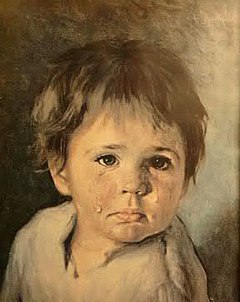
The Crying Boy by Giovanni Bragolin
In 1985, there were reports in the papers in England that the firefighter claimed they kept finding undamaged paintings in burnt down ruins. The paintings were all of the crying boy series, a mass produced scenario from the 1950s and onwards.
The original idea of the paintings was from the Italian painter Giovanni Bragolin that sold over 60 of them to tourists. So many rumours surrounded the painter. Like that he painted the crying boys at an orphanage after fleeing to Spain after the war. The orphanage burnt down.
After the reports from the firefighters printed in the news by tabloid newspaper, the Sun, they organized bonfires to burn the haunted paintings.
Advertisements
The Hands Resist Him by Bill Stoneham
In February in 2000, a new listing on ebay appeared of a strange haunted painting. An elderly couple in California tried to get rid of a painting from their brewery. But the painting had a disclaimer on it. It was said it carried some sort of curse or was haunted.
The characters in the paintings apparently had a habit of moving during the night. And occasionally, they completely left the picture as well, crossing the frame. It sold for so much more than what it was listed for.
The haunted picture was purchased by the Perception gallery that tracked down the artist, Bill Stoneham that painted the picture in 1972. It was originally purchased by John Marley, most known for his role in The Godfather. And the strange travels of the painting and the mystery surrounding it, still lingers, even so many decades after the paint dried.
Advertisements
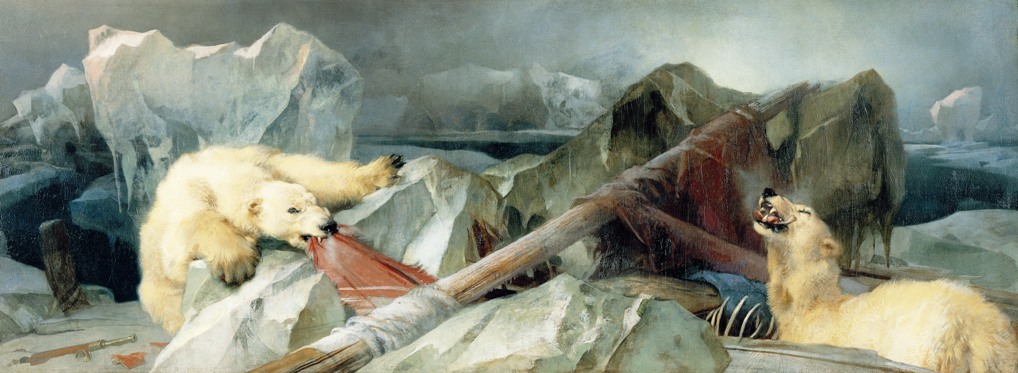
Man Proposes, God Disposes by Edwin Landseer
At Royal Holloway University, there hangs a haunted painting. The picture must be covered every year. Or else…
It is an 1864 oil-on-canvas painting by Edwin Landseer. The haunted painting was inspired by the search for Franklin’s lost expedition which disappeared in the Arctic after 1845.
According to an urban myth a student in the 1920 or 30s. He was taking his exam when he suddendly stabbed a pencil into his eye, writing “The polar bears made me do it” on to their exam paper. He then killed himself. From this alleged incident, another legend sprung out in the 60s, claiming that anyone sitting in front of the painting during an exam would fail.
That is why everytime an exam is on, there is a college tradition of covering the haunted painting with a Union Jack flag after a student refused to take the exam until the painting was covered.
Advertisements
The Rain Woman by Svetlana Telets
Ukrainian artist, Svetlana Telets painted this haunted picture in 1996, the same year she graduated from Odessa Art University. For six months after graduating art school, she always had this feeling of someone watching her.
When Svetlana Telets one day suddenly had the image of The Rain Woman in her head, she started to paint almost without thinking. She herself claimed that something or someone took over her, like drawing through her. The haunted painting was done in five hours, and the result, well… It was this strange and surreal looking woman.
The painting was bought, then returned, then sold, then resold again. The buyers didn’t want it in their homes. They complained that the painting was causing them to experience insomnia and anxiety. And there was always a feeling of being watched. One even rang to Svetlana Telets and complained to her about The Rain Woman:
“Please pick her up. I can not sleep. It seems that there is someone in the apartment besides me. I even took it off the wall and hid it behind the closet. ”
The Rain Woman used to hang in a furniture salon in Vinnitsa trying to sell it. Customers of the shop claim to be dreaming about the woman in the picture and claim to sort of know her, but are unable to place her.
Read More: Read the full story about the The Rain Woman in MoonMausoleum.
Advertisements
The Dead Mother by Edvard Munch
Edvard Munch was an artist known for his inner demons, something we can see in a lot of his paintings like Scream, The Vampire and all off his paintings depicting sickness. This is the case of The Dead Mother, depicting a little child in front of her dead mother, hands up in anguish much like in Scream.
The haunted painting that he painted is probably based on his own mother’s death. Edvard Munch’s mother died of tuberculosis when he was only 5 years old and this trauma lingered with him for all off his life together with the death of his sister as well.
The haunted painting is said to be cursed, or even haunted by some that have seen it. There are several version of the painting though, but the legend never specifies which version of the motief is the cursed one. Perhaps all of them.
The eyes of the little girl is said to follow you wherever you go, and some even go as far as to claim that she sometimes disappear from the frame altogether. There are also those that claim you can hear the sheet in the mother’s bed rustling, as if someone is moving it.
Advertisements
Untitled by Laura P.
This haunted painting was based on a photograph by James Kidd from 1994. A picture believed to have a headless figure some claiming to be a ghost. According to Laura P, she started painting the painting, not knowing why she did so, as if being under some possession.
After the painting was done, she herself told of things surrounding the painting that were, strange. Incidents happening to the artist, possessions missing, and objects falling and breaking are just some of them. This has led to some people claiming the painting is haunted by the spirit from the original photo.
The 2019 faux movie-within-a-movie type of horror has taken up interest again, the movie, “Antrum, the deadliest film ever made”. I can’t really remember that a so popular movie have fooled so many people since Blair Witch. Correct me if I’m wrong, but most of the trending now is challenging people to watch it, believing the intended myth behind this mockumentary-found footage type of movie. The premise of the cursed horror movie is of a real cursed movie from the 70s, now resurfaced. After watching it, jumping on the wagon a bit late, I couldn’t help noticing, what truly terrified me after watching. So after the initial hype has died out, and the truth is sort of “out there”, this is my take on it.
Spoilers ahead, so be warned.
Synopsis
The movie opens with a documentary type of style, talking about a horror movie from the 70s allegedly from the Soviet that caused the death of many many people, from casual movie goers to film festival leaders. It claims that it caused the death of 56 people in Budapest when it screened in a cinema that burned down in 1988. And also it injured and killed a woman in San Francisco in 1993 when someone laced the popcorn with LSD. Then it does a countdown of a clock, and the movie Antrum starts. Simple, but so effective. Then the “real” movie begins.
It tells the story of a teen sister and her kid brother, hiking. They recently lost their dog, and the boy is convinced the dog went to hell. So they travel to a place and try to dig their way to hell to get the dog back. They follow the instruction of a book the sister claims she got from a certain “Ike”. All told through a beautiful European art-house film from the 1970s filter, but with a horror twist in the cinematography. The rest of the movie is them battling hillbillies, what is dream, what is reality and the lurking shadows in the corner of their eyes. An honest discussion about what happens when one believes a lie.
Advertisements
Background of the “movie legend”
Of course, none of this is true, but it is some of the allure of the movie, and in my eyes, some of the social commentary the movie Antrum brings to the table, elevating it from mere horror-flick, to more of a drama with a purpose and moral. We learn halfway through the sister is behind it all, making the book, lying about meeting the devil and that it was all made up in order to help her brother, suffering from nightmares and the belief that the dog went to hell. But the fiction turns on her, making her lie true because of people believing in it.
Perhaps, it is a long time since a mockumentary was able to fool as big of an audience as it did. What is truly frightening is the way some with so many followers, like the teens on Tik-Tok, blogs and YouTube channels fuels this “found footage” story. Isolated, this is fun. Harmless lies we tell in the dark as we always have, as good horror intends to. It is also fascinating that even in the time of internet, were the truth is literary one google search away, people still believe the hype, the narrative, the story. On the other side, it is in these time of “fake news”, a bit sad of when we see how actual important news, fake as well as real, can be manipulated, believed and not believed in. But never mind that (puts the media education away) let’s look at how genius they did it (puts on horror loving hat):
For one, it is clear they put a lot of effort in making it be in the 70s. From the clothes, filming style, the grainy filter and color palette. Even down to that creepy CGI of the squirrel. A truly demonic entity that is.
As with other cult movies, they did something cool in the way they let the influencer who were fooled market the thing for them, making the viewing something of an event rather than just a standard movie night. Also it is something quite endearing about the collective watching of it that is only found in the horror community, I think.
Even with my obsessive googling, it took a couple of searches to truly find evidence of the falseness. Even down to the actors’ age was removed from their IMDb profiles, making it easier to keep up the belief. It is also cool about how it is finally a movie thinking more about the movie being bigger than the actors, not the other way around.
Advertisements
The terrifying thing about the movieAntrum
Is this a scary movie? In some regards, yes. Like the Blair Witch Project, it is the format that makes the scares, the legend behind it, the myth bigger than a simple movie. And the way the shaky camera movements from most found footage makes movies unpredictable and scary, it is the the overlaying of “cut in clips no one knows were came from” and the clip in of the sigils and Latin phrases making one question: Could it really be?
Is it truly “bad” enough to be believed in though? I think not, and I was sort of bothered about how perfect it all looked from a Soviet movie from the 70s. But then again, it did sort of look too rough to be a more “proper” movie. Also they spoke English, and none of the non-English speaking people can sort of believe that mash up. It just seems weird and sort of a very American thing to do, making it in English instead of just putting subtitles on.
What my main take of it was that it was more of a heart felt movie than a demonic one. I felt more sympathy for the siblings and believed in their relationship than I believed I was cursed by Satan after watching it.
Advertisements
It occurred to me mid movie, what scared me the most though. Even the myth, claims I would die few days after watching it, and that creepy demon between the trees, it was none of them though that made my heart race. It was the threat of people:
True, jump scares don’t really work on me in the long run, great costumes sort of blend in when watching as many horror movies as I do. But what never cease to scare me, are the threat of real humans. It never goes away. In the movie, not only do they have to fight of demonic entities, but some good old fashioned hillbillies, that does these random gruesome things like: fucking dead animals, boiling people alive, shooting children and wear antlers on a trucker hat. Yes, not really the most original or in depth type of characters. But when checking my pulse throughout the movie, it is sort of only in those scenes a steady rush of fear comes. I found that very interesting. That no matter how much of a supernatural, demonic myth, claiming it would take your life, nothing is as scary as the threat of real humans, wanting to do you harm.
And that is what really was terrifying about this cursed movie.
In these strange and scary pandemic times, its nice to live in a world of modern health care, science and the wide spread information about the internet. But pandemics and epidemics have always been a part of the human experience through history, and it’s really just in the last couple of centuries, we’ve really been able to combat the spread of viruses. So in that regard, we took a look at past pandemics and epidemics and how they affected the society and how they at that time, tried to combat it.
The plague of Justinian (541-542 AD)
St Sebastian pleading for the life of a gravedigger afflicted with plague during the 7th-century Plague of Justinian. (Josse Lieferinxe, c. 1497–1499)
This plague is the first well documented occurrence of a wide spread pandemic. And according to some historians, the most deadliest. In 2013 it was confirmed that the bacteria was the Yersinia pestis, the same that caused the Black death.
“During these times, there was a pestilence, by which the whole human race came near to being annihilated” – Procopius
The name comes from the Emperor Justinian of the Byzantian empire, a peasant son that had been chosen as emperor Justin, his uncle, to rule in these times. Justinian and members of his court, physically unaffected by the previous 535–536 famine, were afflicted, with Justinian himself contracting and surviving the pestilence. He was said to have been a stern and vicious ruler in the plague times, not budging on collecting the taxes from his starving and sickly farmers.
Mosaic of Justinianus I – Basilica San Vitale (Ravenna) Photo by: Petar Milošević 2015
Merchant ships from Egypt came into the city of Constantinople the seat of the Roman Empire, carrying infected rats in the grain ships. We have a lot of first hands accounts of the Byzantine historians, like Procopius. He recorded that at its peak, the plague killed 10 000 people in the city of Constantinople, daily. There was no room to bury the dead, the bodies had to be stacked on top of each other. In the streets, in the houses, unburied, left unattended, feared. No one was left to bury them. There was no room for funeral rites and the once so great city reeked of death.
Proocopicus, hated the Emperor Justinius, and blamed him in his “Secret History”, claiming the emperor was a demon that created the plague, or at leas, was a punishment for his malice. He told of supernatural beings in human disguise that spread the disease after appearing to people. He claimed other dies after seeing visions in dreams, or heard voices, telling them that they would be getting the plague.
1975. This patient presented with symptoms of plague that included gangrene of the right hand causing necrosis of the fingers. Author=CDC/Dr. Jack Poland
In the end, the tombs were filled, so the soldiers built trenches for the bodies to be thrown in. That too failed, as it in the end, was no where left to dig. In the end the people carried the bodies of the dead down to the sea and threw them in to rid themselves of the stench of death and piling of bodies.
In the VIth century the inhabitants of Philippi embarked on the construction of an imposing basilica on the site of the town’s palaestra; the size of the planned building clearly exceeded the needs of the town, thus indicating that Philippi attracted many pilgrims. In 547 the so-called Justinian plague devastated the countries of the Mediterranean basin and in the early VIIth century an earthquake struck the region of Philippi; these two catastrophic events could have halted the completion of the basilica, standing as a proof and evidence on how plagues can alter the history as intended.
Advertisements
The Black Death (1347-1351)
Physician attire for protection from the Bubonic plague or Black death from 1656. A so called plague doctor. The purpose of the mask was to keep away bad smells, known as miasma, which were thought to be the principal cause of the disease, before it was disproved by germ theory.
It swept cross Europe in medieval times, laying towns, countries, cultures and riches in ruins. It did not start in Europe, but it remained as an imprint on it, to this today, some would even claim, a fear for it, that still rings today. And in the western world, every plague since then, has been compared to the infamous Black Death. So many myths, so many legends spun around it, who was to blame, were did it come from. It left plague pits, its own cemeteries and around 25 million dead in Europe alone.
People would die suddenly. They would be in the market, at work, at home, and the, suddenly fall dead of the illness. Doctors refused to attend the patients and priests declined administering last rites. Even worse, healthy people from families would often leave their infected loved ones to die and escaped to other places.
Contemporary sources say that the plague originated in Mongolia. It traveled all the way before it hit Europe in full force in 1347/48 along the coast. Giovanni Boccaccio, most known for his book, Decameron, was a first hand witness to the plague. In his book, he describes the harsh reality of it:
“The pestilence was so powerful that it was communicated to the healthy by contacting the sick, the way a fire close to dry or oily things will set them aflame.”
They established their camps in fields near towns and held their rituals twice a day. The ritual began with the reading of a letter, claimed to have been delivered by an angel and justifying the Flagellants’ activities. Next, the followers would fall to their knees and scourge themselves, gesturing with their free hands to indicate their sin and striking themselves rhythmically to songs, known as Geisslerlieder, until blood flowed. Sometimes the blood was soaked up in rags and treated as a holy relic. Painting by Pieter van Laer (1599–after 1641 ) from ca. 1635.
In Milan, if a person was found to be infected, they would close them inside the house, the house would be walled up, windows and doors filled with bricks, with all the people still inside.
Several people were blamed of the disease. Jews were burned throughout Germany or banished. In Esslingen, the Jews gathered in their synagogue and set it on fire. In Strasbourg the town counsel tried to protect them, but they were burned in their own cemetery.
The pestilence paved way to a scary brotherhood, The Flagellants, the Brethren of the Cross. Devout Christians looked at the plague as a punishment from God fro their sins. In Germany, this movement spread like the plague itself. They wore dark clothes with red crosses, hiding their face and walked in a line behind their leader. They would parade in a circle before throwing themselves on the ground, the leader beating them all for their sins. Then they would get up before beating themselves with a scourge, a stick with three tails with knots. They would whip their backs bloody. This they hoped, would appease God. Many died from these marches that raged in Germany and France.
Advertisements
Theodor Kittelsen – Pesta i trappen, 1896 (Pesta on the Stairs).
The plague reached far, even to outskirts countries like Iceland and Greenland, The plague managed to hit Norway in 1349 when a wool-carrying ship from England halted at Bergen port. Within days, the entire ship crew were dead and then the rampage started in rest of Norway. Norwegian called the plague “pest”. Folklore thought that the plague was an old woman, “Pesta” and that she came to town with either a rake or a broom. If she used her broom, everyone would die. If she used the rake, some would live. Today, people are named after the deserted and dead farms. Ødegård (desolate farm), a common surname among Norwegians to this date.
This wasn’t the last Europe saw of the plague however. It came and went in waves during the next centuries.
The Third Plague (1855 to the 1950s)
This plague started in Yunnan, China, and eventually led to the discovery of a cure for it. It was then the connection to rats were discovered and a more planned combat against the plague could go forth.
Picture of Manchurian Plague victims in 1910 -1911 that has been historically mislabeled as “Body disposal at Unit 731” A much higher resolution photo, with Russian text stating that these were “Dead plague bodies held in storage awaiting scientific research” can be seen here.
Shi Tao-nan wrote a poem about the plague called: Death of Rats.
Dead rats in the east, Dead rats in the west!
As if they were tigers, Indeed are the people scared.
Few days following the death of the rats, Men pass away like falling walls!..
The coming of the devil of the plague Suddendly makes the lamp dim,
Then it is blown out, Leaving man ghost and corpse in the dark room
The writer of the poem died of the plague only days after it was written.
The plague continued to rage, from Hong Kong it spread with ships to the world. To US, Latin America, India and South Africa. India was particularly hit by the plague, and over the next thiry years, over twelve million people died of it in India alone. It died out in the 1950s. In 1894 the Hong Kong doctore, Alexandre Yersin found evidence of the Yersinia Pestis as in the Justinian plague and Black Death.
Today, fewer than 200 people die of the plague worldwide each year, mainly due to lack of treatment. Plague is considered to be endemic in 26 countries around the world, with most cases found in remote areas of Africa. The three most endemic countries are Madagascar, the Democratic Republic of the Congo and Peru. The latest victim to it being a couple in Mongolia after eating the raw kidney of a rodent. Commonly considered a folk remedy for good health.
Orent, Wendy. Plague: the Mysterious Past and Terrifying Future of the Worlds Most Dangerous Disease. Place of publication not identified: Free Press, 2012.
Khonsuemheb and the Ghost is one of the oldest ghost stories we have in written form about a high priests quest to honor the dead whose tomb were disturbed in the Theban Necropolis in ancient Egypt. The question remains: did he actually complete his mission?
When did people start to tell ghost stories? It is difficult to say exactly when as the earliest ghost stories were probably older than our written language and so old that it is lost like any of the first original stories. What we do have though, are fragments of those who were carved in stone and scribbled on the walls. Perhaps human have always told ghost stories and the real question is if we will ever stop.
One of the more ancient ghost stories we have in writing is the story of Khonsuemheb and the Ghost. This ghost legend comes from Egypt, around 1200 B.C during the Ramesside period. The story was found in four pieces of pottery by Ernesto Schiaparelli, and translated in 1915 by Egyptologist, Gaston Maspero (1846-1916).
The Normalising of Ghosts in Ancient Egypt
The ancient Egyptians believed in life after death, and in the book “Book of the Dead”, they wrote down a series of spells they thought would help them reach the afterlife. The people living at the time thought of the afterlife as a sort of continuation of life were it would be paradise to end up in. So why on earth do we still have ghost stories of people that never reach this perfect afterlife?
In ancient Egypt ghosts (called akh) were somewhat similar to their former self, more a piece of the soul of the living person, the immortal and transformed part of the soul. Interactions between ghosts and living people were seen in a lesser supernatural way than in modern depictions, just as the ghost in Khonsuemheb and the Ghost was more of a task to be handled than something unnatural happening.
Anubis God of Lost Souls: is the god of funerary rites, protector of graves, and guide to the underworld, in ancient Egyptian religion, usually depicted as a canine or a man with a canine head. If the family didn’t do the funeral rites correctly or were cheap with the money, the Gods would sort of grant the part of the soul, the akh permission to go back and complain and haunt the family or its grave.
The akh was a consequence of the burial ritual not being right, the tomb being destroyed or so forth. This ritual was important as it was the way into the afterlife. An akh could harm the living, giving them nightmares, feelings of guilt, punish people or sickness. But it could also do good deeds to help their living family members, influencing for the better etc.
As well as coming on their own volition, they could be invoked by prayers or written letters left in the tomb’s offering chapel, just like what happened in Khonsuemheb and the Ghost.
Read Also: If graves or tombs are not well kept, bad things can happen. Read about The Haunted Barbie Doll in The Shrine and how they take care of that ghosts final resting place.
The Story of Khonsuemheb and the Ghost
The beginning of the story is lost forever, as it being a fragment of some pottery. So the full length of it, is nowhere to be found. But it is implied the story is set in Theban Necropolis, a burial place near the Valley of the Kings and Valley of the Queens.
The burial city was built at the west bank of the Nile, near the ancient city of Thebes, which at the time was the capital and the perhaps even the biggest city in the world at that time. The ruins of the city lies within the modern day city, Luxor, in Upper Egypt. At this time in the New Kingdom, Thebes reached new height of prosperity. It was the time right before the decline of the great city, and it would soon fall into unrest, strikes, looting of the Necropolises.
Ruins of Medinet Habu (Arabic: مدينة هابو) is an archaeological locality situated near the foot of the Theban Hills of the River Nile opposite the modern city of Luxor, Egypt. it is the Mortuary Temple of Ramesses III. This is where the ruins of Thebes can be found.
The Servant in the Place of Truth
But before all this, a man had to spend the night next to a tomb in the Theban Necropolis, literally meaning the city of the dead. He is unnamed in the fragment of Khonsuemheb and the Ghost. Perhaps he was just walking by, perhaps he was a looter. Perhaps he was a Servant in the Place of Truth. That was an ancient Egyptian title of the people working in the Necropolis.
The servants in the Place of Truth constructed the eternal dwelling of the kings, and isolated themselves to safeguard their secrets. They lived in the village Set-Maat (Place of truth) in the Holy Land of the Dead, today known as Deir el-Medina. The village that happens to be were the last bit of fragment of the story was found.
A Night at Thebes Necropolis: The man in the story spent the night in the desolated place of Theban Necropolis, a place outside of today’s Luxor in Egypt. //Source: wikimedia
The man was woken by the ghost residing in the tomb. Was he afraid? Perhaps not if he worked there. Perhaps he was terrified, especially if he was a looter, trying to steal the possessions in the tomb. In any case, he went to the High Priest of Amun, Khonsuemheb, and told what happened in the tomb.
The High Priest Invoking the Ghost
The High Priest of Amun, takes matters into his own hands. He stands on his rooftop, calling to the gods to summon the ghost. Invoking the gods of the sky and the gods of the earth, southern, northern, western and eastern, and (the) gods of the underworld, saying to them: “Send me that august spirit.” And it does. “I grew, and I did not see the rays of the sun. I did not breathe the air, but darkness was before me every day, and no one came to find me,” the ghost says (translation by Maspero).
Khonsuemheb asks his name. Nebusemekh, son of Ankhmen and of the lady Tamshas, the ghost answers. So how does one please an ancient egyptian ghost? Khonsuemheb at least offered to rebuild his tomb, making it better with a gildet ziziphus-wood coffin to make peace with the ghost. But the ghost doesn’t trust Khonsuemheb and his intentions. So what do they do?
The Ghost story on the pottery:Ancient Egyptian ostrakon with the beginning of the Ghost story of of Khonsuemheb and the Ghost. Terracotta from Deir el-Medina, 19-20th Dynasty, New Kingdom. Found by Schiaparelli in 1905. Turin, Museo Egizio.
Khonsuemheb sits down with the ghost, starts to cry and shares his unhappy fate. “I will remain here] without eating or drinking, without growing old or becoming young. I will not see sunlight nor will I inhale northerly breezes, but darkness shall be in my sight every day. I will not get up early to depart.”
Then the ghost proceeds to tell about his life on earth, how he was an overseer of the treasuries and a military official under pharaoh Rahotep. When the ghost, Nebusemekh died in the 14th regnal year of pharaoh Mentuhotep, the ruler gave him a canopic set, an alabaster sarcophagus and a ten-cubits shaft tomb.
But time took over the tomb, and over the centuries, the tomb partially collapsed, allowing wind to reach the burial chamber. Nebusemekh also told Khonsuemheb that others before him offered to rebuild his grave, but never did. Khonsuemheb says to the ghost that he will do it and also offers to send ten servants to make daily offerings at his grave. But the ghost says that wouldn’t be necessary or of any use.
Only Fragments of the Ending Left
Here, the text of Khonsuemheb and the Ghost on the pottery breaks, and in the next fragment three men are sent out by Khonsuemheb to search for a proper place for Nebusemekh new tomb. They find it at Deir el-Bahari, near to the causeway of the mortuary temple belonging to pharaoh Mentuhotep the second.
This is the end, the text suddenly ends here. But perhaps Khonsuemheb honored the last wish of Nebusemekh, giving peace in his afterlife the Egyptians were all so desperate at having.
The Afterlife in Ancient Egypt: Egyptian religious doctrines included three afterlife ideologies: belief in an underworld, eternal life, and rebirth of the soul. The path to the afterlife for the deceased was a difficult one with gates, doors and pylons located in Duat, the land of the underworld. Ultimately, the immortality desired by ancient Egyptians was reflected in endless lives. By doing worthy deeds in their current life, they would be granted a second life for all of eternity.
The tale of Khonsuemheb and the Ghost is a piece of fragment, written in another era of time entirely and there are of course dispute how much of it is an historical account of something that happened and a cautionary tale of what could happen if the living didn’t honor the dead. And the details of the tale are still open to interpretations. Particularly the identity of the to pharaohs in Nebusemekh’s time, and in the ghost actually got to rest in peace and finally enjoy paradise in the afterlife.
An online magazine about the paranormal, haunted and macabre. We collect the ghost stories from all around the world as well as review horror and gothic media.