The metal bar called the Banshee Labyrinth is located in parts of the haunted underground vaults of Edinburgh. And today the place has some haunted stories to tell as well. Everything from ghost children, accused witches, irish folklore creatures and an annoying ghost in the ladies toilet, this pub houses them all.
What can be a more haunted place than a rock and metal bar located in the haunted old town of Edinburgh? Today it is a family run pub that promises a good drink and music all week.
The Banshee Labyrinth bar is located on Niddry Street it is close to the Royal Mile as well as the haunted underground of Edinburgh.
They are also catering to the more macabre with movie nights mostly showing horror movies. But are we to believe legends about this pub you can also expect a couple of ghostly guests as well.
Advertisements
The Haunted Underground Vaults
It is located near The South Bridge Vaults where several businesses, workplace and taverns were located. However, it was built on a low budget and never waterproofed. The place eventually flooded and only the poorest people stayed there, making cheap brothels and pubs flourish instead and crime and murders were not uncommon.
It was allegedly also here the infamous serial killers Burke and Hare haunted victims to sell to the medical schools. The underground vaults have become notorious as a haunted place.
The Wailing Banshee
Part of The Banshee Labyrinth is in one of these vaults and the name the pub has comes from the legend of a banshee haunting the place. Banshee are female spirits and creatures that are an omen of death with their terrifying screams.
The Banshee: It is a female spirit in Irish folklore who heralds the death of a family member
Once when the pub was having some restoration work done, the workmen experienced something strange. The story is that a group of workmen heard this wailing scream of death and right after. According to some sources he also saw a woman in a gray dress who cried into her hands before lifting her head to show off her pale face with rotted teeth and no eyes.
After this they were terrified, but it didn’t stop there. Right after the incident, one of the workers got a call about the death of one of their family members just moments later.
There is also Molly, a six year old girl that are said to haunt the place. She is named Molly after they found a child shoe with the name written on it in one of the old bricked-up chimneys. She apparently disappeared in 1814 according to some sources.
People also report on the ghost they have named Ole Jock, who is said to haunt the ladies toilet. He keeps slamming the doors and is even said to be the one turning the hand driers on and off.
Advertisements
The Witch Hunter
Since its heyday as a part of the criminal hotspot of the city, the people who once walked the vaults are said to have been of the more unsavory characters, and perhaps the ghosts can be seen as the same.
Witches: More than 3000 Scottish people who were accused of witchcraft between the 16th and 17th century. Many of them were burned at the stake in Edinburgh.
One of the neighbors of the building of The Banshee Labyrinth for instance once upon the time belonged to a man named Lord Nicol Edwards. He was a lord Provost and known to be a cruel man, especially to his wife. He is also said to have had a personal dungeon under his house he used to torture accused witches before their trial.
Many pub goers to The Banshee Labyrinth have claimed to have spotted one of these tortured women, and the story of the banshee is often linked together with these women.
There are also stories about inside the pub with some strange things happening. Classical haunted pub things like drinks flying off the tables and crashing in the walls. So bottoms up, The Banshee Labyrinth have spirits for all, both the drinkable and haunted type.
The blinking paper lantern hides a vengeful ghost in one of the most famous Japanese ghost stories. From a local legend about a real woman to the stage, the myth of the ghost of Oiwacontinues to inspire horror.
Many of the more well known stories of ghost and horror from Japan is about the Onryō, meaning a vengeful spirit. A ghost so full of regret and rage, they are posing a threat to living humans. And sometimes, they can come in the form as a Japanese Paper Lantern Ghost. This is the case of the ghost of Oiwa.
In many cultures, ghosts are put in different categories. Such is the case with Onryō (怨霊 onryō,) It basically means “vengeful spirit” or “wrathful spirit” in Japanese and is a mythological spirit of vengeance from Japanese folklore. They also have ghosts, called yurei, but these differ in the will of the ghost. As opposed to…
There are many movies, books and popular culture that feeds on the old legend of the vengeful spirit. Today in modern time we have The Ring and The Grudge series that makes use of this old legend, and in many instances, they are both also inspired by the most iconic Onryō throughout time, the ghost of Oiwa.
Yotsuya Kaidan — The Tale of Oiwa and Tamiya Iemon
The ghost of Oiwa is a vengeful spirit that we first learned of through the kabuki play called Yotsuya Kaidan (四谷怪談) or Ghost Story of Yotsuya from 1825. It was written by the writer Tsuruya Namboku IV, known for his plays with supernatural themes and macabre and grotesque characters.
She is an easy recognisable character on stage with her droopy eye and hair falling out or as the iconic Paper Lantern Ghost. She is also often seen as a Japanese ghost lantern in art.
Read Also: Check out all of the ghost stories from Japan
Kabuki Theatre
The Kabuki theatre is a traditional Japanese style plays originating in the Edo period. It is well known for its characteristics wigs, costumes, makeup and masks. It is exclusively theatre troops of men playing all roles. The distinct styled stage performances is the origin of many iconic looks in modern pop culture, like the distinct style of the Onryō with the white dress, white makeup and long black hair.
Yotsuya Kaidan is not the first and original written account of the legend, but certainly the most famous one. The first written manuscript about the ghost of Oiwa is dated to 1727 called Yotsuya zōtan 四谷雑談. It was an underground publication, most likely of the scandalous rumour of the true rumours of a noble family and lady that acted as an Onryō after her death.
Yotsuya Kaidan tells the story of Oiwa and Tamiya Iemon and in this play it tells the story of a woman scorned by her man and coming back from the dead for revenge. Throughout the years, there have been many adaptation and versions of the story and it was a popular story to tell as a part of a samurai parlor game.
It is considered to be one of Nihon san dai kaidan — Japan’s Big Three Ghost Stories. It is arguably the most famous Japanese ghost story of all time and has spurned a couple of local legends of its own.
Read about the Nihon san dai kaidan—Japan’s Big Three Ghost Stories:
The Botan Dōrō or Tales of the Peony Lantern is a ghost story told since the Ming dynasty in China to today. Most popular through the Kaidan theater plays, it is now one of Japan’s most well known ghost stories.
The tale of Banchō Sarayashiki (番町皿屋敷, The Dish Mansion at Banchō) is a well known Japanese ghost story (kaidan). It was popularized in the kabuki theater tradition, and lives on in popular culture and folklore alike.
Yotsuya Kaidan starts out as a classical romantic tale. Oiwa was said to be a loving and devoted wife that risked everything for her husband, Tamiya Iemon. They married in secret, without her father’s consent. Tamiya Iemon was a wandering samurai, a poor rōnin and not suited to marry his daughter according to the father.
The ghost of Oiwa From the ”Thirty-six Ghosts” series by Tsukioka Yoshitoshi, ”The Yotsuya Ghost Story”, 1892.
Oiwa’s father whoever, was not as pleased with her marrying this man without honor and no money. When he found out the rōnin’s misdeeds, he confronted him. After a heated argument, the father was killed by the son in law when he threatened to make them stay apart from each other, and he did not bless their marriage.
After his death, Oiwa mourned her father. Iemon comforted Oiwa, claiming they would find her father’s killer.
To earn money he had to take up work as an umbrella maker to care for his pregnant wife. The old samurai grew bored doing the tedious work and turned resentful towards his wife, Oiwa. A woman he once loved and done horrible things to stay with. But in the end, there was no love left.
Next door they had a neighbor with a granddaughter that loved Iemon. The neighbor himself wanted his granddaughter and Iemon to get married. They were wealthy neighbors, and Iemon wanted to be that as well. So they planned how to get rid of Oiwa together.
Unbeknownst to Oiwa they sent her either an ointment or face cream laced with poison. But the poison didn’t kill her and only left her disfigured with one eye drooping and her hair falling off as she tried to brush through it, making Iemon so disgusted by her, he came up with a plan to rid himself of her. He hired one of his friends to rape her so that he would have grounds for a divorce.
His friend however is unable to go through with the plan and shows her a mirror instead. When she sees herself she understands what has happen and how she has been deceived. She takes a sword and accidently kills herself with it, and on her last breath, she curses Iemons name. In some versions there is actually Iemon that kills her.
Iemon threw her in the river to rot and went on to plan the wedding to the neighbors granddaughter. That night, the night before his wedding, he had terrible night terrors, and he saw his dead wife manifesting. In a burning paper lantern she comes out as a ghost, frightening him as a warning of the hauntings that are about to come.
The Chōchin obake
In Japanese legends, they have this concept of Tsukumogami (付喪神, “Kami of tool). This is the belief that inanimate objects, when they ‘serve’ their owners for a hundred years, they are granted life and a soul. When the Japanese lantern, or Chōchin reaches this age, it can become Chōchin obake, a Japanese lantern ghost, a mostly harmless ghost that laughs and lightly scares humans. But they could also be inhabited by a powerful onryō.
The Lantern: The print depicts a Kamiya Iantern haunted by the ghost of Oiwa as the Paper Lantern Ghost in Yotsuya Kaidan Kuniyoshi Utagawa, ”The Ghost in the Lantern”, 1852.
But he is not frightened enough as he still goes on with the wedding the next day. When he lifted the veil of his bride though, it was the ghost of Oiwas disfigured face staring back at him. He beheaded her, and therefore, his new bride as well. There is all in all a lot of killing going on.
He was then pursued by the ghost of Oiwa, not wanting him to escape. She was turned into a vengeful ghost, pursuing him into madness, making him suffer. He dies in the end, after suffering horrible.
It changes in the different adaptations of Yotsuya Kaidan how he dies though. Sometimes he is killed by Oiwa’s brother, or brother in law and in other versions it’s the haunting of the ghost of Oiwa that drives him out of his mind and into death. Sometimes it’s Oiwa herself, that pulls him down from the height with her. Either way her revenge is complete.
Advertisements
The Deaths Behind The Play of the Paper Lantern Ghost
The success of the Yotsuya Kaidan play was so big that they had to reschedule more performances to meet the demands. It was mostly believed that the popularity of the play was because it tapped into the zeitgeist of the society at the time.
Oiwa as the lantern: The ghost of Oiwa manifesting herself as a Japanese Paper Lantern Ghost. From the series One Hundred Tales (Hyaku monogatari). Print by Katsushika Hokusai. 1830
The theme of repressed women was something that reflected the Bunsei era that was also a time of great unrest. And the story of the victim taking her revenge of her oppressor was something the audience revelled in.
But where did the story come from? Was it just from the imagination to Nanboku when he wrote the play?
In most blogs it is said the legend created the play. But was it actually the play that created the legend? Yes, it is based on the terrifying vengeful ghost, something older than the kabuki play. But were did Nanboku really get his story from?
According to some sources Nanboku’s play was based of an actual murder of the wife of a samurai that went insane after her husband got another woman pregnant. She wandered off from her home, never to be seen again.
It is also claimed that Nanboku based his play from to separate murders. One of the murders was that of two servants who had murdered their masters. They were caught and executed on the same day. The second murder that inspired the play was a samurai that nailed his wife and her lover to a wooden board and threw them into the Kanda River for being faithless.
In any case what source the play was created from, the play itself became something that created more legend. It has adapted for film over 30 times, and continues to be an influence on Japanese horror today.
The Real Oiwa and her Rocks
But who was the real Oiwa behind the manuscript? Both the play and the written account from 1727 from the underground publication that claimed a dead wife had turned into an onryo. Wether this account really refers to this Oiwa, is a bit uncertaint though.
We can find an Oiwa Tamiya in the real life that had something mysterious happening to her. Living in the 17th century, she was born into a powerful family, but she and her husband had financial difficulties.
One day Oiwa came over two very large rocks she felt was something special and put them both in her garden. She prayed to these rocks for good luck and prosperity for her family to overcome their financial difficulties.
And over time, the things she prayed for to the rocks really happened for the family and everyone believed it was because of the magic rocks that she had prayed to. The rocks became famous, and was called Oiwa Inari or Yotsuya Inary. In the end, a shrine was built for it, and this is the shrine people flock to pray to.
Even the Tokyo Metropolitan Board of Education found it necessary to distinguish the real life Oiwa and the play and they have put this message:
Tamiya Inari Shrine, commonly known as Oiwa Inari, used to be i the premises of Tamiya family of Osakitegumi doshin (military officer in the Edo period). An old story is passed down that Oiwa (died in 1636), a daughter of Tamiya Matazaemon, worshipped at the shrine and restored her family with Iemon, her husband. Therefore, the shrine was gradually worshipped as ‘Oiwa Inari* by people. There was yet another story to attract further worshippers, the ghost story ‘Tokaido Yotsuya Kaidan’, written by Tsuruya Nanbuko and was staged in 1825 and was very popular.
However, it was written after 200 years of time when Oiwa and Iemon actually lived. Unlike the famous ghost story, their marriage in reality was enjoyable. After Inari shrine was lost by a fire in 1879, it moved to Shinkawa in Chuo Ward. The present shrine was rebuilt here at Yotsuya in 1952.
— Tokyo Metropolitan Board of Education
Although not like in the play, there were rumours about Oiwa being a vengeful ghost, long before the Kabuki actors entered the stage for the first time. Something we can read about in the manuscript from 1727 that also hinted to this fate for her.
A more sinister legend of this lady though is the curse she apparently set on three houses had been disrupted, rumour saying it was the grudge of Tamiya’s wife, Oiwa that killed them. They were both victims of the reforming rule of the eight Tokugawa Shōgun, Yoshimune Kō. In some accounts she disappeared, in others she commited suicide, vowing to revenge those who wronged her. In all she was blamed for the deaths of at least fifteen people.
The Shrine in Oiwa’s Honor
Already in 1717, there was a shrine erected in her honor, something they sometimes did to appease the wrath of an Onryō, long before the publication that were written ten years after. This is a list of some of the shrines that were built to restore her honor and protect from the harmful ghost, or at least connected to the Oiwa legend:
They say that when visiting her grave, there is a statue of Oiwa inside the main building in some of her shrines, although not accessible to visitors. you can wish upon it as it is said she grants the wishes of her worshippers. This is also the rumours about her grave.
The Curse of Oiwa’s Grave and The Curse on the Play
The revenge of Oiwa: The ghost of Oiwacoming out from the Japanese lantern in Yotsuya Kaidan as a ghost with her son in her arms. Artist:Kuniyoshi
It is said her body is buried at Myogo-ji temple in Sugamo, Tokyo. Her death is listed in February 22. 1636 and the grave has been rumoured to have been haunted for ages.
After the play started, there have been reports of accidents, injuries and deaths around the production of the play or even TV or movie adaptions of the story. This has been blamed on the ghost of Oiwa and her wish for revenge. Therefore it has become a tradition to visit and pay respect for the people involved in a production of Yotsuya Kaidan just to be safe.
I you go straight through the graveyard, there is suppose to be a red torii (a Shinto shrine archway) by a tree. Under the tree, her grave is supposed to be. But don’t run off to check it out just because you are curious and nothing more. According to legend, if you visit the grave just because of curiosity, your right eye will swell up, just like hers did with the poison.
It is said to be a curse over it all. And very much like the Macbeth curse, the people involved in productions of the legend of Yotsuya Kaidan, still honors it. Before retelling the story there is a tradition to go to her grave, to ask her permission, asking for her blessing to tell her story again. So… will you?
Thes old and noble family House of Hohenzollern in Germany seems to forever be haunted by a Lady in White. Both the ancient family homes of the family, and also the family members, however far they go away, the curse of the house will follow.
In December 1628, the Palace in Berlin can’t keep the cold out, not completely. A hereditary haunting of the ruling family of Prussia sits in the walls of their castles — a bad omen. Most often the bad omen of the curse is seen as a woman dressed in white. You can hear her sometimes, the clanking of the large keys around her waist. A young prince is next this time. She appears to a him and says: – ‘Veni, judica vivos et mortuos’ which means ‘Come, I judge the living and the dead’. The day after, he dies of an illness.
But who is it that haunts this old and noble family? Even the young princes? Years before the young person died, she was also spotted by three young pages in 1619. In one of Hohenzollern Castle halls, it doesn’t need to be the one in Berlin. As long as it is one of the ruling Hohenzollerns. The young pages thought she was a living human being, and approached her. When he asked what she was doing here she turned to him and hit him with her keys, killing him. The two pages ran away, terrified.
The House of Hohenzollerns was growing restless when they heard about the sighting of the woman. She had been spotted again, it was a bad omen. Something was about to happen. Three weeks later, John Sigismund Prince-Elector of the Margraviate of Brandenburg from the House of Hohenzollern, died.
House of Hohenzollern in Germany
The family is an old one. The House of Hohenzollern once ruled what is now known as Germany as a dynasty being princes, electors, kings and emperors. They ruled the lands of Brandenburg, Prussia, The German Empire and as far as to Romania.
Read More: Check out all of our ghost stories from Germany
They began their ruling dynasty in Swabia, in a town called Hechingen during the 11th century and took their name from their ancestral Hohenzollern Castle. The first ancestors of the House of Hohenzollerns were mentioned in 1061.
Burg Hohenzollern on the Hill: The ancestral home in Swabia, Germany, constructed in the early 11th century to the House of Hohenzollern. The haunting may have started here, but the sightings of the White Lady Haunting the family has been spotted everywhere were a member of the family has been residing.
They were the rulers of the lands, growing in power until 18 71 with the unification of the German Empire with the Hohenzollerns as hereditary German Emperors and Kings of Prussia. This title they held until Germany’s defeat in World War I in 1918 led to the German Revolution. The House of Hohenzollerns were overthrown and the Weimar Republic was established, thus bringing an end to the German monarchy.
Sure, they were powerful, and powerful families makes powerful enemies. Blue blood attracts bad blood. But who was so intent on following the family, haunting them for centuries? There have been many claims as to who exactly is the woman behind the hauntings. And this here, is one of the more famed ones.
The Noble Killer Nun Haunting the House of Hohenzollern
Kunigunde von Orlamünde is a ghostly reminder of the ancient past. She was born in 1303 as the first child of Ulrich I, Landgrave of Leuchtenberg, and part of their Bavarian dynasty in the middle-ages.
According to legend, Kunigunde von Orlamünde fell in love in a man called Albrecht the fair, the fourth son of Frederick IV, Burgrave of Nuremberg. A man of the House of Hohenzollern.
The Abbess: Tombstone of Kunigunde von Orlamünde at Himmelskron, is rumored to be behind the curse of the House of Hohenzollern.
Albrecht had expressed that he would marry Kunigunde von Orlamünde, hadn’t it been for that “four eyes did not stand in the way”. Kunigunde thought he meant her son and daughter. Therefore, she stabbed their eyes out with a needle, and they died, freeing her to marry the man she loved.
Johann Löer made a verse about this in 1559:
And thought, those small children I wanted Will certainly be the eyes that Robs me of my love! And if the woman even did That murdered her own children That misery robbed their life That stabbed them with pins Tender and soft all over
This is not what Albrecht meant though, as he was talking about his parents as they disapproved of their match. He refused to marry her after her actions. He married a woman named Sophie von Henneberg and got two daughters on his own.
Kunigunde von Orlamünde was devastated and full of regret. She had murdered her own children for a man that didn’t even want her. Therefore she started on a pilgrimage to the Vatican to get absolution for her sins from the Pope himself. He ordered her to build a monastery and become a nun. She joined the Kloster Himmelkron.
In some version she she was sentenced to life in prison for the murders, other tell of how she died on the way to the Vatican, not being able to beg of forgiveness. She is one of the origin stories of the curse over the House of Hohenzollern and she has been haunting the family ever since.
Weiße Frauen Haunting the House of Hohenzollern
Could Kunigunde von Orlamünde be the lady following the haunted House of Hohenzollern? Lurking along the walls with her keys, paying close attention on every male descendant in the family that she never got to be a part of? A family growing bigger by every generation while she cut down her own? In any case, the legend of the Lady in White is old. Perhaps so old that even not history keeps it in its records?
Basking in the sunlight, hiding in the shadows, her dress is always white. In German legends and folklore the stories of the Weiße Frauen, meaning White Women used to be a name meant to the elven-spirits and the stories of the light elves from pagan times. Many of the ghost stories seems to be based on these old folklore types of myths and legends, even to this day.
The White Lady Haunting Germany: Illustration from the opera, The White Lady. The White women or the Weiße Frauen has been a part of the German mythology for ages. It has know been a part of German ghost stories as well for centuries.
The legend of the Weiße Frauen or white woman has, as everything does, evolved from its elven origins. Now the name is also used on women dying in grief, of sorrow or with a urge of revenge. It has spread throughout Europe and is an image with strong connotations, even today.
The Family Curse Over the House of Hohenzollern
Some call her the White Lady, some call her ‘The Harbinger’. She brings bad luck to those seeing her, and reports of her sightings has been going on for centuries.
In 1667, Louise Henrietta of Orange, the wife of Elector Friedrich Wilhelm of Brandenburg, was lying ill. A few days before she passed away, she saw the White Lady, sitting by her desk almost as an omen that warned the family that death was approaching.
The family members started to learn to spot the signs, but was unable to do anything after her sightings. In 1678, the Margrave Erdmann Philip of Brandenburg saw the White Lady in his armchair as he entered his chamber in Baireuth. He left the room, shocked and terrified. The next day he rode his horse out in the court and there was something weird going on. The horse was uneasy, as if seeing something that scared it and he threw the prince off. The Prince stood up, seemingly fine and he retired to his chamber. But after two hours, he was dead.
Weiße Frauen Curse of the House of Hohenzollern: The White lady, also known as the Harbinger, has been haunting the family for centuries, acting as an omen when someone is about to day, and even as a warning. Is it really a curse, or actually someone watching over them, trying to warn them when danger is afoot?
Even the dead ones seems to warn about the White Lady that haunts the House of Hohenzollern. The White Lady was supposedly absent during Frederick the Great’s reign, but in his death, he came back to warn them about her. In 1792 in Paris, his nephew Frederick William the Second was camped outside the city with his troops, ready to attack the next day. That night his dead uncle appeared before him, warning him about the seeing the White Lady if he didn’t call off the attack. His nephew listened and left France, avoiding the harbinger and according to the legend, a certain death.
Even Napoleon tried to spend a night in one of Hohenzollern castles but left bothered by the ghost haunting the place. In 1806 he had defeated Prussia and claimed some of its land as a French province. He left the next day, never to returned, calling it le maudit chateau, ‘the cursed castle’.
But today? Were is she? Just before World War I in 1914, she was last reported. Just before the Archduke Franz Ferdinand was assassinated. After they lost the war Kaiser Wilhelm the Second was the last ruling Hohenzollern, and he later abdicated the throne.
And it is said as long as there is no Hohenzollern that rules, the White Lady will stay in the shadows, and hopefully, outside of the Hohenzollern castles.
What is the Truth Behind the Curse?
Such a dramatic story, but does it ring any truth? What is true is that Kunigunde married Otto VI, Count of Weimar-Orlamünde. Historians refute the legend as according to record, their marriage produced no children. It is true that she and her husband adopted a daughter, Podika von Schaumburg, but she grew up and married Poske Ritter von Schweritz in 1341.
There are also records of her dying in 29th of April in 1382. And if she really was born in 1303 she would have been close to 80 and most likely in a comfortable home, not on the road to Rome or in prison.
Kinigunde’s husband died in 1340, leaving her with a vast inheritance. She spent it on the monastery she herself would join as a nun. Funnily enough, sources tells he actually bought the monastery from Albrecht.
The Harbinger of Death
For a story as old as this one, there is now difficult to separate facts from fiction and the story of the curse that allegedly looms over the House of Hohenzollern seems to still be there, even if no one has reported about the White Lady for a while.
But what about The House of Hohenzollern and their sightings of the White Lady over the centuries? All of their stories? Were they just that? Stories? Or is it that some details of the past is not for us to know. Not the living.
Could it be something else than a woman with a flare for eternal vengeance? Perhaps something even older like the German myths and legends have been telling for ages?
The Botan Dōrō or Tales of the Peony Lantern is a ghost story told since the Ming dynasty in China to today. Most popular through the Kaidan theater plays, it is now one of Japan’s most well known ghost stories.
Another dark, yet poetic love story of a ghost. The Botan Dōrō (牡丹燈籠), or, the peony lantern was a story that became popular in Japan during the 17th century in the Edo era.
The Stone Lantern: The Title refers to the type of stone lantern often found in Japan.
It was really a Chinese tale called Jiandeng Xinhua (剪燈新話,) or New Tales Under the Lamplight from 1378 by the Chinese writer Qu You. This was a collection of moralic tales and Buddhist lessons on Karma.
Japan was at the time almost entirely closed off as a country and got little to no input from the outside world. The Japanese adapted it as their own with the writer Asai Ryoi and the demand for Kaidan stories, ghost stories, especially for the parlour game Hyakumonogatari Kaidankai.
The story of Botan Dōrō is set during Obon, a three day festival of the dead in the late summer in Nezu district in Tokyo. Kaidan (ghost stories) was immensely popular during this era, especially during Obon.
Botan Dōrō is considered to be one of Nihon san dai kaidan — Japan’s Big Three Ghost Stories. It is arguably the most famous Japanese ghost story of all time and has spurned a couple of local legends of its own. The other two famous Kaidan’s is: Banchō Sarayashiki — the Ghost of Okiku and The Myth of Oiwa — The Paper Lantern Ghost.
The Story of the Botan Dōrō
A long time ago in the Nezu district of Tokyo, the first night of Obon was upon them. This is when the spirits are welcomed back into our world and guided home after three days. A man named Ogiwara was out walking. In some versions he is a young student with his whole life in front of him while in others, he is an elder widowed samurai that carries a lot of regret and grief.
Botan Dōrō Kaidan: The stage production of Botan Dōrōhad many adaptations of the story. Here is an illustration of The character of Otsuyu and the titular peony lantern.
On the first day of Obon he noticed a beautiful woman with a maid carrying a peony lantern by his house and they started talking.
Her name was Otsuyu and charmed her way into Ogiwara’s heart. Over the festival the two fell more and more in love in the light by the lantern. And every night she came back to him.
A neighbor however was growing worried for the young man after having seen them meet the first day. That very night he visited the boy, peeping through the window to make sure of his suspicion. There he saw the man in the arms, not of a young and beautiful woman, but a skeleton.
Almost fainting of shook, the nosy neighbour got on his way, running to get a Buddhist priest to get help for the man. When the buddhist priest and the neighbor came the following day, they told the man about this and decided to throw a protective spell over the house. Not really believing until he saw it with his own eyes, he waited to the following night to see for himself.
When Otsuyu together with her servant came to the door she was unable to pass the protection charms the buddhist priest had put up. When she understood what was happening she was crying, banging on the door, and the man understood that it was all true. She was indeed dead and he had fallen in love with a ghost. She reminded him again and again for their love for each other, not leaving the house.
The man’s health grew worse and worse during the day and he only felt sorrow and a longing for the thing they had together, even though he knew about her. One night he couldn’t resist his longing anymore. He lifted the protection charm on the last day of Obon and let them in.
When the neighbor once again came to check on him, there was not only one dead person in the room, but two. His soul taken away at the end of the Obon festival as the spirits were supposed to, back to the spirit world.
Is Botan Dōrō Another Haunted Play?
Later the story has gotten many variations, on stage as well as on the screen. The story changes with the times from the closed off Edo period to the opening of western influence of the Meiji period up until modern times.
Read More: Check out all of our ghost stories from Japan
The English translation was done by Lafcadio Hearn in 1899 for his book: In Ghostly Japan. He titled his adaptation A Passional Karma, and based it on the kabuki version of the story. Read the full one Here
But just as in the Kaidan theater play of Yotsuya Kaidan, there is said to be a curse on the ones playing the parts of the ghosts. This is from an events in 1919 when the play was set up in the Imperial Theater. The actresses playing Otsuyu and her maid both became sick and died within a week of each other. They were some of the more promising actresses in Tokyo at the time, and their death were sudden and gave rise to many rumours.
It was said that before they died they had been seen nightly with pale-face and their hair worn long and dishevelled. The actress playing the maid held the lantern in hand, moving behind the willow tree following the other one.
So who is to say? Can a made up story turn into something cursed? Or was it something else than a good story that made it linger in the cultural minds of the Japanese as a ghost?
Where the former country estate Campagne Mon Repos in Bern once was, the ghostly council of the military leader from General Robert Scipio von Lentulus was given in times of unrest. Is he still haunting the Könizwald woods, even after his estate is gone?
One of the old cemeteries in Munich said to be haunted is the Alter Südfriedhof, or the old south cemetery. According to lore, the ghostly voices of the so-called Eskimo Tragedy are still heard at night.
In the darkness of night and under the foliage cover of the forest, the demonic spirit of Uhaml is said to roam. The only way to escape it is getting out of the forest faster.
In the shadows between ghost, creature and witch, the Welsh Gwarch y Rhibyn has been given many names. Like a Banshee she has been said to be a deadly omen, often called The Hag of the Mist because of her presence in wet areas, or the Hag of the Dribble because of the versions where her mouth is dripping with blood.
Unhappy with the lack of beer in heaven, the Bavarian angel never returned when sent on a mission back on earth. To this day, he sits at The Hofbräuhaus bar in Munich, enjoying his brew.
Sometimes called the Devil’s Stone, the ruins of the former Mödling Castle is said to be haunted by a demonic bird-like entity, screeching at night as an omen of death and disaster.
Could a beer festival be haunted? Many have spoken about the ghost of an old brewer at Nockherberg haunting the beer festival, creating havoc to retaliate to what his descendants did to his brew.
After her public death in the tower of the Munich Frauenkirche, many have claimed to have seen the ghost of Fanny appearing at her death anniversary wearing white.
What really happened around the Pollingsried Chapel, and its supposed plague cemetery? Is there really a curse around the area? As far as the ringing of the bells can be heard?
Searching for its name, the utburd ghost from Norwegian folklore haunts the forests, waters and houses its parents left them to die. For the most part, they remained in folk tales, but sometimes, the stories about the dead children got real life consequences.
Perhaps one of the most well known figures from Irish mythology is the Banshee, the omen of death, wailing as death comes to a house. But where does she come from? And what does she want from the dead?
Before meeting a vampire in Transylvania, a short story places Jonathan Harket facing the undead outside of Munich. Could it have a connection to the village that according to legend, vanished suddenly in the middle ages.
Along the rivers in Mexico a wailing woman wearing white can be seen and heard as she comes up drenched from the waters. She is desperately looking for her children she herself drowned. And according to the legends of La Llorona or the wailing woman, you are next.
“The scariest part was not that La Llorona was a monster, or that she came when you called her name three times in the dark, or that she could come into your room at night and take you from your bed like she’d done with her own babies. It was that once she’d been a person, a woman, a mother. And then a moment, an instant, a split second later, she was a monster. – Jaquira Díaz’s 2019 memoir, Ordinary Girls
This Mexican legend is one of the more well known, international as well now, as the movie came out a while back. But she has been around for centuries, a legend so well known it is now more or less an important part of the Mexican heritage and culture as well as in the Chicano Mexican community of the US.
Read Also: Check out all of our ghost stories from Mexico
La Llorona is Spanish meaning the weeping woman, or the wailer. She is perhaps a bit older than most think as well. The origin of the legend can have roots as far back in the Aztec legends and being one of ten omens foretelling the Conquest of Mexico and has also been linked to Aztec goddesses like Cihuacōātl.
Cihuacōātl was one of a number of motherhood and fertility goddesses. She was also the mother of the hunting God Mixcoatl, whom she abandoned at a crossroads. Tradition says that she often returns there to weep for her lost son, only to find a sacrificial knife. This story can help us understand why sometimes the story of La Llorona sometimes is set on a crossroad, not a long a river or some form of water.
The most common lore about La Llorona is about how she was being an Indigenous woman who murdered her own children, which she bore from a wealthy Spaniard. The villainous qualities of La Llorona have also been connected to the stories about Doña Marina, also known as La Malinche, or Maltinzin. She has been portrayed as a scheming woman who betrayed her people when she assisted the conquistadors and bore their children.
The Dangerous Wailing Woman in White
As well as finding similarities to the old Aztec mythology as well as working as an allegory about “betraying her own people”, the legend of La LLorona is something we can find similarities to all across the world. The story has also the ring of ‘White Woman’ often found in European legends as well as Greek mythology stories like with Jason and Medea, a scorned woman, killing her children when her man betrays her.
The weeping woman: A wooden cutout in the shape of La llorona. She has a white veil over her and is placed on the island la llorona in the channels of Xochimilco in Mexico.
The difference between the European trope of the Woman in White ghost is that La Llorona are often described as being more dangerous to those encountering her than her European counterpart. This makes her more like the vengeful spirits we often read about in Asian ghost stories as with the Japanese Onryo or the Korean Virgin Ghost for instance.
The story of La Llorona takes many turns and has today many variations. The ghost of La Llorona, the wailing ghost woman appears in crossroads, by lakes or rivers, on the road and has many variations. Even if she is most well known as a Mexican folktales there are other variation of the stoghost story in other South American countries as well like in Guatemala and Venezuela.
And as the history of Mexico, with its changes and social unrest, the story of La Llorona has followed closely behind, reshaped to fit the narrative of the time. Therefore, we will relate one of these variations and one of the common one told in the modern era.
The Story of La Llorona
The most told version of the story of La Llorona is set in a small village in Mexico, were a young woman lived. As mentioned she is often portrayed as an indigenous woman. Her name was Maria and came from a poor family. She was known in the village for her beauty, but will be remembered as La Llorona, the weeping woman. A tragic club to be in.
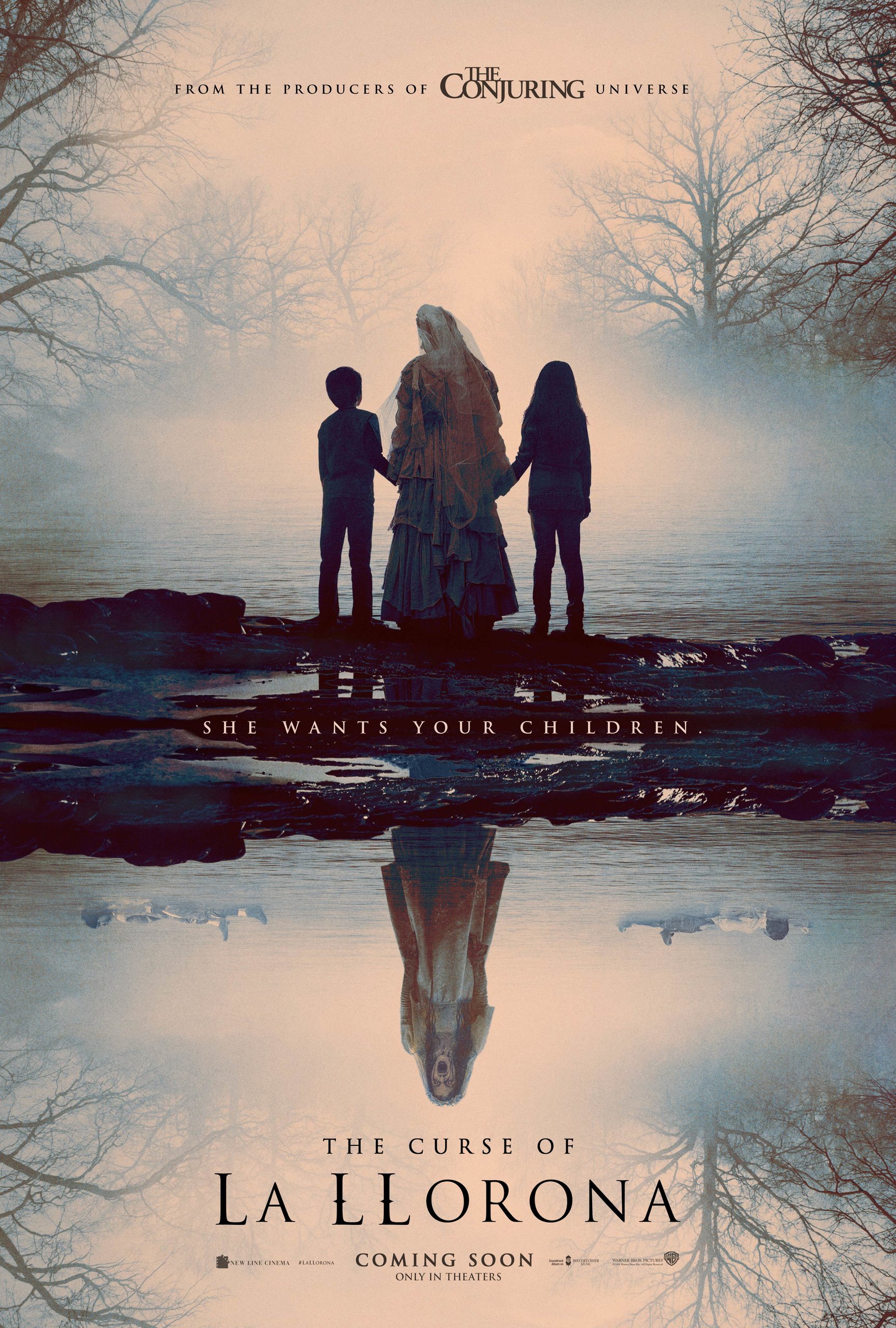
The Curse of La Llorona: The Tragic tale of the woman who drowns her children because her man abandoned her has been made into a movie many times. Here from the 2019 movie, the Curse of La Llorona//Source IMDB
One day, a very wealthy man came passing through town. DEpending to when the story is set, he was a Spanish conquistador or a wealthy rancher. He stopped when he saw the beautiful Maria and approached her. She was charmed by the wealthy man and when he proposed, she accepted at once. Maria’s family was overjoyed that their daughter would marry into a rich family and have a chance at a better life. But the father of this wealthy man however, was deeply disappointed at his sons choice of bride and didn’t approve of their marriage.
They chose to ignore the disapproving father and Maria and her now husband built a house in her town to get away from his judgmental father. Time went by and Maria gave birth to two twin boys. A seemingly happy marriage and life from the outside.
But not everything was rosy colored as it seemed. Her husband was always travelling and almost never spent any time with the family. When he was home, he only spent time with the boys, and Maria knew he no longer loved her and she started to fear that he would leave them.
One day the husband went away and never returned. Many years went by but they didn’t hear from him and they didn’t even know if he were living or dead. Still, there seemed to linger a faint hope in Maria, that he someday would return to them and they would once again be a happy family.
Maria and her boys was out walking along a river one day when the faint hope she had been carrying came crashing down. A carriage was pulled by and to her greatest shock she saw her once husband sitting in it. By his side a much younger and beautiful woman sat and it was clear that he had abandoned them for good.
Maria was furious and desperate as her world fell apart and she could no longer fool herself. Without thinking she picked up her two boys and threw them in the river, drowning them in a fit of rage, of desperation and perhaps even a horrible psychosis. Only after she saw the floating bodies of her now dead sons she realized what she had done. She jumped out after them to die with them. Now she spends rest of eternity on the hunt after her children along that river.
The Haunted Rivers and Dangers of her Ghost
Doomed to linger in purgatory for her sins, she haunts the place were she committed her crime. Exactly where this place is differs as the legend about her ghost now has gone into the cultural sphere and is more like an entity in itself than just a singular ghost.
It is said that is you hear the crying of La Llorona close to rivers or other forms of water, you must run the opposite way as she is known for being a dangerous ghost to encounter, still mad and filled with rage that will harm you.
In some variation of the legend the children were illegitimate children, and she murdered them so that they wouldn’t get taken away from her and be brought up by another woman the father was legally wed to. In any versions though, the legend about La Llorona invokes pity for her fate as well as fear for her actions.
The Danger of La Llorona: The story of La Llorona tells about a woman who murdered her children when her husband abandoned her. Now she haunts the rivers and are a danger to those encountering her.
According to the legends, she still calls after her children “ay, mis hijos” and is said to be on a hunt for her children like she doesn’t remember what happened to them, still unable to accept what she did. It can bring bad luck, even death if you hear her cries.
If you are pregnant, you must be extra careful of her because La Llorona is attracted to children and wants them to join her. Therefore children should not walk alone along rivers and she has become some sort of cautionary tale to keep them away from the dangerous waters.
It is said that in some versions of the story, she kidnaps kids that are reminding her of her own and asks for their forgiveness. Then she murders them to take the place of her own.
La Llorona in Popular Culture
Although the legend about La Llorona is an old one, it is still an iconic figure to feature in books, movies and songs. There she differs from being a misunderstood female ghost to a full on evil spirit that are out to harm people.
In movies there have been made stories about her since the 1930s, mostly horror movies, and it even got its own spin off in James Wan’s The Conjuring Universe in 2019.
The popular folk song called La Llorona that were popularised in 1941, was also included in the Pixar movie Coco in 2017. So it’s safe to say that the legend about the wailing woman still lingers in the Mexican and US cultural sphere and fears of her ghost doesn’t seem to fade away anytime soon.
An online magazine about the paranormal, haunted and macabre. We collect the ghost stories from all around the world as well as review horror and gothic media.