In a cute medieval town in Germany, there is a dark and haunted cemetery. The cemetery in Bernkastel-Kues is said to be haunted by a woman in white. And this particular woman in white is also said to be deadly dangerous.
The city of Bernkastel-Kues is a quaint little town in the Moselle valley known for its sweet Riesling wine, a state recognized health resort and a medieval marketplace. But just outside the city, where the graves and the dead reside, a Woman in White is said to haunt the place.
There are more stories about haunted cemeteries to dive into in the Moonmausoleum. Read them here: Haunted Cemeteries
The Lady In White
At Bernkastel-Kues Cemetery there are several stories floating around. The biggest one is of the White Lady og Bernkastel-Kues, a Lady in White that is often told about in German ghost stories.
The woman in white of this cemetery is said to be wearing a long flowy white dress as she is floating from one grave to another. Many reports tell about her crying.
The Haunted Hunter
One story involving the Lady in White was when a hunter encountered her, possibly at Bernkastel-Kues Cemetery. He was terrified of seeing her and fell ill. The very next day he was taken to Koblenz, which was a military hospital.
When he was put into the hospital he had swollen legs and a high fever, but he didn’t make any sense to the people around him. He kept on rambling about a woman in white that had attacked him. He died after his injuries, and no one ever found out what really happened there.
Built on top of pagan settlement, the areas surrounding Die Karlsteine close to the city of Osnabrück in Germany, the spirit of the slaughtered pagans still linger.
Osnabrück is a city in west Germany of Lower Saxony, founded in 780 by Charlamagne, king of the franks. But before this christian king founded this city, the place used to belong to the pagan Saxons, and it is those who are said to haunt the surrounding area near their once holy places.
Outside of Osnabrück you will find a big heap of rock that once used to be an important pagan monument known as Die Karlsteine.
Read More: Check out all of our ghost stories from Germany
Die Karlsteine, also called Schluppstein, is a Neolithic passage grave near Osnabrück, often used as a tomb for entire families. Karlsteine means The Stones of Charlemagne and comes after a legend about the place.
The Massacre of the Pagans
The place around the city has been settled since the 9th century. First it was the pagan Saxon Engern, that were christened by the Franks in the 800s by Charlemagne. There was a battle between the two camps with Charlamagne on one side and the Saxon lord Widukind on the other.
According to legend, Charlamagne carried out a massacre at this place where they slaughtered the pagan priests and destroyed their holy graves and altars.
Charlemagne is said to have smashed Die Karlsteine with a whip after Widukind demanded a divine sign, showing how the pagan style of life was dying and how the Saxons were losing.
Die Karlsteine: A pagan monument from ancient times that were destroyed by the invasion of Charlemagne and the Christians and the source of the legend. //Source: Sail over/wikimedia
They say that the horror of the massacre of the pagans still lingers around the place, especially around Die Karlsteine. During the important dates for the pagans like during winter solstice they say you can see ors of light floating in the air.
In addition to the strange lights in the dark forest, they are accompanied by the screams of the slaughtered and see their bloodstain on the stones.
The German Will-O-The-Wisp: Strange floating lights or orbs have been told about in the whole world. In Europe they are deeply connected with pagan roots and old folklore. In Germany they are called Irrlicht or Irrwisch (where Wisch translates to ‘wisp’.) The lights means many thing, everything from a guiding light from a dead soul, to something showing were a treasure is buried or even something more supernatural like a fairy or something else taken from the fairytales.
Kirchlengern Forest
Germany is well known for its thick forests that hide darkness, and Kirchlengern Forest is just the same. The Kirchlengern Forest is not far from Osnabrück and Die Karlsteine and many try to connect the strange things happening to the places.
There is an area of the forest where the local forester, the police and the locals can’t explain. Since the 12th century, when Germany first started recording in writing, there have been mysterious things happening in the forest.
Kirchlengern Forest: There is said to be strange things happening in Kirchlengern Forest, and most connects it with its pagan roots. Here from the River Else.// Source: Christian Kortum/Flickr
According to the legends about this place, People visiting the place tell of a feeling of panic gripping them. After you spend some time in the forest you get a sense of being watched by something darker.
Read More: Check out all of our ghost stories from Haunted Forests around the world
The most scary thing though is the missing animals in the forest that are found bloody, and only the remains of them are left around the forest.
However, when looking around for sources, there are not really many of them despite being on many topp haunted places in Germany lists online. What looks like one of the first mentions of the Horror Forest of Kirchlengern is a short story post from 2005 with no more sources added, leading to believe that the strange occurrences is a thing of fiction.
The Pagan Legends Haunting the Stones and Forest
The legends and mysteries surrounding Die Karlsteine and Kirchlengern Forest continue to captivate the imaginations of locals and visitors alike. Whether rooted in historical events or embellished by folklore, these stories remind us of the complex tapestry of history and the lingering spirits that may still inhabit these ancient places.
While skeptics may dismiss these tales as mere superstition or fiction, there is no denying the eerie atmosphere and unexplained phenomena that some have experienced in these locations. Whether it’s the chilling sensation of being watched in Kirchlengern Forest or the spectral lights and echoing screams near Die Karlsteine, there is an undeniable presence that lingers.
As modern society moves forward, these stories serve as a reminder of the ancient traditions and beliefs that once held sway in these lands. They remind us that beneath the surface of our sanitized and predictable world, there are still mysteries waiting to be uncovered.
So, whether you are a believer in the supernatural or a skeptic in search of a good ghost story, the haunted legacy of Die Karlsteine and Kirchlengern Forest invites you to explore the dark corners of history and delve into the depths of the unknown. Just be prepared for what you might encounter as you step into the realm of mystery and embark on your own paranormal adventure.
Safe travels and may you find both answers and questions in your quest to uncover the enigmatic tales of Die Karlsteine and Kirchlengern Forest.
The B215 otherwise known as Bundesstraße 215 is a stretch of roads that are haunted in Germany. It has more deadly accidents than other roads in the country according to the stories, and is also haunted by a Woman in White.
Germany is famous for its comfortable long stretches of highway that cuts through the country in no time. There are some roads though who have a rather dark reputation surrounding the dark concrete.
Read about all the ghost stories about haunted roads in the Moonmausoleum: Here
The B215 is a road in Germany where they say strange things happen. The federal highway runs between Hanover and Hamburg in Lower Saxony. It is an old road and the stretch between Nienurg and Verden was built already in 1849.
Supposedly it has more accidents than any other road in Germany, and in particular close to the city of Verden, they are supposedly more dangerous to drive than other places in the country.
The White Lady Along the Road
There are also stories about a white lady that can be spotted along the Bundesstraße 215. Stories about these White Women are plentiful in Germany and they have long standing in ghost stories. In German legends and folklore the stories of the Weiße Frauen, meaning White Women used to be a name meant to the elven-spirits and the stories of the light elves from pagan times. Today she is known for haunting old castles, families and other places where women died full of regret.
This particular Lady in White is someone you can see out of the corner of your eyes along the haunted Bundesstraße 215 when you are driving down Bundesstraße 215 in the dark. She is said to appear between 2 and 3 am in the night if you are driving too fast. It is unsure if she is a warning to the reckless drivers or if she is the one behind causing the accidents.
In the old gothic castle of Burg Wolfseggin Germany, there is a local castle legend about a White Lady haunting the place. The ghost is supposedly of one of the Countess living there who was murdered by her husband.
Burg Wolfsegg is a wonderful old gothic castle in Germany, built in the 15th century and still standing today in Bavaria. It’s a piece of history and culture that is full of mystery and legends and filled with ghost stories.
This majestic building was once home to German nobility and is one of the few castles that over the years, never was destroyed and rebuilt. The walls still echo the tales of heroism, love, and tragedy, financial trouble and a possible murder. There are stories told around campfires about the haunted old castle— stories of ghosts that roam its corridors and in the underground caves beneath the castle.
One of the ghosts said to roam around the castle to this day is that of the White Lady. There have been tales about her since the 1600s. In European ghost stories, there are often women who are restless spirits that died buried with guilt or shame about something.
The White Lady in the Castle
At Wolfsegg however, the White Lady is said to be a woman who died in the 1400s. There are many variations to the story today, but one of them is the tale about a woman left to her own devices when her husband was away. To run the castle, she turned to the owner of a neighboring manor for his help in managing the big castle.
When her husband and lord of the castle returned, however, he suspected his wife was having an affair with the man and was overcome with jealousy and rage. The husband ended up hiring two people to murder her.
In another variation of the legend, the husband was even in on the plot of seducing the manager to blackmail him. When the feelings between the two turned out to be real however, he killed her with his own hands.
The White Lady: Basking in the sunlight, hiding in the shadows, her dress is always white. In German legends and folklore the stories of the Weiße Frauen, meaning White Women used to be a name meant to the elven-spirits and the stories of the light elves from pagan times.
The Real People Behind the Legend
A legend like this will always be hard to prove, and even harder considering all the different variations of it. The real people behind this legend are thought to be that of Lord von Laaber and his wife. The couple resided in Wolfegg in the 145th and 15th centuries.
Ulrich V. von Laaber and his wife Klara von Helfenstein was struggling with their finances at the start of the 15th century as the owners of Burg Wolfsegg. Although there is not really much evidence to it as the historical records shows that Klara von Helfenstein survived her husband by many years. But the story of the haunting of the castle is very old, and can be found in written accounts back to the start of the 1900s.
The Castle: It is an old medieval castle from the gothic period with more than one ghost story to tell of. The most famous one in Burg Wolfsegg is that of the White Lady. Source// Wikimedia
The story is about the White Lady though, and according to the castle’s own website, the first written account they have found about the White Lady ghost is from 1952 when it gained traction through travel accounts.
From then on the legend about the White Lady and Klara von Helfenstein sped up and the owners of the castle started putting on plays in front of the castle to further drive the legend from the dark corners of the Burg Wolfsegg and into the world.
A Medium Visits the Burg Wolfsegg
In 1966, the legend reached its peak when a weekly magazine published an article about the legend inside of Burg Wolfsegg. The castle was visited by a parapsychologist from New York named Hans Holzer in 1968 together with a medium called Edith Riedl.
The medium was contacted by the Lady in White and she was identified as Klara von Helfenstein where she told them about the story that on October 17, 1463, a young man was murdered in one of the chambers known as the Weizkammer and that the husband had been involved with the murder.
Other than tales from the medium aout Klara von Helfenstein and the murder, there are reports about strange light phenomena and strange noises from the underground cave are heard throughout the castle sometimes.
So what reason did the countess have to haunt the Burg Wolfsegg after her death though? Considering Klara von Helfenstein didn’t really get murdered by her husband’s hand, was she rather full of regret about her dead lover then? Or is the White Lady a mystery still not solved of who it’s behind the white vail?
Once a beautiful manor in Cologne, Germany, Haus Fühlingen continues to decay and fall into ruins with its dark and bloody past. Although an abandoned building, it is said to be filled up with ghosts.
In the city of Cologne in Germany there is an old manor house that is said to be haunted. Most of the former glory is gone now, and only the ruins and skeleton of the main building still stands.
The house of Villa Oppenheim, or as it is better known as, Haus Fühlingen on Neusser Landstraße 5A once belonged to the prominent Oppenheim family, rich from centuries of banking. Eduard Freiherr von Oppenheim built the place in 1884 to keep his horses. It had a racecourse and farm and he wanted it for training.
The Oppenheim’s sold the estate in 1907 as the soil wasn’t really suitable for the training he wanted and by a cruel twist, the home of the jewish family ended up in the hands of the Nazis, marking the beginning of the dark times of the place.
During the war the Nazi’s used Haus Fühlingen as a farm where they used forced laborers who used the house as sleeping quarters. According to both facts and legends it is said they hanged a man that is said to haunt the place.
The Hanged Man
Edward Margol was a 19 year old forced laborer from Poland who got entangled in a web of lies and paid with his life.
At the time it was a man named Ernst Kolb who was the tenant and landowner and he lived there together with his daughter at Haus Fühlingen.
The Nazis fabricated an accusation that he had sexually abused the tenant’s underage daughter. They brought him to a nearby brick factory and hanged him in 1943 for the false claims and he is said to forever wander the estate.
After his death, his body was sent to Bonn University where they dissected him in the anatomy department. What happened to his remains are not so certain, but they were most likely buried.
Other Tragedies
Fast forward to 1962, there was a former Nazi judge named Gerhard van K. living in Haus Fühlingen who hanged himself on the second floor on New Years Eve. People speculate that the two incidents are connected and that the judge was responsible for Margol’s death, although that has never been proven.
By 1967, the city of Cologne demolished part of the building and many of the doors and windows were bricked up. They also found two cars walled up within the walls of the house for no apparent reason.
No one really took care of Haus Fühlingen anymore and it started to show. From this time, many of the ghost stories about the place started being passed around by the locals.
Tragedy struck the house in 2007 again, long after the last person living there had moved. Haus Fühlingen was now abandoned after the widow of the judge, Alice van K. died, but people still visited. That year another suicide happened inside of the house were some young people visited the empty house were they found him on the second floor.
Ghost Hunters in Haus Fühlingen
After its dark history as well as the decaying exterior slowly being taken over by the weather and graffiti, the house has been stapled as haunted and an attraction for ghost hunters. The ones that come out from the house tell about strange light phenomena, shadows fleeting past them, the radio turning on and off by itself and feeling uneasy and sick while being inside.
A prospective buyer once brought a priest to drive away the spirits and ghosts haunting Haus Fühlingen. This proved to be inefficient though as the sightseeings of the paranormal and the darkness kept being reported on, and it looks like the ghosts are the only inhabitants of the house for the time being.
Haus Fühlingen has since 2008 been planned for a renovation to make luxury apartments, however as of now, they are still just plans and the future of the house is still uncertain. The city of Cologne is also in the process of trying to remove it from the list as a protected building, paving a way that one day, it could be torn down completely. Question is, will that help in stopping the reports of shadows around on the old estate?
Few castles capture the European medieval feeling as Eltz Castle does. The long lasting Eltz family has always watched over the place, and even in death, there is an ax wielding countess in full armor, haunting the place.
Steeped in history and mystery, Germany’s old castles are some of the most fascinating pieces of architecture in existence. These majestic fortresses are stories in themselves, filled with centuries-old legends and ghost stories. From dark fairy tales about princesses and knights to hidden passages and hidden rooms – these castles have something to captivate even the most jaded spirit! Every stone tells a tale of intrigue, from ancient battles to wicked plots. Without a doubt, a tour through Germany’s haunted old castles will leave you with an experience unlike any other.
The Eltz castle is definitely on that type of list and is a medieval castle on the top above the Moselle river in the Rhineland, west in Germany. The castle has belonged to the House of Eltz who have lived there since the 1100s and is one of the few castles that have never been destroyed and rebuilt.
The armory and treasury in the Eltz Castle is considered to be one of the most important collections of its kind in Europe, and holds so much history. The castle is also said to hold more than one ghost, but the most well known of them is that of Countess Agnes of Eltz.
The Countess Agnes
Agnes was the daughter of the 15th count of the Eltz Castle at the time. She was said to have been a beautiful girl and was promised to be the wife to the knight of Braunsberg. They had been engaged since they were children, and the time for a proper wedding and marriage were approaching. However, the Countess didn’t like her betrothed at all as he was a ruthless and mean man and far from a chivalry knight as they are often painted to be in fairytales.
On the day of their engagement, they held an engagement party for the two families to come together. The knight of Braunsberg turned out to be even more despicable now as the marriage was more than just a distant future and Agnes refused to kiss him when he went for it as she was known to have a will of her own and out of a fight if she had to.
According to some testaments, she usually hung out with her warrior brother more than her female companions. In some reports, it is said she only refused his advances, in others, she outright slapped him back when he forced himself onto her. This threw him into a rage and he declared a war on the entire family to repay for him being embarrassed in that manner.
The Revenge of the Eltz
A few months passed, some say a whole year as the knight of Braunsberg waited, planned and came back for his revenge. And he returned to Eltz Castle with an army. He managed to lure the count and his knights out of the castle into an open battle, and some say he waited until the Count of Eltz went out hunting.
Agnes remained in the castle together with only some servants, just as the knight of Braunsberg had planned. Alone in the castle the single Countess would be an easy target for the knight and his men.
As he advanced with his soldiers to the Eltz Castle, he was one step closer to Agnes. The knight of Braunsberg had planned to take Agnes back with force, but had never anticipated that she would fight back the way she did. Just as she had done at the engagement party, she chose to hold her ground, but this time with an battle ax.
She put on her brother’s armor and picked up weapons together with her servants. Together they fought side by side against the attackers. She is said to have had a battle-axe she wielded against her enemies.
An arrow from the knight hit her and she died from the wound almost immediately. The servants who had loyally fought by her side were enraged and defeated the knight, killing him and ending the attack.
The Ghost of the Countess
The bravery and steadfastness of the Countess is said to represent the Eltz family and their 800 years of history in the Eltz Castle. The ghost of Agnes is said to still linger inside of the castle. In her former room , the breastplate still hangs on the wall, with the hole from the arrow still visible. Her battle-axe also remained, protecting herself from the horrible knight to this day.
She can be seen by the entrance of the Eltz Castle to this day, still wearing her suit of armor. It is also said that a phantom horseman is also riding outside of the gates, and the knight of Braunsberg is still seeking forgiveness for what he did.
Reichenstein Castle is also known as Falkenburg, standing on a mountain spur in the Rhine Valley. For a long time it was under the domain of a long line of robber knights that plundered everything and everyone. And the last of the robber knights are said to haunt the place as a headless ghost.
Germany may be one of the most beautiful and remarkable countries in Europe, but its haunted old castles have a history filled with ghost stories and legends that are sure to send chills down your spine. From dark fairytales of princesses and knights and robber kings to magnificent castles in ruins, these gloomy buildings have a history of hauntings that make them truly one-of-a-kind.
The oldest part of Reichenstein Castle is far up in the wine producing village of Trechtlingshausen in the Rhine Valley. The castle was built way back in the 11th century, but the castle has been destroyed and rebuilt so many times it is now a time capsule of history. The castle was meant to protect a neighboring village, but ended up with a long period of being the fortress for a robber knight that are said to still haunt the place.
The Robber Baron
One of the people living in Reichenstein Castle was a robber baron named Dietrich von Hohenfels who lived in the castle at the end of the 1200s. He had grown up in Reichenstein Castle as the third born son of Philip von Hohenfels, a robber as well and didn’t know any other way of living. When he took over the castle after his father, he followed in his footsteps and it is said he got even more notorious than his father.
Dietrich von Hohenfels lived together with his nine sons and used the castle to hoard all of his riches he stole from passing ships in the Rhine River. Together the robber baron and the rest of his knights abused their subjects, stole their wives and robbed traders and defenseless wanderess alike according to the stories that are now told of them.
All of this happened in a time of great turmoil known as the Great Interregnum in the Holy Roman Empire that Germany at the time was a part of. No one seemed to be able to gather under only one leader, and anarchy, crime and robber knights such as Dietrich von Hohenfels and his family ran rampant.
This would all come to an end when the House of Habsburg would rise to power and rule the Holy Roman Empire for generations to come. In 1273, Rudolf von Hasburg was elected leader and started his campaign to stop all of the robber knights who had gained too much wealth and power and been left alone for too long.
The Beheading of the Robbers
In the end the robber baron and his knights all got captured and had to pay for their crimes in 1282 when the whole castle was besieged by Rudolf von Habsburg. There are several variations of the legend. Some say that Dietrich von Hohenfels managed to escape the siege of Reichenstein Castle with his wife, Agnes, but the rest of his knights were hanged. But he didn’t live for long as his former subject bore a grudge and hunted him down, eventually finding him and killing him and his wife. Because of their crime and regrets, they are now wandering in their afterlife in the castle.
Another variation of the legend tells that Dietrich von Hohenfels died together with his nine sons during the siege. In this version, Hohenfels pleaded for the lives of his sons, but his plea was denied. All of them were executed by decapitation and buried in the chapel inside of the castle. It says that the headless ghost of Hohenfels is still haunting Reichenstein Castle, himself haunted by being the reason his sons met their early demise.
The last legend is how Dietrich von Hohenfels managed to save his sons with his head. When he pleaded to Rudolf von Habsburg, he was given a challenge. Dietrich von Hohenfels would be beheaded standing up, with his sons standing in a line to await their faith. Each son Dietrich von Hohenfels managed to pass after he was beheaded was to be spared. So he was beheaded and his headless body was swaying for a moment before passing all of his sons and managed to save their life. The sons were spared, and never heard from again.
The Ghost of Reichenstein Castle
Not only do the old castles like Reichenstein Castle provide a peek into Germany’s past, but they also represent amazing architecture from centuries ago. There is something truly captivating about wandering through ancient walled fortifications and hearing about their cursed pasts in between eerie stories of ghostly figures passing by.
Today it is said that the ghost of Dietrich von Hohenfels is heard rather than seen inside of the castle and the guests visiting are said to feel like they are never truly alone. Other unexplained things like windows and doors opening and closing without there being anyone there.
And for eternity the once mighty Robber Baron Dietrich von Hohenfels are forced to haunt the grounds of the ruins of his own castle.
This I found, from men, as the foremost wisdom, That neither earth there was, nor sky above; Nor tree, nor hill there was. Nor stars there were; nor shone the sun. Nor moon-light there was, nor the salty sea. Nothing there was: neither end, nor limit. And there was the One Almighty God, The mildest of men;and many were with them, GodlyGhosts: and God the Holy. — From the Wessobrunn Prayer, the earliest known poetic works in Old High German from the 8th century.
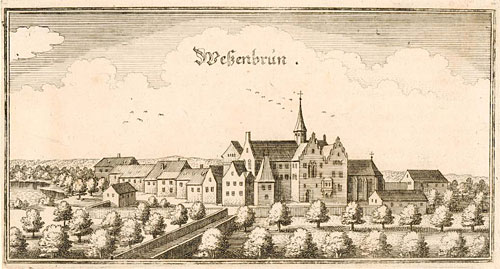
The Benedictine Wessobrunn Abbey is steeped in history and legends. According to stories, the monastery has been haunted for centuries. From martyred monks to a disobedient nun, their ghosts still haunt the holy place.
In 955, the Hungarians invaded part of today’s Germany and wanted to draw the German army out in the open and destroy it.
On their way they came across the Wessobrunn Abbey and burned it all down to the ground. Three of the monks managed to flee to Andechs with their sacred relics they had kept in the Abbey. Abbot Thiente and six of his monks never got out alive though and suffered martyrdom, dying for their faith.
After the defeat of the Hungarians on the Lechfeld, the spiritual life in Wessobrunn Abbey goes into a shadow period. Not much is known about when the first monks started coming back to the place after the sacking.
Today there is a cross commemorating the martyrs just above Wessobrunn. Legend has it that the six dead monks have haunted the place ever since.
The New Wessobrunn Abbey
It was not the last time the abbey was burnt down, and it was not the last time they decided to rebuild it either. Close to the site where the former Wessobrunn Abbey once stood, they built a new one, continuing the tradition of a monastery at the place.
Wessobrunn Abbey: There have been a monastery at this place for a long time. Here a depiction of how it looked like in 1640, centuries after the ghosts started haunting the place.
The monastery of Wessobrunn, near Weilheim in Bavaria had been founded in the 8th century. From 1100 the community of male monks was joined by a sisterhood as well and it included both a community of nuns and monks. There are also legends about one of the nuns in the abbey haunting the place as a ghost.
The Ghost of the Nun
According to this legend there was a nun in the 13th century who might have been a sister of Knight Joseph Diethalm von Wileyhin, the last Count of Weilheim. It is said she entered Wessobrunn Abbey after her brother’s death in 1211.
But the way of the sisters is not for everyone and according to the stories, she broke one of her vows of the order. Nuns had to live by strict rules of Chastity, Poverty and Obedience. Exactly what type of vows she broke are unclear, but it scared her so that she ran off. She hid in an underground passage back at her family’s home in Göterlberg.
Without seeing the sun ever again, she died shortly after and her remains were not found until many years had come and passed. From then on it is reported of sightseeings of a nun around the castle as well as her old abbey, crying in the hallways, still in her nuns’ habit.
Up until the 1800s it was said that locals threw spruce cones into a hollow said to be the former corridor where the nun hid on her escape from the Wessobrunn Abbey to scare away the ghost.
Today there are still a cluster of Benedictine nuns living after God’s words within the walls of the abbey, still seeing their long dead sister walking the halls.
A haunted chapel known as Hardtkapelle Wielenbachcan be found in the darkness of the Bavarian forest, surrounded by black hellhounds and a woman in white. This place is of the more unholy sorts.
Forests in Germany are where the darkness creeps in and where stories about ghosts and ghouls take form.
In this particular Bavarian forest in the city of Weilheim in Wielenbach, perhaps a mere hour away from Munich, there is a small but still frightening chapel according to the legends that is said to be particularly dark and where the devil himself appeared.
The Haunted Hardtkapelle Wielenbach
The building from the outside of the Hardtkapelle Wielenbach looks innocent enough as the white walls and church tower looks like any other little chapel in these parts.
Still, there are many young and hopeful visitors who visit each year to get a taste of the haunted place, not necessarily of the godly kind, but perhaps many of them get a little more than they bargained for. Because according to those visiting, they report about being nauseous and being dizzy, some even suffering a panic attack after spending enough time in that place.
It is said that the Hardtkapelle Wielenbach is surrounded by huge black hellhounds as the dark forces have been plentiful around these parts for centuries. One can wonder if the chapel is really what keeps the evil inside, or if it attracts it all together. You can hear the hellhounds growling in the background between the trees.
The Haunted Hardtkapelle Wielenbach: The chapel look cozy and innocent at day among the green trees, but when the sun goes down and the trees grows darker, the ghosts come out to play. Gras-Ober/wikimedia
At night a light is always burning at the small chapel when no one is there to light it up. Sometimes a woman in white is suddenly appearing at night close to the chapel. Who she is, friend or foe, is difficult to say.
The chapel we see today was built as a pilgrimage church in 1865 with the Patroness being Saint Anne, the mother of Mary. It was built on the grounds of a chapel that used to be there but was demolished back in 1250.
The Devil’s Kick
There have been many reports about this strange place and one of the legends dates back to the time before there ever was a Hardtkapelle Wielenbach there. When this was is unclear as not much of Germany’s history dates back in written form before the 1200s.
But according to this legend there was a huge fight among the neighboring villagers. Citizens of the town of Weilheim and Haunshofen fought about grazing rights for their animals in the surrounding area and the arguments were getting heated with harsh words being thrown back and forth.
A man stepped out from the crowd and they say he was the devil in the form of a shepherd who had come to join them. He put a big stone on the ground and yelled out
“When I kick this stone, this belongs to Haunshofen”
Then he kicked his foot into the ground, creating a hoof-like hole that he disappeared into.
This stopped the argument and the Hardtkapelle Wielenbach was built around the stone with the hoofprint to protect the evil from it to come out again.
If they really were successful remains to be seen.
The Devil’s Hole: At the altar at the Hardtkapelle Wielenbach in Bavaria, Germany, you can see the hole the chapel was built around. // Source: Henning Schlottmann//wikimedia
On the beautiful island known as Pfaueninsel in Berlin, there are rumours about the soul of an alchemist doing black magic still remains.
The Pfaueninsel or Peacock Island is a little island in the River Havel In Berlin. The island is a part of the UNESCO World Heritage Site because of the impressive Prussian architecture. The Pfaueninsel castle looks like something out of a fairy tale, and the island is a heaven for nature and animal lovers.
In the late 1600s the island was called Kaninchenwerder, or rabbit island after they set up a rabbit breeding station by Elector Frederick William I of Brandenburg of the Hohenzollern dynasty.
Did you know: The Hohenzollern family has a long history of being a cursed family, and many have claimed to have been haunted by the Lady in White. Read more
The Alchemist on the Island
Peacock Island: The whole island is adorned with prussian architecture//Source: Sebastian Rittau/wikimedia
The island was also a place where alchemist Johann Kunckel built a glass foundry where he produced artificial rubies known as gold ruby glass. The elector who he produced the red colored glass was so pleased with him that he gifted him the island.
Entering and leaving the island was made a punishale offens except for Kunckel himself, and the whole place became shrouded in secrecy. The black smoke and smell of chemicals from the islands made the farmers around the island suspicious and they started to believe it was witchcraft going on out there.
After he lost financial support after his patron, the Great Elector died, the foundry went up in flames and he took off to work for the Swedish king. It was very possible that the fire was arson.
It is here the dark rumors of the island starts as it is said that Johann Kunckel played with black magic as well as chemistry in his laboratory before he set it aflame, making the island an inhospitable place to be after dark.
It is said that the spirit of him is still wandering restless around as a black ghost with red glowing eyes.
The Exotic Animals
After this the island was abandoned until the Prussian king Fredrick William II got the island and built the Pfaueninsel castle for his mistress.
From then on they started putting excotic animals like alligators, buffalos, kangaroos, monkeys, lions and peacocks on the island. At its peak there were over 900 animals there of over 100 species. They stayed on the island until 1842 when they were transferred to the Berlin Zoo.
Today the remains are a mixture of exotic birds, great architecture and legends about the black soul of a sorcery after witchcraft tainted the very earth.
An online magazine about the paranormal, haunted and macabre. We collect the ghost stories from all around the world as well as review horror and gothic media.