In the watery depths off the Cliffs of Moher in Ireland, it is said that the phantom island and The Lost City of Kilstuitheen appears every seven years. There are still legends that it will return for those that holds the key.
Between the picturesque towns of Lahinch and Spanish Point lies the Liscannor Bay. Its tranquil surface hints at the mysteries concealed beneath its waters, and one of its most intriguing enigmas is the phantom island and The Lost City of Kilstuitheen.
The coastline of County Clare has been shaped by nature’s fury over millennia. Ancient earthquakes and tidal waves have left their mark on this rugged terrain. In the bay’s vicinity, once-verdant forests and bogs have become submerged, and the dramatic events of centuries past split Mutton Island into three separate isles during the tsunami of approximately 800 AD.
Read More: Check out all of the ghost stories from Ireland
This could explain the legends of the lost city of Kilstuitheen. It is also called Kilstapheen, Kilstiffen or Cill Stuifin and is supposedly an ancient city that is now lost outside the coast. It is said that the city sank down into the ocean when the chieftain lost its golden key in a battle. According to the legend, the city will not return until the key is found.
The Cliffs of Moher: The cliffs are well known for its legends. In addition for the legends about the lost city, there are also legends about mermaids, witches, a corpse eating eel as well were the pagan deities took refuge when Christianity came to Ireland.
The Lost City of Kilstuitheen’s Forgotten Splendor
Long ago according to legend, the city of Kilstuitheen was a place of unparalleled magnificence and riches. Its skyline was adorned with golden turrets that graced castles and glistening spires that adorned churches. These structures were a testament to the prosperity of its inhabitants, particularly the Chieftain and his esteemed clan.
However, even the most prosperous of places can succumb to the capricious whims of fate. Kilstuitheen’s fortunes took a dire turn when defeat befell the Chieftain in a fierce battle. What followed was a calamity of epic proportions—an immense tidal wave surged forth, engulfing the island and all its inhabitants. The once-mighty Kilstuitheen lay buried beneath the turbulent waters, its glory swallowed by the relentless sea.
Read More: Check out all of the ghost stories on Haunted Islands
There is a legend telling how to find the island though. It used to be a key which opened the door that the chieftain had lost during the fateful battle. It was later believed to be entombed beneath a towering monolith on Mount Callan.
When the long-lost golden key is unearthed and returned to its rightful place, it is said that Kilstuitheen shall rise once more from the depths of the sea. The valiant Chieftain, now relegated to the annals of history, will reawaken to lead his people anew, and the island’s golden splendor will once again grace the surface.
Glimpses of a Submerged City
Over the centuries, fishermen have claimed to catch fleeting glimpses of The Lost City of Kilstuitheen’s submerged city beneath the restless waves of Liscannor Bay. Every seven years, the phantom island performs a tantalizing upsurge, just enough to be visible from the shores of Lahinch.
This is also the case with the mythical phantom island of Brasil said to be off the coast of Ireland as well.
However, this remarkable sighting comes with a dire warning: those who behold the lost island from the shore shall not live to witness its reemergence and will die before The Lost City of Kilstuitheen appears again.
The Mysteries Beneath the Waves
As we ponder the legends of Kilstuitheen and its submerged treasures, we are reminded that the sea has long been a capricious mistress, capable of concealing the most remarkable of secrets. In the heart of Liscannor Bay, The Lost City of Kilstuitheen’s lost splendor lies beneath the waves, its golden turrets and spires hidden, awaiting the return of the golden key that may one day resurrect its glory. The enigma of Kilstuitheen endures as a testament to the enduring mysteries of Ireland’s coastal landscapes, where legends and history are eternally intertwined.
For many years now, Bor Forest in the Czech Republic is said to house many haunting stories. Everything from strange ghostly legends from Slavic folklore to strange things that went down during the communist regime after the second world war.
Bor Forest, also known as Branišovský les, stands as a silent witness to a myriad of chilling legends and mysterious occurrences in the heart of South Bohemia, near České Budějovice. Bor means pine and the forest is spanning approximately 300 hectares, this mixed forest has gained notoriety for its tragic events, whispers of supernatural entities, and inexplicable phenomena.
It has undergone significant transformations throughout time, serving various purposes such as an excursion forest park, shooting range, and military area close to the Polish border. The landscape features diverse tree species, with the northeastern part covered in spruce mixed with oak, while the southwestern region is dominated by pine trees.
Bor Forest’s reputation for paranormal activity rests on numerous legends and reported encounters. The forest is believed to be haunted by a variety of entities, each contributing to the eerie aura that envelops the area.
The Military Tragedy in Bor Forest
Once upon a time, often set to the 1960 to 80s, there was a military base stationed in Bor Forest to guard the local storage for their ammunition. It is said that four soldiers were patrolling close to the former guard post and one of the pair was taking over the nightshift when something happened. According to the stories, one of the soldiers started to change, like another being, something monstrous. Another version tells that the soldiers got scared from “The Horror of the Forest”.
This caused chaos among the soldiers that started shooting and three of them ended up dead and the last one died from the wounds later at Budweiser Military Hospital where he managed to tell a little bit about what happened, but not enough to end the mystery.
What really happened then is hard to tell. Some say it was more of an internal thing and that stress caused some of the soldiers to take their own life. Some say that it really did happen, but it was in a completely different place and was an argument and jealousy that caused the shooting.
There were no writings about this in the newspapers or other media. Seeing that the Czech Republic was under the Soviet Union and heavily censored could also be an explanation as to why there is not more written about this except from the local gossip. Even to this day, a lot of these documents are still classified.
But what could it have been, this horror from Bor Forest that the story talks about. As it turns out, there could be more than one supernatural and dark thing that the soldiers came face to face with.
The Haunted Swamps and the Vodník
Czech Vodník
References to Bor Forest go back at least 400 years. One of the stories circulating around the Bor forest is about the swamps and waters in the forest. They used to be much bigger than today, and many travelers ended their life in these waters throughout time. It is said that the souls of these people were trapped close to the waters and they stayed to haunt them, trying to lure bypasses to join them in death.
Read More: Check out all ghost stories from Haunted Forests around the world
Some of the early swamps or waters were also said to have a Vodník living there, a sort of sea spirit, or water man from Slavic folklore living in water, much like the German nixon or the Scottish kelpie.
Vodník was said to look much like a man with green hair, but his bride was often a mermaid or a girl he drowned. He was also known for luring children and women to the water by hanging colorful ribbons or mirrors around or shapeshifting to a child and then drowning the one trying to rescue him.
The Black Man
The Black Coloum were the Black Man is said to often be spotted in Bor Forest.
A sound often reported on in Bor Forest is the sound of footsteps in the dry leaves or heavy snow. The sound of the steps have chased many people through the forest and many believe that it is most likely the step coming from the Black Man.
Described as a tall figure with a broad black hat and a flowing black cape, the Black Man is also called the Black Knight and even The Lord of the Forest. He has been witnessed floating above the ground, moving with unnatural speed. Some claim to have heard soft music preceding the appearance of this enigmatic figure, accompanied by a sudden drop in temperature.
The first written reports about the entity was in 1993, and the nest in 1994 and he is mostly sighted around The Black Pillar, a memorial for something people don’t remember. Today it is an integral part of the lore of the Forest.
Another story coming from the 90s is also the rumor for people seeing mysterious red eyes hovering about two meters above the ground after nightfall have been reported by witnesses. The first written account was in 1998. Contrary to explanations attributing them to car taillights, some claim these eyes approached them or even pursued them through the forest.
The White Lady
As with most haunted places in Europe, it wouldn’t be complete without its own Woman in White, and the haunted Bor forest is no exception.
The apparition of a woman in white is tied to a tragic tale of a murdered resident haunting a nearby building, unable to find peace even in death.
It is also said that a young girl is haunting the woods after taking her life in an abandoned farmhouse between České Budějovice and Branišov. Although there is not really any proof that such a thing ever happened in the farmhouse.
The Hanged Man’s Tree
Another story told about Bor Forest is the strange tree said to have taken the lives of many. In 1927 a young couple checked into the new and luxurious Hotel Praha in Branišov. The building is today used as an office for the city council.
The couple went on their way on a hike into the forest, but never returned. When a search party was sent out, they found them hanging in a tree in the midst of the forest. Not much was said about the tree itself until another woman was found hanging in the same tree not too long after.
Mr. Kříž was a local man and decided to take matters into his own hands and went into the forest and cut the deadly branch from the tree and brought it home to burn it. Not too far after this, he ended in an accident and his hand he used to cut the branch off with ended up paralyzed. This alarmed the rest of the townspeople that went to the tree, cut it all up and burned it to the ground.
Although the descendant of Mr. Kříž claims there was no paranormal story connected to the tree, or that there were no accidents after he cut off the branch, the story about it lives on. The tree is gone, it is said that people have heard a voice coming from the place where the tree once stood. The voice is beckoning them to it, encouraging whoever is passing to take their own life.
Time Warps and Unexplained Events:
One of the most perplexing phenomena reported in Bor Forest involves time warps. In the 1960s, one of the residents of U Pěti zlodějů (also named Jednoty, on older maps) was cycling home from České Budějovice, around 6:00 p.m. As he rode through the dusty, unpaved Bor Forest, he experienced an unusual phenomenon.
The entire forest seemed to undulate before him and he got off his bike. He noticed that the road and gravel beneath his feet were in motion. Exiting the forest and passing through Branišov, he was surprised to find no lights in any of the windows, even though it was barely 7:00 p.m. Upon reaching home, he discovered it was 3:00 a.m. The one-hour journey had inexplicably taken nine hours.
The Strange City
Another story about time is when two women walked through Bor, and one of them suddenly ran into the bushes. When she didn’t return for a prolonged period, the other went to look for her. To her surprise, there was no trace of the friend. Just as she wondered where she might have gone, the missing woman reappeared seemingly out of nowhere.
She recounted a strange experience of a green mist enveloping her, parting to reveal an unknown landscape filled with vibrant, intense colors and a distant golden city. A man in black approached her, placed a hand on her forehead, and pushed her back into Bor Forest. While she spent a few minutes in an unfamiliar place, her friend waited in the forest for three-quarters of an hour.
The UFO-Crash
It is certainly a strange place with a lot of old legends. But the strange and mysterious stories from newer times are just as haunting, especially as a lot of information from its time as a closed off communist country hides a lot of the information.
One time, there was an unknown object that crashed in the area and it was closed off for a year by a special unit. Even the local military was denied access to it. When the area finally opened again, many of the trees looked damaged, like something had crashed close to them. What could it be? The firemen claim that the trees caught fire around the year 2000. A witness said that it could have been more likely an airplane or helicopter that crashed in the area, although of course the local gossip is that a UFO landed there, and that the information surrounding this is still top secret.
Branišovský les and its Haunting Allure
Bor Forest, with its haunting mysteries and supernatural tales, invites those brave enough to explore its depths. As legends intertwine with the natural beauty of the landscape, Bor Forest remains an enigmatic realm where reality and the paranormal blur into a tapestry of chilling narratives. Venture forth, if you dare, and immerse yourself in the unsettling allure of Bor Forest’s haunted legacy.
Thought to be the gate to the fairy world, The Fairy Tree on top of Doon Hill is said to be haunted by the man that tried to reveal the fairy folk’s secrets. Was he just silenced, or was he taken to the other realm?
Atop the woodlands on Doon Hill in Aberfoyle, Scotland, a solitary Scots pine stands proudly amidst the oaks—a tree with an enchanting reputation as the Fairy Tree. This mystical landmark in East Lothian, believed to mark the entrance to a Fairy Queen’s underground palace, carries with it a ghostly history that traces back to the intriguing Reverend Robert Kirk.
The Fairy Tree, or Fairy Knowe, perched on the summit of Doon Hill, has long been regarded as a portal to an ethereal realm—a gateway guarded by the mystical beings of the forest of ancient oaks in what has been known as The Fairy Capital ever since a Reverend got curious about the place and tried to reveal its secrets.
Reverend Robert Kirk’s Curiosity
Secret Commonwealth Manuscript Title Page
Reverend Robert Kirk lived in Aberfoyle in the 17th century and would preach about God as well as about fairies when he became minister in 1685 and was dubbed as The Fairy Minister. He was also the seventh son, something also connected with people having supernatural connections or abilities. He was a well educated man and was the first to publish the bible into Gaelic as well as he studied the life and home of the fairies he believed lived on Doon Hill.
In 1691, Reverend Robert Kirk delved into the supernatural with the publication of “The Secret Commonwealth of Elves, Fauns, and Fairies.” This pioneering work sought to unveil the secrets of a magical underworld inhabited by mystical creatures. It has later been seen as one of the most important works about fairy lore and magic.
The work was unlike many publications of the time, not meant to link the magic and folklore to the devil, but more as a genuine interest into the lore and culture of the Scottish community that the Reverend himself had grown up with.
Although it was meant to educate people about the hidden folks, the fairies are said to have taken offense to a human revealing their secrets. Legend has it that the fairies, often called the Good People or daoine sìth in Scottish Gaelic, displeased with the revelations, took swift action.
Reverend Kirk met a tragic end on Doon Hill before he was able to publish his findings. Some say he fell and died, while others believe he was spirited away by the very creatures he sought to expose.
He had a habit of walking in his nightgown to the hill to breathe in the fresh air on summer evenings. But on the evening of May 14th in 1962, he was found dead on the hill.
Did they just want to get rid of the man that was about to expose the fairy world, or did he get to serve the Fairy Queen as a Chaplain and the body the villagers found was only a changeling? Some even question that he is buried in the churchyard at all.
Regardless of the circumstances, the reverend’s spirit is said to linger, forever bound to the Fairy Tree. On certain days, visitors claim to catch glimpses of his ghost, wandering the hillside and standing guard over the entrance to the Fairy Queen’s palace.
Making a Wish on Doon Hill and Fairy Knowe
Reverend Robert Kirk’s pursuit of the supernatural left an indelible mark on the landscape, giving rise to tales of a ghostly guardian and an otherworldly portal.
Even today people walk up to the tree and some tie a ribbon to the tree as a gift to the fairies as they make a little wish. This is a pagan ritual known as clootie wells and is a cleansing ritual. Because who knows, perhaps the Reverend was right, and this ancient oak tree truly is a gateway to the otherworld of the fairies?
The story about the girl and her meeting with a ghost in the graveyard and the white cap she took from it has been retold for centuries in Iceland.
The story about the White Cap is an Icelandic ghost story from the old times, although how old is uncertain, as it is now turned into a folktale that has gone through many retellings. It tells the story about a nameless boy and girl that took something from a ghost and had to pay dearly for it.
The Ghost story was retold from its oral story in Icelandic Legends by Jón Arnason who traveled the country and collected the folktales and ghost stories in the 1800s inspired by the work the Grimm brothers did in Germany in the same area.
The Ghost and its White Cap
The little boy and girl lived close to a church in a small village in Iceland. The boy was a mischievous boy and had a habit of trying to scare the girl when he had the opportunity. But the more he tried to get a scare out of the girl, the more used she got to it, and in the end, nothing faced her anymore. And everything she saw she thought was strange, she was sure it had to be one of the boy’s tricks.
One day while they were washing clothes, the girl was sent to the churchyard by her mother. The linen they had just washed was hung up there to dry. The girl went unafraid into the graveyard and started to fill her basket with the fresh linen when she looked up and saw someone sitting on a tomb close to her. The figure was dressed in all white and she thought instinctively it had to be the boy that was up to one of his tricks, so she wasn’t afraid and figured she would call his bluff.
The girl ran up to the figure on the tomb and pulled off its cap as she said out loud that he would not be able to frighten her this time.
She then went home with the linen, but when she came back, the boy was the first one that greeted her when she reached her cottage. No way he could have reached home before she did and she started to fear the truth.
This was not the only strange thing though, as when they sorted through the linen, they found the cap that she had pulled off from the figure on the tomb. The White Cap, although white was full of mold and earth. They all then understood that it had been a ghost she had encountered, and now, the whole village was paralyzed with fear.
The Icelandic Ghost on the Tomb
The next day, the ghost was again sitting on the same tombstone like it had done the previous day, although now it was missing its White Cap. Nobody dared to approach it and had no idea as to how to rid themselves from it. Ghosts in icelandic ghost stories were often shown to act as flesh and bone that could interact with living humans, and sometimes, they were very dangerous. So they sent for help from a village close to them.
In that village there was an old man that claimed that they had to replace the white cap that the girl had taken from the girl to avoid any bad repercussions. It had to be done with everyone watching in complete silence, and it had to be the little girl that gave the cap back.
Icelandic Legends: The ghost story of the “White Cap” comes from Iceland and was retold by Jón Arnason in Icelandic Legends as he was travelling around collecting oral tales around the country.
So the whole village gathered in the churchyard, watching as the little girl approached the ghost sitting on the tombstone, not really moving, not really showing any sign of what the ghost really wanted. She placed the White Cap on its head and asked if it was satisfied now.
The ghost looked up and answered: “Yes, but are you now satisfied?” as it raised its hand and hit her and the little girl fell over and died. The ghost then sank into the grave he was sitting on and was not seen again.
Djákninn á Myrká meaning the Deacon of Dark River is an Icelandic folk tale that have been passed down for generations now. It tells the story of the ghost of a man trying to make his girlfriend join him in death.
Once upon a time in Horgardalur not far from Akureyri in Iceland a deacon lived on a farm called Myrká. He was riding his trusted horse called Faxi to meet up with the woman he loved named Guðrún. It was the day before Christmas, a stormy and cold winter night.
It was a long ride to her farm called Bægisá. On the way to her he had to cross the river Hörgá, but he fell into it. He ended up drowning and only his horse survived the night. He was found the next morning by a farmer and laid to rest, but Guðrún didn’t get the message and she waited for her loved one to come and pick her up.
So when she got a visitor in the darkness she believed it was him and went with him. He was behaving strangely though and kept calling her Garún. In Icelandic folklore, ghosts are unable to utter the word for God, which Guðrún is compiled of.
It wasn’t before the raging wind blows off the large hat on the visitor she realizes it isn’t her boyfriend alive, but a skeleton. She also saw an open grave in the graveyard the skeleton tried to pull her towards.
The ghost skeleton of her boyfriend keeps pestering her and he wants her to join him in death so they can be together. Guðrún finally breaks free from the ghost and gets the help of a sorcerer. The sorcerer traps the ghost on unholy ground outside the graveyard belonging to the church at Myrka.
He places a large and cursed stone on it that still holds the ghost of the priest’s apprentice. You can still see it today on the unholy ground, still waiting for his girlfriend to be together forever.
The wild hunt is a supernatural ghost ride in the sky during the dark winter days. In Scandinavia this hunt is called Oskorsreia, often a hunt led by Odin himself that could be dangerous for people to get entangled in.
The sound of rumbling thunder, horses tramping in the pitch black night sky, and the screams of the hunters making their way through the sky is a familiar picture for many Europeans. The idea of the wild hunt that can take you away is a frightening one. Especially in the northern part of the world, where the fear from the hunt was real.
Loudly through air at night they haste, An uproar on wild black horses! As a storm the wild crowds travel by With nothing but clouds for foothold. Over the valleys, the woods and meadows – Through darkness and weather, they never heed. The traveler throws himself frightened to ground. Listen… what clamor! It’s the forces of Asgard! — Åsgårdsreien by Johan Sebastian Welhaven (english translation)
The time of Christmas is a cozy one for most people today. Many of the traditional customs however, have a much darker backstory than many know today. From the evil Krampus in Germany, the horse skull of Mari Lwyd in Wales to the wild hunt of Oskorsreia in the north.
Especially in the northern part of the world, the idea of Christmas and winter have much more sinister connotations than elsewhere in the world. The days are shorter here, and the nights are much darker with more dangers lurking in the stormy winds, cold and snowy landscapes where the sun only peaks over the mountains a couple of hours each day. Christmas times are around the darkest time of the year and winter solstice has been celebrated and often feared as well as the time where the wild dark forces get unleashed into the world.
The Wild Hunt in Europe
The idea, the fear and the legends about The Wild Hunt is found in many places in European mythologies. To the Germanic stories about the wild hunt between the Christmas weekend and new years weekend and the phenomenon was popularized when the brothers Grimm brought it up in their writings.
The Wild Hunt: Die Wilde Jagd, a German interpretation of the wild hunt by Johann Cordes from 1856. Almost every part of Europe have their own version of the wild hunt and there are many different historical, mythical or godly persons leading the hunt.
There are a lot of variations of the legends like Oskorsreia and the wild hunt, but mainly, it is the stories about restless spirits riding through the night sky. Often it is historical figures, like King Valdemar stalking a woman in Denmark, Theodoric the Great in Italy.
In Scandinavia they called it Oskorsreia and Wild Hunt was not only connected with the restless spirits in the sky, but also to the Gods and it was told before Christian times, it was believed it was Odin himself that led the hunt, the leader of the Norse Gods.
Oskorsreia in Scandinavia
The Wild Hunt of Asgard raids the county Whilst fall and winter at stormy nights. But it favors to travel at Yuletide… They feast with trolls and giants; they closely ride by meadow and path And pass the fearful nation. Then, – take care farmer! Keep all in order! As the wild hunt of Asgard may visit your home! — Åsgårdsreien by Johan Sebastian Welhaven (english translation)
Oskoreia, or Åsgardsreia as it was later called by the 1800s national romantics as a connotation to Åsgard, where the norse Gods resided, was in Scandinavian lore restless spirits riding in the sky in the night. This happened especially around christmas time, or yule, called Juleskreia. Oskoreia was the older world for it, from a time when even Christmas hadn’t reached the icy tips of Scandinavia.
Oskorsreia was often in folklore about making sure you were ready with the preparations for Christmas and not being outside when the hunt was on. If you were not prepared and out and about when they came riding, chances were high that you would be carried along with them.
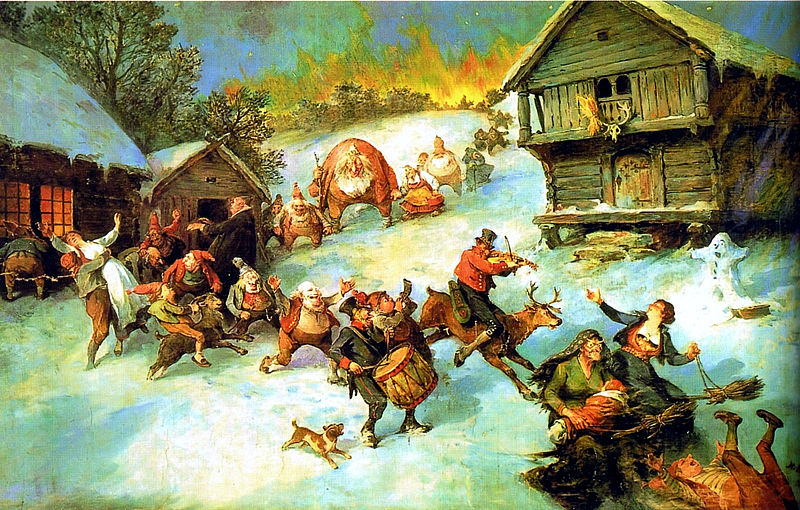
Julereia: Jul, meaning Yule or Christmas was also a version, sometimes used in stead of the more godly ride we oten connect Oskorsreia with. It was a group of goblins, witches, trolls, elfs and other obscure creatures, travelling around during christmas time in order to cause chaos and havoc.//Picture: Nils Bergslien 1922.
Oskorsreia was supposedly dangerous for humans to get entangled with the hunt, as it would tear at your soul and carry you so far you might not get home. Many sagas tell about people taken from their homestead and are let down in an unfamiliar place.
To stay safe against the Oskorsreia hunt, people painted crosses of tar or chalk on their doors both for humans and animals in the more Christian area. They also placed sharp steel over the doors to protect both the people in the house as well as the horses in the stables. If you were already out when you heard the ghost riders coming, your only hope was to throw yourself on the ground, arms and legs spread out and just hope that the riders would pass you.
The Danger of Oskorsreia
As through the air in the dark came a thunder, – a howling horde on ferocious horses, It raced over woods to the wedding house, Intended to visit the bloody performance. Then horns blew, and an awesome noise From bells and riding-gear resounded. Now it was close – it came over the hill – There was an outcry: The wild hunt of Asgard!
There was a tempest in Heaven and Earth, That hurled a horror in every heart, It blasted along in growing circles, It punched with wings and grabbed with arms. Then Wolf was dragged away by his hair, thrown up in the air and taken away, Yes, taken away over woods and mountains, He was never seen or heard of again. — Åsgårdsreien by Johan Sebastian Welhaven (english translation)
Over time when there was a mysterious death no one could explain, it was often blamed on the Oskorsreia, especially during Christmas times. There are many folk tales from Scandinavia where they tell about someone trying to celebrate Christmas, but an unknown corpse appears on the farm, in the woods or close to the house no one knows where it came from. Then it was thought it was a person who got tangled up in the ride, was taken away and dropped down from the sky again.
In the 1800, Oskorsreia and The Wild Hunt was a popular motif for the Germanic painters, poets and sculpture, and today we have many pieces of art depicting the hunt. But it is not the only place we can see the remnants of people’s fear of the wild hunt.
Back in pre Christian times the hunt was either a ride of witches through the night, meaning Gandferd. Gand was originally the word for a pointy staff the witches used, and this witch ride is one of the origins stories of why we think witches ride on brooms.
Why the wild hunt like Oskorsreia was happening varied, but most likely it started as an explanation to the stormy weathers during winter times. Oskorsreia and the Wild Hunt was often thought to be a warning of a coming plague or war, and also more harmless reasons as to check on people if they were doing their Christmas preparations correctly.
The historic building of Frankenstein Castle is now mostly in ruins, but is still a place for myths and legends to live on and inspire new horror.
On a stoney hilltop amidst the dark forest there at the spurs of the low mountain range of Odenwald in Germany is an old medieval castle called Frankenstein Castle.
The place itself with its narrow valleys and dark trees contains many legends and is heavy with myths of the past. The same can be said for the castle on the hilltop that has weathered many storms, legends and ghosts since it was built.
The Frankenstein Castle or Burg Frankenstein was built sometime before 1252, the year of the first historical record, by Lord Conrad Reiz of Breuberg. Already then the place was filled with myths and stories about other older castles that had once stood there.
The castle went through many modernisations and so did the Frankenstein family living there for over 400 years. They saw many things change during their reign as lords and knights and during the Reformation they were strong opponents to the Lutherans, being devoted Roman Catholics.
By the 18th century the castle was used as a hospital and refuge until it fell into ruins. The two iconic towers that are seen today are nothing more than a restoration from the mid 19th century. And an inaccurate version of that.
Myths and Legends of the Frankenstein Castle
Many strange things have happened near this place. Like in the 18th century when fortune tellers made everyone believe that a treasure was hidden close to the castle in 1763. Everyone started digging for it until local authorities had to ban people from gold digging altogether.
Close to the castle you will also find magnetic stones on Mount Ilbes were compases don’t work properly. Many say that there is witchcraft practice at these stones on special occasions like on summer solstice. It is said that Mount Ilbes is the second most important meeting place for witches in the country after Mount Brocken, and visitors are advised to not disturb any ongoing rituals.
Another mythical thing close to the Frankenstein Castleis the Sea of Rocks known as Felsenmeer, and believed to be a place where Siegfried the dragonslayer was murdered in the epic poem Nibelungenlied.
This is also a place where you can see legendary creatures like water spirits that change into a fox.
Mary Shelley’s Frankenstein
The Frankenstein Castle may or may not have been inspired by this historic castle when she wrote her novel Frankenstein; or, The Modern Prometheus in 1818.
The meaning behind the name is the two words, Franks, a Germanic tribe, and Stein, meaning stone. And the name itself is actually a pretty common name for castles in this region. There is also the connection to Benjamin Franklin as an inspiration, so the name itself doesn’t necessarily prove anything.
Mary Shelley’s Frankenstein: Whether or not she really was inspired by the castle or the legends about the place is unclear. But there are myths about a scientist creating a monster with the help of lightening within the walls of Frankenstein Castle.
There is however no mention of the castle itself in the book and many researchers doubt Shelley’s connection to the castle as she herself never went. It is possible that she heard stories about it as the legends were quite notorious when she visited Germany.
The biggest connection is the rumors surrounding one of the alchemists living in Frankenstein castle that the rumors said he also created a monster.
The Alchemist and the Elixir of Life
Once there was a man named Johann Konrad Dippel (1673-1734) who was born in the castle. This man would later become a professional alchemist and he created an oil said to contain the ‘Elixir of Life’ meant to grant eternal life.
The animal oil, which is known as Dippel’s Oil is a dark, tar like liquid with a horrible smell from distillation of bones. It was used mostly as an animal and insect repellent. In World War II it was used to make wells undrinkable. Dippel tried to buy the castle in exchange for the elixir of life, but was turned down.
Fountain of youth: Near castle Frankenstein you will find the fountain of youth. // Source: Pascal Rehfeldt
During his stay at Frankenstein castle there were many rumors going on about the man. He supposedly sold his soul to the Devil in exchange for secret knowledge. They also said he did not only practice alchemy, but also anatomy, a practice strictly forbidden more so than the magic of alchemy.
They said he performed experiments on dead bodies he dug up and took back to the castle. The local cleric warned his parish that Dippel created a monster that he brought to life with the help of a bolt of lightning.
Although none of these experiments have been proven there are local people claiming to this day that this happened within the castle walls.
This is not the only connection the place has with eternal life though, as it is said the place is also where you can find the fountain of youth. According to legend, on the first full-moon night after Walpurgis Night, which is on the night of April 30. Old women from the villages closeby went to test their courage. Those who succeeded would become as young as she had been on her wedding night.
Lord George and the Dragon
According to legend, there lived a dragon in the garden of the Frankenstein Castle near the well in the 1200s. The villagers in the neighboring village Nieder Beerbach lived in fear from this monster who snuck into the village at night to eat them and their children in their sleep.
The Gardens of the Castle: Nature is slowly taking over the castle. According to myth, there was a dragon near the well in the Frankenstein Castle garden// Source: Frank Vincentz
One day a knight named Lord George came by and the people were desperate for his help, which he promised.
The very next day he put on his armor and got his shield and sword. He rode up to the Frankenstein Castle gardens, straight to the well where the dragon was resting in the sun.
The battle that ensued lasted for hours, and Lord George nearly gave up from exhaustion while the dragon spat fire and steam. But Lord George managed at last to pierce the underbelly of the dragon with his sword, giving him a killing blow. But just as the dragon was dying, he clung to the knight with his poisonous tail and stung the knight, leaving them both to die.
The villagers were relieved and happy though and gave the knight an honorable burial for his sacrifice. They took him to the Church of Nieder Beerbach, in a valley east of the Frankenstein Castle, making a tomb for him.
The story of the lost castle of Hollerwiese on Mariahilfberg Hill is still a mystery to this day. It is said that the ghosts of those living in the castle are still seen on the meadow where the castle once stood.
East of the city of Amberg in Bavarian Germany, there is a forest-covered ridge, reaching the top called Mariahilfberg Hill and has many mysterious legends surrounding it. The hilltop is crowned with a beautiful church, surrounded by a vast forest. Behind the church is a meadow known as the Hollerwiese or Hollow Meadow.
It used to be an unwooded area up until the 1800s but is now covered with trees like the rest of the hill, hiding away the name and the legend. But according to legend, the ground sounds strangely hollow when you throw stones on it.
Read Also: This is not the only mysterious forest in the world. Read about the haunted Romanian forest Hoia Baciu as well.
The Two Sisters
There is a legend that once there was a castle standing where two very wealthy sisters lived. They had also inherited the monastery in Amberg and the towns of Raigering and Neumühle from their father and had more than enough for both of them.
Their wealth was stored in huge barrels and chests in the basement of the castle of Hollerwiese. The two sisters decided to share their wealth with each other and together they promised to help each other and live in harmony.
One of the sisters was blind and the seeing sister was the one counting the money and keeping track of their fortune. In the beginning the blind sister trusted her sister without questions.
The Church on the hill: Here you see Wallfahrtskirche Maria Hilf in Amberg. The lost castle and the meadow are supposed to be right behind it. //Source: Campiana/wikimedia
The seeing sister got greedy however and started to keep more and more to herself, giving her sister less. This was something the blind sister started to suspect.
One day, the blind sister felt with her hand on the uneven stacks of gold and realized how her sister had deceived her. She cursed the castle, making it sink into the earth, still with both of them inside where none of them would have the opportunity to spend their fortune.
In some versions of the legend, the blind one got out of Hollerwiese and spent the rest of her life in Neumühle.
It is said that during holy celebrations many see the two sisters, sitting in the meadow, waving at those passing, reminding them about the barrels of gold that sits just underneath the surface.
The Robber Baron
Another version of the story of the lost castle of Hollerwiese is about the thief that supposedly lived in the castle on the mountain. He stole goods from merchants and harvests from farmers. His daughter was grieved by their fathers criminal acts and tried to undo everything he did wrong by giving back to those he robbed.
Often did she beg her father to stop, but he only laughed at her. And when she warned him about the Heavens vengeance, he only ignored her. But in the end, his greed was punished.
Under a terrible thunderstorm the entire castle was washed away with all the residents. According to legend, there can still be sound remains of it under the meadow.
Ever since that fateful night, a maiden in a white robe is seen sitting on a stone near the Hollerwiese on the evening of the solstice. Next to her is a black dog with a golden key in his mouth. This key is said to be able to open the treasure chambers of the sunken castle.
Enter into centuries-old folklore of the legendary Jersey Devil from the Pine Barrens in New Jersey. Uncover its sinister past, how it has been remembered, and why so many theories persist today.
The New Jersey Pine Barrens, also known as the Pinelands or simply the Pines, is a place in New Jersey in the USA. The place is shrouded in mystery and steeped in more than one legend, the most famous one being that of the Jersey Devil who has been a source of fascination for centuries.
Dating back to the 18th century New Jersey folktale, the Jersey Devil has inspired a multitude of theories — some plausible, and some outlandish. Learn more about this legendary creature and its continued cultural significance today.
The Origins of the Jersey Devil
According to local legend, the Jersey Devil, sometimes known as the Leeds Devil, often described as a flying biped with hooves. The Jersey Devil was born in 1735 in Estellville, New Jersey. The story goes that a woman named Deborah Leeds, known as Mother Leeds gave birth to a child cursed with the form of a dragon or other fantastical beast.
She already had twelve children, and when she found out she was pregnant with the 13th one, she cursed the child in her womb, calling the child the devil himself. Mother Leeds gave birth on a stormy night, and the child was born as a monster.
In some variations of the legend, Mother Leeds was a witch herself and the father of the Jersey Devil was the Devil himself.
The Jersey Devil: Here are several depictions of the creature known as the Jersey Devil or the Devil of Leeds throughout the years.
The creature soon escaped and began terrorizing the locals, swooping down from the sky and stealing farm animals, destroying crops, and even reportedly attacking some people. To this day, it remains an enduring element of local folklore — as well as a source of mystery and enchantment for many.
Sightings and Reports Throughout History
Since its first sighting in 1735, the Jersey Devil has been reported to have been seen in various forms and places in and around New Jersey. Before the 1900s, it was mostly referred to as the Leeds Devil or the Devil of Leeds, either because of the family name of Leeds or because of the New Jersey town called Leeds Point.
Sightings of the legendary creature have been reported throughout the centuries, most often as a winged demonic creature that walks on two legs and is able to fly. According to these sightings, it was blamed for killing many livestocks, and even Napoleon Bonaparte was said to have seen the Jersey Devil when he was out hunting in 1820.
Reports of its presence grew after a wave of sightings occurred near Camden between 1909 and 1910, leading to widespread newspaper coverage when the Jersey Devil allegedly attacked a trolley cart as well as livestock and the police themselves supposedly opened fire at the creature.
People reported footprints in the snow looking like the Jersey Devil as far as Delaware and Maryland. According to the writer Gordon Stein in his book Encyclopedia of Hoaxes, a man came forward as the culprit behind the mysterious footprints.
Nevertheless, there were organized manhunts and in the woods and people were advised to stay in their homes. Although these reports tapered off over time, tales of its exploits continue to be told among local residents today.
The Blue Hole
But where does the Jersey Devil really live? The Pine Barrens is a large area, but there is one particular place that is talked about more than others. In the middle of a dense forest there is a lake with a very unusual color that is often connected to the Jersey Devil called the Blue Hole.
As well as being a popular party spot, it also contains countless legends. For instance it is supposedly bottomless with powerful currents. In real life the Blue Hole really has some cold spots, but the legend tells that the water is freezing cold all year-round. It is around these parts that the Jersey Devil is most active.
Modern Theories and Beliefs About the Jersey Devil.
There are various theories and beliefs about the Jersey Devil that have been held throughout history. These range from mythological explanations such as the creature being the Thirteenth Child of Mother Leeds to more scientific concepts like a rare species of mammal surviving in an area where it is not known to exist.
More down to earth explanations have also been put forward saying the Jersey Devil is nothing more than the figment of imagination that came from the fear of the isolated place the Pine Barrens was at the time. It was considered dangerous and inhospitable with highwayman, fugitives, and outcasts like poor farmers, Native Americans and runaway slaves.
Some people believe that the Jersey Devil is actually an alien or interdimensional being, while others speculate that it may be a form of cryptid capable of shape-shifting. Regardless, speculation and legends surrounding the Jersey Devil continue to this day.
Captain Kidd
One of the other legends from the Pine Barrens is that of Captain Kidd. His real name was William Kidd and was a Scottish sea captain who turned into a pirate. He was executed in London in 1701 for both murder as well as piracy.
According to legend he buried a treasure that has yet to be found. It is not only in the Pine Barrens, but also in Nova Scotia, Connecticut and Long Island that have legends and myths about there being buried treasure around those parts.
According to legend from Pine Barrens though it is around Barnegat Bay that CAptain Kidd is haunting as a ghost, often reported about being a headless ghost.
Captain Kidd is often seen in company with the Jersey Devil himself, walking along the beach.
The Black Doctor of the Pines
The ghost of the Black Doctor is said to be the spirit of a man known as James Still. Still was said to be forbidden from practicing medicine due to his race, and he went to the Pine Barrens to practice medicine in the isolated communities of the Barrens.
There he studied medicine from textbooks and according to some legends, learned herbal medicine from the Native Amercans as well.
How he died is still debated. Some say the locals in the Pine Barrens tells the story of how he was lynched when they found out he practised medicine.
Others tell the story about how he was a hero in the isolated community and died of a heart attack, which is the true story of how James Still died.
He is said to be a helping ghost and is said to still come to the aid of lost or injured travelers in the Pine Barrens woods.
The Girl With the Golden Hair
Another ghost that haunts these parts is said to be a woman dressed in white found by the seaside, staring out into the sea as she is still mourning her lover she lost out there.
Her ghost stories are often mixed with the Jersey Devil as well, as he is said to sit next to her.
The White Stag
Something less menacing than the Jersey Devil is the spirit of a white deer that is said to show up when lost travelers need aid in the Pine Barrens. It is also said that the spirit is a warning of danger ahead.
This comes after a story where a stagecoach nearly fell into the Batsto River. The coaches reached Quaker Bridge and the horses refused to move and go over it. When the driver investigated further, he saw the white stag on the road before it disappeared before his eyes.
A closer inspection showed that the bridge was destroyed and since then it is said to mean good luck if you ever spot it.
The Black Dog
Another animal spirit around these parts is that of the Black Dog. Most often, seeing a Black Dog is a bad omen in European mythology, but in this instance, it is a good luck charm. It roams on the beaches and forests from Absecon Island to Barnegat Bay and is considered a harmless spirit.
It is said to be the ghost of a dog that was on board a ship that was attacked by pirates on Absecon Island. They killed the crew on the ship and among the killed were the cabin boy as well as hin trusted black dog.
The Black Forest in Germany is known for its haunted dark fairy tales from the brothers Grimm and the magical place has more than one legend about something magical and strange happening. But how haunted is really this place?
The Black Forest in Germany is not really a single forest, but a whole forested mountain range covering a large part of the country of dark fairy tales where around 60 % of the area is covered with some form of woodland. The Black Forest or Schwarzwald in German goes from southwest in Germany, down the Rhine Valley to the west, almost reaching the border to France and Switzerland, covering over 6000 km2.
The place is mainly rural with a few large towns and many scattered little villagers around and has become a place where legends of the supernatural and fables are allowed to live between the brooding thick woodlands with miles and miles of a forestry trail.
The Most Haunted Places in the World?
The place often pops up on lists of Most Haunted Places both in Germany as well as worldwide, but what exactly makes this entire place haunted as it is known as this dark and magical place for any outsiders? Calling the entire place haunted in the strictest sense doesn’t quite cover it all as the world enchanted does, with both the good and the bad.
Read also: Check out all the haunted places around Germany: Here
The Black Forest with its ominous sounding name is said to house everything from wicked witches, hungry werewolf, beautiful nymphs and forest goblins between the dark trees. Many of the stories sound like they come from one of the Grimm brother’s fever nightmare, and a couple of the stories of the Grimm brothers actually take place in a place that looks a lot like the Schwarzwald.
Stories like Hansel and Gretel losing their way in the forest and being captured by a witch, the menacing Pied Piper leading the children away from the urban town into the wild or the Little Red Riding Hood with the wolf knocking on the door. But do they actually take place here like the tourist guides would like you to believe? Have a bite of the Schwarzwälder Kirschtorte, and finish your glühwein, because many of these legends is like a super dark fairy tale.
Background of the Black Forest
Walking through the landscape of the Black Forest you will see the romantic part of Germany with stout timber farmhouses and remnants of Baroque fortification from the 17th century, especially on the mountain passes. The highest peak is the Feldberg at 1493 meters above sea level before drooping down with its deeply carved valleys and rivers like the Danube river starts and continues through Europe.
In ancient times, The Black Forest was known as Abnoba Mons after a Celtic deity, Abnoba. She was worshiped in the Black Forest and the surrounding areas and couldn’t encapsulate the spirit of The Black Forest better. She was of course a forest and river goddess, showing just how much of an importance the thick woodlands with its wispy waterfalls and evergreen meadows had for the people living there.
Historically the people living in this forest area were known for forestry and the mining of ore deposits. Today however it is tourism that is the primary industry.
It was the Romans that gave the mountain range the name The Black Forest because of the densely growth of the very dark green conifer trees.
Because of its long history, it is easy to believe like The Black Forest area has been this unchanged and wild place forever without any disturbances. However that is not the case and the area has been through many changes and has been thoroughly cultivated by the human hand.
It used to be a mixed forest until the 19th century, when the Black Forest was almost completely deforested by too much forestry. It was replanted, this time, mostly with spruce as the only type of tree. Then in the 90s, a series of windstorms, among them Hurricane Lothar in 1999, swept over the Black Forest and destroyed much of the replanted forest. Large areas were left to nature and have since grown into a natural mixed forest again, showing how nature always finds a way.
Myths and Legends of Schwarzwald
Deep and dark forest landscapes create mysteries and legends and Schwarzwald is no exception. Legend has it that the forest area is haunted by werewolves and witches and in some cases, the devil himself.
Read more about the haunted forests around the world: Here
There are also stories about a headless horseman riding on a great white steed, a mythical motif we see in many instances in countless ghost stories and written horror like the famous Sleepy Hollow for example.
We can also find dark fairy tales of an evil king who kidnaps women to take them to his magical underwater lair where he lives among the nymphs.
The Black Forest is not short of stories that tell about the dangers of the wild and what will happen to those that step outside from the path. And none more of them than what we can find in the Grimm brothers collected stories. But did the brothers really find some of the stories among the dark pine cone trees?
The Stories of The Brothers Grimm
This is a place where magic is everyday, the birthplace of Cuckoo Clocks ticking away on walls, fairy tale is real life and the people use tarot cards as playing cards. The Black Forest is also were most people connect the often bizarre and dark fairy tales of the Grimm brothers, and many of them can be traced back to the area.
Stories from the Black Forest: The Brother Grimm’s Fairy Tales definitely helped making the Black Forest a place of magic and wonder.
Brothers Grimm set many of their most scariest folk tales to the Black Forest as this was one of the places where they collected them throughout Germany. The brothers didn’t actually write the fairy tales themselves though. The stories themselves had been told orally for ages locally, they simply put them down to paper.
Like Hansel and Gretel’s encounter with the witch were well suited as the place had a reputation for witches and witchcraft long before any of these tales were written down. Fairy Tales like Rapunzel and Sleeping Beauty are also said to have been set inside of the Black Forest. But is this true?
How accurate it is though is hard to say, as many of the stories are also said to be from northern part of Germany, especially around Hesse. Although the fairy tales doesn’t really have a super specific location attached to them, and many are reworks of tales that have been told all over the place, locating these fairy tales to this specific mountain range is difficult.
Although the marketing of the tourism in the Black Forest will tell you another story, because many parts of the area really fits perfectly for the more darker tales.
If you are looking for a fairy tale which explicitly plays in the Black Forest is the more under the radar fairy tale called “Heart of Stone” by Wilhelm Hauff.
The Modern Myth of Der Grossmann
There is a particular creature that shows up today on many listicles online about the Black Forest being one of Germany’s most haunted places. This is the story of Der Grossmann and it looks like it originated online together with the urban legend of Slenderman, not in the forest as a fairy tale to keep children out from the dark forest.
Der Grossmann tells of a tall and ugly man, badly disfigured with bulging eyes and too many arms. He is associated with woodcuts carved in the 1700s by an unknown artist in Germany and has as of today a pretty extensive backstory. According to ‘local legend’ bad children were sent into the forest, and they had to confess their sins to der Grossman. It is said that the worst children never came out from the forest again.
This particular story looks like it didn’t originate in the depth of the Black Forest because all information about it comes from articles discussing the historical aspects of the urban legend, the slender man. And in no place does the old legends from Germany mention a creature like this.
Even though it isn’t necessarily an old folk tale, the story is a pretty good one.
Hauntingly Beautiful
Whether a modern ghost story from one of the small towns, or an ancient legend that over time turned into one of the darker fairy tales, the Black Forest holds the macabre and haunted together with the whimsical and magical.
It has and probably will continue to draw people that wish to disappear in between the trees and off the beaten path that leads into the wild.
An online magazine about the paranormal, haunted and macabre. We collect the ghost stories from all around the world as well as review horror and gothic media.