On the night of the solstice, the sound of a little girl is echoes through the old castle. A little girl with blue hair.
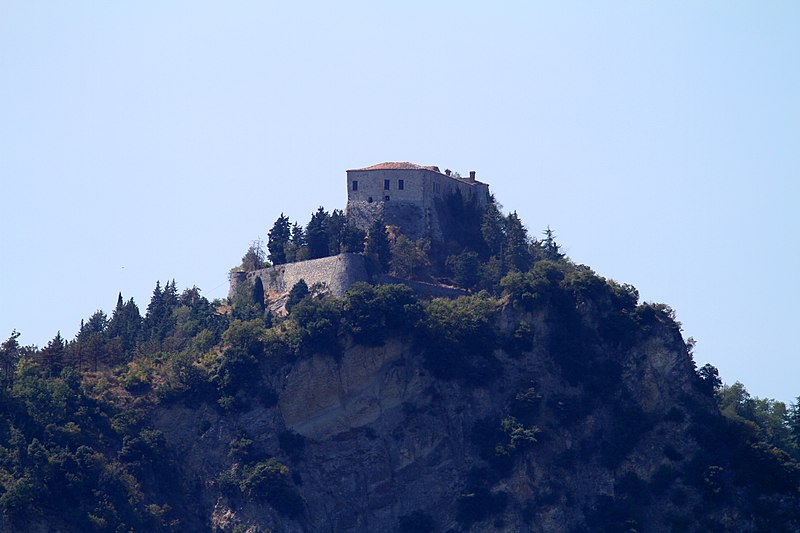
Castle on a Hill: The ghost of Azzurina of Romagna is supposedly haunting the castle Montebello di Torriana. Attribution: Carlo Pelagalli
The sun lingered for a long time over the mountain area where the castle of Montebello di Torriana was. The castle stands in what was known as Romagna, a historical part of northern Italy that no longer exists. It was a stormy June day, in 1375 with thunder going on all around the castle grounds. Towering 400 meters above the ocean, the castle looks out over the valleys of Marecchia and Uso when it was still under the Papal rule. The earliest name of this castle was Mons Belli, or War Mountain in English.
That day was the day of the solstice. The lord of the house’s daughter, Azzurina was playing with a ball, being watched over by her bodyguards Domenico and Ruggero. She was around five years old and running around in the castle with her ball made out of rags. They were distracted for just a moment, and when they turned around, the child was gone. A scream was heard from the castle icehouse and the bodyguards rushed over. Perhaps she had chased the ball and fell? But no trace was left and they were never able to find the child — at least not alive.
The Blue Haired Girl
Centuries later, around 1600 a priest put the legend to paper for the first time as we know of, although the writing itself is lost. The title of the story was Mons Belli ed Deline, hinting that the name was Deline or Adelina, but to most people hearing the legend, her name was Guendalina.
Advertisements
Guendalina was a normal girl wanting to play around the castle grounds. But to the people in the castle, she was more of a secret. She was born as albino, which at the time was connected to persons of a diabolical nature. Her mother tried again and again to color her hair darker with pigments from plants. But the black color wouldn’t stay, and the color faded, leaving only a blue tint of it. This is where her nickname, Azzurrina, meaning blue comes from. So instead she was hidden away from the public eye. This is also why her father ordered her two bodyguards to always watch over her every move as he was worried about the superstitions and rumours surrounding his daughter’s affliction.
The Mystery of the Solstice
Solstice: When the sun is on the sky the longest is the summer solstice. A lot of paranormal rumours surrounds this day, and this is the supposed day the little girl went missing.
What happened to the girl is still debated to this day. Perhaps only a tragic accident? The most gruesome theory is that of her father, Ugolinonuccio, that he himself ordered the death of his daughter because of her being an albino and therefore a problem for him, his reputation and his career. At the time he was supposed to be far away fighting in a war. Even her mere existence is debated as the records of the past are far and few between.
Now, every five year, or to be more exact, on every summer solstice ,strange occurrences have been reported from the castle. Paranormal researchers flock to the place then, to hear “the sound”.
Since the museum opened in the 90s, visitors have heard stories about a child crying or laughing. She is sometimes seen, looking a bit different than the others, running around and disappears in the castle like smoke.
The Claim of the Supernatural
The sound of a child is what the paranormal researchers find over and over again together with strange images. Shame about the manuscript from the priest that could have given more details, which by the way is more of a claim of existence than a trace of it. However, the first real recording we have of the legend actually dates back to 1989, so quite recent, and very in line with the commercial museum that opened up the next year.
But as they say on their web site, they welcome all to have a listen for themselves. Have a look and open your ears. Maybe you as well are able to hear the sound of a faint child’s laughter through the old halls of the castle’s basement?
Outside the shores of Chile, there a tales of a ghost ship that will take you away if it gets you to make you one of their crew. Could you join to sail the sea forever with The Caleuche?
Outside of the Chiloé Archipelago,the group of islands outside of mainland Chile, rich folklore and mystical myths of the sea that surrounds the islands thrives. Here they believe in the great battle of the two serpents of earth and sea that created the area.
Fishing and sailing were the main thing the locals did for a living, and the mythology of the place reflects it. And when the fog comes creeping up to the shores of the canals, bright lights and the sound of jolly music can be heard from the sea. Just a fishing boat passing playing loud music? Or can it be The Caleuche, a ghost ship that collects the drowned and enslaves people to work on the ship forever?
Background of the Mythology
The Caleuche is a ghost ship from Chiloé mythology in southern Chile that has a pretty distinct mythology different from the rest of Chile as a mixture of the indigenous people and the Spanish settlers. It in particular reflects just how important the sea is in the life of Chilotes.
Advertisements
The word Caleuche comes from the Mapuche word Kalewtun, meaning to transform or to change and che, meaning people. It is also called The Enchanted Ship, Barcoiche or The Warlock Ship and has many different variations to the legend.
It has many similarities to the Flying Dutchman in the sense of being a ghost ship you can sail with for an eternity.
According to Chiloé mythology, it is Millalobo that is both the creator and owner of the ship, the second most important being of the sea after Caicai, God of water.
Ghost Ship of Never Ending Partying
The Caleuche is a ghost ship of music and light that sails along Chiloé canals. It has an extraordinary speed. You can not always see the ship, but in certain weather, like on a foggy day, you can both sense as well as see the ship.
People have always had a fear of being captured by The Caleuche and there are particular trees that you can hide behind that will give protection of being spotted, such as the Chilean wineberry and the olivillo. The reason being that in some versions of the legend, you can be enslaved and cursed to work on the ship forever.
The Caleuche: From the fog light can be seen and the sound of music can be hears. According to Chiloé mythology and folklore it is the ghost ship The Caleuche, filled with enslaved sailors, drowned bodies or evil sorcerers depending on what version you hear.
One of the things the ship is known for is the music and sound of partying. In some legends, it is to lure the people to them so that they can be forced to work as a crewmember for eternity.
It is not always for a sinister reason that the party music is so loud from the ship however. In many of the versions it is a ship that recovers the dead bodies from those who drowned at sea, and offers them a place as a crewmate on the ship. They will then be able to spend the rest of eternity partying and celebrating.
Making Pacts with Sorcerers
Another version of the tale is that it is in fact a ship that transports the sorcerers. It is said that they make a voyage every 3 months to gain more power. It is from this legend the idea of merchants trading with these sources to gain wealth quickly, and explaining when a person in Chiloé becomes rich quickly, they have made a pact with the crew on The Caleuche.
It is not a very old myth that never gets told anymore. In the 1960 Valdivia earthquake, or the Great Chilean earthquake, there were many fires, landslides, tsunamis and floods in the area after the initial shock of the quake. Many houses were left untouched by the natural disasters and rumors and talks about a pact having been made with The Caleuche were told.
In the same decade stories about the sound of an anchor being dropped outside of the houses of many prosperous and rich merchants in the area. According to the legends they would lend out their houses to The Caleuche for a party location and other dark purposes. Although many could probably put the blame and the reason for getting rich on normal and mortal smugglers.
Through the power of spiritualism, the bereaved father built a castle designed by the ghost of his dead daughter. And today, the Iulia Hasdeu Castle still stands as a mysterious and haunted place.
Iulia was the beloved daughter of Bogdan Petriceicu Hasdeu (1838-1907) in Romania. He was a Romanian scholar of both history, philology and a great writer. Iulia was somewhat of a prodigy child as well and read by the age of two. Like her father, she was fluent in many languages and spoke French, English and German fluently by the time she was eight. At only 16, she got her degree in philosophy with plans to continue her studies in Latin and Greek Languages at the prestigious University of Sorbonne.
Advertisements
But then on the 29th of September 1888, just a month before her 19th birthday, she tragically died of tuberculosis, a tragic but common way to die in this time. She left behind her many poems, manuscripts and plays to her father who couldn’t move on with his life. That is when he turned to less common ways to keep in contact with his dead daughter.
The Seances to Get in Touch with her Spirit
He was deeply in grief and turned to spiritualism to get in contact with his beloved and missed daughter. There are recordings of over a hundred summaries of these sessions, saying something about his obsession with it.
The Ghost: Portrait of the young prodigy Iulia Hasdeu.
And after he moved to Câmpina which is a bit further north from Bucharest , he spent the time at seances together with the metropolitan bishop, three generals and a processor. All in hope to get a glimpse of his daughter.
He also built an altar for her in their family vault at the Bellu Cemetery in Bucharest that looks more like a Greek temple to pay tribute to her. But this altar was not enough for him to keep as a memento and after six months of trying to reach her in the spirit world, he made contact, and she gave him instructions to build a castle that would later be known as Iulia Hasdeu Castle.
Together with his wife, they went to a mansion in Câmpina they decorated as almost a temple to their dead daughter to sort of keep a part of her with them in this world after it was built. He named it Second of July after his two Iulias as his belated daughter was named after his beloved wife.
Then the plans of the castle started to take form. Hasdeu claimed that he had received messages about the building plans for it through the spiritualism seances he took part in.
The Building Designs of Iulia Hasdeu Castle from Beyond
Work on the Castle began in 1893 and took a lot of Hasdeus’ time, energy as well as wealth. It is more of a folly house than a full fledged castle. She would advise him to use the numbers three and seven, something she considered to be magical numbers. That is why these numbers repeat themselves throughout the building with three underground rooms, three towers and seven steps to every staircase.
The building was completed in 1896 and has since seen its fair share of tragedy befall it. It required a lot of reparation, even when Hasdeu was alive. During the first world war as well as the second world war, the earthquake in 1977 where it suffered many damages. But the castle fought back. There even is a legend to this that during the second world war, the Germans tried to loot the place, but failed as they were ‘struck by some mysterious force.’
Spiritualism: During the turn of the century, seances and spiritualism was a big thing. This is a Seance scene in the classic German silent film Dr Mabuse (1922). People would get together with a medium in hope to make contact with a spirit beyond the grave.
Today the Iulia Hasdeu Castle is still a sort of altar in Iulias memory. With her personal belongings as well as transcripts of the seances that her father attended. The castle itself is described to have a spooky vibe over it, perhaps because there are entire rooms designed specifically for spiritualists rituals, with seats made for the attending ghosts. A shrine like this was bound to get more sinister rumors about it, and it was claimed that Hasdeu used it to worship Satan rather than memorializing Iuelia.
The Ghost of Iulia
The Iulia Hasdeu Castle is not the only place she is reported of haunting. Also back at the cemetery in Bucharest, the ghost has been spotted, dressed in all white while walking through the cemetery in Bucharest holding daisies.
Back In Câmpina at the castle they have also felt her presence. In the night there is the sound of piano playing with the applause and cheering from an old man. So many rumors that the museum itself had troubles finding someone to take the nightshift at the museum.
In the secluded and mountainous streets in La Paz, Bolivia, the ghosts of the past are still roaming the streets. Both dangerous widows and Bolivian freedom fighters.
The street in La Paz has rumors of ghosts roaming. And it is not an anonymous ghost we are talking about. The ghost that supposedly roams these streets is the Bolivian folk hero, Pedro Domingo Murillo, who played a key role in Bolivia’s independence.
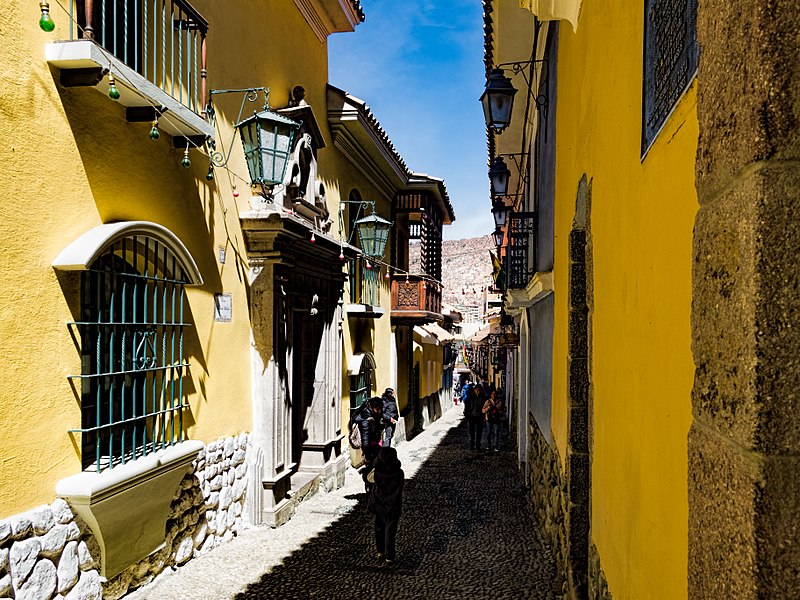
Calle Jaen is one of the old streets in La Paz and it looks like a ghost of colonial times with the architecture. This is the place where Murillo used to live. The streets are also known for the ghostly apparitions that are seen both by the locals and the tourists visiting.
Advertisements
The Ghost of Bolivia’s Freedom Fighter Murillo
He is reported mostly appearing to both locals and tourists by the museum during sunset where he tries to communicate with the people seeing him. They even put up a green cross at the end of the museum to ward off spirits that don’t belong in this world anymore.
Haunted Street: Jaen Street, named after the revolutionary Apollinar Jaén, is the best-preserved colonial street in La Paz with its cobbled streets and Spanish architecture. The houses date from the 18th century. One of the homes was owned by Pedro Domingo Murillo.// Photo: Dan Lundberg/wikimedia
Murillo is known for leading a rebellion against the Spanish crown. He was eventually captured and hanged in 1810. He had this to say:
“Compatriots, I die, but tyrants won’t be able to extinguish the torch I ignited. Long live freedom!”
Many see him as a spark that ignited the battle to free South America from Spain, and each year, there is a parade through central La Paz with lit torches in his honor.
The Black Widow of Calle Jaen
He is not the only ghost of this street though. The ghost of a widow crying for her dead husband begs for help in her black mourning clothes. She looks innocent and manages to lure kind people, especially men. When they try to help her, they will disappear forever.
The staff working at the bars in the streets are serving Ajenjo: a Bolivian variety of absinthe. They claim that the hallucigen from the drink has caused people to see both ghosts and spirits after a few sips, especially the ghost of Pedro Domingo Murillo.
‘Koi Koi’ goes the sound of high heels in the hallways. And this sound is terrifying for students at the haunted boarding schools in Nigeria. Because Madam Koi Koi is after them in this terrifying urban legend about a dead teacher out for revenge.
The myth of Madam koi koi and her high heels is an urban legend about a ghost of a female teacher in Nigeria that has spread throughout many African countries and is today a well known legends among students. The ghost of Madam Koi Koi is said to have been haunting boarding schools in Nigeria for decades and there is no way of telling where the now urban legend surfaced. Many sources attribute the legend to the surface in the 90s. However, on the internet, she first appeared in the forums as Madam Koi Koi in 2011.
As the fear of Madam Koi Koi grew, it spread to more countries as well and the ghost of the former teacher goes by many names. In Ghana for instance, she is known as Madam Moke, Ghanian for high heels. She is also known as Miss Konkoko in Tanzania and Pinky Pinky in South Africa.
The Urban Legend of Madam Koi Koi
With such a popular and saturated story, there are bound to appear variations of the legend of Madam Koi Koi as all good urban legends do. But the most popular goes something like this:
Madame Koi Koi was said to be a beautiful and fashionable teacher in a federal government secondary school. She was known for her beauty as well as her red high heels that would make a sound every time she walked the hallways of the boarding school where she worked. Thereby the name: Koi Koi as it mimics the sound of clicking heels.
Madam Koi Koi: The ghost of Madam Koi Koi is described as the ghost of a mean teacher that used to wear red high heels that you could hear clicking when she came down the hallways of the school she worked at.
Although beautiful, she was not known for being a kind woman and was also said that she was a very strict teacher and mean to the students. She was a brutal and violent woman that would beat the students up for no reason and enjoyed punishing them. This is also why she was deeply despised by them.
Madam Koi Koi was eventually fired after another violent incident where she took it too far and hit a female student. The slap she gave the young student was so hard that Madam Koi Koi injured the little girl’s ear. On her way home that day, Madam Koi Koi got into an accident and died. But before dying, she swore revenge on both the school as well as the students for firing her.
From the Netflix Adaptation: In 2023 Netflix made a mini series about the urban legend from the 90s called The Origin: Madam Koi-Koi .
After her death, the students at the boarding school said they could hear the clicking of her heels during the night throughout their dormitories. Even today the story persists and it is told between frightened students that Madam Koi Koi comes out in the night to haunt the students that wander out of their beds in the night.
The Different Versions of Madam Koi Koi
Another version of her ending was when the students took matters into their own hands after they couldn’t take anymore beatings from her. In this version of the legend, the students captured and gagged her and beat her to death. To conceal their crime they threw her body over the school fence after realizing what they had done and hoped they would blame someone else.
But although they had their reasons, she came back for revenge. One by one, the students that killed her started to disappear from the school and ended up dead. After the last person involved with it died the school was shut down forever as they had no way of knowing how to stop the wrath of the former teacher. The students that were transferred started new schools and spread the urban legend about the teacher that haunts boarding schools.
Popular Urban Legend: In Nigerian schools, especially in boarding schools, they tell the story about Madam Koi Koi to each other and is known as some of the most famous haunted stories in Nigeria. //Photo: Emmanuel Ikwuegbu
Sometimes the legend is retold that she loses one of the shoes, and she comes back to haunt the premise for her other one. Or sometimes, as in the Ghanaian version, it is specified that she was given the rude and bad students and that they one time locked her in a closet where she died and she was more of a victim than a perpetrator.
Read More: For more ghost stories from schools around the world, check out the The Kong Kong Ghost
In the South African one where she goes by the name Pinky Pinky and is a very different version than the Nigerian one. Here she is only part human, animal, male and female and prays in children’s school toilets to rape the girls if they wear pink underwear. The boys can’t see her, but feel the presence through a slap or scratch on the cheek.
No matter the version is told, she is always after the students. You can always hear her before you see her. She walks the corridors, opening doors, singing and whistling while her shoes click on the floor. And if you are caught by her ghost in the hallways or in the toilets, she may become violent.
Netflix Series About the Legend of Madam Koi Koi
In 2023, Netflix released a two part series about the urban legend called, The Origin: Madam Koi-Koi that are based on the story of the former teacher haunting the schools.
The series focuses on a young student named Amanda that are sent to an isolated boarding school called St Augustine Catholic College in the 1990s. The school is plagued with a history of sexual violence that seemingly has gone unpunished because of the powerful parents to the perpetrators.
At the new school, Amanda has troubles to fit in and starts having nightmares about something dark that are lurking in the forest outside of her school. Meanwhile, inside of the school she has to deal with the sexual harassment for the male students and the urban legend about revenge starts to unfold.
The Legend about Madam Koi Koi
In conclusion, the legend of Madam Koi Koi continues to captivate and intrigue students and Madam Koi Koi legacy has left an indelible mark on the haunted boarding schools across the African continent. And for every year that the new students arrives at the schools, the legend about Madam Koi Koi evolves.
So the next time you find yourself near the haunted boarding school, take a moment to reflect on the tales of Madam Koi Koi. Listen closely, and you might just catch the faint echo of a haunting laughter or the distant sound of high heels.
In the 70s, a deadly fire broke out at the Joelma Building in São Paulo, Brasil, killing many people. Later, the building is reported haunted, and the ghosts of the victims are crying for help from beyond the grave.
In downtown São Paulo in the southeast region in Brazil, a building stands that were the site of one of the most horrific fires that the world ever saw. Today the building has been renamed and is called Edifício Praça da Bandeira, but it is probably most known by its former name, the Joelma Building.
The 25-story Joelma Building is famous because of a fire that started in the building in 1974 that took the life of at least 179 people, and is the world’s worst skyscraper fire in history besides the World Trade Center fire by death toll.
The Death Fire of the Joelma Building
On a Friday the 1. February at Avenida 9 de Julho, 225, an air conditioning overheated on the twelfth floor in the morning. The building was used as an office building so at this particular time, the working day had started. The banking company Banco Crefisul S/A that worked in the building had 756 employees present.
The Fire: Although the Joelma Buildingdidn’t collapse, the whole building was swallowed by the flames.
The Joelma Building was a brand new building and completed in 1971 and it shouldn’t have any old or rusty things that would malfunction like this. The reason why the air conditioning overheated was that it used the wrong plug that it needed. Also, the materials that had been used to build the interior of wood, the fabrics and such were very flammable, and in no less than 20 minutes, the entire building was engulfed in flames that trapped the people inside.
There were no emergency lights, fire exits or fire sprinkler systems that would help the people trapped by the fire and smoke inside, and after the tragedy, it put a new focus of how important standard things like this was in a building. But for those trapped inside of the fiery hell, it was all too late.
There was a chain of events that led to the big catastrophe the death fire turned out to be. The firefighters came only 20 minutes after the fire started, but didn’t have proper equipment with them to put out the flames in the tall building. The ladders they had could only reach up to 14 floors of the building with 25 floors, and those above were left to their own devices.
The fire in the Joelma Building turned into a battle of survival. They tried to rescue the people on the upper floors by helicopter as well, but didn’t manage to get close enough to get them safely out.
By the time the fire was extinguished, over 300 people were injured, and they estimate that between 179 to 189 people had lost their lives.
The 13 Souls in the Elevator
40 people tried to jump out of the Joelma Building when they realized they wouldn’t manage to get down on the lower floors. Of these jumper there were none survivors because of the height of the building. The only way to escape was by getting down to the lower floors, but with no emergency exits, the people inside found themselves trapped.
13 people tried to escape by using the elevators of the building that was at the time still working. Although not recommended to use under fire, they were desperate enough to try to escape. The plan didn’t work though and the elevator stopped on its way down and trapped them inside where they died of suffocation as the flames were closing in on them.
The bodies were badly hurt by the fire and it even took time to make the carnage of huddled corpses into 13 individuals. They never managed to identify the 13 souls and today they are buried in anonymous graves at the Vila Alpina Cemetery.
Haunting the Cemetery
These 13 souls have since been suspected of still lingering in this world as ghosts. At the site of the mass grave of the 13 unidentified bodies there were reports of moaning and cries for help for those that in their dying moment, never got rescued.
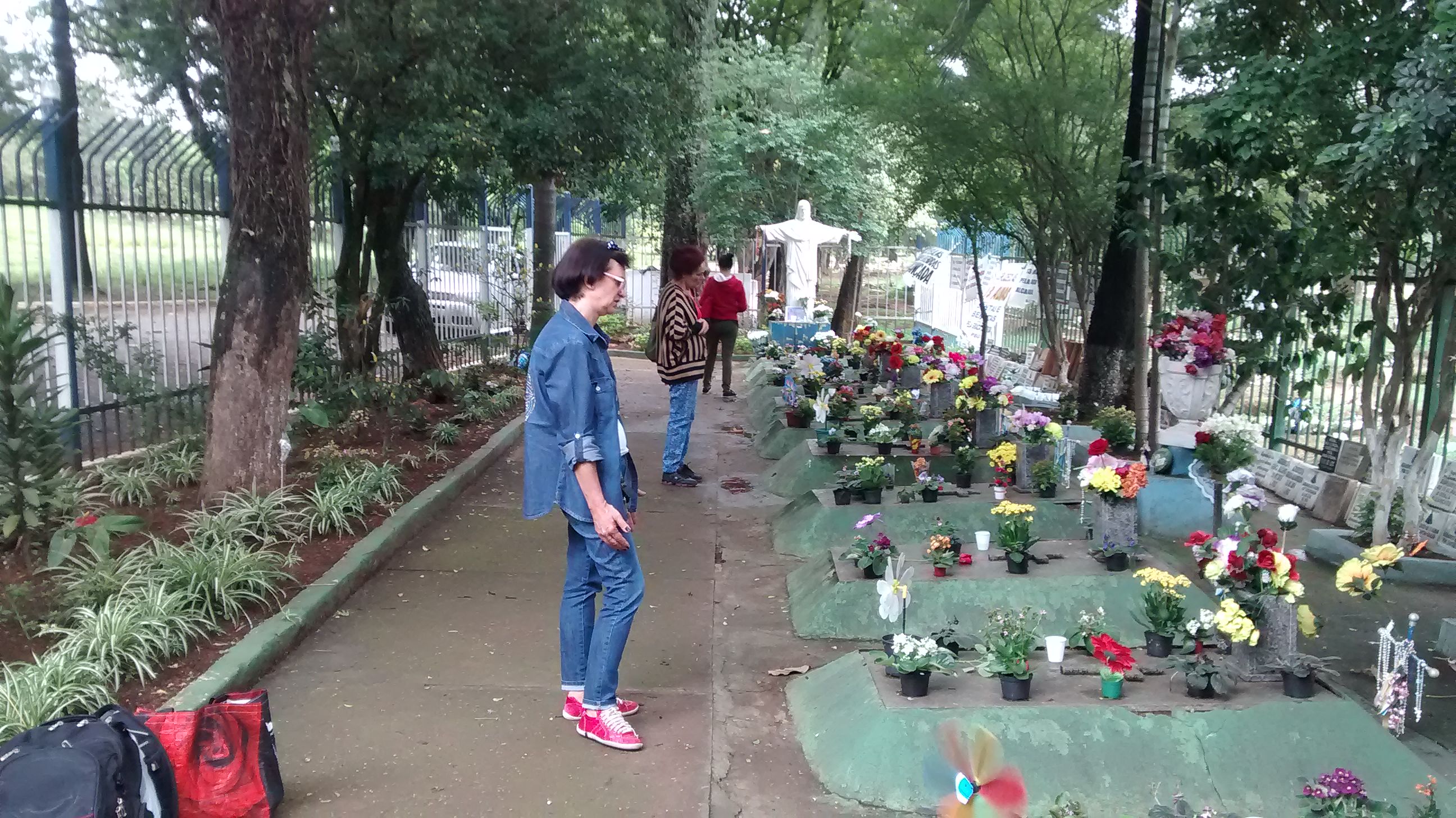
The Thirteen Unknown Graves: The graves of the 13 souls that were never identified in the Joelma Building fire. Visitors comes and puts glasses of water for them. // Photo: Wikimedia
The cemetery caretaker at the time, Luiz Nunez was so bothered by this and became desperate to stop the noise of their cries and poured water over the graves. This act of extinguishing an eternal fire he meant helped to quiet them, at least for one day.
From that day, visitors started leaving a glass of water on the grave instead of the usual flowers.
The Haunting at the Joelma Building
Back at the building where this tragedy happened, the reports of the paranormal continue to this day as well. People experienced strange phenomena where the cars in the parking lot outside of the Joelma Building would suddenly start blinking with their lights without anyone turning them on, and the inside of the building was also haunted.
It is said that every floor above the 15th floor is haunted, where the firefighters ladders didn’t reach. People keep seeing shadows in the stairways and experience malfunctioning elevators. Fire alarms going off with no fire is also some of the activity that is apparently going on there.
Curiously enough It is not the only tragedy that happened on the site of where the building stands either. And the place where the building was built has been called cursed land because of its history.
Cursed Land
In 1948, a chemistry professor named Paulo Camargo lived in a house at the same place where the Joelma Building would be built with his mother and two sisters. They had a lot of illness in their family that took a lot of energy for Camargo that had to take care of them by himself. It didn’t get better when Camargo found a girlfriend named Isaltina dos Amaros that his mother didn’t approve of.
It all ended with Camargo killing his entire family by shooting them and throwing them down a well. They never really found a clear motive as to why he ended up doing what he did. And they never got a chance to dig further either. When the police came and discovered the well, Camargo killed himself with the very gun he had used on his family.
When they built the Joelma building it is said they changed the entrance so the address wouldn’t be the same as the murderers. But the place was still the same and some even called it cursed land because of the place.
Even before the gruesome murders in 1948, the place was believed to be a ‘pelourinho’, a public place were they would take slaves and criminals. They would tie them up and torture them, and at times, also kill them for the public up to the abolition of slavery in 1888.
Purified by a Buddhist Monk
Today the Joelma Building is once again renamed and something stands on the top of a past buried tragedy. After the fire the Joelma Building closed for 4 years for reconstruction. It was renamed Edifício Praça da Bandeira after it opened again to rid itself of its past. But there are some things you just can’t bury.
In 2004, they were doing work on the building, but the owners was met with hesitant workers, not wanting to be there at all because of its haunted history. Many wouldn’t step into the new building until it was blessed by a Buddhist monk. The monk that did the blessing said in interviews that she had purified the place and deemed it safe for the living. The Buddhist monk also said that she could do nothing about the ghosts on the upper floors, and that they still lingered.
But is it enough to ward off another tragedy to have a monk purify the place? Is the supposedly cursed land clean and cured? Or was it just a coincidence that they happened on the same land as the past atrocities?
The spirit of the girl so disappointed in her life on earth she can never move on, continue to echo through time together with the Maidens of Uley in Sibir, Russia.
The Eastern part of Russia can be ruthless. A vast empty land on the map, it is sort of forgotten when looking at pictures of St. Petersburg or Moscow. But there are people there, and they have been there for a long time. And if the Trans-Siberian Railway didn’t pass through it in 1898, we might never have hear about Irutsk Oblast, an area in the southeastern Siberia.
Where we are going the weather is cold. So cold it is almost inconceivable. For almost six months during October to April, the temperature usually is below 0 °C (32 °F). But that is the average, the winter hits harder. In Irutsk the temperature is around −25.3 °C (−13.5 °F) in January. The summers on the other hand is warm, although short. So short.
This is the domain of the tundra. The mountains extend up to almost 3,00 metres (9,800 ft), almost with nothing growing on them.
The Little Song in Love
In the village of Ulei (or Ungin) a legend of the west buryat people have been told for a long time. The Buryats or Буряад are a Mongolic people and the largest indigenous group in Siberia. For a long time they maintained their nomadic lifestyle until being taken over by the Russian Federation were agriculture was more profitable. Although most of the Buryat lives in the federal subject of Russia, some still live in the northeast of Mongolia and Inner Mongolia in China. This is where the legend of the Maidens of Uley comes from.
The Buryat People: Buryat tribe in traditional costumes in the district of Selengiski in South of Sibir. From the early 1900s from the traditional folk museum in Novosibirsk in Russia.
A young lady by the name or the nickname of Bulzhuuhai Duuhai lived in this place. (Duushin means singer in Buryat, Duuhai means something like ‘Little Song’. She had no wish to be married off, but fell in love with a young man that her parents found beneath her and tragedy followed.
But this was wish was not to be granted to Bulzhuuhai, and like so many women before her, she was married off to a richer man her parents found suitable. Some claim he was from Khalyuta, some say he was from Tarasa.
She needed an escape from her home she had with her husband. He was not treating her with respect as she was locked up in a black yurt, and in some legends even chained down, not a traditional white one. In some accounts, it wasn’t necessarily a black yurt, only an empty one.
The White Yurt: The traditional white yurt she was supposed to live in. Novosibirsk State Museum of Regional History and Folk Life.
She asked of her loved one is he could run away with her, but he had nowhere to run to as he was a poor man. She had nowhere to go.
While imprisoned in her yurt, she sang. Every girl that passed her by could hear her song, but there was nothing they could do to help her. All they could, was to throw flowers through the chimney, which was her only source of light.
The Eight Days of Freedom
Advertisements
For twenty days, she was in chains inside with nowhere to go, but she managed to escape. Eight days of freedom was all she got. Along the road she met many people, and along the way she met a group of people carrying the bride to a wedding in Tuglo. She joined them and sang in the wedding. Many men tried to get her attention, even the shamans, every day until the wedding was over.
After the wedding was over, so was her life she felt, and she fell in a deep desperation and loneliness. She had nowhere to go to. She could not go back, and there was nothing ahead of her either.
After the eight days of singing and dancing in the wedding, she hanged herself in the barn, not being able to take it anymore. But this was not the end. There were so many more like her.
The Call of The Zayan Spirit
Maidens of Uley: Women’s Khori-Buryat costume//Photo: KoizumiBS
After she died she became a zayan-spirit, as those killed by their own hands are called. They can find no rest or find their way to Erlen-Khan which is the Lord of the Underworld. They are not necessary malicious spirits, but can call upon the inner thought of female despair.
Instead she called upon other spirits with a similar fate and a group of girls flocked to her. Around 350 Maidens and spirits just like her answered her call. These spirits are called Olon or Many of Uley by Idin and Osin Buryats.
To this day the Maidens of Uley are supposedly forbidden to sing after sundown because of the danger of being captured and turned into one of the Maidens of Uley.
It was a group of around 350, or even more. Maidens of Uley like her on a revenge mission. They haunt the fiances on their wedding day, mesmerizing them with their beauty. Once taken, they lead them to the underworld where they are never seen again.
Now remembered in folklore for the locals, the story of the Maidens of Uley is passed down to the next generations. Like in this theater play by the Buryat Drama Theatre:
Chosen as Hitobashira, a human sacrifice to ensure the construction of Maruoka Castle, O-shizu were promised a bright future for her children. But when the promise were not honoured, her ghost came back to haunt the castle grounds.
The Maruoka Castle (丸岡城) is sometimes called the Mist Castle (霞ヶ城), because according to legend, there will be a protective mist around the castle whenever an enemy is close to hide it. It stands on the top of a hill protected ramparts as well as a pentagonal-shaped moat and perhaps it is the spirit of the human sacrifice entombed in the castle’s foundation that keeps it hidden in the mist?
The Maruoka Castle is one of the oldest castles in Japan, sometimes called one of the twelve original castles and is located in the Fukui Prefecture and built at the end of the Sengoku period around 1576 by Shibata Katsutoyo. According to the legend, it was built with a human sacrifice to ensure its endurance.
Hitobashira — Human Sacrifices Entombed in Buildings
The act of a human sacrifice to be a pillar of a building can be seen throughout the world. In Asia, it was especially done to appease the deities and for protection. In Japan, the practice is known as Hitobashira (人柱), meaning human pillar and has been used since the 500 AD at least.
As well as the spiritual belief it was believed that large constructions like castles, dams and bridges would destroy the feng shui of the land because of the moving of the soil. Because of this, the buildings would then be in danger of all sorts of disasters, both natural as well as man made disasters. The cultural practice of Hitobashira was done then to protect against evil spirits, natural disasters and to make the buildings strong.
It wasn’t necessarily people that were forced to become the human pillars. Some actually chose this path for various reasons. The word Hitobashira can actually be linked to becoming a God as well. Hito is related to the word, kami, which means God in the Shinto tradition. Bashira can be a term used when being enshrined in an important way. So that the sacrifice would actually be more connected to the gods.
But then again, there were also more earthly reasons to choose to become a Hitobashira. Poverty for one, as is the case with the Hitobashira that are under the grounds of the Maruoka Castle.
The Human Pillars of Maruoka Castle
When they were building the Maruoka Castle, they kept running into problems that they couldn’t seem to find a solution to. The stone walls kept collapsing no matter how many times they tried to set it up and they were running out of ideas. Then a vassal suggested that they should have a hitobashira, a human sacrifice.
The choice fell on O-shizu, a one-eyed woman with two children to feed. O-shizu agreed to be the sacrifice on one condition, that one of her children would be made a samurai. She was a poor woman and this way she could ensure a safer future for her children.
O-shizu was then buried under the pillars of the Maruoka Castle, one stone on top of the other as she was slowly being crushed to death. It is said she was stoically standing there as the builders slowly killed her, fully knowing her children would be better off. After the sacrifice were done, the walls didn’t budge and the building of the rest of the castle continued without further problems.
But Shibata Katsutoyo, the one building the castle didn’t follow through on his promise of making her son into a samurai, she came back to haunt Maruoka Castle. Her spirit became resentful and she was the cause of the moat overflowing every spring by the rain. They called the rain that overflowed the moats the ‘Tears of O-shizu’.
To appease the spirit they erected a tomb to sooth her spirit and we today have a handed down poem about her haunting:
“The rain which falls when the season of cutting algae comes Is the rain reminiscent of the tears of the poor O-shizu’s sorrow”
The Maruoka Castle Today
Today we probably would say that the Maruoka Castle had a problem in its design, not because of the deities. And had it had a more stable way of construction, a hitobashira would probably not have been needed. But again, the castle is still standing to this day, so who is to say, really?
Cherry Blossom Festival: Today the Maruoka Castleis known for being a good place to watch the cherry blossoms every spring more than one of the hitobashira buildings.
Today when the mist is clearing and the castle is visible, there are cherry blossoms blooming in the spring. The castle grounds is a part of Kasumigajo Park and is well known for its 400 cherry blossom trees. There is an annual cherry blossom festival during the first three weeks of April. And in the evenings, there are over 3000 paper lanterns lit up in the dark.
Perhaps this is appeasing the ghost of O-shizu enough to not overflow the moat with her tears anymore?
Haunting the iconic Agua Caliente Casino and Hotel in Tijuana, the performer known as La Faraona remains like a ghost from the Golden Age of the Sin City.
During prohibition times in the US in the 1920s, people flocked to the borders to have a drink and a good time. The border towns also become a hot spot for smuggling activity and flourishing establishments that would quench peoples thirst.
Tijuana was one of these border towns that saw a golden age and growth during this time. People came from the whole world to get a drink while gambling at their casino and watch horse racing and bullfighting. For the conservatives, Tijuana became known as a Sin City or was even called Satan’s Playground.
Advertisements
The demand for a good time was profitable however and attracted many people south of the border, and many resorts were established for this particular need. One of these places was Agua Caliente Casino and Hotel that opened in 1928. It was like the American Monte Carlo and Deauville that attracted American celebrities, Mexican politicians, diplomats, gangsters and gamblers alike during the 30s. This is the time that is remembered as Tijuana’s golden age.
The hotel in Tijuana in Mexico in Baja California is said to be haunted now however, and the glamor it once held, is now under the layer of dust and only a footnote in history. It is now a high school and many of the reports of the haunting come from the students themselves. There are many stories, and especially about a woman walking past the student, whose feet don’t even touch the ground. The legend of this ghost has been called La Faraona.
The Dancing Ghost La Faraona
Agua Caliente is a place where performers had the chance of being discovered and making it big. Rita Hayworth was one of those while she was playing a show at the hotel. She went on to be a famous Hollywood star and a cultural icon. But there was not every performer that managed to get out of Tijuana.
Satan’s Playground: The Agua Caliente was a famous tourist spot for a weekend away. It was also a place were many performers were employed and made famous. On the other end it was a place were many illegal activities took place. // Photo: Guy Sensor Landscape Photo, courtesy of San Diego History Center Photo Archive.
It is said that a female performer haunts the former hotel that was built atop of a natural hot spring. In many versions she worked as a singer, but in the most detailed stories, she was a dancer in one of the more popular shows. A flamenco dancer from Spain. The stories told at the school call her La Faraona, apparently her stage name as the star in one of the many shows at the casino at the Agua Caliente.
She was supposedly also known as being somewhat of a good luck charm to keep at your side by the gambling tables at the casino. By her many admirers, she gained a lot of wealth in the form of diamonds and jewelry and there are rumors that she hid her treasures by the minaret which is the place her ghost has been spotted many times.
Crime of Passion
La Faraona: According to the legend, La Faraona laced her lovers drink with poison and they both ended up dead.
She was in a relationship with a man at the resort. Some call him Mr. Patrick, a British gentleman and a dealer that had made money on the alcohol smuggling business. In some accounts, he was even in Al Capone’s mafia. In all accounts however, it ended in tragedy when La Faraona killed him.
Why she did it differs from one version to the next, but it is usually by poison. In some accounts, she only poisons him, but in many versions, she does it to both of them. She supposedly poisoned her lover after stealing his money or after she realized he wasn’t intending to bring her back with him to England. In some versions it was because she saw him with another woman.
Apparently she laughed in his face when she poisoned him and even told him there was an antidote for it that she wouldn’t give him. He ran after her to get the antidote from her but didn’t get it. He then shot and killed her.
This also meant that he would never find the antidote to the poison as well and he too died. Or they both died by the poison she laced their drinks with. Now they both haunt the former hotel where they ended their days.
A Real Murder at the Hotel
When we look at the historical facts, there are only one murder registered at the Agua Caliente, although who knows how many that never made it to the public really happenend, we will never know.
But a dancer working for the past four months at the Agua Caliente was found on 26. March in 1934. Named Esperanza López was found murdered in one of the bungalows at the premise that were kept for the artists at the casino. She had been shot by her husband who also worked at the hotel named Rodrigo Prieto.
The hotel closed down in 1938 when the prohibitions were lifted in the states, and Mexico forbade gambling. Then the building was turned into a private school named Lázaro Cárdenas High School where the stories about the hauntings mostly came from.
And the students at the school keep insisting on seeing her ghost roaming about the place as she is never leaving the Agua Caliente.
This haunted forest known to be the Bermuda Triangle of Romania with its eerily coiled trees and whispers of local legends reminds us all that Transylvania is not only haunted by the legend of Dracula and vampires. Take a walk in the Hoia Baciu Forest and hopefully you will get out as well.
Romania has a rich history of the unexplained and lores and legends that will creep into the bones of those listening. This forest is clouded in mystery and is no exception. Strange orbs of lights are said coming from inside the treeline, and rumors of it being a possible gateway to another dimension draws desperate people to try for themselves. The stories of the haunted forest has reached an international reputation now and is on most lists of “most haunted places in the world“.
Read More: Have a look at all our stories about haunted forests: Here
The forest has always had a paranormal undertone whispering in the wind from old legends, but modern lore of the forest being a hotspot for UFOs, missing time and has started to take hold as well. All of these legends are what has given it the nickname the Bermuda Triangle of Romania. The mysterious forest of Hoia Baciu, or Pădurea Hoia as it is in Romanian, has many haunted legends lingering among the trees.
Hoia Baciu Forest: The Transylvanian forest is shrouded in mystery and intrigue, largely due to its peculiar trees, a dense thicket of gnarled, contorted trees with twisted branches that seem to reach out like spectral fingers. Local legends claim that the trees are imbued with supernatural energy, and many believe that they are gateways to other dimensions or portals to the spirit world.//Source: Wikimedia
The Haunted Forest for Ufology
It’s not only those living close to the Hoia Baciu forest, superstitious people or those seeking ghosts that claim there is something going on in between the trees. Even in academic circles there are those who were intrigued by the strange place and the subject has been dealt with by both national research as well as overseas.
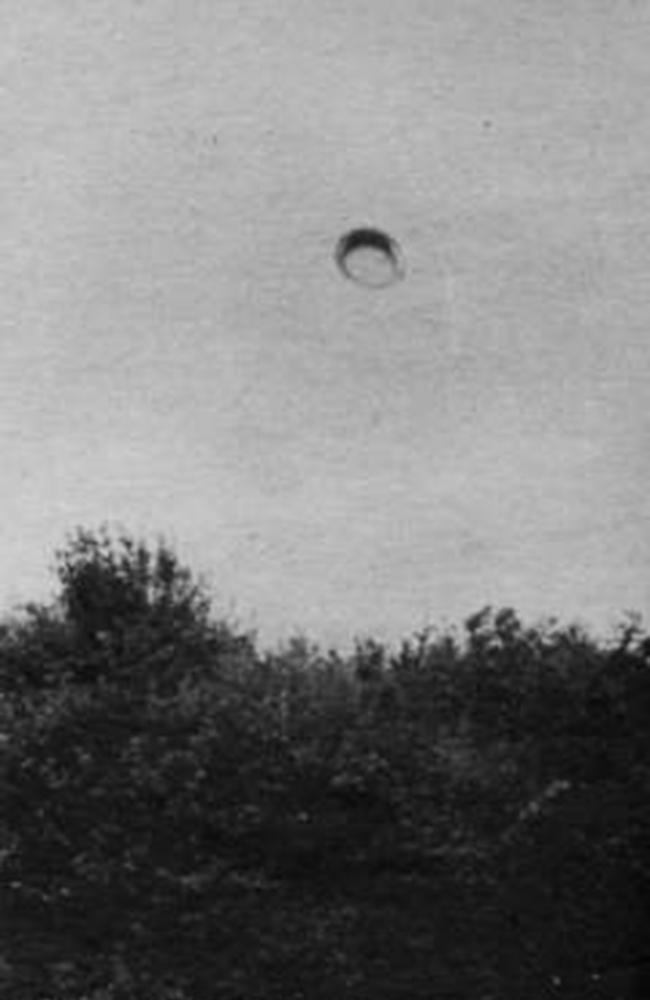
UFOOver the Treetops: This picture is one of the pictures Emil Barnea took of the sky above the forest, now believed to be of more strange origin.
Even some selected professors at the university in the city claim this particular forest is a place where paranormal activity happens, and in the modern world filled with strange disappearance legends, tales of aliens and UFO’s has started becoming a part of the lore of the haunted Hoia Baciu Forest.
In the late 60’s a biologist named Alexandru Sift came back with pictures from the forest that he claimed were flying UFO’s in the sky over the twisted trees. Sift wandered into the forest to have a closer look at the strange vegetation that can be found in there as part of his research.
These pictures of the alleged UFO’s were published by his chemist friend of Sift, side by side with theories about the paranormal stuff happening in the old forest right outside the city. And what he found and reported off got more people interested in both the paranormal legends that had seemingly always followed Hoia Baciu.
The same claim about seeing a UFO inside of Hoia Baciu came from a military technician named Emil Barnea as well. In 1968 he took some pictures in the western part of the forest while he was camping in the forest. Barnea took a huge hit by publishing the pictures as the communist government at the time looked at tales like ghosts and aliens like madness and superstition. He even lost his job because of the publishing of the pictures.
But what was the truth behind the pictures? What flew in the sky that made people think it had to be aliens? Both of these cases, with what seemingly looked like picture evidence, helped to give the forest a sense of notoriety more than a local place filled with local legends.
When first delving into the local lore since the first trees started growing there, strange occurrences had been reported long before the 60’s and people started talking about UFOs.
The Bermuda Triangle of Romania
Hoia Baciu Forest is located near the Cluj-Napoca city in the northwestern part of Romania, an old forest still stands only half an hour away from the city by car. The forest is in notorious Transylvania, and for many it is expected that a haunted forest should be placed right here. Although the city close to the forest is free from the Dracula tales of Bran Castle and the tourist attractions one might find in a lot of towns capitalizing on the vampiric lore of the country. But there is a certain eeriness to the trees bending in twisted ways with skeleton-like branches reaching out for the hikers.
We are away from the bustling modern everyday life from the city and here in Hoia Baciu Forest and the only thing to hear is the falling leaves, whispering as they reach the ground, and the sounds of deer, walking among the trees. Some might say Hoia Baciu is much more scary than Dracula himself.
Strange Lights of Hoia Baciu: Another one of the pictures taken by Barnea in the 60’s showcasing strange lights that has been told legends about in Hoia Baciu throughout the years. What the lights and figures over the forest really was has never been found out, but has been the source of much speculation within the ufology community.
When saying the forest is an old one, it truly is. As in 55 000 year old. With such old places like the mysterious Hoia Baciu, there are old stories that no one really knows when they started or came from. Farmers in the valley claim the forest is haunted to this day, and especially stories about strange disappearances there are plenty of. The story about the strange disappearances are also why the Hoia Baciu forest is also sometimes referred to as: “The Bermuda Triangle of Romania.”
The Disappeared Shepherd
One of these disappearance stories from Hoia Baciu tells of a shepherd that went into the Hoia Baciu and vanished with more than 200 of his sheep without a trace, never to return. Perhaps a man could simply vanish in a forest by himself, but 200 sheep? The stories about many people disappearing are odd considering the forest is not that big compared to other places an covers an area of about 3 square kilometers.
In some sources it is after the disappeared shepherd that the forest is named Hoia Baciu. The locals are at times afraid to enter the forest because of tales like this that have been handed down for generations. The once brave enough to venture in have also complained about feeling nauseous, itching as well as getting migraines when they are brave enough to enter.
The Girl Who Vanished
Perhaps the most famous tale from this forest is of the 5 year old girl that wandered into the forest one day and got lost and disappeared from the face of the earth, at least for the rest of the world. Years passed and after five years of being missing she came back out from Hoia Baciu, supposedly in the same clothes she wore on the day of her disappearance, not looking a day older.
When asked where she had been and what had happened, she had no answers. She reappeared in the forest with no memories of where she had been and what happened to her, at least, she didn’t want to share it. For her it had apparently only been a little while, not many years.
Many accounts claim there are many, perhaps as many as thousands of people that have disappeared in this Bermuda Triangle of Romania over the years. But of course, no hard evidence is found of these occurrences. Because they never happened, or merely because they happened so long ago that evidence of this is long gone?
Ghosts Haunting the Forest
There are not only strange legends about people being whisked away for years or forever or pseudo science of UFO and aliens that are told going on inside of the forest. A part of the local legends of the forest also deals with ghosts haunting the trees.
One of the ghost stories tells of the ghosts of Romanian peasants that were murdered in the forest and is believed to still be trapped in the forest, unable to move on.
They are sometimes seen wandering among the trees in Hoia Baciu, observing the people entering their final resting place. Other tales of shadow figures, something looking like ectoplasms as well as hearing strange voices are also told by joggers and hikers. One of the ghosts are supposedly also wearing something that looks like the northern Romanian traditional clothing.
The Poiana Rotunda Inside Hoia Baciu
The Poiana Rotunda: The clearing in the forest were most of the strange happenings is taking place giving the nickname Bermuda Triangle of Romania// Photo: Lajsikonik
Most of the paranormal reporting has now started centering around a supposed vegetative dead zone found inside of Hoia Baciu. This place is called Poiana Rotunda, or ‘Round Meadow’ found west in the forest.
The Poiana Rotunda is a one kilometer area of grassland inside the thick forest and is a close to perfect circle on the ground where no trees grow from the soil, apparently without an explanation.
People claim that they feel nauseous or dizzy when coming close to this place, and most of the strange things that are told about the forest are said to have started or happened around this dead zone.
What happened here has been up for much speculation. Could it be from a UFO landing at this place, could it be a sign of the gateway to the parallel dimension that seems to have spirited away many people throughout the years?
The more earthly and natural reasoning for this mysterious meadow in the middle of the forest could also be caused by natural causes or illegal deforestation the forest is suffering from. Soil samples have been taken from the place, but as of now, we don’t really have a definite explanation for this phenomenon.
A Walk Inside of the most Haunted Forest in the World
No matter what really lies inside the forest, of it really is haunted or some sort of Bermuda Triangle of Romania, it certainly pulls the strangest and darkest things out from people visiting. It is a perfect setting to put on a tv-show, sell books claiming all sorts of stuff.
Maple groves, gatherings of beech, ash and elm wrap around themselves, contorting to strange shapes that perhaps help the feeling of uneasiness and gives the forest an overall creep factor. Blocking out the sun, leaving us in a sort of eternal shadow below the trees, anything seems possible in Hoia Baciu.
An online magazine about the paranormal, haunted and macabre. We collect the ghost stories from all around the world as well as review horror and gothic media.