Tag Archives: 2000

Ghosts of the Tsunami

Advertisements

The tsunami disaster in 2011 left large parts of Japan in ruins. And some of the people never being found, are still trying to reach home it seems. This is the story of the Ghosts of the Tsunami.

It was a totally normal day. At least the morning was. It was supposed to be a totally normal day in 2011. It was mid day, so everyone was at work, busy filing papers, building buildings that would soon be torn down. Children sat in class at school, trying to learn something they would get on a test some would never even take. It was supposed to be a normal day. But then, the tsunami hit. Several tsunamis, up to about 10 metres rushed in over the coast of Japan after a massive earthquake.

Read Also: Check our all of our ghost stories from Japan

The event was known as 2011 Tōhoku earthquake and tsunami or Great East Japan Earthquake  (東日本大震災). It was the most powerful earthquake ever recorded in Japan, and the fourth most powerful earthquake in the world since modern record-keeping began in 1900 with a magnitude of 9.1.

The earthquake triggered powerful tsunami waves that may have reached heights of up to 40.5 meters (133 ft) in Miyako in Tōhoku’s Iwate Prefecture and people got as little as ten minutes to evacuate before it hit them.

After the waves of the tsunami hit, the entire city of Ishinomaki by the coast of Japan would never be the same again. After six minutes the entire city was under water and taking six thousand of the population with it. Half of those have not even been found. Soon after the survivor started talking about the ghosts of the tsunami that never found their way home.

The Tragedy of the Primary School

One of the big tragedies that the tsunami created was the primary schools that were affected. Especially what happened at the  Ishinomaki primary school, the city with most deaths. 70 of the 180 students was sitting in the classrooms that morning would never finish school.

When the teachers of the school finally got a notification of the oncoming tsunami, they were put in an impossible situation and spent too long making a decision if they should evacuate or not. And when they first group of children tried to run away the teacher chose a route that would lead them right were the tsunami hit and the teachers and students disappeared in the chaos as they tried to cross a bridge on their way to safety.

Massive destruction: The destruction was massive on that fateful day, like taking out an entire school. Many thinks that the victims came back as the ghosts of the tsunami. / Ishinomaki, Miyagi Japan/wikimedia

Later it was exactly the teachers that were blamed for the death of the towns children. A year later one of the teachers committed suicide, burdened by guilt and responsible of the children they weren’t able to rescue. Only the ruins of the school was left when the water retreated, and the ghosts of children was left in the form of the extra shoes, the homework that would never be done and the toys that would never be played with, ever again.

Ghost Passengers in Taxis

Over the decade since the tsunami hit, the echo of the humans that got their life broken by the power of nature. Several reports over the years tells that it’s been seen people that wanders headless, without arms and without legs in the places that was badly affected by the natural disaster. It is not just a particular name or person that is said to haunt the place. It is what we may call a Mass Haunting of the ghosts of the tsunami.

Read Also: Another example of a mass haunting after one particular incident is the The Haunting on Jeju Island in Korea

The ghosts of the tsunami wander the streets, on the hunt after the city they knew when they were alive. Many of the cities had to be completely rebuilt after the disaster and there is not much left of the place before the tsunami took it too the sea. The ghosts of the tsunami stands in line outside of the ruins of shops that were taken by the wave and walks the streets that are no longer there.

Vanishing Hitchhikers: Over the years, taxis in the affected area have reported about passengers they think might have been ghosts of the tsunami. Many taxi drivers talk about picking up passengers of confused ghosts that doesn’t recognize the city that had to be rebuilt after the tsunami.

Perhaps it’s not so weird then, that so many of these stories about the ghosts of the tsunami are told by taxi drivers that they think can guide them home. We have a lot of research and reports on this phenomena thanks to the many rumours about it and a particular university student who wanted to look closer at this phenomenon a few years back.

Yuka Kudo did her investigation on the haunted taxi drivers picking up ghosts of the tsunami as part of a school assignment. She tried to interview drivers about strange encounters they had while out driving. Most of them told her no and ignored her, perhaps not having experienced anything of the sorts. Perhaps it was because they had experienced too much. But those taxi driver who were willing to talk, told of many experiences with ghost passengers, looking for their home that no longer existed after the tsunami.

Read Also: Check out more ghost hitchhiking stories like The Hitchhiking Woman in White in Palavas-les-Flots, The Jayuro Road Ghost, The Ghost Bride at the Devil’s Curve and The Vanishing Hitchhiker

The stories about the ghosts of the tsunami told from the taxi drivers are very similar to one another. All the taxi drivers are sure they pick up completely normal passengers that are alive and well and know were they are going. The taxi drivers let the meter running and are told to go to a specific place. But when they arrive, there are never any passengers in the back seat, even if they had no stops on the way and the backseat door never opened or closed during the drive. Another thing is that the passengers, all seems so young, so full of life.

“Young people feel strongly chagrined (at their deaths) when they cannot meet people they love,” Yuko Kudo says about her findings after interviewing them. “As they want to convey their bitterness, they may have chosen taxis, which are like private rooms, as a medium to do so,” she says about the ghosts the taxi drivers encounters on a regular basis in the areas most affected by the natural disaster.

The Ghosts of the Tsunami in the Destroyed District

One of the stories involving a ghost of the tsunami happened in Ishinomaki in northeastern Miyagi Prefecture in Japan. This is as mentioned one of the cities that experienced most deaths and destructions to the city, and not much was left.

One of the men working as a taxi driver told that a young woman sat in the taxi near Ishinomaki station once, only a couple of months after the tsunami disaster. The incident was still fresh, many of the dead had not even been found and there was a lot of confusion going on. As of 17 June 2011, a total of 3,097 deaths had been confirmed in Ishinomaki due to the tsunami, with 2,770 unaccounted for. The female passenger told the taxi driver to go to Minamihama, a district in the town.

Read more: Check out all of our ghost stories involving Haunted Towns and Cities

The taxi driver reacted to her destination. He wondered why she wanted to go there anymore. Because it was one of the districts in town there was nothing left of after the tsunami had powered its way through and left nothing. He asked her about it and it was a silence from the backseat a while before the young woman said: “Have I died?” The driver turned, but there was no one in the backseat anymore.

The Collective Trauma of Ghosts

So exactly what is the particular nature of the ghosts of the tsunamis? One might be tempted to call them a process and thing of a collective trauma that the entire community had to start processing at the same time. No wonder that the concept of ghosts are easier to believe in than the aftershock the natural disaster left entire cities in.

It is convenient maybe, so many ghosts trapped in one place after one particular event. Perhaps it’s more convenient for the people left and a way to grieve the loss of too many at once. The ghosts of the tsunami acts like echo of all those people disappeared, those they could not rescue, and those they would never see again.

Seeing the ghosts of the tsunami, at least means they are not completely gone.

More like this

Newest Posts

Fengdu Ghost City

Advertisements

The Fengdu Ghost City in China is steeped with the paranormal and cultural afterlife as well as being a big tourist attraction. Check out how the afterlife could end up after your death for the cost of a ticked.

In the Chongqing region in China, at the lean for the Tibetan Plateau and along the Yangtze river. Far from the sea, at the heart of the country, the city for the dead is built: Fengdu Ghost City 丰都鬼城, is a sort of Chinese type of Necropolis and its said this is the place where the devil lives according to local folklore. This city dedicated to its demons and ghosts also works as an amusement park for curious tourist wanting a trip to commercialized hell as well.

Read More: Check out all our collection of ghost stories from China

The strange and peculiar nature of Fengdu Ghost City really leaves the question of: How do you really combine the experience of the eternal afterlife at the price of a ticket? Is it more of a philosophical learning experience or more like a warning of what could happen if you don’t lead your mortal life right?

The King of the Underworld: This statue leading into Fengdu Ghost City is in the Guinness world records for being the largest sculpture carved into a mountain, depicting the King of the Underworld and welcomes those visiting the city./source

People in China follows a lot of different religion, even though religion is officially banned in the country. To Chinese folk religion, Confucianism Taoism and Buddhism, the place is steeped in religious practices and perhaps this is why the way to the afterlife is so important.

Read More: Another haunted town in China is The Ghost of Khar Khot, The Black City in the Gobi Desert

The Gates of Hell to Fengdu Ghost City

On the north bank of the Yangtze river, shrouded in smog and clouds, the Ming Mountain peaks out on clear days. At the Ming Mountain, shrines, monasteries and temples have been built in honor of the underworld over centuries with cute names like “Last Glance at Home Tower,” “Nothing-to-be-Done Bridge,” “Ghost Torturing Pass”.

The place were the Fengdu Ghost city is built on today used to be an ancient burial site with its shrines and temples and an ancient town. It had to be rebuilt further and further uphill in the mountains as the water from the Three Gorges Lake kept rising. So what is this place in all its honesty?

Fengdu Ghost City is the Gate of the Hell in traditional Chinese literature and culture. The city itself is mention in the great folk tales of Chinese tradition such as in Journey to the West, Apotheosis of Heroes and Strange Tales of a Lonely Studio, all three works is a big part of Chinese literature and cultural heritage and have a direct reference to the place.

Read More: Take a look at all our ghost stories on Haunted Towns and Cities

To call the Fengdu Ghost city a proper city is perhaps a bit misleading as it mainly function as an amusement park and there is no one living there anymore. Well, except from the ghosts and the demons it is built for of course. When you are entering the city, you are passing statues of the Heibai Wuchang (黑白无常), which are two Chinese mythological deities in charge of escorting the dead to the underworld. Then you are at the mercy of the demons that exists in the underworld and your own effort on getting out of there.

To get into the city you have to get a ticket at the counter ahead and it tended to be around a 100 RMB per ticket. They used to have customers put money into a water-filled basket as they believed that the paper money would float if they were human and sink if they were ghosts.

How Old is the Fengdu Ghost City

To be called a ghost city, the place, the statues and the temples must be pretty old, right? Well, according to legend the location where the city is built certainly has an old story. Today, some of the building have been rebuilt or added on in modern times, and some of the oldest have been there since previous dynasties.

The story of Fengdu Ghost City goes back for nearly 2000 years according to the legend. It is said that the city got its reputation as a place for dead people and the king of hell during the Tang Dynasty (618-907 AD).

The Fengdu Ghost City got it name in the Eastern Han Dynasty period  (206 BC to 220 BC), when two men came to the Ming Mountain to practice Taoism and to live as recluses away from the big society. The two men, Yin Changsheng and Wang Fangping ran away because they were bored of the political life and lived their life practicing taoism at their own accord in the alleged haunted mountains. According to legend they became immortal and the legend of the strange things happening there kept piling up.

Temples of the Ghost City of Fengdu: A classical Chinese building you will find at most historic sites, here are they all built in honor of the dead though. Many of the temples and shrines are built and dedicated to deities, demons and lords of the underworld and afterlife. They are open to visitors and tourists every day.//Source: Flickr

Word soon spread of this no small feat that two men had reach the stage of immortality and people came to seek what they had found. Their two names, Wang and Yin combined means King of hell or King of the Underworld. And this was the beginning of the focus of the underworld, and the building of Fengdu Ghost City started and continues to grow today.

Read More: Another alleged haunted mountain is the story of The Accursed Mountains of Albania

The city we can see and visit today though wasn’t really built into the mountain before the Three Gorges Dam project was started in the early 1900s and built slowly over the course of the century. Because of this massive project they had to build Fengdu Ghost city higher up because of the flooding the dam caused to the area around.

The Ghosts and Demon of Fengdu Ghost City

So what do you do in a city built for ghosts? This particular place could perhaps work for just its vibrant green scenery. Perhaps the main purpose of the park is helping people learn of the old belief system of what comes next after death. One thing at the park at least is testing your living self of the trials the dead spirits can come face to face with in hell.

Ghost Statues: Examples of the ghosts statues one can see in the Fengdu Ghost City. This is the statue of the “wreath-eating ghost” (食蔓鬼). In legend, this ghost was a girl who adorned herself with flower wreaths she stole from statues of the Buddha. After she died, as punishment, she was not allowed to feast on food offerings from living people and could only feed on flower wreaths/source

Walking in the Fengdu Ghost City there are all reference to the afterlife in terms of architecture and decorations in the city. The statues all depicts ghosts and devils, representing what happens to people not leading good lives, and how Chinese people saw, and at times, still picture the afterlife. It also showcases what is considered a good moral.

Women being thrown in boiling cauldrons for their sins, children being spanked after being naughty and people being poked, stabbed, tortured and judged for their crimes is some of the attractions you can observe when visiting. Perhaps you will even be condemned yourself. In many ways, just as fun as Disney World, bring the whole family.

Pictures of punishments are big in this city, and the way the Gods tortures the wicked. The pictures hang side by side of paintings of scary demons and bureaucrats passing judgement over the sinners. The eerie pictures fills the walls, the roofs and the gardens across the whole city of ghosts.

Read More: Check out the story about the Chinese hungry ghost in the story of Ghost of Tu-Po — The Hungry Ghost

Side by side with these ancient traditions and buildings is a rather tacky theme park of a standard haunted house with people in masks, just doing their best to entertain their guests. Can it be something more in this day and age were the idea of the afterlife has become rather vague and in the long unforeseeable future? Because it didn’t start out as an amusement park. It started out as a cultural exploration of what hell is and what the afterlife will look like. In many ways, it still is.

The Three Tests to an Afterlife

In Chinese traditions Diyu is some sort of purgatory that punishes and renews spirits to prepare them for reincarnation to a new life. A similar thing is Naraka, a Buddhist concept of hell similar to Diyu. All dead must pass three tests before crossing over to the next life. And at Fengdu Ghost City you can put yourself to the test of how you would do ass you can reach Youdu from here, which is the capital of the underworld.

The first test the visitors have to overcome is crossing the “Bridge of Helplessness”. The object is a stone bridge testing good and evil people. There are demons blocking the passage, letting only the worthy pass. Those who fail are pushed to the water below. The object of the test is to cross the test in fewest steps, and of course, not to fall into the water below. In the Fengdu Ghost City it is now a fun test to do, but it actually stems from an old taoist practice to have a good fortune. This particular bridge was actually built in the Ming Dynasty between the 1300s and 1600s.

After the “Bridge of Helplessness” the dead must continue to the Ghost-Torturing Pass were they meet Yama or Yanluo Wang who is the King of Hell. He is the one passing judgement. In this area there are a lot of sculptures with demons.

The third and final test takes place at Tianzi Palace on top of the mountain where the dead stands on a special stone on one foot for three minutes. Only virtuous people will manage this while evil people will fail and go to hell. Tianzi Palace is the largest and oldest building and it is about 300 years old.

Tourists in Hell and the Ghost City Sinking

In recent years the Fengdu Ghost City has become a big tourist attraction with boats carrying tourists up the river and taken to the mountain where they can walk among the statutes relating to Diyu and Naraka that symbolizes the underworld or Hell in Chinese mythology and Buddhism. It attracts many tourist, curious foreigners as well as Chinese visitors wanting to learn about ghost culture and the afterlife.

Read More: For more Chinese culture concerning ghost and the paranormal, check out the story of Ghost Marriage — The Chinese Way to Marry the Dead

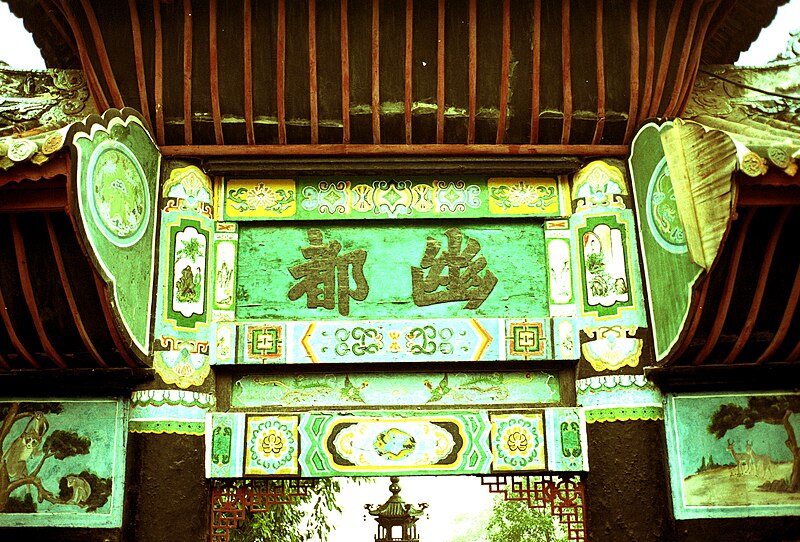
The Capital of Hell: The gate to the capital of the underworld, Youdu (right to left: 幽都). The whole underworld is called Diyu that is displayed in Fengdu Ghost City./source

After the building of Three Gorges Dam is built the Fengdu Ghost City will be an Island of itself, but parts of the city will be submerged in the water. They have also made some recent addition to the city.

In 1985 they built the Last Glance Home Tower, and according to legend, this is where the dead can have one last look back at their home and families before crossing over. Maybe one day, the Fengdu Ghost City itself will be something more of a legend than an actual place.

More like this

Newest Posts

https://www.atlasobscura.com/places/fengdhu-ghost-city