In a town made up of old houses or replicas of homes from the Joseon Dynasty, Yongin Folk Village has today status as one of the more haunted places in South-Korea.
Nestled right amid the modern city in Seoul, where high risers, public transportation and life are all from the 21st century, a small place where the traditional ways are allowed to remain in peace.
The place of Yongin Folk Village perhaps looks a bit familiar to those interested in Korean period dramas, and famous TV series like Kingdom, 100 Days My Prince and The Moon Embracing the Sun for instance. But for many it has also been known in the later years as one of Korea’s most haunted places.
The last few years, K-dramas has certainly taken over much of the media the world consume today. And although it is largely remembered from the overly romantic dramas with umbrellas in the rain and watching over people with a cold like they are on their deathbed, some more darker series has caught on. In fact…
Though the town Yongin Folk Village (한국 민속촌) itself looks real enough it was first opened in 1973 as a response of the rapid westernization as well as the industrialisation of Korea at the time.
Read More: Check out all of our ghost stories from Korea
This first open air museum in the country was supposed to work as a living museum and a destination to experience Korean culture, not only for foreigners to learn, but for Koreans to remember.
Traditional houses: Traditional thatched roofed houses from the late Joseon Dynasty are all around the Yongin Folk Village.
Yongin Folk Village is found in the Gyeonggi province right by the capital, and the over 260 houses were relocated from across the country and put together to be a replica of a village and how it would have worked and looked from the late Joseon period. So although the museum is a fairly new and modern thing, the things inside it are old, very old. And believing the many legends about the place, also very haunted.
The staff working in the folk village are all dressed up in costumes as well, representing characters from the Joseon Dynasty, contributing to the special atmosphere of the place. You can also attend workshops, watch performances or even host a traditional wedding ceremony there.
Ghost Month of Summer
So where do the tales of the Yongin Folk Village being haunted come from? With the old and mysterious atmosphere there are no wonders legends about the place started to come. The events that are held by the village have perhaps also been a contributing factor to the ghost rumors.
During the summer months the folk village hosts ghost events to highlight the ghost season which in Asia for most parts is in the late summer months. But also in later years Halloween later in the fall has become much more popular as well, and there are more than one ghost and haunted related events in the village.
But there are those who claim that the folk village is not only haunted by ghosts or gwisin during ghost month or Halloween, but all year.
Light your lanterns and get ready for The Ghost festival in Japan called The Obon Celebration. The festival, also known as Bon festival is a three day long festival each year in the late and hot summer to honor the dead.
Because there are those claiming to have seen actual ghosts around the village and in the supposed haunted old houses. Mainly tales of the Korean Virgin Ghost have been spotted with her dark long hair and wearing traditional burial clothes.
Performance: Dancers holding a traditional Korean dance performance for the visitors in Yongin Folk Village.
According to legend, virgin ghosts were women that died before being married, and very often held a grudge and power to avenge herself in the afterlife.
The Korean virgin ghost may be based on the ideals that all a woman needs is a husband, but the anger of these spirits tells of a woman with another purpose. And that is mostly vengeance.
Question is, could it be nothing more than an actor wearing a costume and being too good at their job in the haunted house section of the village, or could it actually be something supernatural afoot?
The wildest claim though is the rumor that this is the place where the legends of the Virgin Ghost started. Especially since most written notices about ghosts being spotted in the village are vague or connected to the haunted house events.
But when we look at the history of the Korean Virgin ghost, the legends about them trace back longer than the village itself. Although, perhaps the legend is as old as some of the houses that were relocated?
No place is free from a haunting on Iceland, not even the official house for the president known as Bessastadir were the ghost of a woman named Apollonia Schwartzkopf haunts the house after maybe have been the victim of poison.
Believing in ghost is nothing special or weird in Iceland. In fact, surveys shows that at least ten percent believes in the hidden people, otherwise known as elfs or Huldufólk. And no one is immune, not even the president of the country.
In the official residence of the president of Iceland at Bessastadir in Álftanes not long from Reykjavík, there is allegedly a ghost of a woman called Apollonia Schwartzkopf haunting the house, even to this day.
Apollonia Schwartzkopf was a powerful and rich Norwegian woman who came to Iceland in 1722 after suing the governour of Iceland at the time called Niels Furhman for fraud after he tried to break his promise to marry her after being engaged for 14 years. At the time Iceland was a colony under the Danish crown.
The Danish man working as the governor on Iceland was condemned and had to have Apollonia Schwartzkopf staying with him at Bessastadir until she died under mysterious circumstances.
Apollonia Schwartzkopf then came to Iceland and the wonderful house of Bessastadir to have Niels Furhman fulfill his promises as her husband as well as making him pay huge expenses for her as she was now lawfully his wife. But was it worth it though?
Poisoned by her Mother In Law?
Many sources of this story states that Apollonia died of a broken heart, although when looking at the details doesn’t seem very likely. The marriage with Niels Furhman at Bessastadir was not a happy one though, and according to all accounts they weren’t a good match in the long run. Sources say they didn’t sleep in the same bed or even dine at the same table together. She started to think that the mother in law was planning to poison her, something she confided in a man named Cornelius Wulff.
Apollonia Schwartzkopf died not long after though under strange circumstances of an unknown disease after she ate some porridge she herself claimed to be poisonous on Pentecost day, or on 20. June in 1725 in some sources. Her Danish mother in law Karen Holm also lived with them, and it was believed that she had killed Apollonia Schwartzkopf with poison, although nothing was proven during the trial.
Haunting the President at Bessastadir
The ghost at Bessastadir started to gain some attention when the influential people living in the house started speaking about her.
“I hear her at night, pacing the halls and going from room to room. Sometimes she comes up the stairs and walks in the corridors outside my room. And I say to her: ‘Please, Apollonia dear, be very welcome,’ ” the former president of Iceland and the world’s first elected female president, Vigdis Finnbogadottir, regularly told her visitors when they came to Bessastadir.
A paranormal investigator’s dream, the South Bridge Vaults in Edinburgh have been investigated for its hauntings on many occasions and many have left with a feeling of having experienced something paranormal and ghostly in the dark.
In the late 18th century Edinburgh was a growing community with a limited space in the Old Town nicknamed Old Reeky because of the bad smell and old buildings. The city is built around seven different hills and there are five main bridges connecting the slopes and hills of the town. That is also the reason for the high rise buildings of Edinburgh were they chose to build on top of the old to utilize the uneven location of the city.
The people of Edinburgh started to utilize the spaces under the South Bridge in the Old Town to make more room for business. The spaces within the archers under the bridge are also known as the Edinburgh Vaults or Niddry Street Vaults as well as just the South Bridge Vaults.
Advertisements
They look like a series of chambers next to each other and are actually of the 19 archers underneath the South Bridge. It was supposed to be a place with respectable businesses, but ended up becoming some of the more haunted corners of the very haunted city.
The Cursed South Bridge
According to legend, the place was cursed already from the start. The South Bridge that was built to connect the old town with the new town was completed in 1788, and already at the opening of it the locals deemed it as cursed.
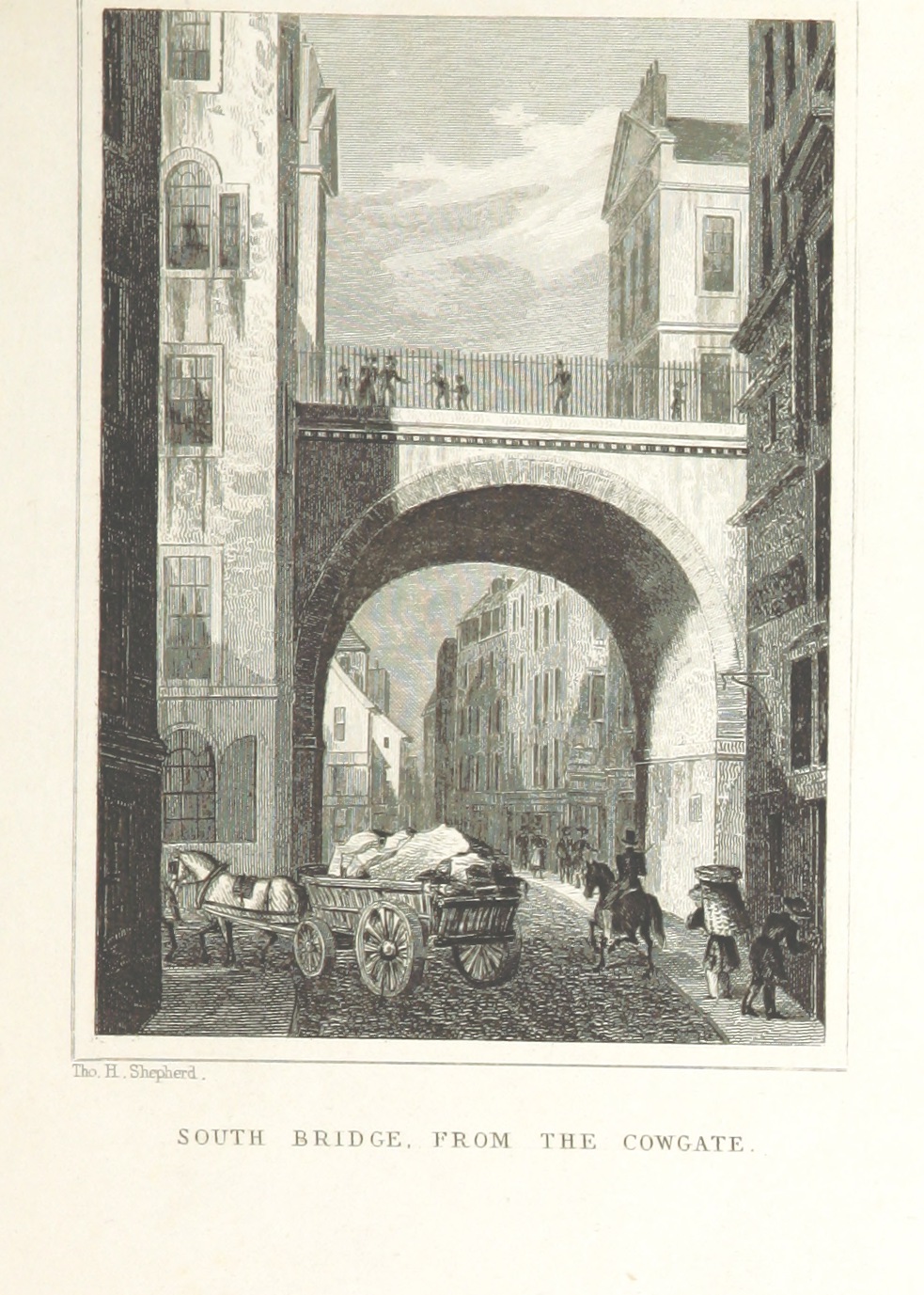
The South Bridge: The largest arch of the bridge, seen from the Cowgate.
It was seen as a grand opening and one of the respected Judge’s wives had been selected to be the first resident to cross the bridge as she was the city’s oldest resident. However, she died before the opening. To keep their promise to the elderly woman though, they decided she after all would be the first person to cross the bridge, although it was in her coffin.
The locals in Edinburgh were scared, now thinking that the bridge was cursed because of the unusual opening of the bridge. And looking back at all that happened on the bridge and in the vaults beneath it, perhaps it indeed was.
In the start, the South Bridge Vaults underneath the bridge were mostly used as taverns, workshops and as storage space for merchants. However it wasn’t long before the well respected businesses started leaving the area because of the poor facilities. The building of the bridge and the vaults underneath had been constructed on a low budget and even the construction itself had been rushed. Therefore they had taken no precaution to seal the surface against water and built it with porous limestone and the place became a damp and dark place which constantly flooded.
The Damp and Dark Underworld of the Vaults
No later than 10 years after the bridge and the vaults opened, respectable businesses like shoemakers, goldsmiths started leaving the area and those that could afford it relocated elsewhere as the murky vaults flooded and the sunlight never shone inside the South Bridge Vaults. It was a place no one wanted to be, and only those that had no other choice remained.
Advertisements
There was also a slum where the poorer people in town started to take over as the surrounding Cowgate area had developed into a slum during the industrial revolution. Crime, filth, poverty and murders were key words to explain the place as no sunlight came through.
More illicit businesses started to pop up in the area like brothels, shady pubs, gambling dents and illegal whiskey distilleries, turning the place into the red light district of the town.
The Legends of the Serial Killers Burke and Hare
A lot of horrible things happened inside these vaults during this time. Most of it, we will never know for sure. Legends however will be told. The South Bridge Vaults were where the body snatchers Burke and Hare were supposedly finding their bodies as well as killing them to sell them off to medical schools.
The Burke and Hare murders: The serial killings were sixteen murders committed over a period of about ten months in 1828 in Edinburgh, Scotland. They were undertaken by William Burke and William Hare, who sold the corpses to Robert Knox for dissection at his anatomy lectures. Here depicted in an etching of Burke murdering Margaret Docherty (also known as Margery Campbell) by Robert Seymour.
Although this legend is often passed down as fact, there is no actual evidence that the South Bridge Vaults was the exact place they got their bodies from, although very likely. The place to find poverty struck people and those that no one would miss if they suddenly ‘disappeared’ was inside the dark and damp vaults.
The Rediscovery of the South Bridge Vaults
At one point during the 1800s, exactly when is unsure, they emptied the vaults for people and started to dump tons of rubble in the vaults, sealing them completely off and making them inaccessible for the public and were kind of forgotten for a long time.
Advertisements
It wasn’t until the 1980s the tunnels to the vaults were rediscovered by a former Scottish rugby player named Norrie Rowan when he found one of the tunnels while he was renovating his flat. He spent the rest of his days excavating the vaults and rediscovering its history to make it accessible for the public once again.
The Ghosts of the South Bridge Vaults
There are many stories about who haunts the place today as the vaults have reopened and daily groups of tourists and paranormal investigators are taken down to the vaults to uncover the dark history.
Many people met their tragic fate on a daily basis down there in the vaults as well as suffered from horrible tragedies that affected the entire town. Like the Great Fire of Edinburgh that lasted for five days after it started in 1824 and took the lives of at least 13 people. There are many stories about victims that were trapped inside the chambers and suffered horrible consequences from then. Although there is no paper trail on this tale though.
There are many tourists that claim to have captured evidence of something paranormal going on, and they even make the newspapers from time to time. The same reports comes from the paranormal investigators that go down into the vaults and come back with what they see as proof of hauntings going on.
Advertisements
Here are some of the ghosts that are said to haunt the vaults until this date and have gathered enough reports to be a part of the haunted ghost tour in Edinburgh:
The Aristocrat
One of the first ghosts that people have reportedly seen over the years is that of the Aristocrat. He is said to be a rich gentleman with a tall black hat and a beard. He is not seen as the most angry spirit as he is known for grinning at visitors while leaning against the wall. People do have a tendency to feel uneasy in his presence though, according to those who claimed to have seen him.
The Happy Shoemaker
There is also a room that is believed to belong to a shoemaker from that time that is said to still practice his profession as a shoemaker.
He is described as a man in his 50s and is one of the ghosts that are said to be friendly and are often seen smiling and laughing by visitors while he happily carries on with his shoemaking while wearing an apron.
The Veiled Woman
In the room with the shoemaker known as The Room of the Cobbler, there is a meaner spirit though and is known as the veiled woman. She is believed to throw small stones at visitors as well. She is seen as a young woman dressed in black while wearing a veil in the north west corner of the Cobbler’s Room.
Women have also reported about feeling an intense rush of grief, anger and a sudden and unexplained abdominal pain, which has left many to believe it is a woman that lost her child in a horrible way and she is still grieving.
The Caretakers Room
In one of the chambers there are reports of a man sitting by the fireplace. He apparently looks like one of the more chill spirits in the place as well with a drink in his hand and legs stretched out. By his side he has a dog that is reported to brush up against people’s legs or sniff them.
Little Jack
Then there is the small boy named Jack or James that are often spotted in the Wine Vault. He is mostly seen as a blonde curly boy around 6 or 8 years old, wearing a blue suit with the classic knickerbocker trousers. Some sources want to connect him to a missing child case from 1810.
He is often playing with a red ball at times and is known to try to hold the hands of female visitors and likes to play around if there are children around. Allegedly, if he spots a person he doesn’t want to enter the South Bridge Vaults he will tuck their sleeves or coat when entering the Blair Street Corridor.
According to the guides down in the vaults, he is afraid of one of the more well known ghosts wandering the narrow alleys and small chambers. And that is that of Mr. Boots or also known as The Watcher.
Advertisements
The Watcher
Perhaps the most well known ghost in the South Bridge Vaults is that of The Watcher. There is a theory that he was a watchman and that is the reason he is known as The Watcher. Or maybe it’s because he always looks as if watching over something.
There are also alternative legends over the years that have tried to explain his presence, and many are also claiming him to be one of the slum landlords or even one of the body snatchers that hid his stolen bodies in the chamber known as The White Room. Today we can only speculate.
He is also called Mr Boots because of how many people in the vaults have experienced him. They can hear loud footsteps in The White Room or in the Niddry Street Corridor which is known as the most active place in all of the vaults.
His face has never been seen as it is hidden, blacked out or he is showing himself to the public with his back. He is supposedly this tall, slim and dark figure with a long flowing coat with his long hair in a ponytail. Sometimes he wears a hat and long boots. Sometimes he carries rattling keys and his breath smells disgusting of rotten teeth and whiskey.
People experiencing stuff within the vaults often get the feeling that he is trying to get them out from the narrow and claustrophobic spaces. Batteries on cameras die or malfunction when he’s present and he is known to push or pull people towards the exit as well as the phrase ‘Get Out’ has been heard on several occasions.
The Stone Circle
There are also rumors about an evil demon trapped inside one of the stone circles in one of the chambers. This is were the late Wiccan High Priest, George Cameron known as The Hermit set up his temple in the 90’s. It was in one of the vaults that have historic connection to the torturing of witches somehow.
According to him, he was trying to rid it from evil and built the stone circle which still stands today. He failed, however, to remove the evil that were supposed to be in the vaults and Cameron abandoned the room after he recommended to seal up the room to protect people from the evil within it. It is not sealed though as it is one of the stops on the tour through the vaults.
The Experience of the Hauntings
No matter the real story of the ghosts in the South Bridge Vaults and the true horror the people living there went through, the vaults itself are an interesting walk through time and history. And perhaps if you choose to go down into the dark chambers you too will hear the same that many claim to have on recordings and etched into their memories. The eerie sound of what can sound like children yelling and crying along with hushed voices and shuffling footsteps.
In a time when suicide was a sin, a man took his own life when he couldn’t have the woman he loved. His tormented soul is said to haunt the moors in Dartmoor in Devon, England were he was buried.
An unmarked grave outside the parish boundary lays the body of George Stephens that lived in Dartmoor in Devon, England. In some sources, he is called John. He committed suicide in 1763 or 62, depending on the sources, after his marriage to Mary Bray, a farmer’s daughter fell through.
There are conflicting variations as to why the marriage fell through. In some cases, it was the parents of the girl that rejected him because they deemed him unworthy of their daughter. In other variations of the legend though, she betrayed his love right before their wedding.
Advertisements
The Haunting Heartbreak
In his mind, Stephens was so in love with Mary and there could only be her for him. In some accounts of the story he would walk outside her home every night to keep an eye on her. It was then he found out she was cheating on him with his best friend only a week away from their wedding.
The Grave: The grave to Stephens can still be seen out in the moors in Dartmoor.// Source
In some versions he only spots her with another man at a fair in their village after her parents tore them apart because he wasn’t worthy. No matter if they actually were engaged or not, the pain of him not being able to be with her was too much for him to bear.
In many versions of the tale, Stephens kills her after her betrayal. It is most often by poison. Either a poisonous apple or deadly nightshade.
In other versions though, he only kills himself with a sort of poison used for rats and Mary lives on without him causing her any harm. It is then said she lived to be very old, but never married.
The Ghost at the Grave
Because of the manner of his death when he took his own life, he was not allowed a proper burial by the church and was laid to rest near Peter Tavy Moor, only marked by a granite post that you to this day can still see.
Shortly after his death, locals began noticing strange things happening out on the moor. His ghost was seen several times and the sound of shrieking could be heard in the night at his anguish. It is even said that a certain Rev. Dr. Jago of Tavistock was summoned to lay his spirit to rest.
If it worked though is not certain as the locals continued to be afraid to walk the moors in the dark in fear of running into the restless spirit of the man so tormented, the pain of it all continued into his afterlife and never gave him the rest he craved for.
Now a quaint Bed and Breakfast, the old Myrtles plantation manor houses more ghosts than living guests.
The old splendor of a plantation in Louisiana, not so far from Baton Rouge, is still quite clear when looking at the Myrtles Plantation. The antebellum mansion was first built in 1796 and is decorated with hand-painted stained glass featuring a French cross to allegedly ward off evil, the walls filled with Aubusson tapestry and from the ceiling, Baccarat crystal chandeliers hang.
But among the Carrara marble mantels and French furnishing there is something more sinister, more primitive than any riches, gold and luxury can cover over — The blood stained history and the legend of ghosts still haunting the place.
The old plantation was handed down from many people and in 1950, the house was sold to Marjorie Munson. It was she who started noticing strange things happening around the Myrtles Plantation and started talking about ghosts, that we still talk about today.
And the tales that are told are many — supposedly, the old plantation is one of the more haunted places in America with reports of at least 12 ghosts inside this Creole cottage style manos sitting on a hill. Although it is only historical records about the murder of William Winter, the number of murders in the house is allegedly 10.
The Legend of Chloe
The most famous ghost on Myrtles Plantation is without a doubt Chloe, or in some records, Cloe. She was supposedly a slave owned by Clark and Sara Woodruff, who took over the plantationin 1817 after Saras father, General David Bradford, who first built the plantation.
Advertisements
In 1992 a picture surfaced after the plantation took some photos of the property to send to the insurance company. When looking closer at the picture, something that looks like a girl can be seen. This is believed to be the ghost of Chloe, who still haunts the Myrtles Plantation with her green turban.
According to the stories, Chloe was one of the slaves that worked in the house rather than out in the field, which was a much more straining work than inside doing the cleaning and cooking. But perhaps it came with other dangers than grueling labor. According to the stories, she was forced by Clark Woodruff to become his mistress.
In some accounts though, Woodruff started having an affair with another girl and Chloe feared she would have to start working in the fields instead of in the house. And she started listening in on conversations to find out her faith or pick up on something that she could use against them.
In any case she was caught listening by the doors and punished by her slave owners. One of her ears was cut off and she wore a green turban to conceal it.
The Revenge
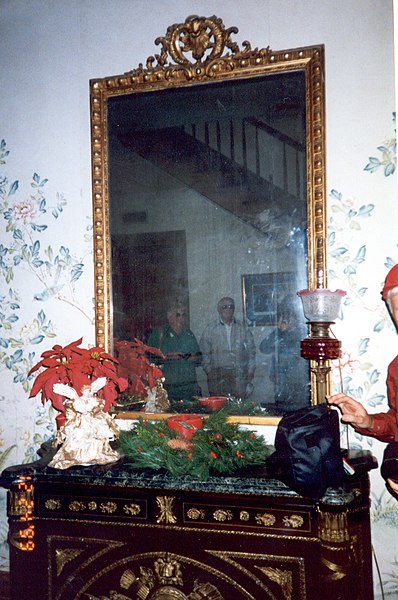
The Haunted Mirror: Where the spirit of Woodruff and her children lingers. Photo: Chris Light/1999
But it wasn’t the end at all, as Chloe planned her revenge on her slave masters. She baked a cake that she had poisoned with oleander leaves, which is extremely poisonous. Even the question of why she poisoned the cake is up for discussion.
Most accounts claim she did it for revenge after cutting off her ear. Another variant saying she was trying to gain favor with the family again as she was planning to cure the family for the poison and come out as a hero instead.
But according to the story, the plan backfired and only Sara Woodruff and the two daughters ate the cake and died from the poison. Chloe was then hanged by the other slaves and thrown in the Mississippi river, as a sort of final punishment for her or to not be punished themselves by Clark Woodruff for harbouring her.
A mirror in the house is supposedly holding the spirit of Sara Woodruff and her children. According to custom at that time, the mirrors were covered by a cloth so the spirit would not disappear into them. But after the poisoning, this particular mirror was forgotten and the ghosts of the victims can be seen in the mirrors and there are reports of handprints being left in the mirror, as their spirits are now trapped in the mirror.
The story about Chloe as a ghost is also told by the previous owner, Frances Kermeen, who also wrote a book on all the strange hauntings that she herself reported about experiencing on her second night in the house:
“I looked up and standing over me was a black lady. Her head was wrapped in a green turban,” I could see her [holding an] old-fashioned tin with the loop in it [through] the candlelight and I lost it. I started screaming…I reached my hand out to touch her, I could tell she was a ghost because she was see-through, but as my hand passed through her, she faded away.”
Do historical records support this though? There is currently not found any records of the Woodruffs owning a slave named either Chloe or Cloe. The legends say that Chloe killed both the wife and the daughters, but one of the daughters, Mary Octavia, survived and grew up to become an adult. And it is said that Sara and the other daughter, Cornelia, were not killed by poison, but by yellow fever in 1823 and 1824.
Either way, despite the historical records refuting the story, the legend about a woman wearing a green turban haunts Myrtles Plantation. Perhaps trying to tell a story that no historical records can?
The Other Ghosts
There are several pictures you can find on the postcards found in the souvenir shop at the plantation, the Chloe postcard being one of them. Another picture that stirred up quite some stories was the picture of a young girl dressed up in classic antebellum clothing that seems to look out from a window. She is now referred to as “The Ghost Girl” on the plantation.
Burial Ground
But the legend of Chloe is not the only claim of ghost sightings at the plantation among the Spanish Moss hanging from the giant oak trees. There is the classic tale that the house itself is built on an Native American burial ground, a trope of American ghost story tales that rarely can be substantiated. But even so, the ghost of a young Natice American woman has been reported.
In this case, the burial ground would be of Tunican tribes in the Mississippi River Valley, and the truth is that the land the manor now stands on used to belong to the Natives before being seized by the Spanish.
Civil War Soldiers
Advertisements
Another legend is about the Civil War and about how the houses were ransacked by union soldiers, and three people were killed. But exactly who was killed? The soldiers or the people living in the mansion? At the time, it was then Ruffin Gray Stirling and his wife Catherine Cobb that lived on the plantation with their slaves. It is true that they were robbed of their fine furniture and luxury items.
According to some of the variations of the legend though, it was the Union soldiers that were shot dead on the premises by the Confederates.
But something that is more up for debate is the supposed blood stain in the doorway, around the size of a human body remains that never will be completley clean after the supposed murders that happened then, no matter how well you scrub it.
The Voodoo Practitioner
The plantation is also the home of the ghost of a young girl that died in 1868, sometimes thought to be the girl in antebellum clothes from the picture. She was treated by a local voodoo practitioner in one of the 22 rooms in the manor, but died. She appears now in the room she died in and has been reported to practice voodoo on people sleeping in the room.
William Drew Winter
One of the other ghosts haunting this place is someone that either staggers or crawls up the stairs. He always stops on the 17th step. This is rumoured to be the ghost of William Drew Winter, the verified murder victim in the house. He was shot on the front porch of the house by a stranger. To get away, he crawled up the stairs but only reached the 17th step before he collapsed and died.
Several guests staying at the now B&B have claimed to hear the crawling coming from the stairs, and believing it could be other guests have gone to check. But when reaching the stairs, they find that no one is there, or worse, the apparition of his ghost, begging for help.
Although here, we have discrepancies in the story as a local newspaper reported that Winter died of a single shot that killed him instantly, and he had no possible way of crawling the stairs after the shot. But did he manage to in his afterlife?
The Plantation
No matter the fact we can now verify, the stories found of plantations from way back cast long shadows. All from the first contact between the natives and Spanish, throughout slavery and a bloody war. The darkest chapters of this plantation, is most likely the stories that we don’t know about.
Now a peaceful place for a road trip, it was once a hot spot for highwaymen and a dangerous place to travel. Sometimes, it was also dangerous for the robbers.
On a chilly Christmas Eve a woman and her father were riding in their carriage down the Road to Hawkhurst Kent. In the eighteenth century highwaymen were notorious and feared in the English countryside. They robbed whoever came their way, and sometimes, the robbery went more violently than necessary. And Hawkhurst housed some of the more notorious gangs and smugglers at the time, making the place feared along the English coast.
Alone With The Highwayman
Dangers on the road: A carriage was a sure sign of wealth and a target for the highwaymen. Photo: Asalto al coche (Robbery of the coach), by Francisco de Goya.
This had been the case of the young woman’s brother, who had been killed on maybe even the same road. But there was one road to take to get anywhere and the same family was again meeting an unfortunate end. The carriage was stopped by the highwayman Gilbert when they were around the village of Marden in Kent. He ordered the father and daughter out of the carriage to strip them of their possessions and valuables. But as soon as the daughter stepped on the ground, the horse bolted, carrying her father away, leaving her all alone with the robberer at the side of the road, seemingly helpless.
But the story comes with a twist seldom seen in other horror stories like these. A horror, not only by being robbed, dawned on her as she laid eyes on the face of the man. She recognised him, Gilbert, as the one who had murdered her brother as well. And she refused to see such a fate befall on herself. Enraged and afraid she drew a knife and stabbed the before he could take more from her by reaching for a hidden knife in her bag and planting it into Gilbert’s side and fled into the bushes.
When the father and the driver managed to calm the horses, they returned to the sight of where they had left her alone. There, all they could find was Gilbert’s dead body that they buried on the side of the road.
The Price of Her Life
It wasn’t until the next day the woman was found by the villagers of Marden, wandering around after having stabbed a man to death. All alone this cold Christmas Eve she had been fleeing from the danger from last night. But although she escaped alive, her body unharmed, it is told that during the night she had gone completely mad.
And every Christmas Eve since, the same scene, the robbery, the murder is repeated by their ghosts, first by Gilbert himself, then later perhaps joined by the woman.
There is more than one ghost at the old manor house in Norway. In addition to a classical Lady in Grey, there are stories about an orphan girl is forever confined to a strange country without her family, trying to lure other children to the same pond she died in at the Manor House in Larvik.
Far back in 1671, a ship came over from Denmark across the Nordic sea. In a time when Norway didn’t have its own king, the Lord High Steward of Norway, Gyldenløve, ruled the country in the danish crown service. He was also the founder of the city this story takes place in, Larvik, still a city today. And with it, he built the Manor House in Larvik that is today rumored to be haunted by more than one ghost.
Read More: Check out all of our ghost stories from Norway
The late 1600s was a time of living large. The wigs were tall, the makeup overdone and the dresses were huge. The french fashion was the only fashion and the kings and nobility had never been stronger.
The Haunted Mansion: The Manor House in Larvik was built to be finished to Gyldenløve’s third wedding in 1677. The Baroque mansion is today rumored to be haunted.
This lifestyle was however only reserved for the rich, like the people owning The Manor House in Larvik. But it was also a more modest soul crossing the ocean to work for these people.
The Young Seamstress with Half of a Medallion
When Gyldenløve came to Norway to found the Countship of Larvik and build the Manor House in Larvik he brought his Danish tailor as well. A young girl followed the tailor because of her skills as a seamstress to work for the High Steward of Norway. The young Danish girl was an orphan and the only relative was a brother, working as a blacksmith in Denmark and had no way of following her.
Before the two orphan’s mother died, she had given her daughter a medallion split in two. The children got each one of the half. They promised they would reunite the medallion when they met again after working. All alone she traveled to work at the Manor House in Larvik, hoping she would one time be back with her brother and see her country again.
It had only been a few years since she got to Norway and the year was 1677. It was just after Gyldenløves wedding with his third wife, 17 year old Antoinette Augusta Komtesse Aldenburg. The city of Larvik was still in a wedding frenzy as it wasn’t everyday the Count himself got married.
For the young girl however, the festive wedding days got an abrupt end and she died at the Manor House of Larvik. She never would see the white beaches of Denmark again, never the open flat fields. The last she would see was the bottom of a carp pond.
The Ghost of the Girl from the Koi Pond
The girl was found dead, floating in the koi pond in the garden at the Manor House in Larvik. She liked to sit there, feeding the carps, watching them swim under the surface. What happened that fateful day only she and the depth of the pond knows. People figured it was an accident as she didn’t know how to swim. Most think that the girl fell into the koi pond when she was feeding the fishes and no one heard her cries of help.
The 1600s and 1700s was a restless one for the ghost of the little girl. The locals in Larvik reported on observing her, haunting the mansion in this strange country she had found herself in and named her Piken fra Karpedammen (Girl from the Koi Pond). Young children seemed to see the ghost of her the most. Her ghost lingered for years, trying to lure children down to the pond. For what reason is uncertain. To help her in some way? Something more ominous like make them suffer the same faith she did?
The Girl from the Koi Pond: The Manor House of Larvik was said to be haunted by the ghost of a young girl that used to work in the mansion. She was said to appear close to the koi pond were she was found drowned.
In any case, the legend has it one can only make her find rest with reuniting her medallions she and her brother shared and thereby giving them peace in the afterlife. The fact that people have reported about seeing her ghost less and less in the later years, gives hope that she somehow found peace.
This is what is told in the legend of Comtesse Juliane Sophie, the daughter of the Count a hundred years later. The young Comtesse came from Denmark when she was 9 years old in 1766. She was said to have seen the ghost of the girl and somehow reunited the medallion the girl was rumored to carry and therefore giving the siblings spirits the rest and peace they were looking for.
The Grey Lady of the Manor House in Larvik
But the ghost of the girl in the koi pond isn’t the only one walking the Manor House in Larvik after her death. There is also suppose to be a grey lady haunting inside the mansion that have been called the Grey Lady in Larvik, or Den Grå Damen i Larvik as she is known as in Norwegian.
The Grey Lady of Larvik: The Manor House in Larvik is also haunted by a woman wearing grey that moves around the furnitures in the mansion.
But of her ghost and who she is, we know less of. We know the Grey Lady in Larvik is supposedly the woman in a painting hanging in the hall called the knight hall. It is the only picture were the people isn’t identified hanging in the Manor House in Larvik.
People that have visited the Manor House in Larvik claim that the picture itself is creepy and perhaps the thing that ties the ghost to the house. When visitors walk around the room it hangs in, they claim the woman in the painting watches and her eyes are following them.
In the addition of the eerie painting and appearing in the corner of the eyes for the staff and visitors, the Grey Lady of Larvik also reported to be somewhat of a classical poltergeist according to the legends. It is said that her ghost is moving around the chairs and other furniture in the mansion.
According to people that have visited the mansion, the ghost of the Grey Lady seems to be active even to this day. Unlike the ghost of the girl in the koi pond, it seems that this ghost still has some unfinished business and haunts the halls of the Manor House in Larvik until further notice.
An online magazine about the paranormal, haunted and macabre. We collect the ghost stories from all around the world as well as review horror and gothic media.