Tag Archives: 1500s

The Ghost of Kathleen who Loved St. Kevin in Glendalough

Advertisements

In the Monastic City of Glendalough in Ireland, the ghost of Kathleen is still haunting the place as her love for the hermit, St. Kevin went wrong. Did he really just reject her? Or did he in fact kill her as well?

“In Glendalough, there lived an auld saint, renowned for his learning and piety, his manners were curious and quaint, and he looked upon girls with disparity.”
The Glendalough Saint

In the heart of the enchanting Glendalough in the valley between two lakes, nestled amidst the lush landscapes of County Wicklow, Ireland, lies a centuries-old legend that continues to cast its spectral spell in the place called the Monastic City. 

Glendalough is where one of the earliest monastic settlements was founded by St. Kevin in the 6th century. He was known for his hermit life and pious look at life in prayer and meditation. It is said he died when he was 120 years old and has a lot of strange and mystical legends surrounding him and his life. 

Two Tales of Love and Remorse

One of the legends is the tale of the ghost of Kathleen haunting the monastic site of Glendalough. She is said to be a woman wearing red whose ethereal presence has etched itself into the annals of Irish folklore and was also published in ‘Haunted Ireland: A Select book of famous Irish ghost stories’ by Leo Bowes in 1975.

St: Kevin

There exist two versions of Kathleen’s haunting narrative, each weaving a unique tapestry of love, desire, and redemption.

Kathleen the Seductress

In the first version, the story unfurls with a local maiden named Kathleen, captivated by the youthful and handsome St. Kevin who was living as a hermit and not looking for earthly love. Although she knew this she sought to seduce the holy man. Yet, St. Kevin, resolute in his faith, rebuffed her advances. 

When she didn’t give up her advances though, he plucked stinging nettles and stung Kathleen upon her face, arms, and feet until her senses returned. Overwhelmed by remorse and shame of what she had done, Kathleen fell to her knees, pleading for forgiveness. St. Kevin, ever the symbol of mercy, offered up prayers to help her see the error of her ways. 

His prayers found favor with the heavens, and Kathleen underwent a profound transformation, becoming a “sincere convert” to the path of righteousness and to lead a pure life from then on.

Kathleen the Witch

The second version of this beguiling legend paints a darker portrait of Kathleen, one of obsession and tragedy. In this rendition, Kathleen, possibly a practitioner of the dark arts and a witch, became so infatuated with the young St. Kevin that she followed him to his remote cave, perched high upon the side of Lugduff Mountain, now known as St. Kevin’s Bed. 

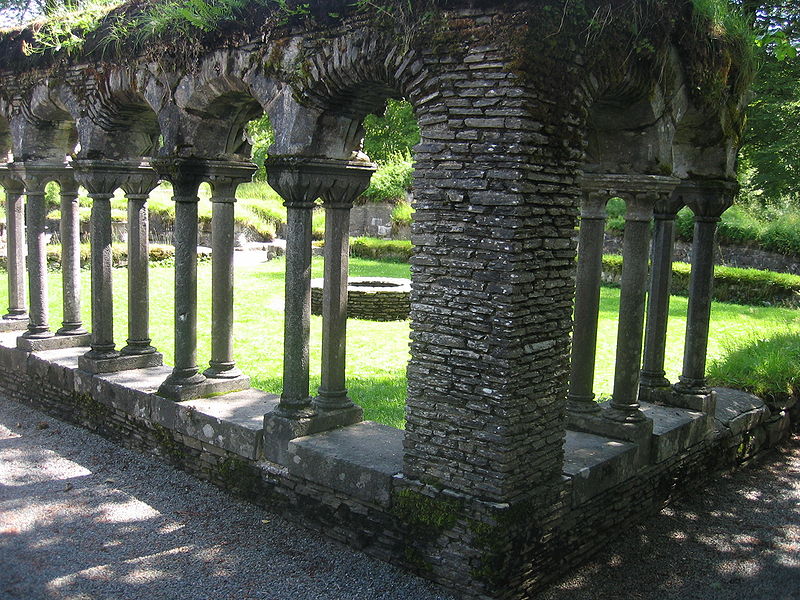
St. Kevin’s Cell: was a stone structure located on a rocky spur above the lake. Only its foundations remain today, and it may have had a stone-corbelled roof. St. Kevin’s Bed is a cave in the rock face, situated about 8 meters above the Upper Lake’s level on its southern side, near The Spinc cliffs. It was traditionally considered a retreat for St. Kevin and later for St. Laurence O’Toole. Partly created by human hands, the cave extends 2 meters into the rock.

This is a cave in the rock on the south side of the Upper Lake and was reportedly a retreat place for St. Kevin spent large parts of his life alone. 

Read More: Check out all of the stories about Witches at the MoonMausoleum.

Fueled by anger that she had forced her way into his holy place of solitude, St. Kevin pushed Kathleen over the precipice of the mountain cliff, where she met her untimely end in the waters below, drowning.

This is the version we find in the folk song about this legend as well, that were made famous when The Dubliners sang it:

Eerie Apparitions in Glendalough

Through the ages, the spectral presence of Kathleen has manifested itself to those who tread the hallowed grounds of Glendalough, leaving an indelible mark on the fabric of local history and lore.

The Wicklow People newspaper, in an article dated April 25th, 1975, documented three chilling sightings of this enigmatic ghostly figure.

Read More: Check out all of the ghost stories from Ireland

The first account speaks of a couple who visited Glendalough on All Souls’ Day in 1970. Armed with their camera, they captured the serene beauty of the landscape. Upon developing their photographs, an unexpected and unsettling sight emerged—a weathered old woman, shrouded in a shawl, standing just a few feet away from the photographer’s fiancé.

St. Kevin’s Church: It is commonly referred to as St. Kevin’s Kitchen, although it was not used for cooking. Its original purpose is unknown although it may have been used to house relics of St. Kevin.

The second sighting involves an American visitor and her daughter, who embarked on a tour of the site in November 1974. When the film from their trip was developed, their images revealed an astonishing figure—a woman draped in a long red gown and shawl, her steps quickening along a path leading to the ancient tower.

The third report comes from Dick Fuller, an American who chose to spend St. Patrick’s Day in Ireland in March 1975. During his visit to Glendalough, he bore witness to something truly extraordinary and said this of their encounter:

My wife had gone to see if the gift shop was open, while I visited the cemetery. I walked from the entrance to the Tower and went around to see if I could read the inscription on the back of the stones. I glanced around to see if my wife was joining me and, as I did so, I saw a red figure moving from the left to the right, towards a fallen down building. I thought it was another person in the cemetery. I walked towards the ruins, expecting to see a person dressed in red, but there was no one there’. He continued ‘Since there was only one entrance the person couldn’t have appeared without passing me… as far as I am concerned, I saw a ghost.

The Monk in Black Robe

The ghost of Kathleen in Red is not the only ghost said to haunt the ancient place though. More recently there have been reports about seeing someone that looks like a monk wearing a black robe. 

This comes from a camping trip in the early 2000 when a group of friends decided to set up a tent on the ancient site. They fled soon enough though when they heard footsteps and suddenly saw a group of monks standing close to them, watching them. 

Glendalough Mysterious Charm

In the Glendalough, where the mists caress the ancient stones and the wind whispers tales of old, we find the conclusion to the haunting legend of Kathleen and St. Kevin.

While the truth about Kathleen’s fate remains shrouded in mystery, the legacy of her ghostly presence lives on. In the Monastic City of Glendalough, visitors still report inexplicable sightings and eerie encounters, as if Kathleen’s spirit lingers, eternally bound to the place that holds both her love and her tragedy.

Although the stories differ, whether depicting Kathleen as a seductress seeking redemption or a witch consumed by obsession, the underlying message remains the same. Love, desire, and remorse intertwine in the tapestry of this haunting tale, reminding us of the power of our choices and the consequences they bear.

Glendalough: A glacial valley known for its Early Medieval monastic settlement, established in the 6th century by St. Kevin. The valley was the site of a galena lead mine from 1825 to 1957. Today, Glendalough serves as a recreational area, offering opportunities for picnics, hiking on well-maintained trails of various difficulty levels, and rock-climbing.

As the ghostly figure of Kathleen continues to materialize in photographs and stories, the ethereal beauty of Glendalough’s landscape becomes intertwined with her spectral presence. Her apparition, dressed in red, stands as a reminder of the longing and heartache that transcends time, leaving an indelible mark on those who encounter her.

And as the misty veil of Glendalough parts to reveal the specter of St. Kevin, a monk in a black robe, it becomes evident that the Monastic City holds more secrets than can be comprehended. The sightings of this enigmatic figure, together with Kathleen’s ghost, add to the mysterious charm that permeates the air, captivating and intriguing all who venture into this ancient place.

As the sun sets over the ancient ruins, and the shadows lengthen, the ghostly whispers of Kathleen and St. Kevin still resonate through the valley. Glendalough remains a place of intrigue and fascination, inviting all who are drawn to its enigmatic charm to experience the ethereal touch of Kathleen’s ghost, forever wandering the sacred grounds of her lost love.

More like this

Newest Posts

References:

The Ghost of Glendalough – County Wicklow Heritage 

Kevin of Glendalough – Wikipedia 

Glendalough | Haunted Wicklow, Ireland | Spirited Isle 

The Haunted Dungeon at Rosenkrantz Tower

Advertisements

The Rosenkrantz Tower in Bergen Norway is one of the oldest buildings still standing and was once the house for kings. Today it is used as a museum and perhaps they also have some of the oldest ghosts still lingering in the dungeon. 

On the old dock in Bergen city you mostly find old buildings dating all the way back to the middle ages when Bergen was the capital in Norway throughout the city’s time as a Hanseatic trading city. Today the fortress the Rosenkrantz Tower is a part of a museum and is considered one of the most important renaissance monuments in Norway. 

One of the old buildings is Rosenkrantz Tower, which still is one of the taller buildings in the city and was once known as “The Castle by the Sea” as it used to be a residence for kings when Bergen was the capital in Norway. 

The Kings Tower

Rosenkrantz Tower was originally built for the king Magnus Lawmender in 1270 and a lot of the original building can still be seen today. King Magnus Lawmender got his nickname after working extensively on the laws in his country, and much of today’s Norwegian constitution comes from his work. 

After the capital in Norway was moved to Oslo and Norway became a part of the Danish kingdom, the keep the tower is part of lost its importance as a royal seat, but was still used as a military keep.

Although the cannons in Rosenkrantz Tower have only been fired one day during war in 1665, the tower has seen its fair share of war. In 1944 during world war two the Rosenkrantz Tower was heavily damaged when a cargo ship with explosives exploded right outside. The upper floors collapsed, but the foundations of the tower still remained, like the dungeon in the tower. And deep down in the darkness of the dungeon in the tower, some former prisoners are said to still linger. 

The Haunted Dungeon

The dungeon in Rosenkrantz Tower was added on to the tower around 1500 and the final tower as we see it today was finalized in the 1560s by Erik Rosenkrantz who was a governor of Bergen Castle during a time when Norway was under Danish reign. He was at the time one of the wealthiest men in Denmark-Norway and work on the tower was done by Scottish builders, explaining the Scottish look from the time. 

The

The dungeon served as a prison where they kept the prisoners who were considered to be very violent and often some of the poorest. These are the prisoners that are rumored to be still haunting the dungeon. 

An architect named Peter Blix reported in 1884 that old people living at the time still remembered the last prisoner in the cell in Rosenkrantz Tower. So perhaps the dungeon was used in the early 19th century? 

You can walk inside of the tower and follow the hollowed and wobbly stairs down to the basement where you can barely stand up straight. The cells are small and the only light is from the cracks in the walls. Still to this day you can see claw marks from the prisoners that were confined into the dark small cells when it was used from the 16th to the 19th century. 

The irony of it all is that so many of the prisoners were convicted by the laws that the original builder, King Magnus Lawmender, made during his reign just a couple of floors above the dungeon they are forever kept. 

More like this

Newest Posts

References

Featured photo: Wikimedia/Rüdiger Stehn

The Most Haunted Places in Bergen 

Rosenkrantztårnet – Lensherrenes slott i Bergen sentrum – Bymuseet

The Bergen Map | Rosenkrantztårnet

Agnes Sampson — The Wise Wife of Keith

Advertisements

The story of the ghost of Agnes Sampson, known as The Wise Wife of Keith in Scotland is a story where a simple midwife was accused of witchcraft so powerful she caused a storm trying to kill her own queen. 

Agnes Sampson was a Scottish healer and a purported witch. Sampson was born in the village of Kirktoun, East Lothian in Scotland and worked as a midwife. She was believed to have healing powers long before she was accused of being a witch. 

She became known as the Wise Wife of Keith and was involved in the North Berwick trials that happened during the 16th century, one of Scotland’s most notorious witchcraft trials. Agnes Sampson is also known for being one of the main accused at this trial. 

There were and still are many tales about who Agnes Sampson really was. Some of them are true tales, some tall tales. She is said to have been married three times, once to William Keith with whom she had two children. She is also said to have been married to two other men and had 14 children with each man. 

So how did this simple midwife become the center of a conspiracy of witches trying to sink the ships belonging to their new queen and threatening her own King? To find out we have to travel across the pond to the court in Denmark-Norway and their fear of black magic and a series of unfortunate events on the sea. 

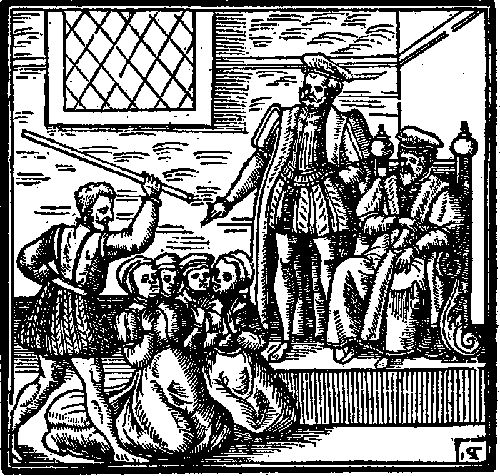
The King as the Judge: Suspected witches with Agnes Sampson kneeling before King James VI from the book Daemonologie (1597). He himself oversaw the trial and ended up sentencing many to be burnt as witches.

The Storm of Contrary Winds

By the autumn of 1590, Scotland was deep into witch hunts, and many of those sent to trial were questioned by the King himself. Today, the city of Edinburgh and the rest of the country is riddled with the memory of those who were burnt at the stake as a witch. King James VI, the son of Mary, Queen of Scots had just returned from Denmark-Norway where he had married Anne of Denmark who was only 14 at their wedding. 

Read Also

Edinburgh Castle Ghosts and Legends

Witches, dragons and ghosts, Edinburgh castle are said to have it all. The sound of bagpipe and drummers can be heard without anyone playing, and those accused for witchcraft as well as prisoners of wars are said to haunt the old castle.

Keep reading

The Danish court at this time was extremely wary of all things black magic and witchcraft. The fear of demons and witches had tightened the European continent and it was probably a fear that the Scottish King James adapted and brought back as well after spending time there. 

The King of Scotland was impatient awaiting his bride from Denmark to cross the seas after the wedding to stay by his side, but on her voyage to Scotland the fleet experienced heavy storms and ended up starting not only one, but two major witch trials that ended in several executions.  

A Series of Unfortunate Events

So how did a simple midwife like Agnes Sampson get accused of something that happened all the way over in Denmark? To this we have to go through the Danish court and the witch trials that happened there before it started in Scotland. 

Peder Munk of Estvadgård was a Danish navigator, politician and ambassador and in charge of carrying the fleet of 18 ships with Anne of Denmark to Scotland to bring her to her throne by her King. They set out on their voyage in 1589 from Copenhagen and were riddled with bad fortune, taking years to reach their final destination.

First they had to stop in a port in Norway to repair a leaking ship and had to stay there for a very long time, on their way to a very impatient king. When they reached The River Forth in central Scotland a ferry boat collided with one of the vessels in a storm and all of the passengers drowned. This was all attributed to witchcraft. 

Back in Denmark, the navigator Peder Munk blamed it all on witchcraft, especially on a certain woman whom he had insulted and believed to be the main witch behind the storms. This became the beginning of the Copenhagen witch trials, which ended in executing 17 people by burning. 

This inspired the King to hold his own trials, and it would be known as the North Berwick Witch Trials, and Agnes SAmpson was one of the main accused. 

Accused of Witchcraft

More than a hundred suspects were arrested in North Berwick, several of them confessed during torture and named other people. Agnes Sampson was accused by Gillis Duncan, another one of the accused. 

Duncan was really the one that linked the other accused of causing the storms that ended up sinking the Queens ships. She worked as a servant and confessed after torture that she was a witch and there were several more. The reason she was accused herself was that she was far too skilled of a healer in her master David Seton’s mind who also thought that Duncan had been sneaking out at night. 

Agnes Sampson ended up being one of the more significant accused persons, as an elderly and respected woman that had healed more than one in the local area. Many attributed their good health to her good work. Now, they all turned on her because of the rumors and her unfortunate circumstances. The fact that she was a widow with children and acted as an independent woman and educated midwife was a part of the indictment against her. She had also been accused of witchcraft and investigated before. 

Witches Sabbath: According to the accusers, Agnes Keith and the rest of her witch coven had met up and created a storm to keep a ship from Denmark arriving to Scotland, carrying Anne of Denmark.

The Wise Wife of Keith was imprisoned and put to torture for a long time before saying anything. She started off refusing to confess at first, but after a long time in the dark and in pain, she as the rest of the accused gave up. 

In the end she was brought before King James VI himself and a council of nobles at the Palace of Holyroodhouse. Sampson denied all the charges, but they kept torturing her until she said otherwise. Her head and body hair were shaved and she was pinned to the wall of her cell with a witches bridle. This was a torture instrument with four sharp prongs pressed into the mouth, meant to humiliate as well as hurt the ones wearing them. 

She was forced to stay awake with no sleep in her cell with a rope around her head, always reminded just how close to death she really was. And in the end, how freeing that prospect must have seen compared to the torture she went through. 

Finally, after all that torture, Agnes Sampson confessed to whatever they asked of her in front of her own king who oversaw the trial. In all she confessed to 53 indictments against her, including attending a Sabbat she led and that she was indeed a witch with supernatural power she used to harm others with. 

According to her testimony, she ended up saying she made a charm that caused a storm that ended up drowning Jane Kennedy. She sank a dead cat with parts of a dead man into the sea near Leith. The same charm she used to threaten the King and his wife on her voyage. 

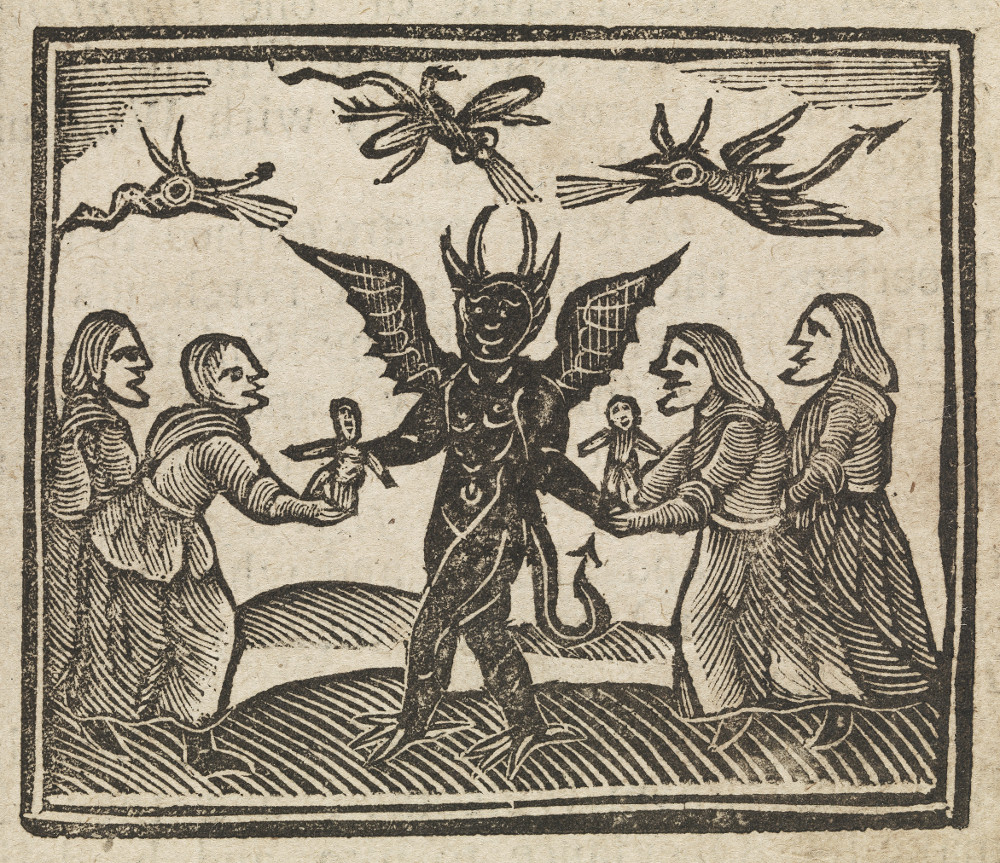
In League with the Devil: Depiction of the Devil giving magic puppets to witches, from Agnes Sampson trial and North Berwick Witch Trials where she and many others ended up being burnt as witches in 1591.

It was her last testimony that was her downfall in the King’s eyes. In it, she disclosed things he and his wife had on their wedding night in Oslo. A conversation she had no way of knowing:

“Item, the said Agnes Sampson confessed before the Kings Majesty sundry things which were so miraculous and strange, as that his Majesty said they were all extreme liars, whereat she answered, she would not wish his Majesty to suppose her words to be false, but rather to believe them, in that she would discover such matter unto him as his majesty should not any way doubt of. And thereupon taking his Majesty a little aside, she declared unto him the very words which passed between the Kings Majesty and his Queen at Oslo in Norway the first night of their marriage, with their answer each to other: whereat the Kings Majesty wondered greatly, and swore by the living God, that he believed that all the Devils in hell could not have discovered the same: acknowledging her words to be most true, and therefore gave the more credit to the rest which is before declared.”

— News from Scotland

Execution and Haunting

King James was allegedly not completely convinced of Agnes Sampson guilt until her last confession. After it however he changed his mind and sent her to be burned. On 28th of January 1591 she was taken to the scaffold on Castlehill where she was garroted before being burnt at the stake. 

Although the exact numbers of the executions are hard to be certain of, it is estimated that around 1500 people were killed as witches by the state of Scotland during this time. 

Agnes Sampson’s naked ghost is said to roam the castle grounds, bald headed roaming around the Palace of Holyroodhouse. 

More like this

Newest Posts

References

Unraveling the Mysteries of the Haunted Château de Châteaubriant

Advertisements

Step into an ancient castle filled with darkness and stories that will send shivers up your spine of murder and ghosts. Inside the old Château de Châteaubriant there are tales of ghost processions on October 16.

Step into the eerie and mysterious Château de Châteaubriant, a magnificent 15th century castle and one of France’s most haunted sites. Enter its dark and imposing halls originally constructed as a defense against Anjou and the Kingdom of France, laden with dark secrets, to experience an unforgettable journey through time. Learn about its chilling legends, hidden secrets, and unsettling specters that linger in the shadows.

History of the Château de Châteaubriant

The Château de Châteaubriant was first constructed in the 11th century, but was heavily modified during the Renaissance which the architecture bears marks of. 

It was taken over by the French during the Mad War after a siege. Over the centuries, it changed hands many times – from its aristocratic owners, to prisoners of war during the revolution, and back again. 

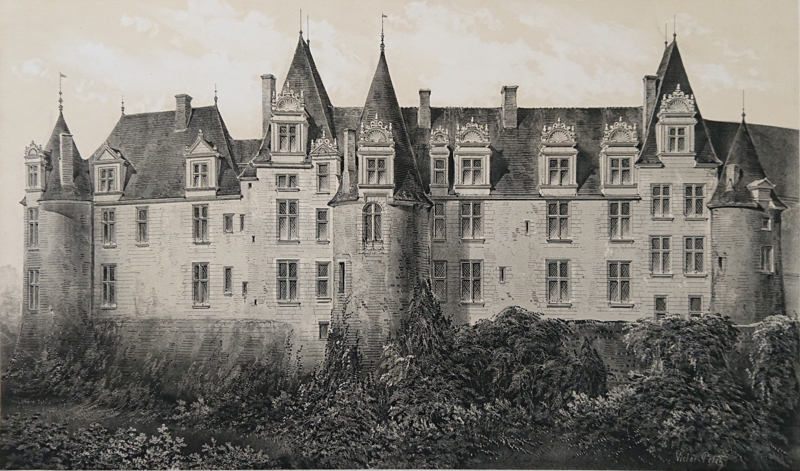
Château de Châteaubriant: drawn by artist Victor Petit in 1871. Already at this point the history of Château de Châteaubriant was old and steeped in legend . It is also said that ghost are walking the halls of the castle every year on October 16th.

Sybille the Shocked Ghost

One of the most famous legends behind the Château de Châteaubriant’s rumored hauntings is that of Sybille, wife of Geoffroy IV. 

Geoffroy IV of Châteaubriant went on crusade to the holy land in the 1250s with King Saint Louis where he was jailed in Egypt after the battle of Mansourah and the entire French army was destroyed by the plague. His death was announced to the Châteaubriant and his wife. 

Sybille, often named Sibylle de la Guerche de Candé started to mourn the death of her dead husband. He wasn’t dead however, and was released from prison and returned to his home and wife a couple of months later. When Sybille saw him again, she fell into his arms and died of the shock. 

She is said to haunt the Château de Châteaubriant at times, but the real haunting is said to be done by the infamous Françoise de Foix, the main mistress of the King of France that did not bear the same loyalty to her husband as Sybille.

The Ghost of Françoise de Foix

In addition to Sybille and other ghosts that are said to haunt Châteaubriant, many also believe in the spirit of Françoise de Foix. She was a tall and dark haired woman that spoke both Latin and Italian as well as writing her own poetry. All of her attributes made her a well sought after woman, and even the King wanted her. 

She was engaged to Jean de Laval, count of  Châteaubriant in 1505 with support of the king and queen Anne de Bretagne and Louis XII. They formally married in 1509 and lived at Château de Châteaubriant.There was a shift in the royals and the new king, Francis I, summoned Jean de Laval to court for his help in 1516. 

Françoise de Foix followed him and became the lady in waiting for Queen Claude de France as well as becoming the chief mistress to King Francis I. At official events she was placed near to the royal princesses, signifying that she was La mye du roi, or the Sweetheart of the King to the rest of the court.

Jean de Laval was sent to fight in the Italian Wars and became Governor of Brittany in 1531. He was aware of the affair but seemed unaffected by it all when his wife remained the King’s mistress for over a decade.

Françoise de Foix was rejected from court in 1525 when the young and blonde Anne de Pisseleu d’Heilly caught the King’s attention and affection. Because of this, she returned to Châteaubriant to live with her husband. 

Killed by her husband Jean de Laval

She died on 16th of October in 1537, most likely of sickness are we to believe some. There is however a different theory. It is said that her husband killed her. 

Read also: This is not the only story of a ghost haunting a French castle after a woman was killed by her husband: The Prisoner of Château de Puymartin

Jean de Laval, also known as John III of Laval-Châteaubriant was according to legend, an incredibly bloodthirsty baron who killed anyone who opposed him and ruthlessly tortured his enemies. 

It is said that he shut his wife in a dark and padded cell and had her killed because of her relationship with the king or something else entirely. Some even think that he locked her up and poisoned her or bled her to death slowly.

The Assassination of Françoise de Foix: The legend of her death are widespread and depicted in art. Here from a book from 1816 by Augustine Gottis.

Ghost Procession at Midnight

Some say they can still hear her weeping within the walls of Châteaubriant and others have even seen her standing near windows or atop towers in traditional 16th-century dress, but perhaps she is best known to appear in the ghost procession on her death anniversary.

Ever since then, there have been a ghost procession in the Château de Châteaubriant in honor of her death on October 16 of monks and knights slowly ascending the main stairs before vanishing. Her ghost is said to come back for this night as the procession begins at the stroke of midnight. 

More like this

Newest Posts

References

Featured Image: source

Françoise de Foix — Wikipédia 

Château de Châteaubriant – Wikipedia

Les fantômes sont des choses qui arrivent – chateau-chateaubriant

Le château de Châteaubriant et la légende de Sibylle

Lady Janet Douglas, Ghost of Glamis Castle

Advertisements

Lady Janet Douglas is said to haunt the Glamis Castle in Scotland after being burned at the stake after being entangled in court politics and being an enemy of the King. 

Glamis Castle is said to have inspired one of Shakespeare’s most famous plays, Macbeth, a play so haunted you are not supposed to say the title out loud inside of a theater. The old castle is located in Angus, Scotland, not far from Edinburgh and is considered one of Scotland’s most haunted castles.  

There are many mysteries surrounding this place, from the monster of Glamis, the ghost playing cards for the rest of the eternity and many more apparitions and legends. One of the ghosts residing in Glamis Castle is that of Lady Janet Douglas, also called Lady Glamis. 

Lady of the Castle

The story behind Lady Janet Douglas and her death is rooted in the bloody battle for power and revenge in 1500s Scotland. King James V was remembered as the vindictive king and of his paranoid fear of his nobility, leading to the death of many of them, Lady Glamis being one of them. 

King James V had Lady Janet Douglas accused of treason against him, although it was clear that the accusations were false. Her only crime was that she was the sister to the King’s stepfather, Archibal Douglas, Earl of Angus, which the king hated after having been imprisoned by him for years before escaping. 

Lady Janet Douglas: A portrait of the Lady Glamis as she was seen as a great beauty when she lived.

The Douglas and Stewart families had been battling for power in Scotland for generations. When King James V’s mother, Margaret Tudor became a widow, Archibald Douglas married her and took control over the kingdom as King James was just a child. 

Living as Archibald’s prisoner for years and having taken the power away from him, the hatred King James V had for the Douglases grew. His hatred for Angus extended to the whole family and he wanted them gone when he finally escaped. 

Charged for Murder and Treason

In 1528, upon the death of Lady Glamis first husband, John Lyon, 6th Lord of Glamis, Lady Janet Douglas was immediately summoned for treason, accused of supporting the civil war against the King and of poisoning Lyon who died on 17th of September 1528. 

Her being unwed left her vulnerable and a target for the King’s vengeance against her brother. Lady Glamis brother, the king’s stepfather was already exiled and King James had seized all his land and property he was once a prisoner in. Now he sought revenge on the one he could get his hands in.

Charges were eventually dropped, and Lady Glamis were free to go back to Glamis Castle. She went on to marry Archibald Campbell in 1532, having ceased all communication with her brother and the rest of the Douglas clan to prove her innocence in any plot against the King. 

Her Final Arrest

Lady Janet Douglas’ reprieve was short-lived, however, as in 1537, she was once again summoned away from Glamis Castle for treason, and this time the King was going to have her punished. There were several reasons as to why she was picked out, one of the reasons was because of her beauty. She was seen as a unique and one of a kind beauty among the nobles and when her first husband died, she had several suitors. 

One of them was William Lyon, a close friend of her first husband. His obsession for her only grew and when she married Campbell, it turned sour. He started whispering in the king’s ear about her plans to poison him, and the king, looking for any excuse to get back at the Douglases, listened intently. 

Lady Janet Douglas was imprisoned with her husband and her son John in a dungeon of Edinburgh Castle, a castle riddled with rumored ghosts as well. Her husband managed to escape from prison, but was later killed when he was found. 

This time, the charges brought against Lady Glamis included being in secret talks with the Douglas clan, attempting to poison the King. To capture Lady Janet Douglas was easy enough, but to convict her for being a witch was more difficult as Lady Glamis reputation was impeccable and a loved character.  

The Lady Burnt at the Stake

To gather enough evidence for a conviction, King James had Lady Janet Douglas family members and servants imprisoned and tortured until they gave answers that he wanted.

In later years she has been remembered as being an accused witch, but nowhere in her files does it say she was ever accused of witchcraft as well. Perhaps it would have been better for her, as those accused of witchcraft were often strangled before being burned. Traitors didn’t have that luxury. 

In the end they all talked and Lady Janet Douglas was convicted. When they led her out from the dungeon, she was nearly blind after being kept behind bars in the dark for so long. Lady Glamis was burned at the stake on 17 July 1537 by Edinburgh Castle and It is said King James forced her young son, John from her first marriage to watch her agonizing death before letting him go.

Lady Glamis’ son was also sentenced to death, but because of his young age, he was not to be executed until he reached eighteen. Luckily for John, the king died before then and was pardoned, reclaiming his property of Glamis Castle and becoming the seventh Lord Glamis.

The Haunted Glamis Castle

Not many years after Lady Glamis’ execution, reports about a gray lady started to appear around the Glamis Castle grounds and people kept seeing this ghost, believing it to be her.  The castle is not the only place her ghost is said to have been seen though. In Edinburgh Castle, were she was held captive and at last burned alive, there have been reports about a ghost reminding them about the Lady Glamis as well.

The Haunted Castle: There are many mysteries if you delve into the legends surrounding Glamis Castle, from the monster of Glamis, the ghost playing cards for the rest of the eternity and many more apparitions and legends.

Back at Glamis Castle, she has been reported around the Clock Tower as well as in the chapel of the castle. People report an atmosphere of great sadness when they have seen her kneeling at the altar. For a long time one seat in the chapel was reserved for her and no one was allowed to sit in that seat. 

Once, The James the old pretender, during the Jacobite Rising in 1716, a direct descendant of her killer saw her sitting there, still haunted by his forefathers actions. 

More like this

Newest Posts

References

Featured Image: Ian Robinson/Wikimedia

Casino degli Spiriti — The House of Souls

Advertisements

By the Venetian lagoon there is a house so cursed not even fishermen will fish near it. Many dark legends surround the Casino degli Spiriti, or The House of Souls, from black magic to the ghost of a heartbroken painter.  

Right by the water there is a decaying of a once grand palace that is haunted by its own legends. The house of Casino degli Spiriti or the House of Souls was once a very beautiful building in Fondamenta Gasparo Contarini, overlooking the famous Murano island just across the lagoon. 

The house of souls is actually part of the Palazzo Contarini dal Zaffo, and the house is an annex which are more commonly known for its legends of ghosts, murder and spiritism. Today, there are so many versions of the legend as to just why it is so cursed. 

The Ghost of Pietro Luzzo da Feltre

One of the most famous legends of Casino degli Spiriti is that of Pietro Luzzo da Feltre, a painter who lived in the 16th century, together with famous artists like Titan. This is at least the painter most associated with the legend, although we have proof that he actually died in war, not over unrequited love as this legend would have it as.  

Casino degli Spiriti: The house, overlooking the Venetian Lagoon.

Anyway, this was at the height of the Renaissance and Italy was a culture center. The Palazzo Contarini dal Zaffo was back then known for a meeting place for Venetian philosophers, artists and learned men. 

Not a lot is known about Pietro Luzzo da Feltre’s life and not many of his works are preserved to this day. We do now know a couple of curious facts about him though. For one, one of his many nicknames was Morto da Feltre, where Morto means ‘dead’ or ‘dead one’. There are a couple of reasons why this was his nickname. It could be because of his joyless temperament, the fact that he looked ghostly or his peculiar hobby of exploring crypts and burial grounds. 

Pietro Luzzo da Feltre’s legacy though is his demise because of an unrequited love rather than his art. The woman was known as La Bella Cecilia and it was said she had a cherub face and was also a singer. She however was Giorgione’s lover and model, another painter during that time and rejected Pietro Luzzo da Feltre when he fell for her.

According to some variations of the legend, he simply disappeared one day. It is believed that he killed himself in the annex he lived in that would be known as Casino degli Spiriti, unable to go on. 

It is said that once, his artist friends saw him through the window a few days after his disappearance, and they hurried over to talk with him. But when they entered the room they thought they saw him in, it was empty. 

Strange noises were heard at night after the place was abandoned. Could it be the ghost of Luzzo? Or perhaps it was religious cults gathering to invoke demons and do magic. According to legend his ghost is still in that house, still pining for the woman he could never have.  

The Murder House

Later, after the artist of the Renaissance had left and the grandieu of the place started decaying overtime, it was used for various purposes. Casino degli Spiriti was the place venetian died from the plague as the house was used as a hospital. It was also used as an anatomical theater where they did autopsies. So a lot of souls came and left in this building. 

In 1929, four people were found dead in the house: a priest, two brothers and a gondolier. There was no explanation of this random gathering of people or what had happened. They were apparently all missing their heads and their right hands, but they never got the ones that did it. 

In recent years, the house is still not rid of its ghosts and gruesome history. Linda Civetta lived in Belluno and managed her family’s bar. She went to Venice in 1947 to resell cigarettes on the black market which was big business after the second world war.  She was never able to return home. She was killed, cut up and thrown into the lagoon in a trunk. She was found right in front of this cursed building two weeks after her murder by a local fisherman. 

Apparently she was carrying large amount of money and this was the motive behind her murder. The murderer was Bartolomeo Toma, a gambler and a gondolier named Luigi Sardi. 

Even to this day, the local Venetian fishermen don’t go near that place to fish. 

Advertisements

More like this

Newest Posts

References

Haunted Venice – Legends, Mysteries and Stories

The Casino of the Spirits — ArtCurious 

The Ghost Monks at Lyseklosteret

Advertisements

In the ruins of Lyse Abbey there are rumors about the ghost monks haunting the ruins as well as a white lady roaming the roads around it. 

Lyse Abbey or Lyseklosteret is a former cistercian monastery that was built in Os, right outside of Bergen in Norway. There are only ruins of it today, as many of the monasteries were destroyed during the reformation from catholicism to protestantism in 1536. 

In 1578 stones were removed from the monastery and shipped to Denmark and used in Kronborg Castle, as Norway at the time was a colony in Denmark. The stones were also used to build the Rosenkrantz tower in Bergen.  

Ghost Monks

The monastery called  Coenobium Vallis Lucidae ( The Monastery in the Valley of Light) in Latin and named after the fjord, Lysefjorden (The Light Fjord) was founded by English monks in  From Fountain Abbey in North Yorkshire 1146 and the building was built over the next hundreds of years. They also brought fruits like apples to Hardanger, a place now renowned for its tasty apples. 

Lyse Abbey: The ruins of the old monastary is said to be haunted by ghost monks// source

It is said that the monks that first built the monastery never left and haunts the location even to this day. Many have reported about seeing cloaked silhouettes walking about as if they are working on the building. 

There have also been heard moans from the ruins of the once great monastery, especially on foggy nights, making people believe that the old ruins are haunted by Ghost Monks. 

Lyse Abbey is not the only place supposedly haunted by a monk in Norway. Read also about the ghost monk haunting Nidarosdommen. 

The White Lady In the Ruins

The ghost monks are however not the only ones that are rumored to haunt the place. Apparently there are stories about a “white lady” that walks around in the ruins of the monastery at night time and in the evening. According to legend there was a terrible accident involving a tractor in 1960 when she was bicycling along the road nearby and a tractor ran her over. 

It is unclear if it actually was an accident since it was her neighbor driving the tractor. Anyway, since then, there have been multiple reports about a woman in white around the weeks leading up to Christmas, often described as a white morning robe, wandering restless around the monastery, just looking straight ahead. 

More like this

Newest Posts

References

Her finner du spøkelser i Bergen – Let’s get lost

Lysekloster – Wikipedia

Kven er den skumle dama som skremmer vatnet av folk ved Lysekloster-ruinane?

The Haunted Château de Commarque

Advertisements

Tales of longing linger within Chateau de Commarque’s ancient ruins and tell of a ghost wandering among them from a legend sounding like a Romeo and Juliet story. However, this ghost is said not to be a human

Lurking among the breathtaking vineyards and cobblestone streets of southwestern France, Chateau de Commarque stands starkly against the fading horizon on a rocky hill. 

Its defensive towers still stand tall despite its age, but it has also silently become a land steeped in mystery – many believe it to be haunted by ancient terrors, while others seek to unravel its mysteries. 

Château de Commarque history

Château de Commarque has a long and storied history. It was first built by the Lords of Commarque in the 12th century built to protect the nearby abbey. But the castle expanded and the wooden towers were built into stone and was a strategic place during the Hundred Year War, where it was taken by the English which held the castle for many years.

Château de Commarque was in and out of the hands of the Beynac family who were essential to the ghost story the castle had. The Beynac family were once again robbed of the castle during the French Wars of Religion in the 1500s because they were a protestant family and partisans.

The Castle was later abandoned in the 18th century as many castles were during that time in the midst of all the revolutions going on. 

Unearth the Castle’s Dark History

With centuries of mystery and events shrouding the Château de Commarque’s walls, it has become more than just another ruin. Its dark past reveals that, over the years, it has been home to numerous secrets – some more macabre than others. 

There is even a prehistoric cave underneath the cliff supporting the Château de Commarque ruins. The cave had around 150 drawings etched into the stone from a man made some 15 000 years ago that wasn’t discovered before 1915. 

From stories of ghostly figures appearing in the now ruins of the former castle to tales of lost souls and torture chambers hidden beneath the castle grounds, there are many stories left untouched as we uncover what truly lies within.

The Horse Haunting the Ruins

The most famed legend told about Château de Commarque is almost like a Romeo and Juliet story of star crossed lovers who were pitted together because of their family’s feud. It is even said that those witnessing the ghost have died under strange circumstances. 

The legend is about the daughter of the Count of Commarque living there at the time. He and the Baron of Beynac were fighting about territory, and his daughter ended up falling in love with the son of her rival family.

The Count of Commarque did not approve of this match at all and ended up putting the young man and his enemy in prison in the dungeons of the castle. He had to be there in the darkness alone for a couple of months until they had him beheaded. 

It isn’t the daughter haunting the ruins of Château de Commarque though, in search of her lost lover who her father killed. It isn’t even said to be the young man who died because of his father and his rival’s battle. It is his horse. The loyal and loving horse once belonging to the man is said to wander in the ruins of the Château de Commarque in search of his former master. 

More like this

Newest Posts

References

Featured Image: Wikimedia/Xfigpower

Gite Château de Commarque haunted, tragic love storyChâteau de Commarque — Wikipédia

The Ghosts Of the Haunted Himeji Castle In Japan

Advertisements

Explore the supernatural stories of Japan’s Magnificent Haunted Himeji Castle and find out why this iconic castle is said to be haunted by both monsters from the Japanese Folklore and tragic ghosts from the castle’s history.

Himeji Castle (姫路城) in Japan is widely known for its grandeur and beauty and one of the countries most recognizable landmark, and a perfect place to watch the cherry blossoms in the spring. 

Himeji Castle may also be known as one of the nation’s most haunted places. Mysterious fog, strange shadows, and eerie sounds have been reported by many who have visited this iconic fortress and legend has it that ghosts appear often here.

Read more: Ghost Stories from all over Japan both new and old.

The History of Himeji Castle

Himeji Castle in the Hyōgo Prefecture was first built in 1333 by Akamatsu Norimura as a fort on top of the hill, however a more grand version of the castle was created by Toyota Hideyoshi in 1581 and is today Japan’s largest castle. 

Over time, the Himeji Castle has undergone many renovations and changes to become the majestic structure it stands as today with 83 rooms and has stood almost intact even after wars like the bombing of Himeji in WW2 og natural disasters like the Great Hanshin Earthquake in 1995. 

The Himeji Castle is known as Hakuro-jō or Shirasagi-jō, meaning the White Heron Castle because of the white color and architecture meant to look like a bird taking flight. 

Himeji Castle: (姫路城, Himeji-jō) is a hilltop Japanese castle complex situated in the city of Himeji which is located in Japan. The castle is regarded as the finest surviving example of prototypical Japanese castle architecture, comprising a network of 83 rooms with advanced defensive systems from the feudal period. The castle is frequently known as Hakuro-jō or Shirasagi-jō (“White Egret Castle” or “White Heron Castle”) because of its brilliant white exterior and supposed resemblance to a bird taking flight. It is also remembered as one of the more haunted places in the country.

The roof tiles of the main tower of Himeji Castle is filled with traditional Kawara ceramic tiles that according to local lore hold mystical powers. The tiles are decorated by Onigawaras, ocra shaped tiles witting at the end of the ridges. These creatures are said to repel evil spirits and protect the castle. Question is, have they really repelled all evil spirits inside?

Many theories point to a long history of secrets and tragedies throughout its lifetime, leading some to believe that it is home to the restless spirits of the past that even the magic tiles are unable to repel.

Ghost Stories in Japan

Legends have been surrounding the maze-like construction of Himeji Castle ever since it was built, often told in summer during the Japanese holiday Obon where they celebrate the spirit of the dead. One of the most famous stories about this castle tells of a “White Lady” who appears on a moonlit night, wearing white kimono as if she were a bride. 

Read more about: Ghosts in Japan

This is linked to one of the most famous ghost stories in Japan called Banshū Sarayashiki  (播州皿屋敷), or The Dish Mansion in Harima Province that have a version of it set to Himeji Castle. A famous Kabuki play that was put on the big stages to bring out fear in the hot summer months when ghost stories theatre was all the rage.

Okiku was a servant that was falsely accused of losing one of the ten valuable plates of her lord’s family. The Samurai master she worked for was angry at her for rejecting him and he hid away the plates to trick her into becoming his lover. She refused again, even if he said he would overlook her mistake of losing one of his valuable plates

Banchō Sarayashiki: The print depicts the ghost of Okiku appearing by the well in which her master, Aoyama Tessan, murdered her. From the Thirty-six Ghosts series by Tsukioka Yoshitoshi 1890.

Enraged, he threw her down a well where she died. In some version, she threw herself down the well to escape the torment from her master. In either cases, she died in that well. Perhaps quickly, hitting the stone walls, perhaps slowly, drowning in the dark water.

It is said she became an onryō, a vengeful spirit, back for revenge of those who wronged her. The ghost of Okiku tormented her murderer every night, rising from the well and coming up to the mansion again, making him go insane in the end. Okiku was still counting the nine plates, one by one. Only reaching nine everytime, then making a terrible shriek when she again missed the tenth plate.

Read the full story of Banchō Sarayashiki and Okiku: Here

The Haunted Okiku Well

Even though the play is set on several castles, there is but one well that claims to be Okiku’s well that are still haunted and most likely the inspiration of Sadako Yamamura coming out from the well in all white with her dark long hair.

Today there is a well that you can find on the castle of Himeji Castle grounds they say is from the ghost story of Banshū Sarayashiki. And people have reported about spotting poor Okiku as she rises from the well to count her plates. 

The Castle Monster of Himeji Castle

Although there is no hard evidence to prove that this mystical tale is true, the Himeji Castle still evokes a sense of mystery with its hidden passages and dark courtyards. Other supernatural legends often tell of mysterious lights in the night sky, strange noises echoing through the castle’s corridors, or ghostly figures watching over visitors from atop the castle walls.

These stories paint an eerie picture of the enigmatic Haunted Himeji Castle, making it one of Japan’s most intriguing tourist spots for those interested in ghosts and legends.

One of these mysterious creatures thought to dwell inside of the castle walls is a mixture of Japanese folklore and modern ghost stories. This is the tale of what is know known as the Castle Monster, or the Legend of Osakabehime.

The Legend of Osakabehime

The story of Osakabehime (刑部姫) is set at Himeji Castle. Osakabehime is a figure in Japanese folklore as yōkai, a class of supernatural entities and spirits. According to this legend she lives in the castle tower and only shows up once a year to the lord of the castle to tell him about the fate of the castle. 

Osakabehime is said to hate people and hides away in the castle corners and is thought to be an old kitsune. She is also said to be an illegitimate child of Princess Inoe (717-775) the empress consort of Emperor Konin of Japan who was deposed in 772 after she was accused of witchcraft. There are also theories that she is the spirit of the courtesans that Emperor Fushimi loved. 

First, the figure of Osakabehime had no assigned gender and was in the earlier legends like in the Shokokuhyakumonogatari (諸国百物語) from 1677, she was just referred to as The Castle Monster.

Today Osakabehime is mostly considered to be a woman in her 30s, wearing  a ceremonial twelve-layered kimono called The jūnihitoe (十二単) and can read human minds and control animals in many of her appearances in classic literature.

The Monster Osakabehime in the Castle: The jūnihitoe the Osakabehime is said to be wearing is a style of formal court dress first worn in the Heian period by noble women and ladies-in-waiting at the Japanese Imperial Court. Her it is worn by Empress Kōjun (Nagako) at the enthronement ceremony 1928.

A Kabuki play is based on Osakabehime story and is considered as one of the Shin-Kabuki Jūhachiban, a set of eighteen of the best kabuki plays.

Haunted Stories and the Unexplained Phenomena at Himeji Castle

So, perhaps the Himeji Castle have something more than romantic cherry blossom images to give to visitors of this old castle. Some of the most prominent haunted stories connected to Himeji Castle include eerie noises such as groans and murmurs, mysterious figures appearing in photos, and sudden drops in temperature throughout certain parts of the castle. You know, classical haunted castle stuff.

Some visitors even swear that they have seen the spirit of Osakabehime gliding along the castle walls in her unmistakable attire, or they have heard the desperate counting of the servant Okiku as she is trying to find the last dish she is missing. Such unexplained phenomena continue to draw curious travelers every year to look for more than beautiful cherry blossoms falling.

More like this

Newest Posts

References

Osakabehime – Wikipedia

Magic and Ghosts: A Short, Odd History of Himeji Castle – Travelogues from Remote Lands

The Red Man haunting the Jardin Tuileries in Paris

Advertisements

In the beautiful Gardens of Tuileries outside of the Louvre in Paris there is sometimes spotted a Red Man. This is thought to be the ghost of Jean l’Ecorcheur, an assassin to Catherine de Medici who ended up being assassinated himself.

The Tuileries Palace was a royal palace directly in front of the Louvre Palace before it was burnt down in 1871 by the Paris Commune, a French revolutionary government that seized power between March to May that year. 

It was built by Queen of France, Catherine de Medici in the 1500s after her husband died to have space for a large garden. Today, the only thing that remains of it is the Tuileries gardens that covers the ground around the Louvre until the Seine and the Place de la Concorde, and if we are to believe the legend, the ghost of the The Red Man. 

Read More: Check out all ghost stories from France

It is in this stately garden that reports that go over centuries tell about the ghost of a red clothed man appearing throughout history to the visitors. And if we are to believe the legend, the ghost belongs to one of the assassins to the Queen of France.

The Tuileries Palace: Was a royal palace the royal family lived in next to the Louvre Palace. It was burned down by revolutionaries and legend has it that one of those working for the royal court cursed those living inside of the palace as long as it existed. Here the burning of the palace is depicted.

Queen of France Catherine de Medici

One of the people who are supposedly haunting the Louvre was one of the henchmen belonging to Queen Catherine de Medicis who ruled as queen in France from 1547 to 1559 at a time when the country was at constant edge because of brewing civil and religious wars. 

Although her husband, Henry allowed her almost no political power or influence as his queen, she found her own way and is regarded as one of the most powerful and influential women in Europe. 

Catherine De Medici: The Queen of France were a highly controversial queen during her reign, but managed to be a strong political figure in a time of unrest. Portrait by Germain Le Mannier.

She was also known for being interested in the occult, especially because she had problems conceiving in the start, something people attributed to witches among other things people found “unnatural” in a woman. She was also linked to being the creator of the Satanic Black Mass, teaching her son in the Dark Arts as well as being Italian. 

The Butcher Jean the Skinner

Who can this The Red Man be? What we know is true however, was that Catherine had a political agenda and needed people to put that agenda into life. But to act on the Queen’s behest came with great danger. 

The most famed legend of the identity of the The Red Man is about a man named Jean. Jean l’Ecorcheur was a butcher living in the palace and Catherine de Medici’s hired assassin to kill on her demand, both for political as well as various occult reasons according to the legends. Through his work as a butcher as well as assassin, Jean l’Ecorcheur earned his charming nickname, Jean the Skinner or the Flayer. 

Acting as the Queen’s henchmen, he also knew about her and the royal family’s secrets, which were plentiful and the Medici family was known to be a scheming family as well and Catherine de Medici had more enemies than most. Because she feared he would spill these dark secrets, she had him murdered before it happened. There are also rumors that she did it because he tried to quit or make her pay up. Nevertheless, he died a bloody death, but it wasn’t the end of him.    

He was according to legend killed by a man named Neuville in the Tuileries garden where he lived in a hut. Neuville left the corpse in the garden, but when he returned, he was gone. 

The Curse on the Royals of The Tuileries Palace

Catherine de Medici was according to popular belief a spiritual woman with a strong belief in the occult and she went to her astrologist Cosme Ruggieri who had a vision. In the vision the astrologist claimed that Jean would haunt the garden and had cursed all those living there. 

Legend has it that The Red Man rose from the dead and cursed all the French Royals who lived in the palace that were the cause of his death. After this they say many of them died under mysterious circumstances they blamed on Jack the Skinner’s ghost and curse and he was reportedly seen before many deaths almost like a dark omen. 

After this he became known as the Red Man, or the L’Homme Rouge of the Tuileries and if we are to believe the legends, he is still dressed in red and haunts the Tuileries Garden. 

Many claimed to have seen the Red Man before King Henry IV was assassinated on 14th of May in 1610, when Louis XIV died of gangrene in 1715. 

The Red Man was also seen before Louis XVI was executed by the guillotine as a traitor in 1739 during the French Revolution. 

The Lady in waiting for Marie Antoinette supposedly saw The Red Man a few days before the Tuileries Palace was stormed in 1792 in the Salle des Gardes and there is even a written account of it:

“Marie Antoinette’s women were sitting in the Salle des Gardes, when they became suddenly aware of the presence of a small man clothed from crown to heel in scarlet, who looked at them with such unearthly eyes that they were frozen with terror. They rushed to the apartments of the Madame la Dauphine and related their adventure.”

Fleeing the Palace: The Royal Family saw a lot of unrest over the generation, none greater than the many French Revolutions. Louis Philippe and the French royal family fleeing the Palace of Tuileries during the French revolution of 1848

Even Napoleon Bonaparte claimed to have seen what could have been him several times during his reign as the head of the state in France, before the battle of the Pyramids, the Battle of Wagram at his coronation and lastly at the battle of Waterloo. And although he wasn’t really a part of the royal family, he did reside in the palace as the king of some sort. 

However, in many sources they claim that The Red Man was acting more like a warning omen about danger to come than a vengeful spirit after his revenge. 

The Last Sightings of the Red Man

Written accounts went on for ages until the Tuileries Palace burned to the ground in 1971. Twelve men were ordered by Jules Bergeret to pour petroleum, tar and turpentine and light the palace on fire, burning it to the ground. And with tearing the once royal palace, did they perhaps succeed in breaking the curse of Jean the Skinner?

More like this

Newest Posts

References

Red Man: The Tuileries Palace Ghost – Geri Walton

Paranormal Paris: The Legend of the Red Man of Tuileries Palace

Phantom of the Queen’s Assassin