Treasures hidden in the caves, a restless ghost of a pirate and an endless murder mystery location: The Burgh Island is continuing to serve as a place of mystery to the visitors.
“He thought: Peaceful sound. Peaceful place…. He thought: Best of an island is once you get there—you can’t go any farther … you’ve come to the end of things…. He knew, suddenly, that he didn’t want to leave the island.” — Agatha Christie, And Then There Were None
Burgh Island is today most known through Agatha Christie’s murder mystery novel “And Then There Were None’ and tells the story of a group of people stranded on an island with a murderer in their midst. And considering the story of the Island on the English coast, it is understandable it had to be this place that inspired the crime queen herself.
Advertisements
It is a tidal island on the coast of South Devon with two of the most famous buildings being the Art Deco Burgh Island Hotel and the pub, the Pilchard Inn. Now it is a cozy place to enjoy the fresh air of the coast, have a few beer and solve the murder mystery evenings the hotel puts on, but it didn’t always use to be a nice getaway place for the bored.
The Pirate Hideout
In the 14th century the coast of Devon was infamous for its piracy. It was great to use as a hideout place as the island is cut off by the tide twice a day and was an easy place to defend against those trying to bring the pirates to justice.
Today the island is known for hosting extravagant guests where the likes of The Beatles, Agatha Christie and Churchill have stayed. The building that stands today was built in 1929, but the history of this inn comes from a much more scandalous and illegal beginning.
Tom Crocker was a famous pirate known to have used the Pilchard Inn Pub as well as the island’s southern caves as a hideout for his smuggling business when the island was known as Burr Island.
The Pirate Ghost
But Crocker’s days as a pirate finally came to an end and he was hanged in the third week of August in 1395, some setting it to the 14th or the 15th of August, but the year however is not confirmed and it could be much later.
This was not the end of his time on the island though. He is said to haunt the Pilchard Inn Pub where he used to spend his time when he was not at sea. Some even say this is the place he died as he was shot. However which year or of what killed him, it is here he makes his appearance on the anniversary of his death.
He has been seen rattling doors and walking all over the island, supposedly to search for his hidden treasures, and who knows, perhaps there really is one about?
On the night of the solstice, the sound of a little girl is echoes through the old castle. A little girl with blue hair.
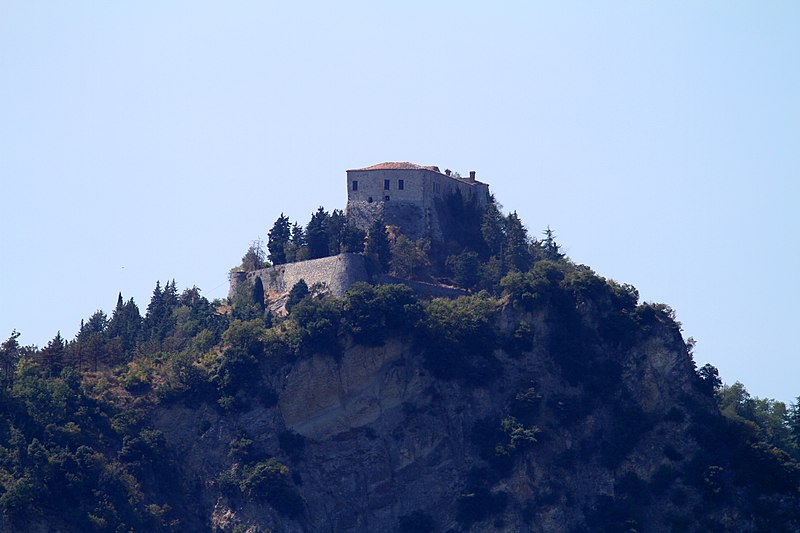
Castle on a Hill: The ghost of Azzurina of Romagna is supposedly haunting the castle Montebello di Torriana. Attribution: Carlo Pelagalli
The sun lingered for a long time over the mountain area where the castle of Montebello di Torriana was. The castle stands in what was known as Romagna, a historical part of northern Italy that no longer exists. It was a stormy June day, in 1375 with thunder going on all around the castle grounds. Towering 400 meters above the ocean, the castle looks out over the valleys of Marecchia and Uso when it was still under the Papal rule. The earliest name of this castle was Mons Belli, or War Mountain in English.
That day was the day of the solstice. The lord of the house’s daughter, Azzurina was playing with a ball, being watched over by her bodyguards Domenico and Ruggero. She was around five years old and running around in the castle with her ball made out of rags. They were distracted for just a moment, and when they turned around, the child was gone. A scream was heard from the castle icehouse and the bodyguards rushed over. Perhaps she had chased the ball and fell? But no trace was left and they were never able to find the child — at least not alive.
The Blue Haired Girl
Centuries later, around 1600 a priest put the legend to paper for the first time as we know of, although the writing itself is lost. The title of the story was Mons Belli ed Deline, hinting that the name was Deline or Adelina, but to most people hearing the legend, her name was Guendalina.
Advertisements
Guendalina was a normal girl wanting to play around the castle grounds. But to the people in the castle, she was more of a secret. She was born as albino, which at the time was connected to persons of a diabolical nature. Her mother tried again and again to color her hair darker with pigments from plants. But the black color wouldn’t stay, and the color faded, leaving only a blue tint of it. This is where her nickname, Azzurrina, meaning blue comes from. So instead she was hidden away from the public eye. This is also why her father ordered her two bodyguards to always watch over her every move as he was worried about the superstitions and rumours surrounding his daughter’s affliction.
The Mystery of the Solstice
Solstice: When the sun is on the sky the longest is the summer solstice. A lot of paranormal rumours surrounds this day, and this is the supposed day the little girl went missing.
What happened to the girl is still debated to this day. Perhaps only a tragic accident? The most gruesome theory is that of her father, Ugolinonuccio, that he himself ordered the death of his daughter because of her being an albino and therefore a problem for him, his reputation and his career. At the time he was supposed to be far away fighting in a war. Even her mere existence is debated as the records of the past are far and few between.
Now, every five year, or to be more exact, on every summer solstice ,strange occurrences have been reported from the castle. Paranormal researchers flock to the place then, to hear “the sound”.
Since the museum opened in the 90s, visitors have heard stories about a child crying or laughing. She is sometimes seen, looking a bit different than the others, running around and disappears in the castle like smoke.
The Claim of the Supernatural
The sound of a child is what the paranormal researchers find over and over again together with strange images. Shame about the manuscript from the priest that could have given more details, which by the way is more of a claim of existence than a trace of it. However, the first real recording we have of the legend actually dates back to 1989, so quite recent, and very in line with the commercial museum that opened up the next year.
But as they say on their web site, they welcome all to have a listen for themselves. Have a look and open your ears. Maybe you as well are able to hear the sound of a faint child’s laughter through the old halls of the castle’s basement?
Hidden by sand in the Gobi desert for centuries, the abandoned city of Khar Khot is still haunted by the ghosts of the inhabitants that didn’t manage to escape.
Secluded in the Gobi desert, hidden by sand and stands the test of time, the abandoned city of Khar Khot houses no dwellers except for sandstorms, deadwood and ghosts.
Khar Khot or Khara-Khoto (ᠬᠠᠷᠠ ᠬᠣᠲᠠ) is Mongolian and means, Black City. It is located in Inner Mongolia, a region in China bordering with Mongolia. The Chinese name for it, Hēichéng (黑城) also means Black City and it certainly marks a dark spot in history considering all the bloodshed that ended the once important trading city.
Read More: Check out all our collection of ghost stories from China
There are also the legends about the city being haunted by demons and spirits. And when explorers from all over the world came to have a look at the legend of the abandoned city, the locals refused to go near it because of the ghosts still roaming the area around Khar Khot.
The City at the Silk Road
The city was founded in 1032 and used to be a busy and important trading place in the 11th century as a part of The Western Xia, also known as the Tangut Empire. In 1226, the city was taken over by Genghis Khan and many blame the Mongolian ruler that the city is now destroyed. That is not true as the city under Kublai Khan’s time, the city expanded three times and flourished.
The city was important as a trading hub along the Silk Road and even Marco Polo wrote about it in his travels along the silk road in The Travels of Marco Polo, where he called Khar Khot for Etzina.
When you leave the city of Campichu you ride for twelve days, and then reach a city called Etzina, which is towards the north on the verge of the Sandy Desert; it belongs to the Province of Tangut. The people are Idolaters, and possess plenty of camels and cattle, and the country produces a number of good falcons, both Sakers and Lanners. The inhabitants live by their cultivation and their cattle, for they have no trade. At this city you must needs lay in victuals for forty days, because when you quit Etzina, you enter on a desert which extends forty days’ journey to the north, and on which you meet with no habitation nor baiting-place.
— Marco Polo, The Travels of Marco Polo, translated by Henry Yule, 1920
The Fall of Khar Khot
In 1372, Khar Khot was under charge of the Mongol general Khara Bator when the army of the Ming Dynasty attacked.The city was surrounded and under siege for a long time, but the city was more of a fortress, built to withstand any attacking army, and the soldiers outside needed to think of a way to breach the walls.
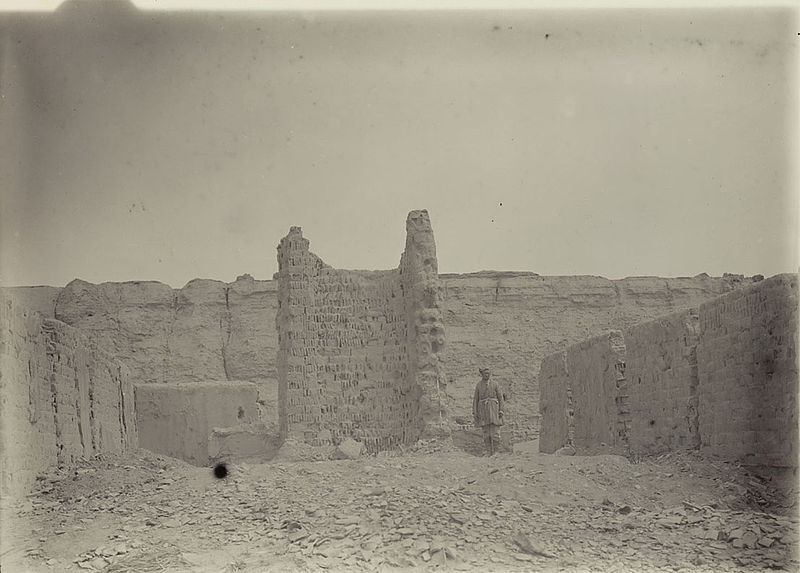
Rediscovered: Ruin At Kharakhoto from east, 30 May 1914.//Photo: Aurel Stein
So to speed things up on the outside, the Chinese went for the fortress one weak spot, the water supply. The name Gobi basically means waterless in Mongolian, and that is what they became. The city was cut off from its water supply by diverting the Ejin River that flowed right outside the city walls away from the thirsty people inside.
The inhabitants inside began desperately to dig in the ground, trying to find drops of water according to the legend, but to no avail. When Khara Bator realized that the siege was not something they could withstand he threw all the valuables of the city into the well so as not to give that up to the invaders, even though they had to give up their life.
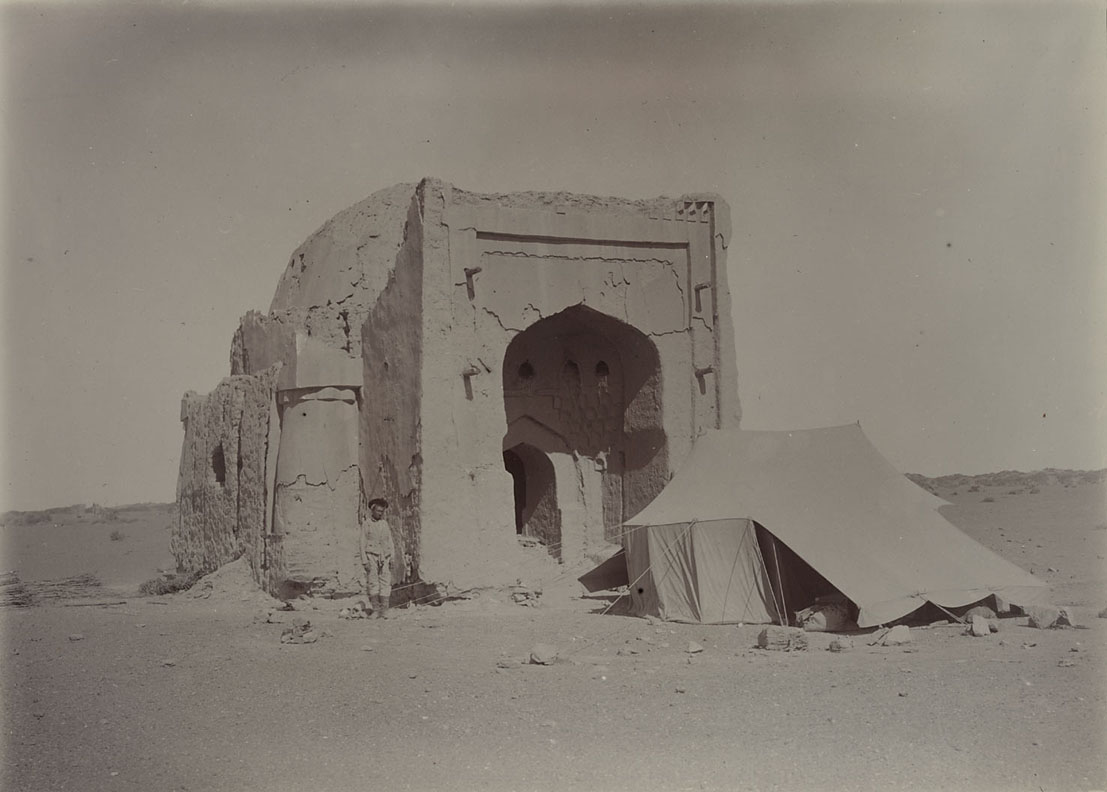
Ruins of Khar Khot: Muhammadan Tomb K.K.VI. at southeast corner of Kharakhoto, from east, 3 June 1914.//Photo: Aurel Stein
As time went on with no water with the Han Chinese army banging on their doors, Khara Bator murdered his family before taking his own life. The Mongols’ reign over Asia was slowly dwindling away.
His soldiers waited until the Ming Dynasty finally breached the walls and attacked, killing the rest of the inhabitants of the city, not burying the bodies and making them live on as the ghost they are today.
Another Version of Escaping
There are alternate versions we can find in the Ming Dynasty annals that tell a different story about Khar Khot. In this version, the leader together with his ministers actually escaped from this ancient Mongolian city.
No matter who died and who escaped, the city was abandoned after the defeat and left in ruins to be swallowed by the desert.
The Black City Today
600 years passed before people returned to the desolated city buried under the dry sand. Because of being so far from any other sign of civilization, the city was largely safe from looters and people seeking to destroy Khar Khot.
When they first started excavating they found a rich amount of manuscripts of the Tangut language along with other important cultural artifacts, untouched because of its remote location, and perhaps because of the ghosts still protecting the city?
Today, tourists can come on a day trip to see the once magnificent city in the desert that the sand has filed down, softened the edges and buried its secrets. But in the night, they go back and miss the action that goes on after the sun goes down. Reports of flames burning for hours and strange lights that lead people astray in the desert are told from the guards watching over this place.
Their ghost haunts the ruins of the garrisons, the walls and the very sand itself. In a way, giving the ghost city of Khar Khot a sort of life other than just being pieces of crumbling stone walls.
Because of the cold winter with no food, people starved to death, even inside the castle walls. And ever since then, the ghost of the queens chambermaid still haunts the castle, known as the Mantelgeist.
The Queen: Left alone in the castle begging for food, Queen Margrete I of Norway was left.
It was a hard winter in medieval times in Oslo in Norway, a place known for its cold and harsh winters. So far north, the cold was biting, sparing no one. The plague had returned to the country again, and the King’s coffins were empty.
There was nothing to buy food with and people fell dead were they were standing either by starvation or the cold. Not only by the deadly plague that killed every one it touched, but the hunger as well was a silent killer.
Norway was a much different country than today, yes it was in the middle ages, but even by medieval standard, the country was poor, uneducated, and ravaged by hunger, weather and wars. Even the royals didn’t escape the plagues clutch.
A hard winter in the 1370s, there was not much food at the Akershus fort, were the queen resided. King Håkon IV Magnusson was king, and the queen was Margrete I, the one that were going to rule all of Scandinavia. But before that, she would go through her hardest winter.
The Cold Winters in the North
There were only decades since the Black Death had put the country in ruins. No another plague was at it and even behind the heavy doors at the fortress the repercussion of the killing plague hit them.
Advertisements
The queen sat alone at the fortress as her husband was away. Pregnant, hungry and desperate. In a letter, she detailed that she and her servants no longer could sustain themselves on the food available. She asked a prayer, begging the King her husband make sure she got credit at a tradesman so that she could manage through the winter with the rest of the court. The nation was in her hands, that’s how bad it was.
The Starved Chambermaid
Queen Margrete made it through alive. As the queen she was, she got the food. Not everyone was that lucky. One of her chambermaids are supposed to have died of starvation that winter. A servant that was much closer to the queen than many, that dressed her and took care of her every need. No she will never leave the fortress.
It is said that she still wanders through the fortress, through the Margrete hall in particular, were she ended her days that cold winter with no food. Her ghostly figure enters in a long robe, thereby the name Mantel, meaning robe or cloak. When she turns to those in the room, she has no face, only a blank surface stares back.
We have no name to the poor girl at the fortress. She is only called the Maiden at the fortress or the Mantelgeist. And that is how she will spend the remaining years, nameless and faceless.
Thes old and noble family House of Hohenzollern in Germany seems to forever be haunted by a Lady in White. Both the ancient family homes of the family, and also the family members, however far they go away, the curse of the house will follow.
In December 1628, the Palace in Berlin can’t keep the cold out, not completely. A hereditary haunting of the ruling family of Prussia sits in the walls of their castles — a bad omen. Most often the bad omen of the curse is seen as a woman dressed in white. You can hear her sometimes, the clanking of the large keys around her waist. A young prince is next this time. She appears to a him and says: – ‘Veni, judica vivos et mortuos’ which means ‘Come, I judge the living and the dead’. The day after, he dies of an illness.
But who is it that haunts this old and noble family? Even the young princes? Years before the young person died, she was also spotted by three young pages in 1619. In one of Hohenzollern Castle halls, it doesn’t need to be the one in Berlin. As long as it is one of the ruling Hohenzollerns. The young pages thought she was a living human being, and approached her. When he asked what she was doing here she turned to him and hit him with her keys, killing him. The two pages ran away, terrified.
The House of Hohenzollerns was growing restless when they heard about the sighting of the woman. She had been spotted again, it was a bad omen. Something was about to happen. Three weeks later, John Sigismund Prince-Elector of the Margraviate of Brandenburg from the House of Hohenzollern, died.
House of Hohenzollern in Germany
The family is an old one. The House of Hohenzollern once ruled what is now known as Germany as a dynasty being princes, electors, kings and emperors. They ruled the lands of Brandenburg, Prussia, The German Empire and as far as to Romania.
Read More: Check out all of our ghost stories from Germany
They began their ruling dynasty in Swabia, in a town called Hechingen during the 11th century and took their name from their ancestral Hohenzollern Castle. The first ancestors of the House of Hohenzollerns were mentioned in 1061.
Burg Hohenzollern on the Hill: The ancestral home in Swabia, Germany, constructed in the early 11th century to the House of Hohenzollern. The haunting may have started here, but the sightings of the White Lady Haunting the family has been spotted everywhere were a member of the family has been residing.
They were the rulers of the lands, growing in power until 18 71 with the unification of the German Empire with the Hohenzollerns as hereditary German Emperors and Kings of Prussia. This title they held until Germany’s defeat in World War I in 1918 led to the German Revolution. The House of Hohenzollerns were overthrown and the Weimar Republic was established, thus bringing an end to the German monarchy.
Sure, they were powerful, and powerful families makes powerful enemies. Blue blood attracts bad blood. But who was so intent on following the family, haunting them for centuries? There have been many claims as to who exactly is the woman behind the hauntings. And this here, is one of the more famed ones.
The Noble Killer Nun Haunting the House of Hohenzollern
Kunigunde von Orlamünde is a ghostly reminder of the ancient past. She was born in 1303 as the first child of Ulrich I, Landgrave of Leuchtenberg, and part of their Bavarian dynasty in the middle-ages.
According to legend, Kunigunde von Orlamünde fell in love in a man called Albrecht the fair, the fourth son of Frederick IV, Burgrave of Nuremberg. A man of the House of Hohenzollern.
The Abbess: Tombstone of Kunigunde von Orlamünde at Himmelskron, is rumored to be behind the curse of the House of Hohenzollern.
Albrecht had expressed that he would marry Kunigunde von Orlamünde, hadn’t it been for that “four eyes did not stand in the way”. Kunigunde thought he meant her son and daughter. Therefore, she stabbed their eyes out with a needle, and they died, freeing her to marry the man she loved.
Johann Löer made a verse about this in 1559:
And thought, those small children I wanted Will certainly be the eyes that Robs me of my love! And if the woman even did That murdered her own children That misery robbed their life That stabbed them with pins Tender and soft all over
This is not what Albrecht meant though, as he was talking about his parents as they disapproved of their match. He refused to marry her after her actions. He married a woman named Sophie von Henneberg and got two daughters on his own.
Kunigunde von Orlamünde was devastated and full of regret. She had murdered her own children for a man that didn’t even want her. Therefore she started on a pilgrimage to the Vatican to get absolution for her sins from the Pope himself. He ordered her to build a monastery and become a nun. She joined the Kloster Himmelkron.
In some version she she was sentenced to life in prison for the murders, other tell of how she died on the way to the Vatican, not being able to beg of forgiveness. She is one of the origin stories of the curse over the House of Hohenzollern and she has been haunting the family ever since.
Weiße Frauen Haunting the House of Hohenzollern
Could Kunigunde von Orlamünde be the lady following the haunted House of Hohenzollern? Lurking along the walls with her keys, paying close attention on every male descendant in the family that she never got to be a part of? A family growing bigger by every generation while she cut down her own? In any case, the legend of the Lady in White is old. Perhaps so old that even not history keeps it in its records?
Basking in the sunlight, hiding in the shadows, her dress is always white. In German legends and folklore the stories of the Weiße Frauen, meaning White Women used to be a name meant to the elven-spirits and the stories of the light elves from pagan times. Many of the ghost stories seems to be based on these old folklore types of myths and legends, even to this day.
The White Lady Haunting Germany: Illustration from the opera, The White Lady. The White women or the Weiße Frauen has been a part of the German mythology for ages. It has know been a part of German ghost stories as well for centuries.
The legend of the Weiße Frauen or white woman has, as everything does, evolved from its elven origins. Now the name is also used on women dying in grief, of sorrow or with a urge of revenge. It has spread throughout Europe and is an image with strong connotations, even today.
The Family Curse Over the House of Hohenzollern
Some call her the White Lady, some call her ‘The Harbinger’. She brings bad luck to those seeing her, and reports of her sightings has been going on for centuries.
In 1667, Louise Henrietta of Orange, the wife of Elector Friedrich Wilhelm of Brandenburg, was lying ill. A few days before she passed away, she saw the White Lady, sitting by her desk almost as an omen that warned the family that death was approaching.
The family members started to learn to spot the signs, but was unable to do anything after her sightings. In 1678, the Margrave Erdmann Philip of Brandenburg saw the White Lady in his armchair as he entered his chamber in Baireuth. He left the room, shocked and terrified. The next day he rode his horse out in the court and there was something weird going on. The horse was uneasy, as if seeing something that scared it and he threw the prince off. The Prince stood up, seemingly fine and he retired to his chamber. But after two hours, he was dead.
Weiße Frauen Curse of the House of Hohenzollern: The White lady, also known as the Harbinger, has been haunting the family for centuries, acting as an omen when someone is about to day, and even as a warning. Is it really a curse, or actually someone watching over them, trying to warn them when danger is afoot?
Even the dead ones seems to warn about the White Lady that haunts the House of Hohenzollern. The White Lady was supposedly absent during Frederick the Great’s reign, but in his death, he came back to warn them about her. In 1792 in Paris, his nephew Frederick William the Second was camped outside the city with his troops, ready to attack the next day. That night his dead uncle appeared before him, warning him about the seeing the White Lady if he didn’t call off the attack. His nephew listened and left France, avoiding the harbinger and according to the legend, a certain death.
Even Napoleon tried to spend a night in one of Hohenzollern castles but left bothered by the ghost haunting the place. In 1806 he had defeated Prussia and claimed some of its land as a French province. He left the next day, never to returned, calling it le maudit chateau, ‘the cursed castle’.
But today? Were is she? Just before World War I in 1914, she was last reported. Just before the Archduke Franz Ferdinand was assassinated. After they lost the war Kaiser Wilhelm the Second was the last ruling Hohenzollern, and he later abdicated the throne.
And it is said as long as there is no Hohenzollern that rules, the White Lady will stay in the shadows, and hopefully, outside of the Hohenzollern castles.
What is the Truth Behind the Curse?
Such a dramatic story, but does it ring any truth? What is true is that Kunigunde married Otto VI, Count of Weimar-Orlamünde. Historians refute the legend as according to record, their marriage produced no children. It is true that she and her husband adopted a daughter, Podika von Schaumburg, but she grew up and married Poske Ritter von Schweritz in 1341.
There are also records of her dying in 29th of April in 1382. And if she really was born in 1303 she would have been close to 80 and most likely in a comfortable home, not on the road to Rome or in prison.
Kinigunde’s husband died in 1340, leaving her with a vast inheritance. She spent it on the monastery she herself would join as a nun. Funnily enough, sources tells he actually bought the monastery from Albrecht.
The Harbinger of Death
For a story as old as this one, there is now difficult to separate facts from fiction and the story of the curse that allegedly looms over the House of Hohenzollern seems to still be there, even if no one has reported about the White Lady for a while.
But what about The House of Hohenzollern and their sightings of the White Lady over the centuries? All of their stories? Were they just that? Stories? Or is it that some details of the past is not for us to know. Not the living.
Could it be something else than a woman with a flare for eternal vengeance? Perhaps something even older like the German myths and legends have been telling for ages?
In Akershus Fortress in Oslo, Norway, there are rumours about something strange haunting the former castle. There is a legend of a ghost of a dog haunting the place, called the Malcanis, or Evil Dog as it means.
In medieval times it was a king’s castle were Akershus fortress in Oslo is today, looking out over the fjords. Under the building of the castle the workers bricked in a living dog. It was a relative normal custom in those days. According to them, they meant that it would bring good luck. Coincidentally, the custom was also meant to warn about accidents.
But when the castle was done around 1299 the “Malacanis” as they called it, “the evil dog” haunts the place, and seemed to be something else than an omen.
Among its first victims that would feel the wrath of the Malcanis was the commander at the fortress at the time. Around the year 1550 the hallway were the dog was bricked in collapsed.
Unrest crept into the guards at the fortress. “What about the Malcanis? It was right there the collapse happened”, they whispered among themselves when they were standing guard. Everyone knew about the legend about the poor dog that had been bricked up. And reports about people spotting the ghost there was plenty of.
The Ghost Under Jomrutårnet: The ghost of the Malcanis is said to be put to rest in the walls around the Virgin tower when it was bricked up there for good luck. Allegedly a tower difficult to penetrate and many thought it was because of the ghost dog.
A sound was heard in the hallway under the fortress and everyone feared that the castle was under attack. No one was brave enough to investigate the cause of the ruckus. Not even if the intruders was Swedish forces. The Malcanis put fear in the soldiers.
Read Also: This is not the only ghost thought to haunt Akershus Fortress. There is also rumours about the ghost of a former maid that are still lingering inside. Check out The Mantelgeist of the Fortress for the full ghost story.
In the end, commander Peder Hanssøn Litle walked down Mørkegangen (The dark hallway) himself, as the rest of the guards refused because of fear from the ghost dog. With a single torch he closed in on the fallen stones and started investigating the dark hallway and tried to get a sense of what had happened.
From the shadows he saw a dog, red-glowing eyes appeared with fangs and a chain around its neck. He got into a bloody fight with the ghost dog, that didn’t disappeared until Peder threw a torch right at it and it retreated back into the darkness. The commander came crawling out on all four, more dead than alive, stuttering only one word: The Malcanis!
The Bad Omen
The hero commander survived – but around a month later he died after being thrown off the horse. Unrelated perhaps, but rumours about his death started to circulate among the guards. Others that have seen the Malcanisen in the eyes suffered a similar fate, according to legends. Could it be that it was because of this the commander died? And if so, was seeing the dog then the warning or the curse?
Read Also: Check out all of the ghost stories from Norway
It was also spotted a ghost hound in 1550, then called Malcanisten in the same hallway under the Virgin Tower that was built at that time. After a soldier was killed by a horse in 1567 it is said it was observed several times under the same tower, and those who observe it, won’t live the year.
An online magazine about the paranormal, haunted and macabre. We collect the ghost stories from all around the world as well as review horror and gothic media.