Tag Archives: world war 1

Hauntingly Beelitz-Heilstätten Hospital

Advertisements

The abandoned sanatorium in Germany is said to be haunted by all those souls that died inside of it because of its dark history. And in the Beelitz-Heilstätten Hospital, it wasn’t just sick people who ended up dying, but several murders took place in it or around it as well. 

Some buildings are just thought to be haunted by the look of them. Especially these old abandoned buildings with a dark and sinister history attached to them. One of these buildings with long ominous corridors and peeling paint is the Beelitz-Heilstätten Hospital not far from Berlin in Germany. 

The sanatorium was first built in 1898 as a response to the rapid increase in tuberculosis patients at the time as it was the number one cause of death in Germany at the time for people between 15 to 40. 

The Abandoned Sanatorium: The Beelitz-Heilstätten Hospital was originally built in 1898 as a treatment place for tuberculosis. Today it is abandoned with a haunted reputation over it.//source//wikimedia//qbanez

One of the treatments for this was fresh air, so the sanatorium was built in a remote pine forest. The Beelitz-Heilstätten Hospital was a complex of around 60 buildings that in the end, almost served as a small town of itself, with its own bakery, shop, apartments, post office, stables, butcher shop and laundry houses. At the time it was the largest treatment center in the world for lung diseases with at its peak beds for over 1200 patients. 

During the first world war Beelitz-Heilstätten Hospital served as a field hospital, and it got famous for treating Adolf Hitler who was wounded in his leg as well as being blinded by a gas attack by the British forces in the Battle of Somme. 

When the second world war started it would again be a treatment hospital for the Nazi forces until they lost and ended up being occupied by the Russians from 1945. Beelitz-Heilstätten Hospital stayed like that until 1995 before closing its door for good. At least for treating patients. 

The Abandoned Buildings as a Murder Place

Many murders have taken place in this remote area and around it. After the Soviet left, it became a hotspot for satanic and occult people to gather to drink and keep seances. And it was also those with an even more sinister idea. 

In March 1991, a mother and her newborn child of three months were brutally murdered right outside the old sanatorium. It was the Beast of Beelitz  who had struck again, a notorious serial killer that had started on 24 of October in 1989. 

The serial killer Wolfgang Schimdt used to be called Beast of Beelitz or Pink Giant because of his choice of weapon. The killer who legally changed name to Beate and underwent gender reassignment had terrorized the local women for years and his modus operandi was to strangle the victims with pink womens underwear. The Beast of Beelitz is in prison to this day after killing 6 people. 

But it wasn’t the only murderer who used this place for his crimes. A photographer and sadist named Michael K brought a 20 year old model named Anja P. to Beelitz-Heilstätten Hospital for pictures, and as he explained it, an erotic photo session that ended with her accidental death. 

During the photo session he ended up killing her, but the police found clear evidence that this was not an accident, but a premeditated murder. He beat her with a frying pan and had sex with her corpse after she died.  

Dark Tourism of Beelitz-Heilstätten Hospital

Like many of these mysterious and abandoned places there are many people attracted to the eerie beauty of the macabre building and its history. Many visit the place to get a closer look at the building itself or just explore the paranormal rumors that are created by just the haunted atmosphere of the place. 

Dark Tourism: Most of the buildings of Beelitz-Heilstätten Hospital are left to decay and a number of visitors come to experience the eery atmosphere of the abandoned building. But one of the reasons it is fenced off and off limits is because it is dangerous. Several people have had accidents in the unsecured and abandoned building who is falling apart. //source:Wendelin Jacober

Before 2015 it was mostly left to its own devices and people would come and go as they pleased. It was used as a movie location for the 2002 movie “The Pianist”, as well as being the place for horrific crimes. 

Today it is more closed off and taken back by the public to renovate and made into a tourist attraction rather than an urbex location for exploration. 

A Haunted Hospital

So is Beelitz-Heilstätten Hospital really a haunted place? Considering all the dark stuff that have happened inside of the building complex it is easy to think why people would call this place haunted. But rather than a specific story or encounter that made the place famous, it seems to be the other way around. 

There are however those who enter the place that exit it with tales of something paranormal happening to them. It is the usual stuff of seeing apparition where there are suppose to be none as well as hearing strange sounds and having the feeling of being watched as the room gets colder. 

So what do we think? Is Beelitz-Heilstätten Hospital haunted or just plain spooky?

More like this

Newest Posts

References

The Haunted Barbie Doll in The Shrine on Pulau Ubin Island

Advertisements

What would you have wanted as an offering after your death? According to this Singaporean legend, this young girl wanted a Barbie doll to appease her spirit in her afterlife. This is the story of the haunted Barbie doll in the shrine on Pulau ubin island.  

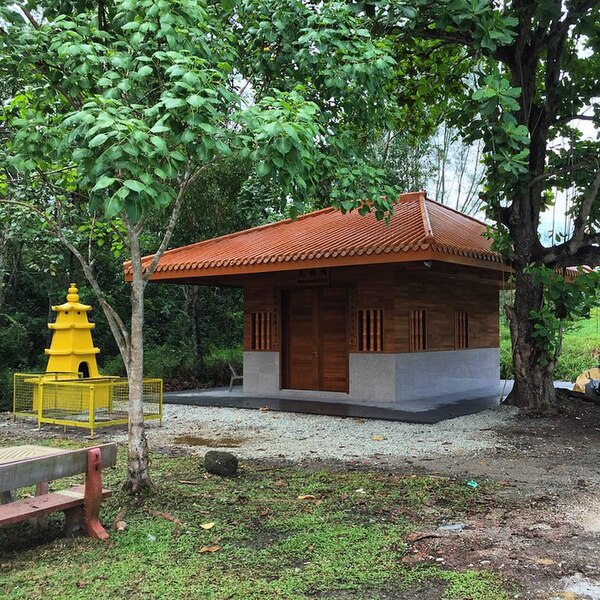
On Pulau Ubin, a boomerang shaped island in northwest Singapore, a peculiar yellow shrine still stands. Hidden away in the forest as one of the last remaining places in Singapore free from urban development, concrete buildings and paved roads, people come to give offerings and pray for their good luck in gambling to the deity of a young German girl that died and remained on the island with only a haunted Barbie doll as comfort. 

Read about: More Haunted Ghost Stories from Singapore

Pulau Ubin used to be a bigger population here, bustling with different businesses like plantations and granite mining. The very word Pulau Ubin means ‘Granite Island’ in Malay. Today, the granite quarries are empty or at least, abandoned. Reclaimed by vegetation or filled up with water.  

Pulau Ubin: The idyllic island is now a well known place to hike the trails and enjoy the nature in Singapore.
Photo: Zairon

The island used to have a few thousand settlers, but today, there are not even forty people left after the work in the quarries dried up. However, the one that still remains, is the spirit of the German girl that to this day, name is unknown. Several attempts have been made to trace the family of the girl back to Germany, but lack of public records of the family has still not been found. 

Now considered a taoist deity, the temple on Pulau Ubin is full of taoist offerings as well as more unique offerings. Most notably a haunted Barbie doll sits between the incense and the food offerings. People still pay tribute to the shrine and the haunted Barbie doll, in the form of make-up, nail polish, mirrors and small feminine things. This to appease the girl who asked for the doll beyond the veil. 

Background For The Haunted Barbie Doll

At the start of the 1900s, uneasiness spread throughout Europe and a full fledged war rippled through the rest of the world as well. Although WWI didn’t quite reach south east Asia in full force as other places, the effects were still real for many of the European settlers in the colonies. 

Singapore, being a part of the British Crown, was not very German friendly. During the 1910s, the island was home to two German families, the Brandts and the Muhlingans that ran coffee plantations according to the legend, although the proper sources for this are missing. 

In July 1914, the British started detaining Germans for security reasons as they were considered enemies to the crown. A military force was sent to Pulau Ubin to detain the two German families residing there. The Germans were, according to the story, sent to a detention barracks on mainland Singapore, mainly in the Tanglin Barracks. 

But the detaining would not go without a dramatic turn. A young daughter of one of the families became frightened and fled from the British forces into the wooded area and disappeared into the dark, never to be seen again. 

The Deity of the German Girl

Days went by without finding her body. And when she finally was discovered by Boyanese plantation workers, she was covered in ants. They concluded that she had died by falling down a cliff near one of the quarries that sustained the community on the island. The workers covered her body with sand and laid flowers on it. When they walked by the place, they said a prayer and lit incense for the girl. 

This was her resting place at Pulau Ubin until Chinese workers recovered the remains of the body and buried the girl on a hill above the quarry. Being a roman catholic, they placed her Jiangsu urn with a crucifix and a number of coins as well as a few strands of her hair.

What happened to the family is still a mystery, but during the war, all German property was confiscated and their business halted. Today only the ruins and foundation of the plantation can be seen. In some versions of the legend, it tells that the family returned to Pulau Ubin after the war, searching for the remains of her daughter, but could’t find her tombstone due to language barriers. Little did they know her remains were kept in the Chinese Taoist temple in an urn on the hill. 

Bitter and sad about it, they left Pulau Ubin and Singapore, never to return. Which is an odd addition to the legend as the family supposedly managed a business on the island before the war, and it’s weird that there suddenly were a language problem when they returned, supposedly to the same people that lived there before they were detained. 

She has since been addressed as Na Du Gu Niang, meaning Datuk Maiden. Sightings of her ghost by the local villagers at Pulau Ubin have kept the legend of the nameless girl alive as well as the peculiar offerings to the shrine that eventually were erected in her honour. 

The Yellow Shrine on Pulau Ubin Island

The Shrine: The home of the deity and the haunted Barbie doll has gone through many changes. Here as it was in 2015.
Photo: Pascal Vuylsteker

While the granite business was still alive on Pulau Ubin, a quarry company built a more permanent shrine in 1974, which is the small yellow chinese temple that still stands today. It is named Berlin Heiligtum, meaning Berlin Sanctuary. 

They transferred the lock of hair and iron cross to the new temple. But when the man who helped to place the remains in the new vase in 1974 checked in 1990, it was already gone, at least that is one of the tales this particular man told over the many years.  

When the shrine was constructed over the grave, it became associated with good luck, especially for gambling as rumours told about people winning the lottery after praying to the shrine. Therefore gamblers from Singapore as well as Malaysia came to the shrine to make offerings, in hope that the German girl would bless them with good luck.

And today the offerings are perhaps more to a young girl’s taste with nail polish, makeup, perfume and the now famous haunted Barbie doll. 

The Haunted Barbie Doll in the Shrine

Today a haunted Barbie doll is placed as an important object in the shrine to the German girl in an enclosed box. Although not haunted as many other objects are rumoured to be, as in being possessed by the soul or a ghost, the origin of the doll is quite haunting. According to legend, and this is a more recent one, the legend will have it that the haunted Barbie doll was requested by the girl herself beyond the grave. 

Pink offerings at the altar: The German girl still gets many presents, many things are of what people think would suit a young girl. Like the now very well known haunted Barbie doll//Photo: Source unknown/via Tineye

An unnamed islander from Pulau Ubin who had moved to Australia kept having these strange dreams back in 2007. He dreamt of a European looking girl for three nights in a row that led him to a specific store with a specific Barbie doll. She asked for it to be placed at her altar back in Singapore. So when he found the same store and doll as he had dreamt of for so many nights, he bought the now haunted Barbie doll and brought it to the shrine. 

And over the years, the haunted Barbie doll itself has gained its own mysteries and haunted stories, giving new life to the story about the girl still not having crossed over from the mortal world entirely.

For more stories about haunted dolls lole Okiku, Ruby or Letta:

Ruby the Haunted Doll

This porcelain doll named Ruby will give the people playing with her an instant sorrow and sense of sickness, just by holding her. Family legend has it that the doll is haunted by a little girl that died with Ruby in her arms.

Keep reading

The Legends of Lies?

So who was the girl? Was there ever a girl? There is today no human remains in the grave as a definitive proof of the legend. Still, many people take the legend at face value today. But that is overlooking all the different tales that have been told throughout the years. Dr William L. Gibson, is one of the people that really took a deep dive into the legend and by just comparing the sources, found many discrepancies to the story told today in his excellent and detailed research you can read here.  

Many sources point to one man, named Chia Yeng Keng, a local on Pulau Ubin. The same man that claimed to be there when they transferred the lock of hair and the cross to the new temple. He has changed his testimony about the girl several times over the years. From claiming that the girls parents were Dutch for example. But seeing that Dutch citizens were not interned as Netherland was neutral during WWI, the story changed to German instead. Could it have just been a glip of details? Or a more elaborate story? As late as 2004, he claimed to not know anything about her at all. 

Although proof that a German family ran a coffee plantation on Pulau Ubin once, it is not proven that they ran it until being detained because of the war. According to The Singapore and Straits Directory, the only plantation on the island in 1914, was run by an Anglo-Irish, with no women recorded as living there.  

The first mention of the grave on Pulau Ubin was actually in 1985, in a Malayan newspaper that told the story of a princess from Java that fled to the island and died there. She was said to haunt the hill as a hantu puteri, meaning a ghost princess, seducing the many quarry workers to meet a terrible fate. The article included a picture of the shrine today known as the German girl shrine. But also this article as well as the story itself lacks proper sourcers. 

So for now, the haunted Barbie doll on Pulau Ubin belongs to a young girl that may or may not rest here. Better safe than sorry.

More like this

Newest Posts

References

Featured image: Unknown original source/via Tineye

Unravelling the Mystery of Ubin’s German Girl Shrine

German Girl Shrine 

Mysterious Pulau Ubin German girl shrine still sees visitors after 100 years in existence – Mothership.SG – News from Singapore, Asia and around the world

The Legend of a German Deity at Ubin | Remember Singapore