Tag Archives: haunted farm

The Haunted Legends of Stenberg Gård, Hoff Church and Toten Legends

Advertisements

Deep in the farmland of Norway, Toten has a lot of ghost stories lingering on the old farms and buildings. Who were the priests said to haunt the Hoff Church and rectory, and who are the ghosts said to linger at the old Stenberg Manor?

The district of Toten is rich in farmland landlocked east in Norway with old churches, and quiet waterways, and a few ghost stories lurking beneath its peaceful surface that have unsettled locals for generations. 

Read More: Check out all ghost stories from Norway

Among these tales are three locations bound together by whispers of the supernatural: Stenberg gård, the brook at Bøverbru, and Hoff Church. Each is said to be touched by a presence that refuses to fade.

Haunted Toten: Toten was part of a small kingdom in the early Viking Age and Halvdan Kvitbein was the most famous king who ruled there. The origin of the name is linked to the Old Norse Þótn , which supposedly means “something one likes”.Toten has traditionally been one of Norway’s largest agricultural areas, and the industrial park at Raufoss is one of the largest industrial centers in the inland.

The Ghost of Stenberg Gård

Stenberg (or Steinberg) is a large open-air museum that shows the cultural landscape, building practices and social conditions in Toten in the 19th century. The museum is built around the county manor Stenberg.

County magistrate Lauritz Weidemann (1775-1856) developed Steinberg into a county magistrate’s residence. He took over the farm in 1802 and laid out today’s yard and an almost 30-acre park in the English landscape style. Weidemann was also known as one of the men at Eidsvoll when Norway received its constitution in 1814.

Stenberg Manor, or Gård (farm) is widely believed to be home to Toten’s most famous ghost. The historic farm, known for its cultural significance and well preserved buildings, has long been surrounded by rumors of unexplained activity. people claim to this day that they have experienced a number of unpleasant incidents on the farm. It has been said that the Weidemann family is going again.

Visitors and staff alike have reported strange sounds after dark, shifting shadows in empty rooms, and the unsettling feeling of being observed. Though the identity of the spirit is never clearly agreed upon, local lore insists that something still walks the halls of the old estate, guarding its past or reliving a tragedy long forgotten.

Blind Ola of Bøverbru

Near the brook at Bøverbru, another chilling legend is often told. According to reports shared in Oppland Arbeiderblad, a blind man known as Blind Ola is said to have drowned in the water long ago. 

Since then, swimmers and passersby have described eerie experiences near the stream. Some claim to feel unseen hands pulling at them beneath the surface, while others speak of sudden cold currents and strange sounds rising from the water. The story has made the area a place of caution, especially after dusk.

Whispers Around Hoff Church

Hoff Church in Lena, east Toten is also the subject of debate among those who believe the past never truly rests. Parishioners and visitors have spoken of unexplained noises, shadowy figures, and an uneasy atmosphere within the church grounds. For believers, these phenomena are signs that the dead still linger close to the sacred site, bound by unfinished business or ancient traditions.

In 2009, the legends stirred when the church bells started ringing and the police were called. The priest stopped the bells, but they found no sign that anyone had been there. The bells are controlled by a remote, and when they checked it out, there was no sign of technical faults, although they could never completely rule out that someone had put on an elaborate prank. 

Haunted Church: Hoff church at Østre Toten by Lena, Oppland, Norway. Hoff kirke ved Lena på Østre Toten. //Source: Øyvind Holmstad

But who is haunting the church? Could it have something to do with the old ghost story? At a Christmas party at the widow Bolette Cathrine in Kristiania (Oslo) in the late 1870s in the presence of several witnesses. 

The event is said to have taken place at Hoff rectory “some time ago”. Author and the storyteller, Marie Wexel came to Hoff rectory one Christmas Eve with a lady from Kristiania. At the dinner table, the priest said a few words about a haunted room on the second floor, but the priest reproached her for mentioning it; it could only frighten the guests unnecessarily. The two ladies got up early to go to bed. 

Marie sat down in the armchair instead to read before going to bed as her companion had done. When she had finished, she put the book in her lap to think about what she had read. “As she looked up, she caught sight of a priest in old-fashioned vestments standing just in front of her with a pleading look and pointing in the direction of the cake oven. Then the vision immediately disappeared. She wiped her eyes and thought it was a figment of her imagination, perhaps brought on by what the priest had said. She went to bed, however; but as she extinguished the last candle she saw the same figure standing before the table and bending over it towards her, as he now pointed with the same pleading look towards the cake oven”.

The Haunted Hoff Rectory on a sunny summers day

The next morning she took a lighted candle with her to get a better look at the attic and the stairs. But as she was about to go out the door, it went out. To get it burning again she took a match from a container on the wall and struck it against the firewall. At the same moment as the light was lit, the priest stood before her for the third time, but this time next to the tiled stove and pointing towards the firewall. Terrified, she rushed downstairs and told her host what she had seen. He told her to keep quiet about it. 

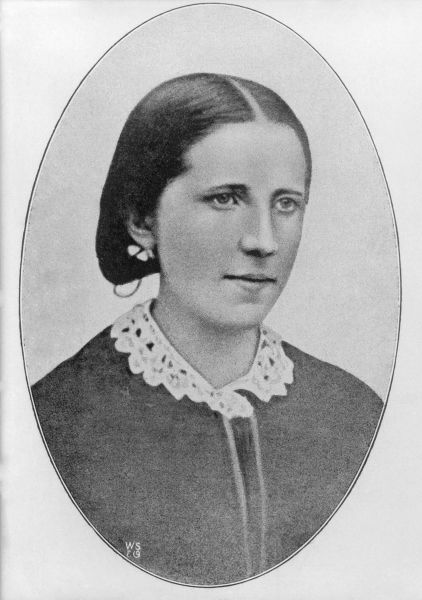
Marie Wexelsen: (born 20 September 1832 at Sukkestad in Østre Toten, was a hymn writer and author. Her full name was Inger Marie Lycke Wexelsen. She is best known for the Christmas hymn Jeg er så glad hver julekveld.

But after the service, he and Miss Wexelsen stayed back in the church, where there were painted portraits of a number of Toten priests. He told her to look at them carefully and point out the one who resembled the ghost. After looking at all the pictures carefully, she went back to one of them and said: “If I haven’t seen a fantasy fetus, then he’s there.”

This was the portrait of a priest (“the name should not be mentioned”) who, according to legend, was supposed to have killed a small child he had with his maid; the child’s body was never found. “Late in the Christmas period, the parish priest quietly made an agreement with a bricklayer and another person – probably the churchwarden – to punch a hole in the firewall in the room upstairs in the rectory. And here they found a child’s skeleton, which was buried in complete silence by the priest. And later there was never a “ghost” at the East Toten rectory. Source

The Ghost of The Yellow Hall

One of the rooms in Hoff vicarage was called “The Yellow Hall” and also have a story of the ghost of a former priest lingering. There is a legend connected to this room, which can be read about both in Totenmål and Anna Mål 12 and in The Great Book of Ghosts (Espeland)

The legend goes that there was a priest who was once a resident of the manor. One evening, as the parish priest was busy with his Sunday sermon, he was said to have seen a figure in a bluish tinge, and he got the feeling that this was someone in deep spiritual distress. The figure led the priest to the yellow hall, where the ghost knelt by a fireplace and appeared to be praying. After the service the next day, the priest recognized the figure in one of the priest pictures in the church. He had the fireplace examined, and there they found the skeleton of a woman. After the skeleton was buried in consecrated ground, the ghost is said to have been seen no more.

Newest Posts

  • A Vrykolakas Vampire in Sunny Mykonos
    A vampiric Vrykolakas from Greek folklore was said to terrorize the inhabitants on Mykonos island. To stop the haunting, they exhumed, burned and buried the remains of the body on an inhabited island. But did it work?
  • Manananggal: The Night Splitter of Filipino Folklore
    As part of the shapeshifting Aswang demons of the Phillipines, the Manananggal was soaring the sky in her bat-like appearance on her hunt for human blood.
  • The Atoning Vrykolakas Vampire in Santorini
    After a man died before atoning for his crimes, he came back from the dead as a vampiric Vrykolakas when his wife failed to follow his final wishes. What followed was a month full of terror and haunting.
  • The Vrykolakas Vampire in Patmos
    After terrorizing his village, the Vrykolakas Vampire from Patmos in Santorini were taken to an inhabited island and set on fire. The question is, did it really work?
  • The Churel: The Vengeful Vampire Woman of South Asian Folklore
    Fueled by anger and vengeance, the vampiric Churel of South Asian folklore, is said to haunt down men to drain their blood as a vengeful spirit brought back from the dead.
  • The Shoemaking Vrykolakas Vampire from Pyrgos Castle
    After a humble life as a shoemaker on Santorini in Greece, a man was said to have come back as a Vrykolakas, the vampire of Greek folklore. But for this Vrykolaka, it wasn’t to devour human life that kept him going.
  • The Sea Draug: The Ghostly Fisherman of the Norwegian Coast
    Thought to be haunting the dark seas of the north, the Sea Draug is a ghost of the drowned fishermen’s and other unfortunate souls who perished on the waters.
  • The Haunted Jane Street Hotel: Echoes of the Lost Sailors
    After tragedy struck and the Titanic sank to the bottom of the Atlantic ocean, the surviving crew members were sent to The Jane Street Hotel in New York. According to stories, they are still haunting the rooms, where the trauma of their tragedy lingers.
  • The Silent Music Haunting Hald Pensjonat
    Who can be haunting the old Hald Pensjonat in Mandal? Playing soft piano music in the afterlife, and rumours about the footsteps of a Norwegian pirate seems to linger.
  • The Mandurugo Vampire Bride of Philippine Folklore
    Hidden among human society, the vampiric Mandurugo creature is slowly draining her unassuming husbands of their blood and life to sustain her eternal youth and beauty.
  • The Ghostly Guardian of MS Nordstjernen
    The MS Nordstjernen spent decades bringing passengers north across the arctic sea, and although the waters can be brought this far north, it always seemed to reach port unharmed. Some think that it could be Ernst, the ship’s ghosts.
  • The Cabin in the Woods where the Forest Watches Back
    The DNT Cabin Flisberget deep in the mystical forest of Finnskogen, bordering Norway and Sweden has a lot of strange tales coming from it. So much so, that it was voted the scariest cabin in the country.

References:

https://www.filmweb.no/filmnytt/de-mest-hjemskte-stedene-i-norge

Stenberg

Stenberg, Stenberg gård | Reporterne flyttet inn på spøkelsesgården

Leter etter spøkelser på Toten

Mystisk klokkeklang – NRK Innlandet – Lokale nyheter, TV og radio

Hoff prestegard (Østre Toten gnr. 94/1) – lokalhistoriewiki.no

The Ghosts of Løp Gård North of the Veil

Advertisements

In the old farm for the rich and the powerful in the northern parts of Norway, Løp Gård is said to hold many of their former inhabitants, even in their death. 

Løp Gård in Nordland, Norway has long carried a reputation that unsettles locals after nightfall for centuries. Løp Gård is today a tourist attraction run by Salten Museum and in the summer times, it turns into a cage. Parts of the house are up to 300 years old.

Read More: Check out all ghost stories from Norway

The old farmstead is steeped in whispered stories, but none are as enduring or as eerie as the legend of the twin sisters said to haunt its halls. Their presence is not announced by screams or violence, but by something far more unsettling. The feeling that someone is watching from just beyond the edge of the light.

Shadows That Move on Their Own

Throughout Løp Gård’s history, people who have had great power have lived here, such as civil servants, skippers and policemen as a center of power. Layers of exclusive tapestry, a rarity in Norway at the time, shows how much riches were poured into the house. The house as it stands today is made up of seven different houses and to this day, a lot of the original furniture is still the museum and cafe. 

Some believe that young children are more sensitive to the supernatural. It has been reported that infants and young children refuse to go inside the house. If they are carried inside, they scream, howl, and want to get out.

The Ghosts of the Sisters at Løp

One of the stories is about an artist and his wife who lived in the house in a room that is now called the Boys’ Room. The room is on the second floor. It is said that the two often heard the main door on the first floor open and close, as if someone was entering the house. They often heard footsteps coming up the stairs, but when they went to check, no one was there. This happened over and over again, but there was never anyone there.

One day, as his wife was painting a picture, she turned around and saw a woman in white. She slowly turned back to the picture. She decided that she wanted to paint the woman, but when she turned back to her, she was gone.

Hanna Krogh-Hansen (1873 – 1971)

It is said that the woman in white was Hannah Løp, who also had a hobby of painting, an early owner of the house. It is said that both of the sisters are haunting their old home today. 

The Sisters Haunting their Home

Sisters Hannah and Arnolda inherited the house after their father Lauritz died, and became sole owners of the house, often called Frøknene på Løp (The Misses on Løp) and were known to be hard working ladies. They still serve their famous lemoncake in the cafe in the summertime. 

Before taking over the farm, Hanna learned photography from Louise Engen and was a professional in Oslo from 1898 until the 30s. Although a learned and well travelled woman, she sought back to her roots together with her sister after her father died in 1945.

Source

They lived there until they died in 1971 and 1979, 97 and 103 years old. The bed they spent their last days in is in one of the rooms in the house and is called the four-poster bed. There they both lay under several quilts to keep warm.

The Maid With the Red Bow

Another story is about a maid who once lived in the house. She fell in love with a civil servant and her employer and became pregnant after a short time. He rejected her though and she confronted him before she left the house forever. But where did she go?

In the 1990s, renovations were done and two workers loosened the floor and found a tiny red bow lying there. It is said it was the exact type of bow the maid had been wearing the last time she was seen. The workers ran out of the house and didn’t return to finish their job at all, according to some stories.

But what happened to the maid? There are many theories. Anna Elisabeth Westerlund is one of the psychics who has visited the farm and presented her own. When she was in the pantry where the two workers found the red ribbon, she said that something terrible had once happened here. The manager for the museum, Barbro Laxaa claimed that she believed the bow was still in the same place to this day. 

Some also said that the maid actually had the child there at the house. The son screamed and cried every day the mother left for work. And it is said that the sound of a child’s cry can still be heard in the house. But what happened to them though, is still a mystery. 

The Shipwrecked Man who Comes Knocking

Once a ship is said to have sunk off Løp. There were reportedly several people on board, but there was one man who managed to climb up from the beach at Løp and up to the farm, fighting his way from the freezing Norwegian winter waters through the equally freezing air.

He knocked as hard as he could on the door, and a man came and opened it. At that time, the farm was inhabited by some people of very high social rank, and they refused to let the man into the house. The poor man is said to have frozen to death outside the house during the night because he could not get anywhere else.

Cold gusts are blowing through the house, some workers say, and they think it’s the man just stopping by for a look.

The Civil Servant in the Ceiling

It is said that a female from the eastern part of Norway came to visit and had heard about the farm. This was after the house had become a tourist attraction and she wanted a tour of the house. The staff were simply too busy preparing for the party and running the café, so they told the lady she could just take a walk around the house and see what she wanted. 

The woman looked around and when she reached the second floor, she entered the room called the Great Hall. There she saw a man hanging from the ceiling. In that very room, it is said that an official had hanged himself, and according to some, his spirit is still hanging. 

At Løp Gård, even in silence, you are never truly alone, as more than one room holds the eternal residences from just beyond the veil. 

Newest Posts

  • A Vrykolakas Vampire in Sunny Mykonos
    A vampiric Vrykolakas from Greek folklore was said to terrorize the inhabitants on Mykonos island. To stop the haunting, they exhumed, burned and buried the remains of the body on an inhabited island. But did it work?
  • Manananggal: The Night Splitter of Filipino Folklore
    As part of the shapeshifting Aswang demons of the Phillipines, the Manananggal was soaring the sky in her bat-like appearance on her hunt for human blood.
  • The Atoning Vrykolakas Vampire in Santorini
    After a man died before atoning for his crimes, he came back from the dead as a vampiric Vrykolakas when his wife failed to follow his final wishes. What followed was a month full of terror and haunting.
  • The Vrykolakas Vampire in Patmos
    After terrorizing his village, the Vrykolakas Vampire from Patmos in Santorini were taken to an inhabited island and set on fire. The question is, did it really work?
  • The Churel: The Vengeful Vampire Woman of South Asian Folklore
    Fueled by anger and vengeance, the vampiric Churel of South Asian folklore, is said to haunt down men to drain their blood as a vengeful spirit brought back from the dead.
  • The Shoemaking Vrykolakas Vampire from Pyrgos Castle
    After a humble life as a shoemaker on Santorini in Greece, a man was said to have come back as a Vrykolakas, the vampire of Greek folklore. But for this Vrykolaka, it wasn’t to devour human life that kept him going.
  • The Sea Draug: The Ghostly Fisherman of the Norwegian Coast
    Thought to be haunting the dark seas of the north, the Sea Draug is a ghost of the drowned fishermen’s and other unfortunate souls who perished on the waters.
  • The Haunted Jane Street Hotel: Echoes of the Lost Sailors
    After tragedy struck and the Titanic sank to the bottom of the Atlantic ocean, the surviving crew members were sent to The Jane Street Hotel in New York. According to stories, they are still haunting the rooms, where the trauma of their tragedy lingers.
  • The Silent Music Haunting Hald Pensjonat
    Who can be haunting the old Hald Pensjonat in Mandal? Playing soft piano music in the afterlife, and rumours about the footsteps of a Norwegian pirate seems to linger.
  • The Mandurugo Vampire Bride of Philippine Folklore
    Hidden among human society, the vampiric Mandurugo creature is slowly draining her unassuming husbands of their blood and life to sustain her eternal youth and beauty.
  • The Ghostly Guardian of MS Nordstjernen
    The MS Nordstjernen spent decades bringing passengers north across the arctic sea, and although the waters can be brought this far north, it always seemed to reach port unharmed. Some think that it could be Ernst, the ship’s ghosts.
  • The Cabin in the Woods where the Forest Watches Back
    The DNT Cabin Flisberget deep in the mystical forest of Finnskogen, bordering Norway and Sweden has a lot of strange tales coming from it. So much so, that it was voted the scariest cabin in the country.

References:

Spøker det på Løp?

Løp gård — Nordlandsmuseet

Hanna Krogh-Hansen (1873 – 1971) – Hederskvinner Nordland

The Ghost From the Mounds of Finnbogastaðir

Advertisements

Buried in the mounds of the Icelandic landscape, a murdered shepherd came back from the dead as a Draugr or perhaps a Haugbúi ghost to haunt the people living at Finnbogastaðir farm.

The ghost story was published in the book Icelandic Folktales and Adventures (1862) and supposedly it all happened 40 years prior to publishing. 

Read more: Check out all ghost stories from Iceland

The author had heard mention of various ridges and mounds here in the district where people say that something “unclean” or haunted lingered in them, and it was thought to show itself most of all in the farm mound at Finnbogastaðir about forty years ago (the mound on which the farm stands). 

Finnbogastaðir is a farm in Árneshreppur, Westfjords, a remote place of rugged coastline, dramatic mountains, and picturesque bays. Finnbogastaðir is a farm of considerable historical importance that traces itself back to the first settlement of Iceland during the Viking Age.

A farmer named Halldór once lived at Finnbogastaðir, but later moved his household to Reykjarfjörður. While he lived at Finnbogastaðir, in a fit of anger he once killed a shepherd boy who was with him, and buried him in the farm mound. Few stories went around about how the boy had died, since people did not press much after such small matters in those days. 

The Nordic Draugr Ghosts and the Haugbúi (mound-dweller)

The Draugr of Icelandic folklore is one of the most feared undead beings in Norse tradition, often described as a malevolent ghost or revenant that clings to its burial mound or roams the living world with violent intent. Unlike the pale, ethereal spirits of later European folklore, the Draugr is corporeal—corpse-like, bloated, and often imbued with supernatural strength. Legends tell of Draugar (plural) crushing their victims, shapeshifting into monstrous animals, or spreading death through pestilence and madness. They were thought to guard treasures buried with them, punishing grave-robbers with terrifying force. Some tales even describe them as growing larger with every breath, an unstoppable presence embodying the fear of restless death and the corruption of the grave. Their origins lie in the belief that those who were greedy, cruel, or unwilling to leave the mortal world could rise again to torment the living.

Closely related, though often portrayed as less aggressive, is the Haugbúi, or “mound-dweller,” a type of ghost bound to its burial site, often mounds in the wild. Unlike the roaming Draugr, the Haugbúi typically remains within or near its grave, emerging only to guard its resting place and treasures. These beings were often seen as the lingering spirits of chieftains or warriors, bound to their burial mounds through strong ties of pride, greed, or unfinished duty. Farmers and villagers avoided disturbing such mounds for fear of awakening the spirit within, which could strike with sudden, spectral fury. The Haugbúi embodies the deep Norse respect for the land of the dead—where burial mounds were not merely graves but thresholds between worlds. Together, the Draugr and the Haugbúi reveal a haunting aspect of Norse belief: that death was not always a peaceful passage, and that the restless dead could remain tethered to the living, their presence a chilling reminder of mortality and vengeance beyond the grave.

The Killed Shepherd Comes Bach to Haunt

Many years later, Magnús Guðmundsson, the district officer who died four years before the publishing of the collection of ghost stories this legend featured in, lived at Finnbogastaðir. Magnús was the son of Guðmundur Bjarnason and did not originally believe in magic and ghost stories but changed his mind after his experiences. 

He built a smithy close by the farm and cut out some sods from that mound in which the boy had been buried. His mother, who was with him then, old and very feeble, was greatly alarmed when she heard of these actions of her son, and said that some evil would come of it, for nowhere could he have cut sods in a worse place.

The very next night a ghost came to Magnús where he lay in his bed, and it seized so firmly on his feet that he was hurt by it and was half-ill the next day. The following night the ghost came again to Magnús and was then still stronger; it seized him by the thighs and elsewhere so that Magnús fell sick afterward. The night after that the ghost came once more to Magnús, seized him by the throat, and was nearly finished strangling him where he lay in bed above his wife. He lay long sick after this and was never the same in voice again, for when he spoke it always sounded as if someone were pressing lightly on his throat.

When these three nights were past and Magnús had fallen sick with fear and dread, people began to think badly of it. But fortunately there was a man in the household named Jón, who was somewhat skilled according to everyone’s report. He was then asked to drive this apparition away, and he was very willing to try it, though he said it would be most difficult. He had the house closed, every door signed with a cross, and planned to seize the ghost and press him so that he would leave the farmer in peace. But the ghost was so quick that Jón could by no means seize him. Then Jón took the plan of opening a window in the living-room and was able to drive the ghost out through it, then ran outside after him and meant to attack him there. But by then the ghost had become so afraid of Jón that he fled before him, and Jón chased him out past the land boundaries of the farm, and there they parted. The ghost has not since been seen at Finnbogastaðir.

But as for the ghost, it went straight to Reykjarfjörður, where the descendants of old Halldór were then living, and that very night went into the cowshed there and killed a cow. After that he has done no great harm, but until recently he has followed people of that family.

Newest Posts

  • A Vrykolakas Vampire in Sunny Mykonos
    A vampiric Vrykolakas from Greek folklore was said to terrorize the inhabitants on Mykonos island. To stop the haunting, they exhumed, burned and buried the remains of the body on an inhabited island. But did it work?
  • Manananggal: The Night Splitter of Filipino Folklore
    As part of the shapeshifting Aswang demons of the Phillipines, the Manananggal was soaring the sky in her bat-like appearance on her hunt for human blood.
  • The Atoning Vrykolakas Vampire in Santorini
    After a man died before atoning for his crimes, he came back from the dead as a vampiric Vrykolakas when his wife failed to follow his final wishes. What followed was a month full of terror and haunting.
  • The Vrykolakas Vampire in Patmos
    After terrorizing his village, the Vrykolakas Vampire from Patmos in Santorini were taken to an inhabited island and set on fire. The question is, did it really work?
  • The Churel: The Vengeful Vampire Woman of South Asian Folklore
    Fueled by anger and vengeance, the vampiric Churel of South Asian folklore, is said to haunt down men to drain their blood as a vengeful spirit brought back from the dead.
  • The Shoemaking Vrykolakas Vampire from Pyrgos Castle
    After a humble life as a shoemaker on Santorini in Greece, a man was said to have come back as a Vrykolakas, the vampire of Greek folklore. But for this Vrykolaka, it wasn’t to devour human life that kept him going.
  • The Sea Draug: The Ghostly Fisherman of the Norwegian Coast
    Thought to be haunting the dark seas of the north, the Sea Draug is a ghost of the drowned fishermen’s and other unfortunate souls who perished on the waters.
  • The Haunted Jane Street Hotel: Echoes of the Lost Sailors
    After tragedy struck and the Titanic sank to the bottom of the Atlantic ocean, the surviving crew members were sent to The Jane Street Hotel in New York. According to stories, they are still haunting the rooms, where the trauma of their tragedy lingers.
  • The Silent Music Haunting Hald Pensjonat
    Who can be haunting the old Hald Pensjonat in Mandal? Playing soft piano music in the afterlife, and rumours about the footsteps of a Norwegian pirate seems to linger.
  • The Mandurugo Vampire Bride of Philippine Folklore
    Hidden among human society, the vampiric Mandurugo creature is slowly draining her unassuming husbands of their blood and life to sustain her eternal youth and beauty.
  • The Ghostly Guardian of MS Nordstjernen
    The MS Nordstjernen spent decades bringing passengers north across the arctic sea, and although the waters can be brought this far north, it always seemed to reach port unharmed. Some think that it could be Ernst, the ship’s ghosts.
  • The Cabin in the Woods where the Forest Watches Back
    The DNT Cabin Flisberget deep in the mystical forest of Finnskogen, bordering Norway and Sweden has a lot of strange tales coming from it. So much so, that it was voted the scariest cabin in the country.

References:

Íslenzkar þjóðsögur og æfintýri/Draugasögur/Draugurinn á Finnbogastöðum – Wikiheimild

Family of Magnús GUÐMUNDSSON and Guðrún JÓNSDÓTTIR