Tag Archives: abbey

The Hunderprest: The Vampire Monk of Melrose Abbey

Advertisements

A devious and unholy monk called The Hunderprest, was said to haunt the countryside on the Scottish border as well as Melrose Abbey. Was this specter really a bloodsucking vampire?

In the Scottish Borders, the ruins of Melrose Abbey have stood since the 12th century as a brooding, atmospheric relic of medieval piety and power. Melrose is a seemingly picture perfect place, drawing people in as the best salmon and trout fishing in the country. 

The Melrose Abbey is on the north east side of the town center and some of the more iconic buildings from the area. Behind its beautiful Gothic arches and solemn grave markers lies a dark legend: the tale of the Hunderprest, or the dog priest, a vampiric monk whose foul deeds and undead existence chilled even the most devout.

The Mysterious and Magical Melrose Abbey

The Abbey was founded by a colony of Cisterian monks in 1136 by the River Tweed. Once, it was said a miracle happened here, when the corn in their cellar multiplied in the time of a great famine, and the monks could feed them all. This and more miracles were said to have been performed by Abbot Waltheof, the stepson to King David I of Scotland. 

Through its time of operation it was one of the wealthiest monasteries in Scotland, but through all the years of war on the Scottish border it was badly damaged by the English in 1385 and rebuilt in the late 14th century. 

Melrose Abbey: A view of the interior of the ruined Melrose Abbey, Scotland. Heath’s Picturesque Annual 1835 by Roger Griffith

Today it’s a museum, although a big part of it is now lichen-covered ruins. In the Chapter House there is a burial casket of a heart, thought to belong to King Robert I, also called, The Bruce. In 1812, an old stone coffin was found close to the altar, thought to be the final resting place of Michael Scot, the mysterious Scottish wizard from the 13th century, said to have changed the River Tweed with his staff and turned the single peak of the Eildon Hills to the three we see today.

But not all miracles were as magical as these wonderful things. Some say that the magic happening around the cloister was also the work of evil, perhaps even a bloodsucking vampire. 

The Hunderprest of Melrose Abbey

According to medieval chronicles, the Hunderprest was a monk of Melrose Abbey during the 12th or 13th century. The Cistercian monks who lived and worshipped there had built the Abbey, the first Cistercian Abbey in the country, at the behest of King David I. They were famous for their Melrose wool they sold to the rest of Europe. 

Though little is known about his mortal life, legend says he was a man of great vice and depravity, a predator hidden behind a habit, whose sins were so grave that even in death, the earth rejected him.

Melrose Abbey in 1800, when part of the abbey was still in use as the parish church

Exactly what his sins were is not explicitly said always, but he was often claimed to have been a womaniser and drunkard, bringing shame upon his order. The region was a place of unlawfulness though, being controlled by independent clans called The Border Reivers that often clashed together in violence. It was both a time and place of ruthless lawlessness. 

Some say that in life, he used to be a chaplain to a lady who lived nearby. He was given the name Hundeprest as his favorite thing to do was hunting on horseback as a pack of howling hounds followed him. 

Howling Hounds: Often in William Newburghs tales of the undead, there is a pack of dogs following as the dog motif has been connected with death for ages in European mythology. The black dog is a supernatural, spectral, or demonic hellhound. It is usually unnaturally large with glowing red or yellow eyes, is often connected with the Devil, and is sometimes an omen of death.

Some accounts claim he practiced the black arts in secret, while others allege unspeakable acts committed under the guise of spiritual authority. The locals whispered of his unnatural appetites and sinister nature — rumors that seemed confirmed after his passing.

The Undead Haunting of the Abbey

Because of his sins in life, there was no way he was getting into heaven, and his soul could not find any peace. Livestock were found drained of blood, villagers claimed to see a shadowy figure lurking near graves, and monks reported being stalked by a ghastly presence within the cloisters at night.

He tried to enter the Abbey in the night in the form of a winged bat, only driven away after vigorous prayer and rituals from the monks. Because he was unable to cross the threshold to the holy ground, he needed another place to torment.

He found the cottage to a woman who he had known when he was alive. Said to be the woman he had been the chaplain for in life. She was also rumored to have been his lover. Her neighbors reported that a vampire roamed around her house, moaning and screeching at her, scaring her. Every night he returned to torment and terrorize, lusting after her blood. Because of this, they decided to summon an elder monk from the abbey for an exorcism. 

The Exorcism of a Vampire

Determined to put an end to the terror, the abbot of Melrose called upon the services of a particularly devout and courageous monk, often believed to be William of Newburgh, a respected chronicler of supernatural events. He ended up writing about a lot of monsters and ghosts in the middle ages. 

William of Newburgh: Many of the tales about the British vampires comes from the 12th century historian, William of Newburgh. William’s major work was Historia rerum Anglicarum or Historia de rebus anglicis (“History of English Affairs”), a history of England from 1066 to 1198, written in Latin. It is written in an engaging fashion and still readable to this day, containing many fascinating stories and glimpses into 12th-century life. He is a major source for stories of medieval revenants, animated corpses that returned from their graves, with close parallels to vampire beliefs.

According to the old accounts, a group of monks were put to task and went to the grave of the priest to investigate. As the day waned, the priest appeared like he was levitating out of his grave. They managed to shove the vampire back with a staff. Sometimes this is changed to a mighty axe the monks swung at him. The earth swallowed the Hunderprest like nothing had happened, the ground undisturbed again. This is when the elder monk knew they were dealing with a vampire and knew what to do. 

They waited for daylight and dug up his grave again. They exhumed the Hunderprest’s corpse and what they found only deepened their horror: though dead for some time, the monk’s body was fresh, his face ruddy, with blood at his lips curled up to a grin, classic signs of the undead in medieval folklore.

It was also said it was through praying and fasting that they managed to defeat him. How they killed the vampire, although not named as such in the early sources, varies. Did they stake him through the heart? Probably not, but they do mention setting him on fire and burning him to ashes as most of the stories of the undead mentions. The legend of the stake came later. 

Revenant: The term vampire or the undead was not used in medieval time, but several of the stories about the Revenant, Sanguisa or the bloodsuckers of folklore bear resemblance to what the modern world would classify as a vampire legend. In folklore, a revenant is a spirit or animated corpse that is believed to have been revived from death to haunt the living and was in medieval times used interchangeably with ghosts. They come from various cultures like the Celtic and Norse, some reminding more about a classic ghost story, some more of a vampire legend. Although today a mixed version of the western and eastern European mythologies of the undead.

After they burned him to ash, they took him to Lammermuir Hills where the wind carried him to the north along the borders. 

To this day, visitors to the hauntingly beautiful ruins of Melrose Abbey claim to feel a chilling presence lingering among the weathered stones. Some report seeing a shadow moving through the broken cloisters at night, or hearing faint whispers in the darkened archways.

Newest Posts

References:

Legend of the “Hunderprest” Vampire of Melrose Abbey

Airhouses – News – The Incredible Legends of Melrose Abbey

The Hunderprest: The Vampire Monk of Melrose.

The Ghosts of the Spanish Armada Stranded at Staad Abbey

Advertisements

After the Spanish Armada were set ablaze in the North Sea, some of the soldiers sought refuge at Staad Abbey in Sligo, Ireland. However, many of them met a haunting fate. 

In the rugged embrace of County Sligo’s Atlantic coastline, history and the supernatural converge at the enigmatic Staad Abbey. This weathered relic from the early medieval period, now a haunting ruin, whispers tales of pilgrimage, tragedy, and apparitions that linger in the depths of time.

The name “Staad” is of Gaelic origins, meaning “stop.” In times gone by, this abbey served as a crucial waypoint for weary pilgrims en route to the nearby Inishmurray Island. Staad Abbey is an early monastic site from the late 5th or early 6th century, reputedly founded by the monk, St Molaise. You can find the ruins of the old abbey in Agharrow, County Sligo, right on the cliff above the beach there.

Read More: Check out all of the ghost stories from Ireland

Staad Abbey can also be called a shore hostel, for travelers to stay in on their journey before venturing to Inishmurray by boat.

Ghosts of Spanish Soldiers

While the abbey’s history is imbued with the essence of spiritual seekers, it is also shrouded in a more sinister narrative. Local lore tells of the restless spirits of executed Spanish soldiers who now call this ruined abbey home. 

Staad Abbey: Only a few rubble stone is left from this ancient monument now.// Source: IrishPost

They came on a ship from the Spanish Armada in 1588 that was passing the Irish coast after rounding the north of Scotland. 

The Spanish Armada

The Spanish Armada was a formidable naval force consisting of approximately 130 ships, over 8,000 seamen, and around 18,000 soldiers, with about 40 warships among them. The Spanish plan was for this massive fleet, known as the “Great and Most Fortunate Navy,” to sail from Lisbon. The combined forces would then cross the English Channel to launch an overland offensive against London.

In May 1588, the Spanish Armada set sail from Lisbon. The English, desperate to prevent this, devised a plan involving fireships. At midnight on August 8, they set eight empty vessels on fire and allowed them to drift toward the Spanish fleet at Calais Roads. This caused panic among the Armada, forcing them to flee to the open sea.

The Spanish Armada: Defeat of the Spanish Armada, history painting by Philippe-Jacques de Loutherbourg (1796)

The Armada, now facing bad weather, was carried into the North Sea, preventing the rendezvous with Parma’s army. With supplies running low and disease spreading, the Duke of Medina-Sidonia decided to return to Spain via Scotland and Ireland. During the journey home, the Armada was ravaged by sea storms, leading to the loss of around 60 of its 130 ships and approximately 15,000 lives.

The treacherous Atlantic Ocean has claimed many a ship, but one of the most infamous tragedies unfolded in 1588 when the Spanish Armada met its demise off the shores of Streedagh Beach, near Staad Abbey. Over 1,000 souls perished in the relentless tempests, and among the survivors, despair mingled with hope.

The Spanish Soldier at Staad Abbey

Unfortunately, the survivors of the Armada’s ill-fated expedition did not find refuge but instead faced a grim fate. In the backdrop of the British occupation of Ireland, these Spanish soldiers, considered enemies of the realm, were captured and subjected to a ruthless judgment.

One of the survivors was Francisco de Cuellar. A few months after surviving the sinking of the Spanish Armada ship La Lavia on Streedagh Beach, Francisco de Cuellar sought refuge in Staad Abbey in 1588. Upon his arrival, he discovered that the church was partially burned, and he saw twelve Spaniards hanged from the rafters. He had encountered hundreds dead soldiers on the nearby beaches as well.

De Cuellar stayed at Staad Abbey for a few weeks before fleeing again. There is some debate about whether it was actually Staad Abbey he visited or another medieval church in the vicinity, possibly Ahamlish Church, located just north of Streedagh, where the ships from the Spanish Armada sank.

The Sinking Haunted Ruins

It is said that the desolation of Staad Abbey is not confined to its crumbling stones and windswept arches. Visitors have reported an eerie, bone-chilling coldness that hangs in the air. 

Shadows dance along the walls, seemingly floating across the ancient stones, evoking the memory of those ill-fated Spanish soldiers who met their end at this lonely ruin.

As you stand amidst the solemn ruins of Staad Abbey which are slowly being eroded away, the whispers of the past beckon, inviting you to contemplate the pilgrims’ journey, the tragic shipwrecks, and the ghosts that may still linger among the timeless stones. Soon it can be too late as the abbey itself is close to collapsing as it edges closer to the cliffs for every storm. 

More like this

Newest Posts

References:

Staad Abbey 

County Sligo: 5 Haunted Places To Visit | Spooky Isles 

Sligo medieval church that once housed remnants of Spanish Armada perilously close to collapsing off cliff | The Irish Post

Spanish Armada – Defeat & Definition 

Francisco de Cuellar – Wikipedia 

St. Katherine’s Abbey and Hauntings of the Black Hag

Advertisements

In the ruins of an old Abbey in Ireland, the locals claim they can still hear the dying screams of a woman that was buried alive, as well as feel the dark forces from the Black Hag that were practicing dark magic in the St. Katherine’s Abbey.

In the picturesque landscapes of County Limerick, Ireland, amidst the serene countryside, lies a silent witness to centuries of history, both sacred and macabre — St. Katherine’s Abbey as it is officially consecrated as. 

The ruins of the once Augustinian abbey are known under many names though like Monasternagalliaghduff or Mainistir na gCailleach Dubh. It is also called the Abbey of St Catherine de O’Conyl or simply Old Abbey.

Read More: Check out all of the ghost stories from Ireland

There are several legends from this place and it is said to be haunted to this day as the dark magic that once were cast still lingers.

The Timeless Convent of Monasternagalliaghduff

Dating back to the 13th century, the Abbey of the Black Hag is a weathered and abandoned convent that has witnessed the passage of time, preserving within its ancient stones the stories of the faithful, the echoes of prayer, and the secrets of its enigmatic past.

Read More: Check out more of haunted abbey’s like the Wessobrunn Abbey’s Ghosts, The History and Legends of the Haunted Abbaye De Mortemer, Dracula and Ghost Nuns in Whitby Abbey

St. Katherine’s Abbey is one of the earliest recorded nunneries in Ireland and was probably in operation until the 1500s until the Dissolution of the Monasteries during the Reformation in Ireland, or perhaps before this.

Monasternagalliaghduff: Only the few ruins are left fro the old abbey in the open field, now covered in grass. Many legends are tied to this place, and some claim St. Katherine’s Abbey is still haunted by them. //Source: JohnArmagh/wikimedia

The Countess Buried Alive in St. Katherine’s Abbey

But it is not the passage of time or the hallowed echoes of devotion that have etched St. Katherine’s Abbey into the annals of Irish folklore. Instead, it is the eerie legends and ghosts said to haunt the abbey, casting an ominous shadow over the abbey’s ruins no matter how much the sun is shining.

One of the legends comes from Countess Fitzgerald. She was the wife of The Earl of Desmond that had a bloody feud against the Butler family that was the Earls of Ormond during the 15th century. 

The Fitzgeral were attacked and the Earl was going to get his wife to safety. She was shot in the thigh by an arrow and throughout the night, she lost so much blood and the Earl thought she had died when they reached the abbey. 

She was buried underneath the altar of the abbey before he quickly rode on. But the nuns started to hear terrible screams coming from the grave during the night. In the end they chose to open the grave, but it was too late and they found the Countess dead, but with broken fingers and torn out nails. She had been buried alive and she had tried to claw her way out. 

Read Also: The Buried Alive Ghosts of Château de Trécesson in the Enchanted Forest, The Mausoleum of Rufina Cambacérès at Recoleta Cemetery — Buried Alive or The Mistletoe Bough – The Bride in the Chest

It is believed that she never found peace through and that she is still waiting for her husband to save her, still trying to claw her way out from her grave. 

The Tale of the Black Hag St. Katherine’s Abbey

As local lore has it, the last head nun or abbess of St. Katherine’s Abbey possessed knowledge of the dark arts and wielded them with terrifying skill. The Black Hag or the Black Nun as she was known as was actually a witch and Satanist according to the legends. 

Her mastery of these forbidden arts cast a long shadow of fear over the locals. Whispers of her malevolent practices spread like wildfire, shrouding the abbey in a sinister reputation.

Read More: Check out all of the stories about Witches at the MoonMausoleum.

According to the legends, the Black Nun wanted power, and to get it she sold her soul to get it. She was said to look gaunt with a skeletal figure wearing her all black robes. Even her face was said to darken, either from ashes or her dark magic. 

The Black Hag’s Cell

In the present day, the room within the abbey’s south end that once served as the abbess’s quarters has become infamous as the Black Hag’s Cell. It is in this chamber that the alleged witch’s spirit is said to linger, her spectral presence a chilling reminder of the darker chapters of the abbey’s history.

The Black Hag: Was she a witch? Did she practice dark arts? Or perhaps she was just the victim of terrible rumours? Was she real at all? One of the enduring legends from the former abbey is that of the Black Nun, or Black Hag, that were said to be the abbess of the abbey and a practitioner of the black arts.

It was in this cell that she performed Black Magic and worshiped Satan. Other nuns fled from the abbey according to legend when they found out what their abbess was up to, and she was left in the darkness. What happened to this supposed witch is uncertain.

The darkest rumor about the Black Nun is that she also sacrificed children during her dark rituals, taken from the nearby villagers, and there actually have been found bones of children on the grounds.

A Wicked End of the Black Hag

Where these legends come from though is uncertain. There certainly came some stories to justify the dissolutions of the nunneries in Ireland when the old Catholicism was seen as something filled with superstition and possible dark magic. 

Also, tales about single women living secluded have always had a trail of witch rumors following them. Because what in the world are unmarried single women up to if not worshiping Satan?

Haunting Echoes coming from the Old Abbey Ruins

Locals who live in the vicinity of St. Katherine’s Abbey speak in hushed tones of nights disturbed by blood-curdling screams that pierce the darkness. These ghostly wails, they claim, are the anguished cries of the Black Hag herself, echoing through the lonely hours of the night.

Or perhaps it is from the ghost of Countess Fitzgerald, who is still trying to let people know that she is alive, replaying her final hours trapped in the coffin. 

The Ruins of St. Katherine’s Abbey

As the moon cast an ethereal glow upon the ancient ruins of St. Katherine’s Abbey, the whispers of the past faded into the night. The haunting echoes of the Black Hag’s chilling cries and the anguished screams of Countess Fitzgerald began to dissipate, carried away by the gentle breeze.

And the Black Hag, a figure shrouded in mystery and fear, gradually faded into the realm of folklore. Her malevolence became a distant memory, forever entwined with the legends of the abbey.

The ruins of St. Katherine’s Abbey, now bathed in the light of a new day visitors wandered through the weathered stones, admiring the beauty of the landscape and contemplating the rich history that had unfolded within those crumbling walls.

As the sun set on St. Katherine’s Abbey, casting a golden hue over the landscape, a sense of tranquility and closure settled upon the abbey grounds. The tales of the Black Hag and the buried Countess became mere echoes, floating in the winds of time. Or do they?

More like this

Newest Posts

References:

IN THE ABBEY OF THE BLACK HAG – DARK EMERALD TALES 

Monasternagalliaghduff – Wikipedia 

Wessobrunn Abbey’s Ghosts

Advertisements

This I found, from men, as the foremost wisdom,
That neither earth there was, nor sky above;
Nor tree, nor hill there was.
Nor stars there were; nor shone the sun.
Nor moon-light there was, nor the salty sea.
Nothing there was: neither end, nor limit.
And there was the One Almighty God,
The mildest of men; and many were with them,
Godly Ghosts: and God the Holy.
From the Wessobrunn Prayer, the earliest known poetic works in Old High German from the 8th century.

The Benedictine Wessobrunn Abbey is steeped in history and legends. According to stories, the monastery has been haunted for centuries. From martyred monks to a disobedient nun, their ghosts still haunt the holy place. 

In 955, the Hungarians invaded part of today’s Germany and wanted to draw the German army out in the open and destroy it. 

On their way they came across the Wessobrunn Abbey and burned it all down to the ground. Three of the monks managed to flee to Andechs with their sacred relics they had kept in the Abbey. Abbot Thiente and six of his monks never got out alive though and suffered martyrdom, dying for their faith. 

After the defeat of the Hungarians on the Lechfeld, the spiritual life in Wessobrunn Abbey goes into a shadow period. Not much is known about when the first monks started coming back to the place after the sacking. 

Today there is a cross commemorating the martyrs just above Wessobrunn. Legend has it that the six dead monks have haunted the place ever since. 

The New Wessobrunn Abbey

It was not the last time the abbey was burnt down, and it was not the last time they decided to rebuild it either. Close to the site where the former Wessobrunn Abbey once stood, they built a new one, continuing the tradition of a monastery at the place. 

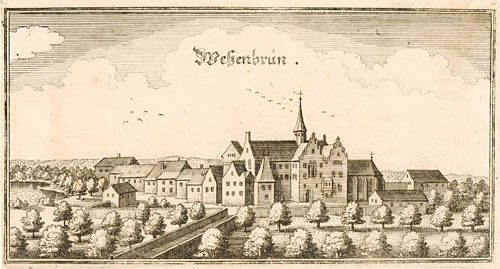
Wessobrunn Abbey: There have been a monastery at this place for a long time. Here a depiction of how it looked like in 1640, centuries after the ghosts started haunting the place.

The monastery of Wessobrunn, near Weilheim in Bavaria had been founded in the 8th century. From 1100 the community of male monks was joined by a sisterhood as well and it included both a community of nuns and monks. There are also legends about one of the nuns in the abbey haunting the place as a ghost. 

The Ghost of the Nun

According to this legend there was a nun in the 13th century who might have been a sister of Knight Joseph Diethalm von Wileyhin, the last Count of Weilheim. It is said she entered Wessobrunn Abbey after her brother’s death in 1211. 

But the way of the sisters is not for everyone and according to the stories, she broke one of her vows of the order. Nuns had to live by strict rules of Chastity, Poverty and Obedience. Exactly what type of vows she broke are unclear, but it scared her so that she ran off. She hid in an underground passage back at her family’s home in Göterlberg. 

Without seeing the sun ever again, she died shortly after and her remains were not found until many years had come and passed. From then on it is reported of sightseeings of a nun around the castle as well as her old abbey, crying in the hallways, still in her nuns’ habit. 

Up until the 1800s it was said that locals threw spruce cones into a hollow said to be the former corridor where the nun hid on her escape from the Wessobrunn Abbey to scare away the ghost. 

Today there are still a cluster of Benedictine nuns living after God’s words within the walls of the abbey, still seeing their long dead sister walking the halls. 

More like this

Newest Posts

References

Die spukende Nonne (Kloster… – Der Märchenonkel | Facebook

Dracula and Ghost Nuns in Whitby Abbey

Advertisements

The gothic haunting of the small town of Whitby is said to be by the old Whitby Abbey were the ghost of a nun is haunting the ruins. Whitby was also a place Bram Stoker used for a setting for Dracula’s arrival to England.

Whitby is cute little English town on the Yorkshire Coast, like taken out from any period drama movie. By the sea on nice days, the people are out in the streets, walking up the piers, sitting in the small cute boat and walking past the picturesque houses. But that is until the weather turns and the clouds are gathering in the sky, making the once blue sea foam. And the weather always turns for the worse in these seaside towns facing the North Sea.

Steeped in history, one need only to spin around to touch ruins, memories and ghosts of the past. And Whitby town is indeed haunted, at least if you believe Bram Stoker, the father of modern horror.

The Legends of Whitby Abbey

But before talking about Dracula, let’s have a look at some of the older legends the place is haunted by.

Much of the settlements back in the day was attributed to Whitby Abbey that was built in the mid 600 and founded by Hilda of Whitby, the abbess of several monasteries and an important figure in the Christianisation of Anglo-Saxon England. At that time the Whitby Abbey was a center for the medieval Northumbrian kingdom.

Hilda of Whitby was renowned for her wisdom and counseled Kings, princes and nuns alike. Whitby Abbey was known as Streoneshalh, and she remained there for the rest of her years as an abbess. Hilda of Whitby was was also the one inspiring one of the first British poets, Cædmon, to start out in his endeavor.

Saint Hilda of Whitby: The Abbess of Whitby Abbey was a well known woman and known for her wisdom and good counselling. She is also one of the ghost reported to haunt the ruins of the abbey.//Source: Detail from St. Hilda at Hartlepool by James Clark James (artist) (oil painting)

The last seven years of her life was a struggle for Hilda as she suffered from a fever. But nevertheless she continued her work until her death on 17th of November in 680 AD. She was then 66 years old, and that was pretty impressive in those days. According to a nun who lived there called Begu, she saw Hilda’s soul being carried to heaven by angels and she became a Saint.

The Ghost of Hilda of Whitby

Many strange legends arose after her death, like how a local legend says that when sea birds fly over the abbey they dip their wings in honour of Saint Hilda.

Read Also: The Haunting of The House of Hohenzollern, a ghost story about the hauntings by a nun.

And it was not the last time someone would claim to see her after her death. On dark nights in Whitby there have been reports of Hilda in the highest window on the northern side of Whitby Abbey when the winds comes blowing in from the sea. She is only seen for a few moments, looking out the window before she again disappears.

According to lore there are also two faiths that can befall you if you look into the well at the abbey at midnight. Those with a pure heart will see Hilda of Whitby, those without a pure will be taken by the devil. So perhaps seeing a ghost here is just a good omen?

Read More: Have a look at all of our ghost stories from churches and monasteries: Haunted Monasteries and Churches

We know little of what happened to Whitby Abbey after the death of Hilda, as Danish Vikings invaded it in 867, leaving it desolate for more than 200 years. It was first then the name Whitby was being used, meaning White City in old Norse.

The Picturesque Scenery: The ruins of Whitby Abbey in the sunset. There have been many legends about this abbey being haunted by the founding abbess, seen in the dark nights in one of the windows, the bells that used to hang in the abbey are sometimes heard ringing under the water where they sank./Wikimedia

After the invaders of the Norman, they made the Whitby Abbey to a Benedictine house for men that lasted to the Dissolution of Monasteries in 1539. A process that was often painted with the blood of the Catholics and where they stripped the churches, abbeys and other holy catholic places for its riches. In any case they stole the bells in Whitby Abbey and tried to take them to London, but on the way there, the ship sank together with the bells.

It is said that the ghost of St Hilda of Whitby appears in the ruins sometime as the bells can be heard ringing under the water were they sank. Now the ruins of the abbey stands at the top of East Cliff, looking out to the sea, missing its bells, its walls and its roof that are now only a story.

The Ghost of the Walled up Nun Haunting Whitby Abbey

But Hilda isn’t alone in the ruins of Whitby Abbey according to the local legend. The legend tells of another nun, a Constance De Beverley, who is haunting the walls of the ruined abbey.

Constance De Beverley was a young girl, but had already taken her vow to become a nun and devote herself to God and take no man for the rest of her life. But she broke them when she fell in love with a young knight and thereby breaking her celibacy. She was found out and the sisters in Whitby Abbey walled her inside the walls when she was still alive in the dungeon.

Haunted by the Ghost of its Nuns: Ruins of Whitby Abbey filled of history, myths and secrets. One of them is the story about the nun who according to legend became walled up inside the walls of the abbey because of her sins. Photo by Pixabay on Pexels.com

Could it be St. Hilda of Whitby who did it? A confirmed Saint that could have done something like burying one of her sisters inside of the walls? These were, as they’re called: The Dark Ages. The abbey had many abbesses over the years though, and who and when it was suppose to happen, is a bit unclear.

It is said that according to legend, if you walk around the ruins one can perhaps hear the screams of a woman in the wind and a plea for forgiveness and mercy. Perhaps it is coming from the walls? There has also reported a fleeting image of the ghost of a young girl, fleeing the abbey, trying to free herself for her eternal tomb in the walls.

Whether the story is true or not, it has certainly left an impression on those who heard it. The story of Constance De Beverley being condemned to be walled up in the abbey might have been the inspiration of Sir Walter Scott’s poem ‘Marmion‘ . It is about a nun of the same name that meets the same fate. Or perhaps the poem gave birth to a legend? Who’s to say?

Read More: This is not the only ghost story about people being buried inside of the walls. Also check out: The Finnish Maiden of Olavinlinna Castle, The Evil Bishop Against the Maiden in Love – A Ghost Story and O-shizu, Hitobashira — The Human Sacrifice of Maruoka Castle

Dracula Arrives In Demeter at Whitby

But perhaps today, Whitby is more known for its fiction than for its history. Today, every summer there is a performance of the story of Dracula at Whitby Abbey. Wonder what Hilda thinks of that.

But many things found in Dracula is drawn on the experience of the Whitby history, even the legend about a nun haunting hte abbey. In the book, Mina writes in her diary:

“Right over the town is the ruin of Whitby Abbey, which was sacked by the Danes … It is a most noble ruin, of immense size, and full of beautiful and romantic bits; there is a legend that a white lady is seen in one of the windows.”

Read Also: 5 Works With Vampires Before Dracula and An Introduction to the Horror Classics

In the book, Dracula arrives with a ship that beaches on the shores of Whitby. This actually happened with the Russian ship Dmitri: “The sequel to the strange arrival of the derelict in the storm last night is almost more startling than the thing itself. It turns out that the schooner is a Russian from Varna, and is called the Demeter. She is almost entirely in ballast of silver sand . . . “ (Bram Stoker, Dracula, 1897). Even the name, Dracula, Stoker found in the old library there.

Dracula in Whitby Town: The arrival of Dracula arriving on the ship Demeter has become a pretty iconic part of the lore. Bram Stoker became inspired to write his story when he visited Whitby Town and and saw the gothic ruins of Whitby Abbey and the grey shores on the English countryside.

Bram Stoker arrived and stayed at Mrs Vewazey’s Guesthouse in the summer of 1890. He was supposed to work on a new story, set in Styria, Austria with a character called Count Wampyr (thank you old public library of Whitby for giving the character another name than that). The Gothic literature drew on landscapes like this, and maybe not surprisingly, the ruins of Whitby Abbey, the desolated shores and the ghostly tales by the locals made it a perfect setting for what would become Dracula’s first encounter with England.

The Last Voyage of the Demeter

The interest for Dracula related movies and books continues to this day, and is based on the single chapter, the Captain’s Log, from Bram Stoker’s classic 1897 novel Dracula, the story is set aboard the Russian schooner Demeter and what happens before they arrive at Whitby Harbour.

The Last Voyage of the Demeter is scheduled to be released theatrically in the United States on August 11, 2023 and will help keep the legends of the Whitby haunting alive as well as creating its own vampiric lore there.

More like this

Newest Posts

References:

Whitby Abbey, An Essential Guide To Its Hauntings | Spooky Isles

Spooky Sunday; the ghost of Constance de Beverley | Whitby Uncovered