Tag Archives: wailing woman

The Banshee: Ireland’s Wailing Spirit of Death

Advertisements

Perhaps one of the most well known figures from Irish mythology is the Banshee, the omen of death, wailing as death comes to a house. But where does she come from? And what does she want from the dead?

Among the most enduring and chilling figures of Irish folklore is the Banshee, the spectral woman whose mournful cry foretells death. Her wail, or caoineadh, drifts through the night like a sorrowful song, a sound that has haunted Irish families for centuries. 

Read More: Check out all ghost stories from Ireland

To hear the Banshee’s cry is to know that death is near, and her presence serves as both warning and lament for the soul soon to depart.

The Irish Banshee: Here pictured the Bunworth Banshee, Fairy Legends and Traditions of the South of Ireland by Thomas Crofton Croker, published 1834.

The Banshee of the Fairy Mound

As with many Irish legends, it has deep connections to the Fairies and the Otherworld. Along the Irish countryside, there are grassy hills or tumuli known as síde that the fairy folk, Tuatha Dé Danann were driven underground to. The banshee or bean sídhe means woman of the sídhe.

The Banshee Appears by R. Prowse 1862 sep, 1

In some later English-language texts, the word sídhe is incorrectly used both for the mounds and the people of the mounds. However, sidh in older texts refers specifically to “the palaces, courts, halls or residences” of the otherworldly beings that supposedly inhabit them.

The Banshee is most often described as a woman with long, flowing hair, sometimes silver as moonlight, sometimes fiery red or jet black. She is said to appear wearing a grey or white cloak over a green dress, her eyes red from endless weeping. 

In some tales she combs her hair with a silver comb, a symbol of her connection to the spirit world and her most prized possession. This is perhaps also why so many who claim to have encountered her say she asks for a comb.

Though she can appear young and beautiful, she can also take the form of a shriveled old woman or a stately matron, her face twisted with grief and sorrow.

The Celtic Goddess of War and Death: Her appearance seems to represent the triple aspects of the Celtic goddess of war and death, namely Badhbh, Macha and Mor-Rioghain. The Morrígan is often described as a trio of individuals, all sisters, called “the three Morrígna”. Image: Macha Curses the Men of Ulster from 1904.

She may also appear as a washer-woman, and is seen apparently washing the blood stained clothes of those who are about to die. In this guise she is known as the bean-nighe (washing woman), although this version is perhaps more known in Scotland.

Brigid Goddess of Fertility: Another goddess connected to the Banshee is Brigid. Her son died in battle, and the goddess broke out in a nasally and high-pitched singing style known as keening. This became a mourning practice. Image: The Coming of Bride (1917) by John Duncan.

The Wailing Woman

Her keening cry is unlike any sound of this world. It is said to begin softly, almost like the wind through the trees, then rise into a piercing wail that can shatter the stillness of the night. 

The scream differs from region to region. in Kerry are said to be pleasant songs, but at Rathlin Island off the shore of Northern Ireland, the banshee’s song is a thin screech almost like that of an owl. And in Leinster, in the Southeast, the wail of a banshee is said to be so piercing it can shatter glass.

Henry Meynell Rheam: La Belle Dame Sans Merci English: The Banshee (1901)

Mourning the death of one of their kin with her piercing “caoine” or keening. This mysterious creature  resembles traditional Irish keeners or mourners of old. Even today, some claim that her cry echoes near homes or graveyards just before tragedy strikes.

Keening Women and the Irish Mourning Song: The Aran Fisherman’s Drowned Child (1841)

Those who hear it know that someone close to them will soon die, for the Banshee’s lament is not random but personal as it’s not every dying person that the Banshee is said to keen for. Traditionally, she was said to follow Ireland’s ancient noble families, or families of the “high Milesian race”. 

The Banshee Haunting the Ancient Families

According to tradition, some families had their own banshee, with the Ua Briain banshee, named Aibell or Aoibheall, being the ruler of 25 other banshees who would always be at her attendance. The banshee of the O’Donnel family was said to live on a rock overlooking the sea and the banshee following the O’Neill family was called Maveen. She was said to have her own room in the family castle. 

The Milesians: The sons of Mil represent the Irish people and are seen as the final race to settle in Ireland according to Christian medieval history, although scholars today think this is just a story. They are Gaels who sail to Ireland from Iberia (Hispania) after spending hundreds of years travelling the Earth. Most, but not all, surnames associated with banshees have the Ó or Mc/Mac prefix that is of Goidelic origin.

Those gifted with music and song could also be lamented by a banshee. 

A Spirit of Sorrow, Not Malice

Despite her terrifying reputation, the Banshee is not a malevolent spirit. She does not bring death; she merely announces it. Her cry is an expression of grief, a sorrowful duty to forewarn the living. In some legends, she appears as a loving guardian, mourning for her family’s loss from beyond the grave. In others, she is one of several ancestral spirits, each tied to an old Irish lineage. 

More modern stories, though, also claim that she can be seen travelling together with the death coach and the headless horseman that are out to collect people’s souls. Sometimes she was also not described as a fairy at all, but a ghost of a woman murdered or a mother who died in childbirth. 

Read also. The Death Coach: Ireland’s Omen of Doom Racing Through the Night 

The Banshee’s lament may be terrifying, but it comes from compassion rather than cruelty. Perhaps strange, as much of her origin stories are about her being the old goddesses that were driven down underground by the same families she laments for. 

Newest Posts

  • The Devil’s Stone in Grafrath
    In the Alpine foothills in Bavaria, strange boulders mark the landscape. Many legends linger over these mysterious stones, some claiming it was the Devil himself who placed it there.
  • The Calf Haunting of the Käfigturm: Bern’s Grotesque Prison Tower
    Said to be cursed forever after mistreating his prisoners, the jailer in Bern’s former prison tower, Käfitier is said to be haunted by the ghost of a monstrous calf.
  • The Lafayette Vampire Grave in Colorado
    For decades, parents have told their children to be home before dark in Lafayette, Colorado. The reason being that local lore tells of a vampire rising from his grave in the cemetery. But who exactly was the man behind the story, buried under the tombstone?
  • Grave of the Helhest in Roskilde Cathedral
    Buried in the same place as the Danish kings and queens, a legend about one of the smaller graves haunts the Roskilde Cathedral. It is said that a horse was buried here before any people, and it haunts the graveyard as the three legged helhest, an omen of death.
  • The Haunted Ruins of Lier Hospital in Norway
    As a place of dubious drug testing and the place where most lobotomies were done, the Lier Hospital and former asylum was left with a haunted rumor lingering in the decaying walls. Although most of the buildings are now torn down, it is still remembered as one of Norway’s most haunted places.
  • A Haunting Helhest in Odense St Canute Cathedral
    The Danish ghostly horse spirit Helhest is said to roam around St. Canute’s Cathedral in Odense, Denmark. It is believed seeing the three legged horse is an omen of imminent death.
  • The Helhest Haunting Saint Olaf’s Church in Helsingør
    According to old legends and Danish folklore, there are stories of three legged horses haunting the churches and graveyards in the country. in Saint Olaf’s Church, the spirit of the helhest is said to be the omen of death.
  • The Hauntings of Gamle Aker Church Over a Dragon’s Den
    Could it be that the oldest church in Oslo also has the oldest haunting? From legends about a dragon’s den underneath the structure and the ghostly silhouette haunting, the Gamle Aker Church perhaps has more activity than what meets the naked eye.
  • The Janissaries Vampires in Veliko Tarnovo
    During a time when Bulgaria was under the Ottoman Empire, there was talk about a vampire haunting the streets of Veliko Tarnovo. The rumours got so bad, that the Islamic rulers had to turn to pagan belief to rid themselves of the bloodthirsty creatures.
  • The Legend of the White Lady of Utstein Monastery
    In the windswept landscape of Norway’s west coast lies the Utstein Monastery, a site steeped in history and haunting tales. Known as Norway’s best-preserved medieval monastery, its ancient stone walls and iconic Gothic windows whisper stories of faith, love, and loss as well as the ghost of a Lady in White.
  • The Lord Edward Pub: The Rebel’s Restless Spirit
    After dying for the cause of Irish Independence, it is said the ghost of Lord Edward is haunting the pub he is buried close to and bears his name.
  • St. Patrick’s Cathedral: The Restless Spirit of Jonathan Swift
    In the ancient St. Patrick’s Cathedral in Dublin, there are said to be restless spirits still lingering. One of the more well known is said to be the ghost of Jonathan Swift, perhaps best known as the author of Gulliver’s Travels.

References:

Banshee – Wikipedia

The Haunting of Caerphilly Castle – The Lady in Green and the Hag of Death

Advertisements

A story of doomed lovers and haunted ivy leaves, the Lady in Green is said to haunt Caerphilly Castle in Wales together with the spirit of Gwrach-y-Rhibyn, wailing as an omen of death. 

Caerphilly Castle, one of the grandest fortresses in Wales, rises out of its mist-shrouded moat like a sleeping giant. Its immense stone walls and leaning tower have watched over the Rhymney Valley since the 13th century, built by Gilbert de Clare, the Norman Marcher Lord who sought to secure his power in South Wales. 

Yet beneath its stoic strength and noble history lies a tale of deathly omens, unquiet spirits, and the restless dead that refuse to release their hold upon its battlements.

A Castle Built for War

Caerphilly Castle was built by Gilbert de Clare (1243 – 1295) to control Glamorgan and halt the territorial expansion of Llewelyn ap Gruffudd (1223-1282). It is the second largest castle in size in Britain. It was built in a time of war and struggle for control over Wales and many of its ghosts come from this time. Spectral men-at-arms witnessed on the battlements.

Read More: Check out all ghost stories from haunted castles 

On the 11th April 1268 Gilbert de Clare began construction of Caerphilly Castle. He built the castle to secure the area from attack and prevent lowland south Wales from falling into the hands of the Welsh leader Llywelyn the Last (Llywelyn ein Llyw Olaf). Llywelyn realised the threat and tried but failed to prevent the castle from being built. 

He made an attack in 1270 but building began again in 1271. Alterations, including the great hall by Hugh le Despenser in 1322-6, were the last making it a very pure example of late 13th century military architecture and a place of ghosts.

The Lady in Green Haunting

One of the more well known ghosts said to haunt the castle is that of Princess Alice. Alice de Lusignan, or Alice of Angoulême (October 1236 – May 1290), was described as being very beautiful with dark hair and dark eyes. She was also flirtatious and provocative according to people and rumors followed her because of it. She is said to haunt the castle, having died of a broken heart after de Clare killed her lover Gruffudd the Fair, Prince of Brithdir. 

Alice was the first wife of Marcher baron Gilbert de Clare, 7th Earl of Gloucester, and half-niece of King Henry III of England. In 1253, Alice married Gilbert de Clare, 7th Earl of Gloucester (2 September 1243 – 7 December 1295). He was the son of Richard de Clare, 6th Earl of Hertford and Maud de Lacy. He was ten years old at the time of his marriage. According to the story, she moved with her husband to the castle and fell in love with a prince.

Gruffudd confessed their secret to a monk, but was betrayed as the monk told her husband. Gilbert, filled with rage, sent his wife back to France and ordered his men to find Gruffudd. Gruffudd had caught the traitor monk and hanged him from a tree at a site now known as “Monk’s Vale” in, although it’s unknown if this is a real place. Gilbert’s men caught up with him, and Gruffudd was also hanged in the forest.

As a final step in his revenge, Gilbert sent a messenger to France to inform Alice that he had killed Gruffudd and she dropped dead on the spot.

Her ghost has haunted the ramparts of Caerphilly Castle ever since and her green robes mock her husband’s envy. Her presence has made ivy grow at rampant rates around the castle so it might be said she has eyes everywhere. 

How True was the Story  of the Doomed Lovers?

Did the legend of the Green Lady of Caerphilly Castle actually happen? It looks like history will say no. It actually looks like Alice de Lusignan or Angoulême never stepped foot in Caerphilly Castle. She lived until her husband’s treason against the crown in Tonbridge Castle in Kent, England. She died in May 1290 in Warren, Sussex, England and perhaps it was not of a broken heart at all. 

There were rumors about her infidelity, but that was with her half first cousin Prince Edward, while she was briefly imprisoned on account of her husband’s treason. In later years, “Red” Gilbert would become one of the most powerful and important noblemen in the kingdom. The marriage produced two daughters although the marriage was annulled on 16 May 1285.

But what about ‘Gruffudd the Fair, Prince of Brithdir’? Brithdir is actually a small village in the northern part of the Rhymney Valley near New Tredegar, in the county borough of Caerphilly, south Wales. But there was never a prince connected to it, and even though not all sources claim he was a prince, there wasn’t a ‘Gruffudd the Fair either as far as sources goes. There was however Gilbert’s Welsh rival Llywelyn ap Gruffudd, Prince of Gwynedd, who later was recognised as one of the last independent  Prince of Wales. Perhaps he was the source of the legend, although he and Alice probably never met in real life.

So what about the Lady in Green said to haunt the castle? There have been countless stories of the green woman throughout the British Isles, often connected with the supernatural, like a crossover between witches, goddesses, fairy folk and the like. What is it that is said to haunt the ivy leaves and green of the castle? Could it just be a made up story, or could it be something else, something older? There was also a room at the castle, built into the wall, and supposedly haunted by an evil entity, but even less is said in regards to this. 

The Haunting of The Hag of the Mist

The Lady in Green is not the only spirit said to roam around the old castle grounds. And something even older is said to be behind the next haunting. 

De Clare family, once proud masters of Caerphilly Castle, were stalked by a spirit not of this world. The Gwrach-y-Rhibyn, the “Hag of the Mist,” was their personal harbinger of doom. To hear her rasping cry or glimpse her thin, leathery form was to know that death would soon strike the family. She would appear cloaked in shadow, her long hair matted, her hands twisted, her mouth opening in a mournful wail that echoed through the halls like the wind before a storm. Her presence foretold tragedy, a spectral messenger calling the family to prepare for loss.

The story of how she ended up at Caerphilly Castle stems from the 1700s. Apparently, she used to live in a swamp outside of Caerphilly. However, when the swamp flooded, she ventured into the town itself, terrifying everyone by flying around, screaming like a banshee. Some of the local boys tried to catch her but she fled into the castle, where she still resides today. 

When the de Clares finally left Caerphilly, fleeing war and ruin, the Gwrach-y-Rhibyn remained behind. The people of Caerphilly whisper that she is still there, bound to the castle’s ruins by grief and duty. Even today, when the de Clare family has died out, she is said to linger. 

On misty nights, when the moonlight shimmers on the flooded moat, she is seen drifting toward the castle’s gatehouse, her form little more than vapor in the cold air. It is said that the Gwrach-y-Rhibyn still walks toward Caerphilly on nights of death and change, her wail announcing another soul claimed by fate. 

Newest Posts

  • The Devil’s Stone in Grafrath
    In the Alpine foothills in Bavaria, strange boulders mark the landscape. Many legends linger over these mysterious stones, some claiming it was the Devil himself who placed it there.
  • The Calf Haunting of the Käfigturm: Bern’s Grotesque Prison Tower
    Said to be cursed forever after mistreating his prisoners, the jailer in Bern’s former prison tower, Käfitier is said to be haunted by the ghost of a monstrous calf.
  • The Lafayette Vampire Grave in Colorado
    For decades, parents have told their children to be home before dark in Lafayette, Colorado. The reason being that local lore tells of a vampire rising from his grave in the cemetery. But who exactly was the man behind the story, buried under the tombstone?
  • Grave of the Helhest in Roskilde Cathedral
    Buried in the same place as the Danish kings and queens, a legend about one of the smaller graves haunts the Roskilde Cathedral. It is said that a horse was buried here before any people, and it haunts the graveyard as the three legged helhest, an omen of death.
  • The Haunted Ruins of Lier Hospital in Norway
    As a place of dubious drug testing and the place where most lobotomies were done, the Lier Hospital and former asylum was left with a haunted rumor lingering in the decaying walls. Although most of the buildings are now torn down, it is still remembered as one of Norway’s most haunted places.
  • A Haunting Helhest in Odense St Canute Cathedral
    The Danish ghostly horse spirit Helhest is said to roam around St. Canute’s Cathedral in Odense, Denmark. It is believed seeing the three legged horse is an omen of imminent death.
  • The Helhest Haunting Saint Olaf’s Church in Helsingør
    According to old legends and Danish folklore, there are stories of three legged horses haunting the churches and graveyards in the country. in Saint Olaf’s Church, the spirit of the helhest is said to be the omen of death.
  • The Hauntings of Gamle Aker Church Over a Dragon’s Den
    Could it be that the oldest church in Oslo also has the oldest haunting? From legends about a dragon’s den underneath the structure and the ghostly silhouette haunting, the Gamle Aker Church perhaps has more activity than what meets the naked eye.
  • The Janissaries Vampires in Veliko Tarnovo
    During a time when Bulgaria was under the Ottoman Empire, there was talk about a vampire haunting the streets of Veliko Tarnovo. The rumours got so bad, that the Islamic rulers had to turn to pagan belief to rid themselves of the bloodthirsty creatures.
  • The Legend of the White Lady of Utstein Monastery
    In the windswept landscape of Norway’s west coast lies the Utstein Monastery, a site steeped in history and haunting tales. Known as Norway’s best-preserved medieval monastery, its ancient stone walls and iconic Gothic windows whisper stories of faith, love, and loss as well as the ghost of a Lady in White.
  • The Lord Edward Pub: The Rebel’s Restless Spirit
    After dying for the cause of Irish Independence, it is said the ghost of Lord Edward is haunting the pub he is buried close to and bears his name.
  • St. Patrick’s Cathedral: The Restless Spirit of Jonathan Swift
    In the ancient St. Patrick’s Cathedral in Dublin, there are said to be restless spirits still lingering. One of the more well known is said to be the ghost of Jonathan Swift, perhaps best known as the author of Gulliver’s Travels.

References:

Green Lady of Caerphilly Castle

Caerphilly Castle

The Green Lady of Caerphilly Castle, Wales — Facts-Chology

Alice de Lusignan, Countess of Gloucester – Wikipedia

Caerphilly Castle

La Llorona the Mexican Weeping Woman Ghost

Advertisements

Along the rivers in Mexico a wailing woman wearing white can be seen and heard as she comes up drenched from the waters. She is desperately looking for her children she herself drowned. And according to the legends of La Llorona or the wailing woman, you are next.

“The scariest part was not that La Llorona was a monster, or that she came when you called her name three times in the dark, or that she could come into your room at night and take you from your bed like she’d done with her own babies. It was that once she’d been a person, a woman, a mother. And then a moment, an instant, a split second later, she was a monster.
– Jaquira Díaz’s 2019 memoir, Ordinary Girls

This Mexican legend is one of the more well known, international as well now, as the movie came out a while back. But she has been around for centuries, a legend so well known it is now more or less an important part of the Mexican heritage and culture as well as in the Chicano Mexican community of the US.

Read Also: Check out all of our ghost stories from Mexico

La Llorona is Spanish meaning the weeping woman, or the wailer. She is perhaps a bit older than most think as well. The origin of the legend can have roots as far back in the Aztec legends and being one of ten omens foretelling the Conquest of Mexico and has also been linked to Aztec goddesses like Cihuacōātl.

Cihuacōātl was one of a number of motherhood and fertility goddesses. She was also the mother of the hunting God Mixcoatl, whom she abandoned at a crossroads. Tradition says that she often returns there to weep for her lost son, only to find a sacrificial knife. This story can help us understand why sometimes the story of La Llorona sometimes is set on a crossroad, not a long a river or some form of water.

The most common lore about La Llorona is about how she was being an Indigenous woman who murdered her own children, which she bore from a wealthy Spaniard. The villainous qualities of La Llorona have also been connected to the stories about Doña Marina, also known as La Malinche, or Maltinzin. She has been portrayed as a scheming woman who betrayed her people when she assisted the conquistadors and bore their children.

The Dangerous Wailing Woman in White

As well as finding similarities to the old Aztec mythology as well as working as an allegory about “betraying her own people”, the legend of La LLorona is something we can find similarities to all across the world. The story has also the ring of ‘White Woman’ often found in European legends as well as Greek mythology stories like with Jason and Medea, a scorned woman, killing her children when her man betrays her.

The weeping woman: A wooden cutout in the shape of La llorona. She has a white veil over her and is placed on the island la llorona in the channels of Xochimilco in Mexico.

Read Also: The Lady in White in Zitadelle Spandau or The Haunting of The House of Hohenzollern are all ghost stories featuring the trope of the lady in white haunting a place.

The difference between the European trope of the Woman in White ghost is that La Llorona are often described as being more dangerous to those encountering her than her European counterpart. This makes her more like the vengeful spirits we often read about in Asian ghost stories as with the Japanese Onryo or the Korean Virgin Ghost for instance.

The story of La Llorona takes many turns and has today many variations. The ghost of La Llorona, the wailing ghost woman appears in crossroads, by lakes or rivers, on the road and has many variations. Even if she is most well known as a Mexican folktales there are other variation of the stoghost story in other South American countries as well like in Guatemala and Venezuela.

Read Also: The Legend of La Sayona or La Descarnada of the Highway for more stories about dangerous female ghosts found in Latin American folklore.

And as the history of Mexico, with its changes and social unrest, the story of La Llorona has followed closely behind, reshaped to fit the narrative of the time. Therefore, we will relate one of these variations and one of the common one told in the modern era.

The Story of La Llorona

The most told version of the story of La Llorona is set in a small village in Mexico, were a young woman lived. As mentioned she is often portrayed as an indigenous woman. Her name was Maria and came from a poor family. She was known in the village for her beauty, but will be remembered as La Llorona, the weeping woman. A tragic club to be in.

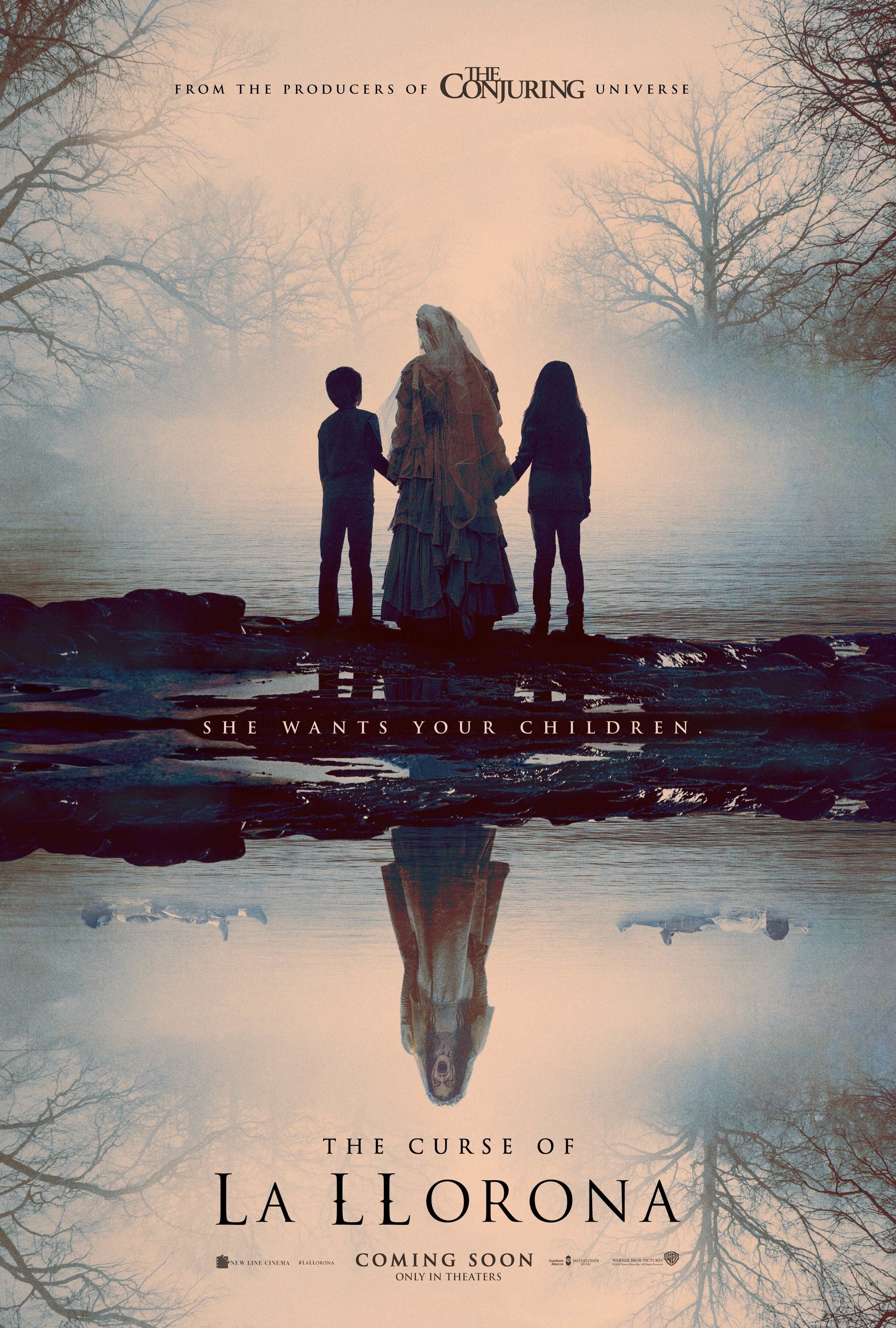
The Curse of La Llorona: The Tragic tale of the woman who drowns her children because her man abandoned her has been made into a movie many times. Here from the 2019 movie, the Curse of La Llorona//Source IMDB

One day, a very wealthy man came passing through town. DEpending to when the story is set, he was a Spanish conquistador or a wealthy rancher. He stopped when he saw the beautiful Maria and approached her. She was charmed by the wealthy man and when he proposed, she accepted at once. Maria’s family was overjoyed that their daughter would marry into a rich family and have a chance at a better life. But the father of this wealthy man however, was deeply disappointed at his sons choice of bride and didn’t approve of their marriage.

They chose to ignore the disapproving father and Maria and her now husband built a house in her town to get away from his judgmental father. Time went by and Maria gave birth to two twin boys. A seemingly happy marriage and life from the outside.

But not everything was rosy colored as it seemed. Her husband was always travelling and almost never spent any time with the family. When he was home, he only spent time with the boys, and Maria knew he no longer loved her and she started to fear that he would leave them.

Read Also: There are many ghost stories about women being left by their lover. Like The Ghost on Emily’s Bridge, The Grey Lady of Stavern at Hotel Wassilioff or the ghost of Chaonei No. 81 — Beijing Horror House

One day the husband went away and never returned. Many years went by but they didn’t hear from him and they didn’t even know if he were living or dead. Still, there seemed to linger a faint hope in Maria, that he someday would return to them and they would once again be a happy family.

Maria and her boys was out walking along a river one day when the faint hope she had been carrying came crashing down. A carriage was pulled by and to her greatest shock she saw her once husband sitting in it. By his side a much younger and beautiful woman sat and it was clear that he had abandoned them for good.

Maria was furious and desperate as her world fell apart and she could no longer fool herself. Without thinking she picked up her two boys and threw them in the river, drowning them in a fit of rage, of desperation and perhaps even a horrible psychosis. Only after she saw the floating bodies of her now dead sons she realized what she had done. She jumped out after them to die with them. Now she spends rest of eternity on the hunt after her children along that river.

The Haunted Rivers and Dangers of her Ghost

Doomed to linger in purgatory for her sins, she haunts the place were she committed her crime. Exactly where this place is differs as the legend about her ghost now has gone into the cultural sphere and is more like an entity in itself than just a singular ghost.

It is said that is you hear the crying of La Llorona close to rivers or other forms of water, you must run the opposite way as she is known for being a dangerous ghost to encounter, still mad and filled with rage that will harm you.

In some variation of the legend the children were illegitimate children, and she murdered them so that they wouldn’t get taken away from her and be brought up by another woman the father was legally wed to. In any versions though, the legend about La Llorona invokes pity for her fate as well as fear for her actions.

The Danger of La Llorona: The story of La Llorona tells about a woman who murdered her children when her husband abandoned her. Now she haunts the rivers and are a danger to those encountering her.

According to the legends, she still calls after her children “ay, mis hijos” and is said to be on a hunt for her children like she doesn’t remember what happened to them, still unable to accept what she did. It can bring bad luck, even death if you hear her cries.

If you are pregnant, you must be extra careful of her because La Llorona is attracted to children and wants them to join her. Therefore children should not walk alone along rivers and she has become some sort of cautionary tale to keep them away from the dangerous waters.

It is said that in some versions of the story, she kidnaps kids that are reminding her of her own and asks for their forgiveness. Then she murders them to take the place of her own.

La Llorona in Popular Culture

Although the legend about La Llorona is an old one, it is still an iconic figure to feature in books, movies and songs. There she differs from being a misunderstood female ghost to a full on evil spirit that are out to harm people.

In movies there have been made stories about her since the 1930s, mostly horror movies, and it even got its own spin off in James Wan’s The Conjuring Universe in 2019.

The popular folk song called La Llorona that were popularised in 1941, was also included in the Pixar movie Coco in 2017. So it’s safe to say that the legend about the wailing woman still lingers in the Mexican and US cultural sphere and fears of her ghost doesn’t seem to fade away anytime soon.

More like this

Newest Posts

References:

La Llorona – Wikipedia 

Cihuacōātl – Wikipedia

The Wailing Woman | History Today