Tag Archives: torture

Agnes Sampson — The Wise Wife of Keith

Advertisements

The story of the ghost of Agnes Sampson, known as The Wise Wife of Keith in Scotland is a story where a simple midwife was accused of witchcraft so powerful she caused a storm trying to kill her own queen. 

Agnes Sampson was a Scottish healer and a purported witch. Sampson was born in the village of Kirktoun, East Lothian in Scotland and worked as a midwife. She was believed to have healing powers long before she was accused of being a witch. 

She became known as the Wise Wife of Keith and was involved in the North Berwick trials that happened during the 16th century, one of Scotland’s most notorious witchcraft trials. Agnes Sampson is also known for being one of the main accused at this trial. 

There were and still are many tales about who Agnes Sampson really was. Some of them are true tales, some tall tales. She is said to have been married three times, once to William Keith with whom she had two children. She is also said to have been married to two other men and had 14 children with each man. 

So how did this simple midwife become the center of a conspiracy of witches trying to sink the ships belonging to their new queen and threatening her own King? To find out we have to travel across the pond to the court in Denmark-Norway and their fear of black magic and a series of unfortunate events on the sea. 

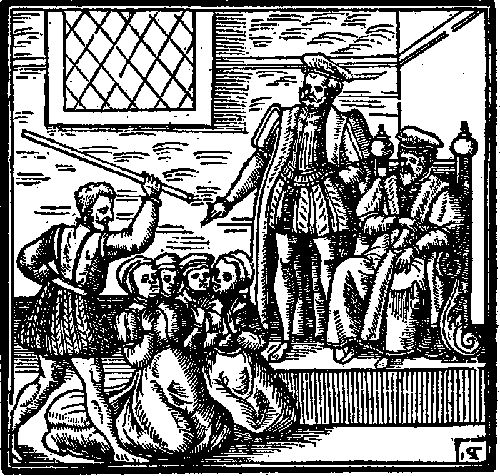
The King as the Judge: Suspected witches with Agnes Sampson kneeling before King James VI from the book Daemonologie (1597). He himself oversaw the trial and ended up sentencing many to be burnt as witches.

The Storm of Contrary Winds

By the autumn of 1590, Scotland was deep into witch hunts, and many of those sent to trial were questioned by the King himself. Today, the city of Edinburgh and the rest of the country is riddled with the memory of those who were burnt at the stake as a witch. King James VI, the son of Mary, Queen of Scots had just returned from Denmark-Norway where he had married Anne of Denmark who was only 14 at their wedding. 

Read Also

Edinburgh Castle Ghosts and Legends

Witches, dragons and ghosts, Edinburgh castle are said to have it all. The sound of bagpipe and drummers can be heard without anyone playing, and those accused for witchcraft as well as prisoners of wars are said to haunt the old castle.

Keep reading

The Danish court at this time was extremely wary of all things black magic and witchcraft. The fear of demons and witches had tightened the European continent and it was probably a fear that the Scottish King James adapted and brought back as well after spending time there. 

The King of Scotland was impatient awaiting his bride from Denmark to cross the seas after the wedding to stay by his side, but on her voyage to Scotland the fleet experienced heavy storms and ended up starting not only one, but two major witch trials that ended in several executions.  

A Series of Unfortunate Events

So how did a simple midwife like Agnes Sampson get accused of something that happened all the way over in Denmark? To this we have to go through the Danish court and the witch trials that happened there before it started in Scotland. 

Peder Munk of Estvadgård was a Danish navigator, politician and ambassador and in charge of carrying the fleet of 18 ships with Anne of Denmark to Scotland to bring her to her throne by her King. They set out on their voyage in 1589 from Copenhagen and were riddled with bad fortune, taking years to reach their final destination.

First they had to stop in a port in Norway to repair a leaking ship and had to stay there for a very long time, on their way to a very impatient king. When they reached The River Forth in central Scotland a ferry boat collided with one of the vessels in a storm and all of the passengers drowned. This was all attributed to witchcraft. 

Back in Denmark, the navigator Peder Munk blamed it all on witchcraft, especially on a certain woman whom he had insulted and believed to be the main witch behind the storms. This became the beginning of the Copenhagen witch trials, which ended in executing 17 people by burning. 

This inspired the King to hold his own trials, and it would be known as the North Berwick Witch Trials, and Agnes SAmpson was one of the main accused. 

Accused of Witchcraft

More than a hundred suspects were arrested in North Berwick, several of them confessed during torture and named other people. Agnes Sampson was accused by Gillis Duncan, another one of the accused. 

Duncan was really the one that linked the other accused of causing the storms that ended up sinking the Queens ships. She worked as a servant and confessed after torture that she was a witch and there were several more. The reason she was accused herself was that she was far too skilled of a healer in her master David Seton’s mind who also thought that Duncan had been sneaking out at night. 

Agnes Sampson ended up being one of the more significant accused persons, as an elderly and respected woman that had healed more than one in the local area. Many attributed their good health to her good work. Now, they all turned on her because of the rumors and her unfortunate circumstances. The fact that she was a widow with children and acted as an independent woman and educated midwife was a part of the indictment against her. She had also been accused of witchcraft and investigated before. 

Witches Sabbath: According to the accusers, Agnes Keith and the rest of her witch coven had met up and created a storm to keep a ship from Denmark arriving to Scotland, carrying Anne of Denmark.

The Wise Wife of Keith was imprisoned and put to torture for a long time before saying anything. She started off refusing to confess at first, but after a long time in the dark and in pain, she as the rest of the accused gave up. 

In the end she was brought before King James VI himself and a council of nobles at the Palace of Holyroodhouse. Sampson denied all the charges, but they kept torturing her until she said otherwise. Her head and body hair were shaved and she was pinned to the wall of her cell with a witches bridle. This was a torture instrument with four sharp prongs pressed into the mouth, meant to humiliate as well as hurt the ones wearing them. 

She was forced to stay awake with no sleep in her cell with a rope around her head, always reminded just how close to death she really was. And in the end, how freeing that prospect must have seen compared to the torture she went through. 

Finally, after all that torture, Agnes Sampson confessed to whatever they asked of her in front of her own king who oversaw the trial. In all she confessed to 53 indictments against her, including attending a Sabbat she led and that she was indeed a witch with supernatural power she used to harm others with. 

According to her testimony, she ended up saying she made a charm that caused a storm that ended up drowning Jane Kennedy. She sank a dead cat with parts of a dead man into the sea near Leith. The same charm she used to threaten the King and his wife on her voyage. 

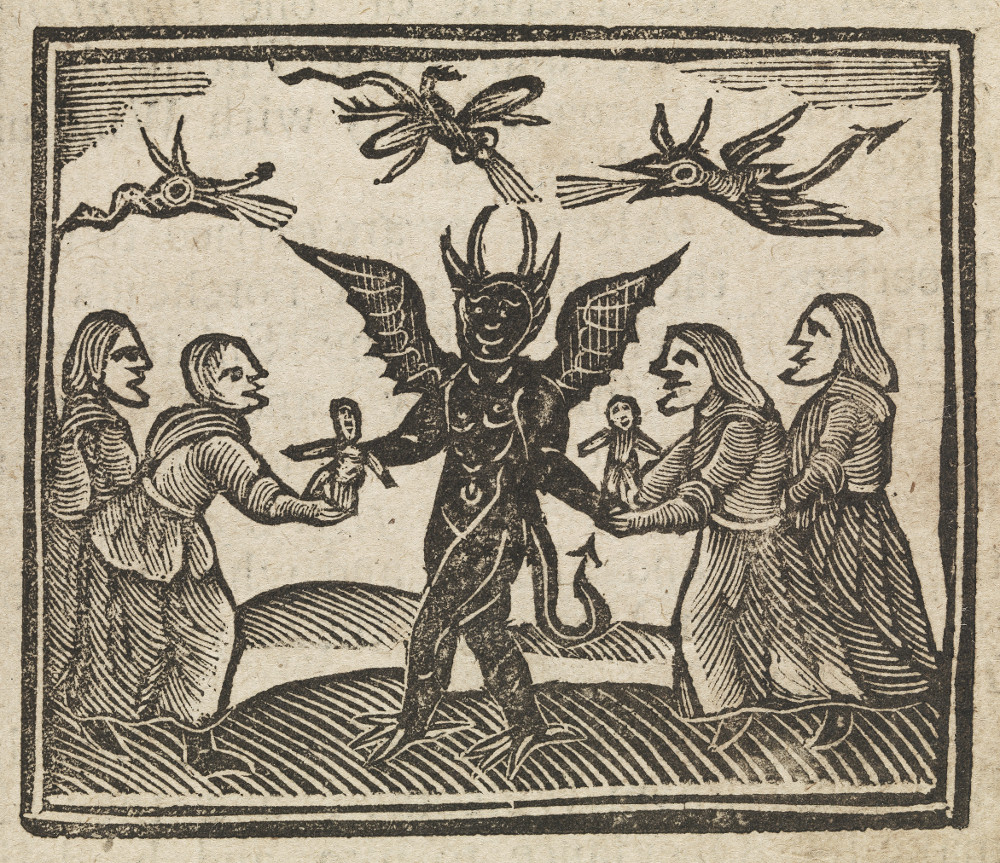
In League with the Devil: Depiction of the Devil giving magic puppets to witches, from Agnes Sampson trial and North Berwick Witch Trials where she and many others ended up being burnt as witches in 1591.

It was her last testimony that was her downfall in the King’s eyes. In it, she disclosed things he and his wife had on their wedding night in Oslo. A conversation she had no way of knowing:

“Item, the said Agnes Sampson confessed before the Kings Majesty sundry things which were so miraculous and strange, as that his Majesty said they were all extreme liars, whereat she answered, she would not wish his Majesty to suppose her words to be false, but rather to believe them, in that she would discover such matter unto him as his majesty should not any way doubt of. And thereupon taking his Majesty a little aside, she declared unto him the very words which passed between the Kings Majesty and his Queen at Oslo in Norway the first night of their marriage, with their answer each to other: whereat the Kings Majesty wondered greatly, and swore by the living God, that he believed that all the Devils in hell could not have discovered the same: acknowledging her words to be most true, and therefore gave the more credit to the rest which is before declared.”

— News from Scotland

Execution and Haunting

King James was allegedly not completely convinced of Agnes Sampson guilt until her last confession. After it however he changed his mind and sent her to be burned. On 28th of January 1591 she was taken to the scaffold on Castlehill where she was garroted before being burnt at the stake. 

Although the exact numbers of the executions are hard to be certain of, it is estimated that around 1500 people were killed as witches by the state of Scotland during this time. 

Agnes Sampson’s naked ghost is said to roam the castle grounds, bald headed roaming around the Palace of Holyroodhouse. 

More like this

Newest Posts

References

Fengdu Ghost City

Advertisements

The Fengdu Ghost City in China is steeped with the paranormal and cultural afterlife as well as being a big tourist attraction. Check out how the afterlife could end up after your death for the cost of a ticked.

In the Chongqing region in China, at the lean for the Tibetan Plateau and along the Yangtze river. Far from the sea, at the heart of the country, the city for the dead is built: Fengdu Ghost City 丰都鬼城, is a sort of Chinese type of Necropolis and its said this is the place where the devil lives according to local folklore. This city dedicated to its demons and ghosts also works as an amusement park for curious tourist wanting a trip to commercialized hell as well.

Read More: Check out all our collection of ghost stories from China

The strange and peculiar nature of Fengdu Ghost City really leaves the question of: How do you really combine the experience of the eternal afterlife at the price of a ticket? Is it more of a philosophical learning experience or more like a warning of what could happen if you don’t lead your mortal life right?

The King of the Underworld: This statue leading into Fengdu Ghost City is in the Guinness world records for being the largest sculpture carved into a mountain, depicting the King of the Underworld and welcomes those visiting the city./source

People in China follows a lot of different religion, even though religion is officially banned in the country. To Chinese folk religion, Confucianism Taoism and Buddhism, the place is steeped in religious practices and perhaps this is why the way to the afterlife is so important.

Read More: Another haunted town in China is The Ghost of Khar Khot, The Black City in the Gobi Desert

The Gates of Hell to Fengdu Ghost City

On the north bank of the Yangtze river, shrouded in smog and clouds, the Ming Mountain peaks out on clear days. At the Ming Mountain, shrines, monasteries and temples have been built in honor of the underworld over centuries with cute names like “Last Glance at Home Tower,” “Nothing-to-be-Done Bridge,” “Ghost Torturing Pass”.

The place were the Fengdu Ghost city is built on today used to be an ancient burial site with its shrines and temples and an ancient town. It had to be rebuilt further and further uphill in the mountains as the water from the Three Gorges Lake kept rising. So what is this place in all its honesty?

Fengdu Ghost City is the Gate of the Hell in traditional Chinese literature and culture. The city itself is mention in the great folk tales of Chinese tradition such as in Journey to the West, Apotheosis of Heroes and Strange Tales of a Lonely Studio, all three works is a big part of Chinese literature and cultural heritage and have a direct reference to the place.

Read More: Take a look at all our ghost stories on Haunted Towns and Cities

To call the Fengdu Ghost city a proper city is perhaps a bit misleading as it mainly function as an amusement park and there is no one living there anymore. Well, except from the ghosts and the demons it is built for of course. When you are entering the city, you are passing statues of the Heibai Wuchang (黑白无常), which are two Chinese mythological deities in charge of escorting the dead to the underworld. Then you are at the mercy of the demons that exists in the underworld and your own effort on getting out of there.

To get into the city you have to get a ticket at the counter ahead and it tended to be around a 100 RMB per ticket. They used to have customers put money into a water-filled basket as they believed that the paper money would float if they were human and sink if they were ghosts.

How Old is the Fengdu Ghost City

To be called a ghost city, the place, the statues and the temples must be pretty old, right? Well, according to legend the location where the city is built certainly has an old story. Today, some of the building have been rebuilt or added on in modern times, and some of the oldest have been there since previous dynasties.

The story of Fengdu Ghost City goes back for nearly 2000 years according to the legend. It is said that the city got its reputation as a place for dead people and the king of hell during the Tang Dynasty (618-907 AD).

The Fengdu Ghost City got it name in the Eastern Han Dynasty period  (206 BC to 220 BC), when two men came to the Ming Mountain to practice Taoism and to live as recluses away from the big society. The two men, Yin Changsheng and Wang Fangping ran away because they were bored of the political life and lived their life practicing taoism at their own accord in the alleged haunted mountains. According to legend they became immortal and the legend of the strange things happening there kept piling up.

Temples of the Ghost City of Fengdu: A classical Chinese building you will find at most historic sites, here are they all built in honor of the dead though. Many of the temples and shrines are built and dedicated to deities, demons and lords of the underworld and afterlife. They are open to visitors and tourists every day.//Source: Flickr

Word soon spread of this no small feat that two men had reach the stage of immortality and people came to seek what they had found. Their two names, Wang and Yin combined means King of hell or King of the Underworld. And this was the beginning of the focus of the underworld, and the building of Fengdu Ghost City started and continues to grow today.

Read More: Another alleged haunted mountain is the story of The Accursed Mountains of Albania

The city we can see and visit today though wasn’t really built into the mountain before the Three Gorges Dam project was started in the early 1900s and built slowly over the course of the century. Because of this massive project they had to build Fengdu Ghost city higher up because of the flooding the dam caused to the area around.

The Ghosts and Demon of Fengdu Ghost City

So what do you do in a city built for ghosts? This particular place could perhaps work for just its vibrant green scenery. Perhaps the main purpose of the park is helping people learn of the old belief system of what comes next after death. One thing at the park at least is testing your living self of the trials the dead spirits can come face to face with in hell.

Ghost Statues: Examples of the ghosts statues one can see in the Fengdu Ghost City. This is the statue of the “wreath-eating ghost” (食蔓鬼). In legend, this ghost was a girl who adorned herself with flower wreaths she stole from statues of the Buddha. After she died, as punishment, she was not allowed to feast on food offerings from living people and could only feed on flower wreaths/source

Walking in the Fengdu Ghost City there are all reference to the afterlife in terms of architecture and decorations in the city. The statues all depicts ghosts and devils, representing what happens to people not leading good lives, and how Chinese people saw, and at times, still picture the afterlife. It also showcases what is considered a good moral.

Women being thrown in boiling cauldrons for their sins, children being spanked after being naughty and people being poked, stabbed, tortured and judged for their crimes is some of the attractions you can observe when visiting. Perhaps you will even be condemned yourself. In many ways, just as fun as Disney World, bring the whole family.

Pictures of punishments are big in this city, and the way the Gods tortures the wicked. The pictures hang side by side of paintings of scary demons and bureaucrats passing judgement over the sinners. The eerie pictures fills the walls, the roofs and the gardens across the whole city of ghosts.

Read More: Check out the story about the Chinese hungry ghost in the story of Ghost of Tu-Po — The Hungry Ghost

Side by side with these ancient traditions and buildings is a rather tacky theme park of a standard haunted house with people in masks, just doing their best to entertain their guests. Can it be something more in this day and age were the idea of the afterlife has become rather vague and in the long unforeseeable future? Because it didn’t start out as an amusement park. It started out as a cultural exploration of what hell is and what the afterlife will look like. In many ways, it still is.

The Three Tests to an Afterlife

In Chinese traditions Diyu is some sort of purgatory that punishes and renews spirits to prepare them for reincarnation to a new life. A similar thing is Naraka, a Buddhist concept of hell similar to Diyu. All dead must pass three tests before crossing over to the next life. And at Fengdu Ghost City you can put yourself to the test of how you would do ass you can reach Youdu from here, which is the capital of the underworld.

The first test the visitors have to overcome is crossing the “Bridge of Helplessness”. The object is a stone bridge testing good and evil people. There are demons blocking the passage, letting only the worthy pass. Those who fail are pushed to the water below. The object of the test is to cross the test in fewest steps, and of course, not to fall into the water below. In the Fengdu Ghost City it is now a fun test to do, but it actually stems from an old taoist practice to have a good fortune. This particular bridge was actually built in the Ming Dynasty between the 1300s and 1600s.

After the “Bridge of Helplessness” the dead must continue to the Ghost-Torturing Pass were they meet Yama or Yanluo Wang who is the King of Hell. He is the one passing judgement. In this area there are a lot of sculptures with demons.

The third and final test takes place at Tianzi Palace on top of the mountain where the dead stands on a special stone on one foot for three minutes. Only virtuous people will manage this while evil people will fail and go to hell. Tianzi Palace is the largest and oldest building and it is about 300 years old.

Tourists in Hell and the Ghost City Sinking

In recent years the Fengdu Ghost City has become a big tourist attraction with boats carrying tourists up the river and taken to the mountain where they can walk among the statutes relating to Diyu and Naraka that symbolizes the underworld or Hell in Chinese mythology and Buddhism. It attracts many tourist, curious foreigners as well as Chinese visitors wanting to learn about ghost culture and the afterlife.

Read More: For more Chinese culture concerning ghost and the paranormal, check out the story of Ghost Marriage — The Chinese Way to Marry the Dead

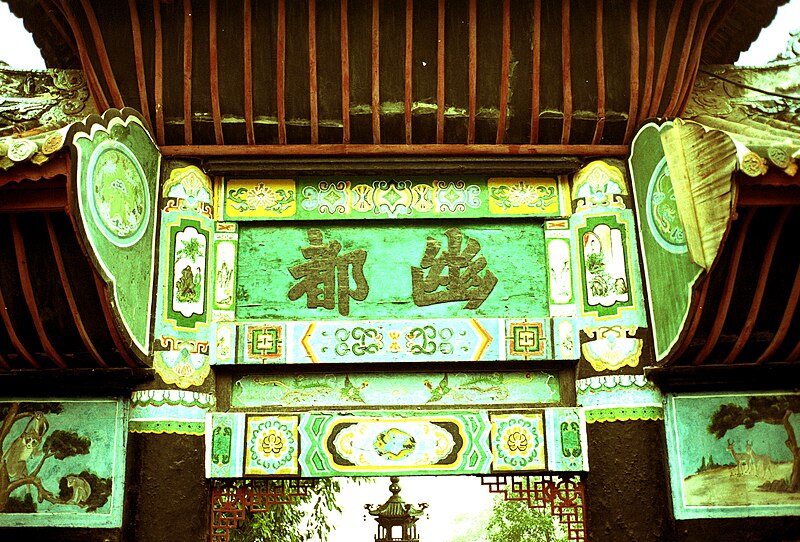
The Capital of Hell: The gate to the capital of the underworld, Youdu (right to left: 幽都). The whole underworld is called Diyu that is displayed in Fengdu Ghost City./source

After the building of Three Gorges Dam is built the Fengdu Ghost City will be an Island of itself, but parts of the city will be submerged in the water. They have also made some recent addition to the city.

In 1985 they built the Last Glance Home Tower, and according to legend, this is where the dead can have one last look back at their home and families before crossing over. Maybe one day, the Fengdu Ghost City itself will be something more of a legend than an actual place.

More like this

Newest Posts

https://www.atlasobscura.com/places/fengdhu-ghost-city