Tag Archives: shapeshifter

The Mandurugo Vampire Bride of Philippine Folklore

Advertisements

Hidden among human society, the vampiric Mandurugo creature is slowly draining her unassuming husbands of their blood and life to sustain her eternal youth and beauty. 

In Philippine folklore terminology, Mandurugo is distinguished from the broader category of aswang, a general term for malevolent shape-shifters. The name mandurugo itself comes from the root word dugo, which means “blood” in several Philippine languages. A mandurugo is literally “one who deals in blood.”

Read More: Check out all ghost stories from the Philippines

The mandurugo is typically described as a woman of striking beauty by day, indistinguishable from any other person in her community. And unlike many vampiric notions, she is not seen as a revenant or a part of the undead, but rather a real life woman or creature with powers.

A Beautiful Woman in the Dark

As mentioned, the mandurugo blends in with the rest of human society and targets mainly young men. She marries time and time again to feed on her husbands.  She feeds on her husband at night, laying in bed next to him as he sleeps. She has a pointed tongue she uses to prick and suck his blood and life. 

She also has the ability to shapeshift into a harpy-like creature with wings and at night she can fly and hunt her prey, something she has in common with another vampiric creature in Filipino mythology we’ll come back to.

Her appetites give rise to fear and mystery. If a man suddenly falls ill without explanation, communities whisper that a mandurugo may have visited him in the night. If livestock weaken or drain perplexingly, people suspect the same hunger at work. 

For protection, some would make a concoction of duhat (Java plum) mixed with ginger, manzanitas bark, yantok, blood and makahiya leaves and used as an offering to the mandurugo, so she wouldn’t harm those in the household.

Folklore and Fear of the Filipino Shapeshifters

The Mandurugo is thought of being a type of Aswang creature, shapeshifting monsters in Filipino myths and legends. These creatures were documented to be some of the most feared in folklore and their motifs were often nothing but causing most harm.  

Asawang: Aswang is an umbrella term for various shape-shifting evil and malevolent creatures in Filipino folklore, such as vampires, ghouls, witches, viscera suckers, and transforming human-beast hybrids. Spanish colonists noted that the aswang was the most feared among the mythical creatures of the Philippines, even in the 16th century.

Most of the stories and legends about the Mandurugo are found in both Tagalog and Bicol lore, specifically around Capiz, Panay Island it seems to have been most prominent.

We have documented tales about the lore from the Spanish from the 16th century and where the lore about the Asawang and Mandurugo were seen and understood through the Christian lense and demonology, that made an impact about how they are seen today. 

It seems that the lore about the Mandrurugo changed drastically. In pre-colonial Philippines the Mandurugo used protective rituals during vulnerable life stages such as childbirth. It is also likely that once, the mandurugo were a type of Kinnara or kinnari, gentle and beautiful winged creatures that resemble slim youths. They have wings same as birds on their backs, some on their buttocks, in oral tradition it is believed that the Kinari will love and serve devotedly any human who has treated it kind and when the human breaks the creature’s heart the kinari turns into a blood sucking monster.

Kinnara: (Sanskrit: किन्नर Kiṃnara) is a creature from Hindu and Buddhist mythology that the monster of Mandurugo could have sprung out from. They are described as part human and part bird, and have a strong association with music and love. Believed to come from the Himalayas, they often watch over the well-being of humans in times of trouble or danger. // Source: Wikimedia

The Manananggal Vampiric Creature Targeting Pregnant Women

As mentioned, the Mandurugo is only one of many vampiric creatures with a bird-like appearance. The manananggal is described as being an older, beautiful woman capable of severing its upper torso in order to fly into the night with huge bat-like wings. 

They are definitely similar and have sometimes been used interchangeably in stories. The main difference being who they are hunting. The Manananggal prey on unsuspecting, sleeping pregnant women in their homes. The myth of the manananggal is widely recognized in the Visayan regions of the Philippines.

The word manananggál is derived from the Tagalog word tanggál, meaning “to remove” or “to separate”, and literally translating to “remover” or “separator”. They also use an elongated proboscis-like tongue to suck fetuses from these pregnant women. They also prefer to eat the heart and the liver and the phlegm of sick people. Folklore also associates the creature with targeting newlyweds, lovers, newborn children, and occasionally grooms who were abandoned before marriage.

Traditional practices for killing a manananggal include applying salt, garlic, ash, or fire to the lower half, thereby preventing the upper torso from reuniting with it. If it fails to recombine before sunrise, the creature is believed to die.

The Girl With Many Lovers

One of the most famous stories about the husband hunting mandurugo vampire, is the Tagalog story of The Girl With Many Lovers. 

A young girl said to have been the most beautiful in the land, married at the age of sixteen. Although she was from an unknown place and an unknown family, her beauty won everyone over. Her husband was young and strong, but something was wrong. Although there were no clear signs of illness or disease, he withered away within a year and died. 

After his death she remarried, but her second husband, and then her third, suffered the same fate. After all the death that kept following her, suspicion around her grew, although nothing could be proved. 

Her fourth husband, having been warned, feigned sleep one night while keeping a knife close at hand. At midnight he felt a presence looming over him and then a prick in his neck. He stuck at the creature with his knife, and heard a screech and the flapping of wings. 

The next day, his bride was found dead near their house with a knife wound in her chest, having been a blood sucking Manurugo the whole time. 

Newest Posts

  • A Vrykolakas Vampire in Sunny Mykonos
    A vampiric Vrykolakas from Greek folklore was said to terrorize the inhabitants on Mykonos island. To stop the haunting, they exhumed, burned and buried the remains of the body on an inhabited island. But did it work?
  • Manananggal: The Night Splitter of Filipino Folklore
    As part of the shapeshifting Aswang demons of the Phillipines, the Manananggal was soaring the sky in her bat-like appearance on her hunt for human blood.
  • The Atoning Vrykolakas Vampire in Santorini
    After a man died before atoning for his crimes, he came back from the dead as a vampiric Vrykolakas when his wife failed to follow his final wishes. What followed was a month full of terror and haunting.
  • The Vrykolakas Vampire in Patmos
    After terrorizing his village, the Vrykolakas Vampire from Patmos in Santorini were taken to an inhabited island and set on fire. The question is, did it really work?
  • The Churel: The Vengeful Vampire Woman of South Asian Folklore
    Fueled by anger and vengeance, the vampiric Churel of South Asian folklore, is said to haunt down men to drain their blood as a vengeful spirit brought back from the dead.
  • The Shoemaking Vrykolakas Vampire from Pyrgos Castle
    After a humble life as a shoemaker on Santorini in Greece, a man was said to have come back as a Vrykolakas, the vampire of Greek folklore. But for this Vrykolaka, it wasn’t to devour human life that kept him going.
  • The Sea Draug: The Ghostly Fisherman of the Norwegian Coast
    Thought to be haunting the dark seas of the north, the Sea Draug is a ghost of the drowned fishermen’s and other unfortunate souls who perished on the waters.
  • The Haunted Jane Street Hotel: Echoes of the Lost Sailors
    After tragedy struck and the Titanic sank to the bottom of the Atlantic ocean, the surviving crew members were sent to The Jane Street Hotel in New York. According to stories, they are still haunting the rooms, where the trauma of their tragedy lingers.
  • The Silent Music Haunting Hald Pensjonat
    Who can be haunting the old Hald Pensjonat in Mandal? Playing soft piano music in the afterlife, and rumours about the footsteps of a Norwegian pirate seems to linger.
  • The Mandurugo Vampire Bride of Philippine Folklore
    Hidden among human society, the vampiric Mandurugo creature is slowly draining her unassuming husbands of their blood and life to sustain her eternal youth and beauty.
  • The Ghostly Guardian of MS Nordstjernen
    The MS Nordstjernen spent decades bringing passengers north across the arctic sea, and although the waters can be brought this far north, it always seemed to reach port unharmed. Some think that it could be Ernst, the ship’s ghosts.
  • The Cabin in the Woods where the Forest Watches Back
    The DNT Cabin Flisberget deep in the mystical forest of Finnskogen, bordering Norway and Sweden has a lot of strange tales coming from it. So much so, that it was voted the scariest cabin in the country.

References:

Mandurugo – Wikipedia

mandurugo | Facts, Information, and Mythology

https://solarspell-dls.sfis.asu.edu/mea/wikipedia/wp/v/Vampire.htm

Bicolano Myths : ASWANG (BIKOLANO MYTHOLOGY)

Mandurugo: A vampire from Filipino folklore

Kinnara – Wikipedia

Manananggal – Wikipedia

The Amalanhig: The Undying Hunters of Visayan Folklore

Advertisements

Rising from their graves, the vampiric Amalanhig from the Philippines are after your flesh and blood. But where did these creatures come from? 

Across the Philippine archipelago, amidst thick jungles and quiet villages where the night air seems to hum with ancient secrets, there exists a terrifying legend told in hushed voices: the tale of the Amalanhig. Part vampire, part restless revenant or some sort of zombie-like creature, these undead beings are feared in Visayan mythology, especially among the Hiligaynon-speaking people of the central Philippines.

Though the shapeshifting creature aswang often steals the spotlight in Filipino lore, the Amalanhig is a uniquely haunting breed of monster. Neither entirely living nor fully dead, these creatures stalk the night in search of the warmth of human blood… or the eerie sound of laughter in the dark.

The Birth of the Amalanhig

According to myth, the Amalanhig were once human aswangs which is sinister, flesh-hungry creatures of Filipino legend known for their bloodlust and shape-shifting abilities. But unlike their counterparts, these particular aswangs failed to successfully pass on their dark powers before death. Stripped of their chance for a peaceful afterlife and denied their monstrous legacy, they rose from their graves — stiff, unyielding, and ravenous for human blood.

These undead beings are said to haunt burial grounds, thick forests, and isolated villages, forever cursed to chase down the living. Their appearance mirrors that of ordinary humans, though their upper canines are often unnaturally long and sharp, betraying their true nature.

It is also said that some humans could turn into these creatures as well. Most often people who died with some unfinished business or are after revenge after being murdered. 

Death by Bite… or Tickle

In some versions, they relentlessly pursue the living, aiming to sink their oversized canines into the necks of unsuspecting victims. 

But in one particularly strange and eerie variant of the myth, the Amalanhig dispatches its victims not with fangs, but through tickling. Yes — these deathless beings are said to chase humans until they catch them, and then proceed to tickle them to death. A grotesque and terrifying ordeal, where the victims perish from a mixture of laughter, breathlessness, and sheer horror.

The Army of Undead

Some legends claim that the Amalanhig was created by humans. According to one legend, a long time ago before the Spaniards came to the Philippines a chieftain ordered his priestess to create an army of warriors that couldn’t be killed. 

They were created by killing ordinary men with dark rituals like putting dark soot, and putting a cursed pebble in their mouths. After three days they came back to life but they were mindless, walking corpses that only died after accomplishing their task.

How to Escape an Amalanhig

Due to the rigor mortis-like stiffness of their corpses, Amalanhigs can only walk in straight lines. A would-be victim can escape by running in a zigzag pattern, weaving unpredictably to confuse the creature.They can also be outrun as they are unable to bend their knees. 

Another time-honored method is to seek refuge in high places like trees, rooftops, or raised platforms as the Amalanhig’s rigid limbs prevent it from climbing. Deep bodies of water are another safeguard; these undead fear rivers and lakes, and will not follow their prey into the depths.

Newest Posts

  • A Vrykolakas Vampire in Sunny Mykonos
    A vampiric Vrykolakas from Greek folklore was said to terrorize the inhabitants on Mykonos island. To stop the haunting, they exhumed, burned and buried the remains of the body on an inhabited island. But did it work?
  • Manananggal: The Night Splitter of Filipino Folklore
    As part of the shapeshifting Aswang demons of the Phillipines, the Manananggal was soaring the sky in her bat-like appearance on her hunt for human blood.
  • The Atoning Vrykolakas Vampire in Santorini
    After a man died before atoning for his crimes, he came back from the dead as a vampiric Vrykolakas when his wife failed to follow his final wishes. What followed was a month full of terror and haunting.
  • The Vrykolakas Vampire in Patmos
    After terrorizing his village, the Vrykolakas Vampire from Patmos in Santorini were taken to an inhabited island and set on fire. The question is, did it really work?
  • The Churel: The Vengeful Vampire Woman of South Asian Folklore
    Fueled by anger and vengeance, the vampiric Churel of South Asian folklore, is said to haunt down men to drain their blood as a vengeful spirit brought back from the dead.
  • The Shoemaking Vrykolakas Vampire from Pyrgos Castle
    After a humble life as a shoemaker on Santorini in Greece, a man was said to have come back as a Vrykolakas, the vampire of Greek folklore. But for this Vrykolaka, it wasn’t to devour human life that kept him going.
  • The Sea Draug: The Ghostly Fisherman of the Norwegian Coast
    Thought to be haunting the dark seas of the north, the Sea Draug is a ghost of the drowned fishermen’s and other unfortunate souls who perished on the waters.
  • The Haunted Jane Street Hotel: Echoes of the Lost Sailors
    After tragedy struck and the Titanic sank to the bottom of the Atlantic ocean, the surviving crew members were sent to The Jane Street Hotel in New York. According to stories, they are still haunting the rooms, where the trauma of their tragedy lingers.
  • The Silent Music Haunting Hald Pensjonat
    Who can be haunting the old Hald Pensjonat in Mandal? Playing soft piano music in the afterlife, and rumours about the footsteps of a Norwegian pirate seems to linger.
  • The Mandurugo Vampire Bride of Philippine Folklore
    Hidden among human society, the vampiric Mandurugo creature is slowly draining her unassuming husbands of their blood and life to sustain her eternal youth and beauty.
  • The Ghostly Guardian of MS Nordstjernen
    The MS Nordstjernen spent decades bringing passengers north across the arctic sea, and although the waters can be brought this far north, it always seemed to reach port unharmed. Some think that it could be Ernst, the ship’s ghosts.
  • The Cabin in the Woods where the Forest Watches Back
    The DNT Cabin Flisberget deep in the mystical forest of Finnskogen, bordering Norway and Sweden has a lot of strange tales coming from it. So much so, that it was voted the scariest cabin in the country.

References:

Amalanhig – Wikipedia 

Amalanhig | Myth and Folklore Wiki

Aswang – Wikipedia 

Visayans – Wikipedia 

The Alp: Night Terrors of German Folklore

Advertisements

Sitting on your chest, crushing you in your sleep, The Alp of Germanic Folklore was said to be a vampiric entity after people’s life force. But where did this creature come from?

In the dark hours between dusk and dawn, when restless dreams twist and turn through the minds of sleepers, a sinister being from old German folklore is said to descend upon its victims. Known as the Alp, this malevolent supernatural creature doesn’t haunt abandoned castles or misty graveyards — instead, it invades the fragile realm of sleep itself, leaving terror and suffocation in its wake.
Read more: Check out all ghost stories from Germany

A figure of nightmares dating back to medieval Europe, the Alp exists in the shadowy intersection between spirit, demon, and vampire. Sometimes a seductive human, a butterfly, a pig in a magical hat, it has long served as a terrifying explanation for the most intimate of fears: what comes for us when we are most vulnerable, in our beds, under the cover of night.

The Alp And Mare: An Alp is typically male, while the mara and mart appear to be more feminine versions of the same creature. The Alp, in many cases, is considered a demon, but there have been some instances in which the Alp is created from the spirits of recently dead relatives, more akin to a spirit or ghost.

A Creature of the Night

But what was an Alp? There are so many variations of this legend, but mostly it’s a male entity, often the spirit of a recently deceased man. It is also seen in connection to the Germanic Elf, or the otherworldly or underworld creatures. 

It could also be the spirit of a woman who died as a sinner and pregnant. It was also believed that she could create the Alp if she ate something unclean or something that had dwarf spit on it. She could also create an Alp if she did inappropriate gestures during pregnancy or frightened a dog or horse during it. 

Unlike the towering monsters of other myths, the Alp is an insidious tormentor, striking unseen and unfelt until its victim is gripped by an unnatural terror in the midst of sleep. It’s traditionally described as a malevolent spirit or goblin-like being, often invisible, though sometimes appearing in grotesque, human-like forms or even taking on the shape of a cat, dog, snake, or butterfly.

Shapeshifter: The Alp may change into a cat, pig, dog, snake or a small white butterfly and can fly like a bird and ride a horse. The Alp always wears a hat, known as a Tarnkappe which is simply a hat or veil that gives the Alp magic powers and the ability to turn invisible while worn. The hat is visible no matter what shape the Alp takes. An Alp who has lost this hat will offer a great reward for its safe return. The Alp also possesses an “evil eye” whose gaze will inflict illness and misfortune. Removing or damaging this eye also removes the Alp’s malicious intentions.

The Alp’s most feared ability, however, is its power to induce terrifying sleep paralysis — what folklore once called a “nightmare” (the term originally referring not to a bad dream, but to the demon itself).

Victims would wake to find themselves unable to move or cry out, an invisible weight pressing down on their chest as a suffocating dread filled the room. They might hear the Alp’s breath, feel its claw-like fingers at their throat, or see shadowy shapes moving just beyond the edge of reason.

An Appetite for Blood and Breath

The Alp was believed to feed on both the life essence and the blood of its victims, not unlike a vampire. It was said to drink the milk of nursing women and, disturbingly, sometimes the blood from their nipples. Livestock were not safe either — cows found mysteriously drained of milk were often blamed on the Alp’s nocturnal visits.

Another chilling feature of the Alp legend is its association with dreams themselves. The creature was thought to control a sleeper’s dreams, turning them dark and violent, manipulating the victim’s mind as it fed upon their fear.

Nightmare: A haunting depiction of the Alp, a malevolent creature from German folklore, tormenting a sleeping woman in her bed. the German word Alpdruck (literally ‘elf-oppression’) means ‘nightmare’. There is also evidence associating elves with illness, specifically epilepsy. In the early modern period, elves are described in Northern Germany as doing the evil bidding of witches; Martin Luther believed his mother to have been afflicted in this way.

Its favorite targets were said to be those in states of emotional turmoil, the ill, and the vulnerable. It would even sometimes fixate on specific individuals, tormenting them night after night, sometimes also sexually, like a Succubus and Incubus.

Defending Against the Alp

German folklore offered a variety of protective measures against the Alp’s predations. One common method involved placing a broomstick under the pillow, a shoe at the side of the bed with the toes pointing towards the door, or an iron horseshoe hung nearby — symbols meant to confuse or repel the spirit.

It was also believed that calling the Alp by its name could banish it, though given its invisibility and secretive nature, discovering the true identity of an Alp was often impossible.

From Dwarf to Demon: In Teutonic myth and folklore, Alp were considered friendly elf-like beings which lived in the mountains, but eventually turned more negative and malevolent. They were likened more to the moss people or mountain dwelling dwarfs until becoming closer to demonic.

Another curious belief held that binding one’s hair before sleep or keeping the bedroom door slightly ajar would prevent the creature from entering, as the Alp was a creature of rules and compulsions, easily deterred by simple tricks or obstacles.

Echoes in the Modern World

Many modern scholars and folklorists view tales of the Alp as early cultural interpretations of sleep paralysis, a phenomenon still experienced worldwide today. The suffocating weight, inability to move, hallucinated figures, and overwhelming terror described in Alp encounters mirror accounts of sleep paralysis episodes in astonishing detail.

Yet even with the benefit of modern science, the age-old fear persists. There’s something uniquely unsettling about the idea of being helpless within your own home, your own bed — and perhaps that’s why the legend of the Alp continues to cast a long, dark shadow in the collective memory of Europe.

Newest Posts

  • A Vrykolakas Vampire in Sunny Mykonos
    A vampiric Vrykolakas from Greek folklore was said to terrorize the inhabitants on Mykonos island. To stop the haunting, they exhumed, burned and buried the remains of the body on an inhabited island. But did it work?
  • Manananggal: The Night Splitter of Filipino Folklore
    As part of the shapeshifting Aswang demons of the Phillipines, the Manananggal was soaring the sky in her bat-like appearance on her hunt for human blood.
  • The Atoning Vrykolakas Vampire in Santorini
    After a man died before atoning for his crimes, he came back from the dead as a vampiric Vrykolakas when his wife failed to follow his final wishes. What followed was a month full of terror and haunting.
  • The Vrykolakas Vampire in Patmos
    After terrorizing his village, the Vrykolakas Vampire from Patmos in Santorini were taken to an inhabited island and set on fire. The question is, did it really work?
  • The Churel: The Vengeful Vampire Woman of South Asian Folklore
    Fueled by anger and vengeance, the vampiric Churel of South Asian folklore, is said to haunt down men to drain their blood as a vengeful spirit brought back from the dead.
  • The Shoemaking Vrykolakas Vampire from Pyrgos Castle
    After a humble life as a shoemaker on Santorini in Greece, a man was said to have come back as a Vrykolakas, the vampire of Greek folklore. But for this Vrykolaka, it wasn’t to devour human life that kept him going.
  • The Sea Draug: The Ghostly Fisherman of the Norwegian Coast
    Thought to be haunting the dark seas of the north, the Sea Draug is a ghost of the drowned fishermen’s and other unfortunate souls who perished on the waters.
  • The Haunted Jane Street Hotel: Echoes of the Lost Sailors
    After tragedy struck and the Titanic sank to the bottom of the Atlantic ocean, the surviving crew members were sent to The Jane Street Hotel in New York. According to stories, they are still haunting the rooms, where the trauma of their tragedy lingers.
  • The Silent Music Haunting Hald Pensjonat
    Who can be haunting the old Hald Pensjonat in Mandal? Playing soft piano music in the afterlife, and rumours about the footsteps of a Norwegian pirate seems to linger.
  • The Mandurugo Vampire Bride of Philippine Folklore
    Hidden among human society, the vampiric Mandurugo creature is slowly draining her unassuming husbands of their blood and life to sustain her eternal youth and beauty.
  • The Ghostly Guardian of MS Nordstjernen
    The MS Nordstjernen spent decades bringing passengers north across the arctic sea, and although the waters can be brought this far north, it always seemed to reach port unharmed. Some think that it could be Ernst, the ship’s ghosts.
  • The Cabin in the Woods where the Forest Watches Back
    The DNT Cabin Flisberget deep in the mystical forest of Finnskogen, bordering Norway and Sweden has a lot of strange tales coming from it. So much so, that it was voted the scariest cabin in the country.

References:

The Haunted Freetown State Forest and the Bridgewater Triangle

Advertisements

Sometimes you can tell which dark trees are covered in darkness, and the haunting that follows. The Haunted forest of Freetown State Forest in Massachusetts is one example said to be in the mysterious Bridgewater Triangle, where the area seems to have attracted much evil throughout the years and lingers within the trees.

Behind the picturesque scenes of Massachusetts’ Freetown State Forest lurks a haunting history steeped in murder, fear, and the ominous presence of the paranormal outside of the Hockomock Swamp. The natives named it as a place where the spirits dwell, and the early settlers named it the Devils Swamp. 

Being a part of the infamous Bridgewater Triangle, this seemingly serene forest conceals a dark reputation, earning it the chilling moniker of the Cursed Forest of Massachusetts of alleged paranormal phenomena, ranging from UFOs to poltergeists, and other spectral phenomena, various bigfoot-like sightings, giant snakes and thunderbirds. 

The Cursed Bridgewater Triangle

Part of the legendary Bridgewater Triangle, Freetown State Forest stands as a magnet for the weird and horrifying lingering inside of the 5000 acres forest. Amidst its shady paths and sunlit clearings, people seem to think that the very forest emits a dark energy that creates more darkness. 

The Bridgewater Triangle is an area of about 200 square miles in southeastern Massachusetts. First described in the 1970s by cryptozoologist, Loren Coleman in his book, Mysterious America. 

Read more: One of the more famous spots in the Bridgewater Triangle is perhaps the Lizzie Borden House where a horrible murder was committed and only paranormal forces lingered. 

The Bridgewater Triangle is known for hosting an array of spooky sightings, from Bigfoot, Thunderbird to UFOs to ghosts to satanic cults and old Native American monsters and ghost stories. The history of this haunted expanse is more than mere speculation—it is a documented tapestry of tragedies and crimes that contribute to the ominous allure of the Freetown State Forest.

The Haunted Forest of Massachusetts Of Freetown State Forest Murders

On a cold November in 1978, the dead body of Mary Lou Arruda was found inside of the woods. She was a 15 year old cheerleader that had been kidnapped from Raynham town two months ago when she was riding her bike through the Freetown State Forest, only two days after her birthday. She was found tied to one of the trees. Dead. 

An autopsy revealed that she had either died from strangulation or asphyxia. In addition, it was uncovered that Arruda was alive when she was tied to the tree and that she had died the same day she had been abducted. Medical examiners believe that she died when she became unconscious from a ligature around her neck. Ultimately, this caused her to suffocate.

Mary Lou Arruda: 15 year old Mary Lou Arruda is only one of the victims the forest has claimed. Her death was much written about and her case certainly tainted the forest reputation in modern times.

The suspicion soon fell on James M. Kater when a composite sketch was created with the help of an eyewitness. Kater worked at a local donut store at the time of the killing and had previously been convicted for kidnapping. According to him he had gotten married and left on a honeymoon abroad the day after Arruda went missing. 

Afterwards, due to the endless efforts of local police and eyewitnesses, he was linked to the crime using multiple pieces of evidence, the most important one being tire tracks found near Arruda’s cycles which matched the unusual patterns made by his car tires. 

Kater was found guilty in 1978 and 1986, but both convictions were overturned on appeal due to hypnotized witness evidence. The 1992 trial resulted in a mistrial, which was followed by another one in 1996, when he was ultimately found guilty and sentenced to life in prison.

Despite efforts by local police and eyewitnesses, Kater’s initial convictions in 1978 and 1986 were overturned on appeal, primarily due to evidence presented by hypnotized witnesses. 

The case went through multiple trials, with the 1992 trial resulting in a mistrial. Another trial in 1996 ultimately found Kater guilty, and he was sentenced to life in prison. The crucial piece of evidence linking him to the crime was tire tracks found near Arruda’s bicycle, which matched the distinct patterns made by Kater’s car tires. The complex legal proceedings and the use of witness testimony under hypnosis added layers of intricacy to a case that sought justice for the tragic fate of Mary Lou Arruda.

Satanic Cult Activity and Satanic Panic in the 80s

The murder of Arruda was not the last time the Freetown State Forest got tied up in a murder investigation. In 1980, police investigating a murder near the forest were confronted with reports of Satanic cult activity during the fear and Satanic Panic years of the 1980s and 90s. 

Locals spoke of witnessing eerie rituals in the woods, possibly linked to the infamous “Fall River Cult Killings” that was going on simultaneously taking the life of Doreen Levesque, Barbara Raposa and Karen Marsden. 

Stained clearings, marked with animal blood, fueled rumors of ritual sacrifice within the haunted woods, amplifying the forest’s already ominous reputation.

Its connection to satanism didn’t stop there though and especially animal mutilation have been reported, most notably in 1998 when the police investigated a case of mutilated animals believed to be the work of a cult. One was of a butchered cow found in the forest, and the other was a group of mutilated calves in a clearing of the Freetown State Forest. 

Assaults and Mysterious Incidents Throughout the Years

So what is really going on inside of this forest? Freetown State Forest’s sinister legacy extends to multiple murders, assaults, and bizarre occurrences along the forest and at its paths. From the mistaken killing of a homeless man in 1987 when someone thought he was an undercover cop. 

There was also the discovery of gunshot-riddled bodies on Bell Rock Road in 2001, the forest bears witness to a series of dark events. Reports of aggressive dogs, an escaped emu, and wires strategically placed to harm visitors underscore the unsettling atmosphere that pervades the woods.

In 2006 there were aggressive dogs running wild in the area and in May in 2016 they found wires along paths that many people frequented. The purpose of these wires was most likely to decapitate off-road bikers when they came driving. 

But there are also more ancient and more supernatural forces at play if we are to believe the local legends that came to be much earlier than the country itself. 

Supernatural Forces at Play in Freetown State Forest

The paranormal veil hanging over Freetown State Forest thickens with tales of blood sacrifices, UFO sightings, ghostly apparitions, black helicopters, mysterious orbs of light, and strange disappearances. Legends speak of giant snakes slithering through the shadows, poltergeist activity, and rumored abductions. 

Read More: Check of all stories from Haunted Forests

Even President Ronald Reagan himself reported witnessing unexplained lights in the forest’s sky. Whispers of the forest’s dark influence leading people to suicide circulate, while ancient legends weave the presence of Pukwedgies, humanoid creatures from Wampanoag native tradition, who are said to stalk the haunted woods.

The Native American Curses

Once, this land around Freetown State Forest used to belong to the native Americans that used to go from Cape Cod up to Rhode Island. Even though there still are tribes in the area, their designated living places have diminished extensively after the first European settlers arrived. 

Some of the local legends of the land is that it is a Native American curse over it. One of the legends is about a lost object that is still missing. Once, the wampum belt, a traditional shell bead of  the Eastern Woodland Tribes, was lost during the King Philip’s War from 1675-76 between the European settlers and the local tribes. 

“Philip’s belt, curiously woven of wampum nine inches broad in black and white figures and flowers, and many pictures of birds and bears. This when hung upon Captain Church’s shoulders it reached to his ankles. And another belt of wampum he presented to him wrought after the former manner, which Philip was wont to put upon his head. It had two flags on the back part which hung down his back, and another small belt with a star upon the end of it, while he used to hang upon his breast.”

Metacom (c. 1638–1676), was Massatoit younger son who is also a part of the haunted Freetown State Forest history, became tribal chief in 1662 after Massasoit’s death. He had taken the name Philip and led the war that was one of the bloodiest wars in Colonial American history. After his loss and his death, more than 1000 colonists and 3000 natives had died. Half of the New England’s towns were destroyed and hundreds of the Natives were enslaved and sent to Spain, Portugal, Jamaica and Barbados.

After the war, the belt was lost, something that was often used as a token of identity as well as currency in the early decades of colonization. 

In addition to causing a ruckus and a bad energy in the Freetown State Forest there is also a cave said to belong to King Philip as one of his hiding places. People claim to have seen strange lights known as spook lights inside it, especially around Anawan Rock. Phantoms fires, things that look like campfires are also known to have appeared in the distance, however when coming close to them, they disappear. People also claim to hear the sound of drums that are now known as phantom drums. 

The Pukwudgies Roaming in the Freetown State Forest

Another thing said to haunt Freetown State Forest is the monster from the Wampanoag native tribe known as the Pukwudgie. Translated to English often as “little wild man of the woods that vanishes.”

It is said to be a human-like creature about three feet tall that lives in parts of Indiana, Delaware and Massachusetts. Often seen as little people or tricksters of the Algonquian folklore.

According to folklore, Pukwudgies possess the ability to manifest and vanish at their discretion, adeptly shapeshifting into various forms—a common depiction involves a creature resembling a porcupine from the rear and a half-troll, half-human from the front, walking upright. These mystical beings are attributed with luring individuals to their demise, employing magical arts, launching toxic arrows, and wielding control over fire.

In Native American beliefs, Pukwudgies were initially benevolent towards humans but eventually turned antagonistic, warranting caution and distance. Legend has it that those who irked a Pukwudgie faced reprisals in the form of malicious pranks or relentless pursuit, leading to various troubles. 

Their menacing activities include kidnapping, pushing victims off cliffs, employing short knives and spears in attacks, and using sand to blind their targets.

The Ghost sitting on Profile Rock

There is also a big rock inside of the Freetown State Forest the local legends claim depicts the Wampanoag Chief Massasoit who was known to have a long standing alliance with the colonists. The 50 foot granite rock is also sometimes known as Old Man of Joshua Mountain, taking its name from Joshua Tisdale, a settler that once claimed to own the land. 

The true origin of the rock though is thought to be the result of dynamite in the mid 1800s. Some also claim that the son of Chief Massasoit Sachem, King Philip, spent the last night of his life under this rock.  

Some claim that the ghost of the Chief Massasoit Sache has been seen sitting cross legged with his arms stretched out toward something. Almost as if he is blessing his surroundings, or perhaps even cursing it. 

In recent years the attraction inside of Freetown State Forest has been severely damaged by both graffiti and incidents where portions of the rock have fallen off, and it is almost unrecognizable. The park issued people to stay away from the area. 

The Ghost at Assonet Ledge

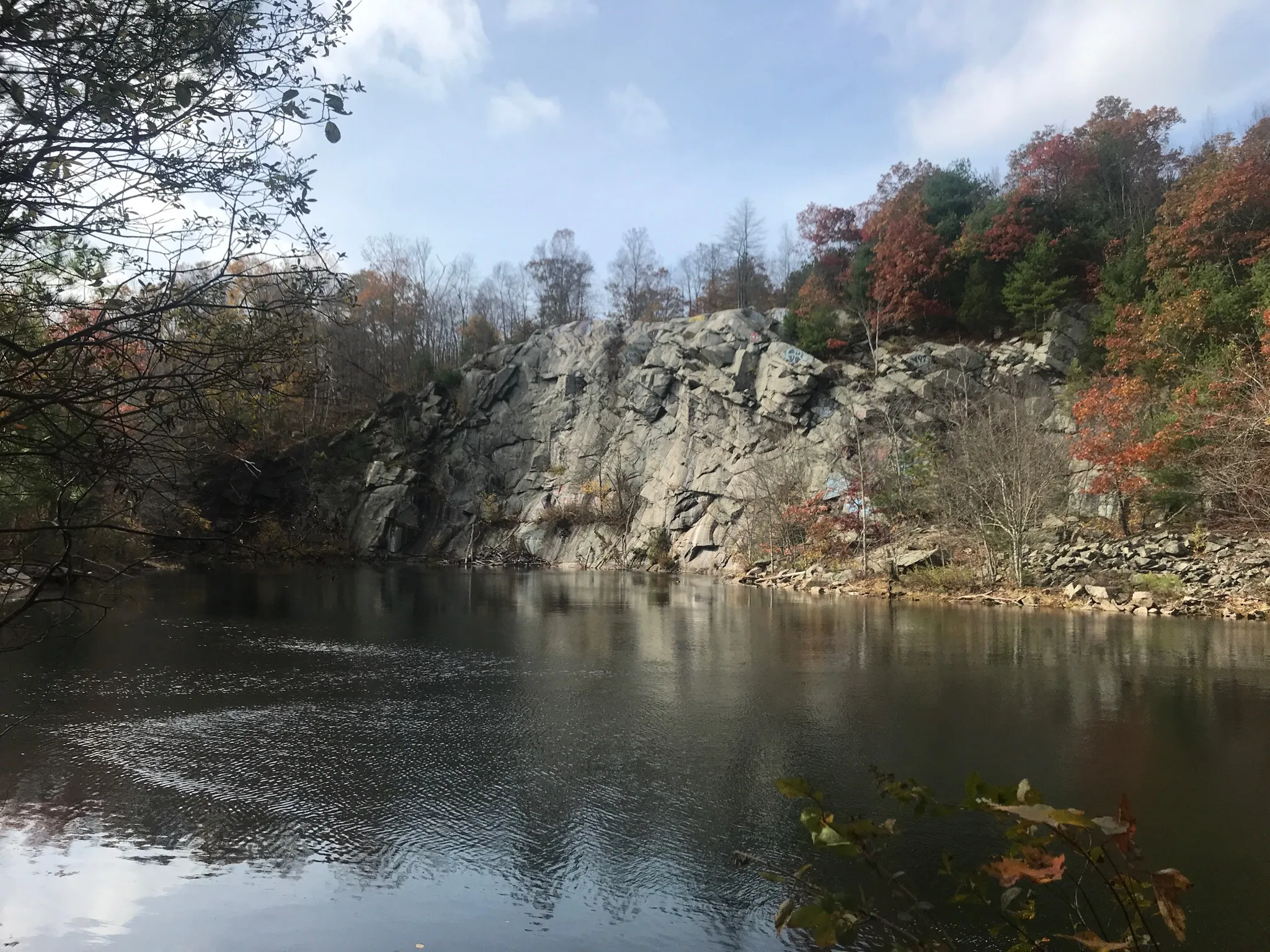
The Assonet Ledge is another landmark found in the Freetown State Forest and people think that it’s a haunted place as well. The place is a high rock looking over the dark pond underneath. Many say they have seen the spirit of a native person among the trees as well as mysterious lights and phantom fires. Some even believe that the granite stone is cursed. Allegedly it was one of the victims of the war against the Puritans in the 17th century. 

Assonet Ledge: According to the legends, this ledge as well as the waters below is haunted by the many that ended their life jumping off the cliff.

According to the legend, several of the native warriors chose to jump off the cliff rather than die by the hands of the English. One thing though, it is also said that both the ledge as well as the pond underneath didn’t exist in the 17th century.

Another ghost story associated with this place inside of Freetown State Forest is about the lady of the ledge, a young girl who regularly met up with her boyfriend at the ledge. Their parents didn’t approve of their relationships, so it was both risky as well as futile to pursue their love. In some variations of the legend it is the story about a native american princess and a white man. Then one day he suddenly stopped coming. After being left, she threw herself off the ledge and died. Although her spirit remained. 

Many have claimed to have seen her ghost wandering on top of the ledge, some even see her jumping off the cliff and disappearing as she hits the water without a splash. 

One of the creepiest parts of this legend though, are all of the people that have been standing at the edge with an urge to jump, even though they were far form suicidal before coming. In 2004 a man even did the leap in front of his friends and girlfriend, even though his family claimed he had no history of mental illness. 

A Walk Through the Haunted Freetown State Forest

As the moon ascends high in the night sky, casting an eerie glow over the Freetown State Forest, the shadowy woods come alive with whispers of the past. Among the rustling leaves and foreboding silence, the spirits of the departed seem to beckon from the darkness, their spectral presence palpable in the chilling air.

As the brave souls who dare to venture through this haunted realm tread cautiously, an inexplicable sense of unease settles upon them. Wisps of fog weave through the gnarled trees, and the distant sound of phantom drums echoes through the desolate expanse. Amidst the oppressive stillness in Freetown State Forest, the legends and tragedies of the forest converge, intertwining with the present in a spectral dance.

More like this

Newest Posts

References:

NEW ENGLAND FOLKLORE: Ghosts of the Assonet Ledge 

Massasoit – Wikipedia 

The Most Haunted Forest in America: Massachusetts’ Eerie Freetown Fall River State Forest 

The Most Haunted Forest In America Is Right Here In Massachusetts 

Bridgewater Triangle – Wikipedia 

https://eu.patriotledger.com/picture-gallery/entertainment/2020/10/28/enter-the-bridgewater-triangle-if/581946007/

What happened to Mary-Lou Arruda’s killer James Kater? Details explored ahead of Killer Cheer on ID 

Disturbing Details Found In Mary Lou Arruda’s Autopsy 

Profile Rock – Wikipedia 

https://en.wikipedia.org/wiki/Pukwudgie

Bridgewater Triangle – Wikipedia 

https://en.wikipedia.org/wiki/Fall_River_murders

https://eu.heraldnews.com/story/news/courts/2022/11/15/robin-murphy-convicted-in-fall-river-cult-murders-denied-parole-satanic-carl-drew/69646239007/

https://www.findagrave.com/memorial/90782637/mary-lou-arruda