Tag Archives: scotland

The Gorbals Vampire: Glasgow’s Night of Terror

Advertisements

One night, the Southern Necropolis Cemetery in Glasgow is filled with children. In their mind they are not playing, they are hunting the horrible vampire that is said to have taken the life of more than one child. The absolute mania of the Gorbals Vampire ended up passing several new laws. 

In the heart of Glasgow, Scotland, beneath the looming industrial smokestacks and crowded tenement blocks of the Gorbals district, a strange and unnerving legend took root in the mid-20th century — one that would see dozens of children descend on a graveyard armed with makeshift weapons, hunting for a vampire with iron teeth.

This bizarre incident remains one of Britain’s most famous examples of mass hysteria, though some still whisper that something truly sinister once prowled the crumbling headstones of Southern Necropolis.

Southern Necropolis: Stone gatehouse of Glasgow’s Southern Necropolis cemetery. // Source

The Night of the Vampire Hunt

The legend began one gray, mist-cloaked evening in September 1954 in one of the city’s poorest neighbourhoods, with little to no open spaces for the children to play except from the old cemetery. Rumors had spread like wildfire among the children of the Gorbals district that a seven-foot-tall vampire with glinting iron teeth was stalking the Southern Necropolis cemetery, having allegedly abducted and devoured two young boys.

Within hours, the graveyard was teeming with local children — some as young as five, others in their early teens — armed with sticks, knives, pieces of wood, and stones. They combed the Victorian graveyard in groups, peering behind headstones, ducking into mausoleums, and calling out to each other in hushed voices.

In the back of the graveyard, steelworks were throwing up flames and a sulphur filled smoke covered the sky. It was all giving the scene, casting shadows the children were chasing. 

Reports say some adults were also drawn to the scene, though most dismissed the affair as childish nonsense. Yet, the sheer number of armed, determined children — and their insistence that a vampire lurked among the graves — unsettled more than a few bystanders.

Authorities Intervene

As night fell, the cemetery watchman and local police arrived, attempting to disperse the crowds. One of them was PC Alex Deeprose and he couldn’t believe what he was seeing. The children refused to leave, claiming they wouldn’t abandon the graveyard until the vampire was caught or killed. 

The Gorbals Vampire was supposedly a seven-foot-tall monster with long metal fangs. They claimed the vampire had captured and eaten two boys and was living in the graveyard.

It took several hours and repeated police patrols to finally send the would-be vampire hunters home. The event made national headlines the following day, alarming both the public and local officials. The next evening, the children was back to hunting down the vampire. Theories abound as to what had caused such a mass outbreak of panic and belief in a blood-drinking monster. It even reached parliament. 

Blame on American Horror Comics

Authorities were quick to blame American horror comics, such as Tales from the Crypt and Vault of Horror, for filling young minds with terrifying fantasies. In the aftermath of the incident, parents, teachers, and church leaders joined forces to push for the Children and Young Persons (Harmful Publications) Act 1955, which banned the sale of certain horror comics to minors in the UK.

According to the children, it had all started in the playground, and spread from school to school before blowing up like a full blown panic. As Ronnie Sanderson, who was eight and one of the hunters said:

‘The word was there was a vampire and everyone was going to head out there after school. At three o’clock, the school emptied and everyone made a beeline for it. We sat there for ages on the wall, waiting and waiting. I wouldn’t go in because it was a bit scary for me.’

Although the base of the story was that children had been taken by the vampire, there was no records of any missing or murdered children around the time of the incident. A 1953 issue of Dark Mysteries had included a story called The Vampire with the Iron Teeth. Could this be where the hysteria came from? Or was it in fact something much older? There’s no evidence that any of the Glasgow vampire hunters had ever glimpsed an American comic.

A Deeper, Older Fear

Some folklorists have suggested the tale may have deeper roots in Scottish folklore. Tales of iron-toothed witches and ogres appear in old Scottish legends, often as bogeymen figures used to frighten children into good behavior. One such character is the “Jenny wi’ the Iron Teeth,” an old Glasgow nursery bogeywoman said to lurk in dark corners and snatch naughty children. There was also the Iron Man, an ogre that was out for children. 

It’s possible that these older, orally transmitted stories resurfaced in a new form amid the poverty and anxiety of post-war Glasgow, where violent deaths, disappearances, and urban legends weren’t uncommon. According to the legend of Jenny, she was hunting for children not wanting to go to bed around Glasgow Green in the early 1800s. 

Jenny wi’ the Airn Teeth

Come an tak’ the bairn (child)

Tak’ him to your den

Where the bowgie bides (bogie lives)

But first put baith (both) your big teeth

In his wee plump sides

Was the Gorbals Vampire Ever Real?

No vampire was ever found, and no missing children were officially reported to match the tale. Whether a sinister figure once stalked those fog-drenched graveyards, or whether it was simply the product of fear, folklore, and fertile imaginations remains a mystery.

Corbals Vampire Today: A mural of the Gorbals Vampire by local teenage artist Ella Bryson and Art Pistol street artists, Ejek, in an archway on St Luke’s Place near the Citizens’ Theatre. //Source

But to this day, Glaswegians still recall the night in 1954 when an army of fearless children armed themselves to confront the unknown, determined to drive a bloodthirsty monster from their streets. The Act and laws passed back then are still a thing today. 

And at night, beneath the crumbling stones of the Southern Necropolis, some claim you can still feel the weight of ancient legends… and hear the echoes of small, determined footsteps in the dark.

Newest Posts

References:

The Gorbals Vampire – Did a 1950s Nosferatu Prowl Glasgow’s Southern Necropolis? – David Castleton Blog – The Serpent’s Pen

The Gorbals Vampire – Media Centre

The Vampire Secrets of Glamis Castle: Bloodlines and Bloodlust in Scotland’s Haunted Fortress

Advertisements

In one of the oldest inhabited castle in Scotland, Glamis Castle is said to be filled to the brick with ghost stories and legends. According to the stories though, there is seemingly something more monstrous and more blood thirsty said to be sealed inside of the bricked up secret chambers, waiting to get out. 

Standing in stoic grandeur amidst the rolling Angus countryside, Glamis Castle has long held a reputation for secrets, shadows, and spectral figures. Known as the childhood home of Queen Elizabeth, the Queen Mother, Glamis or Glammis Castle, in Forfarshire, the seat of Lord Strathmore, is steeped in royal history and ancient nobility — but its corridors also echo with stories far darker than those found in any history book.

Of its many chilling legends, two vampire tales rise above the rest, hinting at unnatural bloodlines and eternal imprisonment behind stone walls. These stories, passed down for generations, have become the cornerstone of Glamis Castle’s macabre mythology.

The Vampire Child: The Sinister Family Secret

At the heart of Glamis Castle’s vampire lore is the enduring whisper of a “vampire child” — a secret so terrible, it was said to be known only to the laird, his heir, and one trusted family retainer in each generation. According to the legend, there is a secret chamber in the castle where the vampire child was placed. There is an old story that guests staying at Glamis once hung towels from the windows of every room in a bid to find the bricked-up suite of the monster. When they looked at it from outside, several windows were apparently towel-less. Though this is more likely due to the owners removing them in order so that the guests would not find the rooms, according to several relatives of the family.

The lords of Glamis. who, according to legend, were drinking and gambling, losing their family fortune. By the mid-17th century, the castle was in ruins. It was inherited by Patrick Lyons, who rebuilt the castle and rehabilitated the family, for which he was made the earl of Strathmore.

According to lore, in the early l800s the first son of the 11th earl of Strathmore was born a hideously deformed, egg-shaped monster with no neck, tiny arms and legs, and a large, hairy torso. According to legend, the child was once born into the Bowes-Lyon family with monstrous characteristics: deformed, unnatural, and blood-hungry. This child, believed to be a vampire or some other unholy being, was hidden away in a sealed chamber within the castle — a room known only to a few and never spoken of publicly.

In fact, there was a son born, Thomas Lyon-Bowes, the first child of Thomas Lyon-Bowes, Lord Glamis, and his wife Charlotte Lyon-Bowes née Grimstead. He is however recorded born and died in October 21, 1821. The stories about the child being “a monster” allegedly started when the unnamed midwife retold it in the local village. 

The castle was given to the second son, unlawfully, and the creature, after so many years away became mad. It reportedly died in 1921 or 1941. 

Some versions of the tale go further, suggesting that the “secret of Glamis” is that in every generation, one such child is born — cursed or blessed, depending on the point of view — with vampiric traits. Another legend tells that the monster is in Loch Calder near the castle. These children, it is said, never die, but are locked away, immortal and unseen, sustained through blood or other unknowable means. Over time, the corridors of the castle have become riddled with rumors of bricked-up rooms, hollow walls, and windows that can be seen from the outside but do not exist within.

Searches for the supposed secret chamber have never revealed definitive answers — only more questions. But for those thinking that concealing a child inside a room seems to harsh about this family, just think about the tragic case of Nerissa and Katherine Bowes-Lyon, cousins of the queen, listed dead for years, but turned out to live in Earlswood Hospital for mentally disabled people in 1941, classified as: “imbeciles”. 

The Blood-Sucking Woman: The Servant Entombed Alive

A separate legend, no less disturbing, tells the story of a serving woman who was caught engaging in a grotesque act of vampirism. According to lore dating back several centuries, the woman was found leaning over the corpse of a fellow servant, her mouth stained red, drinking the blood from the lifeless body.

Horrified, the castle’s occupants did not attempt to destroy her in the traditional methods associated with vampires — no stake, no fire, no silver. Instead, they condemned her to a crueler fate: she was bricked up alive within a hidden room, left to die in solitude, possibly in the very act of waiting for another victim.

Some stories say she remains alive to this day, an immortal vampire trapped inside the walls, forever hungry and vengeful. Those who work at Glamis today have reported unexplained cold spots, sounds of scratching, and even soft crying from behind thick stone walls — perhaps signs of the entombed servant still begging for release.

The Secret Chamber

This part of a secret chamber being haunted is told by many and could have sprung out from an older legend. The origins of this story go back hundreds of years, to an age when the Lyon and Lindsay clan were engaged in a bitter, ongoing feud. 

On a cold snowy night, there was a group of Lindsays on the run from other clans and they went to Glamis to seek refuge. Some say it was the Ogilvie who was trying to escape the clutches of their enemies, the Lindsays. 

The Earl promised them his protection, but trapped them in a room where he looked inside. Some say that the Earl was working with the Lindsays and caught them and imprisoned them. He never let them out of the  16 feet thick room, and for years, there were banging from the walls, screams and noises coming from them. Even after they were dead and long gone fro hundreds of years, you could still hear their cries through the castle. 

The sitting Earl decided to put a stop to the haunting and went into a room where no one went. He opened the door with a key and he was frozen with terror. He closed the door, bricked it up and never spoke about what he saw ever again. 

A Castle of Secrets and Shadows

Glamis Castle is no stranger to the paranormal. In addition to its vampire legends, it’s also home to numerous ghost stories — from the Grey Lady thought to haunt the chapel, to the Earl Beardie, cursed to play cards with the Devil for eternity. Yet none are as unsettling — or as persistently whispered about — as the vampire tales that seem woven into the very walls of the building.

Read More: Glamis Castle is filled with ghost stories. Read more about them in Lady Janet Douglas, Ghost of Glamis Castle

Visitors often speak of a strange feeling of being watched, even in empty rooms. Some claim that doors open and close on their own, or that footsteps echo down halls long after the castle has closed for the night. Could one of those footsteps belong to the vampire child, still pacing in darkness? Or is it the blood-sucking servant, endlessly circling her unseen prison?

The castle may gleam proudly by daylight, but as night falls, the questions it refuses to answer begin to stir. And somewhere, in one of its sealed rooms, the undead may still be waiting.

Newest Posts

References:

Monster of Glamis Fireside Companion | Vault Of Evil: Brit Horror Pulp Plus!

Glamis Castle – Simple English Wikipedia, the free encyclopedia 

Glamis Castle – Wikipedia

Nerissa and Katherine Bowes-Lyon – Wikipedia

The Hunderprest: The Vampire Monk of Melrose Abbey

Advertisements

A devious and unholy monk called The Hunderprest, was said to haunt the countryside on the Scottish border as well as Melrose Abbey. Was this specter really a bloodsucking vampire?

In the Scottish Borders, the ruins of Melrose Abbey have stood since the 12th century as a brooding, atmospheric relic of medieval piety and power. Melrose is a seemingly picture perfect place, drawing people in as the best salmon and trout fishing in the country. 

The Melrose Abbey is on the north east side of the town center and some of the more iconic buildings from the area. Behind its beautiful Gothic arches and solemn grave markers lies a dark legend: the tale of the Hunderprest, or the dog priest, a vampiric monk whose foul deeds and undead existence chilled even the most devout.

The Mysterious and Magical Melrose Abbey

The Abbey was founded by a colony of Cisterian monks in 1136 by the River Tweed. Once, it was said a miracle happened here, when the corn in their cellar multiplied in the time of a great famine, and the monks could feed them all. This and more miracles were said to have been performed by Abbot Waltheof, the stepson to King David I of Scotland. 

Through its time of operation it was one of the wealthiest monasteries in Scotland, but through all the years of war on the Scottish border it was badly damaged by the English in 1385 and rebuilt in the late 14th century. 

Melrose Abbey: A view of the interior of the ruined Melrose Abbey, Scotland. Heath’s Picturesque Annual 1835 by Roger Griffith

Today it’s a museum, although a big part of it is now lichen-covered ruins. In the Chapter House there is a burial casket of a heart, thought to belong to King Robert I, also called, The Bruce. In 1812, an old stone coffin was found close to the altar, thought to be the final resting place of Michael Scot, the mysterious Scottish wizard from the 13th century, said to have changed the River Tweed with his staff and turned the single peak of the Eildon Hills to the three we see today.

But not all miracles were as magical as these wonderful things. Some say that the magic happening around the cloister was also the work of evil, perhaps even a bloodsucking vampire. 

The Hunderprest of Melrose Abbey

According to medieval chronicles, the Hunderprest was a monk of Melrose Abbey during the 12th or 13th century. The Cistercian monks who lived and worshipped there had built the Abbey, the first Cistercian Abbey in the country, at the behest of King David I. They were famous for their Melrose wool they sold to the rest of Europe. 

Though little is known about his mortal life, legend says he was a man of great vice and depravity, a predator hidden behind a habit, whose sins were so grave that even in death, the earth rejected him.

Melrose Abbey in 1800, when part of the abbey was still in use as the parish church

Exactly what his sins were is not explicitly said always, but he was often claimed to have been a womaniser and drunkard, bringing shame upon his order. The region was a place of unlawfulness though, being controlled by independent clans called The Border Reivers that often clashed together in violence. It was both a time and place of ruthless lawlessness. 

Some say that in life, he used to be a chaplain to a lady who lived nearby. He was given the name Hundeprest as his favorite thing to do was hunting on horseback as a pack of howling hounds followed him. 

Howling Hounds: Often in William Newburghs tales of the undead, there is a pack of dogs following as the dog motif has been connected with death for ages in European mythology. The black dog is a supernatural, spectral, or demonic hellhound. It is usually unnaturally large with glowing red or yellow eyes, is often connected with the Devil, and is sometimes an omen of death.

Some accounts claim he practiced the black arts in secret, while others allege unspeakable acts committed under the guise of spiritual authority. The locals whispered of his unnatural appetites and sinister nature — rumors that seemed confirmed after his passing.

The Undead Haunting of the Abbey

Because of his sins in life, there was no way he was getting into heaven, and his soul could not find any peace. Livestock were found drained of blood, villagers claimed to see a shadowy figure lurking near graves, and monks reported being stalked by a ghastly presence within the cloisters at night.

He tried to enter the Abbey in the night in the form of a winged bat, only driven away after vigorous prayer and rituals from the monks. Because he was unable to cross the threshold to the holy ground, he needed another place to torment.

He found the cottage to a woman who he had known when he was alive. Said to be the woman he had been the chaplain for in life. She was also rumored to have been his lover. Her neighbors reported that a vampire roamed around her house, moaning and screeching at her, scaring her. Every night he returned to torment and terrorize, lusting after her blood. Because of this, they decided to summon an elder monk from the abbey for an exorcism. 

The Exorcism of a Vampire

Determined to put an end to the terror, the abbot of Melrose called upon the services of a particularly devout and courageous monk, often believed to be William of Newburgh, a respected chronicler of supernatural events. He ended up writing about a lot of monsters and ghosts in the middle ages. 

William of Newburgh: Many of the tales about the British vampires comes from the 12th century historian, William of Newburgh. William’s major work was Historia rerum Anglicarum or Historia de rebus anglicis (“History of English Affairs”), a history of England from 1066 to 1198, written in Latin. It is written in an engaging fashion and still readable to this day, containing many fascinating stories and glimpses into 12th-century life. He is a major source for stories of medieval revenants, animated corpses that returned from their graves, with close parallels to vampire beliefs.

According to the old accounts, a group of monks were put to task and went to the grave of the priest to investigate. As the day waned, the priest appeared like he was levitating out of his grave. They managed to shove the vampire back with a staff. Sometimes this is changed to a mighty axe the monks swung at him. The earth swallowed the Hunderprest like nothing had happened, the ground undisturbed again. This is when the elder monk knew they were dealing with a vampire and knew what to do. 

They waited for daylight and dug up his grave again. They exhumed the Hunderprest’s corpse and what they found only deepened their horror: though dead for some time, the monk’s body was fresh, his face ruddy, with blood at his lips curled up to a grin, classic signs of the undead in medieval folklore.

It was also said it was through praying and fasting that they managed to defeat him. How they killed the vampire, although not named as such in the early sources, varies. Did they stake him through the heart? Probably not, but they do mention setting him on fire and burning him to ashes as most of the stories of the undead mentions. The legend of the stake came later. 

Revenant: The term vampire or the undead was not used in medieval time, but several of the stories about the Revenant, Sanguisa or the bloodsuckers of folklore bear resemblance to what the modern world would classify as a vampire legend. In folklore, a revenant is a spirit or animated corpse that is believed to have been revived from death to haunt the living and was in medieval times used interchangeably with ghosts. They come from various cultures like the Celtic and Norse, some reminding more about a classic ghost story, some more of a vampire legend. Although today a mixed version of the western and eastern European mythologies of the undead.

After they burned him to ash, they took him to Lammermuir Hills where the wind carried him to the north along the borders. 

To this day, visitors to the hauntingly beautiful ruins of Melrose Abbey claim to feel a chilling presence lingering among the weathered stones. Some report seeing a shadow moving through the broken cloisters at night, or hearing faint whispers in the darkened archways.

Newest Posts

References:

Legend of the “Hunderprest” Vampire of Melrose Abbey

Airhouses – News – The Incredible Legends of Melrose Abbey

The Hunderprest: The Vampire Monk of Melrose.

The Baobhan Sith: Scotland’s Legendary Bloodthirsty Woman

Advertisements

In the Scottish Highlands, there have been tales of a bloodthirsty creature, in disguise of a beautiful and seductive woman. The Baobhan Sith, a much older version of the vampire lore as we know of it today, still remains in between the lore and stories we tell ourselves.

In the misty glens and ancient forests of the Scottish Highlands, where the wind carries whispers of forgotten tales and the land itself feels alive with ancient magic, lingers the legend of the Baobhan Sith — a deadly, seductive vampire spirit of Gaelic folklore. 

Sometimes pronounced baa-van shee, her name translates roughly to “fairy woman”, but there is nothing benign about this creature. Beautiful yet malevolent, the Baobhan Sith was said to lure unwary travelers to grisly deaths, draining their blood beneath the cover of night.

Origins in Highland Lore

The Baobhan Sith legend belongs to Scotland’s rich tapestry of fairy and supernatural beliefs, although she might remind us more about a succubus or even a vampire-like creature. Like many creatures of Celtic folklore, she occupies a space between fairy and vampire — both a spirit of nature and a bloodthirsty predator.

The Green Clad: In addition to the Irish Banshee or the Succubus, the Baobhan Sith can also remind about the Scandinavian Huldra or Hylje. Often described as a beautiful green clad woman with animalistic features she hides before seducing men. Although the Huldra is more about luring the men into the mountains. Here from the play Peer Gynt where she is a character.

Folklore suggests the Baobhan Sith would typically appear as an enchanting, green-clad woman with long, flowing hair. But beneath her alluring appearance lay clawed hands and fangs, hidden until she chose to strike. Traditionally, she was said to emerge at night, often in the lonely Highland wilderness, where travelers, hunters, and wanderers might become her prey.

The Lure of Beauty and Dance

According to legend, groups of men traveling or hunting would sometimes wish aloud for the company of women. Their innocent desires would be answered by the sudden appearance of beautiful, ethereal women who seemed to emerge from the mists themselves. The Baobhan Sith would dance with the men — a popular motif in Celtic folklore where the act of dance carries supernatural consequences — and, at the height of merriment, reveal their true nature.

Once the men were entranced, the Baobhan Sith would use their sharp talons to slash at their victims and drink their blood, often leaving lifeless, pale bodies behind by morning. Some versions of the tale describe them feeding in groups, often appearing in fours.

In a similar tale one of the men noticed that the women had deer hooves instead of feet and fled from them. He returned the next morning to find that the other hunters had their “throats cut and chests laid open”.

In a third story the hunters took refuge in a cave. Each of the men said he wished his own sweetheart were there that night, but one of them, named Macphee, who was accompanied by his black dog, said he preferred his wife to remain at home. At that moment a group of young women entered the cave, and the men who had wished for their sweethearts were killed. Macphee was protected by his dog who drove the women from the cave.

The Story of the Men Meeting The Baobhan Sith

The story of the creatures normally goes something like this:

Four hunters, weary from a day in the hills, stumbled upon an old bothy as night fell. Inside, a fire waited, as though expecting them. As flames licked the hearth, one of the men joked, “All we need now are four beautiful women.” The wind answered with a knock.

At the door stood four stunning women in green, their eyes cold and unnatural. The men, smitten and careless, welcomed them in. Laughter turned to song, and song to dancing. One by one, the hunters twirled in the arms of their enchanting guests — all except the eldest, who grew uneasy. The fire flickered, and he caught a glimpse of something crimson.

His blood chilled. One of the women had slit the youngest hunter’s throat, her lips dark with blood. The others fell swiftly, caught in the women’s gaze as sharp nails tore them open.

He bolted into the night, the women following, their voices sweet and terrible. He dove among the iron-shod horses — the one thing they feared. The Baobhan Sith circled, hissing and begging, then cursing him with promises of death.

But dawn came. And with the first pale light, they vanished.

At sunrise, he returned to the bothy. His friends were cold and bloodless. Weeping, he vowed to tell the tale — to warn others of the green-clad death that dances in the Highlands.

The Weakness of Iron and the Protection of Cattle

Much like other fae and vampiric beings of the Celtic world, the Baobhan Sith was believed to have certain weaknesses. Iron was said to repel her, as it does with many fairy creatures in Gaelic folklore. Travelers would carry small iron charms or weapons for protection.

Another tradition claimed that taking refuge among livestock, particularly cattle, could offer safety. The Baobhan Sith was said to be reluctant to approach herds of animals, perhaps owing to their association with fertility and the natural order — realms where spirits of death had no dominion.

The Baobhan Sith in Modern Culture

Though tales of the Baobhan Sith have their roots in oral Highland tradition, the creature has enjoyed a resurgence in recent years, appearing in novels, films, and fantasy games exploring vampire and Celtic mythos. Modern interpretations often emphasize her duality — both tragic and monstrous — reflecting themes of isolation, forbidden desire, and the dangers lurking in the untamed wild.

Ultimately, the Baobhan Sith stands as a chilling reminder of the Highlands’ wild, untamed heart, where the line between beauty and terror is perilously thin. She embodies the folkloric warning against succumbing to temptation, the perils of the night, and the ancient belief that not all is as it seems beneath Scotland’s mist-clad hills.

In the modern world, her legend endures as one of Scotland’s darkest and most alluring vampire myths, a spectral woman in green forever waiting in the shadows for an unwary soul.

Newest Posts

References:

Baobhan sith – Wikipedia

The Baobhan Sith – Folklore Scotland

Ghostly Sailors of Sandwood Bay: Scotland’s Haunted Shoreline

Advertisements

Coming from the dark waters in what has been called the shipwreck grave of Scotland, ghosts are said to linger on the beach of Sandwood Bay, far away from any civilization. 

Tucked away along the rugged, windswept northwest coast of Scotland, far from the reach of city lights and modern noise, lies Sandwood Bay in Sutherland, a stretch of sand and sea so hauntingly beautiful it feels untouched by time. The beach is considered to be one of the cleanest and most unspoilt beaches in the whole of mainland Britain.

Isolated by towering cliffs and miles of moorland far away from any roads, this remote paradise in Sutherland has long lured travelers, artists, and adventurers with its lonely splendor. But those who linger past sundown whisper of more than waves and starlight — for at Sandwood Bay, the spirits of the drowned are said to walk.

Sandwood Bay: On the rocky beach in Scotland it is said ghosts from the wrecked ships over the years are haunting the shore. // source: Peter Bond / Beach at Sandwood Bay / CC BY-SA 2.0

A Shoreline Stained with Shipwrecks

For centuries, the treacherous waters off Sandwood Bay claimed the lives of countless sailors around the dangerous Cape Wrath. The name likely derived from the norse Sandvatn, meaning sand water. Legends speak of galleons lost to storms, fishing boats swallowed by hungry waves, Viking boats wrecked, and merchant vessels dashed against hidden rocks before the lighthouse was built in 1828.

The most enduring tale involves a Spanish galleon from the Armada, said to have been wrecked along the bay’s sandy embrace in the shadowy days of empire. Local folklore claims its cursed treasure still lies beneath the silt and surf, forever guarded by the spirits of those who perished alongside it.

Ghostly Fishermen and Wandering Sailors

The earliest documented ghost sightings at Sandwood Bay date back to the 1940s, when solitary visitors and locals reported seeing two fishermen collecting driftwood along the shore. These figures, pale and weathered, would cry out to any who approached:

“All on this beach is mine — begone!”

Eyewitnesses said the men vanished if challenged, dissolving into the mist as though they’d never been there. Some insist they are the remnants of wrecked sailors still staking claim to the land their bodies washed upon, calling out if you try to take the driftwood or other things from the beach. There have also been reports about a group of people, crying into their hands as they wander the beach, but vanishing if spoken to. 

Water Horses Haunting the Beach: Another story told about the beach is the sounds of hooves running over the beach when no one is there. Could it be something from more ancient times? Water horse is a mythical creature, such as the Ceffyl Dŵr, Capaill Uisce, and kelpie? The water horse has often become a basic description of other lake monsters such as the Nessie. Loch Morar is reputedly home to “Morag”, a lake monster that has been portrayed as a water horse. Or perhaps it is an each-uisge, a supernatural water horse found in the Scottish Highlands, has been described as “perhaps the fiercest and most dangerous of all the water-horses”.

The Knock at Sandwood Bay Cottage

A short distance from the sands, nestled amid rolling dunes, stands Sandwood Bay Cottage, an old crofter’s home steeped in ghost stories of its own close to Loch Sandwood. Today it’s abandoned and roofless. On stormy nights, when the wind howls like a chorus of lost voices, it’s said a phantom sailor knocks at the door. Legend suggests this may be a lone survivor of the fabled Spanish galleon, cursed to wander the earth in search of shelter and the treasure he swore to guard.

Residents and travelers who’ve stayed at the cottage have reported strange rapping at windows, wet footprints appearing on dry floors, and the unmistakable scent of saltwater and seaweed drifting through tightly shuttered rooms. 

Sandwood Bay Cottage: The abandoned Sandwood Bay Cottage, a remnant of the region’s ghostly tales and maritime history. // Source

Some accounts even claim to have glimpsed a sodden figure standing at the edge of the bay, watching the cottage with hollow, mournful eyes. Perhaps the worst are the stories about the crouching sound of heavy boots outside before the bearded face of a sailor is looking at you through the window. 

Was it a ghost, or was it simply the local hermit James MacRory-Smith who lived close to the beach for 32 years until he died in 1999? He retreated to the bay after his wife died in a horrible car accident.

Mermaids and Myths of the Deep

Sandwood Bay’s eerie reputation isn’t reserved for restless sailors. The waters here also hum with older legends of selkies and mermaids — sea creatures said to lure men to their deaths with song and beauty. Fishermen have long spoken of beautiful, unearthly women seen sunning themselves on the rocks before vanishing into the surf. Could these beings have played a hand in the bay’s tragic maritime history, claiming sailors for their own beneath the waves?

Kelpie: Kelpies have the ability to transform themselves into non-equine forms, and can take on the outward appearance of human figures, in which guise they may betray themselves by the presence of water weeds in their hair.

A story from a local called Alexander (Sandy) Gunn told that he went on a walk around Sandwood Bay in January 1900 with his dog when he saw one. Apparently, the creature had long golden hair and piercing blue/green eyes. 

He was ridiculed by the others, but never changed a word about his story of the 7 feet long creature he had seen on the beach until he died in 1944. And more stories about these sea creatures kept popping up, both after and long before in old history.

A Place Where the Dead Walk

Today, Sandwood Bay remains one of Britain’s most remote and untamed beaches, accessible only by foot over miles of heather-clad moorland. Hikers and campers who brave the long journey often report an unnerving sense of being watched, especially as dusk settles over the beach. Cold spots, distant voices, and ghostly apparitions are said to linger, particularly around the old shipwreck sites still half-buried in the sand.

Magical Stones: Ancient stone circles scattered across the lush green landscape near Sandwood Bay, hinting at centuries of history and folklore. // Source: Brian MacLennan / Ancient Ruin above Sandwood Bay / CC BY-SA 2.0

Whether you believe in the vengeful spirits of drowned sailors or see these tales as a product of isolation and wind-whipped imagination, one thing is certain: Sandwood Bay’s haunted past lives on in every crashing wave and shifting shadow.

So, if you should ever find yourself on that lonely Scottish shore as darkness falls, listen closely to the wind. You might just hear the long-lost cries of shipwrecked souls — still laying claim to Sandwood Bay.

Newest Posts

References:

The Haunted Fairytale of Doon Hill and Fairy Knowe

Advertisements

Thought to be the gate to the fairy world, The Fairy Tree on top of Doon Hill is said to be haunted by the man that tried to reveal the fairy folk’s secrets. Was he just silenced, or was he taken to the other realm?

Atop the woodlands on Doon Hill in Aberfoyle, Scotland, a solitary Scots pine stands proudly amidst the oaks—a tree with an enchanting reputation as the Fairy Tree. This mystical landmark in East Lothian, believed to mark the entrance to a Fairy Queen’s underground palace, carries with it a ghostly history that traces back to the intriguing Reverend Robert Kirk. 

The Fairy Tree, or Fairy Knowe, perched on the summit of Doon Hill, has long been regarded as a portal to an ethereal realm—a gateway guarded by the mystical beings of the forest of ancient oaks in what has been known as The Fairy Capital ever since a Reverend got curious about the place and tried to reveal its secrets.

Reverend Robert Kirk’s Curiosity

Secret Commonwealth Manuscript Title Page

Reverend Robert Kirk lived in Aberfoyle in the 17th century and would preach about God as well as about fairies when he became minister in 1685 and was dubbed as The Fairy Minister. He was also the seventh son, something also connected with people having supernatural connections or abilities. He was a well educated man and was the first to publish the bible into Gaelic as well as he studied the life and home of the fairies he believed lived on Doon Hill. 

In 1691, Reverend Robert Kirk delved into the supernatural with the publication of “The Secret Commonwealth of Elves, Fauns, and Fairies.” This pioneering work sought to unveil the secrets of a magical underworld inhabited by mystical creatures. It has later been seen as one of the most important works about fairy lore and magic.

The work was unlike many publications of the time, not meant to link the magic and folklore to the devil, but more as a genuine interest into the lore and culture of the Scottish community that the Reverend himself had grown up with. 

Although it was meant to educate people about the hidden folks, the fairies are said to have taken offense to a human revealing their secrets. Legend has it that the fairies, often called the Good People or daoine sìth in Scottish Gaelic, displeased with the revelations, took swift action.

The Ghostly Guardian of Doon Hill

The Minister’s Pine:Source

Reverend Kirk met a tragic end on Doon Hill before he was able to publish his findings. Some say he fell and died, while others believe he was spirited away by the very creatures he sought to expose. 

He had a habit of walking in his nightgown to the hill to breathe in the fresh air on summer evenings. But on the evening of May 14th in 1962, he was found dead on the hill.

Did they just want to get rid of the man that was about to expose the fairy world, or did he get to serve the Fairy Queen as a Chaplain and the body the villagers found was only a changeling? Some even question that he is buried in the churchyard at all.

Regardless of the circumstances, the reverend’s spirit is said to linger, forever bound to the Fairy Tree. On certain days, visitors claim to catch glimpses of his ghost, wandering the hillside and standing guard over the entrance to the Fairy Queen’s palace.

Making a Wish on Doon Hill and Fairy Knowe

Reverend Robert Kirk’s pursuit of the supernatural left an indelible mark on the landscape, giving rise to tales of a ghostly guardian and an otherworldly portal. 

Even today people walk up to the tree and some tie a ribbon to the tree as a gift to the fairies as they make a little wish. This is a pagan ritual known as clootie wells and is a cleansing ritual. Because who knows, perhaps the Reverend was right, and this ancient oak tree truly is a gateway to the otherworld of the fairies?

More like this

Newest Posts

References:

Spooky spots to visit – Forestry and Land Scotland 

Doon Hill Fairy Tree – Loch Lomond | Trossachs 

https://en.wikipedia.org/wiki/Robert_Kirk_(folklorist)

The Ghostly Duel with Seath More in Rothiemurchus Forest

Advertisements

Up in the wild Scottish Highlands, inside the dark Rothiemurchus Forest it is said that the ghost of the Great Shaw warrior, Seath Mor is ready to challenge everyone passing for a final duel to show your bravery.

In the Scottish Highlands close to Aviemore in Inverness-shire, the dark Forest of Rothiemurchus stands as a silent witness to centuries of history and folklore and is a remnant of the ancient Caledonian Forest in Scotland. 

Sir David Attenborough once called the Rothiemurchus Forest, One of the glories of wild Scotland. Beyond its verdant canopy and ancient trees lie tales of spectral encounters and haunted legends of the highlands.

The Ghost of Seath Mor, The Great Shaw

The most well known ghost story from the depths of Rothiemurchus Forest is about the 14th-century tribal chief of the Clan Shaw, Seath Mor Sgorfhiaclach, meaning Bucktooth.

Read More: Check out all ghost stories from Haunted Forests around the world.

He was known as a good warrior, with a twisted smile that would scare everyone. He was also called The Great Shaw by his contemporaries, was also 6 feet tall and even his own people feared him according to the legends. 

The Ghostly Challenge

It is said that he is still haunting the Rothiemurchus Forest. As legend has it, those who venture into the woods may chance upon his ghostly apparition, still ready for battle it seems. Seath Mor, adorned in the vestiges of a bygone era, allegedly challenges unsuspecting walkers to a spectral duel of bravery.

Rothiemurchus Forest: Lochan Deo. Lochan Deo in Rothiemurchus forest in, Cairngorms. It is said to be haunted by the old chieftan of the clan. // Source: Scot Tares / Lochan Deo / CC BY-SA 2.0

According to local lore, those who stand their ground and accept the spectral challenge are granted safe passage through the forest’s depths. But those who succumb to fear and attempt to flee are condemned to an eternal wandering within the shadowy embrace of Rothiemurchus and they are never heard from again.

The Guardian Stones

Out of the woods of Rothiemurchus Forest you will find the Old Doune Church Burial ground in the kirkyard of St. Tuchaldus and Seath Mor’s grave who is rumored to be cursed for anyone who dares tamper with it. 

At the grave it reads: “Victor at the battle of Perth in 1396”, a battle where only he was left alive and that helped carve his legacy as a fearsome warrior. Some people even leave the grave a couple of coins for protection. 

Five stones rest upon Seath Mor’s tomb found close to the Doune of Rothiemurchus, possibly symbolic of the comrades who fell alongside him in battle. They are certainly put there to protect the grave and Seath Mor’s soul. 

Tampering with these stones is deemed a reckless act, tempting fate itself and it is said that many have fallen ill or even died from touching them. They will feel the wrath of the Shaw Clan’s guardian spirit, an elf-like spirit or a familiar called Bodach of Gealic folklore. Bodach is a Duin, a goblin of the Doune. Although mostly acting like a boogeyman in folklore, the Bodach an Duin is its protector.

The Protective Iron Cage

It is said that it happened once in the early 19th century, and a man that stole a center stone from the grave threw it into the River Spey. He was apparently a footman set to protect the graveyard from body snatchers. He wanted to prove to everyone that the curse was nonsense. Four days later the stone was back and the man was found dead, floating down the river four days later.

In the 1940s, it is said that a journalist lifted one of the stones over his head, only to die in a car crash a couple of hours after he did it. 

In 1978 a Mr Leslie Walker and his two friends were working in the graveyard when Mr. Walker touched the stones to show it to his friends. He told the story to Aberdeen Evening Press where he fell ill with a mysterious disease right after and had a temperature of almost 40 degrees. He had to spend the next 6 weeks in hospital. 

His friend did the same and joined Mr Walker with the same mysterious illness, suffering stomach pains after identifying the last friend who was even more unlucky. 

The friend was not so fortunate though as he was found dead the following day in the graveyard after he rearranged the stones. He died after a cerebral hemorrhage.

In any case, the stones kept getting stolen, and curse or not, they decided to do something to the grave after the stones were missing for two weeks before returning. 

To safeguard this ancient resting place, a wrought-iron cage was erected in the 1980s, standing as both a physical barrier and a metaphysical deterrent against the restless spirit that dwells within.

The Final Battle of Seath Mor

As sunlight filters through the towering trees of Rothiemurchus Forest, the legends of Seath Mor linger like shadows among the ancient roots, ready to challenge any wanderers for another battle. 

The wrought-iron cage on his grave, though a symbol of protection, also hints at the delicate balance between preserving history and allowing the spirits of the past to weave their tales within the heart of Rothiemurchus.

More like this

Newest Posts

References:

The Cursed Grave of Seath Mor Sgorfhiaclach 

Loch An Eilein (and Seath Mor’s cursed grave) – Tartan Trailblazers

Mysterious Grave of the “Great Shaw” – Bagtown Clans 

Hauntings at the Penkaet Castle in Scotland

Advertisements

The Penkaet Castle in Scotland has its fair share of hauntings and is the home of not only one ghost, but several with its story of witchcraft, murder and royalty. 

Whether it’s a creaking door in an old castle or a cold chill down your spine in an abandoned building, many Scots have experienced paranormal activity during this festive season. As we explore Scotland’s age-old legends and curious customs this Christmas, let us not forget to look out for its ghosts too.

Penkaet Castle is a historic castle located in the Scottish Borders that is also known as Fountainhall near Haddington in Lothian, Scotland. The castle dates back to the 16th century and was originally built as a tower house by the Ker family. Over the years, the castle has been expanded and renovated, and today it stands inside in a walled garden as a magnificent example of Scottish architecture.

It also stands as a haunted castle and many have claimed to have heard screams and moans from voices in the corners and things being moved without any living having been there. 

History of Penkaet Castle

The Ker family were a prominent Scottish family who owned Penkaet Castle for many years. The castle was built in the 16th century as a tower house, and was expanded over the years to include additional wings and a courtyard. The castle was used as a residence for the Kers until the 18th century, when it was sold to the Pringles.

Penkaet Castle: The castle pictured from 1898 in Pencaitland in East Lothian in Scotland. It has several ghost stories attached to it.

The Pringles were another prominent Scottish family, and they continued to use the castle as a residence until the 20th century. During this time, the castle was renovated and updated to include modern amenities, such as electricity and running water. The castle was eventually sold to a private owner in the 1960s, and today it is a private residence.

Ghost of the Beggar that Cursed the Castle

One of the ghosts said to haunt the halls is the spirit of Alexander Hamilton. He was a beggar that was accused of witchcraft after the lady of the house, Lady Ormison and her eldest daughter died of a mysterious illness. 

It was believed that Alexander Hamilton had cursed them both after he was thrown off their property when he came to beg and had to go back empty handed. 

Because of how they had cruelly turned him away, it is said he returned and bound the gates with blue thread, which was some form of witchcraft he had used to kill the two women.  

Two days later the woman who turned him away died together with her daughter. An arrest order was put on Hamilton and he was caught and convicted. For this he was executed in Edinburgh on Castle Hill. 

Read Also: He is not the only convicted and executed on Castle. Read more about this is: Edinburgh Castle Ghosts and Legends and our stories about Witches

After his death, the ghost of Alexander Hamilton has been reported being seen close to the castle, perhaps vengeful of the family that sent him to his death and returned to the place of the crime. Question is, whose crime? His, or those who accused him for something like that?

The Murdered John Cockburn

A ghostly banging on the doors, moving of the furniture and strange footsteps are also thought to be the ghost of John Cockburn that once belonged in the house that har haunted by his bad conscience and then in turn, haunting the Penkaet Castle.

According to the legend, he killed his relative, John Deton and because of his bad conscience over what he did, he is still haunting the castle today. And people who have lived in the castle were often disturbed by a strange sound of something being dragged along over the floor. 

He has also been seen as the ghost of a man coming out from one of the cupboards and walking across the room before vanishing through the wall. 

When this was supposed to have happened is unsure, but it is said that a Sir George Cockburn of Ormiston sold the castle and the rest of the land to the Pringill family in 1635, so it must have been before this probably. 

The Ghost in the Fireplace

Sir Andrew Lauder’s family owned the estate from the end of the 1600s up to 1922. He claimed to have seen something that looked like a ghost upstairs by the fireplace when he was a child. 

He remembered the incident all the way through adulthood and thought the ghosts might have been one of his ancestors of the Lauder family. 

The Christmas Hauntings at Penkaet Castle

The legends about the castle being haunted really started getting attention when Professor Holbourn and his wife bought the Penkaet Castle in 1923. 

Many of the ghost stories from the room they called King Charles Bedroom comes from them, their family and the guests that had to stay the night at Penkaet Castle. 

It was said to have been haunted all year around, but there is in particular one Christmas in 1923, the Holbourn family remembered when a piece of wood carved with the family crest. They all saw it move on its own leaning away from the wall. It paused for a little moment before it returned to were it would be. Whatever happened that christmas is uncertain, but it led them to believe that the place was most definitely haunted.

The Haunted Bed of King Charles I

One of the rooms said to have an extra touch of hauntings is the room that has a bed King Charles I used. The bed is decorated with a copy of his death mask that was given to the owners in 1923 by his students. 

The King Haunting the Bed: One of the bed in Penkaet Castle they think is haunted with the death mask of King Charles I on one of the bed posts.

The story goes that the maid of the house would notice that the bedclothes of the bed would be found like if someone had slept in the bed, even though she knew very well no one hadn’t. The bed itself would move around in the room and sometimes people even claimed to have heard noises coming from the bed as if someone was actually sleeping there. 

In 1924 there was a guest coming to the castle that was put up in the room with the bed. When they entered it, the bed was already a mess, even though the housekeeper knew she had tidied the bed just moments before showing the guest in.  

More like this

Newest Posts

References:

Penkaet Castle | Fountainhall | The Castles of Scotland, Coventry | Goblinshead

Nightmare before Christmas: The history of festive ghost stories

Penkaet Castle – Mysterious Britain & Ireland

Agnes Sampson — The Wise Wife of Keith

Advertisements

The story of the ghost of Agnes Sampson, known as The Wise Wife of Keith in Scotland is a story where a simple midwife was accused of witchcraft so powerful she caused a storm trying to kill her own queen. 

Agnes Sampson was a Scottish healer and a purported witch. Sampson was born in the village of Kirktoun, East Lothian in Scotland and worked as a midwife. She was believed to have healing powers long before she was accused of being a witch. 

She became known as the Wise Wife of Keith and was involved in the North Berwick trials that happened during the 16th century, one of Scotland’s most notorious witchcraft trials. Agnes Sampson is also known for being one of the main accused at this trial. 

There were and still are many tales about who Agnes Sampson really was. Some of them are true tales, some tall tales. She is said to have been married three times, once to William Keith with whom she had two children. She is also said to have been married to two other men and had 14 children with each man. 

So how did this simple midwife become the center of a conspiracy of witches trying to sink the ships belonging to their new queen and threatening her own King? To find out we have to travel across the pond to the court in Denmark-Norway and their fear of black magic and a series of unfortunate events on the sea. 

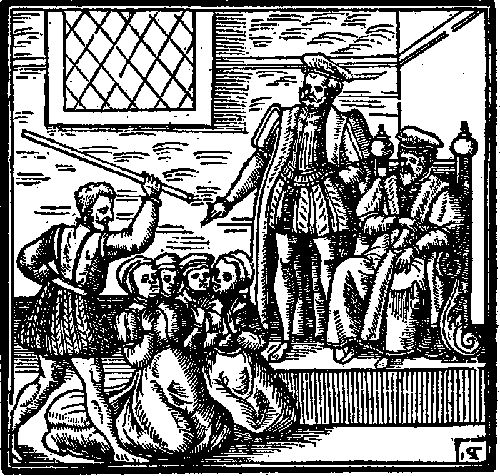
The King as the Judge: Suspected witches with Agnes Sampson kneeling before King James VI from the book Daemonologie (1597). He himself oversaw the trial and ended up sentencing many to be burnt as witches.

The Storm of Contrary Winds

By the autumn of 1590, Scotland was deep into witch hunts, and many of those sent to trial were questioned by the King himself. Today, the city of Edinburgh and the rest of the country is riddled with the memory of those who were burnt at the stake as a witch. King James VI, the son of Mary, Queen of Scots had just returned from Denmark-Norway where he had married Anne of Denmark who was only 14 at their wedding. 

Read Also

Edinburgh Castle Ghosts and Legends

Witches, dragons and ghosts, Edinburgh castle are said to have it all. The sound of bagpipe and drummers can be heard without anyone playing, and those accused for witchcraft as well as prisoners of wars are said to haunt the old castle.

Keep reading

The Danish court at this time was extremely wary of all things black magic and witchcraft. The fear of demons and witches had tightened the European continent and it was probably a fear that the Scottish King James adapted and brought back as well after spending time there. 

The King of Scotland was impatient awaiting his bride from Denmark to cross the seas after the wedding to stay by his side, but on her voyage to Scotland the fleet experienced heavy storms and ended up starting not only one, but two major witch trials that ended in several executions.  

A Series of Unfortunate Events

So how did a simple midwife like Agnes Sampson get accused of something that happened all the way over in Denmark? To this we have to go through the Danish court and the witch trials that happened there before it started in Scotland. 

Peder Munk of Estvadgård was a Danish navigator, politician and ambassador and in charge of carrying the fleet of 18 ships with Anne of Denmark to Scotland to bring her to her throne by her King. They set out on their voyage in 1589 from Copenhagen and were riddled with bad fortune, taking years to reach their final destination.

First they had to stop in a port in Norway to repair a leaking ship and had to stay there for a very long time, on their way to a very impatient king. When they reached The River Forth in central Scotland a ferry boat collided with one of the vessels in a storm and all of the passengers drowned. This was all attributed to witchcraft. 

Back in Denmark, the navigator Peder Munk blamed it all on witchcraft, especially on a certain woman whom he had insulted and believed to be the main witch behind the storms. This became the beginning of the Copenhagen witch trials, which ended in executing 17 people by burning. 

This inspired the King to hold his own trials, and it would be known as the North Berwick Witch Trials, and Agnes SAmpson was one of the main accused. 

Accused of Witchcraft

More than a hundred suspects were arrested in North Berwick, several of them confessed during torture and named other people. Agnes Sampson was accused by Gillis Duncan, another one of the accused. 

Duncan was really the one that linked the other accused of causing the storms that ended up sinking the Queens ships. She worked as a servant and confessed after torture that she was a witch and there were several more. The reason she was accused herself was that she was far too skilled of a healer in her master David Seton’s mind who also thought that Duncan had been sneaking out at night. 

Agnes Sampson ended up being one of the more significant accused persons, as an elderly and respected woman that had healed more than one in the local area. Many attributed their good health to her good work. Now, they all turned on her because of the rumors and her unfortunate circumstances. The fact that she was a widow with children and acted as an independent woman and educated midwife was a part of the indictment against her. She had also been accused of witchcraft and investigated before. 

Witches Sabbath: According to the accusers, Agnes Keith and the rest of her witch coven had met up and created a storm to keep a ship from Denmark arriving to Scotland, carrying Anne of Denmark.

The Wise Wife of Keith was imprisoned and put to torture for a long time before saying anything. She started off refusing to confess at first, but after a long time in the dark and in pain, she as the rest of the accused gave up. 

In the end she was brought before King James VI himself and a council of nobles at the Palace of Holyroodhouse. Sampson denied all the charges, but they kept torturing her until she said otherwise. Her head and body hair were shaved and she was pinned to the wall of her cell with a witches bridle. This was a torture instrument with four sharp prongs pressed into the mouth, meant to humiliate as well as hurt the ones wearing them. 

She was forced to stay awake with no sleep in her cell with a rope around her head, always reminded just how close to death she really was. And in the end, how freeing that prospect must have seen compared to the torture she went through. 

Finally, after all that torture, Agnes Sampson confessed to whatever they asked of her in front of her own king who oversaw the trial. In all she confessed to 53 indictments against her, including attending a Sabbat she led and that she was indeed a witch with supernatural power she used to harm others with. 

According to her testimony, she ended up saying she made a charm that caused a storm that ended up drowning Jane Kennedy. She sank a dead cat with parts of a dead man into the sea near Leith. The same charm she used to threaten the King and his wife on her voyage. 

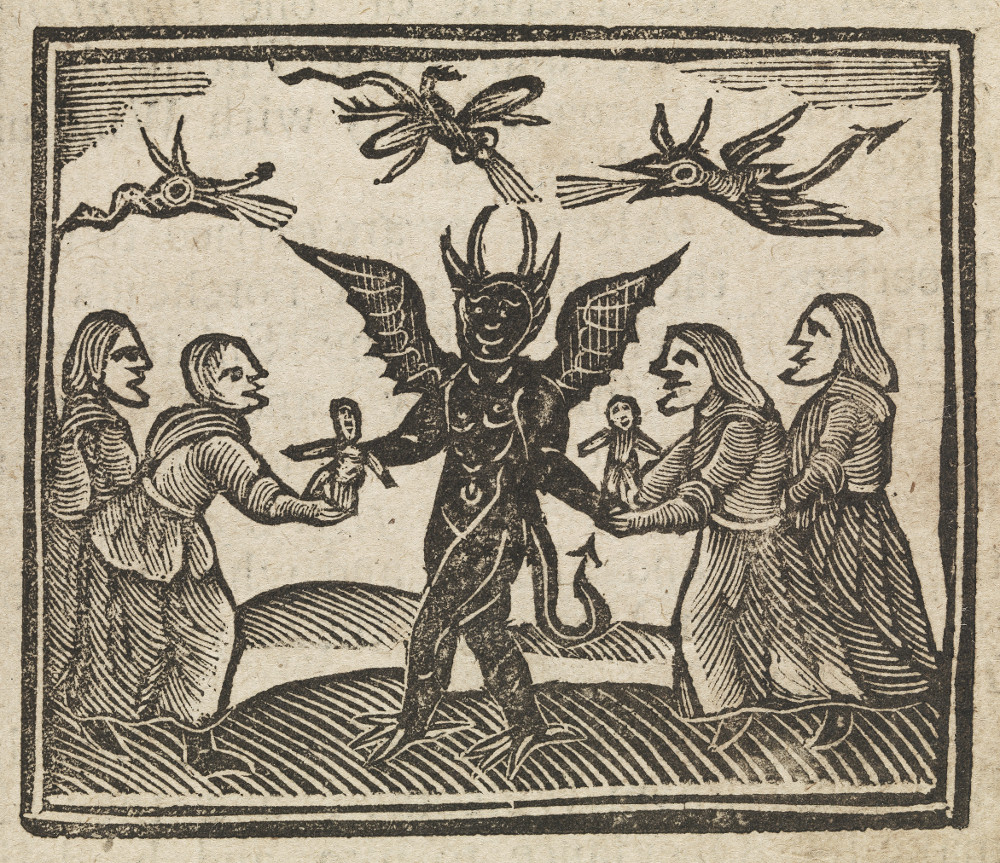
In League with the Devil: Depiction of the Devil giving magic puppets to witches, from Agnes Sampson trial and North Berwick Witch Trials where she and many others ended up being burnt as witches in 1591.

It was her last testimony that was her downfall in the King’s eyes. In it, she disclosed things he and his wife had on their wedding night in Oslo. A conversation she had no way of knowing:

“Item, the said Agnes Sampson confessed before the Kings Majesty sundry things which were so miraculous and strange, as that his Majesty said they were all extreme liars, whereat she answered, she would not wish his Majesty to suppose her words to be false, but rather to believe them, in that she would discover such matter unto him as his majesty should not any way doubt of. And thereupon taking his Majesty a little aside, she declared unto him the very words which passed between the Kings Majesty and his Queen at Oslo in Norway the first night of their marriage, with their answer each to other: whereat the Kings Majesty wondered greatly, and swore by the living God, that he believed that all the Devils in hell could not have discovered the same: acknowledging her words to be most true, and therefore gave the more credit to the rest which is before declared.”

— News from Scotland

Execution and Haunting

King James was allegedly not completely convinced of Agnes Sampson guilt until her last confession. After it however he changed his mind and sent her to be burned. On 28th of January 1591 she was taken to the scaffold on Castlehill where she was garroted before being burnt at the stake. 

Although the exact numbers of the executions are hard to be certain of, it is estimated that around 1500 people were killed as witches by the state of Scotland during this time. 

Agnes Sampson’s naked ghost is said to roam the castle grounds, bald headed roaming around the Palace of Holyroodhouse. 

More like this

Newest Posts

References

The Colorful Ghosts at Stirling Castle

Advertisements

Stirling Castle keeps the dramatic events of Scotland’s history as it stands firmly on the castle hill. Just beware of seeing ghosts in all colors, whether it is the Lady in Green, the Pink Ghost Lady or The Woman in Black. 

Stirling Castle sits atop a dramatic hill in the heart of Scotland and has been a witness to centuries of battles and royal drama as it stands on an important crossroad through Scotland and has been attacked no less than 16 times. 

The castle has also seen many kings and queens come and go and has been a place of crowning them, including Mary, Queen of Scots who held her coronation there in 1542.

Black, green, pink and white, the ghosts of Stirling Castle come in them all, each of them bearing a different story and meaning if you spot them in the old castle. Beyond tales of human history, the castle is shrouded in ghostly legends of mysterious figures that have been seen during dark nights. 

The History Of Stirling Castle

Stirling Castle is an ancient royal fortress located in the city of Stirling, Central Scotland. Built within a dramatic volcanic plug commanding the route north into the Scottish Highlands, the castle was once an impenetrable stronghold of power and influence for Scotland’s monarchs. 

Stirling Castle is a unique and grand castle, boasting an impressive history dating back to the 12th century. Castle Hill as it is built on has had some type of fort built on it since Roman times, perhaps settled even earlier, as far back as the 600s. 

Stirling Castle: Is the old castle in Scotland really haunted? According to the rumours, it is more than one ghost said to wander the haunted castle even today.

The architecture of the castle reflects its changing history; striking evidence of its evolution can be seen in the stone walls and turrets that surround it. Visitors to the castle can explore four levels of magnificent stonework designed by Robert Adam, from a Great Hall and Chapel Royal to guard towers and residential quarters.

Is Stirling Castle Really Haunted?

Many believe that the strange apparitions and ominous sounds are signs that Stirling Castle is truly haunted and not only by one ghost, but by many. Over the years, numerous visitors have encountered mysterious sightings or felt a presence of some kind while visiting this ancient monument. 

Read More: Check out more Haunted Castles from all over the world.

Whether or not these accounts can be trusted is up for debate, but there’s no denying the castle’s long and formidable history makes it a perfect place for paranormal activity.

The Green Lady at her Queen’s Service

Legends of Stirling Castle tell tales of many spooky specters haunting its walls. One of them is referred to as the Green Lady with many stories trying to name her. She is thought to be the daughter of a Commander of the fortress that threw herself from the Elphinstone Tower because her father separated her from her lover, a common soldier and shot him dead.

The most retold legend though is that the Lady in Green could be one of the servants to Mary Queen of Scots who worked there when Mary returned to Scotland in 1562 after spending two decades in France after her husband Francis died. 

A Highlander girl was sent to serve her, and many claim she was gifted with the Second Sight and could foretell the future. The servant girl had seen something in her dreams and stayed with the Queen and had a bad feeling that something wasn’t right.

When the Queen was sleeping in her chambers her bed curtains went up in flames because of a candle on her bedside. This part is an actual event that happened. According to the legend though, the servant went straight for the flames and lost her life when saving the Queen. 

Still Fortelling Tragic Events

There have been countless sightings of her over the years, both by visitors and staff that have stayed in the Castle. When she has appeared, she has frightened the people stiff, as not only is seeing a ghost a scary thing, but her sightings are also said to be a bad omen. 

The Lady in Green: Although there are many variants to the legend, the most told one is that the ghost is that of a former servant that died in the flames while protecting her queen. It is thought that seeing her is a bad omen.

One evening the chef was preparing dinner at the garrison in the Officer’s Mess when he felt like someone was watching  him. He turned around and saw a see through green shape in front of him and he fainted from fear. 

Usually seeing the Green Lady is a bad omen and often she has been seen right before things like a fire or deaths on the castle has occurred, just like how she perished. 

The Pink Lady in the Kirkyard

The ghost of the pink lady can be seen outside of the castle as she is walking to the church next door in her flowing pink dress. The Church of the Holy Rude at Ladie’s Rock was a place court ladies went to watch the knights in jousting tournaments. 

People have speculated that the Pink Lady is actually the ghost og the only survivor after the castle became under siege in 1304 by Edward I. She escaped the siege and returned to the castle after only to find her husband who starved to death. 

The Lady in Pink: Who could this mysterious woman in pink be, and why is she still haunting the castle?

It has also been speculated that it could be Mary Queen of Scots herself that is said to haunt the castle. 

A third option of who this pink lady can be is the Widow Witherspoon. She was an old townswoman who died in 1823 and her corpse was robbed from her grave by the Resurrection Men to be sold to surgeons for further studies.  

The Steps on the Battlements

In the 1820s there used to be castle sentries that made their rounds on the battlements around the Governor’s Block. When they were walking they reported about hearing mystic sounds and seeing unexplainable things. 

One night a sentry was making his way to start his shift when he saw the guard he was replacing dead on his post. His mouth was wide open and his eyes had the look of pure fear and shock. Some say that he ended up meeting the gaze of the woman in green, something legend tells can be deadly.

Ever since then, even after the guards stopped patrolling on the battlements you could still hear footsteps from it as if the sentry was still making his rounds. 

The Lady in Black on the Back Walk

The Lady in Black is a mysterious figure that is seen roaming on the Back Walk that circles the Holy Rude graveyard. She is thought to perhaps be the ghost of a nun that is looking to reunite with her secret lover, a priest as the legend goes. 

Because of her mortal sin, her ghost is thought to be dangerous and said to bring death if you meet her gaze. 

The Ghost in the Kilt

Can you see the man in kilt?

There have also been spotted a male ghost wearing a traditional Highland kilt. Many have mistaken him for a tour guide working at Stirling Castle and are shocked when he just turns and passes through the wall. 

The ghost of the man in the kilt is often seen walking around the corner and disappearing through the wall near a dungeon of Stirling Castle. Back in the day, there used to be a door there, but today it is bricked up and just a solid wall.

The ghost has been talked about in the more modern times as it was allegedly caught in a photograph. In 1935 the Highland ghost is said to have been pictured by an architect, when he was planning for some upcoming building work of the castle.

It must be said that many of the people that owned the picture of the supposed ghost that they claimed could be seen in the picture and passed it around as a ghost picture, was known to be fond of practical jokes. 

Still, the mystery and intrigue of the picture has kept the story of the lonely man in kilt alive at Stirling Castle.

Watch out for the Harbinger of Misfortune

As centuries passed and the castle stood as a symbol of Scotland’s resilience, the ghosts came to understand the importance of their presence. The Lady in Green, the Pink Ghost Lady, The Woman in Black, and the other spectral figures were not simply omens of tragedy, but reminders of the castle’s enduring spirit.

Through their ethereal presence, the ghosts sought to protect the castle from any harm that may befall it. They would appear before devastating fires, revealing themselves as a warning and allowing enough time for the flames to be extinguished. The tragic stories of their origins served as cautionary tales, ensuring that history would not be repeated.

Over time, the castle staff and visitors learned to respect and honor the ghosts, recognizing their role as custodians of Stirling Castle. Instead of fear and superstition, they felt a sense of gratitude for the protection and connection to the past that the apparitions provided.

So, if you happen to visit Stirling Castle and catch a glimpse of a ghostly figure in black, green, or pink, remember to show respect and gratitude. For they are not harbingers of misfortune, but eternally loyal guardians of Scotland’s past, ensuring that the legacy of Stirling Castle lives on for generations to come.

More like this

Newest Posts

References:

Stirling Castle – Wikipedia 

The Green Lady of Stirling Castle 

Ghosts of Stirling Castle

The Haunted Stirling Castle, Scotland  

Stirling Ghostwalk :: The Pink Lady of the Auld Kirkyard