Tag Archives: Monster

The Tschäggättä: Switzerland’s Masked Monsters of Winter

Advertisements

Deep in the heart of the Swiss Alps, the enchanting yet eerie Lötschental Valley harbors a chilling tradition that has captivated and terrified generations. Known as the Tschäggättä, these fearsome, fur-clad figures emerge from the shadows of snow-laden forests during the dark, cold months of winter. Combining ancient folklore with theatrical spectacle, the Tschäggättä embody the primal fears and superstitions of a bygone era.

Deep within the isolated Lötschental Valley of the Swiss Alps, amid snow-laden forests and frostbitten villages, lurks a chilling winter tradition few outside of Switzerland have heard of: the Tschäggättä. These grotesque, fur-clad figures prowl the narrow streets during the coldest, darkest months of the year — a living echo of ancient Alpine superstitions and forgotten fears.

The Origins of the Tschäggättä

Though no one can say exactly when the tradition began, written references to the Tschäggättä date back to the 19th century, with local authorities at times attempting to ban the custom due to its rowdy and unsettling nature. Way back, this used to be one of the poorest regions of Switserland. The first written record dates back to 1860, when prior Johann Baptist Gibsten banned the use of masks during carnival.

However, folklore scholars suggest the practice is far older, a survival of pre-Christian beliefs in malevolent winter spirits that roamed the mountains when the sun was weakest. The second theory links the Tschäggättä to the demonic figures that appeared in ecclesiastical Baroque theatre.

In earlier centuries, the Alpine winter was an unforgiving season of darkness, hunger, and death. Isolated valleys like Lötschental often felt cut off from the world, and stories of spirits, witches, and vengeful phantoms were common. The Tschäggättä became a way to personify these fears — and perhaps to ward them off.

Wooden Masks: The oldest Lötschental wooden mask still in existence from 1790-1810. // Source: Lötschental Museum; Deposit Swiss National Museum

The Schurten Thieves

The best-known legend of the origins of the Tschäggättä is the legend of the Schurten thieves from the middle ages. In the shady forests on the opposite side of the valley once resided the legendary Schurten thieves. They were thieves who lived on the shady side of the valley and disguised themselves to plunder farms on the sunny and richer side of the valley. 

Even today, their farmsteads can still be recognised, particularly clearly visible on the Giätrich, in the “Obri Wald” forest opposite the village of Wiler. 

At nightfall, they went on the prowl in wild disguise with masks on. It was said that the Schurten thieves did not accept anyone into their ranks who was not able to jump over the Lonza with a load of a hundred pounds.

The Appearance of the Tschäggättä

Each Tschäggättä is immediately recognizable by its disturbing appearance. The figures wear heavy animal furs, typically from goats or sheep, to shield them from the brutal cold. Most terrifying, however, are the wooden masks they don — hand-carved, each unique from Swiss stone pine, and featuring grotesque, distorted faces with exaggerated noses, glaring eyes, twisted mouths, and long, matted hair.

Read More: Check out all ghost stories and haunted legends from Switzerland

Some masks resemble demons or monstrous old men, while others are bestial and almost supernatural in form. The craftsmanship of these masks is a source of local pride, with some families passing them down through generations.

The Ritual and Terror of Carnival Nights

The Tschäggättä emerge during Fasnacht — the Swiss pre-Lenten Carnival season, typically in February. from Candlemas until “Gigiszischtag” (i.e. the Tuesday before Ash Wednesday) with the traditional Lötschental carnival procession in Wiler, on the Saturday after the “feisten Frontag”. As night falls, these masked beings descend from the mountains and roam the villages of Lötschental. Carrying cowbells and sticks, they chase anyone they encounter, especially the young, and revel in causing fright.

Craftsmanship: Today there are masks made for the masses, but some of them have hours and hours of time spent carving, some being passed down in the family. Tschäggättä Masks, traditionnal wooden mask from Lötschental in Switzerland. // Source: photographed by Robbie Conceptuel

Traditionally, the Tschäggättä are adult men of the valley, though the anonymity provided by the masks has allowed even women and children to join the fray. The Tschäggättä will often burst uninvited into homes, overturn furniture, scatter hearth ashes, and steal food — an ancient ritual chaos meant to purge winter’s stagnation and welcome the coming spring.

Symbolism and Folkloric Meaning

The Tschäggättä tradition is thought to serve as a way of confronting and mastering communal fears during the most perilous season. The masks might have once represented the spirits of the dead, ancestral ghosts, or demonic forces banished by light and human defiance.

The Tschäggätä: carnival figures wander through the remote Lötschental in the canton of Valais, Switzerland, for several weeks in February, scaring the population. The costumes consist of masks made of Swiss stone pine, sheep or goat skins and cowbells. // Source

Some folklorists believe the Tschäggättä also embodied social rebellion. In a culture tightly controlled by religious and communal expectations, the anonymity of the mask allowed for a brief, sanctioned breakdown of norms — a time when men could mock the authorities, frighten neighbors, and behave wildly without consequence.

The Tschäggättä Today

While modernization has softened some of its rougher edges, the Tschäggättä remain a vital part of Lötschental’s identity. Each year, the locals still carve the terrifying masks and don the heavy furs, parading through villages in eerie processions. Today, any villager can take part, but historically, the fur-clad revelers were exclusively young, unmarried men who moved alone or in small groups during the day (save Sundays) during Carnival.

Though now mingled with festive Carnival celebrations, the primal eeriness of the Tschäggättä endures — a living link to a time when long winters meant living with darkness, death, and things unseen.

Newest Posts

  • The Ghost Procession of Basel and the Dance of Death
    Mirroring the famous Dance Macabre mural that used to hang on the walls near the Predigerkirche in Basel, it is said that plague victims were buried in the patch of grass outside of the church. Legend has it that when the city needs it, the dead will rise from it in a macabre procession, as a warning of an oncoming disaster.
  • The Haunted Halls of the Bern City Hall (Rathaus)
    Where history whispers and shadows reign, the Rathaus in Bern is said to be haunted by a myriad of ghosts. Who are the ghosts lingering in the City Hall after dark?
  • The Restless Dead Buried Inside of Basel’s Double Cloister
    The two adjoining cloisters by Basel Cathedral are said to be haunted by a couple of spectres entombed within the building. In the darkness of Basel’s Double Cloister, it is said you can hear the moaning of a man slowly suffocating and feel the unsuspected slap from a man, as mean in death as he was in life.
  • The Portobello Bar: Spirits on the Canal
    A lock keeper from the adjacent lock next The Portobello Bar in Dublin is said to be haunting it. Ever since his mistake cost the lives of someone crossing, he is said to be lingering in the area.
  • Val Sinestra Hotel and the Ghost of Hermann Haunting the Lower Engadine
    In an old sanatorium in Switzerland the ghost of Hermann is said to have been haunting for ages. But who was he when he was alive, and what was his true name before he died in the remote fortress up in the mountains? And is he still haunting the old halls where he never made his recovery?
  • Glasnevin Cemetery and the Faithful Ghost Dog still Waiting for his Master
    After his master died at sea, the faithful dog was by his master’s grave, day in and day out. After dying of hunger and grief it is said that the Newfoundland dog is still seen, slipping between the graves at Glasnevin Cemetery in Dublin.
  • The Ghosts of the Sinful Nuns Haunting Bern
    Once, the city of Bern was filled with nuns working and living inside of the city walls. According to ghost stories though, some of them remained, even after the Reformation that closed their convents down. And those stories tell about them being guilty of terrible things with terrible ends.
  • A Vampire in Ohio: The Strange and Grim Superstition of the Salladay Family
    Seeking new land and a new life, the Salladay family went to Ohio, but brought a silent killer with them: Consumption. Falling into odd superstitions, they believed the only way to stop the disease was to stop the undead from rising from their graves.
  • Cell Number 11: Whispers in the Attic of the Norwegian Justice Museum in Trondheim
    Is Cell Number 11 in the former prison for the criminally insane haunted? The attic of the Norwegian Justice Museum in Trondheim, Norway has had many who come out, claiming so.
  • The Haunted Legends of Carl Beck House in Ontario, Canada
    Now a place you can rent and stay at, the Beck House in Canada is said to be one of the more haunted places. Those who have stayed the night come back with stories of strange encounters, believed to be the ghost of the Beck family members.
  • The Burgträppe-Balzli Haunting: The Ghost of Nydegg Castle
    Where the Nydegg Church is today, there once used to be a castle. Tales about ghosts lingering around the old Nydegg Castle and the stairs leading up to it still roams. And one of the more infamous and feared ghosts of Bern is the Burgträppe-Balzli.
  • The Wailing Spirit of Old Beaupre Castle
    The Haunted Ruins of Beaupre Castle in Wales is one of the places in Wales said to have been haunted by the wailing spirit and deadly omen of the The Gwrach y Rhibyn, also known as the Hag of Mist.

References:

Tschäggättä Lötschental

Face time: the terrifying Swiss tradition of Tschäggättä – SWI swissinfo.ch

The Legend of the Rollibock: Guardian of the Aletsch Glacier

Advertisements

Coming down as an avalanche through the Swiss Alps, the Rollibock monster is the avenger on man when they take too much from nature. 

Deep in the Swiss Alps, where eternal ice clings to jagged peaks and ancient glaciers wind their way through forgotten valleys, a chilling legend endures — the tale of the Rollibock. 

Read More: Check out all ghost stories from Switzerland

Among the locals of Valais and villages like Naters and Fieschertal, and the scattered alpine villages near the Great Aletsch Glacier, this supernatural creature is spoken of in hushed voices, especially when the wind howls through the mountain passes and the ice groans beneath the weight of unseen forces.

The Aletsch Glacier: is the largest glacier in Switzerland and the Alps. It is 15 miles long and up to 800 metres deep. Since the late 19th century Aletsch has lost almost two miles of its length, and by 2100 it is predicted to shrink by eight miles more, reducing it to a tenth of the mass it is today and nine in 10 glaciers in the Alps will disappear by the end of this century.

The Rollibock of the Alps

The Rollibock is no ordinary beast. Descriptions passed down through generations tell of a massive goat-like creature, its eyes glowing an unnatural, eerie light in the darkness. Its twisted, towering horns resemble gnarled branches coated in frost, and its entire body is encrusted with jagged shards of ice that clatter together as it moves. It is said to have torn open land, stones, and fir trees with its horns and hurled them high into the air. Some say when it breathes, the air turns brittle and the snow itself recoils in terror.

According to legend, the Rollibock is the ancient guardian of the Aletsch Glacier, protector of the frozen world from the greed and carelessness of men. According to legend, the RolliBock is a terrifying creature that takes revenge on everyone and everything that tramples on nature.

Fieschertal Village: Between the year 1300 and 1850/1860 the Aletsch Glacier grew rapidly in size and regularly pushed through the natural dam of the Märjelensee, causing flooding in large parts of the canton of Valais. In the 17th century, during the little ice age, German-speaking Catholics from the village of Fiesch began an annual pilgrimage to beg God to turn the glacier back.

The Rollibock and the Hunter

Woe to those who trespass on his domain with disrespect. One of the most enduring tales involves a reckless hunter who, driven by greed, ventured onto the glacier to harvest rare ice crystals believed to hold magical properties. As he smashed them from the ice, a sudden storm engulfed the glacier, and a lone ferryman appeared to offer him passage to safety.

The desperate hunter accepted, only to realize too late that the ferryman’s eyes gleamed like twin embers in the gloom. Midway across a frozen expanse, the ferryman’s form shifted and swelled, his cloak of furs transforming into shards of clinking ice, his visage twisting into the monstrous form of the Rollibock. With a bellow that echoed across the mountains, the beast dragged the screaming man into the depths of the glacier, his cries swallowed by the ice.

To this day, sudden storms and avalanches on the Great Aletsch Glacier are blamed on the Rollibock, a grim reminder that nature’s ancient powers still watch over the high places of the world. They also fear the mysterious Märjelen Lake they thought to be the place where the hunter disappeared. 

The Revenge of the Rollibock.

Locals swear that if you hear the distant clatter of ice when the wind is still, you’d best turn back — for the Rollibock is near, and he does not forgive trespassers. And when the people of the Upper Valais experienced flooding, it was said the Rollibock was angered. Only those who fled to a chapel or a house where blessed objects were kept could save themselves. Those who didn’t make it was crushed to like dust in the sun, swallowed by the ice and snow. 

It remains one of Switzerland’s most unnerving alpine legends, a chilling testament to the dangers of arrogance in the face of nature’s dominion.

Newest Posts

  • The Ghost Procession of Basel and the Dance of Death
    Mirroring the famous Dance Macabre mural that used to hang on the walls near the Predigerkirche in Basel, it is said that plague victims were buried in the patch of grass outside of the church. Legend has it that when the city needs it, the dead will rise from it in a macabre procession, as a warning of an oncoming disaster.
  • The Haunted Halls of the Bern City Hall (Rathaus)
    Where history whispers and shadows reign, the Rathaus in Bern is said to be haunted by a myriad of ghosts. Who are the ghosts lingering in the City Hall after dark?
  • The Restless Dead Buried Inside of Basel’s Double Cloister
    The two adjoining cloisters by Basel Cathedral are said to be haunted by a couple of spectres entombed within the building. In the darkness of Basel’s Double Cloister, it is said you can hear the moaning of a man slowly suffocating and feel the unsuspected slap from a man, as mean in death as he was in life.
  • The Portobello Bar: Spirits on the Canal
    A lock keeper from the adjacent lock next The Portobello Bar in Dublin is said to be haunting it. Ever since his mistake cost the lives of someone crossing, he is said to be lingering in the area.
  • Val Sinestra Hotel and the Ghost of Hermann Haunting the Lower Engadine
    In an old sanatorium in Switzerland the ghost of Hermann is said to have been haunting for ages. But who was he when he was alive, and what was his true name before he died in the remote fortress up in the mountains? And is he still haunting the old halls where he never made his recovery?
  • Glasnevin Cemetery and the Faithful Ghost Dog still Waiting for his Master
    After his master died at sea, the faithful dog was by his master’s grave, day in and day out. After dying of hunger and grief it is said that the Newfoundland dog is still seen, slipping between the graves at Glasnevin Cemetery in Dublin.
  • The Ghosts of the Sinful Nuns Haunting Bern
    Once, the city of Bern was filled with nuns working and living inside of the city walls. According to ghost stories though, some of them remained, even after the Reformation that closed their convents down. And those stories tell about them being guilty of terrible things with terrible ends.
  • A Vampire in Ohio: The Strange and Grim Superstition of the Salladay Family
    Seeking new land and a new life, the Salladay family went to Ohio, but brought a silent killer with them: Consumption. Falling into odd superstitions, they believed the only way to stop the disease was to stop the undead from rising from their graves.
  • Cell Number 11: Whispers in the Attic of the Norwegian Justice Museum in Trondheim
    Is Cell Number 11 in the former prison for the criminally insane haunted? The attic of the Norwegian Justice Museum in Trondheim, Norway has had many who come out, claiming so.
  • The Haunted Legends of Carl Beck House in Ontario, Canada
    Now a place you can rent and stay at, the Beck House in Canada is said to be one of the more haunted places. Those who have stayed the night come back with stories of strange encounters, believed to be the ghost of the Beck family members.
  • The Burgträppe-Balzli Haunting: The Ghost of Nydegg Castle
    Where the Nydegg Church is today, there once used to be a castle. Tales about ghosts lingering around the old Nydegg Castle and the stairs leading up to it still roams. And one of the more infamous and feared ghosts of Bern is the Burgträppe-Balzli.
  • The Wailing Spirit of Old Beaupre Castle
    The Haunted Ruins of Beaupre Castle in Wales is one of the places in Wales said to have been haunted by the wailing spirit and deadly omen of the The Gwrach y Rhibyn, also known as the Hag of Mist.

References:

Der Rollibock – Forgotten Creatures 

Rollibock – Wikipedia

The Cherokee Legend of Spearfinger in Great Smoky Mountains National Park

Advertisements

Disguised as an old woman or a loved one, the liver eating Spearfinger has terrified the Cherokees for centuries. She hides in the mountain, attacking children to eat their livers.  

In the mist-laden embrace of the Great Smoky Mountains National Park between North Carolina and Tennessee lies a haunting tale, a Cherokee legend that weaves through the dense forests and shadowy trails under the misty mountain peaks. 

Read More: Check out all ghost stories from the USA

The legend of Spearfinger, or the U’tlun’ta in the Cherokee language meaning “she had it sharp’, is said to live in this area. According to Cherokee lore, Spearfinger is no ordinary witch; she is a sinister entity with a penchant for deception and a hunger for the flesh of unsuspecting children.

The Legend of Spearfinger

The legend unfolds along the winding paths of the Great Norton Creek Trail, trails along the Chilhowee Mountain and by Little Tennessee River. Among her favorite places she calls home is the thunder mountain, Whiteside.  

Spearfinger is said to disguise herself as a kindly grandmother or a family member of children she sees to sneak up on her victims. Dancing in clouds, she sang her favorite song with her raven friend:

Uwe la na tsiku. Su sa sai.

Liver, I eat it. Su sa sai.

Uwe la na tsiku. Su sa sai.

Armed with a finger that resembles a sharp, knife-like blade that looks like a spear or obsidian knife, she lures innocent children away from the safety of their homes and into the heart of the ancient woods. Once under her spell, Spearfinger reveals her true form, her mouth stained with blood from livers she has eaten and with her Nûñ’yunu’ï, which means “Stone-dress”, for her stone-like skin. With a single, fatal stroke, she cuts her victims and consumes their tender body parts.

Arrows cannot pierce her stone skin and she is strong, picking up boulders without any effort. She is also said to often clutch her right hand tightly, as she is hiding her heart in her palm, her only weak spot. 

Stories About Spearfinger

The Cherokee have traditionally been very cautious about strangers, and were suspicious of those who wandered off alone. They could come back as the liver-eater in disguise, and there were many stories about this. 

Some tales told about her deceiving people by hiding the victims after turning into them. She went to their families and waited until they were asleep so she could steal the children’s livers. 

Hunters in the woods told about an old woman with a strangely shaped hand, singing her song and scaring them so they ran off. Because Spearfinger is quick and doesn’t even leave a scar, making the victims ill before they die after a few days. 

When birds flock to the sky, villagers say it was her. Her presence was marked by the graceful dance of the birds, as if they were paying homage to her mysterious spirit. The villagers whispered about her shadowy figure, weaving tales of her mystical connection to the natural world.

The Spearfinger Place

But where did she come from? What is her purpose? Was she just a story parents told their children to keep out of woods and strangers? According to the storyteller, Kathi Littlejohn of the Eastern Band of Cherokee Indians, she says that there are portals to the other worlds. The upper world of the creator, the middle world of humans and the underworld were creatures like Spearfinger comes from. 

Years ago, sometime in the 19th century, the Cherokee pinpointed the location where the ruins of Spearfinger’s Tree Rock remain, in Blount County, Tennessee. This area, rich with history and legend, is known as Nantahala. The Cherokee name for the place is U’Tluntun’yi, which means “The Spearfinger Place.” U’Tluntun’yi holds a significant place in Cherokee lore as it is believed to be where Spearfinger built a rock bridge that offended the higher spirits who struck it down with a bolt of lightning, giving her a body of rocks. 

The Death of Spearfinger

The Cherokee called a great council, including towns like Tomotley, Tenase, Setico, and Chota, which were haunted by the liver eater, Spearfinger. The medicine man, adawehi, revealed Spearfinger’s deception and proposed a trap: a pit covered with brush and a smoky fire. Spearfinger, drawn by the smoke, approached disguised as an old woman. Though initially mistaken for one of their own, the medicine man recognized her trick. Despite arrows breaking against her stone skin, Spearfinger fell into the pit, unharmed by the stakes. 

Birds descended to help; a titmouse misled them to aim at her chest, but a chickadee correctly indicated her right hand. The hunters severed her heart by hitting her wrist, ending her curse. Stone Man, her ally, dismissed the warning of her death and continued his ominous song. In gratitude, the chickadee was forever known as the “truth teller.” Cherokee storytellers still recount Spearfinger’s legend and mark where her stone form fell.

But even though the Cherokee claim to have killed the liver-eating witch of stone, there are still stories of her cackles and shrieks echoing through the mountains. The legend tells of how she would lure unsuspecting travelers into her lair with promises of shelter, only to devour their livers in a grotesque display of her insatiable hunger. Some say her spirit still haunts the darkest caves and craggy peaks, seeking vengeance for her demise.

More like this

Newest Posts

References:

The Cherokee Legend of Spearfinger 

Spearfinger – Wikipedia The terrifying legend of Spearfinger as told by a Cherokee storyteller

The Mysteries of The Bennington Triangle on Glastenbury Mountain

Advertisements

People have always feared the wilderness. This is also the case of the area around Glastenbury Mountain where several strange disappearances have made people think that it could be something strange going on in what has been known as The Bennington Triangle. 

Deep within the picturesque landscape of Vermont lies a region cloaked in mystery and shrouded in eerie tales—the Bennington Triangle. An area encompassing the southwestern part of the state, the Bennington Triangle has become synonymous with a series of unexplained disappearances, ghostly encounters, and inexplicable phenomena that have perplexed locals and intrigued paranormal enthusiasts alike. 

Read More: Check out all ghost stories from USA

The Bennington Triangle has been compared to the similar Bridgewater Triangle of Bermuda Triangle, a place where strange things happen. The phrase was coined in 1992 by the author Joseph A. Citro, who wrote about this in his books, Shadow Child. Citro has also called the area as a “Yankee Shangri-La”, a place where people go to never be seen again. 

The area is said to be around the Glastenbury Mountain and Long Trail, encompassing towns like Bennington, Woodford and Shaftsbury as well as once thriving logging towns, now abandoned ghost towns of Somerset and Glastenbury. 

It is said that strange disappearances started way back and that from 1920 to 1950, as much as 10 people vanished in these parts. At the heart of the strange things said to go on in the triangle is a series of disappearances from 1945-1950:

The Disappearances of the Bennington Triangle

The unsettling reputation of the Bennington Triangle stems from a series of unexplained disappearances that occurred between 1945 and 1950. Five individuals, including a seasoned hiker, a college student, and a war veteran, vanished without a trace within the confines of Glastenbury Mountain—a prominent feature within the triangle. 

Disappearing People: Circulated photograph of Paula Jean Welden; clipping from missing persons flyers. Her case in particular drew a lot of media attention.

The first incident occurred on November 12, 1945, when 74-year-old Middie Rivers vanished during a hunting trip in the mountains by Long Trail Road. Despite an extensive search, the only evidence discovered was a rifle cartridge in a stream. 

A year later, on December 1, 1946, Paula Jean Welden, an 18-year-old sophomore at Bennington College, disappeared during a hike on the Long Trail. An elderly couple said they saw her in front of them on the trail. She turned a corner, and when they turned the same, she had vanished. Despite a substantial search effort and FBI involvement, no trace of her was found. Her disappearance got a lot of attention, and it even inspired the Shirley Jackson novell from 1951, Hangsaman.

On December 1, 1949, James E. Tedford, a veteran from the Bennington Soldiers’ Home, vanished mysteriously while on a bus from St. Albans. According to the stories, he vanished into thin air between the last stop and Bennington, leaving all of his belongings in the luggage rack with an open bus timetable on his seat. Skepticism surrounds claims that he “dematerialized” as he wasn’t reported missing until a week later.

In 1950, the mystery continued with the disappearance of 8-year-old Paul Jepson, left unattended near a local highway for an hour as his mother fed some pigs. He was wearing a red jacket at the time and were supposed to be clearly visible in the greenery, but not a trace was found. It is said that just in case, people don’t wear red clothes in the area because of this. 

Lastly, 53-year-old Frieda Langer, who vanished during a hike near Somerset Reservoir. Frieda Langer’s body was found seven months later, three and a half miles from the campsite, with no determined cause of death.

Other than the area they disappeared in and the time period, they found no other connections between the five disappearances.   

The Bennington Monster

So what happened in this time period? Some claim it had to be UFOs, perhaps even Bigfoot himself. Others say that the forests of the area have become haunted and people claim to hear strange noises and voices. 

The place has been known as a place to avoid since colonial time with people encountering strange lights and even monstrous animals in the wilderness. 

The legend of the “Bennington Monster” dates back to the early 1800s when a stagecoach encountered a washed-out road. The stage driver discovered massive footprints in the mud, distinctly larger than human. Suddenly, the coach was assaulted by a colossal creature, toppling the vehicle on its side. Terrified passengers glimpsed only a pair of eyes before the monster emitted a roar and vanished into the forest. Subsequent sightings portrayed the creature as a towering, hairy figure, dark in color, and exceeding six feet in height.

There is also a story about a man named Carol Herrick who in 1943 went missing while hunting. He was found three days later near Glastonbury, crushed to death, surrounded by big footprints.

Native American Legends

There are also early colonists that have retold native american stories and Algonquin legends that called the Glastenbury Mountain a human eating rock. An evil stone on the mountain that would open up and swallow those standing on it. 

Legends tell of ancient Native American curses and supernatural entities that haunt the region and that they wouldn’t step on the land unless to bury the dead. They said that the “four winds” met there in an eternal struggle, which has some truth to it, as the wind on Glastenbury Mountain is prone to sudden shifts, and even the plants grow in weird angles because of this. 

The Vortex of The Bennington Triangle

While the disappearances of the 1940s and 1950s remain unsolved, the Bennington Triangle continues to captivate the imagination of those intrigued by the unknown. What could it be? Some from the native tribes legends? Could it be a monster like Bigfoot roaming the place, or perhaps even a serial killer wandering the mountain?

Ghost hunters, paranormal investigators, and curious seekers venture into the depths of the triangle, searching for clues and attempting to unlock the secrets that have eluded explanation for decades.

Today as well as in the old days, the wilderness of Glastenbury Mountain and the surrounding Bennington Triangle makes us afraid for what could be in the vast and wild area where a person can disappear without a trace. 

More like this

Newest Posts

References:

Bennington Triangle, Vermont – Legends of America 

The Haunting of Glastenbury Mountain 

https://eu.southcoasttoday.com/story/lifestyle/1996/11/23/vermont-mountains-haunted-by-disappearances/50617656007/

Bennington Triangle – Wikipedia 

The Jersey Devil in the Pine Barrens New Jersey

Advertisements

Enter into centuries-old folklore of the legendary Jersey Devil from the Pine Barrens in New Jersey. Uncover its sinister past, how it has been remembered, and why so many theories persist today.

The New Jersey Pine Barrens, also known as the Pinelands or simply the Pines, is a place in New Jersey in the USA. The place is shrouded in mystery and steeped in more than one legend, the most famous one being that of the Jersey Devil who has been a source of fascination for centuries. 

Dating back to the 18th century New Jersey folktale, the Jersey Devil has inspired a multitude of theories — some plausible, and some outlandish. Learn more about this legendary creature and its continued cultural significance today.

The Origins of the Jersey Devil

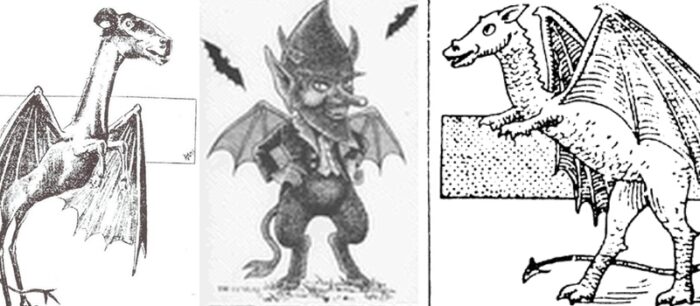
According to local legend, the Jersey Devil, sometimes known as the Leeds Devil, often described as a flying biped with hooves. The Jersey Devil was born in 1735 in Estellville, New Jersey. The story goes that a woman named Deborah Leeds, known as Mother Leeds gave birth to a child cursed with the form of a dragon or other fantastical beast. 

She already had twelve children, and when she found out she was pregnant with the 13th one, she cursed the child in her womb, calling the child the devil himself. Mother Leeds gave birth on a stormy night, and the child was born as a monster. 

In some variations of the legend, Mother Leeds was a witch herself and the father of the Jersey Devil was the Devil himself. 

The Jersey Devil: Here are several depictions of the creature known as the Jersey Devil or the Devil of Leeds throughout the years.

The creature soon escaped and began terrorizing the locals, swooping down from the sky and stealing farm animals, destroying crops, and even reportedly attacking some people. To this day, it remains an enduring element of local folklore — as well as a source of mystery and enchantment for many.

Sightings and Reports Throughout History

Since its first sighting in 1735, the Jersey Devil has been reported to have been seen in various forms and places in and around New Jersey. Before the 1900s, it was mostly referred to as the Leeds Devil or the Devil of Leeds, either because of the family name of Leeds or because of the New Jersey town called Leeds Point. 

Sightings of the legendary creature have been reported throughout the centuries, most often as a winged demonic creature that walks on two legs and is able to fly. According to these sightings, it was blamed for killing many livestocks, and even Napoleon Bonaparte was said to have seen the Jersey Devil when he was out hunting in 1820.  

Reports of its presence grew after a wave of sightings occurred near Camden between 1909 and 1910, leading to widespread newspaper coverage when the Jersey Devil allegedly attacked a trolley cart as well as livestock and the police themselves supposedly opened fire at the creature. 

People reported footprints in the snow looking like the Jersey Devil as far as Delaware and Maryland. According to the writer Gordon Stein in his book Encyclopedia of Hoaxes, a man came forward as the culprit behind the mysterious footprints. 

Nevertheless, there were organized manhunts and in the woods and people were advised to stay in their homes. Although these reports tapered off over time, tales of its exploits continue to be told among local residents today.

The Blue Hole

But where does the Jersey Devil really live? The Pine Barrens is a large area, but there is one particular place that is talked about more than others. In the middle of a dense forest there is a lake with a very unusual color that is often connected to the Jersey Devil called the Blue Hole.

As well as being a popular party spot, it also contains countless legends. For instance it is supposedly bottomless with powerful currents. In real life the Blue Hole really has some cold spots, but the legend tells that the water is freezing cold all year-round. It is around these parts that the Jersey Devil is most active.  

Modern Theories and Beliefs About the Jersey Devil.

There are various theories and beliefs about the Jersey Devil that have been held throughout history. These range from mythological explanations such as the creature being the Thirteenth Child of Mother Leeds to more scientific concepts like a rare species of mammal surviving in an area where it is not known to exist. 

More down to earth explanations have also been put forward saying the Jersey Devil is nothing more than the figment of imagination that came from the fear of the isolated place the Pine Barrens was at the time. It was considered dangerous and inhospitable with highwayman, fugitives, and outcasts like poor farmers, Native Americans and runaway slaves. 

Some people believe that the Jersey Devil is actually an alien or interdimensional being, while others speculate that it may be a form of cryptid capable of shape-shifting. Regardless, speculation and legends surrounding the Jersey Devil continue to this day.

Captain Kidd

One of the other legends from the Pine Barrens is that of Captain Kidd. His real name was William Kidd and was a Scottish sea captain who turned into a pirate. He was executed in London in 1701 for both murder as well as piracy. 

According to legend he buried a treasure that has yet to be found. It is not only in the Pine Barrens, but also in Nova Scotia, Connecticut and Long Island that have legends and myths about there being buried treasure around those parts. 

According to legend from Pine Barrens though it is around Barnegat Bay that CAptain Kidd is haunting as a ghost, often reported about being a headless ghost. 

Captain Kidd is often seen in company with the Jersey Devil himself, walking along the beach. 

The Black Doctor of the Pines

The ghost of the Black Doctor is said to be the spirit of a man known as James Still. Still was said to be forbidden from practicing medicine due to his race, and he went to the Pine Barrens to practice medicine in the isolated communities of the Barrens. 

There he studied medicine from textbooks and according to some legends, learned herbal medicine from the Native Amercans as well. 

How he died is still debated. Some say the locals in the Pine Barrens tells the story of how he was lynched when they found out he practised medicine. 

Others tell the story about how he was a hero in the isolated community and died of a heart attack, which is the true story of how James Still died. 

He is said to be a helping ghost and is said to still come to the aid of lost or injured travelers in the Pine Barrens woods. 

The Girl With the Golden Hair

Another ghost that haunts these parts is said to be a woman dressed in white found by the seaside, staring out into the sea as she is still mourning her lover she lost out there. 

Her ghost stories are often mixed with the Jersey Devil as well, as he is said to sit next to her. 

The White Stag

Something less menacing than the Jersey Devil is the spirit of a white deer that is said to show up when lost travelers need aid in the Pine Barrens. It is also said that the spirit is a warning of danger ahead. 

This comes after a story where a stagecoach nearly fell into the Batsto River. The coaches reached Quaker Bridge and the horses refused to move and go over it. When the driver investigated further, he saw the white stag on the road before it disappeared before his eyes. 

A closer inspection showed that the bridge was destroyed and since then it is said to mean good luck if you ever spot it. 

The Black Dog

Another animal spirit around these parts is that of the Black Dog. Most often, seeing a Black Dog is a bad omen in European mythology, but in this instance, it is a good luck charm. It roams on the beaches and forests from Absecon Island to Barnegat Bay and is considered a harmless spirit. 

It is said to be the ghost of a dog that was on board a ship that was attacked by pirates on Absecon Island. They killed the crew on the ship and among the killed were the cabin boy as well as hin trusted black dog. 

More like this

Newest Posts

References

Top Korean Horror TV-Series

Advertisements

The last few years, K-dramas has certainly taken over much of the media the world consume today and that goes for the Korean horror TV-Series as well.

Although it is largely remembered from the overly romantic dramas with umbrellas in the rain and watching over people with a cold like they are on their deathbed, some more darker series has caught on. In fact one of the more famous k-drama must certainly be the zombie driven historical drama Kingdom that entered as Koreans first entry to the Netflix family. And since then, the gems keeps on coming. Here are ten of the more darker k-dramas out there.

Revenant |악귀 (2023)

This slow burn ghost story is based on Korean folklore. It follows a professor in folklore (Oh Jung-se) who can see ghosts that teams up with a young woman (Kim Tae-ri) after her father dies in what seems to be a suicide. But strange things starts to happen to her and it turns out she is possessed by a vengeful ghosts, and that the string of mysterious suicides that happens around them is something much more horrifying.

Strangers From Hell | 타인은 지옥이다 (2019)

With a top stellar cast of Im Shi Wan (Run On) and Lee Dong Wook (Goblin), this had to be an iconic duo. The series is a trippy Korean horror TV-Series quest for a poor writer to distinguish between what is and isn’t real as well to figure out his true friends he can trust is. When he moves into a cheap hostel, Eden Gosiwon, he has to deal with the truly creepy residents he has to share kitchen and bathroom with. But although he hates it, he endures it to he has enough money saved up to move to something better in Soul. But then he starts fearing for his life when strange occurrences keeps happening around him.

Advertisements

All Of Us Are Dead | 지금 우리 학교는 (2022)

This is another zombie series for Netflix that rose to the top streaming, even more so than the hit series, Squid Games. It is an adaptation of the popular webtoon of the same name and are now one of the biggest Korean horror TV-Series. A seemingly normal day at school that ends in an international disaster as a rabid zombie outbreak starts from the schools science lab. The student quickly learn that they are all on their own and must escape so not turn to one of the living dead. This is a gory series that doesn’t shy away from blood, violence and deeply flawed human beings with a twist on the zombie lore.

NB! Confirmed for more seasons!

Advertisements

Hotel Del Luna | 호텔 델루나 (2019)

A series that managed to balance the campy romantic side of classic k-dramas with the gory horror of ghost is Hotel Del Luna and not purely a Korean horror TV-Series. Although the plot is not that terrifying, some of the characters and ghosts in the hotel definitely are. Super Idol K-Pop star IU stars as the greedy CEO, Man Wol, for a hotel that only caters to the dead to help them cross the bridge to the afterlife. Chan Sung is forced to manage the hotel as his father sort of sold him of to Man Wol as a child. And together they have to manage the hotel together as well as solve the mystery as to why Chan Sung keeps reminding Man Wol of her ex that betrayed her many years ago.

Advertisements

Sell Your Haunted House | 대박부동산 (2021)

If nothing else, this is a great business idea. Ji Ah runs the company, Deabak Realty, specialising in selling haunted houses. A handy thing as she got her exorcism abilities from her mother (who btw haunts her daughter). She needs an assistant and meets the conman In Beom. He specializes in selling stuff that apparently exorcises ghosts, although it’s mostly junk. But together they team up to sell houses, exorcise vengeful spirits and deal with their pasts filled with sorrow in this action packed Korean horror TV-Series. 

Advertisements

Bring It On, Ghost | 싸우자 귀신아 (2016)

The cuter entry on the list is Bring it on, Ghost. Although it contains its fair share of ghosts, gore and dead cats so it falls into the Korean horror TV-Series. The series certainly hit its audience, and there is already a Thai adaption of the series. A college boy works as an exorcist part time. On a job he faces a teenage ghost that he accidently kisses, making her regain some part of her memory she searches for in the afterlife. Together they try to piece together the mystery behind her death as well as the strange stuff happening around the college he attends.

Advertisements

Kingdom | 킹덤 (2019)

The mega series helped turn the tide for Korean horror TV-Series and certainly the interest in Korean zombies. A mysterious illness has befallen the king in a fictionalized version of Korea in the Joseon area. The illness of zombification is spreading throughout the kingdom and the crown prince travels out from the castle to solve the mystery behind his father’s ailment. Out there he finds a kingdom in disarray and hoards of zombies threatening the whole kingdom he was born to protect. With its two season wrapped story it looks like this is the whole of it, but with sidequel/prequel like movies like Kingdom: Ashin of the North, and the original cartoon with its specials, who is to say this is the end of the franchise?

Advertisements

Sweet Home | 스위트홈 (2020)

This monster flick is truly on testosterone with the most crazy characters and designs for monsters roams freely in this damp and shabby residential building. This Korean horror TV-Series is based on the famous korean webtoon. A strange virus that turns humans to monsters has taken over the world. In a residential building a reclusive teen lives in isolation. But as the dangers of the virus threathernes everyone around him, he must come out of his shell and help fight back for the human survival.

Advertisements

The Guest |  손 (2018)

A young shaman, Yoon Hwa Pyung, learns about the demon named “son”, (meaning guest) in this Korean horror TV-Series from 2018. The demon is a danger to everyone and leaves a trail of corpses. The young shaman meets up with a catholic guy and the daughter of a detective when their families are killed by a demon. Twenty years later they meet up again when the killings start once again. This time, to work together to bring down the demon.

Advertisements

Possessed | 빙의 (2019)

A classic detective meets a medium to hunt down criminals in this Korean horror TV-Series. They meet when the detective is working a case and he immediately takes an interest in her. With both of their abilities, they start to solve cases together. One of the more divisive shows as many watchers found the k-drama way to dark for their expectations and for some it was right up their alley. Decide for yourself.

Advertisements

Missing: The Other Side | 미씽: 그들이 있었다 (2020)

This is one of those rare cases were a k-drama actually gets a sequel with a second season confirmed. The first season started with a small village named Duon Village, that holds the spirits of missing and deceased people were they gather. A group of a fraud man, detective, a hacker and a mysterious man teams up to solve the mysteries behind the strange village and to find the missing people.

Advertisements

Night Watchman’s Journal | 야경꾼일지 (2014)

One cannot complete a k-drama list without a historical drama on the list from the Joseon period, that is the law! And here comes the Night Watchman’s Journal in as a ghostbuster story in hanbok in this Korean horror TV-Series. With the backdrop of the royal palace, a group of guys spends their time fighting demons and vengeful spirits as well as dealing with the living trying to usurp the king.

Advertisements

More like this

Newest Posts

References

Bunyip in the Billabongs

Advertisements

G’day mates! The Bunyip in the Billabongs of the wild from Australia is a mythical creature rumored to be living in the lakes and swamps in the untamed Australian wilderness. What was the swamp creature that scared them all? Or rather, what is it?

As the white settlers started to take land in the 1840 and 1850 in Australia, they started to observe something they didn’t think they would. Particularly near the southeast colonies like Victoria, New South Wales they heard unknown cries in the night, found strange bones and started taking notes of the new surroundings. But what was this newly discovered animal? This is something modern day cryptozoologists still debates, even to this day and age.’

Read Also: Check out all of the ghost stories from Australia on the Moonmausoleum.

Most written down sightings we know of from the creature comes from 1840 and 1850, when there were a collective hysteria almost and hunt for this strange creature in this strange country. Perhaps this strange creature that the white settlers saw wasn’t as “newly discovered” as the settlers claimed it to be as there were many local stories from the native Aboriginal Australians.

Proof of the Monster: The much debated skull from the alleged Bunyip that is said to roam in the Australian swamps or Billabongs. Back in the early days of European settlement, the creature was thought of a native animal of Australia. Photo: Henry Dowling, John Murray January 1847 /wikimedia

As the European settlers found skulls they didn’t know the origin off and displayed them in museums for people to behold the strange creatures of the new world, writing sensationalist news articles about the animal and the dangers it posed for humans wandering in the wild, the native aboriginals had a different story to tell about the Bunyip that had haunted the Billabongs long before any Europeans set foot on the ground.

The Evil Spirit in Aboriginal Mythology

The creature is part of traditional Aboriginal beliefs and stories throughout Australia, while its name varies according to tribal nomenclature, it sometimes comes up in their mythology and stories.

The mere word, Bunyip, is today most often translated as devil or evil spirit in the “Down Under”. The stories of the Bunyip varies widely from region to region. The tales of this strange and mythical swamp creature was told before the white settlers came, but what happened to the mythology and folklore of the native aboriginals is an atrocity, and they got their whole culture and way of life wiped away for centuries, at some times, forever.

So who really knows the true origins of the Bunyip today? When the white settlers came they mixed their own folklore into the mix, especially of the Irish mythological monster, Púca. Still, the ones keeping the tales of the Bunyip alive today is the local legends that have been passed down for a long time.

A monster from the lakes: Drawing of the Australian Bunyip coming up from the swamps, rivers and lakes in hunt for food. The creature has been a part of the aboriginal mythology long before the European settlers arrived in the country. The illustration is from 1935/Wikimedia.

One of the origin stories of the legend claims that the monster was once a man whose name was Bunyip. He was banished by the good spirit Biami. This is what drove the man to become an evil spirit that lured his fellow tribesmen into the waters to eat them.

Other stories of the creatures think that it is the remembrance of some sort of extinct animal that used to live on the land, but now only exists in myths and legends. Perhaps it could even be seals that lost their way and ended up in the inland rivers. There are many theories today, but no one has really managed to claimed to have cracked the code.

The Roaring Screams of the Bunyip from the Billabongs

Most of the accounts describes the creature like a sea spirit, river monster or something of a dog or a seal. However, descriptions varies and it also described with feathers, or like a starfish.

What most agree on though is its amphibious traits, swimming in lakes, billabongs, rivers and other forms of inland waters. The creature it is described as highly dangerous if a human gets in its way. While most aboriginal myths claims they are a nocturnal being, feeding on crayfish, there are also so many legends, claiming it to pray on humans as well, especially small children and women.

Read Also: check out the story about The Jersey Devil in the Pine Barrens New Jersey or The Legend of the Mothman for more haunting stories about monsters in the wild.

Although sightings of the creature are said to be rare, the sound of the monster is the most told about legend and how many have claimed to recognize its existence. The Bunyip supposedly makes a booming and roaring scream from the billabongs and swamps, sending shivers to everyone that are unfortunate enough to hear it. Children was told to never go swimming so not to be taken by the Bunyip and the creature has now become a part of the cautionary tale for them.

The Case of the Burrawang Bunyip

It is not like the tales of the Bunyip disappeared as the aboriginal myths were silenced and the white settlers got a better understanding for the wild and foreign country they found themselves in. So far up to modern times, accounts of the Bunyip has been reported across the country. Even in the 1960s, there was tales about the swamp monster, lurking in the deep south murky swamps.

A Hunger for Humans: In many on the reconts of the creature, the monster can be dangerous for humans. Macfarlane, J. 1 October 1890/wikimedia

This is the case of Burrawang, a highland village south-west from Sydney in the southern highland in New South Wales. With a permanent population of around 300 today, Burrawang is truly a quaint Aussie village from an older time. A number of the cottages and churches in the area date back to colonial times and hints at how it would had been back when the European settlers first arrived.

Below the village of Burrawang there is a large swamp that is the home of many rare creatures, and locals claim they’ve heard the sounds from the Bunyip.

There are also a tale of railway workers running away from the monstrous sounds coming from the swamps when they were working there in the 1930s, breathing new life into the legend.

The Burrawang locals heard the roaring sounds from their local Bunyip, all up until they built a dam in 1974, and the sounds disappeared. Why? Did they push the wildlife away and in that, the Bunyip as well? Perhaps it was only something else making the sounds. But what? That is something the modern world perhaps is too late to figure out.

Even today, the monster enthusiast comes to Burrawang in search for the strange creature no one really know exists, but many claims to have heard, bellowing from the depths of the swamps.

More like this

Latest posts

References:

https://www.britannica.com/topic/bunyip,

https://www.australiangeographic.com.au/blogs/tim-the-yowie-man/2020/03/the-case-of-the-roaring-bunyip/

Bunyips: Australia’s Folklore of Fear by Robert Holden, Nicholas Holden

5 Books About Monsters and their Legends

Advertisements

The idea of the ‘other’ has always lurked around the corner in fiction. None more than monsters and creatures we can’t explain. What we fear are what we don’t know. And even though the only thing we use the phrases “being a monster” or “a monstrosity”, it is about humans, there are some comfort that there could exist other monsters, except for us.

Here we have compiled a list of some of the weird, great and scary monster books.

Kronos Rising

By Max Hawthorne

A series of several books that deals with prehistoric creatures and have been compared to Micheal Crichton Jurassic Park. Only this is in the deep sea and no one can hear you scream.

Synopsis: Steve refused to surrender. Even though he knew the creature was right behind him, he wouldn’t quit. He would make it. Just as that beacon of hope began to shine down upon him, the bright sun overhead vanished from view. Confused, he gazed wide-eyed as the daylight grew dim. Then he realized the ultimate horror: the creature had overtaken him, its jaws opened wide. He was in its mouth.

A coastal community faces the wrath of a prehistoric marine predator in Max Hawthorne’s heart-pounding new novel, Kronos Rising.

Devastated by his wife’s tragic drowning, Olympic hopeful Jake Braddock turns his back on fame and fortune and retreats to his childhood home of Paradise Cove, Florida. He accepts the job of town sheriff, hoping to find the solace he so desperately craves.

He finds anything but.

A series of horrifying deaths and disappearances send a flood of panic through the idyllic town. It is only after the ravaged carcass of a full-grown whale surfaces, however, that the real terror begins.

Soon Jake finds himself drawn into an ancient mystery – a mystery that ends with him adrift at sea, battling for survival against the deadliest predator the world has ever seen. It is a creature whose ancestors ruled the prehistoric seas. Now freed after eons of imprisonment, it has risen to reclaim the oceans of the world as its own.

And it’s hungry.

Read it here

Listen to it here (PS! The sequel)

Monster

By Frank Peretti

This author is perhaps most known for writing Christian fiction, but this books takes on the Bigfoot legend. But were it also is presented some views on evolution, mutation and natural selection.

Synopsis: Miles away from the hectic city, Reed and Rebecca hike into the beautiful Northwester woods. They are surrounded by gorgeous mountains, waterfalls, and hundreds of acres of unspoiled wilderness.

During their first night camping, an unearthly wail pierces the calm of the forest. Then something emerges from the dense woods. Everything that follows is a blur to Reed-except the unforgettable image of a huge creature carrying his wife into the darkness.

Enter into deep wilderness where the rules of civilization no longer apply. A world where strange shadows lurk. Where creatures long attributed to overactive imaginations and nightmares are the hunters . . . and people are the hunted.

Read it here

Listen to it here

Advertisements

The Mothman Prophecies

By  John A. Keel

This is a particular weird one, as this is not fiction in the strictest sense. Or is it? Who is to tell, really? But it is written by a journalist, detailing the events of Point Pleasant in West Virginia in the late 60’s. The origin for the legend of the Mothman.

Read also: The Legend of the Mothman

Synopsis: West Virginia, 1966. For thirteen months the town of Point Pleasant is gripped by a real-life nightmare culminating in a tragedy that makes headlines around the world. Strange occurrences and sightings, including a bizarre winged apparition that becomes known as the Mothman, trouble this ordinary American community. Mysterious lights are seen moving across the sky. Domestic animals are found slaughtered and mutilated. And journalist John Keel, arriving to investigate the freakish events, soon finds himself an integral part of an eerie and unfathomable mystery.

Read it here

Listen to it here

Devolution

By Mark Brooks

From the author who gave us World War Z, now he delves into the myth, the legend and how to survive the Bigfoot legend.

Synopsis: As the ash and chaos from Mount Rainier’s eruption swirled and finally settled, the story of the Greenloop massacre has passed unnoticed, unexamined . . . until now.

But the journals of resident Kate Holland, recovered from the town’s bloody wreckage, capture a tale too harrowing – and too earth-shattering in its implications – to be forgotten.

In these pages, Max Brooks brings Kate’s extraordinary account to light for the first time, faithfully reproducing her words alongside his own extensive investigations into the massacre and the beasts behind it, once thought legendary but now known to be terrifyingly real.

Kate’s is a tale of unexpected strength and resilience, of humanity’s defiance in the face of a terrible predator’s gaze, and inevitably, of savagery and death.

Yet it is also far more than that.

Because if what Kate Holland saw in those days is real, then we must accept the impossible. We must accept that the creature known as Bigfoot walks among us – and that it is a beast of terrible strength and ferocity.

Part survival narrative, part bloody horror tale, part scientific journey into the boundaries between truth and fiction, this is a Bigfoot story as only Max Brooks could chronicle it – and like none you’ve ever read before.

Read it here

Listen to it here

The Monstrumologist

By Rick Yancey

This is a series for the YA fans out there. The series deals with more than one monster, like the Wendigo in the sequel as the book center around a group of people studying monsters.

Synopsis: These are the secrets I have kept. This is the trust I never betrayed. But he is dead now and has been for nearly ninety years, the one who gave me his trust, the one for whom I kept these secrets. The one who saved me . . . and the one who cursed me. So starts the diary of Will Henry, orphan and assistant to a doctor with a most unusual specialty: monster hunting. In the short time he has lived with the doctor, Will has grown accustomed to his late night callers and dangerous business. But when one visitor comes with the body of a young girl and the monster that was eating her, Will’s world is about to change forever. The doctor has discovered a baby Anthropophagus–a headless monster that feeds through a mouth in its chest–and it signals a growing number of Anthropophagi. Now, Will and the doctor must face the horror threatening to overtake and consume our world before it is too late. The Monstrumologist is the first stunning gothic adventure in a series that combines the spirit of HP Lovecraft with the storytelling ability of Rick Riorden.

Read it here

Advertisements

More like this

Newest Posts

An Introduction to the Horror Classics

Advertisements

And before you ask – no, I don’t look at Stephen King as a classic. Not yet. What I am talking about are these major players that started it all before they even knew what they were doing. They are not only scary fiction, but an examination of the human darkness before it was OK to talk about it in the open. They are sort of at a junction between classical literature and folklore. They helped to build the bridges of the mythology from our cultures and to the modern horror and scares in daily life. I only wish they could have seen how it impacted the culture, even for those not loving the horror genre. So this a small deep dive into the classics and why they are important.

Disclaimer – Oh look, it’s the affiliate ghost at out side. Yes, these links will take you to the works I’ve written about. If one chooses to purchase anything through these links, we will earn a small commission from it. The opinions are as always, our own. No let’s go!

Dracula

Let’s get the more obvious out of the picture first. But let me ask you; have you ever heard about Dracula? Do you know a lot about the work? But have you actually read it? Surprisingly many haven’t even if they have an extensive knowledge of the tale. That is how important Dracula has been for later literature and movies. And even, I would say, fashion, culture, language, and interest in the country of Romania. But all good, it is all good, we thank our Lord, Dracula for it. Although it wasn’t really the first modern vampire tale, not even the one that got the vampire genre popular, it was however the one that iconified it for future generation.

The importance of the Other – vampires are often depicted as foreigners, they are of a different race. Stoker himself was writing stuff about the invasion and threat to the British Empire. On a small funny not, he was Irish himself, as Sheridan LaFenu that wrote Carmilla. Was this perhaps something about not feeling as the rest, perhaps they themselves were feeling like an outsider? Surely we can see this is a thing that are still relevant, still as delicate and must sometimes be treated through these codes, the codes of vampires, and vampires as our self. We are them, they are us.

The Modern Version

Stoker spent seven years researching European folklore and drew from this when he wrote. It was not an instant bestseller and has meant more to the modern reader than those of Victorian times. Something that is very evident our culture.

Richard Matheson gave us a continuation of vampires as dangerous and the reason why mankind falls

Ann Rice with her books gave the vampires a heart that are very in now. And every time we think the vampire genre is played out, it continues to reinvent itself (read Let the Right one in)

Even what we consider the most silly spins on the vampire tropes (read Twilight), we can sense the important of it when looking at it as a metaphore for teenage angst for their own sexual drives and desires they feel will consume them.

Preface

Dracula comprises journal entries, letters, and telegrams written by the main characters. It begins with Jonathan Harker, a young English lawyer, as he travels to Transylvania. Harker plans to meet with Count Dracula, a client of his firm, in order to finalize a property transaction. When he arrives in Transylvania, the locals react with terror after he discloses his destination: Castle Dracula. Though this unsettles him slightly, he continues onward. The ominous howling of wolves rings through the air as he arrives at the castle.

Where to find it

Books

Luckily, this classic has been in circulation since it came out (me thinks) and it is translated into so many languages, formats and the likes. It is really to pick and choose what you like best. So for this, I have looked at the two things that decides what to go for. Price and cover.

If you care for the cheaper option, go for the Wordsworth Classic. Don’t worry. If you don’t collect the Wordsworth ones, Collins Classics also have one pretty cheap.

Buy here

If you are more of a collector you got to get to Barnes and Nobles Collectible Classics, Omnibus Edition. Its leather bound cover is just everyone’s dream for a grand library, filled with thick books that you just want to put on display. It also have a couple of other stories, including The Jewel of Seven Stars and The Lair of the White Worm. In also includes a dozen of Stoker’s short tales of the macabre, including “Dracula’s Guest,” a sidebar to his famous novel.

Buy here

Audio Books

There are a lot of Dracula audio books to listen to, and I mean, a lot. First, start off with two things, do you want to hear the full version or the short one. Because the long one is long, but then again, in an abridged version you will miss out on some details.

For the full version, I recommend the version were Alan Cumming is one of the narrators of several (there are a lot of character so be warned).

The abridged version is a bit altered, a bit cut, but I think overall they managed to keep it in the same feeling. Also, bonus point, In the abridged version, Tom Hiddelston is on of the narrators.

Listen to the full version here

Listen to the abridged version here

Advertisements

Frankenstein

Sort of like Dracula, this has spun its own franchise it has no control over and a people knows a lot about it without ever having read a page of it. At least they think they know the story. I don’t know at how many accounts I’ve corrected when they call the monster for Frankenstein. Yes, I know, I’m that person, and I regret having open my mouth every time, but alas, it has become a reflex – sorry in advance.

What is it about monsters? What made a 19 year old girl write something so profoundly harrowing and deep beyond her years? We love reading about the underdog, but the underdog in fiction we always need to see evolve as a hero and come out on top. This is the way, but not the horror way. This is the only genre that can deal with the failing monster that tries to come out as a hero, but will ever remain as the villain. It is deeply uncomfortable reading the same tales if the monsters, vampires and ghosts were actual living human beings, the stories wouldn’t work because that meant we have to acknowledge something about ourselves, not everyone comes out as the hero, not all underdogs will win. The only way we accept this in horror is that is a thinly veil between us and them that makes us able to leave the moral high ground and preconceived notions at the door.

The Modern Version

Frankenstein is like made for modern area. Every bit of human enhancement, every bit of artificial intelligence, everything that makes us question what is a human, and who has the right to live and in that, what does that entail. That is a pretty powerful question I personally only think will take Frankenstein with its creature on a long journey.

Preface

Frankenstein is written in the form of a frame story that starts with Captain Robert Walton writing letters to his sister. It takes place at an unspecified time in the 18th century, as the letters’ dates are given as “17—”. In the story following the letters by Walton, the readers find that Victor Frankenstein creates a monster that brings tragedy to his life.

Where to find it

Books

If you are looking for a cheap paperback, they got it all over. Collins, Penguin, everyone. I personally collect the Collins ones because I like the size of them. Choose your favorite. If you look for a paperback, but want a more exiting cover, Barnes and Nobles got you covered with their slick Flexibound Collection. Check them out!

Buy it here

If however, you are after a hardcover to look nice in your bookshelve, there are also a bunch of them. I personally like the one from Penguin Classic Hardcover Collection. If you are starting to collect minimalism hardcover books, this is the series you want. Look how cute and creepy it is!

Buy it here

Audio Books

My personal favorite it the edition narrated by Derek Jacobi. Just listen to the sample of the audio and you will see exactly what I mean.

The abridged version is also pretty cool. The director and star of the movie Mary Shelley’s Frankenstein, Kenneth Branagh is the one doing the narration, and knows the story in and out, and it shows, or hears… whatever. That guy must really like Frankenstein.

Listen to the full version here

Listen to the abridged version here

Advertisements

The Strange Case of Dr. Jekyll and Mr. Hyde

What happens when complex human beings have to hide their true selves, their other side so to speak, the one not necessarily fun one to bring to dinner parties. This is what Robert Louis Stevenson explored when he wrote the Strange Case of Dr. Jekyll and Mr. Hyde, or at least, that is what we were faced with when reading it.

The Modern Version

All psychological an character driven piece of fiction has certain elements to what makes a whole human, and how does it look if it’s split and let loose. What happens to a person too constrained, what happens to a person too careless.

Perhaps the on the nose and direct character from modern fiction must be the character of Hulk, constantly battling the darker side of himself, in a perhaps self inflicted happening because of his quest of perfection.

Preface

Gabriel John Utterson and his cousin Richard Enfield reach the door of a large house on their weekly walk. Enfield tells Utterson that months ago he saw a sinister-looking man named Edward Hyde trample a young girl after accidentally bumping into her. Enfield forced Hyde to pay £100 to avoid a scandal. Hyde brought them to this door and provided a cheque signed by a reputable gentleman (later revealed to be Doctor Henry Jekyll, a friend and client of Utterson). Utterson is disturbed because Jekyll recently changed his will to make Hyde the sole beneficiary. Utterson fears that Hyde is blackmailing Jekyll. When Utterson tries to discuss Hyde with Jekyll, Jekyll tells Utterson he can be rid of Hyde when he wants and for Utterson to drop the matter. And then the investigation starts.

Where to find it

Book

This is a pretty slim book, and easy to carry around. Me personally like when the classics use old photographs, even if it isn’t hundred percent accurate. Therefore I like this Penguin Classic paperback more than the others. It also includes some bonus stories like: The other stories in this volume also testify to Stevenson’s inventiveness within the Gothic tradition: ‘Olalla’, a tale of vampirism and tainted family blood, and ‘The Body Snatcher’, a gruesome fictionalisation of the exploits of the notorious Burke and Hare.

Buy it here

For the hardcover, I came upon this one right here. Have you ever seen something so beautiful! This edition only have like 100 copies, is cloth-bound book includes a Victorian inspired dust-jacket, and is my librarian wet dream.

Buy it here

Audio Book

The novella is not so long that it needs it’s own abridged version. This one her is narrated by Martin Jarvis. He started out in a career in film and television, but I think he has become particularly noted for his voice acting for radio and audio books. Or perhaps I listen too much, either way:

Listen to it here

Advertisements

The Turn of the Screw

The story is a masterpiece for those interested in the unreliable narrator. Or is she? I- I don’t really know, but i gets me guessing. What do we know, and what is made up in our minds. How long can we only rely on our own mind when other tell us we’re crazy. It is a question about who we can trust and how far we can go for a job. Jesus, the life of a governess was a tough one.

It is also something about the children. They are cute, innocent and one wants to look after them. But still. There is something there… an eeriness that doesn’t go away. We can’t trust them, and at times, those kids scare us profoundly.

The Modern Version

In the century following its publication, The Turn of the Screw became a cornerstone text of academics who subscribed to New Criticism. The novella has had differing interpretations, often mutually exclusive. Many critics have tried to determine the exact nature of the evil hinted at by the story. However, others have argued that the brilliance of the novella results from its ability to create an intimate sense of confusion and suspense within the reader.

No a days it lives on in the little details. The creepy children, the big house in the dark. Television embraced it for instance with shows like Dark Shadows, the second season of Haunting of Hill House and a constant source for BBC dramas. Keep them coming.

Preface

On Christmas Eve, an unnamed narrator, along with some other unnamed characters, listens to Douglas, a friend, read a manuscript written by a former governess whom Douglas claims to have known and who is now dead. The manuscript tells the story of how the young governess is hired by a man who has become responsible for his young nephew and niece after the deaths of their parents. He lives mainly in London but also has a country house, Bly. He is uninterested in raising the children and she takes on the job. And creepiness ensues.

Where to find it

Book

So, one of the lesser known collection of classics are from Arcturus Publishing. Of some of the more gothic and horror genre classics, they have these cool graphic covers that i enjoy. Other titles they do are from Edgar Allan Poe, Lovefract, The Yellow Wallpaper and many others.

Buy it here

But the beauty of hardcover is back at it again. I mean, the color, the font, the cover and the idea of a limited edition is just the thing I wish dearly for in my heart. And you know it’s legit when the publisher calls themselves Royal Classics

Buy it here

Audio Book

I Personally like this performance with Emma Thomson and Richard Armitage in the introduction. Emma Thomson is such a well read in British literature and it really shows in her work that deals with the written word of a time long forgotten.

Listen to it here

The King in Yellow

I brought this on the list here, because I know of several becoming aware of the concept of The King in Yellow through True Detective’s first season, and I just saw it. So many years behind, but in my defense, I thought is was just a boring cop-show. But then everyone was like: what the fuck is the King in Yellow? And why is so many talking about it?

The King in Yellow is a book of short stories by the American writer Robert W. Chambers, first published by F. Tennyson Neely in 1895. It contains several weird stories easily categorized as supernatural

The Modern version

This is sort of an elusive one, that many doesn’t take the reference to. It is reference by many authors in books, movies, tv-series, but it is never really explained were it is from. Stephen King used it in Thinner, Edgar Allan Poe referenced it in The Masque of the Red Death and Lovecraft referenced it so much it became a part of the Cthulhu mythos and people often mistake Lovecraft as the sole creator.

List of Stories

The stories in the book are:

  1. “The Repairer of Reputations” – A weird story of egotism and paranoia which carries the imagery of the book’s title.
  2. “The Mask” – A dream story of art, love, and uncanny science.
  3. “In the Court of the Dragon” – A man is pursued by a sinister church organist who is after his soul.
  4. “The Yellow Sign” – An artist is troubled by a sinister churchyard watchman who resembles a coffin worm.
  5. “The Demoiselle d’Ys” – A ghost story
  6. “The Prophets’ Paradise” – A sequence of eerie prose poems that develop the style and theme of a quote from the fictional play The King in Yellow which introduces “The Mask”.
  7. “The Street of the Four Winds” – An atmospheric tale of an artist in Paris who is drawn to a neighbor’s room by a cat; the story ends with a macabre touch.
  8. “The Street of the First Shell” – A war story set in the Paris Siege of 1870.
  9. “The Street of Our Lady of the Fields” – Romantic American bohemians in Paris.
  10. “Rue Barrée” – Romantic American bohemians in Paris, with a discordant ending that playfully reflects some of the tone of the first story.

Where to find it

Book

There are many to choose from. For the paperback, Wordsworth Classics have one that is cheap, yellow and totally adequate. But my personal favorite is the graphic novel adaption, with really cool illustration by  I. N. J. Culbard it really brings new life into the old story.

Buy it here

For the Hardcover you also must chose between some cool content or a cool cover. For the best cover I think the edition from The Pushkin Press have a nice cover on it. Contains: ‘The Repairer of Reputations’, ‘The Mask’, ‘In the Court of the Dragon’, ‘The Yellow Sign’

Buy it here.

But there is also this one edition that have Lovecraft as the introduction piece from the Wildside Press that also includes some illustrations.

Buy it here

Audio Book

Horrorbabble have this great thing were they narrate lesser known horror stories. It is not often a thing that is prioritized so that little fact makes me happy. This is only one of the stories they have at audible, they have a bunch, check them out!

Listen to this and other here

Any of this seem interesting for you? How about getting into the listening train of audio books. Now, get 50% off for the next 3 months. I’ve checked and I am now firmly sure these are the one that can offer most horror titles of the audio book platforms.

Advertisements

More like this

Newest Posts

5 Movies About Being in Quarantine

Advertisements

Who else suffers from cabin fever, the stress of self-isolation and how many have rearranged their whole apartment? More than us? Good. In honor of staying home and staying safe, we have collected a few of the wide selection of quarantine movies and how it effects us. At least, we’re not as crazy as these right here!

The Lighthouse (2019)

Robert Pattinson has made some weird movies. And this is no exception. And that is precisely why we love him. Two lighthouse keepers try to maintain their sanity whilst living on a remote and mysterious New England island in the 1890s. The story is very loosely based on a real-life tragedy from 1801 (called “The Smalls Lighthouse Tragedy”), in which two Welsh lighthouse keepers, both named Thomas, became trapped on their lighthouse station during a storm. When one man died, it is said to have driven the other mad. Other influences were seafaring literary classics by Herman Melville and Robert Louis Stevenson, and supernaturally tinged cosmic horror tales of H.P. Lovecraft, as well as Algernon Blackwood.

Advertisements

The Thing (1982)

This one is a classic. At leas we’re not in Antarctica when thing goes wrong. However, when reading about those scientists, it looks like they have a more care free and pandemic free life right now. That is nit the case here, however.

The Thing is a film directed by John Carpenter and written by Bill Lancaster. Based on the 1938 John W. Campbell Jr. novella Who Goes There?, it tells the story of a group of American researchers in Antarctica who encounter the eponymous “Thing”, a parasitic extraterrestrial life-form. The group is overcome by paranoia and conflict as they learn that they can no longer trust each other and that any one of them could be the Thing. 

Advertisements

Rec (2007)

DO NOT WATCH THE AMERICAN REMAKE. Watch the Spanish now cult classic. A great addition to the found footage genre. It has spawned a whole franchise now, from series, sequels, spin offs, and yes, remakes.

Reporter Ángela Vidal (Manuela Velasco) and her cameraman Pablo are covering the night shift in one of Barcelona‘s local fire stations for the documentary television series While You’re Sleeping. While they are recording, the firehouse receives a call about an old woman, Mrs. Izquierdo, who is trapped in her apartment and screaming. Ángela and Pablo accompany two of the firefighters, Álex and Manu, to the apartment building, where two police officers are waiting. As they approach, the old woman becomes aggressive and attacks one of the officers, biting his neck. As they carry the injured officer downstairs, they find the building residents gathered in the lobby. The police and military have sealed off the building and trapped them inside.

Hidden (2015)

Directed and written by The Duffer Brothers, creators of the popular Stranger Things. The film stars Alexander SkarsgårdAndrea Riseborough, and Emily Alyn Lind. This was producer Richard D. Zanuck’s last film; he died before filming began. It was well received, but didn’t get many reviews because of its limited release.

An unknown strange outbreak has devastated the area of the United States. A family of three, Ray (Alexander Skarsgård), Claire (Andrea Riseborough) and their daughter Zoe (Emily Alyn Lind), have taken refuge in an abandoned fallout shelter shortly after the catastrophe to hide from the monsters outside

Advertisements

Isolation (2005)

On a remote Irish farm, five people become unwilling participants in an experiment that goes nightmarishly wrong. The broken farmer Dan rents his farm for the scientist John from the Bovine Genetics Technology that is researching genetic modifications of cattle to increase its fertilization. The veterinarian Orla is bitten by the calf while helping the cow to deliver, and she feels that something went wrong with the experiment.

It’s written and directed by Billy O’Brien and stars Essie DavisSean HarrisMarcel Iures, and was fairly well received.

Advertisements

More like this

Newest Posts