Tag Archives: monk

The Sinful Monk Haunting the Former Monastery House on Junkerngasse

Advertisements

Could Junkerngasse be the most haunted street in Bern? From a former monastery that used to be here, locals complained for a long time about the haunting of a monk who committed a sin so grave that neither his body, nor his soul ever left. 

Beneath the elegant façades of Bern’s Junkerngasse and its parallel Gerechtigkeitsgasse, now known for its stately houses, flagstone walks, and commanding views of the Aare, lies a buried past of devotion, downfall, and damnation.

Read More: Check out all ghost stories from Switzerland

In medieval times, this street, then called Kirchgasse or Church Lane, was the sacred artery of Bern’s religious life. It wound past chapels, cloisters, and courtyards belonging to powerful abbeys. Among these was a quiet but significant property: the Frienisberghaus, the urban residence of the Cistercian monks of Frienisberg Abbey, who came to the city on church business or for rest.

But for centuries after the Reformation, the house was shunned, whispered about, and eventually torn down. It was said to be haunted by a monk, one who carried a sin so grave that death could not bring him rest.

Junkerngasse: Known as one of the most haunted streets in Bern perhaps. A street with a long history, with a new street built on top of what used to be there. Here you se number 57, 55, 53, 51, 49. // Source: Tilman2007/Wikimedia

The Monastery in the City

The Cistercian Order was one of deep discipline and purity, founded on silence, labor, and a vow of chastity. The monks of Frienisberg Abbey, located in the Seeland region northwest of Bern, were among the many religious orders who held property within the city walls. As early as 1285, they owned a house in Bern. In the 14th century, their holdings expanded when the city filled in the old moat of the Nydegg fortress, granting the monks their monastery courtyard next to the Interlakenhaus, the biggest monastery courtyard in the city, a stone’s throw from the Nydeggkirche and what would later become the Nydegg Bridge.

Old Bern: Map of Berne, wooden cut by Hans Rudolf Manuel, 1549. Earliest topographically accurate depiction of Berne.

This was not a grand abbey, but rather a quiet urban refuge, a place to shelter monks traveling from Frienisberg. And yet, in this serene setting, something terrible happened.

Sin in the Cloister

One monk, whose name has been lost to history, committed the unthinkable: he violated a nun, a crime so heinous in the Cistercian world that it still lingers. The details remain vague, but the sin of lust, in a setting that demanded purity, sealed the monk’s eternal punishment.

After the Reformation swept through Bern in the 1520s, the monasteries and their property were dissolved or repurposed. The Frienisberghaus became a state building used for charitable causes, but its halls were never peaceful again.

Image: André Corboz from 1983, Source

For years afterward, locals reported that a ghostly monk would wander the courtyard at midnight, his hood drawn low, his feet never touching the ground. He climbed the stairs slowly, mournfully, only to descend again moments later, as if condemned to walk in infinite, unfulfilled penance. His form was pale and nearly transparent, a whisper of cloth and shadow.

Read Also: Junkerngasse is known as Bern’s most haunted street, mostly because of the story of The Headless Ghost Woman of Bern

Later still, as the house aged and became derelict, the haunting intensified. Groans, sighs, and scraping sounds echoed from the attic. Tools rusted without cause, and workers who tried to repair the building reported a sense of dread they couldn’t shake. During the building’s eventual demolition, something even more sinister was uncovered: a skeleton, walled up in a sealed niche, curled in on itself in a final pose of suffering. His blackened robes and rotted rosary still clung to bone.

It was confirmation of the old fears. Whether buried in secret as punishment or hidden to avoid scandal, this monk had been walled up alive, and his soul had never left.

Newest Posts

  • The Restless Dead Buried Inside of Basel’s Double Cloister
    The two adjoining cloisters by Basel Cathedral are said to be haunted by a couple of spectres entombed within the building. In the darkness of Basel’s Double Cloister, it is said you can hear the moaning of a man slowly suffocating and feel the unsuspected slap from a man, as mean in death as he was in life.
  • The Portobello Bar: Spirits on the Canal
    A lock keeper from the adjacent lock next The Portobello Bar in Dublin is said to be haunting it. Ever since his mistake cost the lives of someone crossing, he is said to be lingering in the area.
  • Val Sinestra Hotel and the Ghost of Hermann Haunting the Lower Engadine
    In an old sanatorium in Switzerland the ghost of Hermann is said to have been haunting for ages. But who was he when he was alive, and what was his true name before he died in the remote fortress up in the mountains? And is he still haunting the old halls where he never made his recovery?
  • Glasnevin Cemetery and the Faithful Ghost Dog still Waiting for his Master
    After his master died at sea, the faithful dog was by his master’s grave, day in and day out. After dying of hunger and grief it is said that the Newfoundland dog is still seen, slipping between the graves at Glasnevin Cemetery in Dublin.
  • The Ghosts of the Sinful Nuns Haunting Bern
    Once, the city of Bern was filled with nuns working and living inside of the city walls. According to ghost stories though, some of them remained, even after the Reformation that closed their convents down. And those stories tell about them being guilty of terrible things with terrible ends.
  • A Vampire in Ohio: The Strange and Grim Superstition of the Salladay Family
    Seeking new land and a new life, the Salladay family went to Ohio, but brought a silent killer with them: Consumption. Falling into odd superstitions, they believed the only way to stop the disease was to stop the undead from rising from their graves.
  • Cell Number 11: Whispers in the Attic of the Norwegian Justice Museum in Trondheim
    Is Cell Number 11 in the former prison for the criminally insane haunted? The attic of the Norwegian Justice Museum in Trondheim, Norway has had many who come out, claiming so.
  • The Haunted Legends of Carl Beck House in Ontario, Canada
    Now a place you can rent and stay at, the Beck House in Canada is said to be one of the more haunted places. Those who have stayed the night come back with stories of strange encounters, believed to be the ghost of the Beck family members.
  • The Burgträppe-Balzli Haunting: The Ghost of Nydegg Castle
    Where the Nydegg Church is today, there once used to be a castle. Tales about ghosts lingering around the old Nydegg Castle and the stairs leading up to it still roams. And one of the more infamous and feared ghosts of Bern is the Burgträppe-Balzli.
  • The Wailing Spirit of Old Beaupre Castle
    The Haunted Ruins of Beaupre Castle in Wales is one of the places in Wales said to have been haunted by the wailing spirit and deadly omen of the The Gwrach y Rhibyn, also known as the Hag of Mist.
  • Iveagh House: The Dying Servant and the Cross in the Window
    It is said a cross shows up in the window of the Iveagh House in Dublin, the former home of the powerful Guinness family. Legend has it’s a haunting that happened after a maid was denied her last rites in the house.
  • The Haunted Legends of Pennard Castle
    Said to have been conjured up by a sorcerer or even the fairy folk themselves, Pennard Castles history is both mysterious and haunted by the sound of the howling witch left in the sandy ruins of the abandoned castle in Wales.

References:

P. Keckeis & M. Waibel, Legends of Switzerland. Bern, Zurich 1986

Frienisberghaus – Bern City Archive

The Haunting of the Antoniterkirche: Where the Monks Never Left

Advertisements

The transition from Catholicism to Protestantism sometimes got bloody. This was also the case in Bern where the Antonite monks of Antoniterkirche had been residing for centuries. Cast out, their former churches and chapels were left desecrated, but did they truly leave the city?

In the twisted veins of Bern’s Old Town, where cobblestones whisper and centuries sleep behind shuttered windows, stands a building most passersby ignore. They shouldn’t. Tucked behind Postgasse 62 is the Antoniterkirche, now a shell of holy ground that once echoed with prayers and plague, now just as likely to echo with ghostly footsteps and the whispers of dead monks.

Read More: Check out all ghost stories from Switzerland

The Bern Disputation was a debate over the theology of the Swiss Reformation that occurred in Bern from 6 to 26 January 1528 that ended in Bern becoming the second Swiss canton to officially become Protestant. After this, the monks were expelled from the city, but according to some ghost stories, some never left. 

The Church: Painting by Michael Neher (1798–1876), The former Antoniter Church as a fire-fighting equipment house (1870)

The Antonites and their History in Bern

The Antonites, a medieval order of monks known for their care of the sick and their infamous symbol of the Tau cross, settled here in Bern before 1283 as servants of St. Anthony the Great. They were healers, yes—but also collectors of bone relics and donations, said to tend to the ill with both herbs and dark rituals. As their presence grew, so did the unease around them. Something about the way they looked at you, it was said. Something about the smell that clung to their robes.

The Monks: They were known across Europe for caring for the sick—particularly those suffering from “holy fire,” or ergotism, a disease that twisted limbs and seared flesh with a burning agony. Clad in black habits emblazoned with the blue tau cross, the brothers brought with them piety, relics, and rituals.

Their grand church, rebuilt in 1444 and again in the 1490s, stood proud for just a few short decades. By the 15th century, they had rebuilt their chapel into a grand Gothic church, welcomed the Shoemakers’ Guild and the Society of Rebleuten to worship at its altars, and staffed their hospital with six brothers and several lay nurses.

Then came the Reformation—a righteous blaze that burned through Bern and cast the Antonites into shadow. In 1528, the last friar was expelled. Mobs ransacked the sanctuary. Altars were shattered. Candles snuffed. Statues dragged and burned in the streets. 

Hatred had also accumulated against the Antonite brothers, as against all monks, in the years before the Reformation. People complained about their shameless begging, the decline in morals, and their unexemplary lifestyle. This hatred now erupted. Lynchings of monks were not uncommon. But did the monks ever truly leave?

The Haunting of The Antoniterkirche

After its secularization, the church served many purposes: a granary, a saddlery, a fire station. The pews were torn out, the partitions fell, and the prayers ceased. But not the presence. In every incarnation, workers reported strange noises. Moaning. Shuffling. Cold hands where there should be none. Rats, people claimed. But rats don’t whisper in Latin. Rats don’t sigh from behind the walls.

Antonierkirche before 1930

And then there’s the woodcutter’s tale that was written down in a collection of ghost stories from Bern. He was working alone in a partitioned room when a cold wind passed through the boarded walls. Something moved behind him. He turned, expecting vermin. Instead, there stood a tall figure in the black robes of a monk, cowl drawn, eyes large and sorrowful. The monk raised his hands slowly. No sound, no breath, just that chilling gaze. The woodcutter dropped his saw. “It was the prior,” he said later, trembling. “The last one. The one who never left.”

The Haunted Former Church

Source

The building today is shared by the Evangelical Lutheran Church of Bern, and the Russian Orthodox chapel hides quietly in the basement. The altar is long gone, the pews removed, but those who enter the chapel still speak of feeling watched. Of cold drafts that move against the grain of the wind. Of whispered invocations they didn’t speak.

The faithful come and go. But beneath the floorboards, something still lingers. In the coldest months, neighbors speak of low chanting beneath the stone. Of muffled crying. Of ghostly figures moving along the old monastic paths.

The Antoniterkirche was meant to be a place of healing. But after centuries of misuse, desecration, and silence—it seems the wounds here go too deep. And in Bern’s dark heart, the dead do not always rest easy.

Newest Posts

  • The Restless Dead Buried Inside of Basel’s Double Cloister
    The two adjoining cloisters by Basel Cathedral are said to be haunted by a couple of spectres entombed within the building. In the darkness of Basel’s Double Cloister, it is said you can hear the moaning of a man slowly suffocating and feel the unsuspected slap from a man, as mean in death as he was in life.
  • The Portobello Bar: Spirits on the Canal
    A lock keeper from the adjacent lock next The Portobello Bar in Dublin is said to be haunting it. Ever since his mistake cost the lives of someone crossing, he is said to be lingering in the area.
  • Val Sinestra Hotel and the Ghost of Hermann Haunting the Lower Engadine
    In an old sanatorium in Switzerland the ghost of Hermann is said to have been haunting for ages. But who was he when he was alive, and what was his true name before he died in the remote fortress up in the mountains? And is he still haunting the old halls where he never made his recovery?
  • Glasnevin Cemetery and the Faithful Ghost Dog still Waiting for his Master
    After his master died at sea, the faithful dog was by his master’s grave, day in and day out. After dying of hunger and grief it is said that the Newfoundland dog is still seen, slipping between the graves at Glasnevin Cemetery in Dublin.
  • The Ghosts of the Sinful Nuns Haunting Bern
    Once, the city of Bern was filled with nuns working and living inside of the city walls. According to ghost stories though, some of them remained, even after the Reformation that closed their convents down. And those stories tell about them being guilty of terrible things with terrible ends.
  • A Vampire in Ohio: The Strange and Grim Superstition of the Salladay Family
    Seeking new land and a new life, the Salladay family went to Ohio, but brought a silent killer with them: Consumption. Falling into odd superstitions, they believed the only way to stop the disease was to stop the undead from rising from their graves.
  • Cell Number 11: Whispers in the Attic of the Norwegian Justice Museum in Trondheim
    Is Cell Number 11 in the former prison for the criminally insane haunted? The attic of the Norwegian Justice Museum in Trondheim, Norway has had many who come out, claiming so.
  • The Haunted Legends of Carl Beck House in Ontario, Canada
    Now a place you can rent and stay at, the Beck House in Canada is said to be one of the more haunted places. Those who have stayed the night come back with stories of strange encounters, believed to be the ghost of the Beck family members.
  • The Burgträppe-Balzli Haunting: The Ghost of Nydegg Castle
    Where the Nydegg Church is today, there once used to be a castle. Tales about ghosts lingering around the old Nydegg Castle and the stairs leading up to it still roams. And one of the more infamous and feared ghosts of Bern is the Burgträppe-Balzli.
  • The Wailing Spirit of Old Beaupre Castle
    The Haunted Ruins of Beaupre Castle in Wales is one of the places in Wales said to have been haunted by the wailing spirit and deadly omen of the The Gwrach y Rhibyn, also known as the Hag of Mist.
  • Iveagh House: The Dying Servant and the Cross in the Window
    It is said a cross shows up in the window of the Iveagh House in Dublin, the former home of the powerful Guinness family. Legend has it’s a haunting that happened after a maid was denied her last rites in the house.
  • The Haunted Legends of Pennard Castle
    Said to have been conjured up by a sorcerer or even the fairy folk themselves, Pennard Castles history is both mysterious and haunted by the sound of the howling witch left in the sandy ruins of the abandoned castle in Wales.

References:

Die Geschichte der Antonierkirche | Evangelisch-Lutherische Kirche Bern

https://www.maerchenstiftung.ch/maerchendatenbank/11839/im-antonierkloster

Antoniterkirche (Bern) – Wikipedia

The Ghostly Monk of Spittelsprung (Münsterberg) in Basel

Advertisements

Back at a time when the hills of Münsterberg were called Spittelsprung in the really old parts of Basel in Switzerland, it was also said a monk was haunting the streets. Gliding in and out of the houses frightening the children, he took no notice of the world of the living, always deep in his prayers. The question is, prayer for what?

In the tangled web of Basel’s medieval streets, history lies thick as mist, and nowhere more so than on the Münsterberg, the quiet hill crowned by the grand sandstone edifice of Basel Münster. The old town rises and falls with small hills, each carrying the weight of centuries. 

The Münsterberg is the most storied of them, its cobbled alleys flanked by 18th-century palaces, austere official buildings, and the venerable Naturhistorisches Museum. Yet long before these elegant façades graced the streets, this hill bore another name: Spittelsprung.

Read More: Check out all ghost stories from Switzerland

In the days when death came swiftly and often, a hospital and almshouse once stood here. A place where the sick and dying clung to what comfort the Church could offer, and where sins were whispered to unseen ears in dimly lit corners.

And it is from this time that one of Basel’s most quietly unnerving hauntings is said to have begun.

A Monastic Shadow Along the Streets of Münsterberg

According to accounts passed down through generations, a spectral monk used to make his mournful rounds upon the Münsterberg back when it was called Spittelsburg. It is told that on certain nights, when the wind sighs low through the narrow alleys and the bell of the cathedral tolls its midnight note, he appears without warning in one of the houses along the hill.

It was said that the pale glow of a flickering lamp or hearth reveals his dark robes and tonsured head as he silently crosses the living room floor, eyes never lifting from the pages of his ancient breviary. His lips move in soundless prayer, and the room fills with a sense of something ancient and sorrowful.

Read More: The Chanting Monks Haunting La Boquería Market, The Devil’s Monastery in Carmona and The Ghost Monks at Lyseklosteret

Children, watching from behind chairs or half-open doors, would scream at the sight of him, but the ghostly monk didn’t seem to even notice them, never pausing in his devotions or lifting his head from his books. It was only when an adult stepped forward to confront him, hand outstretched or voice raised in command, that the figure would vanish like smoke caught in a draft, leaving nothing but the lingering scent of old candle wax and dust.

The Forgotten Sins of Spittelsprung

Why this monk’s restless soul should remain is lost to time. Was he a healer who succumbed to one of the plagues that ravaged Basel? A sinner seeking penance? Or perhaps a witness to unspoken horrors within the hospital walls?

He was certainly not the only monk that used to haunt the city of Basel. On Herbergsgasse there used to be a poorhouse that used to be haunted by one as well. At least back in 1626 where fire crackling in the stove could be heard when there was no fire seen. A  monk in a dark robe appeared with a small dog in his arms in the rooms several times and the farmers who stayed overnight at the inn to pay their rent to the landlords were said to have been paralyzed when they laid in their beds, watching the monk glide through their rooms.

The street, now called Münsterberg, seems tranquil in daylight, its medieval square echoing with little but the footsteps of museum-goers and students. But come nightfall, when the ancient stones remember their past, the air can turn heavy. Locals whisper that in certain houses, a shape still moves by lamplight, and prayers too old for memory still pass through unseen lips.

Newest Posts

  • The Restless Dead Buried Inside of Basel’s Double Cloister
    The two adjoining cloisters by Basel Cathedral are said to be haunted by a couple of spectres entombed within the building. In the darkness of Basel’s Double Cloister, it is said you can hear the moaning of a man slowly suffocating and feel the unsuspected slap from a man, as mean in death as he was in life.
  • The Portobello Bar: Spirits on the Canal
    A lock keeper from the adjacent lock next The Portobello Bar in Dublin is said to be haunting it. Ever since his mistake cost the lives of someone crossing, he is said to be lingering in the area.
  • Val Sinestra Hotel and the Ghost of Hermann Haunting the Lower Engadine
    In an old sanatorium in Switzerland the ghost of Hermann is said to have been haunting for ages. But who was he when he was alive, and what was his true name before he died in the remote fortress up in the mountains? And is he still haunting the old halls where he never made his recovery?
  • Glasnevin Cemetery and the Faithful Ghost Dog still Waiting for his Master
    After his master died at sea, the faithful dog was by his master’s grave, day in and day out. After dying of hunger and grief it is said that the Newfoundland dog is still seen, slipping between the graves at Glasnevin Cemetery in Dublin.
  • The Ghosts of the Sinful Nuns Haunting Bern
    Once, the city of Bern was filled with nuns working and living inside of the city walls. According to ghost stories though, some of them remained, even after the Reformation that closed their convents down. And those stories tell about them being guilty of terrible things with terrible ends.
  • A Vampire in Ohio: The Strange and Grim Superstition of the Salladay Family
    Seeking new land and a new life, the Salladay family went to Ohio, but brought a silent killer with them: Consumption. Falling into odd superstitions, they believed the only way to stop the disease was to stop the undead from rising from their graves.
  • Cell Number 11: Whispers in the Attic of the Norwegian Justice Museum in Trondheim
    Is Cell Number 11 in the former prison for the criminally insane haunted? The attic of the Norwegian Justice Museum in Trondheim, Norway has had many who come out, claiming so.
  • The Haunted Legends of Carl Beck House in Ontario, Canada
    Now a place you can rent and stay at, the Beck House in Canada is said to be one of the more haunted places. Those who have stayed the night come back with stories of strange encounters, believed to be the ghost of the Beck family members.
  • The Burgträppe-Balzli Haunting: The Ghost of Nydegg Castle
    Where the Nydegg Church is today, there once used to be a castle. Tales about ghosts lingering around the old Nydegg Castle and the stairs leading up to it still roams. And one of the more infamous and feared ghosts of Bern is the Burgträppe-Balzli.
  • The Wailing Spirit of Old Beaupre Castle
    The Haunted Ruins of Beaupre Castle in Wales is one of the places in Wales said to have been haunted by the wailing spirit and deadly omen of the The Gwrach y Rhibyn, also known as the Hag of Mist.
  • Iveagh House: The Dying Servant and the Cross in the Window
    It is said a cross shows up in the window of the Iveagh House in Dublin, the former home of the powerful Guinness family. Legend has it’s a haunting that happened after a maid was denied her last rites in the house.
  • The Haunted Legends of Pennard Castle
    Said to have been conjured up by a sorcerer or even the fairy folk themselves, Pennard Castles history is both mysterious and haunted by the sound of the howling witch left in the sandy ruins of the abandoned castle in Wales.

References:

Spuk und Geister im alten Basel

San Fernando Cathedral and the Ghosts Haunting it

Advertisements

The oldest church in San Antonio, Texas is said to be haunted by the spirits of those entombed in it. The San Fernando Cathedral holds many legends and myths, and some of them might be of the paranormal sorts.

Inside of the San Fernando Cathedral, located in the heart of San Antonio, Texas a group of people is renovating the Gothic revival church. When working away, they come across bones entombed inside of the building. The work disturbs the bones’ peace and awakens their spirits. Today, they are still said to haunt the place. 

The church stands as a testament to the city’s rich history and cultural heritage, predating the United State as a nation even. Established in 1738 by a group of 15 families from the Canary Islands, it holds the distinction of being the oldest continuously operating religious community in Texas. The cathedral’s Gothic Revival architecture, with its imposing spires and intricate stained-glass windows, has long been a focal point for both worshippers and tourists. It even got a visit from Pope John Paul II in 1987. 

Read More: Check all ghost stories from the USA

In addition to worshippers, there is also a trail of ghost pilgrims that have started to seek out the ghosts that are said to haunt the church. 

The History of San Fernando Cathedral

The 56 Canary Islanders came to the New World in 1731 wanting a new life with land and the Spanish title of hidalgo. But they had been lied to, the King of Spain only wanted to send some countrymen to the territories before the French came and claimed it instead. 

They had to start from scratch as there was nothing there. That is when they started to build the Cathedral, also known as Cathedral of Our Lady of Candelaria and Guadalupe and named after Spain’s Ferdinand III of Castille. For this reason the interior is an image of the Virgin of Candelaria, the patroness of the Canary Islands.

Read More: Check out all ghost stories from Haunted Churches

Perhaps they thought it would keep them safe from the Lipan Apache, who declared war on the Spaniards that had arrived on their land, even before the Canary Island settlers arrived. 

Throughout its existence, San Fernando Cathedral has witnessed numerous historical events, including the Battle of the Alamo in 1836. 

Remember the Alamo!: The Battle of the Alamo, fought from February 23 to March 6, 1836, was a pivotal event in the Texas Revolution. A group of Texian defenders, including notable figures like James Bowie and Davy Crockett, fortified the Alamo Mission against Mexican forces led by General Antonio López de Santa Anna. Despite a fierce 13-day siege, the Mexican army ultimately overran the Alamo, resulting in the deaths of almost all Texian defenders. This battle became a symbol of resistance and sacrifice, galvanizing Texians to continue fighting for independence, which they ultimately achieved later that year.

Legend has it that Mexican General Santa Anna raised a flag of “no quarter” from the cathedral’s tower, signaling the commencement of the siege. A sign meaning that there would be no prisoners taken and all would die. Today it is considered a war crime. It is said that the Texans only answered by shooting their cannons. 

Over the centuries, the cathedral has undergone various renovations and expansions, each adding layers to its storied past.

Unearthed Secrets Within the Church Walls

Back to the story of unearthing the bones said to haunt the church. In 1936, during a significant renovation project, construction workers made a chilling discovery near the cathedral’s altar: bones, nails, and fragments of military uniforms. Many believe these remains belonged to soldiers from the Battle of the Alamo, interred hastily during the tumultuous period. Perhaps it was Davy Crockett and Jim Bowie?

If this burial by Colonel Juan Seguin really happened or not is uncertain. There were no survivors of the battle, and the defenders of Alamo were said to not have been given a proper burial by General Santa Ana and simply burned on pyres or tossed in the river. 

This is what has been said was the catalyst for the haunting that has been talked about ever since. But was it only the unearthed bones now haunting the church, or something else that was awakened?

Ghost Stories From the Cathedral

San Fernando Cathedral is reputed to be one of the most haunted locations in the United States. Dark silhouettes have been observed moving silently along the cathedral’s interior, often vanishing when approached. 

San Fernando Cathedral: Although a wonderful thing to look at without the light shows, the lights help chase the shadows away. Source: Wikimedia

Some individuals have reported sudden drops in temperature, the faint scent of incense when none is burning, or even the strong smell of rotten eggs. There are also those speaking of the distant echo of disembodied voices during quiet moments.

Orbs in Photographs

Photographs taken inside the cathedral sometimes reveal unexplained orbs of light, which some interpret as manifestations of spiritual energy. 

A history from 2007 is put forth to showcase this phenomenon, when a tour-goer went on Halloween and got a picture of a shadowy figure, some say, a face kissing a skull. The church was going through renovations at the time, and according to rumors, the workers inside felt a chill and saw three balls of light hover at the entrance.

Although one of the most retold stories, not many sources provide picture evidence though. 

Haunting Legends of the White Horse

Visitors and parishioners have reported a variety of unexplained phenomena, even a white stallion prancing about outside. 

When the Apache tribe tried for peace in the 1730s, they dug a hole in the ground and buried their hatchets, quite literally, as well as their arrows and clubs as a sign of a peace offering. They also buried a white horse, still alive. Horses were significant to their culture after the Europeans brought them over, and the white color symbolized peace. They danced around the hole in the ground and enjoyed their peace, even if it was only for a short time. 

The Ghost of the Monk Haunting the Church

Witnesses have described encounters with spectral figures clad in monk-like robes, silently traversing the aisles with his hood drawn over his face. This is the ghost most reported seeing and it is said to mostly appear in the back of the church and appears as quickly as he vanishes.

The tradition of burying priests and parishioners was common back in the day, and it’s not a stretch to speculate that a monk is one of the people buried within the foundations of the church. Perhaps he was worshipping in the church, or perhaps helped build it even. 

Read Also: The Murder Monk in Franziskaner-Klosterkirche, The Chanting Monks Haunting La Boquería Market, The Ghost Monks at Lyseklosteret and Ghost of the Cathedral — The Bloody Monk in Nidarosdomen for more ghost stories about monks.

One of the strange rumors from demonologists though, is that this is not a monk at all, but a dark spirit acting like one, and say that whatever you do, you should never follow the figure. 

Interior of the Church: San Fernando Cathedral is still a place of worship, even though it has been commercialized through tours, ghost tours being one of those. Perhaps you will see the ghostly monk said to roam there?

The Shadows of a Man

Additionally, the apparition of a man dressed in black has been reported near the back of the church. The story tells of a guest on one of the ghost tours listening to the guide in the church. She felt the stares and when she looked, she saw a man in dark clothes from another time, lurking just behind them, following the tour. In the end, he simply disappeared into thin air. 

A true story, or a good marketing strategy from the many ghost tours moving through the church? We will never really know. But according to the legend, this particular shadow of a man has been witnessed by more than one tour-goer, some sources claim six people saw the same..

A Living Monument

Despite its haunted reputation, San Fernando Cathedral remains a vibrant center of faith and community. It hosts regular masses, including the renowned Mariachi Mass on Sundays, blending traditional liturgy with lively musical accompaniment. 

Whether one is drawn to its architectural grandeur, its pivotal role in Texas history, or the haunting legends that envelop it, the cathedral offers a profound and captivating experience for all who cross its threshold.

More like this

Newest Posts

References:

I visited San Antonio’s San Fernando Cathedral, the oldest church in Texas, to meet a ghost

San Antonio Ghost Tours: Ghosts of the San Fernando Cathedral 

https://ghostcitytours.com/san-antonio/haunted-places/san-fernando-cathedral/?srsltid=AfmBOopBMMu5pnCRx1I7LpwM-mXSfH-D9goA5sfrvEyjEjTlFhSXjUZZ

San Fernando Cathedral: A History Of Shadows

Inside The Cathedral Said To Be One Of The Most Haunted Places In Texas – Grunge 

Kinnitty Castle and the Christian and Druid Hauntings

Advertisements

Built in a magical place both for the Christians as well as the druids that once owned the land, the Kinnitty Castle in Ireland houses ghosts that might be older than the castle itself. 

North of the Irish Slieve Bloom Mountains lies Kinnitty Castle, a place where centuries of history have intertwined with tales of ghostly apparitions and supernatural phenomena. This gothic revival castle from the 19th century is steeped in history and mystery that the locals deem as haunted.

Read More: Check out all of the ghost stories from Ireland

Even the village of Kinnitty, or Cionn Eitigh as it is in Irish, is steeped in legend. The name is from an old story about the head of a princess buried underneath it. A nearby pyramid was built by the Bernard family who resided in the castle, also giving the place a curious feel.

A History Engraved in Time

Kinnitty Castle’s history dates back to ancient times when the O’Carroll clan first erected a castle at Glinsk around 350 AD. Simultaneously, on the same site, an abbey was founded by St. Finian, a disciple of St. Brendan of Clonfert. These early structures bore witness to centuries of tumultuous events.

In 1209, the original castle fell victim to destruction at the hands of Murtagh O’Brien, only to be rebuilt by the Normans in 1213. Ely O’Carroll later reclaimed it, holding the territory until the arrival of Cromwell and the turbulent times that followed.

Read More: Check out all of the Haunted Castles from around the world

The present Kinnitty Castle took shape in 1630 when William O’Carroll constructed it on the site of the former abbey. Subsequently, during the plantation of Offaly, English forces confiscated the castle in 1641. In 1663, Colonel Thomas Winter was granted these lands by King Charles II in recognition of his military service. The Winter family eventually sold the property to the Bernards of County Carlow in 1764.

Kinnitty Castle: The haunted castle that is standing today is built from the 1600s. But there have been stories about it being haunted for much longer than that.// Source: Larry Goodwin/Flickr

In 1811, Lady Catherine Hutchinson, wife of Colonel Thomas Bernard, enlisted the renowned Pan Brothers to transform the building into a castellated mansion. However, the castle faced a devastating setback in 1922 when it was burned by Republican forces. 

For nearly four decades, the castle served as a Forestry Training Centre until its purchase in 1994, after which it was transformed into a luxurious 37-bedroom hotel, welcoming guests from near and far.

The Hauntings of Kinnitty Castle

Kinnitty Castle is not only a repository of history but also a haven of ghostly legends. Situated in ‘The Haunted Triangle’ of Ireland, which also includes Leap Castle and Charleville Castle. Like the other Irish castles with its haunted legends, Kinnitty Castle has earned a reputation for its spectral residents.

Read More: Check out all of the Haunted Hotels around the world

Many staff and guests are claiming to have heard or seen something paranormal in the castle. Even their Tripadvisor is filled with guests commenting about the strange things that happened during their stay. Guests can hear breathing in their room, shadows are dancing in the corner of their eyes and the TV is changing channels by itself. There is not only one ghost said to haunt the castle, and here is an intro to some of the more talked about.

The Guest of Monk Hugh

One tale that lingers within its walls is that of Monk Hugh or sometimes only referred to as the monk of Kinnitty. During the Norman era, an Augustinian Abbey was established near the castle, and remnants of the abbey still grace the estate, including the famous High Cross and Abbey wall.

Legend has it that Monk Hugh’s spirit roams the castle and the ruins of the Abbey to ensure the preservation of this historical era and safeguard the abbey and castle to this day. Who this ghost was when he was alive is unknown and many different legends have been told. Some say that he took his own life, something unthinkable for a monk seeking salvation.

He has also been seen wandering in the banquet hall and in the Dungeon Bar. People claim his appearance is a tall man dressed in a black robe with a face without any features. He has even said to have been talking to the staff and guests. 

The Ghost of the Little Girl in the Geraldine Room

Also in the attic it is said that a ghost is haunting the castle and there is even a hotel room named after her ghost. Guests staying have talked about hearing little footsteps over the floor and have even seen something that looks like a little girl. She is also talked about looking like a red mist hovering above peoples beds at night.

Sometimes she is laughing, sometimes she is crying. She is often seen with the ghostly woman in white, and people speculate that she may have been a child out of wedlock when the staff and guests start to speculate. 

The Lady in White

No European castle is complete without a Lady in White. Guests and staff have seen her in the same room as the little girl as well as the rooms on the first and second floor. They believe she must be the ghost of Lady Catherine Hutchinson who was behind most of the castle renovations. 

The Circle of Stones

There are also strange stones around 650 acres from the castle. People that have passed claim to have seen strange shadows and little lights they can’t pinpoint were coming from around them. 

A Druid Haunting: Circle of Stones Behind Kinnitty Castle

The stone is perhaps a druid altar from pagan time, and one can only start to speculate about the forces that made the druid build one there. 

This is also one of the things that make Kinnitty Castle a part of the Haunted Triangle of this place, the other two points being Leap Castle and Charleville. These grounds once belonged to the druids and perhaps some of them still linger. 

Whether these tales are rooted in fact or woven from the fabric of folklore, Kinnitty Castle’s haunted reputation adds an air of mystery to its already captivating history. Visitors are invited to explore its storied past and perhaps encounter the echoes of another time, lingering in the corridors of this enchanting Irish castle.

In the end, Kinnitty Castle stands as a testament to Ireland’s rich and complex history, where each stone has witnessed centuries of events, both earthly and otherworldly.

More like this

Newest Posts

References:

Kinnitty Castle’s History 

What it’s like to spend a night at one of Ireland’s most haunted castle hotels 

We Spent a Night In a Haunted Castle. Here’s What Happened. | Cool Material 

Kinnitty Castle Hotel: Ireland’s Druids, Demise And Hauntings | Spooky Isles 

Kinnitty Castle – Wikipedia

Elche’s Historic and Haunted Library

Advertisements

In the old town of Elche there is an old library that is said to be haunted. Securitas have claimed to have witness an entire procession of ghost monks wandering through the halls that once used to be a Franciscan Monastery.

The Historic and Haunted Library of Elche has a long and storied history. Originally established as a convent of Franciscan friars in the 16th century, it later served as a charity hospital before being converted into a library in the 18th century. This transformation laid the foundation for the library’s reputation as a place of both knowledge and mystery.

Read more: Check out all of our ghost stories from Spain

The library’s location within the historic city center of Elche adds to its significance. Elche itself is renowned for its rich cultural heritage, and the library stands as a testament to the city’s commitment to preserving its past. 

The Historic and Haunted Library of Elche is no stranger to tales of paranormal activity. Over the years, numerous stories have circulated about ghostly encounters and unexplained phenomena within its walls. One of the most enduring legends is that of the spirit of the monks who once inhabited the library.

According to local folklore, the ghost of a friar roams the library at night, his presence felt by those who dare to venture into the dimly lit corridors. Visitors have reported hearing soft footsteps and murmured prayers, as if the spirit of the friar is still carrying out his duties even in death. Some have even claimed to have seen the apparition of a hooded figure, silently gliding through the shelves, disappearing into thin air.

Haunted Encounters in the Library

One such encounter of the paranormal involved a group of security guards who were stationed at the library during the night shift. They reported strange noises, cold drafts, and flickering lights that seemed to have no logical explanation. Some even claimed to have seen shadowy figures darting in and out of the corners of their vision, and even an entire monastic procession. 

On this particular night in the early 1990s, they were making their rounds as usual when one of them heard the sound of chains being dragged on the ground from the courtyard. Later that night, around 3 o’clock, he heard the same again inside of the library. When he went to check, he found piles of books stacked on the table, without anyone having gone inside. He tried to ignore it and went back to work. But then the specter of a ghost monk appeared and he fled from the library, running as fast as he could and spent the rest of the night in his car with his weapon ready, scared to death. 

The case reached the press, but the staff of the library was asked to not talk about ghosts and phantoms in the library. Their work was to offer the service of books, not ghost stories. What could it be?

Sure, there are many things that could explain strange things happening in an old building like the library. According to a staff member at the time, it was apparently a rat infestation in the air-went, making strange rattling and scratching sounds. The books could be a prank or just something the security guard forgot about. The wind can also create mystical sounds. But a whole procession of monks?

More like this

Newest Posts

References:

LOS FANTASMAS DE LA BIBLIOTECA DE ELCHE
Los fantasmas de la Biblioteca de Elche

The Ghosts of The Ancient Ram Inn: Exploring a Haunted History

Advertisements

The Ancient Ram Inn in England is said to be one of the most haunted places in the country as well as a quaint little resting place for travellers dating back centuries. Located in Gloucestershire, it is said to house the restless spirits of both witches, demons, ghosts and ghouls all gathered under the same roof. 

The Ancient Ram Inn is a notoriously haunted building located in the small village of Wotton-Under-Edge, Gloucestershire. Dating back to 1145 to house the workers and slaves building the church nearby, this centuries old inn and former pub has been the focus of hauntings, poltergeists and strange occurrences throughout its mysterious history.

There are many stories told about why the place is so haunted, is it because it is built at the intersection of 2 Ley Lines? Because it is built on a Pagan burial ground? After all this time it is difficult to pinpoint to just one thing, but the haunted rumors and ghosts roaming inside of the walls keep piling up as the history of the building just keeps getting longer. 

The History of the Ancient Ram Inn

The Ancient Ram Inn has a long history that dates back to 1145, and it is believed that the building was originally constructed on the site of a pagan burial ground according to the legends. 

Read Also: Check out more ghost stories from Haunted Hotels around the world

During its 600 year lifespan, this inn has been home to several owners and been frequented by travelers, locals and untold numbers of supernatural beings. Once serving as a monastery and later as a pub, this building has seen much tragedy in its time.

Ancient Ram Inn: The old and historic building is said to house more than just travelling guests. People that have stayed there, visited when it was a pub as well as the owners claim that as many as 20 ghosts is haunting the building. //Source: Brian Robert Marshall / Ram Inn, Potters Pond, Wotton under Edge / CC BY-SA 2.0

Wotton-under-Edge, in Gloucestershire UK, is an ancient market town and one of the primary locations in which The Ancient Ram Inn still stands even after most of it is built anew. As part of the Cotswolds, Wotton-under-Edge has a long and storied history – having been mentioned in the Domesday Book of 1086! 

Pagan Burial Ground and Ley Lines through the Ancient Ram Inn

Over the years many strange occurrences have occurred at The Ancient Ram Inn, stories of haunting and screaming in the night. Visitors have reported hearing children playing on the stairs while others have seen eerie shadows lurking in the corners. The room called the Men’s Kitchen is said to have been built on top of the pagan burial ground and the staircase is a place where people have claimed to have felt a push.

© Copyright Ray Bird

As with many haunted buildings in the UK, there are also talk about the Ancient Ram Inn being built on top of 2 ley lines, one of them coming directly from Stonehenge and the other from Glastonbury Tor. These types of lines are drawn between sites of spiritual importance like churches, burial grounds and the likes. Ley lines are thought by spiritualist to fuel paranormal sites like this one with some sort of energy.

The Owner Looking for Demonic Energy

One of the owners, John Humphries, who bought The Ancient Ram Inn in the late 1960s to save it from demolition after it closed down as a pub in 1968. Humphries was very interested in the haunted history of the Inn, or he certainly became a believer after staying there for many years. Already at the first day at his new home he claimed to have been thrown out from the bed by an unseen force.

This didn’t deter him from his mission though, and even when his wife and daughter left the place, he stayed on to preserve his life work.

He claimed to have found evidence that some were worshiping the Devil. He owned and lived in the building until his death in 2017 and many of the ghost stories comes from him when he run it as a guesthouse. Once he found the skeletal remains of children under the staircase he believed to have been stabbed with daggers and that they were actually ritual sacrifices. 

The current owner, his daughter Caroline Humphries says that the place is now a haunting ground for paranormal investigators and that there is as many as 20 ghosts lingering in the little inn. With such a lengthy history, it’s no surprise that this mysterious inn continues to be surrounded by ghostly tales.

The Witch’s Room

One popular legend about The Ancient Ram Inn is the story about the supposed witch that was burned at the stake in the 1500s. The witch panic had taken England  and she was fleeing from the mob that were after her to have her killed because of it.

Read more: Check out all of our stories concerning Witches

Many believe that it is the spirit of the woman that is haunting the place and people have claimed to have seen the ghost of a girl in the window, waving to the people passing by. According to the legend she was hiding in one of the rooms at the inn before getting caught and killed. Today the room is known as The Witch’s Room.

© Copyright Ray Bird

One detail about this legend though is that witches weren’t actually burned in England, they were hanged. So if there really was an alleged witch fleeing prosecution at the inn, her death would have been hanging, not burning. 

There is also said that there is a black cat haunting the room, said to be the spirit of a 500 year old mummified cat John Humphries found in the wall. It is said they put animals in the walls as a sort of good luck charm.

The Incubus and Succubus at the Ancient Ram Inn

Although with a long story as an inn or a guesthouse, it seems to be a problem with the rooms and how private it is. People seem to not have a great night sleep and complain about succubus and incubus in several of the rooms at the Inn.

The latin word of Incubus means a nightmare induced by a demon. This is a female and male demon often said to seducing people in their sleep, disturbing them. There are parallels of this type of demon found in every religion and culture across the world. Today we often explain this type of demon as night terrors, or simply a disturbing erotic dream.

Humphries is said to have shared his bedroom at The Ancient Ram Inn with this type of demon until his death. This bedroom was called the Bishop’s Room and said to be one of the most haunted places in the inn.

The Incubus: In Mesopotamian history, dating back to 2400 BC, demons with incubus-like qualities were mentioned, such as Lilu, who disturbed and seduced women in their sleep. In Western Christian literature, Incubi were believed to engage in sexual relations with women to father children, as seen in the legend of Merlin, making it one of the earliest examples of demonic parentage. The Incubus is said to have been inspired by the feeling of sleep paralysis. Some authors speculate that rapists may have attributed the rapes of sleeping men and women to demons to escape punishment. // Source: The dream of Countess Marguerite of Flanders. Illustration after the ballet pantomime “Riccardo Cuor di Leone” by Salvatore Viganò.

The Bishop’s Inn

The room where most guests complained about in The Ancient Ram Inn something paranormal happening in there was in a room on the first floor called The Bishop’s Inn where as many as 9 ghosts are said to reside in. Even a roman centurion has been spotted riding his horse through the walls by some plumbers doing their work.

According to one story there once was a medium investigating the place and opened up the door. The medium was lifted off the floor and flung across the hallway, giving only bad energy from inside. 

It is said that a ghost of a monk or in some versions, two, is haunting the place and that the ghost has scared more than one guest that fled in the night after being woken up.

By the door there have been more than one guests claiming to have seen a man that look like a shepherd with a dog. There have also been heard screams from a man that was murdered by someone casting his head into the fire. 

Ghost Stories: The owners of the Inn has never shied away from the haunted rumours of the building. Here from the inside of the Ancient Ram Inn. There are several newspaper cuttings to be seen, mostly focusing on the various ghosts that reportedly inhabit the place. The owner was, it has been stated, yanked out of bed on his first night in residence by one of the incumbents wishing to make his or her presence known.//Source: Brian Robert Marshall / Ram Inn interior, Potter’s Pond, Wotton under Edge / CC BY-SA 2.0

The Innkeeper’s Daughter in the Attic

If you make your way up to the attic of The Ancient Ram Inn, it is said the room is filled with an intense feeling of sadness lingering in the old room that has become so unstable you can almost not walk all the way to the back because of the dangerous floor. 

In the early 1500s, the innkeeper had a daughter working there with him at the inn. One night, she was lured up to the attic where she was killed. People that have been directly under the room have said to have heard the sound of something heavy being dragged over the floor. 

There is also said to be a murdered woman named Elizabeth that were buried underneath the bar. She is often seen wandering the house together with all of her fellow spirits of the house.

The Ancient Ram Today

Today as the many years the Ancient Ram Inn has been operating, the Inn will house its ghosts for many years to come as well. After her father died, Caroline Humphries picked up her father’s legacy and continue to keep the old building standing and taking care of its spirits.

More like this

Newest Posts

References:

Ancient Ram Inn – Wikipedia 

Ancient Ram Inn Ghost Hunts, Wotton under Edge, Gloucestershire | Haunted Rooms®

The Ancient Ram Inn – Wotton-Under-Edge, Gloucestershire.

The Murder Monk in Franziskaner-Klosterkirche

Advertisements

In the ruins of the Franziskaner-Klosterkirche in Berlin, there is a legend of a murderous monk haunting the place, after he ended up murdering his own son. 

The old ruins of the once great Franziskaner-Klosterkirche was a Franciscan monastery since the 1200s and was before its destruction the most important medieval building in Berlin. 

Read More: Check out all of our ghost stories from Germany

Franziskaner-Klosterkirche was bombed to ruins by the allies during the last day of the second world war in 1945. It was probably one of the oldest buildings in the city. Still today it is a part of the city landscape though, just by the Alexanderplatz in the city center of Berlin. 

The Runaway Knight Roderich

But the monks of Franziskaner-Klosterkirche have been gone for years and the only ones living there now are ghosts. The most famous ghost in the ruins of the monastery was once a knight named Roderich. He became a monk when he was running away from the father of his one night stand. The father was enraged as he had dishonored his daughter and was after him. 

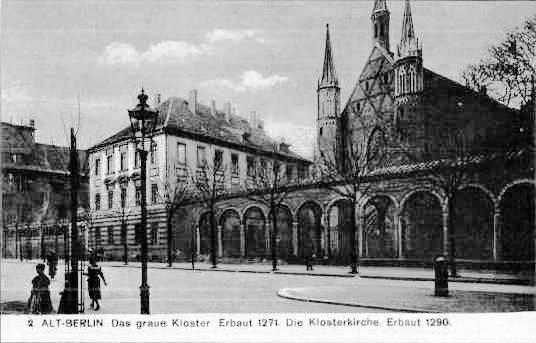
Franziskaner-Klosterkirche: The monastery was also called Graues Kloster (The Gray Monastery) and was in use even after the reformation and used as a school. This is from a postcard around 1910.

On the run, the knight turned monk broke his leg and kept walking with a limp. From then on everyone called Roderich the limping monk, and he was not a popular one. 

Because of his injury and his unfortunate circumstances isolated in the monastery, Roderich grew bitter over the long years. He didn’t get along with the other monks either and paid two criminals to murder one of the other monks in the monastery. He blamed the murder on some Knights Templar who ended up being executed for it. 

The Murderous Monk in Franziskaner-Klosterkirche

Another monk was sent to the Franziskaner-Klosterkirche called Bernhard. He entered because of the grief he had of his miserable love that turned out badly. He loved and wanted to marry a woman, but as the cruel fate would have it, it turned out she was his sister, and he was unable to go on outside of the monastery. 

Read More: Check out all of the ghost stories from Haunted Monasteries

Bernhard was a skeptical person though and had his own theory of the murder of the monk Roderich had killed in Franziskaner-Klosterkirche. When Bernard met Roderich he told him that he didn’t believe that the Knights Templar was behind the murder of their fellow monk brother. 

This was the nail in the coffin for Bernhard and Roderich locked him up in a dark cellar of the monastery to cover his crime when he was found out, ending up killing him so he wouldn’t spill his secret. 

The Ultimate Sin

While this is going on, the two criminals Roderich hired came clean and confessed to what really happened when they murdered the monk and it was in fact Roderich that was behind it all. The anger and rage against Roderich grew and an angry mob stormed the monastery, searching for Roderich to put things right. 

The angry mob found him kneeling in the cellar next to the dead body of Bernhard. After he had killed Bernhard, Roderich went through Bernhards stuff and found a letter from Bernard’s mother. This was a woman who Roderich knew intimately and it was Roderich’s former lover telling him that Roderich in fact was the father of Bernhard. 

Overcome with grief and regret he confessed at once and was killed on the spot without a trial. 

Since then, Roderich has been haunting the Franziskaner-Klosterkirche, even after it all turned to ruins. He can be heard wailing in the night from the outside of the monastery, unable to atone for his sins of killing his own son in cold blood to cover his own tracks. 

More like this

Newest Posts

References

Franziskanerkloster in Berlin: Ruine ist Schauplatz einer düsteren Legende

The Devil’s Monastery in Carmona

Advertisements

The ruins of Huerta de San José Monastery in Carmona, Seville were once thought to be haunted by demons and the devil himself. After a horrible tragedy that ended in the death of all the monks, the place has been known as The Devil’s Monastery or the Monastery from Hell. 

Spain is famous for its haunted history and tales of angels and demons. With its rich history and diverse culture, there are many places that are said to be haunted. In Carmona in Seville, Spain there is the ruins of a monastery that is said to be cursed by the devil himself. 

Read more: Check out all of our ghost stories from Spain

The church known as The Devil’s Monastery is known for the mysterious and spooky presence of a ghost, who is rumored to have been lingering there for centuries. The stories surrounding this The Devil’s Monastery are fascinating and are sure to give you chills down your spine. In this blog post, we will explore the history of the haunted church in Spain and the ghost that haunts it.

The Monastery from Hell

Huerta de San José Monastery, belonged to the religious order of the Carmelites of Saint Joseph. The cloister dates back to the 17th century but was never completed. The building close to the small and sleepy village was only used for a couple of decades before a horrible tragedy befell the monastery. 

Read more: Check out all of our stories from Haunted Monasteries and Churches from all around the world.

A group of Franciscan-Dominican friars came to the hilltop to build their monastery to both be a convent as well as a boarding school for the locals. Here they would serve the words of their lord in peace. But the fact was that their dream about Huerta de San José Monastery would never be true and the convent would never be remembered as the place of god, but The Devil’s Monastery.

In 1680, Don Jaime Malvidas joined the convent as a new monk. According to the documents that were made from the case about the Huerta de San José Monastery at the time, Maldives woke up in the morning and found out his door was bolted from the outside.

The fact that the door was locked wasn’t an unusual thing, as the Dominican monks had a habit of locking themselves in after Vespers before opening the doors in the morning. But this time, there was no one there to open it. 

He tried to meditate as he waited for morning, but the sound of steps outside made him curious. They stopped right outside and the door was opened with a bang. But when he looked outside, he found no one. 

He thought maybe he was late for mass and hurried toward the chapel they were building. But there was no one. The only thing he heard was a wailing he almost thought came from himself. He started to investigate and went down into the basement. There he found all of the friars hanging from hooks, all dead. 

And according to his testimony he also said this:  I, gentlemen, upon seeing that infernal and bloody setting, began to see some small beings, who crowded around the dead bodies, ate their meat.

A fire broke out in now The Devil’s Monastery, and the monk ran out screaming that Satan was here. Some say that the monk really did meet the devil in the basement and left him alive to tell the world about his arrival. No one believed him and he was arrested after reporting it all to the authorities.

Satan Appearing in Huerta de San José Monastery

The next day the locals approached the burnt The Devil’s Monastery with crosses and bibles burying the dead monks. As they did it was as the sky darkened and what seemed like the face of Satan himself appeared between two columns of Huerta de San José Monastery.

Carmona City: The entire city had to live with the after effects of the cursed monastery. For years the city tried to repent for what happened that night in the convent.

They entered the building with their protection, but it was all for nothing as Satan was watching from the bell tower. He threw them around “like dolls” according to the documents. but an earthquake forced them out and further damaged the building. 
Huerta de San José Monastery was purged with salt and the whole city had two years of masses to absolve them from the evil they had encountered those days. 

Read more: Have a look at the story about Haunting in Hardtkapelle Wielenbach where the devil also is said to have appeared. 

In the ruins of what is left of the The Devil’s Monastery, it is said the souls of the murdered monks are still trapped inside and haunt the place, all the documents signed by the Archbishop of Jerez. 

The Ghost of The Devil’s Monastery

People that have visited the ruins of The Devil’s Monastery claim to have heard whispers and ghostly silhouettes of the monks. Gregorian voices and chants have been heard as well as strange lights floating around the place. 

Today the ruins of Huerta de San José Monastery is abandoned except for those wandering in the outskirts of the nearby village or the nightly ghost tours they have to try to catch a glimpse of the murdered monks trapped forever where they died. 

More like this

Newest Posts

References:

El misterio del ‘Monasterio del Diablo’

Monasterio Huerta de San José – Carmona

Huerta de San José monastery, Carmona, Spain, December 2017 | Derelict Places – Urban Exploring Forum

Abandoned Devil’s Monastery, Seville, Spain

Ten paranormal places that you can actually visit in Spain

The Chanting Monks Haunting La Boquería Market

Advertisements

Every year it is said that a procession of ghost monks are haunting La Boquería market in Barcelona. They are still mad about how the monks that lived in the monastery that were there behaved, and the story is that it ended bloody. 

The thought of a haunted place is enough to make many people shiver. Some people love nothing more than to explore the creepy corners of spooky locations, while others run the other way. But what happens when a church is haunted? In Spain, there is a former monastery that has been the subject of many spine-chilling stories. The haunted church is known for the ghost that is said to be lingering there. Are these stories true or just a legend?

Read more: Check out all of our ghost stories from Spain

Right by the bustling La Rambla in Barcelona there is a famous food market called La Boquería or The Mercat de Sant Josep de la Boqueria. Fresh vegetables, traditional food, al within the enclosed marked that has become a staple of Barcelona landmarks now. But there used to be a time were it was a place of worship, and ended with a visit from the devil himself.

La Boquería Marked: Today the place is a bustling marked for food and no one really pays any attention to the haunted legends about this place. But it is said that every year a procession of ghost monks wanders and chants after the devil himself made an appearance in the monastery that used to be there.

The first mention of the La Boquería is from 1217 when a few tables were put up by the old city gate to sell meat. Until the 1800s the market wasn’t officially recognized and not enclosed as it is today. It was simply growing and spreading until the city decided to make a roof over the stalls and recognize it as a proper marked. 

La Boquería market was built on top of an old monastery built by the Carmelites Descalços in 1586. There was a time in Barcelona filled with riots towards the monesteries and churches and it is from this place the ghost story takes place. 

The Broken Traditions in the Monastery

The haunting incident happened in 1835 and according to the stories the monks had become too relaxed in their ways of worship. Their whole tradition was built on prayer and celebrating their patrons and weren’t even praying on the date of their patron saint Our Lady of Carmen. 

Read more: Check out all of our stories from Haunted Monasteries and Churches from all around the world.

There was only one monk who cared about their lacking ways and spoke up about it to the higher ups. But the convent prior didn’t care about the young monks’ warnings and the monks relaxed ways continued until the warnings came back to haunt them. 

According to legend the place became haunted when a group of dead friars suddenly appeared to the brothers of the convents, singing to them, perhaps cursing them, perhaps warning them about their oncoming demise?

The Chanting Skeleton Monks

One night the monks in the convent woke up by the chanting and went to the church where the sound came from. They found a choir of skeletal monks singing a sinister psalm, one more sinister than the other to the monks of the monastery. The skeleton monks chanting to them were all dead brothers of the order that used to live in the convent.

The living monks waited in terrified silence until the singing was over before they lit up the candles and led the ghosts back to their tombs in the convent cemetery. The tombs of the skeleton monks were already open and didn’t close before the chanting skeleton monks returned from their nightly choir session.

The Murder of the Monks

Why did the ghost monks appear to them? What did they want, chanting sinister psalms to their living brothers? There are several stories about what happened, and they all ended in fire and blood.  

One version of the legend is that the monks returned to where the choir had been singing and found the young monk that had complained about the lack of prayer dead. Why he died and by what means was never found out. There is also a version that tells that he was the only survivor of his brothers. Because what happened next was a bloodbath.

The Chanting Monks: Only one monk is said to have spoken up about not honoring their traditions and responsibilities as monks. The monks were all murdered in a riot after he warned them in the place were the La Boquería market today is.

Because, ten days after the apparition of the ghostly friars chanting their ghost songs, the monastery was attacked and burnt to the ground in the riots and the monks that lived there were all killed. It was because of riots that happened against religious buildings at the time and the day was remembered as Burning of the Convent

There is a really complex and long history of why the convents were attacked. Barcelona was in a state of unrest, and a riot were culminating under the lid, only waiting for a chance to blow up.

The riots started after an especially bad bullfight in El Torrin which was a bullring in Barcelona not too far from La Boquería market. The angry people watching the bullfight turned into a mob and started rioting, dragging decapitated heads of the bulls around the city and set fire to churches. And the convent were La Boquería is now standing was dragged into the mess.  

The Chanting Annual Ghosts at La Boquería

After the destruction of the convent the city of Barcelona decided to expand on the La Boquería market to fill the empty void the convent left. The blood bath was soon forgotten, and people returned to discuss meat and vegetable prices across the stalls, not vague talk about ghost monks and the devil appearing… at least for most of the year. 

According to legend the monks come back every year to haunt the La Boquería marked on the place were the monastery was. On the day the monastery was burned, July 25th, you can still hear the ghostly voices of the monks singing through the whole market. 

There are also those that say that the singing on La Boquería market happens on July the 15th on Our Lady of Carmen’s Eve. 

More like this

Newest Posts

References:

The Gothic Arch of Sant Adrià: Gateway to Barcelona

History of the Boqueria | Market of the Ramblas of Barcelona

La Boqueria – Wikipedia

13 Barcelona Haunted Houses & Places that will creep you out

Haunted and Mysterious Places in Barcelona | 19 Local Legends

Halloween: Spain’s most haunted places – The Local

Visiting Spain’s Most Haunted Locations | Right Casa Estates