Tag Archives: Massachusetts

The Haunting Legacy of the Salem Witch Trials: Gallows Hill and Old Burying Point

Advertisements

Most people know about the Salem witch trials and the horror of the hunt. No wonder that haunted rumors about the place have formed in the aftermath of the trials and death. 

Along the northeastern shores of Massachusetts, the town of Salem is forever etched into the annals of American history as the site of one of the most infamous chapters of colonial-era terror: the Salem Witch Trials. This dark period in 1692 saw hysteria grip the Puritan settlement, leading to the tragic execution of innocent men and women accused of witchcraft. 

Read More: Check out all ghost stories from USA

Today, Salem is most known for this tragic ordeal. Places like The Haunted House of The Seven Gables in Salem is perhaps the most famous building in the town which inspired Nathaniel Hawthorn to write his novel. But the ghostly echoes of those who died are said to linger elsewhere in town, particularly at Gallows Hill and Old Burying Point, where the spirits of the accused are said to still roam.

Salem Witch Trials: The witch trials were a product of mass hysteria. But also the following interest, representation and stories about the trial has been somewhat fanciful. Representation of the Salem witch trials, lithograph from 1892.

The Historical Tapestry of Salem

Founded in 1626, Salem was initially a thriving Puritan settlement, built on religious conviction and a stringent moral code. Its early prosperity stemmed from a bustling port and a community tightly knit by shared beliefs. However, the seeds of paranoia and superstition were sown deeply within its society, setting the stage for one of the most notorious episodes in American history.

Read more: Check out all ghost stories related to witches and witch trials

By the late 17th century, tensions in Salem were running high. A combination of religious fanaticism, political instability, and a harsh frontier environment led to an atmosphere ripe for fear and suspicion. In this climate, the Salem Witch Trials erupted—a stark reminder of the dangers of mass hysteria and the consequences of unchecked fear.

The Witch Trials: A Tragic Descent into Madness

The Salem Witch Trials began in the spring of 1692 when a group of young girls in the town claimed to be possessed by the devil, accusing several local women of witchcraft. What followed was a frenzy of accusations, leading to the arrest of more than 200 people. By the time the hysteria subsided in 1693, 19 men and women had been executed by hanging, one man had been pressed to death, and several others had died in jail.

The Young Girls: The witch hunt started with Betty Parris (9), Abigail Williams (11), Ann Putnam Jr. (12), and Elizabeth Hubbard (17). The accusations centered around the concept of “affliction”, and the women accused of having caused physical and mental harm to the girls through witchcraft.

The Salem Witch Trials were fueled by a combination of fear, religious extremism, and the desire for social control. The accused were often those who stood out in the community—women who defied traditional roles, outcasts, or those who held properties that others coveted. The panic and cruelty that characterized this period left an indelible mark on Salem’s history, one that continues to resonate today.

Gallows Hill: The Site of Execution

“This was the field where superstition won her darkest triumph […] the high place where our fathers set up their shame, to the mournful gaze of generations far remote. The dust of martyrs was beneath our feet. We stood on Gallows Hill.”
Nathaniel Hawthorne, Alice Doane’s Appeal, 1835

Gallows Hill at the intersection of Manswell Parkway and Witch Hill Road was the site where the accused were believed to have been executed for centuries, according to local lore hanged from locust trees. They believed this was the spot much because historian Charles Wentworth Upham said so in 1867, although there were murmurs about that the place was not the correct one. According to legends, the ancestors of those involved in the Salem Witch Trials went to Gallows Hill and revealed the location for the dead to those who came after them. The writer Nathanial Hawtorn was one of them, being the many times great-grandson of Judge John Hathorn, the man responsible for sentencing the victims to the gallows for witchcraft. But how much of this local lore was actually true?

Salem, from the lookout on Witches’ Hill

Nevertheless the Gallows Hill and the area around has long been shrouded in mystery and legend. Screaming is said to come from the wooded area that surrounds the hill. The specter of a lady in white is said to appear in the night. 

According to the locals, they say that this place is a common spot for suicides as well. Paranormal researchers have long thought this fuels the other. The sadness of the area draws souls to it, and creates this haunted aura of the place. In October in 1992, there were almost 200 people from nearby churches gathered to “cleanse” the dark energy from the hill. Did they manage it?

Proctors Ledge: The Actual Location for the Executions

However, in 2016, it was proved that the exact place was Proctors Ledge, named after the victims John Proctor and his wife who died in the Salem Witch Trials. Proctor doubted the accusation of the girls and even proclaimed that any Devil in Salem was within the accusers – not the accused.

This exact place is a ledge on a small hill between Proctor Street and Pope Street in Salem, overlooking a Walgreens in a residential area. It got a memorial placed there in 2017. 

They were also said to have been hanged, not by locust trees, but on traditional gallows. 

Execution of Reverend George Burroughs: On August 19, 1692, Martha Carrier, George Jacobs Sr., George Burroughs, John Willard, and John Proctor were executed. Elizabeth Proctor was given a temporary stay of execution because she was pregnant.

The ghost tours and visitors have now started to accept the fact that this was the place and now direct their haunted focus on Proctor’s Ledge, which now starts to have the same haunted legends about the woman in white appearing to visitors, the disembodied voices and orbs floating around them. One thing about Proctor’s Ledge is that many believe that it also acted as a temporary burial ground for the victims before they were discreetly moved for a proper burial by their family members. So even if their bodies are no longer there, could their spirits be?

Proctors Ledge: Much more discreet than other memorial places, the actual location of the Salem Witch Trials was most likely here at Proctors Ledge. Wally Gobetz/Flickr

Old Burying Point: The Resting Place of the Accused

The Old Burying Point Cemetery, also known as Charter Street Cemetery, is one of the oldest cemeteries in the United States, dating back to 1683. Buried there are even passengers from the Mayflower. It is also the final resting place for many of Salem’s notable figures, including some of the judges involved in the Salem Witch Trials. 

The graveyard is said to have the spirits from the accused from the witch trials as well. But is this true? Is this the final resting place for the victims of the witch hunt? The short answer is, we simply don’t know for sure. While none of the accused witches were officially buried here and many were interred in unmarked graves or simply discarded according to lore. 

Now, is this part true? The same answer applies. After the hanging, there was a lot happening. Some say that the victims’ families discreetly took the hanged victims and moved them away to give them the proper Christian burial they were denied. Did they manage to sneak them into this graveyard as their final resting place? No matter what the truth is, the cemetery is still steeped in spectral lore.

Legend has it that the spirits of the accused roam the cemetery, seeking justice and acknowledgment for the wrongs done to them. Visitors to Old Burying Point often speak of ghostly apparitions, strange lights, and the sensation of an otherworldly presence. The cemetery, with its weathered tombstones and ancient trees, exudes an atmosphere of haunting beauty and melancholy.

At the graveyard, the same story of a ghost of a woman in white is said to haunt as well. A specter of one of the accused and murdered woman haunting her grave? Attracted to the final resting place to the people who sentenced her to death? 

The Ghost of the Judge Condemning the Salem Witches

Another one said to haunt this place is the ghost of Judge John Hathorne. He was asked to lead the trials and was harsh when questioning them all, convinced they were witches and in league with the devil. Among the locals he was known as the “hanging judge”, because of his tendency to send the accused to the gallows and abuse his power for his own gain. 

At the Salem Witch Trials he accused seven months pregnant Sarah Proctor of being a witch, sending her to jail where her baby died a few days after being born. He sentenced her to death, leaving her 4 year old daughter an orphan. Before she died, local lore say that she cursed the Reverend Nicholas Noyes presiding over her execution. “You are a liar. I am no more a witch than you are a wizard, and if you take away my life, God will give you blood to drink,”

Examination of a Witch: Painted in 1853 by T. H. Matteson, inspired by the Salem witch trials

Although falsely accused, one can almost wonder if the words uttered by Sarah Good ringed true for many of the ones in charge of her trial, as many of them are said to have died horrible deaths, like the Reverend who died of a hemorrhage that brought blood to his mouth. And the case with Judge Hathorn, who is said to have lingered in the world as a ghost.

His ghost is said to haunt the Old Burying Point Cemetery as well as the Witch House close by, made with the intention to keep witches and other paranormal creatures at bay. It used to belong to his friend, Jonathan Corwin. One can wonder how a ghost could step into a house like that, proving that the measures made to keep them out didn’t really work. 

Honoring the Accused: A Shift in Perspective

In modern times, Salem has transformed its legacy from one of persecution to one of remembrance and education. The city now honors the memory of the accused witches, emphasizing their innocence and the tragedy of their unjust treatment. Each October, during the annual Salem Haunted Happenings festival, thousands flock to the city to remember the victims and reflect on the lessons of the past.

The Salem Witch Trials Memorial, located near Old Burying Point, serves as a poignant tribute to the 20 individuals who lost their lives. The memorial features 20 stone benches, each inscribed with the name of an accused person and the method of their execution, symbolizing the enduring need to remember and honor their stories.

The Enduring Haunt of Salem and the Witch Trials

The haunting legends of Gallows Hill and Old Burying Point serve as stark reminders of the horrors of the Salem Witch Trials. The echoes of the past are palpable in these hallowed grounds, where the spirits of the accused are said to linger, a testament to the enduring impact of fear, injustice, and human suffering. Today, Salem stands not only as a historical site but also as a beacon of reflection, ensuring that the lessons of the past continue to resonate with future generations.

More like this

Newest Posts

References:

Gallows Hill in Salem, Mass – History of Massachusetts Blog 

The Ghosts of Proctor’s Ledge in Salem Massachusetts 

The Ghosts of Gallows Hill in Salem Massachusetts 

The Haunted Freetown State Forest and the Bridgewater Triangle

Advertisements

Sometimes you can tell which dark trees are covered in darkness, and the haunting that follows. The Haunted forest of Freetown State Forest in Massachusetts is one example said to be in the mysterious Bridgewater Triangle, where the area seems to have attracted much evil throughout the years and lingers within the trees.

Behind the picturesque scenes of Massachusetts’ Freetown State Forest lurks a haunting history steeped in murder, fear, and the ominous presence of the paranormal outside of the Hockomock Swamp. The natives named it as a place where the spirits dwell, and the early settlers named it the Devils Swamp. 

Being a part of the infamous Bridgewater Triangle, this seemingly serene forest conceals a dark reputation, earning it the chilling moniker of the Cursed Forest of Massachusetts of alleged paranormal phenomena, ranging from UFOs to poltergeists, and other spectral phenomena, various bigfoot-like sightings, giant snakes and thunderbirds. 

The Cursed Bridgewater Triangle

Part of the legendary Bridgewater Triangle, Freetown State Forest stands as a magnet for the weird and horrifying lingering inside of the 5000 acres forest. Amidst its shady paths and sunlit clearings, people seem to think that the very forest emits a dark energy that creates more darkness. 

The Bridgewater Triangle is an area of about 200 square miles in southeastern Massachusetts. First described in the 1970s by cryptozoologist, Loren Coleman in his book, Mysterious America. 

Read more: One of the more famous spots in the Bridgewater Triangle is perhaps the Lizzie Borden House where a horrible murder was committed and only paranormal forces lingered. 

The Bridgewater Triangle is known for hosting an array of spooky sightings, from Bigfoot, Thunderbird to UFOs to ghosts to satanic cults and old Native American monsters and ghost stories. The history of this haunted expanse is more than mere speculation—it is a documented tapestry of tragedies and crimes that contribute to the ominous allure of the Freetown State Forest.

The Haunted Forest of Massachusetts Of Freetown State Forest Murders

On a cold November in 1978, the dead body of Mary Lou Arruda was found inside of the woods. She was a 15 year old cheerleader that had been kidnapped from Raynham town two months ago when she was riding her bike through the Freetown State Forest, only two days after her birthday. She was found tied to one of the trees. Dead. 

An autopsy revealed that she had either died from strangulation or asphyxia. In addition, it was uncovered that Arruda was alive when she was tied to the tree and that she had died the same day she had been abducted. Medical examiners believe that she died when she became unconscious from a ligature around her neck. Ultimately, this caused her to suffocate.

Mary Lou Arruda: 15 year old Mary Lou Arruda is only one of the victims the forest has claimed. Her death was much written about and her case certainly tainted the forest reputation in modern times.

The suspicion soon fell on James M. Kater when a composite sketch was created with the help of an eyewitness. Kater worked at a local donut store at the time of the killing and had previously been convicted for kidnapping. According to him he had gotten married and left on a honeymoon abroad the day after Arruda went missing. 

Afterwards, due to the endless efforts of local police and eyewitnesses, he was linked to the crime using multiple pieces of evidence, the most important one being tire tracks found near Arruda’s cycles which matched the unusual patterns made by his car tires. 

Kater was found guilty in 1978 and 1986, but both convictions were overturned on appeal due to hypnotized witness evidence. The 1992 trial resulted in a mistrial, which was followed by another one in 1996, when he was ultimately found guilty and sentenced to life in prison.

Despite efforts by local police and eyewitnesses, Kater’s initial convictions in 1978 and 1986 were overturned on appeal, primarily due to evidence presented by hypnotized witnesses. 

The case went through multiple trials, with the 1992 trial resulting in a mistrial. Another trial in 1996 ultimately found Kater guilty, and he was sentenced to life in prison. The crucial piece of evidence linking him to the crime was tire tracks found near Arruda’s bicycle, which matched the distinct patterns made by Kater’s car tires. The complex legal proceedings and the use of witness testimony under hypnosis added layers of intricacy to a case that sought justice for the tragic fate of Mary Lou Arruda.

Satanic Cult Activity and Satanic Panic in the 80s

The murder of Arruda was not the last time the Freetown State Forest got tied up in a murder investigation. In 1980, police investigating a murder near the forest were confronted with reports of Satanic cult activity during the fear and Satanic Panic years of the 1980s and 90s. 

Locals spoke of witnessing eerie rituals in the woods, possibly linked to the infamous “Fall River Cult Killings” that was going on simultaneously taking the life of Doreen Levesque, Barbara Raposa and Karen Marsden. 

Stained clearings, marked with animal blood, fueled rumors of ritual sacrifice within the haunted woods, amplifying the forest’s already ominous reputation.

Its connection to satanism didn’t stop there though and especially animal mutilation have been reported, most notably in 1998 when the police investigated a case of mutilated animals believed to be the work of a cult. One was of a butchered cow found in the forest, and the other was a group of mutilated calves in a clearing of the Freetown State Forest. 

Assaults and Mysterious Incidents Throughout the Years

So what is really going on inside of this forest? Freetown State Forest’s sinister legacy extends to multiple murders, assaults, and bizarre occurrences along the forest and at its paths. From the mistaken killing of a homeless man in 1987 when someone thought he was an undercover cop. 

There was also the discovery of gunshot-riddled bodies on Bell Rock Road in 2001, the forest bears witness to a series of dark events. Reports of aggressive dogs, an escaped emu, and wires strategically placed to harm visitors underscore the unsettling atmosphere that pervades the woods.

In 2006 there were aggressive dogs running wild in the area and in May in 2016 they found wires along paths that many people frequented. The purpose of these wires was most likely to decapitate off-road bikers when they came driving. 

But there are also more ancient and more supernatural forces at play if we are to believe the local legends that came to be much earlier than the country itself. 

Supernatural Forces at Play in Freetown State Forest

The paranormal veil hanging over Freetown State Forest thickens with tales of blood sacrifices, UFO sightings, ghostly apparitions, black helicopters, mysterious orbs of light, and strange disappearances. Legends speak of giant snakes slithering through the shadows, poltergeist activity, and rumored abductions. 

Read More: Check of all stories from Haunted Forests

Even President Ronald Reagan himself reported witnessing unexplained lights in the forest’s sky. Whispers of the forest’s dark influence leading people to suicide circulate, while ancient legends weave the presence of Pukwedgies, humanoid creatures from Wampanoag native tradition, who are said to stalk the haunted woods.

The Native American Curses

Once, this land around Freetown State Forest used to belong to the native Americans that used to go from Cape Cod up to Rhode Island. Even though there still are tribes in the area, their designated living places have diminished extensively after the first European settlers arrived. 

Some of the local legends of the land is that it is a Native American curse over it. One of the legends is about a lost object that is still missing. Once, the wampum belt, a traditional shell bead of  the Eastern Woodland Tribes, was lost during the King Philip’s War from 1675-76 between the European settlers and the local tribes. 

“Philip’s belt, curiously woven of wampum nine inches broad in black and white figures and flowers, and many pictures of birds and bears. This when hung upon Captain Church’s shoulders it reached to his ankles. And another belt of wampum he presented to him wrought after the former manner, which Philip was wont to put upon his head. It had two flags on the back part which hung down his back, and another small belt with a star upon the end of it, while he used to hang upon his breast.”

Metacom (c. 1638–1676), was Massatoit younger son who is also a part of the haunted Freetown State Forest history, became tribal chief in 1662 after Massasoit’s death. He had taken the name Philip and led the war that was one of the bloodiest wars in Colonial American history. After his loss and his death, more than 1000 colonists and 3000 natives had died. Half of the New England’s towns were destroyed and hundreds of the Natives were enslaved and sent to Spain, Portugal, Jamaica and Barbados.

After the war, the belt was lost, something that was often used as a token of identity as well as currency in the early decades of colonization. 

In addition to causing a ruckus and a bad energy in the Freetown State Forest there is also a cave said to belong to King Philip as one of his hiding places. People claim to have seen strange lights known as spook lights inside it, especially around Anawan Rock. Phantoms fires, things that look like campfires are also known to have appeared in the distance, however when coming close to them, they disappear. People also claim to hear the sound of drums that are now known as phantom drums. 

The Pukwudgies Roaming in the Freetown State Forest

Another thing said to haunt Freetown State Forest is the monster from the Wampanoag native tribe known as the Pukwudgie. Translated to English often as “little wild man of the woods that vanishes.”

It is said to be a human-like creature about three feet tall that lives in parts of Indiana, Delaware and Massachusetts. Often seen as little people or tricksters of the Algonquian folklore.

According to folklore, Pukwudgies possess the ability to manifest and vanish at their discretion, adeptly shapeshifting into various forms—a common depiction involves a creature resembling a porcupine from the rear and a half-troll, half-human from the front, walking upright. These mystical beings are attributed with luring individuals to their demise, employing magical arts, launching toxic arrows, and wielding control over fire.

In Native American beliefs, Pukwudgies were initially benevolent towards humans but eventually turned antagonistic, warranting caution and distance. Legend has it that those who irked a Pukwudgie faced reprisals in the form of malicious pranks or relentless pursuit, leading to various troubles. 

Their menacing activities include kidnapping, pushing victims off cliffs, employing short knives and spears in attacks, and using sand to blind their targets.

The Ghost sitting on Profile Rock

There is also a big rock inside of the Freetown State Forest the local legends claim depicts the Wampanoag Chief Massasoit who was known to have a long standing alliance with the colonists. The 50 foot granite rock is also sometimes known as Old Man of Joshua Mountain, taking its name from Joshua Tisdale, a settler that once claimed to own the land. 

The true origin of the rock though is thought to be the result of dynamite in the mid 1800s. Some also claim that the son of Chief Massasoit Sachem, King Philip, spent the last night of his life under this rock.  

Some claim that the ghost of the Chief Massasoit Sache has been seen sitting cross legged with his arms stretched out toward something. Almost as if he is blessing his surroundings, or perhaps even cursing it. 

In recent years the attraction inside of Freetown State Forest has been severely damaged by both graffiti and incidents where portions of the rock have fallen off, and it is almost unrecognizable. The park issued people to stay away from the area. 

The Ghost at Assonet Ledge

The Assonet Ledge is another landmark found in the Freetown State Forest and people think that it’s a haunted place as well. The place is a high rock looking over the dark pond underneath. Many say they have seen the spirit of a native person among the trees as well as mysterious lights and phantom fires. Some even believe that the granite stone is cursed. Allegedly it was one of the victims of the war against the Puritans in the 17th century. 

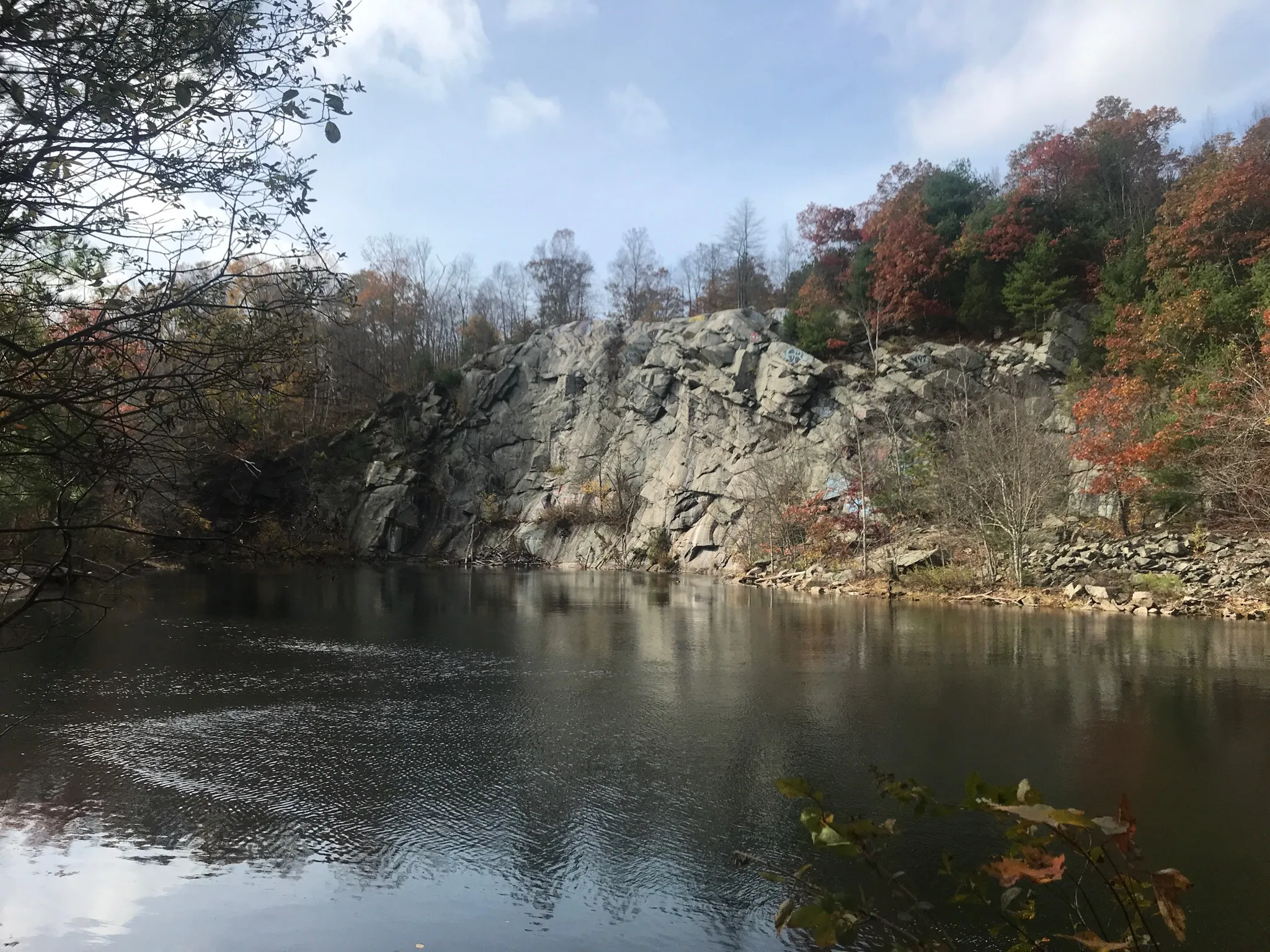
Assonet Ledge: According to the legends, this ledge as well as the waters below is haunted by the many that ended their life jumping off the cliff.

According to the legend, several of the native warriors chose to jump off the cliff rather than die by the hands of the English. One thing though, it is also said that both the ledge as well as the pond underneath didn’t exist in the 17th century.

Another ghost story associated with this place inside of Freetown State Forest is about the lady of the ledge, a young girl who regularly met up with her boyfriend at the ledge. Their parents didn’t approve of their relationships, so it was both risky as well as futile to pursue their love. In some variations of the legend it is the story about a native american princess and a white man. Then one day he suddenly stopped coming. After being left, she threw herself off the ledge and died. Although her spirit remained. 

Many have claimed to have seen her ghost wandering on top of the ledge, some even see her jumping off the cliff and disappearing as she hits the water without a splash. 

One of the creepiest parts of this legend though, are all of the people that have been standing at the edge with an urge to jump, even though they were far form suicidal before coming. In 2004 a man even did the leap in front of his friends and girlfriend, even though his family claimed he had no history of mental illness. 

A Walk Through the Haunted Freetown State Forest

As the moon ascends high in the night sky, casting an eerie glow over the Freetown State Forest, the shadowy woods come alive with whispers of the past. Among the rustling leaves and foreboding silence, the spirits of the departed seem to beckon from the darkness, their spectral presence palpable in the chilling air.

As the brave souls who dare to venture through this haunted realm tread cautiously, an inexplicable sense of unease settles upon them. Wisps of fog weave through the gnarled trees, and the distant sound of phantom drums echoes through the desolate expanse. Amidst the oppressive stillness in Freetown State Forest, the legends and tragedies of the forest converge, intertwining with the present in a spectral dance.

More like this

Newest Posts

References:

NEW ENGLAND FOLKLORE: Ghosts of the Assonet Ledge 

Massasoit – Wikipedia 

The Most Haunted Forest in America: Massachusetts’ Eerie Freetown Fall River State Forest 

The Most Haunted Forest In America Is Right Here In Massachusetts 

Bridgewater Triangle – Wikipedia 

https://eu.patriotledger.com/picture-gallery/entertainment/2020/10/28/enter-the-bridgewater-triangle-if/581946007/

What happened to Mary-Lou Arruda’s killer James Kater? Details explored ahead of Killer Cheer on ID 

Disturbing Details Found In Mary Lou Arruda’s Autopsy 

Profile Rock – Wikipedia 

https://en.wikipedia.org/wiki/Pukwudgie

Bridgewater Triangle – Wikipedia 

https://en.wikipedia.org/wiki/Fall_River_murders

https://eu.heraldnews.com/story/news/courts/2022/11/15/robin-murphy-convicted-in-fall-river-cult-murders-denied-parole-satanic-carl-drew/69646239007/

https://www.findagrave.com/memorial/90782637/mary-lou-arruda

The Red-Headed Hitchhiker on the Rehoboth-Seekonk Line

Advertisements

The vanishing hitchhiker comes in all shapes and sizes as well as throughout all different religions and cultures. This is also the case with the so-called Red-headed hitchhiker from the Bridgewater Triangle that is said to haunt the Rehoboth-Seekink Line. 

Venturing into the heart of the Bridgewater Triangle in New England by Rehoboth Massachusetts, where folklore intertwines with reality, one encounters a tale that surpasses the ordinary bounds of the supernatural—the legend of the red-headed hitchhiker along Route 44 in Massachusetts. As the sun sets on Route 44 along the Rehoboth-Seekonk line, an unsettling encounter may await those who traverse the darkened road. 

Described as an figure with fiery red hair, clad in red flannel and blue jeans, this spectral hitchhiker is said to emerge with his thumb outstretched, seeking a ride into the unknown.

Route 44 is a patch of road in New England in the USA where the modern world is constantly reminded of its past on this highway. People believe this ghost to be someone that died on these roads, but have been unable to find the origin story of it all and who this ghost is supposed to be is a big mystery to all. 

The Mysterious Hitchhiker

The narrative surrounding the red-headed hitchhiker takes on various forms. Some claim to have seen him on the side of the road, while others speak of an eerie reflection on windshields, a phantom presence that materializes in the shadows. Despite the lack of a known origin story, the mystique surrounding this spectral figure has woven itself into the fabric of local legend.

It is said that he only gets in the back seat, even if it is only the driver there, looking perhaps around 40 to his early 50s and normal looking enough to stop and ask him for a lift. If you ask him about where he is headed, he doesn’t give any response. He only points down to the direction of where the driver is headed anyway. 

After a while The Red-Headed Hitchhiker starts to giggle, soon sounding maniacal and uncontrollable, piercing the ears of the driver. When the driver gets fed up with this and threatens to drop the hitchhiker off on the side of the road, the hitchhiker disappears without a trace except from emotionally scarring the people in the car. 

Description of the Apparition

Eyewitness accounts converge on a vivid depiction of the red-headed hitchhiker—a man with striking red hair that is said to be long with a big bushy red hair, his attire a haunting ensemble of red flannel shirt and dirty blue jeans. 

His spectral form appears, thumb extended mostly although not always for his hitchhiking adventures, beckoning to those who pass by. Whether glimpsed on the roadside or as a ghostly reflection in the windshield, the hitchhiker’s presence is undeniably unsettling with his harrowing dark, empty and soulless eyes.

The Haunted Bridgewater Triangle

But what really is the Bridgewater Triangle that seems to hold so many legends, like the one of the The Red-Headed Hitchhiker haunting the roads?

The Bridgewater Triangle is an area of about 200 square miles in southeastern Massachusetts. First described in the 1970s by cryptozoologist, Loren Coleman in his book, Mysterious America. 

Read more: One of the more famous spots in the Bridgewater Triangle is perhaps the Lizzie Borden House where a horrible murder was committed and only paranormal forces lingered. 

The Bridgewater Triangle is known for hosting an array of spooky sightings, from Bigfoot, Thunderbird to UFOs to ghosts to satanic cults and old Native American monsters and ghost stories. The history of this haunted expanse is more than mere speculation—it is a documented tapestry of tragedies and crimes that contribute to the ominous allure of the Cursed Forest.

Unlike many legends within the Bridgewater Triangle, the red-headed hitchhiker lacks a discernible origin story. Local legend trippers, those intrepid seekers of the supernatural, confess to never stumbling upon a first-hand account. The absence of a concrete beginning only adds to the chilling aura that surrounds this spectral hitchhiker, leaving the curious traveler with more questions than answers.

The legend was made famous by the book, The New England Ghost Files written by Charles Turek Robinson.

Tales of The Red-Headed Hitchhiker

Throughout the years, many have laid claims to have seen The Red-Headed Hitchhiker’s ghost supposedly haunting these roads. 

One driver recalls the hitchhiker moving right alongside his fast moving car. Another picked him up only to have him disappear from his seat. One couple, Harry and Sheena Hanson living in Swansea, talked about how their car broke down around 10 pm and the woman stayed in the car as the man walked to get some help. The man claims he saw him sitting on the side of the road:

“Suddenly, the man’s face got very strange,” Harry remembers. “He stopped grinning, he twisted his mouth, and I noticed that there was something wrong with his eyes. They were all clouded over…no pupils or anything…just (blank) and all white. I began to feel weird and started to walk away from him. As I hurried away, I heard the man laughing. I turned around, but he was no longer there. I mean, I could no longer see him there, but I still heard the laughing, (as though) it was coming from just a few feet away from me. And the laughing kept switching locations. First I heard it in front of me, then behind me, then to the left of me. It was bizarre. I began to run along the highway back toward the car, and, as I did, the laughing followed me for a good two or three hundred feet. It scared the (expletive) out of me. And then, it suddenly stopped.”

The man saw him on the side of the road and tried to talk to him, only to be yelled at before disappearing. The woman heard his laughing voice coming through the radio, taunting her until she ran away from the car crying as she was waiting for her boyfriend. 

People have also tried to call out to the man they see on the road, The man is slowly making his way towards their car, but as he approaches, he slowly gets transparent until he suddenly disappears. 

Journeying into the Unknown

As night descends upon Route 44, casting an inky veil over the Rehoboth-Seekonk line, the red-headed hitchhiker’s legend takes on an eerie life of its own, although no one knows where he comes from. Did he die on these roads?.

Drivers navigating the winding roads may find themselves captivated by an inexplicable sense of foreboding, a subtle whisper in the wind that hints at the possibility of encountering the enigmatic figure with the outstretched thumb.

More like this

Newest Posts

References:

 The Redheaded Hitchhiker of Route 44, Rehoboth, Massachusetts (Haunted Place) 

Red Headed Hitchhiker of Route 44 – Spooky Southcoast 

The Ghostly Tale of the Redheaded Hitchhiker of Route 44 

13 Days of Halloween Tales of Terror: Red-Headed Phantom | Boothbay Register 

The Infamous Haunted Lizzie Borden House

Advertisements

The infamous Lizzie Borden House is said to be one of New England’s most haunted homes after a brutal ax murder happened inside. After the murders, there are tales that ghosts are still haunting it. 

Lizzie Borden took an ax
and gave her mother forty whacks.
When she saw what she had done,
She gave her father forty-one.

Step back in time to the home of one of America’s most notorious unsolved crimes – the Lizzie Borden House on Second Street in Fall River. Experience its creepy atmosphere and listen to its spine-tingling tales as you explore this legendary haunted house full of secrets and the occasional supernatural surprise!

Grab a candle, journey upstairs and learn the history of the infamous New England home. Find out how in 1892 Andrew and Abby Borden were discovered brutally murdered in this very house, passing down stories for generations to come. 

Who was Lizzie Borden?

Lizzie Andrew Borden was born in 1860 in Fall River Massachusetts and was given the name Andrew as well because her father so wanted a son. She grew up in an affluent family in what would later be known as the Lizzie Borden House. Although a rich family, her father was well known for being frugal and they had a complicated relationship to say the least. 

She grew up with her sister, Emma Lenora Borden and was involved in church activities such as Sunday school, the Woman’s Christian Temperance Union as well as the Ladies’ Fruit and Flower Mission.

Two years after her mother died, her father remarried. They didn’t get along and Lizzie believed she had married her father for his wealth. Their live in maid, Sullivan claimed that both Emma and Lizzie rarely ate meals together with their father and stepmother.

Before the murders, tension grew in the family inside of the Lizzie Borden House. Her father kept gifting real estate to her stepmother’s family. Days before the murders the whole family was violently ill, and her stepmother feared poison as her husband was not really a popular man. 

Her father had also killed pigeons in the barn with hatches that Lizzie was upset about. She had built a roost for them and after a family argument, she was even sent away to New Bedford and didn’t return until a week before the murders. 

The Ax Murders in the Borden House

On August 4, 1892, her stepmother and father were found murdered by an ax in their home in broad daylight. When they questioned Lizzie Borden she made answers that were both strange and contradictory. 

The police investigation were later criticized for their lack of diligence as they did not even check her for bloodstains, only search her room superficially and let them stay in the house the following night after the murder. They also had a hatchet they thought could be the murder weapon, but never bothered to take fingerprints even though it was a method the police had started with elsewhere. 

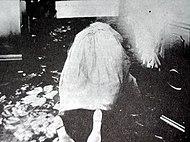
Abby Borden: Lizzie Borden’s stepmother, Abby was found upstairs and had suffered 17 hits on the back of her head.
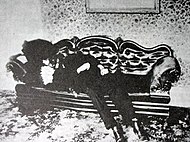
Andrew Borden: Her father, Andrew were found in the couch in the downstair sitting room murdered after being hit 10 or 11 times with a hatchet like weapon.

Lizzie Borden was arrested and put on trial that received a lot of media coverage nationwide. During the trial there was also another ax  murder that looked so similar to the Borden house, and many started to take Lizzie Bordens side and claim her innocence. 

In the end Lizzie Borden was acquitted on all charges and let off after many had come to her defense, including her maid, her sister and neighbors all testified that she never could have done it. 

Life After the Murder Trial

After she was acquitted from the trial of the murders she moved into a house with her sister and they stayed in Fall River. When coming out from the courthouse she said she was ‘The happiest woman in the world.’ 

But for the remainder of her days, she was an outcast in the Fall River society. Even if she by trial was found innocent, the fact that they never found the killer and the strange rumors about her continued and fuelled the idea that she might have done it after all. Even her maid, Sullivan confessed on her death bed allegedly that she had lied on the stand to protect Lizzie Borden. 

No one was ever arrested for the murders, but Lizzie Bordens guilt and motive has ever since been debated without any answers being found. 

The Hauntings in the Lizzie Borden House

After the gruesome murders in the Lizzie Borden House, the house itself has drawn attention to itself of being a haunted house where a lot of paranormal activity is going on. The house is preserved as it was and is hosting tours to continue to speculate what really happened that fateful and hot August day. 

It is said that the ghost of Lizzie Borden’s father and stepmother, Abby and Andrew is haunting the Lizzie Borden House, still trying to get the truth about their murder out. 

One long time guide though has another explanation for the strange sounds many attributes to ghosts. After they put air conditioning in the house, the sound travels in a strange manner as Lizzie Borden House is filled with holes and cracks.  

The Lizzie Borden House: The busy street were the murder happened on 92 Second St, Fall River, MA, the home of Lizzie Borden at the time of the murders as it appeared in 1892.

Another haunting that is said to be going on is the death next door of a mother that murdered her children. A woman named Eliza Darling Borden had three children. She murdered two of them before taking her own life in 1848. One of the theories is that she killed herself in the house that would eventually become Andrew Borden’s in 1872. 

Even Lizzie herself is rumored to haunt the place. It is not only in the Lizzie Borden House she is said to haunt tough as she is also said to haunt the place known as Maplecroft, the home she lived in on French Street after the trial. For what is she haunting the place for though? Is it because of the grief and trauma after the horrible murders that happened. Or is it perhaps guilt as she herself really was the killer?

More like this

Newest Posts

References

Murder in the Well – Lizzie Borden

https://eu.heraldnews.com/story/lifestyle/travel/2021/10/26/lizzie-borden-house-fall-river-best-haunted-hotel-ghost-paranormal/8546497002/

https://lizzie-borden.com/history/

The Haunted House of The Seven Gables in Salem

Advertisements

In the eerie mansion in Salem of The Haunted House of the Seven Gables, also known as the Turner-Ingersoll Mansion, discover what lurks in darkness and uncover secrets behind its perpetual terror.

Step inside The Haunted House of the Seven Gables and explore its halls of perpetual terror and darkness. The house is a 1668 colonial mansion in Salem Massachusetts, a place known for being a place of mystery and witchcraft.  

From ghostly figures roaming the corridors to mysterious tales of hauntings, prepare to discover what lurks in this fascinating haunted house.

“But as for the old structure of our story, its white-oak frame, and its boards, shingles, and crumbling plaster, and even the huge, clustered chimney in the midst, seemed to constitute only the least and meanest part of its reality. So much of mankind’s varied experience had passed there,—so much had been suffered, and something, too, enjoyed,—that the very timbers were oozy, as with the moisture of a heart. It was itself like a great human heart, with a life of its own, and full of rich and sombre reminiscences.”
― Nathaniel Hawthorne, The House of the Seven Gables

Nathaniel Hawthorne’s Novel

The House of the Seven Gables is a real house that was known as The Turner House or the Turner-Ingersoll Mansion before the novel inspired by it came out. The thing that made it famous was the American author Nathaniel Hawthorne when he wrote a gothic novel inspired by the house in the 1850s. 

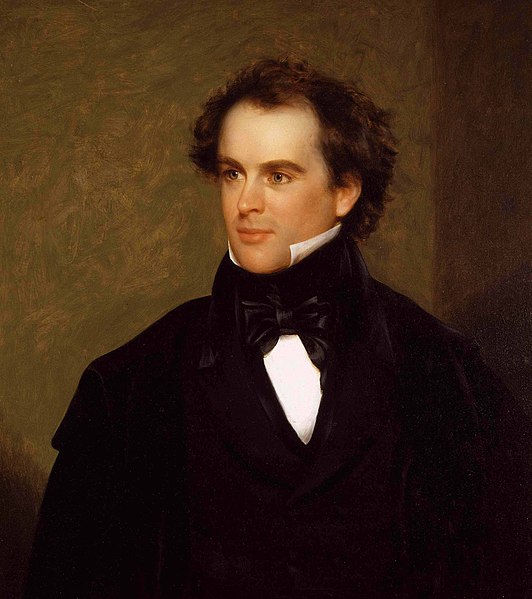
Nathaniel Hawthorne: (July 4, 1804 – May 19, 1864) was an American novelist and short story writer. His works often focus on history, morality, and religion. He wrote the novel The House of the Seven Gables inspired by the house in Salem Massachusetts he used to visit.

The novel follows a New England family and their home where he explores guilt, retribution and atonement. The story is filled with hints at the supernatural and witchcraft and influenced horror writers like H.P Lovecraft. 

Read Also: Find some novels about witchcraft like The House of the Seven Gables: Here

Hawthorne, most known for the novel The Scarlet Letter, was himself born in Salem and grew up hearing stories about the house. His great-great-great grandfather was one of the judges in the Salem Witch Trials which the house also had a connection to. 

Explore the Legends of The Haunted House

From legendary tales of cursed spirits trapping guests to mysterious hauntings that have been reported through the ages, explore the legends that make The Haunted House of the Seven Gables one of the most haunted locations in the world. Learn about the curses that lurk in its dark corners, and find out about the secrets this house has been concealing for centuries.

The house was built as a place for peace and quiet, but ended up being in the center of one of the most notorious witchcraft trials in 1692 to 1693 were over 200 people in the puritan New England town were accused of witchcraft. 

John Turner Jr. lived in the house at the time with his sisters and wanted to protect them from the hysteria of the locals that accused their neighbors, their friends and family for being witches and in league with the devil. A part of the protection was to build a hidden staircase with the fireplace. 

In later years there were also uncovered a hidden dining room and accounting room to hide if any in the family were ever accused of witchcraft. 

The Salem Witch Trials

The Salem Witch Trials was a product of mass hysteria that happened in the British Colonies as well as in Europe at the time. It all started when two small girls started having these fits of contorting bodies, making strange noises and speaking gibberish. 

The Salem Witch Trials: A series of hearings and prosecutions of people accused of witchcraft in 1692 and 1693. More than 200 people were accused. Thirty people were found guilty, 19 of whom were executed by hanging (14 women and five men). One other man, Giles Corey, was pressed to death after refusing to enter a plea, and at least five people died in jail.

This type of affliction seemed to spread to other girls and they were all diagnosed with witchcraft. And when the girls were interrogated, they started naming names about who cursed them, and a witch hunt began. 

A total of 14 women and 6 men were executed in the witch trials by hanging, one by being pressed to death. Another 5 died while in prison. 

Although the Turner family remained safe during those trials, the imprint and trauma of the witch hunt remained in all of Salem and ringed back for generations, something Hawthorne also discusses in his book. 

The Ingersoll’s and Hawthorns Ancestral Sins

After being in the Turner family for 3 generations it was sold to Captain Samuel Ingersoll as there were no remaining heirs. He had a daughter named Susannah, a cousin of Nathaniel Hawthorne who knew well and would come to hang out with. 

When inside the house, Hawthorne was inspired by the house and its quirky features and old history. There they also talked about their families involvement in a dark past. Hawthornes involvement in the Salem Witch Trials and Ingersoll’s involvement in slavery as an example. 

Susannah even advised him to put a W in his last name, which originally was Hathorne, to remove himself from his ancestral sin. Hawthorne often wrote about his guilt for his family’s involvement and in his most famed work, The Scarlet Letter, he even opens up with an analogy for it all. 

Is the House of The Seven Gables Haunted?

Mystery and terror await you as you attempt to uncover the secrets of The Haunted House of the Seven Gables. If you ask many of the tour guides, they will be quick to reply with a no. However, there are many who tell about another side of the story. 

One of the ghostly silhouettes that are reported to be seen is that of Susannah Ingersoll. There are not only one, but many paranormal activities that are said to take place within the old house. 

Today the dark wooden house is made into a museum and gets plenty of visitors that are looking for something paranormal, and many claim to have found it. A psychic visiting the house claimed to see a young boy play near the gables as well. Little footsteps can be heard from the attic followed by giggles and laughs.

A man can be seen climbing up and down the infamous staircase and lights are turning on and off and even the water faucets have a habit of turning on and on on their own. 

so, would you like to visit and see for yourself whether or not the house is haunted?

More like this

Newest Posts

References

House of the Seven Gables – Salem Ghosts

House of the Seven Gables – Wikipedia

The Haunted House of the Seven Gables