Djákninn á Myrká meaning the Deacon of Dark River is an Icelandic folk tale that have been passed down for generations now. It tells the story of the ghost of a man trying to make his girlfriend join him in death.
Once upon a time in Horgardalur not far from Akureyri in Iceland a deacon lived on a farm called Myrká. He was riding his trusted horse called Faxi to meet up with the woman he loved named Guðrún. It was the day before Christmas, a stormy and cold winter night.
It was a long ride to her farm called Bægisá. On the way to her he had to cross the river Hörgá, but he fell into it. He ended up drowning and only his horse survived the night. He was found the next morning by a farmer and laid to rest, but Guðrún didn’t get the message and she waited for her loved one to come and pick her up.
So when she got a visitor in the darkness she believed it was him and went with him. He was behaving strangely though and kept calling her Garún. In Icelandic folklore, ghosts are unable to utter the word for God, which Guðrún is compiled of.
It wasn’t before the raging wind blows off the large hat on the visitor she realizes it isn’t her boyfriend alive, but a skeleton. She also saw an open grave in the graveyard the skeleton tried to pull her towards.
The ghost skeleton of her boyfriend keeps pestering her and he wants her to join him in death so they can be together. Guðrún finally breaks free from the ghost and gets the help of a sorcerer. The sorcerer traps the ghost on unholy ground outside the graveyard belonging to the church at Myrka.
He places a large and cursed stone on it that still holds the ghost of the priest’s apprentice. You can still see it today on the unholy ground, still waiting for his girlfriend to be together forever.
Step back in time and visit the historic Château de Blandy-les-Tours which is said to be one of the many haunted castles in France. It is said that the castle is especially busy on All Saint Day were the dead are walking the halls.
Nestled in the Loire Valley, France’s Château de Blandy-les-Tours is a true gem of history famous for its towers. Dating back to the 13th to 14th century, this castle is full of charm and allure, with intricate details and stunning architecture. Tour the grounds and explore its fascinating history to uncover its secrets with our guide.
The fortified Château de Blandy-les-Tours that stands today was a keep built for the Hundred Year War and was home to some of the most prominent families in France before it fell into obscurity for years.
Merovingian Necropolis Cemetery
Before it was a castle, it used to be a cemetery for one of the most powerful rulers of Europe during their time. Which maybe can help explain why Château de Blandy-les-Tours is considered to be one of France’s most haunted places.
The Merovingian dynasty was the ruling family of the Franks from the middle of the 5th century until 751. By 509 they had united all the Franks and northern Gaulish Romans under their rule The 7th-century Chronicle of Fredegar implies that the Merovingians were descended from a sea-beast called a quinotaur:
It is said that while Chlodio was staying at the seaside with his wife one summer, his wife went into the sea at midday to bathe, and a beast of Neptune rather like a Quinotaur found her. In the event she was made pregnant, either by the beast or by her husband, and she gave birth to a son called Merovech, from whom the kings of the Franks have subsequently been called Merovingians.
In the past, this tale was regarded as an authentic piece of Germanic mythology and was often taken as evidence that the Merovingian kingship was sacral and the royal dynasty of supernatural origin.
Exploring the Inside of the Château de Blandy-les-Tours
Visitors to the Château de Blandy-les-Tours can explore its vast corridors, halls, and chambers that they spent years restoring from 1992 to 2007 when they opened the Château for the public again. Wander through rooms filled with centuries-old artifacts and furniture that tell stories of past inhabitants where you can enjoy open-air cinema nights, circus shows and concerts.
Discover grand fireplaces decorating lush salons, wooden ceilings from the fifteenth century in its numerous bedrooms, as well as other hidden gems revealed by a team of archaeologists that have been working for years to restore the castle’s structure.
All Saint Day Haunting
All saints day is also known as All Hallows Day, a prelude to the modern Halloween we celebrate today. It’s a Christian day to celebrate and honor all the saints of the church and usually celebrated on November 1st. In France it is known as La Toussaint and usually flowers like chrysanthemums or wreaths are placed on tombs and graves.
All Saint Day Haunting: November 1st is All Saint Day and is supposedly when the Château de Blandy-les-Tours is most haunted if we are to believe local lore.
One of the château’s most interesting stories is that it may be haunted on this holy day. There have been reports of strange noises, shadows, and ghostly figure sightings throughout its history. Whether you believe in ghosts or not, this castle definitely has a mysterious and fascinating past!
This Château has a peculiar haunting as it isn’t necessarily connected to one specific ghost. It is said that on All Saint Day the hallways of the Château de Blandy-les-Tours are taken over by ghosts and spirits trapped inside. You can hear them screaming and rattling their chains the entire night.
The Murderous Ghost Lord
One ghost we have a certain amount of control over is the ghost of a feudal lord from the 10th or 11th century. He is said to walk around with a dagger wearing a bloody shroud walking from room to room in the Château de Blandy-les-Tours, perhaps looking for another victim as he was quite notorious for his crimes when he was alive? It is said that when he was alive, he used to be a murderer, and forever cursed to haunt his castle in his afterlife.
In the ruins of the Franziskaner-Klosterkirche in Berlin, there is a legend of a murderous monk haunting the place, after he ended up murdering his own son.
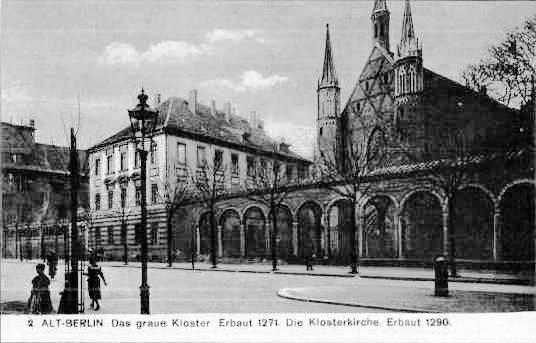
The old ruins of the once great Franziskaner-Klosterkirche was a Franciscan monastery since the 1200s and was before its destruction the most important medieval building in Berlin.
Read More: Check out all of our ghost stories from Germany
Franziskaner-Klosterkirche was bombed to ruins by the allies during the last day of the second world war in 1945. It was probably one of the oldest buildings in the city. Still today it is a part of the city landscape though, just by the Alexanderplatz in the city center of Berlin.
The Runaway Knight Roderich
But the monks of Franziskaner-Klosterkirche have been gone for years and the only ones living there now are ghosts. The most famous ghost in the ruins of the monastery was once a knight named Roderich. He became a monk when he was running away from the father of his one night stand. The father was enraged as he had dishonored his daughter and was after him.
Franziskaner-Klosterkirche: The monastery was also called Graues Kloster (The Gray Monastery) and was in use even after the reformation and used as a school. This is from a postcard around 1910.
On the run, the knight turned monk broke his leg and kept walking with a limp. From then on everyone called Roderich the limping monk, and he was not a popular one.
Because of his injury and his unfortunate circumstances isolated in the monastery, Roderich grew bitter over the long years. He didn’t get along with the other monks either and paid two criminals to murder one of the other monks in the monastery. He blamed the murder on some Knights Templar who ended up being executed for it.
The Murderous Monk in Franziskaner-Klosterkirche
Another monk was sent to the Franziskaner-Klosterkirche called Bernhard. He entered because of the grief he had of his miserable love that turned out badly. He loved and wanted to marry a woman, but as the cruel fate would have it, it turned out she was his sister, and he was unable to go on outside of the monastery.
Bernhard was a skeptical person though and had his own theory of the murder of the monk Roderich had killed in Franziskaner-Klosterkirche. When Bernard met Roderich he told him that he didn’t believe that the Knights Templar was behind the murder of their fellow monk brother.
This was the nail in the coffin for Bernhard and Roderich locked him up in a dark cellar of the monastery to cover his crime when he was found out, ending up killing him so he wouldn’t spill his secret.
The Ultimate Sin
While this is going on, the two criminals Roderich hired came clean and confessed to what really happened when they murdered the monk and it was in fact Roderich that was behind it all. The anger and rage against Roderich grew and an angry mob stormed the monastery, searching for Roderich to put things right.
The angry mob found him kneeling in the cellar next to the dead body of Bernhard. After he had killed Bernhard, Roderich went through Bernhards stuff and found a letter from Bernard’s mother. This was a woman who Roderich knew intimately and it was Roderich’s former lover telling him that Roderich in fact was the father of Bernhard.
Overcome with grief and regret he confessed at once and was killed on the spot without a trial.
Since then, Roderich has been haunting the Franziskaner-Klosterkirche, even after it all turned to ruins. He can be heard wailing in the night from the outside of the monastery, unable to atone for his sins of killing his own son in cold blood to cover his own tracks.
In the outskirts of the moors in Cornwall with a dark history of smugglers and gothic romances. The Jamaica Inn is a perfect setting for a british ghost story, and according to the legends, it has many.
“Dead men tell no tales, Mary.” ― Daphne duMaurier, Jamaica Inn
Located in the rugged landscape of Cornwall, England, Jamaica Inn is said to be one of the most haunted places in Britain. Its walls are steeped with stories of ghosts, dust and deep secrets of smugglers and stolen goods and murdered guests – it’s a place that has enticed many looking for paranormal activity.
The Jamaica inn is said to be haunted by small children being mischievous, old smugglers lurking in the corners, blacksmiths that burned to death but are still handsy with the female guests and mysterious Victorian women in the dark shadows. So let’s put on our tricorn hat and bring our smuggled rum for a stay at the haunted Jamaica Inn.
History of Jamaica Inn
Jamaica Inn was built in 1750 as a coaching inn and has a long history of being a hideout for smugglers during the 19th century. It was originally known as The Jamaica Arms, but underwent many changes over time, including the addition of drunkards’ dens and clandestine accommodation for smugglers.
Over the years, it has served several purposes, most notably a coaching inn for local travelers. But what really sets it apart is its mysterious stories of hauntings by spirits that lurk in its passageways and hidden doorways.
Jamaica Inn lies upon the ancient Bodmin Moor – a wild and untamed landscape which has held a certain allure for centuries. The moor is full of legends, myths, and stories from both ancient Britain and more recent times. It was once home to people living in remote settlements and Iron Age Hillforts, as well as a hideout for smugglers and pirates.
Jamaica Inn The Novel
Jamaica Inn is perhaps best known for its namesake novel, written by Daphne du Maurier in 1936. She was inspired by the real Inn when she was staying there in 1930. It is also a song by Tori Amos which she wrote when she was driving along the cliffs in Cornwall and was inspired by all the legends she had heard of at the inn.
The book is a classic example of gothic romance, and tells the story of a young woman called Mary Yellen, who moves to the Cornish inn and becomes involved in the murderous activities of its inhabitants.
While some argue that Jamaica Inn is purely a work of fiction, many locals have cited uncanny similarities between their own experiences at the inn, and Daphne’s descriptions of unexplained events and hauntings in her novel.
The Ghosts of Jamaica Inn
Many believe that Jamaica Inn still remains haunted, with multiple unexplained occurrences taking place in the inn over the years. There have been countless investigations, even TV shows about the Inn. Especially an episode of the TV show Most Haunted in 2004 sparked a new interest in the old inn.
Most of the ghosts and paranormal things that have been spotted have been at The Smugglers Bar, The Stable Bar, which now is a museum, in the old bedrooms upstairs as well as in the restaurant and gift shop area.
Some claim to have seen faceless figures wandering through the corridors, while others have heard strange noises coming from empty rooms. Staff and visitors have many times heard conversations in a completely different language than English, some speculating that it could be old Cornish, meaning that these spirits can be really old as the language became extinct for a long time at the end of 18th century.
Ghost Hunting at the Jamaica Inn
Now the Jamaica Inn has opened up for its own weekends and late nights for ghost hunting at the inn. Perhaps you as well can experience seeing the highwayman in the traditional three cornered hat often seen passing through the doors before vanishing into thin air. Or perhaps the young mother in distress with her crying baby that also has been seen.
One thing the ghost hunters got on tape was a strange thing that happened on a Sunday on October 23rd in 2017, when the CCTV camera picked up something strange when the wall phone hanging by the bar looked like it was lifted before dropping to the floor. The staff member April was startled, and had earlier heard the bar door open without anyone entering. Nobody alive at least.
Have a look at the footage and see for yourself. What do you think?
The Mother with her Crying Baby
As mentioned, one of many possible ghosts at the inn is the many reports about people having heard a baby crying at the inn. This has apparently mostly been close to room 3 and 7, and the baby has been heard even if it has been confirmed that no baby has been staying at the inn at the time.
Most often this ghost is linked to the tragic story of Mary Downing. She was young and single, but had an illegitimate son. In 1934 she sued the landlord at the time, Thomas Dunn to make him recognise their son. Thomas Dunn was a married man, but the son ended up being christened Thomas Downing Dunn at Altarnun Church.
Hannah the Child Ghost
The baby crying is not the only child haunting the inn if we are to believe the rumors. There is the ghost of a small girl that has been dubbed Hanna that is said to roam the inn barefoot. One guest that stayed in room 5 once woke up and saw her wet footprints in the carpet that led to the wardrobe where there used to be a bathroom.
People have heard her running around their bedrooms at night and even claim that their feet have been touched in their sleep as they see her transparent figure by the side of their bed. There is a story about a service man that was so frightened that he fled his room and spent the rest of the night in his car.
In the later years there seems to be a bigger interest for the ghost of Hannah and people have started to write her letters and send her toys. And even these toys are said to sometimes move on their own.
The Murdered Stranger
Perhaps the most talked about ghost is the stranger that ended up murdered in the moors by the inn. His apparition around 1911 were especially noticeable as many reported about seeing someone who shouldn’t be there on the walls by the inn.
The inn has become shrouded in myths and legends over the centuries, with tales of apparitions seen near hidden staircases and secret rooms, eerie noises coming from the old stables even though no horses were ever kept there, ghostly figures roaming the grounds at night, and strange sightings in each of its many otherworldly locations.
One of the tales is the ghost of the murdered stranger that passed through the inn. Once a man was in the bar having an ale before someone called him to come outside. The stranger didn’t even finish his drink, but went into the night and was never seen again.
The next morning they found his dead body in the moors, but how he died and murderer was never found.
There have been reports of a stranger by the wall outside the Inn that neither moved or responded when people greeted him. Sometimes when the bar is closed and the inn is empty, there have been footsteps heard towards the bar, but no one reaching it, and some have speculated that it is the man returning to finish his ale.
Once a beautiful manor in Cologne, Germany, Haus Fühlingen continues to decay and fall into ruins with its dark and bloody past. Although an abandoned building, it is said to be filled up with ghosts.
In the city of Cologne in Germany there is an old manor house that is said to be haunted. Most of the former glory is gone now, and only the ruins and skeleton of the main building still stands.
The house of Villa Oppenheim, or as it is better known as, Haus Fühlingen on Neusser Landstraße 5A once belonged to the prominent Oppenheim family, rich from centuries of banking. Eduard Freiherr von Oppenheim built the place in 1884 to keep his horses. It had a racecourse and farm and he wanted it for training.
The Oppenheim’s sold the estate in 1907 as the soil wasn’t really suitable for the training he wanted and by a cruel twist, the home of the jewish family ended up in the hands of the Nazis, marking the beginning of the dark times of the place.
During the war the Nazi’s used Haus Fühlingen as a farm where they used forced laborers who used the house as sleeping quarters. According to both facts and legends it is said they hanged a man that is said to haunt the place.
The Hanged Man
Edward Margol was a 19 year old forced laborer from Poland who got entangled in a web of lies and paid with his life.
At the time it was a man named Ernst Kolb who was the tenant and landowner and he lived there together with his daughter at Haus Fühlingen.
The Nazis fabricated an accusation that he had sexually abused the tenant’s underage daughter. They brought him to a nearby brick factory and hanged him in 1943 for the false claims and he is said to forever wander the estate.
After his death, his body was sent to Bonn University where they dissected him in the anatomy department. What happened to his remains are not so certain, but they were most likely buried.
Other Tragedies
Fast forward to 1962, there was a former Nazi judge named Gerhard van K. living in Haus Fühlingen who hanged himself on the second floor on New Years Eve. People speculate that the two incidents are connected and that the judge was responsible for Margol’s death, although that has never been proven.
By 1967, the city of Cologne demolished part of the building and many of the doors and windows were bricked up. They also found two cars walled up within the walls of the house for no apparent reason.
No one really took care of Haus Fühlingen anymore and it started to show. From this time, many of the ghost stories about the place started being passed around by the locals.
Tragedy struck the house in 2007 again, long after the last person living there had moved. Haus Fühlingen was now abandoned after the widow of the judge, Alice van K. died, but people still visited. That year another suicide happened inside of the house were some young people visited the empty house were they found him on the second floor.
Ghost Hunters in Haus Fühlingen
After its dark history as well as the decaying exterior slowly being taken over by the weather and graffiti, the house has been stapled as haunted and an attraction for ghost hunters. The ones that come out from the house tell about strange light phenomena, shadows fleeting past them, the radio turning on and off by itself and feeling uneasy and sick while being inside.
A prospective buyer once brought a priest to drive away the spirits and ghosts haunting Haus Fühlingen. This proved to be inefficient though as the sightseeings of the paranormal and the darkness kept being reported on, and it looks like the ghosts are the only inhabitants of the house for the time being.
Haus Fühlingen has since 2008 been planned for a renovation to make luxury apartments, however as of now, they are still just plans and the future of the house is still uncertain. The city of Cologne is also in the process of trying to remove it from the list as a protected building, paving a way that one day, it could be torn down completely. Question is, will that help in stopping the reports of shadows around on the old estate?
Reichenstein Castle is also known as Falkenburg, standing on a mountain spur in the Rhine Valley. For a long time it was under the domain of a long line of robber knights that plundered everything and everyone. And the last of the robber knights are said to haunt the place as a headless ghost.
Germany may be one of the most beautiful and remarkable countries in Europe, but its haunted old castles have a history filled with ghost stories and legends that are sure to send chills down your spine. From dark fairytales of princesses and knights and robber kings to magnificent castles in ruins, these gloomy buildings have a history of hauntings that make them truly one-of-a-kind.
The oldest part of Reichenstein Castle is far up in the wine producing village of Trechtlingshausen in the Rhine Valley. The castle was built way back in the 11th century, but the castle has been destroyed and rebuilt so many times it is now a time capsule of history. The castle was meant to protect a neighboring village, but ended up with a long period of being the fortress for a robber knight that are said to still haunt the place.
The Robber Baron
One of the people living in Reichenstein Castle was a robber baron named Dietrich von Hohenfels who lived in the castle at the end of the 1200s. He had grown up in Reichenstein Castle as the third born son of Philip von Hohenfels, a robber as well and didn’t know any other way of living. When he took over the castle after his father, he followed in his footsteps and it is said he got even more notorious than his father.
Dietrich von Hohenfels lived together with his nine sons and used the castle to hoard all of his riches he stole from passing ships in the Rhine River. Together the robber baron and the rest of his knights abused their subjects, stole their wives and robbed traders and defenseless wanderess alike according to the stories that are now told of them.
All of this happened in a time of great turmoil known as the Great Interregnum in the Holy Roman Empire that Germany at the time was a part of. No one seemed to be able to gather under only one leader, and anarchy, crime and robber knights such as Dietrich von Hohenfels and his family ran rampant.
This would all come to an end when the House of Habsburg would rise to power and rule the Holy Roman Empire for generations to come. In 1273, Rudolf von Hasburg was elected leader and started his campaign to stop all of the robber knights who had gained too much wealth and power and been left alone for too long.
The Beheading of the Robbers
In the end the robber baron and his knights all got captured and had to pay for their crimes in 1282 when the whole castle was besieged by Rudolf von Habsburg. There are several variations of the legend. Some say that Dietrich von Hohenfels managed to escape the siege of Reichenstein Castle with his wife, Agnes, but the rest of his knights were hanged. But he didn’t live for long as his former subject bore a grudge and hunted him down, eventually finding him and killing him and his wife. Because of their crime and regrets, they are now wandering in their afterlife in the castle.
Another variation of the legend tells that Dietrich von Hohenfels died together with his nine sons during the siege. In this version, Hohenfels pleaded for the lives of his sons, but his plea was denied. All of them were executed by decapitation and buried in the chapel inside of the castle. It says that the headless ghost of Hohenfels is still haunting Reichenstein Castle, himself haunted by being the reason his sons met their early demise.
The last legend is how Dietrich von Hohenfels managed to save his sons with his head. When he pleaded to Rudolf von Habsburg, he was given a challenge. Dietrich von Hohenfels would be beheaded standing up, with his sons standing in a line to await their faith. Each son Dietrich von Hohenfels managed to pass after he was beheaded was to be spared. So he was beheaded and his headless body was swaying for a moment before passing all of his sons and managed to save their life. The sons were spared, and never heard from again.
The Ghost of Reichenstein Castle
Not only do the old castles like Reichenstein Castle provide a peek into Germany’s past, but they also represent amazing architecture from centuries ago. There is something truly captivating about wandering through ancient walled fortifications and hearing about their cursed pasts in between eerie stories of ghostly figures passing by.
Today it is said that the ghost of Dietrich von Hohenfels is heard rather than seen inside of the castle and the guests visiting are said to feel like they are never truly alone. Other unexplained things like windows and doors opening and closing without there being anyone there.
And for eternity the once mighty Robber Baron Dietrich von Hohenfels are forced to haunt the grounds of the ruins of his own castle.
This I found, from men, as the foremost wisdom, That neither earth there was, nor sky above; Nor tree, nor hill there was. Nor stars there were; nor shone the sun. Nor moon-light there was, nor the salty sea. Nothing there was: neither end, nor limit. And there was the One Almighty God, The mildest of men;and many were with them, GodlyGhosts: and God the Holy. — From the Wessobrunn Prayer, the earliest known poetic works in Old High German from the 8th century.
The Benedictine Wessobrunn Abbey is steeped in history and legends. According to stories, the monastery has been haunted for centuries. From martyred monks to a disobedient nun, their ghosts still haunt the holy place.
In 955, the Hungarians invaded part of today’s Germany and wanted to draw the German army out in the open and destroy it.
On their way they came across the Wessobrunn Abbey and burned it all down to the ground. Three of the monks managed to flee to Andechs with their sacred relics they had kept in the Abbey. Abbot Thiente and six of his monks never got out alive though and suffered martyrdom, dying for their faith.
After the defeat of the Hungarians on the Lechfeld, the spiritual life in Wessobrunn Abbey goes into a shadow period. Not much is known about when the first monks started coming back to the place after the sacking.
Today there is a cross commemorating the martyrs just above Wessobrunn. Legend has it that the six dead monks have haunted the place ever since.
The New Wessobrunn Abbey
It was not the last time the abbey was burnt down, and it was not the last time they decided to rebuild it either. Close to the site where the former Wessobrunn Abbey once stood, they built a new one, continuing the tradition of a monastery at the place.
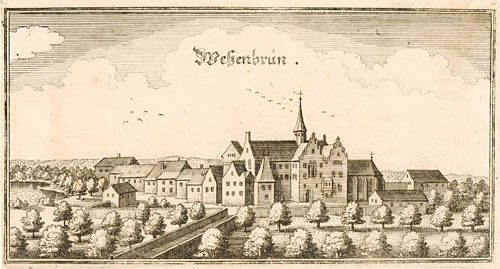
Wessobrunn Abbey: There have been a monastery at this place for a long time. Here a depiction of how it looked like in 1640, centuries after the ghosts started haunting the place.
The monastery of Wessobrunn, near Weilheim in Bavaria had been founded in the 8th century. From 1100 the community of male monks was joined by a sisterhood as well and it included both a community of nuns and monks. There are also legends about one of the nuns in the abbey haunting the place as a ghost.
The Ghost of the Nun
According to this legend there was a nun in the 13th century who might have been a sister of Knight Joseph Diethalm von Wileyhin, the last Count of Weilheim. It is said she entered Wessobrunn Abbey after her brother’s death in 1211.
But the way of the sisters is not for everyone and according to the stories, she broke one of her vows of the order. Nuns had to live by strict rules of Chastity, Poverty and Obedience. Exactly what type of vows she broke are unclear, but it scared her so that she ran off. She hid in an underground passage back at her family’s home in Göterlberg.
Without seeing the sun ever again, she died shortly after and her remains were not found until many years had come and passed. From then on it is reported of sightseeings of a nun around the castle as well as her old abbey, crying in the hallways, still in her nuns’ habit.
Up until the 1800s it was said that locals threw spruce cones into a hollow said to be the former corridor where the nun hid on her escape from the Wessobrunn Abbey to scare away the ghost.
Today there are still a cluster of Benedictine nuns living after God’s words within the walls of the abbey, still seeing their long dead sister walking the halls.
By the Venetian lagoon there is a house so cursed not even fishermen will fish near it. Many dark legends surround the Casino degli Spiriti, or The House of Souls, from black magic to the ghost of a heartbroken painter.
Right by the water there is a decaying of a once grand palace that is haunted by its own legends. The house of Casino degli Spiriti or the House of Souls was once a very beautiful building in Fondamenta Gasparo Contarini, overlooking the famous Murano island just across the lagoon.
The house of souls is actually part of the Palazzo Contarini dal Zaffo, and the house is an annex which are more commonly known for its legends of ghosts, murder and spiritism. Today, there are so many versions of the legend as to just why it is so cursed.
The Ghost of Pietro Luzzo da Feltre
One of the most famous legends of Casino degli Spiriti is that of Pietro Luzzo da Feltre, a painter who lived in the 16th century, together with famous artists like Titan. This is at least the painter most associated with the legend, although we have proof that he actually died in war, not over unrequited love as this legend would have it as.
Casino degli Spiriti: The house, overlooking the Venetian Lagoon.
Anyway, this was at the height of the Renaissance and Italy was a culture center. The Palazzo Contarini dal Zaffo was back then known for a meeting place for Venetian philosophers, artists and learned men.
Not a lot is known about Pietro Luzzo da Feltre’s life and not many of his works are preserved to this day. We do now know a couple of curious facts about him though. For one, one of his many nicknames was Morto da Feltre, where Morto means ‘dead’ or ‘dead one’. There are a couple of reasons why this was his nickname. It could be because of his joyless temperament, the fact that he looked ghostly or his peculiar hobby of exploring crypts and burial grounds.
Pietro Luzzo da Feltre’s legacy though is his demise because of an unrequited love rather than his art. The woman was known as La Bella Cecilia and it was said she had a cherub face and was also a singer. She however was Giorgione’s lover and model, another painter during that time and rejected Pietro Luzzo da Feltre when he fell for her.
According to some variations of the legend, he simply disappeared one day. It is believed that he killed himself in the annex he lived in that would be known as Casino degli Spiriti, unable to go on.
It is said that once, his artist friends saw him through the window a few days after his disappearance, and they hurried over to talk with him. But when they entered the room they thought they saw him in, it was empty.
Strange noises were heard at night after the place was abandoned. Could it be the ghost of Luzzo? Or perhaps it was religious cults gathering to invoke demons and do magic. According to legend his ghost is still in that house, still pining for the woman he could never have.
The Murder House
Later, after the artist of the Renaissance had left and the grandieu of the place started decaying overtime, it was used for various purposes. Casino degli Spiriti was the place venetian died from the plague as the house was used as a hospital. It was also used as an anatomical theater where they did autopsies. So a lot of souls came and left in this building.
In 1929, four people were found dead in the house: a priest, two brothers and a gondolier. There was no explanation of this random gathering of people or what had happened. They were apparently all missing their heads and their right hands, but they never got the ones that did it.
In recent years, the house is still not rid of its ghosts and gruesome history. Linda Civetta lived in Belluno and managed her family’s bar. She went to Venice in 1947 to resell cigarettes on the black market which was big business after the second world war. She was never able to return home. She was killed, cut up and thrown into the lagoon in a trunk. She was found right in front of this cursed building two weeks after her murder by a local fisherman.
Apparently she was carrying large amount of money and this was the motive behind her murder. The murderer was Bartolomeo Toma, a gambler and a gondolier named Luigi Sardi.
Even to this day, the local Venetian fishermen don’t go near that place to fish.
In one of the oldest theaters there are also famous ghosts for those enjoying the drama of the stage. In Theatre Royal Drury Lane those working there as well as visitors keep reporting on several ghosts, one of them being the well known Man in Grey.
There is not only one ghost haunting the old Theatre Royal Drury Lane. From the end of the front row in the upper circle to the wall near the royal box, many have claimed to have seen the ghost of W. J. MacQueen-Pope, an English theater historian and publicist.
Also actors are said to have been haunting the stage, like the ghost of the Irish actor Charles Macklin who is haunting the backstage and wandering the halls where he once killed a fellow actor when they argued over a wig. Macklin threw a cane into the actor named Hallam’s left eye and murdered him in what was known as ‘The Green Room’. The murder was considered back then as an accident and he went free, but since then he has been haunted by the place of his crime.
The pantomime actor from the Regency Era Joseph Grimaldi is seen as ‘the father of the modern clown’, and is also said to be a helpful ghost that guides nervous actors on the stage.
There is also the ghost of Dan Leno that you can notice by the smell of lavender, a scent he often wore when alive. He can be mostly heard clog dancing in empty dressing rooms, still practicing without anyone to see.
The Man in Grey
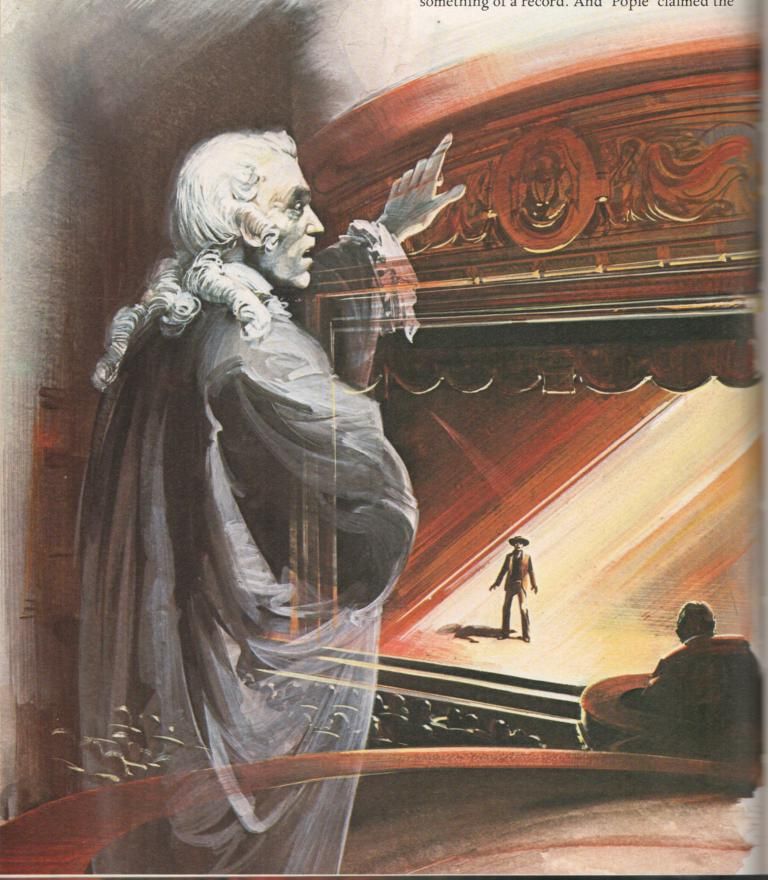
But perhaps the most famous ghost in the theater is the most mysterious one. The Man in Grey is a ghost that appears dressed as a nobleman in 18th century style of clothes. He has powdered his hair, wearing a tricorn hat, with riding boots and a sword. Who this man is, his name and what he does in the theater, no one knows for sure.
Even before they built this theater in this place in 1812, there was another one before and is one of the oldest places for theater in continuous use and was even the place where the first version of the national anthem was sung. Several buildings burned down all the way back to when the original Theatre Royal Drury Lane was built already in 1663.
So its not so strange that ghost stories like about the Man in Grey started being told in the old and murky hallways when the stage light was low and there are no laughter from the audience or lively drama from the stage. And all the legends thinks the ghost of the Man in Grey is the haunting of the skeleton they found bricked up in the walls of the glorious theater.
The Ghost on Fourth Row
In 1848 they did some renovations on the building and according to the legend, they discovered the skeleton of a man who appeared to have been stabbed inside. Builders are said to have broken into a secret room behind the wall that the ghost were always seen disappearing into.
The Ghost: The Grey Man haunting the Theatre Royal Drury Lane. From the Hamlyn Book of Ghosts.
Many have reported about strange things happening in the Theatre Royal Drury Lane, mostly between 10 am to 6 pm. People hear doors being slammed when they are alone in the building. Seeing a fleeting image of a gray man before he disappears into the walls.
The entire cast of The Dancing Years reported seeing him in 1939. One time a cleaner came in and saw him sitting in the fourth row in the Upper Circle and she thought he was an actor. She tried to speak with him, but then he vanished. When she looked around she could see him disappearing into the wall, the same wall where his skeleton was found.
Actor Clive Carter told about a paranormal experience he had in the changing room were the TV kept changing the channel without anyone touching it. It first started when they talked about the Drury Lane Ghost, as if something was being summoned or could hear them very well.
The Good Omen
Who was this man found inside the walls of Theatre Royal Drury Lane though? Only legends live on and many of them tell that the Man in Grey was killed because of a love affair with one of the actresses. He was once called to their usual meeting spot, but on one particular night it was his love rival who waited for him and killed him when he showed up. The murderer later walled up the alcove to cover up his crime.
In contrast to many other ghosts out in the world, seeing the Man in Gray in the Theatre Royal Drury Lane is considered a good omen as sightings of the ghost have been seen before successful theater productions like The King and I, Oklahoma and Miss Saigon.
Explore one of Paris’ most haunted destinations with this tour featuring stories and legends about the Catacombs’ chilling past. Don’t forget to bring a flashlight!
Take your flashlight and follow along with a knowledgeable tour guide on an eerie journey through the catacombs of Paris, one of the city’s most haunting and mysterious places. Hear tales of chilling ghostly encounters and uncanny moments throughout history as you venture deeper into these damp, dark corridors.
Arrête! C’est ici l’empire de la Mort
This is the sign that greets you when you are entering the catacombs. It means: Stop! This is the empire of Death. And it certainly is.
The Catacombs of Paris, or l’Ossuaire Municipal, are an ancient network of tunnels located beneath the streets of Paris that date back to the Roman period. It used to be an underground quarry to get stone to build the city on top of it.
Over time, the city began to outgrow its ancient cemeteries, and in the late 1780s officials began a project to move millions upon millions of bones and remains into the quarries deep beneath the streets. These bones comprise much of what is now known as “the Catacombs” in reference to the underground necropolis in Rome and represent centuries worth of Parisian history and houses now the graves of 6 million people.
Tales of Terror from Paris’s Underworld
People have been telling tales of terror from the Catacombs of Paris for centuries. From ghostly figures spotted in the shadows to strange noises and apparitions, these chilling stories of paranormal activity are sure to leave you shuddering. There’s also said to be a secret chamber deep within the catacombs that hints at an even more ominous past — although no one knows what lies beyond its entrance.
Philibert Aspairt Ghost
One of the scariest tales associated with the Catacombs is that of Philibert Aspairt, a 62 year old hospital worker at Val-de-Grâce hospital who disappeared in November of 1793 during the French Revolution. He entered the catacombs via a staircase in the hospital courtyard, but his motive for going in is unclear.
Many say that he was going to fetch a particular liquor, was drunk himself and ended up getting lost in the maze of corridors. When his light went out it was impossible to find out from the catacombs.
Rumor has it that his body was discovered in the Catacombs in 1804, nearly 11 years later in one of the quarry galleries where he was identified by the key ring belonging to the hospital, but the cause of death was never determined.
The tragedy doesn’t end there as according to legend, Aspairt’s ghost continues to haunt the underground labyrinth to this day.
Legends of the Catacombs
The Catacombs of Paris are not just filled with bones, but also stories and legends that have been passed down for centuries. From tales of mysterious creatures lurking in the tunnels to sightings of the ghost of a monk and others, those brave enough to explore the Catacombs may never know what they might encounter.
An online magazine about the paranormal, haunted and macabre. We collect the ghost stories from all around the world as well as review horror and gothic media.