Tag Archives: Italy

The Burning Skeleton in Venice

Advertisements

In Cannaregio district in the city of Venice, there is a burning skeleton of a mean man that is cursed to haunt the city around Campo de l’Abazia. 

Walking around the picturesque streets and canals in Venice you might think you are so safe. There are people everywhere and the windows so close to the street are always open. Wandering over the curved bridges and walking over the old cobblestone, you might not even notice other people as you are so preoccupied by the wonderful old architecture in the Cannaregio district. But you should never feel too safe. 

Read More: Check out every ghost story from Italy

According to old Venetian legend, there is a story about the ghost of a man still haunting the streets, especially around Campo de L’Abazia where he made a sin so great, he was cursed to walk around the area for eternity. He comes in the shape of an old man with a big bag on his back, begging for help. According to legend you must never help him, and whatever you do, never look him in the eyes. If you do this, he will turn into the burning skeleton and frighten you, maybe even to death?  

The skeleton is said to be of the usurer or a moneylender known as Bartolomeo Zenni that was so mean that he was condemned to be transformed into the burning skeleton. He lived in the 1400s, a time where Venice and Milan fought off territory in Northern Italy. Venice was at this time one of Europe’s wealthiest and most powerful cities. The Renaissance period which would change the world forever had just begun to take root in Italy and would bring them into a new area. 

Amidst all of these world changing events, everyday life went on in the streets of Venice, for people like Bartolomeo Zenni on Campo de L’Abazia. But tragedy struck the small neighborhood. 

On 13th of May in 1437, a fire broke out at Campo de l’Abazia and several of the houses were engulfed in flames. The neighbors of Bartolomeo Zenni asked him to help them, trying to save their children from the fire that was devouring everything. Bartolomeo Zenni refused to help his neighbors and instead grabbed all of his gold and jewels to save himself. Perhaps he escaped the fire safely, but in the afterlife, he will never escape from the fire as he was cursed to haunt these streets forever without a coin of gold to his name. 

So if you walk these cobbled streets and someone asks for your help, do you offer it?

More like this

Newest Posts

References

Haunted Venice – Legends, Mysteries and Stories

Venice Legends and Ghosts

Poveglia Island — The Most Haunted Place in the World

Advertisements

The haunted Poveglia Island has always been a place for the unwanted. It has been a place for plague victims, a psychiatric hospital and burial ground. Today it’s known for being one of the most haunted places in the world. 

Today, even fishermen avoid the Poveglia Island, not only because it is forbidden to go there. On clear days you can allegedly see skulls and bones under the surface. If a skull is caught in the fishing net, the fisherman will just dump it all back into the sea. There are no fish that are worth taking from the cursed plague island. 

The Plague Island

Most of the legends started when the government closed off the whole island because of cases of the plague. There have been found numerous plague pits of dead bodies. Over the years it turned into a dumping ground of the undesired to isolate them from the rest of the population. According to locals there have been over 160 000 deaths on the island of no return. According to the legends, the ground on Poveglia Island consists of half dirt and half human ashes. 

Read Also: The Plague of the Past?

The Plague Island: Plague mask and tools for disinfecting letters discovered on Poveglia island by Theodor Weyl in 1889.

People with the plague were shipped off to this island, both the dead as well as those still alive. From 1776 it was used as a quarantine station for ships that were coming and going from Venice, although it had been used as a quarantine station way before that as well. Most notably in 1348 when Venice was hit with the Bubonic Plague, more commonly known as the Black Death. It is said you had to stay on the island for 40 days to see if you would die or survive. The word quarantine comes from the Italian quaranta, meaning 40. 

The Vampires on Poveglia Island

Because of the death toll the island saw, the locals started calling it the Island of Ghosts. But it wasn’t the only fear the Venetians had of the dead that had their final resting place there. They were also afraid of Vampires living on the Poveglia Island. 

When people rediscovered these mass graves of the plague pits, they noticed something strange about some of the skeletons. Some were found with large rocks between their jaws, and it is believed that the Venetians did this because they believed they were vampires. 

A scientific explanation of this of course is the decomposition gasses that caused internal organs to rupture. Sometimes, blood came out from these organs and out from the dead bodies mouth. So when the Venetians opened up the plague pits to put more people into it, they were sometimes met with dead bodies with bloody mouths, looking like they had just been feasting on human flesh. That is at least what we hope happened, as the paranormal explanation is so much worse. 

The Mad Doctor in the Belltower

In 1922 the whole Poveglia Island turned into an asylum to hide away the mentally ill. Because a cursed island is not complete before having operated as an asylum. The patients supposedly reported seeing ghosts of the plague victims all the time, but who would take a pshycriatic patient’s visions of ghosts seriously in an asylum?

Read Also: Gonjiam Psychiatric Hospital

But it wasn’t only plague victims from the past that were torturing the patients. Their doctors were as well. According to legends, there was this one doctor who took to experiment and torture his patients in the bell tower. Apparently he used to do these crude lobotomies with a hammer and a chisel into the patient’s brain.  

Cursed Asylum: View of Poveglia in the Lagoon of Venice. Closeup of the Hospital and the belltower.//source//Chris 73

Exactly what happened in the bell tower with the patients, we will never really know. He himself died when he fell from that very same tower sometime in the 1930s. Some say he went mad and threw himself off, some say it was the angry spirits of those he tortured and killed who drove him to it. 

The fall from the tower itself didn’t kill him immediately, but he died from the wounds not long after. Together with his victims, he now haunts Poveglia Island that no one returns from. 

The mental hospital closed down in 1968 and Poveglia Island has been vacant ever since. Or has it? 

The Ghost of Little Maria

Although the fishermen in the lagoon try to stay away from Poveglia Island, it is impossible not to hear the screams and the moans coming from it at times. Even the bell from the bell tower can be heard at times, even though the bell was removed from the towers years ago. 

One of the more known ghosts is called ‘Little Maria’. she has been spotted on Poveglia Island for more than 400 years now and is considered to most likely have been one of the plague victims that never returned. She is forever doomed now to walk along the beach on Poveglia Island as she cries for help to get away. 

The Forbidden Island

Getting there is hard as Poveglia Island is off limits and its remaining buildings in desperate need of repair. This is fuelling the legends of the island being haunted. But does anyone really want to stay on the island themselves? It is said to be a haunted place by the locals, believing that the very soil, mixed with the ashes of people laid to rest there, made the very ground cursed. 

More like this

Newest Posts

References

https://no.hotels.com/go/italy/venice-haunted-spots

Poveglia Island – The Little House of Horrors

Inside Poveglia Island, Venice’s Haunted Quarantine For The Black Plague

The Cursed Merchants at Campo dei Mori

Advertisements

In the square of Campo dei Mori in Venice there are three stone statues placed in the. Legend has it that the three brother merchants were cursed and turned to stone, together with their camel. 

The Cursed Merchant: One of the brothers, Sior Antonio Rioba with his iron nose//Source//Wikimedia/
Doris Antony

In Venetian legends, there are many stories of people being cursed, often by greed, and this is one of them.  Around 1100 AD there were 3 rich merchants named Rioba, Afani and Sandi trying to sell fabric by Palazzo Mastelli at Campo dei Mori square.

Sior Antonio Rioba together with his brothers came from Morea which was the Venetian name for the Peloponnese in Greece. They were very rich silk and spice merchants of the Mastelli del Cammello family who built the entire area and had a house nearby named ‘the House of the Camel’. They were called Mastelli because they were known to have ‘Thousands of tubs of gold coins’.

However the fabric they were selling was poor quality compared to the price they tried to sell it for. In some variation of the legend, Sior Antonio Rioba and his brothers were also bankmen that scammed their customers by high priced loans. 

They tried to scam this local old lady to buy one of their fabrics one they, or give her a loan, depending on the variant of the legend. They told her that this ordinary fabric was the best yarn in Venice and the Lord could turn them into stone if they didn’t tell her the truth. She was recently a widow and took over a tailoring workshop, and she knew what a good quality fabric was. When she found out their plan, she cursed the money she gave them by praying to Mary Magdalene to help her. This turned the 3 men, along with their camel, into stone and are still standing there to this day. 

In the 19th century, one of the statues lost his nose and was replaced with a nose of iron. Venetians believe that if you touch the nose of the statue of Sior Antonio Rioba, you will have good luck in business. 

It is said that sometimes at night, you can hear Sior Antonio Rioba lamenting about his grief, and if you put your hand on his stone cold chest, you can still hear a heart beating forever confined to his corner at Campo dei Mori. 

More like this

Newest Posts

References

Azzurrina of Romagna

Advertisements

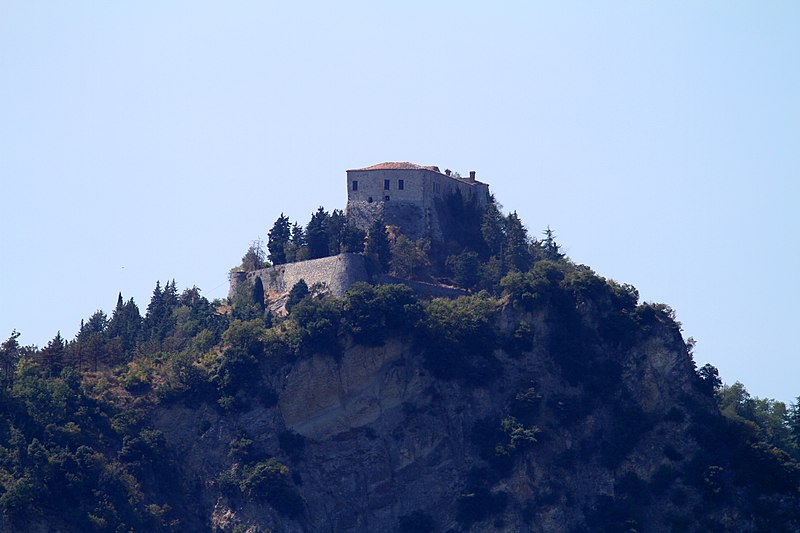
On the night of the solstice, the sound of a little girl is echoes through the old castle. A little girl with blue hair.

Castle on a Hill: The ghost of Azzurina of Romagna is supposedly haunting the castle Montebello di Torriana.
Attribution: Carlo Pelagalli

The sun lingered for a long time over the mountain area where the castle of Montebello di Torriana was. The castle stands in what was known as Romagna, a historical part of northern Italy that no longer exists. It was a stormy June day, in 1375 with thunder going on all around the castle grounds. Towering 400 meters above the ocean, the castle looks out over the valleys of Marecchia and Uso when it was still under the Papal rule. The earliest name of this castle was Mons Belli, or War Mountain in English. 

That day was the day of the solstice. The lord of the house’s daughter, Azzurina was playing with a ball, being watched over by her bodyguards Domenico and Ruggero. She was around five years old and running around in the castle with her ball made out of rags. They were distracted for just a moment, and when they turned around, the child was gone. A scream was heard from the castle icehouse and the bodyguards rushed over. Perhaps she had chased the ball and fell? But no trace was left and they were never able to find the child — at least not alive.

The Blue Haired Girl

Centuries later, around 1600 a priest put the legend to paper for the first time as we know of, although the writing itself is lost. The title of the story was Mons Belli ed Deline, hinting that the name was Deline or Adelina, but to most people hearing the legend, her name was Guendalina.  

Advertisements

Guendalina was a normal girl wanting to play around the castle grounds. But to the people in the castle, she was more of a secret. She was born as albino, which at the time was connected to persons of a diabolical nature. Her mother tried again and again to color her hair darker with pigments from plants. But the black color wouldn’t stay, and the color faded, leaving only a blue tint of it. This is where her nickname, Azzurrina, meaning blue comes from. So instead she was hidden away from the public eye. This is also why her father ordered her two bodyguards to always watch over her every move as he was worried about the superstitions and rumours surrounding his daughter’s affliction. 

The Mystery of the Solstice

Solstice: When the sun is on the sky the longest is the summer solstice. A lot of paranormal rumours surrounds this day, and this is the supposed day the little girl went missing.

What happened to the girl is still debated to this day. Perhaps only a tragic accident? The most gruesome theory is that of her father, Ugolinonuccio, that he himself ordered the death of his daughter because of her being an albino and therefore a problem for him, his reputation and his career. At the time he was supposed to be far away fighting in a war. Even her mere existence is debated as the records of the past are far and few between.

Now, every five year, or to be more exact, on every summer solstice ,strange occurrences have been reported from the castle. Paranormal researchers flock to the place then, to hear “the sound”.

Since the museum opened in the 90s, visitors have heard stories about a child crying or laughing. She is sometimes seen, looking a bit different than the others, running around and disappears in the castle like smoke. 

The Claim of the Supernatural

The sound of a child is what the paranormal researchers find over and over again together with strange images. Shame about the manuscript from the priest that could have given more details, which by the way is more of a claim of existence than a trace of it. However, the first real recording we have of the legend actually dates back to 1989, so quite recent, and very in line with the commercial museum that opened up the next year. 

But as they say on their web site, they welcome all to have a listen for themselves. Have a look and open your ears. Maybe you as well are able to hear the sound of a faint child’s laughter through the old halls of the castle’s basement?

Advertisements

More like this

Newest Posts

References

The legend of the ghost of Azzurrina of the castle of Montebello | e-borghi 

Montebello (Poggio Torriana)

Azzurrina – WikipediaLa Leggenda