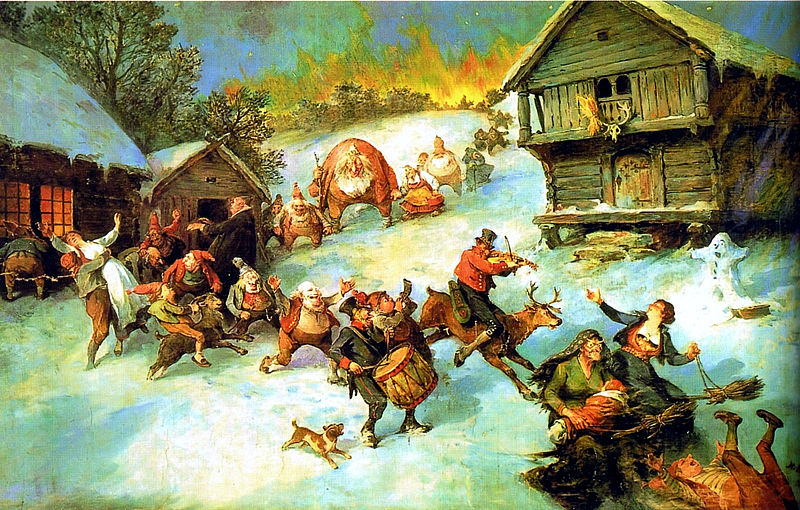
In the darkness of night and under the foliage cover of the forest, the demonic spirit of Uhaml is said to roam. The only way to escape it is getting out of the forest faster.
In the folklore of the Germans living in former Bohemia and Silesia, places that are now part of Czech Republic and Poland, a forest spirit was warned about. Particularly in the regions shaped by dense woods, marshes, and old trade routes, the spirit known as the uhaml prowled. This entity is something between ghost and monster that no one can describe how it looks like.
Lore described the uhaml as a formless figure, often glimpsed only in fleeting moments or seen more as movement in the shadows than a solid body. It was not a spirit tied to a specific grave or location, but a presence that could appear anywhere in the darkness.


The Forest Spirit
The uhaml was not merely a scary story told to discourage children from wandering at night. It served as a cultural explanation for tragedies that the people of earlier centuries could not otherwise explain. Carriages that overturned, travelers who disappeared between towns, hunters who never returned from the woods, and people who died suddenly in the dark were all sometimes attributed to the presence of the uhaml.
The exact nature of the uhaml varied by region and storyteller. In some tales it resembled a disembodied shape moving just beyond the sight of the observer. In others it was more like a presence that could not be seen at all, only felt. Although there is no description for the creature, it is often said to be female.
The spirit is sometimes described as some sort of a demonic bird, although it is said to have horse feet. The call of uhaml is what is most prominent of the spirit, sounding something like Uhuhu, like an owl. People imitating the spirit are in danger of being chased by it.

A Folkloric Warning
But how do you save yourself from a danger you can’t see? To protect oneself of the uhaml, people were said to sometimes leave three chips of wood or a loaf of bread in the parlor. The uhaml would enter and cut the bread in two and take one of the pieces with her. If you were being chased by her, the only way to escape was to reach the border of the forest and home and to seek cover of the eaves of the roof, hoping she would pass by.
Another similar creature is found in Lower Austria close to the historical territories that had tales of the uhaml, there is the Udl. This is a demonic kind of bird dwelling in the woods covering the slopes of the castle mountain in Mödling. The screeching and nightly call of the Udl is an omen for war or other disasters.
Read Also: The Demonic Omen of Disaster at Mödling Castle Hill
So what was the uhaml? Some connect the legends as a sort of cousin to the German Aufhocker, another unidentifiable shapeshifting spirit of the forest, jumping on the back of other people, wearing them down. The victims often die of exhaustion because the Aufhocker cannot be shaken off or killed. As the Uhalm, the only way of getting out of the situation is by making it back home in time.
Newest Posts
- The Hauntings of Gamle Aker Church Over a Dragon’s Den
 Could it be that the oldest church in Oslo also has the oldest haunting? From legends about a dragon’s den underneath the structure and the ghostly silhouette haunting, the Gamle Aker Church perhaps has more activity than what meets the naked eye.
 - The Janissaries Vampires in Veliko Tarnovo
 During a time when Bulgaria was under the Ottoman Empire, there was talk about a vampire haunting the streets of Veliko Tarnovo. The rumours got so bad, that the Islamic rulers had to turn to pagan belief to rid themselves of the bloodthirsty creatures.
 - The Legend of the White Lady of Utstein Monastery
 In the windswept landscape of Norway’s west coast lies the Utstein Monastery, a site steeped in history and haunting tales. Known as Norway’s best-preserved medieval monastery, its ancient stone walls and iconic Gothic windows whisper stories of faith, love, and loss as well as the ghost of a Lady in White.
 - The Lord Edward Pub: The Rebel’s Restless Spirit
 After dying for the cause of Irish Independence, it is said the ghost of Lord Edward is haunting the pub he is buried close to and bears his name.
 - St. Patrick’s Cathedral: The Restless Spirit of Jonathan Swift
 In the ancient St. Patrick’s Cathedral in Dublin, there are said to be restless spirits still lingering. One of the more well known is said to be the ghost of Jonathan Swift, perhaps best known as the author of Gulliver’s Travels.
 - The Hauntings of Stortorvet Gjestgiveri Restaurant
 In one of the city’s oldest buildings, the freshest food is served in the ancient locale. For years though, there have been talks about Stortorvet Gjestgiveri restaurant being haunted, and even made it as one of the most haunted clips in the national ghost hunting show.
 - The Headless Ghost of Buck Jones: Dublin’s Restless Sheriff
 Haunting Jone’s Road in Dublin, a headless horseman is said to roam after his life turned dark after scheming peers. And the former Dublin Sheriff, Buck Jones has become one of Ireland’s most well known headless horseman ghosts.
 - John Kavanagh’s ‘The Gravediggers’: A Pint with the Dead
 Next to the Glasnevin Cemetery in Dublin, there is a pub called John Kavanagh’s ‘The Gravediggers’, where they went to have a pint after working at the cemetery. Rumor has it that the pub is haunted by those buried next door.
 - The Armenian Vampire Dakhanavar of the Valleys
 Said to be a protector of the Valleys in Armenia, the Dakhanavar vampire hides in the caves in the mountains, waiting for intruders to quench his thirst.
 - Connolly Station: The Soldier Who Waits for a Train That Never Comes
 Could the Connolly Station in Dublin be haunted? Some claim that the ghosts of the victims from the Dublin Bombing in world war two could still be lingering near the tracks.
 - The Headless Undead in the Ruffinihaus Courtyard
 Once a place for executions, the place the Ruffinihaus in Munich, Germany is built upon is said to be haunted. It is said that in the dead of night, the undead rises from their graves, still carrying their heads the executioners took.
 - The Ghost of Könizwald, Bern: The Ghost of General Robert Scipio von Lentulus
 Where the former country estate Campagne Mon Repos in Bern once was, the ghostly council of the military leader from General Robert Scipio von Lentulus was given in times of unrest. Is he still haunting the Könizwald woods, even after his estate is gone?