Tag Archives: buried alive

The Mistletoe Bough – The Bride in the Chest

Advertisements

The Legend of the Mistletoe Bough or the Mistletoe Bride is a ghost tale that many big houses claim as their own. Bramshill House is one of them, and the story of the dead bride trapped in the chest haunts the already haunted place. 

Buried Alive: On Christmas Day the tale of the Mistletoe Bride that gets trapped in a chest and dies is told and retold throughout England.

A girl will always remember her wedding day, and making the wedding be held on Christmas day will surely make it easier to remember the wedding anniversary. But more people will remember it, if the bride turns into a ghost. 

This is the case of the bride of Bramshill House in Hampshire, one of Britain’s most crowded paranormal places. And although many big houses tries to claim the ghost of the bride in the oak chest as their own, Bramshill could be one of the choices with no less than 14 ghosts they claim wander there. 

Deadly Hide and Seek

In the early 17th century a girl named Anne Cope was to be married in this house. Anne is the name in some accounts, Genevre Orsini in others. English in some accounts while she was believed to be Italian in others. What remains the same is that it was Christmas Day and everyone was in a festive mood. She and her husband, Sir Hugh Bethell celebrated after having taken their vows, and as the old custom went, she was to be escorted to the marital bed.

Advertisements

But before the party was over, the bride wanted to play a round of hide and seek, where the target to be found was her. And after a five minute start the search began, but to no avail.

Searching the whole house, the guest came back empty with no sign of the bride. Perhaps it was a trick from the bride? Could she just be exceptionally good at this game? But as time went on, the innocent prank she could have played on the guest turned into a dangerous one. 

Many believed the bride had fled from her marriage. Her husband Hugh on the other side, spent decades searching for his bride that was lost. It was only after fifty years the mystery surrounding her disappearance came into light, and then her haunting had already began.

It is not the only ghost story from England that starts at a wedding during Christmas.

Read the full story of Fatima’s Harp

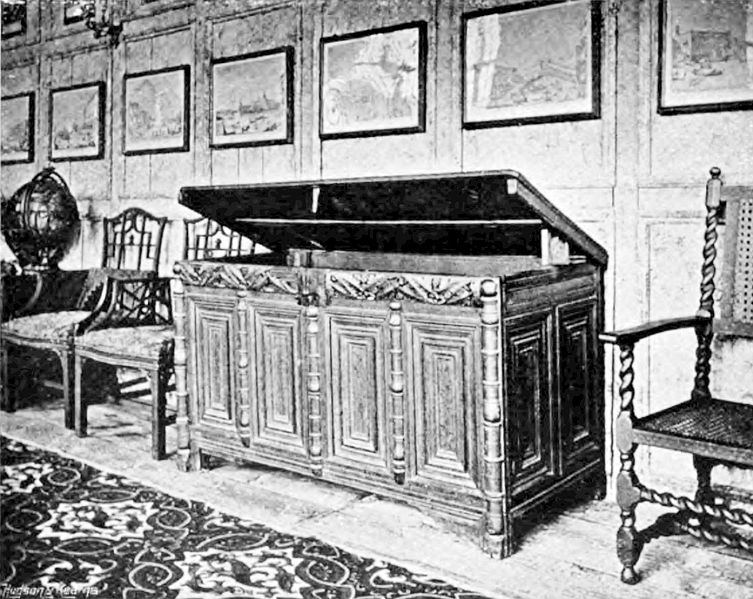
Hugh, now an old man, was in the attic, still searching. Having been through the mansion so many times, one should have thought there could be no more things to be found. But then, when knocking on some oak panelling, a secret door he didn’t know about suddenly opened. Inside the door was a room with a wooden chest. It was locked. Inside the chest when he finally got it open, the remains of the bride he had hoped to spend his life with, still in her wedding dress, holding her bouquet of wilted flowers, she had been by his side all this time. 

In the lid of the chest the bride had been trapped in, there were signs of nails scraping in her dying efforts to escape, to get out, but she never would. 

The Bride in the Oak Chest

The Chest: Although the original chest was removed in 1812, there is always a chest in the houses claiming the ghost.
Photo: Country Life page 435 by Edward Hudson (1854–1936

So many accounts of the white lady has been reported at Bramshill House. Even Michael the first of Romania asked to move room after the white lady kept passing his room during his stay there. And you can sense her arrival by scent, lily of the valley, which was Anne’s favorite. 

Not so many remember her wedding, her death, all in one. She is remembered as much, although her real name is disputable, the name Mistletoe Bride remains. Poems, movies, books and folklore retells about the young bride in the oak chest. 

The same story was retold by Susan E Wallace in 1887 as ‘The Old Oak Chest’ and by Henry James as ‘The Romance of Certain old Clothes’ in 1868. The old tale also made it onto the silver screen in 1904 when Percy Stow made the short film ‘The Mistletoe Bough.’

And every Christmas, her death is retold again and again, without her ever being found alive. 
“Oh sad was her fate! In sportive jest,
She hid from her Lord, in an old oak chest.
It closed with a spring and her Bridal bloom,
Lay withering there in that living tomb.”

The Mistletoe Bough by Thomas Haynes Bayley
Advertisements

More like this

Newest Posts

References

The Bramshill House Bride, or the Legend of the Mistletoe Bough

https://books.google.no/books?id=dogvornHYEAC&pg=PA33&lpg=PA33&dq=ginevra+chest&source=web&ots=TG2RwFaz3b&sig=SYANGBWZkYlcjQbqizM6iAESkRo&redir_esc=y#PPA33,M1

The Mausoleum of Rufina Cambacérès at Recoleta Cemetery — Buried Alive

Advertisements

Marble mausoleums, famous people and haunted graves with excellent architecture. The city of Buenos Aires got more to offer than tango and good food. And in the old Recoleta Cemetery there are stories that those buried there is haunting the place. One of them is the grave of Rufina Cambacérès who were buried alive.

In the wonderful cemetery of Recoleta Cemetery in Buenos Aires, the most prominent of Argentina’s dead is laid to rest. Graves of famous people like Eva Peron, Nobel Prize winners, grandchildren of Naloleón Bonaparte and those who served as presidents have graves you can visit.

Walking through Recoleta Cemetery is an architectural wandering among the marble mausoleums with art-deco, neo-classical and neo-gothic architecture in the tombs to enjoy looking at and wondering the story of those inside.

The Recoleta Cemetery is more like a city of graves with narrow streets and cobbled ground, almost like the most quiet neighbourhood in Buenos Aires. Although the inhabitants of this city is no longer alive and the only ones roaming here are their ghosts.

Read Also: Check out all of our ghost stories around haunted cemeteries from around the world.

There are also those graves found in the Recoleta Cemetery that people got to know of the person resting there, only after the death. 

Rufina Cambacérès: The Girl who Died Twice

Buried Alive: Portrait of Rufina Cambacérès that is now buried in the Recoleta Cemetery in Buenos Aires. Photo: Source

This is the case of Rufina Cambacérès, a girl that barely reached the age of nineteen before she tragically died, twice. Although she was a well known socialite in Buenos Aires at the turn of the 1900s when she was alive, it is her death she is remembered for today and is one of the buried in The Recoleta Cemetery. Although her burial was anything but peaceful.

Rufina Cambacérès’ family rose to the upper class of society in Buenos Aires from the money they made from cattle farming in Argentina. Her father, Eugenio Cambacérès was originally from France and a sort of famous writer in the country at the time.

Her father died of tuberculosis however when Rufina was only four, giving a precedent of premature deaths in the family, like the one Rufina herself would soon suffer from. 

A Temporary Death

In 1902 Rufina died for the first time in her life. Her death happened on her birthday no less. On her 19th birthday to be exact on May 31st. Her mother threw a party at their lavish house in Buenos Aires and they were all supposed to go to Teatro Colón to see a show or the opera.

Rufina Cambacérès retreated to her bedroom before they went out. She was getting ready in her bedroom for the night when something felt off. Perhaps she didn’t even get a chance to realize what was happening. She suddenly collapsed on the floor and was deemed to be dead for everyone around, even her doctors.

The reason of death the doctors gave was by catalepsy, a classical diagnosis that they have given those who were buried alive in history, especially the dramatic temporarily deaths from literature. This is the same death that Juliet was given temporarily by the poison, and in Edgar Allen Poe’s writing: ‘A Premature Burial’, also beginning with a false death that ends in a true death in the coffin.

Catalepsy: Is a strange disorder from from Ancient Greek meaning “seizing, grasping”. It really is a nervous condition characterized by muscular rigidity and fixity of posture regardless of external stimuli, as well as decreased sensitivity to pain. It has been today linked to epilepsy, parkinson or drug related.

Being declared dead before your time was not unheard of during those time at all and there are many examples of it throughout time. Sadly, Rufina became a part of this tragic statistic and before anyone could prove any different, she was buried, and first after her burial, she died. 

Read Also: For more ghost stories of those buried alive, check out The Buried Alive Ghosts of Château de Trécesson in the Enchanted Forest, O-shizu, Hitobashira — The Human Sacrifice of Maruoka Castle, The Mistletoe Bough – The Bride in the Chest, The Finnish Maiden of Olavinlinna Castle and The Evil Bishop Against the Maiden in Love – The Ghost of Haapsalu Castle.

Buried in Recoleta Cemetery

No less than three doctors pronounced her dead before she was put in a coffin and preparation for her birthday changed into preparing for her funeral. She was placed in her extravagant final resting place in the mausoleum already the next day in la Recoleta Cemetery. This seems extremely quick as there usually is held a wake to prevent people from being buried alive, and they really should have kept to the old customs before rushing her funeral.

Read also: The Poltergeist of Greyfriars Kirkyard or The Joelma Building and the Ghosts of the 13 Souls for more cemeteries that are supposedly haunted.

According to legend, she woke up in the coffin, dark and she was all alone far from her bedroom she was getting ready to go party. No one could hear her screams from outside the huge mausoleum that now was her prison. She tried to break free from her tomb she suddenly found herself in, trying to scratch herself out with her bare hands. The luxurious and sturdy coffin was sealed shut though and she had no chance of breaking free from it with her bear hands.

She was stuck inside as the air was slowly fading away. She must have lasted for a couple of days perhaps before eventually suffocating to death. For real this time. 

Recoleta Cemetery: a massive cemetery that houses many famous people like Eva Peron. The supposed haunted cemetery in Buenos Aires has also been hailed as the best cemetery by BBC in 2011, whatever that entails. It is known for looking almost like a little city within the city with streets and doors to the many mausoleums.

A cemetery worker allegedly noticed the lid of her casket was broken a few days later when he was around checking the many graves. The fact her grave was disturbed could also be attributed to robbers, since she was very likely to have been buried with her expensive jewelry because of her high status and riches.

But not according to those subscribing to the more macabre version, it was worse, it was the signs of her trying to escape from the coffin when she awoke from her shallow death and took one last shot at living. 

The Final Death of Rufina Cambacérès

Another legend tells that Rufina even managed to get out of the casket and ran through the cemetery at night. She managed to get to the gates, but there she died of a heart attack from the fright and had to be put back inside the coffin. 

More rumors about why she collapsed in the first place have been told throughout the years, creating more drama leading up to her collapsing. Among other things, her friend supposedly told her a secret so gruesome that it knocked her out so hard that they thought she was dead. According to her friend, the boyfriend Rufina was seeing was also together with Rufinas mother, or even worse, his own. A true scandal for a Tela Novela and would certainly send everyone into a shock. 

No matter the origin of the story and what really happened that day before going to the opera, the statue outside the mausoleum is solemn enough to create a number of haunted rumours as the statue really looks like she is trying to escape.

The Haunted Mausoleum: The mausoleum of the young girl Rufina Cambacérès, completed with a statue, representing her, with her hand on the door, her eyes looking, almost with a longing look, away from her tomb in Recoleta Cemetery.
Photo: Source: Tim Adams

Her family spared no expense on her mausoleum and Rufina Cambacérès final resting place is the only mausoleum made of marble from Milan and is decorated with beautiful ornaments. The young girl, supposed to be the young girl with one of her hands on the door, almost escaping, never able to see her 20th birthday or the exit of la Recoleta Cemetery.

According to some, the ghost of Rufina Cambacérès can still be seen roaming in the Recoleta Cemetery, still trying to get out of her shallow death.

Read Also: Another haunted cemetery with a strange Mausoleum is found in the story of Paris’ Haunted Père Lachaise Cemetery

So many legends surround the cemetery to this day like we find in Recoleta Cemetery. Among some of the ghosts supposed to haunt the place, is a cemetery worker, destined to linger in this place forever, as well as a woman in white, roaming the place. Perhaps trying to get out? 

More like this

Newest Posts

References

008. rufina cambacérès ◊ – AfterLife 

The Tomb of Rufina Cambacérès – Buenos Aires, Argentina 

Catalepsy

The girl who died twice and other secrets of Argentina’s La Recoleta cemetery

The Evil Bishop Against the Maiden in Love – The Ghost of Haapsalu Castle

Advertisements

There is a ghost story that a Lady in White is haunting Haapsalu Castle in Estonia. According to the legend, she was walled up alive inside of the walls when the Bishop discovered her true identity. Her crime? She fell in love.

The ghost of the Lady in White is a wide spread thing in Europe. Every country and even region have their own local version on it. Many are haunting the old castles, cathedrals and mansions scattered across the universe. Some are haunting the waterfalls, some haunts whole families. Estonia is no exception and according to legend, their White Lady is found in Haapsalu Castle.

Sitting in the midst at the cusp of the eastern Europe Baltic heritage as well as so far north, the culture of Estonia is somewhat of a mix of the two. Many consider themselves more Nordic than Baltic, being so influenced by both Sweden and Finland, they have a rich and varied lore still alive and well today.

The Haunted Haapsalu Castle

On the western shore, the sleepy seaside town of Haapsalu is best known for its warm seawater, curative mud and peaceful atmosphere facing the Vaiinameri Sea. Salt mud spas frequented by the Russian Romanov family still operate. Everything is made for a relaxing weekend and a nice holiday for sunny days. Just don’t go to the Haapsalu Castle, it’s haunted.

Read More: Check out all of our ghost stories from Haunted Castles around the world

In the 13th century in the coastal city of Haapsalu, a castle and a cathedral was built from 1279 and it’s the only one of its kind preserved today. It was also known as Haapsalu piiskopilinnus, or more simply Bishop’s Castle. It was to be the new seat of the Bishopric of Ösel-Wiek, were God’s law was the lands law. So it was a sort of royal as well as godly position, and the design of the castle was as well.

The Haapsalu Castle by night: The castle in Haapsalu is said to be haunted by a lady in white that still lingers long after her death. She is perhaps the most well known ghost in Estonia. Here is a picture from Haapsalu Castle in the dark, or, at least what is left, is still there. Photo:Sergei Gussev/

It was not a particular popular way of ruling as the last seat they had ruled from in Perona, where the Lithuanians burned his home down to the ground. Although he needed the place quick as his previous residence had been burned down, the whole castle took around 300 years to complete with the attached cathedral and monastery to it.

The position of Bishopric of Ösel-Wiek changed hands all up to the 1500s, and in 1279, the Bishopric of Ösel-Wiek was Hermann of Buxhoeveden. It was also then he founded the castle and probably the bishop who is talked about in the legend of the Lady in White in Haapsalu Castle.

The life there, especially in the episcopal castle, was a strict one. Every canon working and living there in the monasteries were meant to live a chaste and virtuous life according to the monastery rules.

Read Also: Check out our ghost stories from all of the churches and monasteries from around the world.

Meeting women in the Haapsalu Castle was therefore strictly forbidden and punishable by death. The castle forbade all access for women and the monks rarely ventured outside to test their vows. But all of these rules is useless, love will always find a way.

The Maiden and the Canon in Love

The Forbidden Love inside of the Castle Walls: One of the monks was on a walk outside of the castle walls when he fell in love with a woman he brought back to the castle with him.

As legend of the White Lady Haapsalu Castle tells, one of the canon working there fell in love with a girl when he was outside of the castle walls. When it was clear they had to be together no matter what, he brought her with him to the Haapsalu Castle.

As there was a strict no women allowed policy, they had to disguise her so that no one would now her true identity. She went undercover and was working as a choirboy for a while to be able to meet and have a relationship with him.

They were then able to meet and talk and be in each others lives as long as they were able to pass her off as a boy to the rest of the men living there. They had no other choice if they wanted to be together. He had taken a vow to god that couldn’t be broken, and she had no way of following him with being herself.

Read Also: Check out more ghost stories about love that goes wrong with The Lady Nak of Phra Khanong — Thailand’s Famous Ghost Mae Nak, The Hauntings of the Chute de la Dame Blanche or Botan Dōrō – Tales of the Peony Lantern.

Their little scheme worked for a while. That is, until the bishop came back to the castle and their whole world came crashing down.

The bishop had been away for some time while this was going on and when he returned, a young choirboy caught his eye. Something was off, and even though they had been able to fool the rest he caught on to the deceit.

Perhaps he wasn’t the only one who knew, but everyone else had left them in peace as long as it was discreet. These details we’ll never know for sure. The bishop however couldn’t be fooled and he ordered an investigation, finding out the singer’s gender and found her to be a woman.

Starving to Death inside of Haapsalu Castle Walls

Sightings of the White Lady: The ghost of the Lady in White in Haapsalu Castle has been spotted in the chapel for a long time. Photo: Sander Säde

When the girl was found out, the bishop summoned his council to decide on their punishment. The boy was sentenced to prison were he was going to starve to death. But the girl got the worst end of the deal according to some.

She was to be put immured inside of the walls of Haapsalu Castle. The chapel was under construction at the time and they made a space where they could wall her up. They gave her a single piece of bread and mug of water before they closed up the wall with her inside and left her to die.

Read Also: This was a crime that happened from time to time. To hear more ghost stories about women being buried alive inside the walls, have a look at The Finnish Maiden of Olavinlinna Castle or Dracula and Ghost Nuns in Whitby Abbey

For several days her cries for help, her banging on the walls rung throughout the castle. No one came to her aid and everyone just passed the wall in silence, ignoring the screams that grew fainter and fainter.

Who know what she must have been thinking. She probably didn’t know she would die the way that she had been living since she arrived at Haapsalu castle, hidden inside of the castle walls.

Eventually, she died. But her soul, according to legend, remained and came back as a ghost.

Haunting the Chapel During Full Moon

Now the White Lady can move through the walls. In Haapsalu Castle there was built a chapel still standing today, and this girl is always seen at the inner wall of it, or standing by the Baptistery window around the place she is said to have been walled up.

Read Also: Check out the ghost story of the old Japanese practice of walling people up inside of walls of buildings in O-shizu, Hitobashira — The Human Sacrifice of Maruoka Castle

Whether some have actually done some digging and looked if there actually is a walled up skeleton inside of the chapel wall, is unknown.

The sightseeing of this Lady in White are always around full moons, particularly in August, when it is said is when the Bishop returned to Haapsalu Castle and she was walled up inside of the walls. Why full moon? Did it all happen during a full moon? Perhaps because of the legends that strange things happen during full moons? Or perhaps it was the imagination of the writer Carl Russwurn who popularized the legend, or perhaps even made it up?

Full Moon Haunting: It is said that the ghost of the Lady in White comes out and shows herself during the hot August full moons. Photo by Ben Mack on Pexels.com

The Lady in White is not said to do anything in particular other than to mourn her lost love and life that were taken from her because of the verdic of one man.

Coincidentally, the sightings of her in Haapsalu Castle happens during full moon in the hot August nights. This sightings is also said to happen when a music festival is held in her honor, called: The White Lady Days.

More like this

Newest Posts