The story of The Lady Nak of Phra Khanong or Mae Nak Phra Khanong is a very popular ghost story in Thailand about a wife waiting for her husband even in her death.
Mae Nak Phra Khanong (แม่นากพระโขนง), meaning The Lady Nak of Phra Khanong is one of the most famous Thai ghost stories. Her hauntings are retold in countless movies, books and series and even today, you can visit a shrine in her honor to give offerings in Thailand.
The Story of Mae Nak Phra Khanong
During the reign of King Rama IV in the mid 1800s, there lived a woman named Mae Nak. She lived together with her husband, Mak on the banks of the Phra Khanong Canal in Bangkok until he was conscripted to fight in a war.
In many versions of the story it was a war against the Shan tribe where he was wounded and had to spend time away to recover. He was sent to central Bangkok where he was nursed back to health before being sent home.
During this time, Mae Nak was pregnant and waiting for her husband’s return, but the birth of their child would be struck with tragedy. While in labor, she died together with their child after a long and difficult birth. But instead of going to the afterlife, she turned into a powerful spirit called Phi Tai Hong Thong Klom (ผีตายโหงทองกลม), a vengeful and restless spirit of a person that suffered a violent or cruel death.
Finally when Mak returns home from the war after being healed from his injuries, he finds his wife and their child waiting for him and thinks they are alive and well as the news of their deaths never reached him. When neighbors try to warn him that they have already died, he refuses to believe them and lives together with his family in blissful ignorance.
Ghost Legend in Movies: The legend of Mae Nak Phra Khanong has been made into a movie on several occasions. Here actress Davika Hoorne in ‘Pee Mak Phra Kanong.
One day Mae Nak is preparing nam phrik, a type of Thai chili sauce, she drops a lime on the porch. The house was built in a traditional thai way with piles, so the lime fell on the ground under the house. Being a ghost, she makes her arm longer and picks it up from the ground. This is the moment when Mak realizes that his wife is in fact a ghost and his undying love turns to fear.
He tries to flee the house without her noticing and manages to slip away when lying about going to the toilet. In the dead of the night he escapes. When Mae Nak notices that her husband has left her, she goes after him. Mak hides behind a Blumea balsamifera (หนาด) bush. According to folklore, ghosts fear this bush and he is protected.
He finally reaches Wat Mahabut temple, a holy ground where ghosts cannot enter and is finally safe from the ghost of his wife, whose undying love for her husband is turning to anger and grief.
Mae Nak’s Spirit in a Jar
Mae Nak uses her anger and in her grief, she starts to terrorize the people of Phra Khanong for helping Mak to see the truth and leave her. She is finally captured by an exorcist, trapping her spirit in a jar that is thrown in the canal.
From there, the story has several versions for the continuing haunting of the ghost. In all versions though, some finds her jar in the canal and opens it and thereby freeing her.
This time it was the famous monk Somdet Phra Phutthachan that captured her spirit and trapper her in the jar. He was a widely recognized monk that they said possessed magical powers and confined her spirit in the bone of her forehead. He then binded it to his waistband. Legend says that the waistband is actually in possession of the Thai royal family. However, in other versions, the monk promised Mae Nak that she would be together with her husband in the next life, and she chose to go to the afterlife herself.
The Shrine of Mae Nak Phra Khanong
The Shrine: Mae Nak Phra Khanong shrine in 2009, part facing the canal// Source: Xufanc
The shrine to Mae Nak was built at Wat Mahabut until it was moved in 1997 to central Bangkok near the Suan Luang District and is located next to a large temple on Soi 77 by the Sukhumvit Road.
The Mae Nak shrine has a statue of her and her infant son. People often make offerings to her, giving her clothes, toys for her child, fruits, lotuses and incense sticks. She even has a display of beautiful dresses behind her. The people giving these offerings to her often ask her for help, either to have an easy childbirth or to help their husband be exempted from military conscription. They also asks her for the lottery numbers.
The Story Behind the Haunting
Although the legend of this Thai ghost story is well imprinted in the culture, there are no historical evidence of it being nothing more than a myth. But there are however, some similar stories.
In 1899 there was a story about the legend in the Siam Praphet newspaper. The author claimed that the story of Nak was based on the life of Amdaeng Nak (อำแดงนาก) that died when she was pregnant. Her living son was worried that his father would remarry and that he had to share his inheritance with his stepmother.
To prevent this, he invented the ghost story and dressed in womens clothing. When boats passed the house he threw rocks at them to make them believe it was the ghost of his mother that did it.
No matter the origin of the story, it continues to scare and inspire people and is an example of a living legend and Mae Nak’s story that refuses to die.
The Botan Dōrō or Tales of the Peony Lantern is a ghost story told since the Ming dynasty in China to today. Most popular through the Kaidan theater plays, it is now one of Japan’s most well known ghost stories.
Another dark, yet poetic love story of a ghost. The Botan Dōrō (牡丹燈籠), or, the peony lantern was a story that became popular in Japan during the 17th century in the Edo era.
The Stone Lantern: The Title refers to the type of stone lantern often found in Japan.
It was really a Chinese tale called Jiandeng Xinhua (剪燈新話,) or New Tales Under the Lamplight from 1378 by the Chinese writer Qu You. This was a collection of moralic tales and Buddhist lessons on Karma.
Japan was at the time almost entirely closed off as a country and got little to no input from the outside world. The Japanese adapted it as their own with the writer Asai Ryoi and the demand for Kaidan stories, ghost stories, especially for the parlour game Hyakumonogatari Kaidankai.
The story of Botan Dōrō is set during Obon, a three day festival of the dead in the late summer in Nezu district in Tokyo. Kaidan (ghost stories) was immensely popular during this era, especially during Obon.
Botan Dōrō is considered to be one of Nihon san dai kaidan — Japan’s Big Three Ghost Stories. It is arguably the most famous Japanese ghost story of all time and has spurned a couple of local legends of its own. The other two famous Kaidan’s is: Banchō Sarayashiki — the Ghost of Okiku and The Myth of Oiwa — The Paper Lantern Ghost.
The Story of the Botan Dōrō
A long time ago in the Nezu district of Tokyo, the first night of Obon was upon them. This is when the spirits are welcomed back into our world and guided home after three days. A man named Ogiwara was out walking. In some versions he is a young student with his whole life in front of him while in others, he is an elder widowed samurai that carries a lot of regret and grief.
Botan Dōrō Kaidan: The stage production of Botan Dōrōhad many adaptations of the story. Here is an illustration of The character of Otsuyu and the titular peony lantern.
On the first day of Obon he noticed a beautiful woman with a maid carrying a peony lantern by his house and they started talking.
Her name was Otsuyu and charmed her way into Ogiwara’s heart. Over the festival the two fell more and more in love in the light by the lantern. And every night she came back to him.
A neighbor however was growing worried for the young man after having seen them meet the first day. That very night he visited the boy, peeping through the window to make sure of his suspicion. There he saw the man in the arms, not of a young and beautiful woman, but a skeleton.
Almost fainting of shook, the nosy neighbour got on his way, running to get a Buddhist priest to get help for the man. When the buddhist priest and the neighbor came the following day, they told the man about this and decided to throw a protective spell over the house. Not really believing until he saw it with his own eyes, he waited to the following night to see for himself.
When Otsuyu together with her servant came to the door she was unable to pass the protection charms the buddhist priest had put up. When she understood what was happening she was crying, banging on the door, and the man understood that it was all true. She was indeed dead and he had fallen in love with a ghost. She reminded him again and again for their love for each other, not leaving the house.
The man’s health grew worse and worse during the day and he only felt sorrow and a longing for the thing they had together, even though he knew about her. One night he couldn’t resist his longing anymore. He lifted the protection charm on the last day of Obon and let them in.
When the neighbor once again came to check on him, there was not only one dead person in the room, but two. His soul taken away at the end of the Obon festival as the spirits were supposed to, back to the spirit world.
Is Botan Dōrō Another Haunted Play?
Later the story has gotten many variations, on stage as well as on the screen. The story changes with the times from the closed off Edo period to the opening of western influence of the Meiji period up until modern times.
Read More: Check out all of our ghost stories from Japan
The English translation was done by Lafcadio Hearn in 1899 for his book: In Ghostly Japan. He titled his adaptation A Passional Karma, and based it on the kabuki version of the story. Read the full one Here
But just as in the Kaidan theater play of Yotsuya Kaidan, there is said to be a curse on the ones playing the parts of the ghosts. This is from an events in 1919 when the play was set up in the Imperial Theater. The actresses playing Otsuyu and her maid both became sick and died within a week of each other. They were some of the more promising actresses in Tokyo at the time, and their death were sudden and gave rise to many rumours.
It was said that before they died they had been seen nightly with pale-face and their hair worn long and dishevelled. The actress playing the maid held the lantern in hand, moving behind the willow tree following the other one.
So who is to say? Can a made up story turn into something cursed? Or was it something else than a good story that made it linger in the cultural minds of the Japanese as a ghost?
Could the Connolly Station in Dublin be haunted? Some claim that the ghosts of the victims from the Dublin Bombing in world war two could still be lingering near the tracks.
Once a place for executions, the place the Ruffinihaus in Munich, Germany is built upon is said to be haunted. It is said that in the dead of night, the undead rises from their graves, still carrying their heads the executioners took.
Where the former country estate Campagne Mon Repos in Bern once was, the ghostly council of the military leader from General Robert Scipio von Lentulus was given in times of unrest. Is he still haunting the Könizwald woods, even after his estate is gone?
One of the old cemeteries in Munich said to be haunted is the Alter Südfriedhof, or the old south cemetery. According to lore, the ghostly voices of the so-called Eskimo Tragedy are still heard at night.
In the darkness of night and under the foliage cover of the forest, the demonic spirit of Uhaml is said to roam. The only way to escape it is getting out of the forest faster.
In the shadows between ghost, creature and witch, the Welsh Gwarch y Rhibyn has been given many names. Like a Banshee she has been said to be a deadly omen, often called The Hag of the Mist because of her presence in wet areas, or the Hag of the Dribble because of the versions where her mouth is dripping with blood.
Unhappy with the lack of beer in heaven, the Bavarian angel never returned when sent on a mission back on earth. To this day, he sits at The Hofbräuhaus bar in Munich, enjoying his brew.
Sometimes called the Devil’s Stone, the ruins of the former Mödling Castle is said to be haunted by a demonic bird-like entity, screeching at night as an omen of death and disaster.
Could a beer festival be haunted? Many have spoken about the ghost of an old brewer at Nockherberg haunting the beer festival, creating havoc to retaliate to what his descendants did to his brew.
After her public death in the tower of the Munich Frauenkirche, many have claimed to have seen the ghost of Fanny appearing at her death anniversary wearing white.
What really happened around the Pollingsried Chapel, and its supposed plague cemetery? Is there really a curse around the area? As far as the ringing of the bells can be heard?
Searching for its name, the utburd ghost from Norwegian folklore haunts the forests, waters and houses its parents left them to die. For the most part, they remained in folk tales, but sometimes, the stories about the dead children got real life consequences.
The Fengdu Ghost City in China is steeped with the paranormal and cultural afterlife as well as being a big tourist attraction. Check out how the afterlife could end up after your death for the cost of a ticked.
In the Chongqing region in China, at the lean for the Tibetan Plateau and along the Yangtze river. Far from the sea, at the heart of the country, the city for the dead is built: Fengdu Ghost City 丰都鬼城, is a sort of Chinese type of Necropolis and its said this is the place where the devil lives according to local folklore. This city dedicated to its demons and ghosts also works as an amusement park for curious tourist wanting a trip to commercialized hell as well.
Read More: Check out all our collection of ghost stories from China
The strange and peculiar nature of Fengdu Ghost City really leaves the question of: How do you really combine the experience of the eternal afterlife at the price of a ticket? Is it more of a philosophical learning experience or more like a warning of what could happen if you don’t lead your mortal life right?
The King of the Underworld:This statue leading into Fengdu Ghost City is in the Guinness world records for being the largest sculpture carved into a mountain, depicting the King of the Underworld and welcomes those visiting the city./source
People in China follows a lot of different religion, even though religion is officially banned in the country. To Chinese folk religion, Confucianism Taoism and Buddhism, the place is steeped in religious practices and perhaps this is why the way to the afterlife is so important.
On the north bank of the Yangtze river, shrouded in smog and clouds, the Ming Mountain peaks out on clear days. At the Ming Mountain, shrines, monasteries and temples have been built in honor of the underworld over centuries with cute names like “Last Glance at Home Tower,” “Nothing-to-be-Done Bridge,” “Ghost Torturing Pass”.
The place were the Fengdu Ghost city is built on today used to be an ancient burial site with its shrines and temples and an ancient town. It had to be rebuilt further and further uphill in the mountains as the water from the Three Gorges Lake kept rising. So what is this place in all its honesty?
Fengdu Ghost City is the Gate of the Hell in traditional Chinese literature and culture. The city itself is mention in the great folk tales of Chinese tradition such as in Journey to the West, Apotheosis of Heroes and Strange Tales of a Lonely Studio, all three works is a big part of Chinese literature and cultural heritage and have a direct reference to the place.
To call the Fengdu Ghost city a proper city is perhaps a bit misleading as it mainly function as an amusement park and there is no one living there anymore. Well, except from the ghosts and the demons it is built for of course. When you are entering the city, you are passing statues of the Heibai Wuchang (黑白无常), which are two Chinese mythological deities in charge of escorting the dead to the underworld. Then you are at the mercy of the demons that exists in the underworld and your own effort on getting out of there.
To get into the city you have to get a ticket at the counter ahead and it tended to be around a 100 RMB per ticket. They used to have customers put money into a water-filled basket as they believed that the paper money would float if they were human and sink if they were ghosts.
How Old is the Fengdu Ghost City
To be called a ghost city, the place, the statues and the temples must be pretty old, right? Well, according to legend the location where the city is built certainly has an old story. Today, some of the building have been rebuilt or added on in modern times, and some of the oldest have been there since previous dynasties.
The story of Fengdu Ghost City goes back for nearly 2000 years according to the legend. It is said that the city got its reputation as a place for dead people and the king of hell during the Tang Dynasty (618-907 AD).
The Fengdu Ghost City got it name in the Eastern Han Dynasty period (206 BC to 220 BC), when two men came to the Ming Mountain to practice Taoism and to live as recluses away from the big society. The two men, Yin Changsheng and Wang Fangping ran away because they were bored of the political life and lived their life practicing taoism at their own accord in the alleged haunted mountains. According to legend they became immortal and the legend of the strange things happening there kept piling up.
Temples of the Ghost City of Fengdu: A classical Chinese building you will find at most historic sites, here are they all built in honor of the dead though. Many of the temples and shrines are built and dedicated to deities, demons and lords of the underworld and afterlife. They are open to visitors and tourists every day.//Source: Flickr
Word soon spread of this no small feat that two men had reach the stage of immortality and people came to seek what they had found. Their two names, Wang and Yin combined means King of hell or King of the Underworld. And this was the beginning of the focus of the underworld, and the building of Fengdu Ghost City started and continues to grow today.
The city we can see and visit today though wasn’t really built into the mountain before the Three Gorges Dam project was started in the early 1900s and built slowly over the course of the century. Because of this massive project they had to build Fengdu Ghost city higher up because of the flooding the dam caused to the area around.
The Ghosts and Demon of Fengdu Ghost City
So what do you do in a city built for ghosts? This particular place could perhaps work for just its vibrant green scenery. Perhaps the main purpose of the park is helping people learn of the old belief system of what comes next after death. One thing at the park at least is testing your living self of the trials the dead spirits can come face to face with in hell.
Ghost Statues: Examples of the ghosts statues one can see in the Fengdu Ghost City. This is the statue of the “wreath-eating ghost” (食蔓鬼). In legend, this ghost was a girl who adorned herself with flower wreaths she stole from statues of the Buddha. After she died, as punishment, she was not allowed to feast on food offerings from living people and could only feed on flower wreaths/source
Walking in the Fengdu Ghost City there are all reference to the afterlife in terms of architecture and decorations in the city. The statues all depicts ghosts and devils, representing what happens to people not leading good lives, and how Chinese people saw, and at times, still picture the afterlife. It also showcases what is considered a good moral.
Women being thrown in boiling cauldrons for their sins, children being spanked after being naughty and people being poked, stabbed, tortured and judged for their crimes is some of the attractions you can observe when visiting. Perhaps you will even be condemned yourself. In many ways, just as fun as Disney World, bring the whole family.
Pictures of punishments are big in this city, and the way the Gods tortures the wicked. The pictures hang side by side of paintings of scary demons and bureaucrats passing judgement over the sinners. The eerie pictures fills the walls, the roofs and the gardens across the whole city of ghosts.
Side by side with these ancient traditions and buildings is a rather tacky theme park of a standard haunted house with people in masks, just doing their best to entertain their guests. Can it be something more in this day and age were the idea of the afterlife has become rather vague and in the long unforeseeable future? Because it didn’t start out as an amusement park. It started out as a cultural exploration of what hell is and what the afterlife will look like. In many ways, it still is.
The Three Tests to an Afterlife
In Chinese traditions Diyu is some sort of purgatory that punishes and renews spirits to prepare them for reincarnation to a new life. A similar thing is Naraka, a Buddhist concept of hell similar to Diyu. All dead must pass three tests before crossing over to the next life. And at Fengdu Ghost City you can put yourself to the test of how you would do ass you can reach Youdu from here, which is the capital of the underworld.
The first test the visitors have to overcome is crossing the “Bridge of Helplessness”. The object is a stone bridge testing good and evil people. There are demons blocking the passage, letting only the worthy pass. Those who fail are pushed to the water below. The object of the test is to cross the test in fewest steps, and of course, not to fall into the water below. In the Fengdu Ghost City it is now a fun test to do, but it actually stems from an old taoist practice to have a good fortune. This particular bridge was actually built in the Ming Dynasty between the 1300s and 1600s.
After the “Bridge of Helplessness” the dead must continue to the Ghost-Torturing Pass were they meet Yama or Yanluo Wang who is the King of Hell. He is the one passing judgement. In this area there are a lot of sculptures with demons.
The third and final test takes place at Tianzi Palace on top of the mountain where the dead stands on a special stone on one foot for three minutes. Only virtuous people will manage this while evil people will fail and go to hell. Tianzi Palace is the largest and oldest building and it is about 300 years old.
Tourists in Hell and the Ghost City Sinking
In recent years the Fengdu Ghost City has become a big tourist attraction with boats carrying tourists up the river and taken to the mountain where they can walk among the statutes relating to Diyu and Naraka that symbolizes the underworld or Hell in Chinese mythology and Buddhism. It attracts many tourist, curious foreigners as well as Chinese visitors wanting to learn about ghost culture and the afterlife.
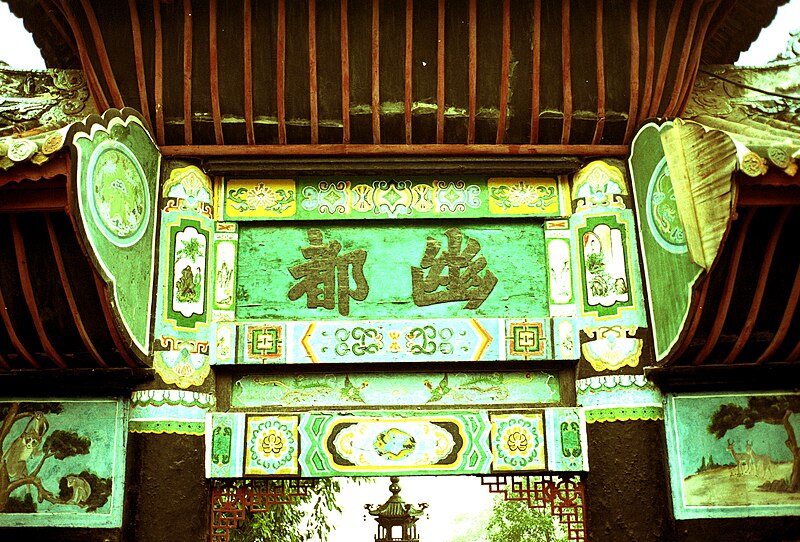
The Capital of Hell: The gate to the capital of the underworld, Youdu (right to left: 幽都). The whole underworld is called Diyu that is displayed in Fengdu Ghost City./source
After the building of Three Gorges Dam is built the Fengdu Ghost City will be an Island of itself, but parts of the city will be submerged in the water. They have also made some recent addition to the city.
In 1985 they built the Last Glance Home Tower, and according to legend, this is where the dead can have one last look back at their home and families before crossing over. Maybe one day, the Fengdu Ghost City itself will be something more of a legend than an actual place.
Light your lanterns, put on your Yukata and get ready for The Ghost festival in Japan called The Obon Celebration. The festival, also known as Bon festival is a three day long festival each year in the late and hot summer to honor the dead.
Why is every Japanese ghost story set during the hot and humid summer nights? It’s not really, but a staggering amount is and there is a reason for it!
Beautiful lanterns: Bon-odori festval at Higashiyama Onsen (Fukushima) 17 August 2009. Photo by: Yoichiro Akiyama/source
In mid July you can hear the sound of wind chimes and there is shaved ice on every corner in the summer heat with people wearing their traditional Yukata. Perhaps coming from or going to one of the big parades? The cicadas sings and the Japanese takes the time to tell their many ghost stories in the hot summer nights.
Fun fact, some says that telling a chilling ghost story in the hot humid summers in Japan, will help cool you down, because of the goose bumps you get from being scared. And because of that, a trend in the Edo period started with telling ghost stories in the theaters in the summer times, called Kaidan.
The Obon Celebration is not only an ancestral celebration from the old days they keep alive. Horror movies takes over the cinema, Kabuki theaters put on their traditional ghost plays and teenagers dares each other to visit the cemeteries at night, making the whole festival seem very similar to the modern Halloween celebration in the west.
The paranormal hunters are also about, visiting well known haunted locations around the country and the belief in spirits reach an all time high. But there are also less sinister traditions that comes with the festival.
The Buddhist Obon Celebration
So what really is the The Obon Celebration other than watching horror movies, telling ghost stories and ghost hunting? Obon (お盆) or just Bon (盆) is a Japanese Buddhist custom to honor the spirits of one’s ancestors that incorporated the Japanese native folk religion Shinto, differentiating it a bit from the other Buddhist Ghost Festivals from other countries.
The Obon Celebration originated from the Indian and Chinese Ghost Festival during ghost month. There are many variant of this ghost festivals across the Asian continent coming from the same buddhist story.
Read Also: Interested in more haunted Japanese tales? Have a look at all our ghost stories from Japan
The Obon Celebration is one of the few events on the Japanese calendar that focuses on the importance of family and is there to give the families in Japan time together. It is not a public holiday, but customary to be given leave to travel to your hometown, back to your family. Both the living, as well as the dead.
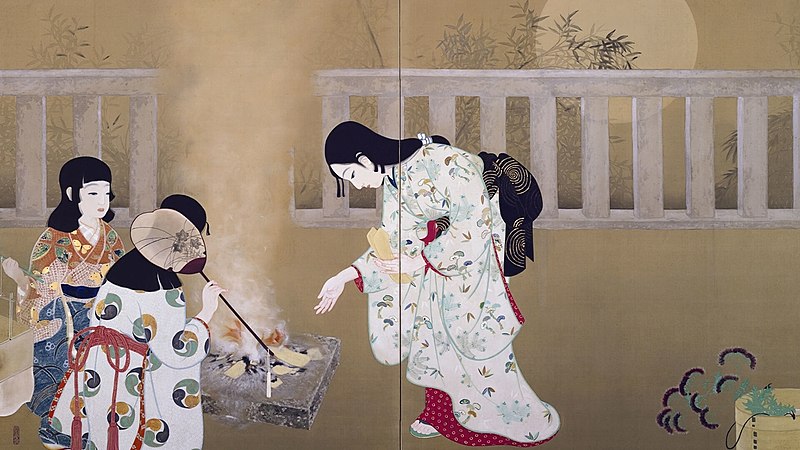
Welcoming the Dead: “Bonfire for the Spirits of the Dead (Okuribi)”, two-panel screen, Color painting on silk from 1916. Showing how the Japanese light fires to welcome the spirits of the dead during Obon in a ritual known as Mukaebi.
When is Obon Celebrated?
The Obon Celebration has been going on every summer for over 500 years. The exact dates changes according to where you live though because the lunar calendar was changed in favor to the Gregorian calendar instead. During these days the employers often grant their workers and the trains, planes and busses are filled with people out in the countryside to celebrate it with their family or into the cities to join the big parades and happenings throughout all big cities.
In eastern Japan, it is held 15th of July, but in the western part it’s held on August 15. However, in Okinawa and the Amami Islands it’s different again and follow the Chinese way to celebrate on the 15th day of the 7th lunar month like their ghost festival. In common though, the festival lasts for three days and the official Obon holiday is from 13-15 July.
Visiting the Grave: A huge part of The Obon Celebration is going home and visiting the graves of your ancestors, clean them and make offerings to them throughout the festival before sending them back to the afterlife.
It is believed that during these three days the ancestors spirits return to the world to visit their relatives. In this time the veil between the spirit world and the world of the living is at its thinnest and therefore the spirit can pass through.
How do the Japanese Celebrate Obon?
To prepare for the return of the ancestors during the The Obon Celebration, the Japanese clean the grave sites in a ritual called Haka Mari. From the newly cleaned graves it gives a path to them back to the house in a ritual called mukae-bon. A spirit altar is put up back at the home and offerings like fruit, flowers and incense is given.
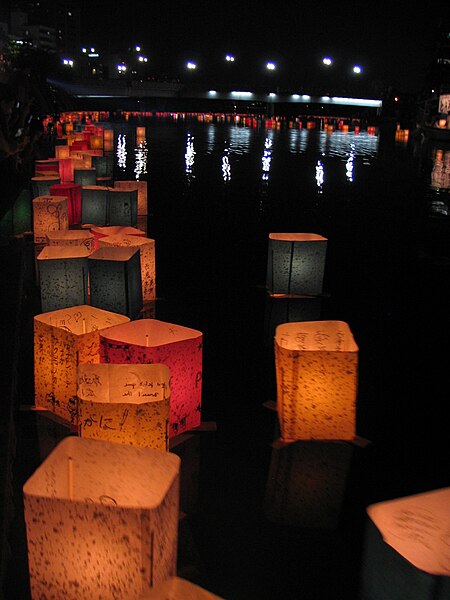
Floating lanterns: Tōrō nagashi float in the river in Hiroshima, as part of the Hiroshima Peace Memorial Ceremony in 2009. Photo: 藤谷良秀(Yoshihide Fujitani) /source
The Obon Celebration begins with Mukaebi, which is a ritual of lightning fires to guide spirits home for the duration of the festival. Often in the form of lanterns hung in front of the houses.
In this way the Obon Celebration reminds much of the western All Saints Days or Halloween celebration as it is believed the veil separating the living and the dead world is thinner and it’s a time for hauntings and ghost roaming the world.
The lanterns most often used is the traditional paper chochin lanterns, but how you use these lanterns and were is very different from region to region.
In some regions of Japan they light up huge fires outside the houses instead of lanterns. Like they do in The Daimonji Festival in Kyoto were they light up series of , 200m-long, character-shaped bonfires built on mountainsides.
When the Obon Celebration ends, the chochin lanterns is often used to guide them back to the spirit world, a ritual called okuri-bon.
On the final evening of the Obon festival it is thought that placing floating lanterns down the rivers will help guide the spirits back to the spirit world if you live close to a river or some sort of water. This tradition has gained a lot of popularity in modern time.
This ceremony is called Tōrō nagashi 灯籠流し, but the custom of sending floating lanterns during the Obon Celebration differs from place to place. The largest floating lanterns event though is in Hiroshima and Nagasaki to commemorate the victims of the atomic bombs during the second world war.
Welcoming and Feeding the Hungry Ghosts
One of the things The Obon Celebration is for, is to ease the suffering of spirits. To do this they have to perform the ritual of segaki 施餓鬼, meaning feeding the hungry ghosts, otherwise known as a vengeful spirit, or in the western tradition: a poltergeist. It is a ritual of Japanese Buddhist tradition.
During the festival, the ritual is performed at Buddhist temples and more offerings are given to the hungry ghosts: Rice and water. This is for the muenbotoke, or the ghosts with no living relatives that have no one to welcome them.
The food served is often vegetarian and a thing eaten much of is sticky rice balls called ohagi and odango.
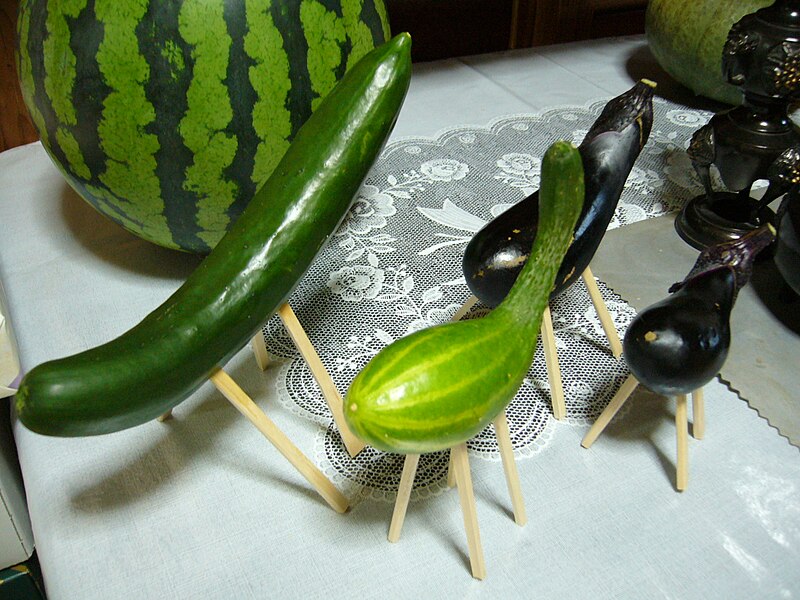
Another significant ritual people do during the Obon festival is to craft a cucumber horse and eggplant cow, known as shōryō uma (精霊馬, “spirit horse”) or ushi uma (牛馬, “cow horse”). This type of carved food works almost as a vessel for the ancestors to come back home when the festival starts and return when it’s over.
Food Offerings at the Alter: Cucumber and Eggplant crafted as a vessel so the spirits can come and go during the Obon Festival //Source: Wikimedia
The Buddhist Dance from the Spirit Realm Bon Odori
But exactly why do the Buddhists and buddhism influenced places celebrate the dead during this time? It is best seen through one of the ways the Japanese celebrate.
The Bon Dori Dance 盆踊りis a dancing style performed during The Obon Celebration. It comes from the story of Maha Maudgalyayana, or simply Mokuren which was the incident that made people celebrate the ghost festival in the first place. He was a disciple of Buddha and used his powers to look into the spirit realm. There he saw his mother, and saw she had become a hungry ghost.
He asked Buddha what to do and Buddha said to give offerings to the monks that completed their summer retreat on the 15th day of the 7th month. Mokuren did it and it worked. His mother was freed from the suffering of being a hungry ghost. He burst out dancing from pure joy.
Bon Odori Dance: This is a scene from one of the dance festival at the Hanazono Shrine, Shinjuku, Tokyo city. They are celebrating The Obon Celebration. Yukata-clad people dance in circles around the yagura as the music plays just as Maha Maudgalyayana did when he saved his mother from the afterlife as a hungry ghost.
The dance has so many variations and each region perform their local dance with their own music, however, the Japanese taiko drum is often used to the melodies of old folk songs.
There are several big parades showcasing the Bon Odori dance during the Obon Celebrations. The Tokushima Awa Festival (阿波踊り) is perhaps the most well known bon odori dance that draws millions of visitors to Tokushima to watch and join the huge parades in the city. There are the also Gujo Odori Festival in Gifu (郡上おどり) and the Akita Bon Odori Nishimonai Festival (西馬音内盆踊り). These are all well known for their Bon Dori during the ghost festival, but it is held smaller Bon Odori dances as well everywhere.
Since the celebration and all its customs is so different from region to region, the dance will look so different as well. But very often it is people lining up in a circle around a wooden scaffold made for the festival called Yagura. The dance can also include the history of the region as well. Like mimicking fishing in fishing areas, dance moves reminding of digging in coal mining areas and the likes. What they have in common though is their intent is to honor their ancestors and those that came before us.
Things to Watch out for During the Ghost Festival
Although mostly a family holiday and a time to spend with your family and religious days of remembrance and folk festivities, there are also several superstition that are said to be remembered during the days.
The first rule during Obon to beware of is to not take pictures during the night so not to capture a ghost. Perhaps a bit difficult because of all the festivities people take a photo of to remember.
It is also said not to swim as it is more likely to be drowned by a ghost. Do not steal the food offering to the hungry ghost of obvious reasons. Do not hang your clothes out to dry in the night as iit believed that the dead will wear them and don’t put the slipper heals towards your bed. Ghost will find your bed and climb into it, causing sleep paralysis.
All in all, do not do anything but being respectful to the dead during the Obon Celebration.
An online magazine about the paranormal, haunted and macabre. We collect the ghost stories from all around the world as well as review horror and gothic media.