Tag Archives: afterlife

The Haunting Mystery of Ka’ena Point State Park: A Portal to the Afterlife

Advertisements

At first sight the end of the Ka’ena Point State Park seems like just as any tropical paradise in Hawaii. But behind the beauty are the legends, and this end of the trail is believed to be the portal to the afterlife and where wandering spirits not accepted are left to roam. 

At the westernmost tip of Oahu, Ka’ena Point State Park is a windswept and rugged coastline that offers visitors a glimpse into the untamed beauty of Hawaii. Known for its stunning vistas, wildlife, and serene beaches, this remote destination is also shrouded in mystery and folklore, not too far from the bustling big city life of Honolulu. 

Read More: Check out all ghost stories from the USA

According to Hawaiian legend, Ka’ena Point at the westernmost tip of the island is more than just a beautiful landscape—it’s a sacred place where souls depart from the earth, known as a “leina a ka uhane,” or a portal to the afterlife.

Steven Pavlov/Wikimedia

A Place of Beauty and Adventure

Ka’ena Point State Park, accessible from both the Waianae Coast to the south and Mokuleia on the north shore, offers a scenic escape from the more crowded parts of Oahu. The area is best known for its rugged hiking trails that meander along dramatic sea cliffs, offering panoramic views of the Pacific Ocean after trekking the last bit by foot. Hikers often come across native Hawaiian plants and seabirds, such as the Laysan albatross and wedge-tailed shearwaters, which nest along the shore.

Read Also: The Haunted Banyan Trees on Manoa Falls Trail

While visiting Ka’ena Point, you can explore its stunning landscapes, enjoy birdwatching, fish off the shore, or simply take in the breathtaking views of the waves crashing against the rocks. A popular activity is hiking the Ka’ena Point Trail, which is relatively flat and easy to navigate, leading you to the tip of the island where the terrain becomes more rugged and mysterious. But for those who are aware of the ancient legends, this seemingly serene landscape holds much deeper, spiritual significance.

Steven Pavlov/Wikimedia

The Legends of Ka’ena Point

The place is considered the most holy place perhaps on the island and has been used for thousands of years, both as a fishing place as well as a place for ceremonial things.

Once upon a time, the goddess who created the Hawaiian Islands had a male relative, perhaps a brother or a cousin. He traveled to this point and stayed, naming it ka’ena after himself, which means red hot in Hawaiian. 

In Hawaiian folklore, Ka’ena Point is considered one of the most sacred places on the island, believed to be a “leina a ka uhane”—a jumping-off place for souls leaving this world. According to legend, when a person dies, their spirit wanders the earth, searching for a “leina a ka uhane” to make the final leap into the afterlife. Ka’ena Point, with its remote and otherworldly atmosphere, is said to be one such place.

Leina Kauhane: (meaning “leaping place of ghosts”) is white rock located approximately 0.4 mi (0.64 km) offshore on the northwest area of the Hawaiian island Oahu. It is noted in Hawaiian folklore as the point where souls of the dead journey into the afterlife (Lua-o-Milu) and overlook the ocean. // Wikimedia

It is said that first the wandering spirit who has left its body reaches a fishing shrine called hauone. If everything the spirit has done during its time on earth checks out, its purpose is fulfilled and allowed to cross over. 

The specific location for the leap is marked by a formation known as “Ka leina a ka uhane,” or “the leap of the soul.” This area, also referred to as White Rock due to a large limestone formation on the northern side of the point, is believed to be where souls gather before taking their final journey into the unknown. 

When reaching this point, the spirit is met with two gods who throw them into Lua a Kehana, a gigantic pit where death is finalized and the spirit must wander to Na ulu o lei walu for its final judgment. The good go right, the bad go left. 

Departing souls either passed into one of several spirit realms or were returned to the body to continue life. The fate of these souls often depended on the help or absence of friendly ‘aumakua (ancestral family or personal god) that would guide a soul to the appropriate realm: ao kuewa, a place of wandering souls, ao ‘aumakua, where the soul could be reunited with the souls of ancestors, or au milo or pō pau ‘ole, a place of eternal night.

Locals and visitors alike have reported feeling a profound sense of spiritual energy in this place, as if the souls of the departed are still lingering, waiting to take their final leap into eternity.

A Portal to the Afterlife

There is also a warning associated with Ka’ena Point: visitors are advised not to take anything from the area, especially stones or shells. The belief is that taking anything from a sacred place could result in bringing a spirit back with you, a wandering soul that is desperately seeking its way home. The energy of Ka’ena Point is said to cling to objects, making them a conduit for restless spirits.

Source: Wikimedia

So, if you find yourself at the edge of the island, looking out over the endless expanse of ocean, remember the legends of Ka’ena Point. Feel the wind on your face, listen to the waves crashing against the rocks, and know that you are standing at a place where the veil between this world and the next is thin—a place where the souls of the departed gather, waiting for their leap into the afterlife.

Newest Posts

References:

Kaena Point: Hawaii’s Leaping Point to the Spirit World

he moʻolelo ʻāina no kaʻena, waialua, oʻahu “a land story for kaʻena

Ka’ena Point State Park, Oahu

The Haunting Legends of Polihale Beach and the Cliffs of Ha‘ele‘ele

Advertisements

It’s not only sandy beaches and blue water you can find at Polihale Beach on Kauai. If you go far enough out, legend has it you can also find the cliffs of Ha‘ele‘ele, the gateway to the afterlife. 

Polihale Beach, a stunning and remote stretch of sand on the western edge of Kauai, known as the Garden Isle, is not just a place of breathtaking sunsets and endless waves. It is also a place steeped in ancient Hawaiian legends, where the boundary between the physical world and the spirit realm is said to be thin.

Read More: Check out all ghost stories from the USA

The Polihale Beach is also the longest beach in Hawaii, stretching for 17 miles, and in the dunes remains of bones and ancient temple ruins shows that this was a place of great importance for the Hawaiians throughout history. 

Polihale Beach: Meeting the rocky cliffs of Ha‘ele‘ele, Polihale Beach are said to be haunted by the spirits trying to cross the portal to the afterlife said to be on the cliffs. // Erich Geist/Flickr

The Sacred Cliffs of Ha‘ele‘ele

At the far end of Polihale Beach, the cliffs known as Ha‘ele‘ele rise dramatically from the shoreline. To the ancient Hawaiians, these cliffs were far more than a natural wonder; they were the “jumping off point” for spirits, or ‘uhane, leaving this world. The very word, Polihale means the underworld or sacred ruins. 

According to legend, when a person died, their spirit would journey to these cliffs to leap into the afterlife and join their ancestors. For those fortunate enough to have an ‘aumakua, or family of spirits, waiting for them, the transition was peaceful, a return to the embrace of their forebears.

But not every spirit finds a warm welcome on the other side.

The Wandering Spirits of Polihale Beach

For the unfortunate souls who arrived at Ha‘ele‘ele with no ‘aumakua to guide them, the cliffs of Polihale became a place of restless wandering. These lost spirits, unable to make the final leap, would attach themselves to the rocks, plants, or even travelers who dared to disturb their resting place. It is said that these wayward spirits, frustrated and lost, can cause mischief for the living, bringing bad luck or even sickness to those who unknowingly take them from their place of haunting.

Beware of What You Take

Local lore strongly warns against removing anything—especially stones—from Polihale Beach or the surrounding cliffs. Many believe that by taking a rock or a piece of the landscape, you may inadvertently bring back a spirit longing to return to its sacred home. These spirits, desperate and confused, might follow you, causing eerie disturbances in your home until they are properly returned to where they belong.

Polihale Beach: Pete Harmer/Flickr

Visitors who have ignored these warnings have reported strange occurrences—unexplained noises, sudden illness, or a feeling of being watched. Some have even felt an overwhelming compulsion to return the stones to Polihale, finding peace only when the spirits are back where they belong.

A Place of Beauty and Mystery

Polihale Beach, with its miles of golden sand and majestic cliffs, is undoubtedly one of Kauai’s most beautiful and enigmatic places. But it is also a place where the past lingers, where the spirits of the ancient Hawaiians continue their eternal journey. Those who visit are reminded to tread lightly, respect the land, and above all, leave behind what belongs to the spirits. The cliffs of Ha‘ele‘ele are not just a gateway to the afterlife; they are a reminder that some parts of Hawaii are touched by the supernatural, where the unseen world is always close at hand.

Newest Posts

References:

Is Arch Rock One of the Reasons Mackinac Island is so Haunted?

Advertisements

Many legends are told of the Arch Rock on Mackinac Island and its origin. Thought to be a portal to the afterlife, many people tie the many haunted ghost stories from this little island to the legends behind this mysterious rock formation. 

In the glistening waters of Lake Huron between Michigan’s Upper and Lower Peninsulas, Mackinac Island is a serene retreat known for its picturesque beauty, historic charm, and an eerie reputation for the supernatural. In fact, Mackinac Island was called the most haunted town in America in 2021, with many stories having been covered over the years. And with only a full time population of around 583 people, the ghosts perhaps even outnumber the living. 

Read More: Check out all ghost stories from the USA

With no cars allowed and transportation limited to bicycles and horse-drawn carriages, the island offers a unique step back in time. Some come to enjoy the quiet seaside and enjoy the famous fudge. The island has become a perfect summer destination for Americans, but after the tourists leave in the fall, the fog from the Straits comes rolling in, and the leaves turn color, the ghost of the island remains to haunt it. 

The Arch Rock: A place of legend on Mackinac Island. The Arch Rock are said to have been a portal to the afterlife, where spirits on the other side could come and the living could go.

A Brief History of Mackinac Island

Mackinac Island’s history stretches back thousands of years, with indigenous peoples such as the Odawa, Ojibwe, and Huron considering it a sacred place long before European settlers arrived. The island’s name itself, derived from the Ojibwe word “Michilimackinac,” means “big turtle,” referring to the island’s shape when viewed from above.

Read more: Check out all ghost stories from Mackinac Island

The French established a fur trading post here in the 17th century, and the island later became a strategic military outpost during the Revolutionary War and the War of 1812. In the late 19th century, it became more of a summer colony and a tourist destination that it still is. 

The Arch Rock and it’s Legends

Many believe that many hauntings on Mackinac Island come from the stored energy the island holds. Some believe that the energy is stored inside of the many limestone and quartz the state park has. One of these places is the rock formation on the east coast of the Island called Arch Rock. 

It is one of the more famous places to visit on the island, arching 140 feet above the water of Lake Huron and is more than fifty feet wide. 

It is not only in recent times that people have begun talking about energy coming from the stones. Archaeologists have found evidence for the island being inhabited since AD 900, 700 years before any European settlers put their foot on the land. 

The Legends of the Arch Rock

Over the years the rock formation took place in more than one legend. One tells of the Ottawa nation committing a shameful act once upon a time, so shameful that the Master of Life punished them for it. He sent a wind to earth, so powerful, the rocky hills trembled for a whole day, even blowing the sun away. The Ottawa nation could only watch as when the sun turned into the color of blood before falling into the island, carving a hole through it, making an arch. Ever since then, the Ottawa have kept away from the rock and not even the bravest of them all walked over it.  

The Anishinaabek natives have long roots to the island and used to believe that the Arch Rock was a portal to the afterlife. According to their belief, it worked both ways. People would be able to cross over into the spirit world, and the spirit could return to the world of the living. 

The Anishinaabe people believed the island to be the home of the Gitche Manitou, or the Great Spirit. This was said to be the first land to appear after the Great Flood, and was a gathering place for tribes who made offerings to Gitche Manitou and a burial place of tribal chiefs. 

The Legend of She-Who-Walks-Like-The-Mist

One of the famous legends comes from a book by Dirk Gringhus’s, The Lore of the Great Turtle about an Ojibwe Chief and his daughter called, She-who-walks-like-the-mist, or ‘Mist Woman’.

Misty was a beautiful woman, always smiling as she went about her chores, although she rejected every suitor giving her gifts. One day, her smile faded, and she didn’t do her chores as she used to, only sitting down and looking miserable. 

The chief wanted her married and angry that she didn’t care to make an effort. He asked her what’s the matter. She answered that she would only marry the Sky Person:

“Two moons ago…..a handsome brave appeared to me…..‘Oh, lovely one,’ he said. ‘Long have I watched you in the village wishing that you might be mine for all time. In my home, high above you, I am the son of a chief, Evening Star, and therefore, a Sky Person…..(I descended) to earth that I might ask you to join me in my sky home.’”

“You should marry no one at all then!” her father said and put her in his canoe and paddled out to the Island of Turtle Spirits we today know as Mackinac Island, already a holy place for the natives.

He took her to the rocky formation and said she had to stay there until she was ready to obey him. She didn’t fight or move, only cried, her tears turning into an arch as she mourned her loved one she didn’t believe would come. One night however, the stars shone so bright it was a ray of light through the arch and the Sky People came down for her. He picked her up and carried her home to live in the sky for all its time. 

Ties with Freemasonry

Also when the Europeans arrived, there was a lot of mysticism over the place. The mysterious Freemasonry came to the Great Lakes region in the 1700s and built lodges around the area. Mackinac Island was home to St. John’s Lodge No. 15 (1782–1813), holding meetings at the newly constructed Fort Mackinac in the rooms in the Officers Stone Quarters. 

What really happened when they arrived is unknown as there are few records of the lodge in existence.
Was it only a boys and mens club for the military people stationed there? Or something else? The second Masonic Lodge was Mackinac Lodge No. 71, operating as a so-called moon lodge, with meetings on Monday evenings on or proceeding full moons until the 1860s.

The Haunting of Mackinac Island

For those believing in the paranormal, the Arch Rock is often said to be one of the sources of whatever strange things happening on the island. Truth is, going back to before the Europeans settled here, the whole island was considered somewhat holy to the local tribes. 

This is were they came to make offerings to Gitche Manitou or the Great Spirit they believed created the island and whose home it was after the Great Flood receded. Today the island is considered to be the home of more spirits than living. 

More like this

Newest Posts

References:

Is Mackinac Island Haunted? The Haunts of Mackinac in 2025 – Wandering Michigan Wisconsin

Early Accounts of Arch Rock – Mackinac State Historic Parks

Arch Rock on Mackinac Island

A Bridge to Another World: Mackinac Island’s Arch Rock – MiCannaTrail 

Mackinac Island – Wikipedia 

Top Korean Horror TV-Series

Advertisements

The last few years, K-dramas has certainly taken over much of the media the world consume today and that goes for the Korean horror TV-Series as well.

Although it is largely remembered from the overly romantic dramas with umbrellas in the rain and watching over people with a cold like they are on their deathbed, some more darker series has caught on. In fact one of the more famous k-drama must certainly be the zombie driven historical drama Kingdom that entered as Koreans first entry to the Netflix family. And since then, the gems keeps on coming. Here are ten of the more darker k-dramas out there.

Revenant |악귀 (2023)

This slow burn ghost story is based on Korean folklore. It follows a professor in folklore (Oh Jung-se) who can see ghosts that teams up with a young woman (Kim Tae-ri) after her father dies in what seems to be a suicide. But strange things starts to happen to her and it turns out she is possessed by a vengeful ghosts, and that the string of mysterious suicides that happens around them is something much more horrifying.

Strangers From Hell | 타인은 지옥이다 (2019)

With a top stellar cast of Im Shi Wan (Run On) and Lee Dong Wook (Goblin), this had to be an iconic duo. The series is a trippy Korean horror TV-Series quest for a poor writer to distinguish between what is and isn’t real as well to figure out his true friends he can trust is. When he moves into a cheap hostel, Eden Gosiwon, he has to deal with the truly creepy residents he has to share kitchen and bathroom with. But although he hates it, he endures it to he has enough money saved up to move to something better in Soul. But then he starts fearing for his life when strange occurrences keeps happening around him.

Advertisements

All Of Us Are Dead | 지금 우리 학교는 (2022)

This is another zombie series for Netflix that rose to the top streaming, even more so than the hit series, Squid Games. It is an adaptation of the popular webtoon of the same name and are now one of the biggest Korean horror TV-Series. A seemingly normal day at school that ends in an international disaster as a rabid zombie outbreak starts from the schools science lab. The student quickly learn that they are all on their own and must escape so not turn to one of the living dead. This is a gory series that doesn’t shy away from blood, violence and deeply flawed human beings with a twist on the zombie lore.

NB! Confirmed for more seasons!

Advertisements

Hotel Del Luna | 호텔 델루나 (2019)

A series that managed to balance the campy romantic side of classic k-dramas with the gory horror of ghost is Hotel Del Luna and not purely a Korean horror TV-Series. Although the plot is not that terrifying, some of the characters and ghosts in the hotel definitely are. Super Idol K-Pop star IU stars as the greedy CEO, Man Wol, for a hotel that only caters to the dead to help them cross the bridge to the afterlife. Chan Sung is forced to manage the hotel as his father sort of sold him of to Man Wol as a child. And together they have to manage the hotel together as well as solve the mystery as to why Chan Sung keeps reminding Man Wol of her ex that betrayed her many years ago.

Advertisements

Sell Your Haunted House | 대박부동산 (2021)

If nothing else, this is a great business idea. Ji Ah runs the company, Deabak Realty, specialising in selling haunted houses. A handy thing as she got her exorcism abilities from her mother (who btw haunts her daughter). She needs an assistant and meets the conman In Beom. He specializes in selling stuff that apparently exorcises ghosts, although it’s mostly junk. But together they team up to sell houses, exorcise vengeful spirits and deal with their pasts filled with sorrow in this action packed Korean horror TV-Series. 

Advertisements

Bring It On, Ghost | 싸우자 귀신아 (2016)

The cuter entry on the list is Bring it on, Ghost. Although it contains its fair share of ghosts, gore and dead cats so it falls into the Korean horror TV-Series. The series certainly hit its audience, and there is already a Thai adaption of the series. A college boy works as an exorcist part time. On a job he faces a teenage ghost that he accidently kisses, making her regain some part of her memory she searches for in the afterlife. Together they try to piece together the mystery behind her death as well as the strange stuff happening around the college he attends.

Advertisements

Kingdom | 킹덤 (2019)

The mega series helped turn the tide for Korean horror TV-Series and certainly the interest in Korean zombies. A mysterious illness has befallen the king in a fictionalized version of Korea in the Joseon area. The illness of zombification is spreading throughout the kingdom and the crown prince travels out from the castle to solve the mystery behind his father’s ailment. Out there he finds a kingdom in disarray and hoards of zombies threatening the whole kingdom he was born to protect. With its two season wrapped story it looks like this is the whole of it, but with sidequel/prequel like movies like Kingdom: Ashin of the North, and the original cartoon with its specials, who is to say this is the end of the franchise?

Advertisements

Sweet Home | 스위트홈 (2020)

This monster flick is truly on testosterone with the most crazy characters and designs for monsters roams freely in this damp and shabby residential building. This Korean horror TV-Series is based on the famous korean webtoon. A strange virus that turns humans to monsters has taken over the world. In a residential building a reclusive teen lives in isolation. But as the dangers of the virus threathernes everyone around him, he must come out of his shell and help fight back for the human survival.

Advertisements

The Guest |  손 (2018)

A young shaman, Yoon Hwa Pyung, learns about the demon named “son”, (meaning guest) in this Korean horror TV-Series from 2018. The demon is a danger to everyone and leaves a trail of corpses. The young shaman meets up with a catholic guy and the daughter of a detective when their families are killed by a demon. Twenty years later they meet up again when the killings start once again. This time, to work together to bring down the demon.

Advertisements

Possessed | 빙의 (2019)

A classic detective meets a medium to hunt down criminals in this Korean horror TV-Series. They meet when the detective is working a case and he immediately takes an interest in her. With both of their abilities, they start to solve cases together. One of the more divisive shows as many watchers found the k-drama way to dark for their expectations and for some it was right up their alley. Decide for yourself.

Advertisements

Missing: The Other Side | 미씽: 그들이 있었다 (2020)

This is one of those rare cases were a k-drama actually gets a sequel with a second season confirmed. The first season started with a small village named Duon Village, that holds the spirits of missing and deceased people were they gather. A group of a fraud man, detective, a hacker and a mysterious man teams up to solve the mysteries behind the strange village and to find the missing people.

Advertisements

Night Watchman’s Journal | 야경꾼일지 (2014)

One cannot complete a k-drama list without a historical drama on the list from the Joseon period, that is the law! And here comes the Night Watchman’s Journal in as a ghostbuster story in hanbok in this Korean horror TV-Series. With the backdrop of the royal palace, a group of guys spends their time fighting demons and vengeful spirits as well as dealing with the living trying to usurp the king.

Advertisements

More like this

Newest Posts

References

Fengdu Ghost City

Advertisements

The Fengdu Ghost City in China is steeped with the paranormal and cultural afterlife as well as being a big tourist attraction. Check out how the afterlife could end up after your death for the cost of a ticked.

In the Chongqing region in China, at the lean for the Tibetan Plateau and along the Yangtze river. Far from the sea, at the heart of the country, the city for the dead is built: Fengdu Ghost City 丰都鬼城, is a sort of Chinese type of Necropolis and its said this is the place where the devil lives according to local folklore. This city dedicated to its demons and ghosts also works as an amusement park for curious tourist wanting a trip to commercialized hell as well.

Read More: Check out all our collection of ghost stories from China

The strange and peculiar nature of Fengdu Ghost City really leaves the question of: How do you really combine the experience of the eternal afterlife at the price of a ticket? Is it more of a philosophical learning experience or more like a warning of what could happen if you don’t lead your mortal life right?

The King of the Underworld: This statue leading into Fengdu Ghost City is in the Guinness world records for being the largest sculpture carved into a mountain, depicting the King of the Underworld and welcomes those visiting the city./source

People in China follows a lot of different religion, even though religion is officially banned in the country. To Chinese folk religion, Confucianism Taoism and Buddhism, the place is steeped in religious practices and perhaps this is why the way to the afterlife is so important.

Read More: Another haunted town in China is The Ghost of Khar Khot, The Black City in the Gobi Desert

The Gates of Hell to Fengdu Ghost City

On the north bank of the Yangtze river, shrouded in smog and clouds, the Ming Mountain peaks out on clear days. At the Ming Mountain, shrines, monasteries and temples have been built in honor of the underworld over centuries with cute names like “Last Glance at Home Tower,” “Nothing-to-be-Done Bridge,” “Ghost Torturing Pass”.

The place were the Fengdu Ghost city is built on today used to be an ancient burial site with its shrines and temples and an ancient town. It had to be rebuilt further and further uphill in the mountains as the water from the Three Gorges Lake kept rising. So what is this place in all its honesty?

Fengdu Ghost City is the Gate of the Hell in traditional Chinese literature and culture. The city itself is mention in the great folk tales of Chinese tradition such as in Journey to the West, Apotheosis of Heroes and Strange Tales of a Lonely Studio, all three works is a big part of Chinese literature and cultural heritage and have a direct reference to the place.

Read More: Take a look at all our ghost stories on Haunted Towns and Cities

To call the Fengdu Ghost city a proper city is perhaps a bit misleading as it mainly function as an amusement park and there is no one living there anymore. Well, except from the ghosts and the demons it is built for of course. When you are entering the city, you are passing statues of the Heibai Wuchang (黑白无常), which are two Chinese mythological deities in charge of escorting the dead to the underworld. Then you are at the mercy of the demons that exists in the underworld and your own effort on getting out of there.

To get into the city you have to get a ticket at the counter ahead and it tended to be around a 100 RMB per ticket. They used to have customers put money into a water-filled basket as they believed that the paper money would float if they were human and sink if they were ghosts.

How Old is the Fengdu Ghost City

To be called a ghost city, the place, the statues and the temples must be pretty old, right? Well, according to legend the location where the city is built certainly has an old story. Today, some of the building have been rebuilt or added on in modern times, and some of the oldest have been there since previous dynasties.

The story of Fengdu Ghost City goes back for nearly 2000 years according to the legend. It is said that the city got its reputation as a place for dead people and the king of hell during the Tang Dynasty (618-907 AD).

The Fengdu Ghost City got it name in the Eastern Han Dynasty period  (206 BC to 220 BC), when two men came to the Ming Mountain to practice Taoism and to live as recluses away from the big society. The two men, Yin Changsheng and Wang Fangping ran away because they were bored of the political life and lived their life practicing taoism at their own accord in the alleged haunted mountains. According to legend they became immortal and the legend of the strange things happening there kept piling up.

Temples of the Ghost City of Fengdu: A classical Chinese building you will find at most historic sites, here are they all built in honor of the dead though. Many of the temples and shrines are built and dedicated to deities, demons and lords of the underworld and afterlife. They are open to visitors and tourists every day.//Source: Flickr

Word soon spread of this no small feat that two men had reach the stage of immortality and people came to seek what they had found. Their two names, Wang and Yin combined means King of hell or King of the Underworld. And this was the beginning of the focus of the underworld, and the building of Fengdu Ghost City started and continues to grow today.

Read More: Another alleged haunted mountain is the story of The Accursed Mountains of Albania

The city we can see and visit today though wasn’t really built into the mountain before the Three Gorges Dam project was started in the early 1900s and built slowly over the course of the century. Because of this massive project they had to build Fengdu Ghost city higher up because of the flooding the dam caused to the area around.

The Ghosts and Demon of Fengdu Ghost City

So what do you do in a city built for ghosts? This particular place could perhaps work for just its vibrant green scenery. Perhaps the main purpose of the park is helping people learn of the old belief system of what comes next after death. One thing at the park at least is testing your living self of the trials the dead spirits can come face to face with in hell.

Ghost Statues: Examples of the ghosts statues one can see in the Fengdu Ghost City. This is the statue of the “wreath-eating ghost” (食蔓鬼). In legend, this ghost was a girl who adorned herself with flower wreaths she stole from statues of the Buddha. After she died, as punishment, she was not allowed to feast on food offerings from living people and could only feed on flower wreaths/source

Walking in the Fengdu Ghost City there are all reference to the afterlife in terms of architecture and decorations in the city. The statues all depicts ghosts and devils, representing what happens to people not leading good lives, and how Chinese people saw, and at times, still picture the afterlife. It also showcases what is considered a good moral.

Women being thrown in boiling cauldrons for their sins, children being spanked after being naughty and people being poked, stabbed, tortured and judged for their crimes is some of the attractions you can observe when visiting. Perhaps you will even be condemned yourself. In many ways, just as fun as Disney World, bring the whole family.

Pictures of punishments are big in this city, and the way the Gods tortures the wicked. The pictures hang side by side of paintings of scary demons and bureaucrats passing judgement over the sinners. The eerie pictures fills the walls, the roofs and the gardens across the whole city of ghosts.

Read More: Check out the story about the Chinese hungry ghost in the story of Ghost of Tu-Po — The Hungry Ghost

Side by side with these ancient traditions and buildings is a rather tacky theme park of a standard haunted house with people in masks, just doing their best to entertain their guests. Can it be something more in this day and age were the idea of the afterlife has become rather vague and in the long unforeseeable future? Because it didn’t start out as an amusement park. It started out as a cultural exploration of what hell is and what the afterlife will look like. In many ways, it still is.

The Three Tests to an Afterlife

In Chinese traditions Diyu is some sort of purgatory that punishes and renews spirits to prepare them for reincarnation to a new life. A similar thing is Naraka, a Buddhist concept of hell similar to Diyu. All dead must pass three tests before crossing over to the next life. And at Fengdu Ghost City you can put yourself to the test of how you would do ass you can reach Youdu from here, which is the capital of the underworld.

The first test the visitors have to overcome is crossing the “Bridge of Helplessness”. The object is a stone bridge testing good and evil people. There are demons blocking the passage, letting only the worthy pass. Those who fail are pushed to the water below. The object of the test is to cross the test in fewest steps, and of course, not to fall into the water below. In the Fengdu Ghost City it is now a fun test to do, but it actually stems from an old taoist practice to have a good fortune. This particular bridge was actually built in the Ming Dynasty between the 1300s and 1600s.

After the “Bridge of Helplessness” the dead must continue to the Ghost-Torturing Pass were they meet Yama or Yanluo Wang who is the King of Hell. He is the one passing judgement. In this area there are a lot of sculptures with demons.

The third and final test takes place at Tianzi Palace on top of the mountain where the dead stands on a special stone on one foot for three minutes. Only virtuous people will manage this while evil people will fail and go to hell. Tianzi Palace is the largest and oldest building and it is about 300 years old.

Tourists in Hell and the Ghost City Sinking

In recent years the Fengdu Ghost City has become a big tourist attraction with boats carrying tourists up the river and taken to the mountain where they can walk among the statutes relating to Diyu and Naraka that symbolizes the underworld or Hell in Chinese mythology and Buddhism. It attracts many tourist, curious foreigners as well as Chinese visitors wanting to learn about ghost culture and the afterlife.

Read More: For more Chinese culture concerning ghost and the paranormal, check out the story of Ghost Marriage — The Chinese Way to Marry the Dead

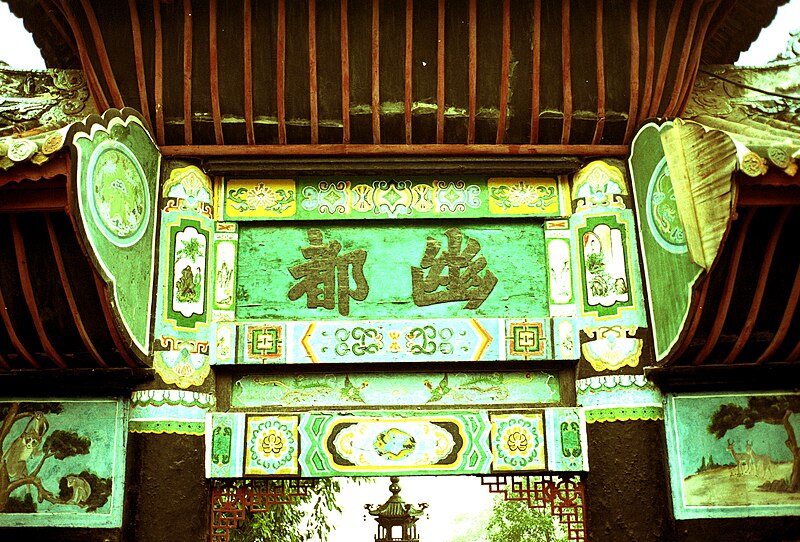
The Capital of Hell: The gate to the capital of the underworld, Youdu (right to left: 幽都). The whole underworld is called Diyu that is displayed in Fengdu Ghost City./source

After the building of Three Gorges Dam is built the Fengdu Ghost City will be an Island of itself, but parts of the city will be submerged in the water. They have also made some recent addition to the city.

In 1985 they built the Last Glance Home Tower, and according to legend, this is where the dead can have one last look back at their home and families before crossing over. Maybe one day, the Fengdu Ghost City itself will be something more of a legend than an actual place.

More like this

Newest Posts

https://www.atlasobscura.com/places/fengdhu-ghost-city

Huaka’i Pō – The Night Marchers of Hawaii

Advertisements

When the moon peak out after the long and sunny days in Hawaii, there are things to beware in the dark like the Huaka’i Pō. The Hawaiian Night Marchers is legend told for a long time, and will continue to be so.

In sunny Hawaii, the island of Oahu is hot, palms swaying in the wind soaking up the sun during the day. Along the streets, people from all over the streets are walking side by side and no one thinks of these modern marches of the modern people. But there are other types of marches that are still held in high esteem by the locals.

The day time Hawaii is a light place, a sunny place. That is during the day. Then the night comes and darkness prevails. You know, the nights are long, even though they are hot and the ghost walks among us, just as any other place.

A majority of Hawaii residents can tell about a supernatural or at least creepy encounter in their life. But these encounters are not only creepy, they are holy. One of the most popular legend to tell is of the Hawaiian Night Marchers, or the Huaka’i Pō.

Huaka’i Pō The Warriors of the Afterlife

The Hawaiian Night Marchers come in groups as they mark their presence by blowing a conch shell, beating their pahu drums, pounding out a rhythm, keeping everyone in the march in line as they chant an oli, giving everyone around a heads up. Make way, a march is on the way.

Pahu Drum: The Night Marchers comes to the sound of drums.

The locals on the Hawaiian islands claim they are the spirit of warriors coming home from, or more ominous, to a battle. Why are they doing this? What war are they still fighting?

Some claim the Night Marchers are the ancestors reclaiming of lost territory, spirits of warriors from a battle gone wrong or spirits avenging their death. And considering the Hawaiian history, the Hawaiian Night Marchers might consider the battle still ongoing.

The spirits of the Huaka’i Pō are the proud Hawaiian warriors, bound to protect their ali’i in life, and the afterlife. They are also said to be spirits, either going somewhere or welcoming new warriors to their beating band.

More than mere ghosts, the Huaka’i Pō reminds more of the wild hunt from European pagan mythology and folklore.

Marching Through the Night

Although some accounts of the the Hawaiian Night Marchers legend have been reported during the day, most Huaka’i Pō is marching through the night. They are recognized with their torches held high and chanting the same olis over and over again.

Perhaps they at first glance just looks like a group of living human beings are doing a traditional march, but when one looks more closely, one can see their feet are a couple of inches above ground. Local accounts tell that the only remains that the Hawaiian Night Marchers ever marched there, is the mysterious footprints in the soil or sand just after passing.

Pathways for the Huaka’i Pō: Along the highway, deep in the jungle, it doesn’t matter, the the Hawaiian Night Marchers will find their way// Photo by Kehn Hermano on Pexels.com

The Night Marches has been documented by white settlers as far back in 1883 by Captain Cook’s arrival on the islands. Hawaiian language was only a spoken one, so this is one of the first written account. But of course, the marches have been going on, long before any white settler put their foot on the islands. And the stories the locals know about, is the ones that have been passed down for generations.

The reports from Captain Cook though, tells of a mighty phantom army, led by spirit of King Kamehameha, marching angrily over the Big Island of Hawaii. In these account, the night marchers were written down as ‘oi’o.

The Hawaiian Night Marchers to Honor the Ancestors

Over the years the marchers have become somewhat of a boogeyman tale for children. But this is not the origin story of them. The Huaka’i Pō are originally holy processions, a manifestation of Hawaiian gods. The Hawaiian also had a strict caste system were the ali’i (chief) passed, commoners was not to look at them. Consequence of disobeying this rule was death.

Hawaiian storyteller and author that has taken a deep dive into the Hawaiian ghost lore as well as the legends of the Night Marchers, Lopaka Kapanui had this to say to OluKai:

The night marchers’ job wasn’t to terrorize people. It was simply to protect the most sacred, high-ranking chiefs (depending on kapu status, the Chiefs marched in front or behind the procession). The night marchers showed mercy by traveling at night to spare people from harm.

Warriors of Hawaii: Night Marchers of Hawaiian legend is not only ghosts and lingering people of people that have died, but have said to also be ancient warriors or manifestations of the Hawaiian gods. /Flickr/Jai Mansson

It is not all cozy history though, as the Hawaiian Night Marchers have been blamed for many accidents of the road. Especially along he Oahu’s Pali Highway after dark, an established pathway for the marches, and there have been reports about car accidents elsewhere as well. Perhaps a note city planners should keep in mind. Listen to the old lores of the land. In any case, just to be safe: Do not travel alone on these paths at night.

Read Also: More ghost stories about Haunted Roads across the world

How to Show the Huaka’i Pō Respect

But what to do when you are out and about and suddenly the drums and chanting of the marchers are heard. How to act when you are in presence of warrior souls?

According to the warnings you must never interrupt these marchers, they have been going on long before your time, and will continue to do so, long after you’re gone. This is a custom that have been in place, even when the Hawaiian Night Marchers was done by the ancient living warriors. It was so sacred, their mission that they could not be interrupted. This is also a theory as to why the Huaka’i Pō are known to travel at night as well, because they disturb less people then.

If you can’t get out in the way before the marchers are right by you, there are some things to keep in mind: You can’t meet anyone’s eye or look at them. Unless some of your relatives are one of the spirits and acknowledged you, you are most likely dead. It is considered a bad omen and bad luck for you, your friends or family.

A foul scent of decay comes before anything else, before anything is seen. the Hawaiian Night Marchers blow their conch shells and beat their drum to announce their arrival. So what to do? Especially if there is a marching path, right through your house?

To ward off the Huaka’i Pō, Hawaiian people plants Ti plants around their home, to keep them away. But if you don’t have time to cultivate plants? It is advised that the best thing is to run and get the hell out of there. But if it’s too late it is advised to crouch down and play dead. Remember, don’t look at anyone. The Night Marchers already have their destination, don’t let it be to you.

Protection from the Night Marchers: The Ti plant of Hawaii is said to have protective abilities on the Hawaiian Night Marchers. Among a lot of ethnic groups in Austronesia it is regarded as sacred and they believe they can hold souls and thus are useful in healing “soul loss” illnesses and in exorcising against malevolent spirits, their use in ritual attire and ornamentation, and their use as boundary markers. Red and green cultivars also commonly represented dualistic aspects of culture and religion and are used differently in rituals. Red ti plants commonly symbolize blood, war, and the ties between the living and the dead; while green ti plants commonly symbolize peace and healing. / source

Where the Hawaiian Night Marchers have been Observed

There are stories about the Huaka’i Pō marching on most Hawaiian islands, but reports tell mostly about places on Oahu. These are some specific locations were it is said that the Night Marchers have a pathway:

La Perouse Bay (Maui) – The Hawaiian name for this bay is Keoneʻōʻio. It has a a lava landscape that according to legends are and have been visited by night marchers.

Kamehameha Schools Campus (Oahu) – In Kapalama on Oahu. This school is over a hundred years and is said to have been visited by the Huaka’i Pō many times.

Kualoa Ranch (Oahu)– It is said to be housing the remains of hundreds of Hawaiian chiefs and the night marchers have been spotted here several times. This is also a place that the car accidents happening have been because of the Huaka’i Pō.

La’ie (Oahu) – Historically this was a city of refuge. A place where criminals were held were they didn’t get harmed and could get out free after a certain time of service.

Oahu’s Highway (Oahu)– once there was a site for a famous Kamehameha battle. Now there are many road accidents attributed to the Huaka’i Pō that are marching through this area.

Kaunakakai town (Molokai) – a sacred temple site of the Ili’ili’opae Heiau is nearby on this small and tranquil island.

When to see the marching of Huaka’i Pō

Although there are no specific days set that limits the night marchers, there are some days of the calendar that seems more important than other for the Huaka’i Pō. That includes:

Po Kane – Nights of the Hawaiian God Kane, the first of the Gods that created the universe. This day falls on the 27th day of the moon cycle of Kaulana Mahina or the Hawaiian Moon Calendar. This is the main day were they say the Huaka’i Pō is about.

Po Akua – 14th night of the new moon has also been a date were they say the Huaka’i Pō is especially active. This is a night were the spirits of chiefs, warriors and aumakua (guardian spirits) march between sunset and sunrise.

More like this

Newest Posts

Sources

  1. https://www.to-hawaii.com/legends/night-marchers.php
  2. https://www.hawaiinewsnow.com/story/27171113/exploring-the-legend-of-the-night-marchers/
  3. https://olukai.com/blogs/news/legends-hawaiis-night-marchers
  4. https://theculturetrip.com/north-america/usa/hawaii/articles/huakai-po-the-legend-of-the-hawaiian-night-marchers/