Tag Archives: 1537

Unraveling the Mysteries of the Haunted Château de Châteaubriant

Advertisements

Step into an ancient castle filled with darkness and stories that will send shivers up your spine of murder and ghosts. Inside the old Château de Châteaubriant there are tales of ghost processions on October 16.

Step into the eerie and mysterious Château de Châteaubriant, a magnificent 15th century castle and one of France’s most haunted sites. Enter its dark and imposing halls originally constructed as a defense against Anjou and the Kingdom of France, laden with dark secrets, to experience an unforgettable journey through time. Learn about its chilling legends, hidden secrets, and unsettling specters that linger in the shadows.

History of the Château de Châteaubriant

The Château de Châteaubriant was first constructed in the 11th century, but was heavily modified during the Renaissance which the architecture bears marks of. 

It was taken over by the French during the Mad War after a siege. Over the centuries, it changed hands many times – from its aristocratic owners, to prisoners of war during the revolution, and back again. 

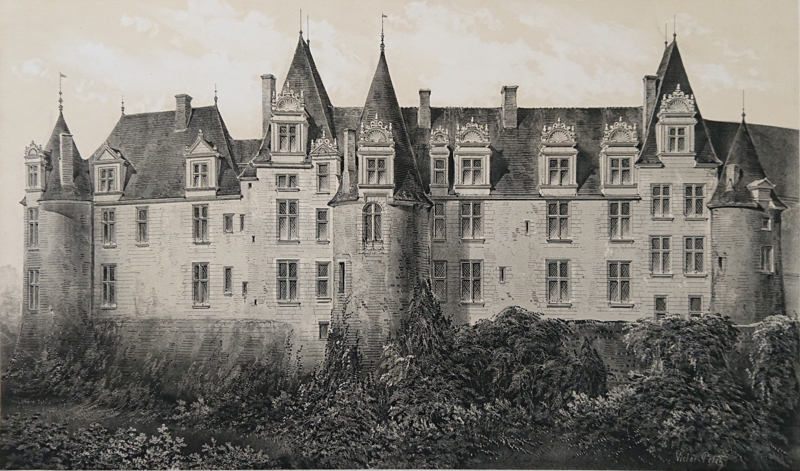
Château de Châteaubriant: drawn by artist Victor Petit in 1871. Already at this point the history of Château de Châteaubriant was old and steeped in legend . It is also said that ghost are walking the halls of the castle every year on October 16th.

Sybille the Shocked Ghost

One of the most famous legends behind the Château de Châteaubriant’s rumored hauntings is that of Sybille, wife of Geoffroy IV. 

Geoffroy IV of Châteaubriant went on crusade to the holy land in the 1250s with King Saint Louis where he was jailed in Egypt after the battle of Mansourah and the entire French army was destroyed by the plague. His death was announced to the Châteaubriant and his wife. 

Sybille, often named Sibylle de la Guerche de Candé started to mourn the death of her dead husband. He wasn’t dead however, and was released from prison and returned to his home and wife a couple of months later. When Sybille saw him again, she fell into his arms and died of the shock. 

She is said to haunt the Château de Châteaubriant at times, but the real haunting is said to be done by the infamous Françoise de Foix, the main mistress of the King of France that did not bear the same loyalty to her husband as Sybille.

The Ghost of Françoise de Foix

In addition to Sybille and other ghosts that are said to haunt Châteaubriant, many also believe in the spirit of Françoise de Foix. She was a tall and dark haired woman that spoke both Latin and Italian as well as writing her own poetry. All of her attributes made her a well sought after woman, and even the King wanted her. 

She was engaged to Jean de Laval, count of  Châteaubriant in 1505 with support of the king and queen Anne de Bretagne and Louis XII. They formally married in 1509 and lived at Château de Châteaubriant.There was a shift in the royals and the new king, Francis I, summoned Jean de Laval to court for his help in 1516. 

Françoise de Foix followed him and became the lady in waiting for Queen Claude de France as well as becoming the chief mistress to King Francis I. At official events she was placed near to the royal princesses, signifying that she was La mye du roi, or the Sweetheart of the King to the rest of the court.

Jean de Laval was sent to fight in the Italian Wars and became Governor of Brittany in 1531. He was aware of the affair but seemed unaffected by it all when his wife remained the King’s mistress for over a decade.

Françoise de Foix was rejected from court in 1525 when the young and blonde Anne de Pisseleu d’Heilly caught the King’s attention and affection. Because of this, she returned to Châteaubriant to live with her husband. 

Killed by her husband Jean de Laval

She died on 16th of October in 1537, most likely of sickness are we to believe some. There is however a different theory. It is said that her husband killed her. 

Read also: This is not the only story of a ghost haunting a French castle after a woman was killed by her husband: The Prisoner of Château de Puymartin

Jean de Laval, also known as John III of Laval-Châteaubriant was according to legend, an incredibly bloodthirsty baron who killed anyone who opposed him and ruthlessly tortured his enemies. 

It is said that he shut his wife in a dark and padded cell and had her killed because of her relationship with the king or something else entirely. Some even think that he locked her up and poisoned her or bled her to death slowly.

The Assassination of Françoise de Foix: The legend of her death are widespread and depicted in art. Here from a book from 1816 by Augustine Gottis.

Ghost Procession at Midnight

Some say they can still hear her weeping within the walls of Châteaubriant and others have even seen her standing near windows or atop towers in traditional 16th-century dress, but perhaps she is best known to appear in the ghost procession on her death anniversary.

Ever since then, there have been a ghost procession in the Château de Châteaubriant in honor of her death on October 16 of monks and knights slowly ascending the main stairs before vanishing. Her ghost is said to come back for this night as the procession begins at the stroke of midnight. 

More like this

Newest Posts

References

Featured Image: source

Françoise de Foix — Wikipédia 

Château de Châteaubriant – Wikipedia

Les fantômes sont des choses qui arrivent – chateau-chateaubriant

Le château de Châteaubriant et la légende de Sibylle

Lady Janet Douglas, Ghost of Glamis Castle

Advertisements

Lady Janet Douglas is said to haunt the Glamis Castle in Scotland after being burned at the stake after being entangled in court politics and being an enemy of the King. 

Glamis Castle is said to have inspired one of Shakespeare’s most famous plays, Macbeth, a play so haunted you are not supposed to say the title out loud inside of a theater. The old castle is located in Angus, Scotland, not far from Edinburgh and is considered one of Scotland’s most haunted castles.  

There are many mysteries surrounding this place, from the monster of Glamis, the ghost playing cards for the rest of the eternity and many more apparitions and legends. One of the ghosts residing in Glamis Castle is that of Lady Janet Douglas, also called Lady Glamis. 

Lady of the Castle

The story behind Lady Janet Douglas and her death is rooted in the bloody battle for power and revenge in 1500s Scotland. King James V was remembered as the vindictive king and of his paranoid fear of his nobility, leading to the death of many of them, Lady Glamis being one of them. 

King James V had Lady Janet Douglas accused of treason against him, although it was clear that the accusations were false. Her only crime was that she was the sister to the King’s stepfather, Archibal Douglas, Earl of Angus, which the king hated after having been imprisoned by him for years before escaping. 

Lady Janet Douglas: A portrait of the Lady Glamis as she was seen as a great beauty when she lived.

The Douglas and Stewart families had been battling for power in Scotland for generations. When King James V’s mother, Margaret Tudor became a widow, Archibald Douglas married her and took control over the kingdom as King James was just a child. 

Living as Archibald’s prisoner for years and having taken the power away from him, the hatred King James V had for the Douglases grew. His hatred for Angus extended to the whole family and he wanted them gone when he finally escaped. 

Charged for Murder and Treason

In 1528, upon the death of Lady Glamis first husband, John Lyon, 6th Lord of Glamis, Lady Janet Douglas was immediately summoned for treason, accused of supporting the civil war against the King and of poisoning Lyon who died on 17th of September 1528. 

Her being unwed left her vulnerable and a target for the King’s vengeance against her brother. Lady Glamis brother, the king’s stepfather was already exiled and King James had seized all his land and property he was once a prisoner in. Now he sought revenge on the one he could get his hands in.

Charges were eventually dropped, and Lady Glamis were free to go back to Glamis Castle. She went on to marry Archibald Campbell in 1532, having ceased all communication with her brother and the rest of the Douglas clan to prove her innocence in any plot against the King. 

Her Final Arrest

Lady Janet Douglas’ reprieve was short-lived, however, as in 1537, she was once again summoned away from Glamis Castle for treason, and this time the King was going to have her punished. There were several reasons as to why she was picked out, one of the reasons was because of her beauty. She was seen as a unique and one of a kind beauty among the nobles and when her first husband died, she had several suitors. 

One of them was William Lyon, a close friend of her first husband. His obsession for her only grew and when she married Campbell, it turned sour. He started whispering in the king’s ear about her plans to poison him, and the king, looking for any excuse to get back at the Douglases, listened intently. 

Lady Janet Douglas was imprisoned with her husband and her son John in a dungeon of Edinburgh Castle, a castle riddled with rumored ghosts as well. Her husband managed to escape from prison, but was later killed when he was found. 

This time, the charges brought against Lady Glamis included being in secret talks with the Douglas clan, attempting to poison the King. To capture Lady Janet Douglas was easy enough, but to convict her for being a witch was more difficult as Lady Glamis reputation was impeccable and a loved character.  

The Lady Burnt at the Stake

To gather enough evidence for a conviction, King James had Lady Janet Douglas family members and servants imprisoned and tortured until they gave answers that he wanted.

In later years she has been remembered as being an accused witch, but nowhere in her files does it say she was ever accused of witchcraft as well. Perhaps it would have been better for her, as those accused of witchcraft were often strangled before being burned. Traitors didn’t have that luxury. 

In the end they all talked and Lady Janet Douglas was convicted. When they led her out from the dungeon, she was nearly blind after being kept behind bars in the dark for so long. Lady Glamis was burned at the stake on 17 July 1537 by Edinburgh Castle and It is said King James forced her young son, John from her first marriage to watch her agonizing death before letting him go.

Lady Glamis’ son was also sentenced to death, but because of his young age, he was not to be executed until he reached eighteen. Luckily for John, the king died before then and was pardoned, reclaiming his property of Glamis Castle and becoming the seventh Lord Glamis.

The Haunted Glamis Castle

Not many years after Lady Glamis’ execution, reports about a gray lady started to appear around the Glamis Castle grounds and people kept seeing this ghost, believing it to be her.  The castle is not the only place her ghost is said to have been seen though. In Edinburgh Castle, were she was held captive and at last burned alive, there have been reports about a ghost reminding them about the Lady Glamis as well.

The Haunted Castle: There are many mysteries if you delve into the legends surrounding Glamis Castle, from the monster of Glamis, the ghost playing cards for the rest of the eternity and many more apparitions and legends.

Back at Glamis Castle, she has been reported around the Clock Tower as well as in the chapel of the castle. People report an atmosphere of great sadness when they have seen her kneeling at the altar. For a long time one seat in the chapel was reserved for her and no one was allowed to sit in that seat. 

Once, The James the old pretender, during the Jacobite Rising in 1716, a direct descendant of her killer saw her sitting there, still haunted by his forefathers actions. 

More like this

Newest Posts

References

Featured Image: Ian Robinson/Wikimedia