Perhaps none are more superstitious than the sailors. Or at least, what the old sailors used to be. Rolling clouds or roaring waves means little to us on land, but in the 18th century New England, it meant bad luck. Some of them are plain ridiculous, like having an umbrella on the ship means bad luck, or even saying the word horse because it can mean death.
However, maybe they are the ones who needed it the most. They were, after all, left alone to the mercy of the unruly seas and the hidden depths most never sees. Perhaps the old ways of the seafarers knew something we don’t?
Red Sunrise
There is a lot affecting the weather according to old superstitions. Clapping could cause thunder, whistling could summon a wind and throwing a stone in the water could bring swells.
However one of the more likely and poetic sailors weather forecast was this:
“Red sky at night, sailors delight. Red sky in the morning, sailors take warning. “
This poetic warning told about the day ahead and that it would take a dangerous turn. In fact, it does have some sort of scientific background, although not a hundred percent accurate. A red sky can actually warn about bad weather ahead.
Bananas on board
This is seemingly one of the weirder ones. But it actually makes sense, even just a bit. It is a superstition from the 1700 and the banana trade. A big amount of the ships went missing carrying a load of bananas, trying to cross the sea. The bananas turned bad pretty quickly, and the ships had to hurry to deliver the goods before it rotted away and no one would profit or get their bananas. So how does it make sense? People make bad decisions, taking a wrong course, pushing the ship too much. It also is said rotten bananas let off lethal gasses and deadly spiders living in the bananas took some out on board. So, do you crave a banana now?
Advertisements
The Dies Infaustus
Not only the weather was something they were afraid of. There were even some days more frightening than others. Like the day Friday, which considered to be an unlucky day in some cultures or the Dies Infaustus as it’s called in fancy Latin. This is perhaps one of the most enduring superstitions, at least in the days since we started calling the day Friday. It was unlucky to begin a voyage or set sail on this day. It is also the root of the well-known urban legend of HMS Friday. In more Viking and Norse oriented ships, Thursday was the day to avoid since it’s Thor, God of thunders day.
The Albatross
At length did cross an Albatross, Thorough the fog it came; As if it had been a Christian soul, We hailed it in God’s name. ‘God save thee, ancient Mariner! From the fiends, that plague thee thus! — Why look’st thou so?’— With my cross-bow I shot the ALBATROSS.
From: The Rime of the Ancient Mariner By: Samuel Taylor Coleridge
Birds have a massive influence on superstition. Seeing a swallow means you are close to land, spotting an albatross can bring good fortune. But as the Mariner and the crew in the famous poem experience, killing it will bring bad luck. The crew thought to kill the albatross only brought them more misfortune:
Water, water, every where, And all the boards did shrink; Water, water, every where, Nor any drop to drink.
In the end, they blamed in all on the Mariner and made him wear the dead albatross around his neck. Birds are also believed to be or carry the souls of dead sailors, making their significance even greater. They are one of the crew.
Advertisements
The Jonah
Jonah will for many be remembered from as the biblical figure from the Book of Jonah. A guy who was trying to flee from the presence of God by sailing away. A huge storm came over the ship and it was no ordinary storm. The crew discovers that Jonah is the one to blame and they throw him overboard. The storm calms by the sacrifice and Jonah is saved by being swallowed by a large fish where he spends three days and three nights, repenting for his sins.
Jonah is now a well-established expression of a sailor or a passenger bringing bad luck to the ship. Often clergymen and women would be considered a Jonah. Also, redheads would be sometimes accused of being a Jonah.
The Lodgers from 2017 is an Irish Gothic horror film by David Turpin and Brian O’Malley. It stars Charlotte Vega, Bill Milner and Eugene Simon.
If you like eerily dark and hauntingly beautiful movies like The Others or newer one like Crimson Peak, The Lodgers will be an obvious next escape to a haunted house through the television.
With it’s aesthetic like a classical Victoria Frances illustration the movie perfectly capture the dreamy and seductive pull gothic romance that made Jane Eyre and The Phantom of the Opera such iconic in all their formats. However it doesn’t quite capture the horror aspect of it as it seems to try like The Woman in Black and The Orphanage did.
Advertisements
Plot
1920, rural Ireland. Anglo-Irish twins Rachel (Charlotte Vega) and Edward (Bill Milner) share an isolated existence in their crumbling family estate. Each nighttime, the property becomes the domain of sinister watery presences (“the lodgers”) which enforce three rules upon the twins: they must be in bed by midnight; they may not permit an outsider past the threshold; if one attempts to escape, the life of the other is placed in jeopardy. They are reminded of these rules by way of a nursery rhyme: “Girl child, boy child, listen well. Be in bed by midnight’s bell. Never let a stranger through your door. Never leave each other all alone. Good sister, good brother be, follow well these cautions three. Long as your blood be ours alone, we’ll see you ever from below.”[6] A curse lies upon their family. A “stain” that is passed on from one generation to the next. Each generation bears incestuous twins, breeding the next generation before taking their lives by drowning. When Rachel and Edward’s eighteenth birthday comes, Rachel wishes to leave with Edward, and in doing so hopefully leave the family curse behind. Edward, due to the trauma of his parents’ suicide and the legacy they left him and his sister, has become a recluse and refuses to leave. Tensions rise when troubled war veteran Sean (Eugene Simon) returns to the nearby village. He is immediately drawn to the mysterious Rachel, who in turn sees in Sean a chance for freedom and so begins to break the rules set out by the lodgers. The consequences pull Rachel into a deadly confrontation with her brother — and with the curse that haunts them.
So this is one of those movies that will not be everybody’s cup of tea. And if you like your movies straightforward and well explained, look away! This is a movie you will want to ponder and google extensively after it’s final scene.
The basic storyline can remind a lot of the classic “the Fall of the House of Usher” from Edgar Allan Poe in it’s depicting of family, madness, incest and a big crumbling house. So much likeness in fact, that I have a feeling true Poe fans are able to guess a lot of the movie and it’s intention.
There is also the twins with a fate to be together as they are the only members of the family and an ominous looking lake outside the house that connect these two stories.
Twin incest has often been a metaphor of a sickly family. And as the movie follows the gothic rules so to speak, it would be wrong to look past it. As with a lot of twincest (Game of Thrones being only a modern example of a millennial old trope), it speaks greatly of a family and minds crumbling from within. It is a generation trait, of abuse, lack of love and affection, shame and secrets.
The family curse as Edward and Rachel puts it, is them being destined to do as their ancestors has done, bring forth a new pair of twins and drown themselves in the lake as the shame takes over them.
Why would you ask? Well, Edward gives a hint in the big confrontation when he tells Rachel that she will “learn to see it their way soon”. He speaks about immortality and how they have to do this to fullfill this part of the curse.
Advertisements
It can be a metaphor of what people are capable of doing to stay above normal people. A grasp for power and something more than just an average life. Even if that will have a horrible effect on the generations to come, that both have the shame of their ancestors and pressure to withhold the family name as the ones that came before. A ripple effect as the imagery hints at throughout the movie. Do as they did before sort of thing.
So the next generation do as they are told, follows the rules and uphold the appearance, not letting anybody else see their weakness. Meanwhile the house is croumbling from withing. From mould, from hauntings, deacaying like the minds of the remains of the family.
I also have a feeling that the Irish War of Independence has a bigger meaning than the movie lets on with. Several times it is stated that the twins are in fact, not Irish, but English at heart. They just live there. They also speak in a British accent, differing them from the village people. It must also have this deeper meaning speaking of the Irish heart that Sean just came back from the war, and that Rachel basically just sacrifices him to get her free pass into the Irish countryside as a free woman. It is not unheard of gothic romance speaking to this matter in a small whisper. With some laying claims that the novella Carmilla also have some Irish versus British undertones.
I wouldn’t exactly call it a rip-off as the Lodgers takes these well established tropes and formula to it’s own. They try mid way to do a full on horror flick of the story, where it fell short for a lot of people. It’s strength is in the strong imagery as a homage to the genre it’s born out of.
The ending is far less tragic. Rachel breaks free from the family curse, escaping from her destiny on her own. Only a black crow follows her, like the last stain from the family she comes from. It’s there, but not defining. But also it will always be a shadow, lurking just behind her footsteps.
The Brown Lady of Raynham Hall is probably one of the most iconic ghost pictures out there. But what is the story behind it? And who is that ghostly figure?
Is it real? Was it just a double exposure? The picture of The Brown Lady of Raynham Hall has been viral since 1936. A photographer that year took the infamous picture, forever putting it in the mystery box for people to wonder about ever since.
It was just another day in the upper class England, with their old and haunted mansions and stories. Up in Norfolk lays the old Raynham Hall, that were about to become one of the most famous hauntings in Great Britain.
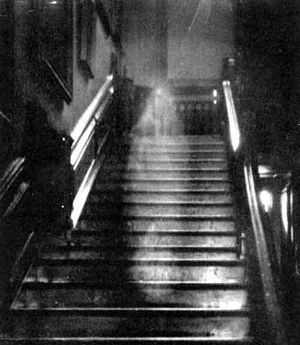
Brown Lady of Raynham Hall: This is the picture taken in the staircase that is now perhaps one of the most famous ghost photos.
Captain Hubert C. Provand, was a working in London as an photographer for the Country Life magazine. On September 19th, 1936, he and his assistant, Indre Shira were taking photographs of the Raynham Hall for an article.
Inside the 300 year old mansion, they were setting up the cameras to take another of the old Hall’s main staircase. Suddenly, Shira saw a ” vapoury form gradually assuming the appearance of a woman” The figure was “moving down the stairs towards them.” Shira directed Provand to take the cap of the lens while Shira pressed the trigger to take the picture.
After the negative was developed for the article, they saw more clear what they had gotten on camera that day. And the famous legendary photo of the Brown Lady of Raynham Hall was born. And after the photo, so was the legend.
So who was this lady? According to legend, the Brown Lady of Raynham Hall is the lost ghost of Dorothy Walpole. She was born in 1686 and according to gossip, the prettiest sister of Robert Walpole, seen as the first prime minister of Great Britain.
Walpole was neighbour with Charles Townshend, 2nd Viscount Townsend in Norfolk. And it just so happened that his sister Dorothy married Townshend in 1713. Although they were good neighbours, and even brother-in-laws, there was bad blood between the men. Especially in politics and when Walpole built his own mansion, Houghton Hall. Did this affect poor Dorothy at all?
What we know is that it wasn’t a particularly happy marriage. Dorothy was Charles second wife. He looked upon the Hall as his pride, as a Lord Hervey said: “Lord Townshend looked upon his own seat at Raynham as the metropolis of Norfolk, and considered every stone that augmented the splendor of Houghton, as a diminution of the grandeur of Raynham.”
Lady Dorothy Walpole: The Brown Lady of Raynham Hall is believed to be the ghost of Lady Dorothy Walpole who died in 1726.
Charles was also well known for his violent temper. Dorothy Walpole was rumored to have been a mistress of a Lord Wharton, a well known womanizer, and that no woman could be twenty four hours under his roof and walk out with her reputation intact.
When Charles discovered his wife and her affair with Lord Wharton, the story says he punished her by locking her in her rooms in the family, Raynham Hall. To make matters worse, there are still rumours that she was in fact entrapped by the Countess of Warton, inviting Dorothy to stay a few days, knowing full well, her husband wouldn’t let her walk out with her reputation intact.
After this, Dorothy Walpole remained at Raynham Hall until her death in 1726. She died of smallpox. But did she really leave the Halls? Is she still roaming the place, still locked up, still trying to get out and are forever trapped as The Brown Lady of Raynham Hall?
Sightings of the Brown Lady at Raynham Hall
Raynham Hall was thought to have been haunted long before the picture was taken. People that stayed in the mansion, experienced visitation and paranormal activity that most believed to be the ghost of The Brown Lady of Raynham Hall.
1835
Whatever the truth is, the legend was there to stay. And the first recorded sighting of the The Brown Lady of Raynham Hall was in 1835. One Christmas the new Lord Charles Townshend invited some guest to the Hall for celebrations. Among the guest were Colonel Loftus and another guest named Hawkins. One night night as they approached their bedrooms, they saw the Brown Lady, noticing the dated and brown dress she wore.
The following night, Loftus claimed he saw The Brown Lady of Raynham Hall again. he said he was drawn to the spectre’s empty eye-sockets, dark in the glowing face, the once so pretty Dorothy Walpole. After Loftus reported what he saw it ended with some of the staff permanently left Raynham Hall. It was all recorded by another guest, Lucia C. Stone.
Just a year after, the The Brown Lady of Raynham Hall was seen again. This time it was Captain Frederick Marryat, a friend of Charles Dickens. He originally wanted to prove a theory of his that the hauntings was caused by local smugglers. According to him, the smugglers spread the story to keep people away from the area. That night hi requested that he spent the night in the haunted room at Raynham Hall.
Marryat’s daughter, Florence wrote about her father’s experience in 1891:
…he took possession of the room in which the portrait of the apparition hung, and in which she had been often seen, and slept each night with a loaded revolver under his pillow. For two days, however, he saw nothing, and the third was to be the limit of his stay. On the third night, however, two young men (nephews of the baronet), knocked at his door as he was undressing to go to bed, and asked him to step over to their room (which was at the other end of the corridor), and give them his opinion on a new gun just arrived from London. My father was in his shirt and trousers, but as the hour was late, and everybody had retired to rest except themselves, he prepared to accompany them as he was. As they were leaving the room, he caught up his revolver, “in case you meet the Brown Lady,” he said, laughing. When the inspection of the gun was over, the young men in the same spirit declared they would accompany my father back again, “in case you meet the Brown Lady,” they repeated, laughing also. The three gentlemen therefore returned in company.
The corridor was long and dark, for the lights had been extinguished, but as they reached the middle of it, they saw the glimmer of a lamp coming towards them from the other end. “One of the ladies going to visit the nurseries,” whispered the young Townshends to my father. Now the bedroom doors in that corridor faced each other, and each room had a double door with a space between, as is the case in many old-fashioned houses. My father, as I have said, was in shirt and trousers only, and his native modesty made him feel uncomfortable, so he slipped within one of the outer doors (his friends following his example), in order to conceal himself until the lady should have passed by.
I have heard him describe how he watched her approaching nearer and nearer, through the chink of the door, until, as she was close enough for him to distinguish the colors and style of her costume, he recognised the figure as the facsimile of the portrait of “The Brown Lady”. He had his finger on the trigger of his revolver, and was about to demand it to stop and give the reason for its presence there, when the figure halted of its own accord before the door behind which he stood, and holding the lighted lamp she carried to her features, grinned in a malicious and diabolical manner at him. This act so infuriated my father, who was anything but lamb-like in disposition, that he sprang into the corridor with a bound, and discharged the revolver right in her face. The figure instantly disappeared – the figure at which for several minutes three men had been looking together – and the bullet passed through the outer door of the room on the opposite side of the corridor, and lodged in the panel of the inner one. My father never attempted again to interfere with “The Brown Lady of Raynham”.
1926
When the son of Lady Townshend and his friend saw the ghost next, they knew who The Brown Lady of Raynham Hall was. They saw her on the staircase, and identified the ghost with the portrait, hanging on the wall in the haunted room. Of course, the portrait of Lady Dorothy Walpole.
Raynham Hall: The haunted hall is a country house in Norfolk and was for 400 years the seat of the Townshend family. The hall is reported to be haunted, providing the scene for possibly the most famous ghost photo of all time, The Brown Lady of Raynham Hall descending the staircase.//Source: Wikimedia
What is the truth?
After Provand and Shira took the picture of The Brown Lady of Raynham Hall, they published their experience in Country life magazine, December 26th, 1936. They were published again in Life magazine on January 4th, 1937. So all in all, they did profit on this. But could it be that they just took a picture?
After the picture was taken, a paranormal investigator, Harry Price interviewed both Provand and Shira. He said: “I will say at once I was impressed. I was told a perfectly simple story: Mr. Indre Shira saw the apparition descending the stairs at the precise moment when Captain Provand’s head was under the black cloth. A shout – and the cap was off and the flashbulb fired, with the results which we now see. I could not shake their story, and I had no right to disbelieve them. Only collusion between the two men would account for the ghost if it is a fake. The negative is entirely innocent of any faking.”
But there have been numerous attempts of debunking the picture of The Brown Lady of Raynham Hall and its status of “proof”. Some claim Shira faked the image by putting grease or something in the lense in shape of a lady, maybe moved down the stairs himself during an exposure? Or maybe it is as simple as an accidental double exposure or light somehow got in the camera. Some even claim that the figure looks eerily like the Virgin Mary statue, and that the image is of her in the staircase, the statue that is, not the Virgin Mary.
Among the examiners trying to debunk the validity of the picture of The Brown Lady of Raynham Hall is Joe Nickell’s detailed writings that the photograph is nothing more than double exposure. And the magician John Booth wrote that the photograph could be easily made. Booth had the magician Ron Wilson cover himself in a bed sheet and walk down the staircase at the Magic Castle in Hollywood. It apparently turned out very similar to the photograph.
An online magazine about the paranormal, haunted and macabre. We collect the ghost stories from all around the world as well as review horror and gothic media.