Category Archives: article

Khonsuemheb and the Ghost of Theban Necropolis

Advertisements

Khonsuemheb and the Ghost is one of the oldest ghost stories we have in written form about a high priests quest to honor the dead whose tomb were disturbed in the Theban Necropolis in ancient Egypt. The question remains: did he actually complete his mission?

When did people start to tell ghost stories? It is difficult to say exactly when as the earliest ghost stories were probably older than our written language and so old that it is lost like any of the first original stories. What we do have though, are fragments of those who were carved in stone and scribbled on the walls. Perhaps human have always told ghost stories and the real question is if we will ever stop.

One of the more ancient ghost stories we have in writing is the story of Khonsuemheb and the Ghost. This ghost legend comes from Egypt, around 1200 B.C during the Ramesside period. The story was found in four pieces of pottery by  Ernesto Schiaparelli, and translated in 1915 by Egyptologist, Gaston Maspero (1846-1916).

The Normalising of Ghosts in Ancient Egypt

The ancient Egyptians believed in life after death, and in the book “Book of the Dead”, they wrote down a series of spells they thought would help them reach the afterlife. The people living at the time thought of the afterlife as a sort of continuation of life were it would be paradise to end up in. So why on earth do we still have ghost stories of people that never reach this perfect afterlife?

In ancient Egypt ghosts (called akh) were somewhat similar to their former self, more a piece of the soul of the living person, the immortal and transformed part of the soul. Interactions between ghosts and living people were seen in a lesser supernatural way than in modern depictions, just as the ghost in Khonsuemheb and the Ghost was more of a task to be handled than something unnatural happening.

Anubis God of Lost Souls: is the god of funerary rites, protector of graves, and guide to the underworld, in ancient Egyptian religion, usually depicted as a canine or a man with a canine head. If the family didn’t do the funeral rites correctly or were cheap with the money, the Gods would sort of grant the part of the soul, the akh permission to go back and complain and haunt the family or its grave.

The akh was a consequence of the burial ritual not being right, the tomb being destroyed or so forth. This ritual was important as it was the way into the afterlife. An akh could harm the living, giving them nightmares, feelings of guilt, punish people or sickness. But it could also do good deeds to help their living family members, influencing for the better etc.

As well as coming on their own volition, they could be invoked by prayers or written letters left in the tomb’s offering chapel, just like what happened in Khonsuemheb and the Ghost.

Read Also: If graves or tombs are not well kept, bad things can happen. Read about The Haunted Barbie Doll in The Shrine and how they take care of that ghosts final resting place.

The Story of Khonsuemheb and the Ghost

The beginning of the story is lost forever, as it being a fragment of some pottery. So the full length of it, is nowhere to be found. But it is implied the story is set in Theban Necropolis, a burial place near the Valley of the Kings and Valley of the Queens.

The burial city was built at the west bank of the Nile, near the ancient city of Thebes, which at the time was the capital and the perhaps even the biggest city in the world at that time. The ruins of the city lies within the modern day city, Luxor, in Upper Egypt. At this time in the New Kingdom, Thebes reached new height of prosperity. It was the time right before the decline of the great city, and it would soon fall into unrest, strikes, looting of the Necropolises.

Ruins of Medinet Habu (Arabic: مدينة هابو)  is an archaeological locality situated near the foot of the Theban Hills of the River Nile opposite the modern city of Luxor, Egypt. it is the Mortuary Temple of Ramesses III. This is where the ruins of Thebes can be found.

The Servant in the Place of Truth

But before all this, a man had to spend the night next to a tomb in the Theban Necropolis, literally meaning the city of the dead. He is unnamed in the fragment of Khonsuemheb and the Ghost. Perhaps he was just walking by, perhaps he was a looter. Perhaps he was a Servant in the Place of Truth. That was an ancient Egyptian title of the people working in the Necropolis.

The servants in the Place of Truth constructed the eternal dwelling of the kings, and isolated themselves to safeguard their secrets. They lived in the village Set-Maat (Place of truth) in the Holy Land of the Dead, today known as Deir el-Medina. The village that happens to be were the last bit of fragment of the story was found.

A Night at Thebes Necropolis: The man in the story spent the night in the desolated place of Theban Necropolis, a place outside of today’s Luxor in Egypt. //Source: wikimedia

The man was woken by the ghost residing in the tomb. Was he afraid? Perhaps not if he worked there. Perhaps he was terrified, especially if he was a looter, trying to steal the possessions in the tomb. In any case, he went to the High Priest of Amun, Khonsuemheb, and told what happened in the tomb.

The High Priest Invoking the Ghost

The High Priest of Amun, takes matters into his own hands. He stands on his rooftop, calling to the gods to summon the ghost. Invoking the gods of the sky and the gods of the earth, southern, northern, western and eastern, and (the) gods of the underworld, saying to them: “Send me that august spirit.” And it does. “I grew, and I did not see the rays of the sun. I did not breathe the air, but darkness was before me every day, and no one came to find me,” the ghost says (translation by Maspero).

Khonsuemheb asks his name. Nebusemekh, son of Ankhmen and of the lady Tamshas, the ghost answers. So how does one please an ancient egyptian ghost? Khonsuemheb at least offered to rebuild his tomb, making it better with a gildet ziziphus-wood coffin to make peace with the ghost. But the ghost doesn’t trust Khonsuemheb and his intentions. So what do they do?

The Ghost story on the pottery: Ancient Egyptian ostrakon with the beginning of the Ghost story of of Khonsuemheb and the Ghost. Terracotta from Deir el-Medina, 19-20th Dynasty, New Kingdom. Found by Schiaparelli in 1905. Turin, Museo Egizio.

Khonsuemheb sits down with the ghost, starts to cry and shares his unhappy fate. “I will remain here] without eating or drinking, without growing old or becoming young. I will not see sunlight nor will I inhale northerly breezes, but darkness shall be in my sight every day. I will not get up early to depart.”

Then the ghost proceeds to tell about his life on earth, how he was an overseer of the treasuries and a military official under pharaoh Rahotep. When the ghost, Nebusemekh died in the 14th regnal year of pharaoh Mentuhotep, the ruler gave him a canopic set, an alabaster sarcophagus and a ten-cubits shaft tomb.

But time took over the tomb, and over the centuries, the tomb partially collapsed, allowing wind to reach the burial chamber. Nebusemekh also told Khonsuemheb that others before him offered to rebuild his grave, but never did. Khonsuemheb says to the ghost that he will do it and also offers to send ten servants to make daily offerings at his grave. But the ghost says that wouldn’t be necessary or of any use.

Only Fragments of the Ending Left

Here, the text of Khonsuemheb and the Ghost on the pottery breaks, and in the next fragment three men are sent out by Khonsuemheb to search for a proper place for Nebusemekh new tomb. They find it at Deir el-Bahari, near to the causeway of the mortuary temple belonging to pharaoh Mentuhotep the second.

This is the end, the text suddenly ends here. But perhaps Khonsuemheb honored the last wish of Nebusemekh, giving peace in his afterlife the Egyptians were all so desperate at having.

The Afterlife in Ancient Egypt: Egyptian religious doctrines included three afterlife ideologies: belief in an underworld, eternal life, and rebirth of the soul. The path to the afterlife for the deceased was a difficult one with gates, doors and pylons located in Duat, the land of the underworld. Ultimately, the immortality desired by ancient Egyptians was reflected in endless lives. By doing worthy deeds in their current life, they would be granted a second life for all of eternity.

The tale of Khonsuemheb and the Ghost is a piece of fragment, written in another era of time entirely and there are of course dispute how much of it is an historical account of something that happened and a cautionary tale of what could happen if the living didn’t honor the dead. And the details of the tale are still open to interpretations. Particularly the identity of the to pharaohs in Nebusemekh’s time, and in the ghost actually got to rest in peace and finally enjoy paradise in the afterlife.

More Like this

Newest Posts

References:

Ghosts in Ancient Egypt – World History Encyclopedia 

Theban Necropolis – Wikipedia 

Khonsuemheb and the Ghost – Wikipedia

A Ghost Story of Ancient Egypt – World History Encyclopedia 

The Brown Lady of Raynham Hall

Advertisements

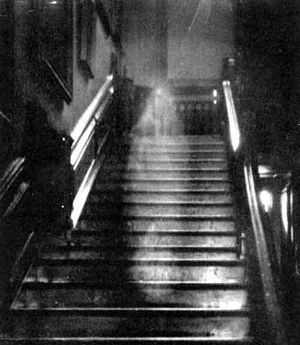
The Brown Lady of Raynham Hall is probably one of the most iconic ghost pictures out there. But what is the story behind it? And who is that ghostly figure?

Is it real? Was it just a double exposure? The picture of The Brown Lady of Raynham Hall has been viral since 1936. A photographer that year took the infamous picture, forever putting it in the mystery box for people to wonder about ever since.

It was just another day in the upper class England, with their old and haunted mansions and stories. Up in Norfolk lays the old Raynham Hall, that were about to become one of the most famous hauntings in Great Britain.

Brown Lady of Raynham Hall: This is the picture taken in the staircase that is now perhaps one of the most famous ghost photos.

Captain Hubert C. Provand, was a working in London as an photographer for the Country Life magazine. On September 19th, 1936, he and his assistant, Indre Shira were taking photographs of the Raynham Hall for an article.

Inside the 300 year old mansion, they were setting up the cameras to take another of the old Hall’s main staircase. Suddenly, Shira saw a ” vapoury form gradually assuming the appearance of a woman” The figure was “moving down the stairs towards them.” Shira directed Provand to take the cap of the lens while Shira pressed the trigger to take the picture.

After the negative was developed for the article, they saw more clear what they had gotten on camera that day. And the famous legendary photo of the Brown Lady of Raynham Hall was born. And after the photo, so was the legend.

Read More: This is not the only ghost picture that caused a stir: The Haunting in Pasir Ris Park 

Who was the Brown Lady of Raynham Hall

So who was this lady? According to legend, the Brown Lady of Raynham Hall is the lost ghost of Dorothy Walpole. She was born in 1686 and according to gossip, the prettiest sister of Robert Walpole, seen as the first prime minister of Great Britain.

Walpole was neighbour with Charles Townshend, 2nd Viscount Townsend in Norfolk. And it just so happened that his sister Dorothy married Townshend in 1713. Although they were good neighbours, and even brother-in-laws, there was bad blood between the men. Especially in politics and when Walpole built his own mansion, Houghton Hall. Did this affect poor Dorothy at all?

What we know is that it wasn’t a particularly happy marriage. Dorothy was Charles second wife. He looked upon the Hall as his pride, as a Lord Hervey said: “Lord Townshend looked upon his own seat at Raynham as the metropolis of Norfolk, and considered every stone that augmented the splendor of Houghton, as a diminution of the grandeur of Raynham.”

Lady Dorothy Walpole: The Brown Lady of Raynham Hall is believed to be the ghost of Lady Dorothy Walpole who died in 1726.

Charles was also well known for his violent temper. Dorothy Walpole was rumored to have been a mistress of a Lord Wharton, a well known womanizer, and that no woman could be twenty four hours under his roof and walk out with her reputation intact.

When Charles discovered his wife and her affair with Lord Wharton, the story says he punished her by locking her in her rooms in the family, Raynham Hall. To make matters worse, there are still rumours that she was in fact entrapped by the Countess of Warton, inviting Dorothy to stay a few days, knowing full well, her husband wouldn’t let her walk out with her reputation intact.

Read More: This is not the only ghost story involving a husband imprisoning his wife in her own home: The Prisoner of Château de Puymartin

After this, Dorothy Walpole remained at Raynham Hall until her death in 1726. She died of smallpox. But did she really leave the Halls? Is she still roaming the place, still locked up, still trying to get out and are forever trapped as The Brown Lady of Raynham Hall?

Sightings of the Brown Lady at Raynham Hall

Raynham Hall was thought to have been haunted long before the picture was taken. People that stayed in the mansion, experienced visitation and paranormal activity that most believed to be the ghost of The Brown Lady of Raynham Hall.

1835

Whatever the truth is, the legend was there to stay. And the first recorded sighting of the The Brown Lady of Raynham Hall was in 1835. One Christmas the new Lord Charles Townshend invited some guest to the Hall for celebrations. Among the guest were Colonel Loftus and another guest named Hawkins. One night night as they approached their bedrooms, they saw the Brown Lady, noticing the dated and brown dress she wore.

The following night, Loftus claimed he saw The Brown Lady of Raynham Hall again. he said he was drawn to the spectre’s empty eye-sockets, dark in the glowing face, the once so pretty Dorothy Walpole. After Loftus reported what he saw it ended with some of the staff permanently left Raynham Hall. It was all recorded by another guest, Lucia C. Stone.

Read More: Ghost Stories of Christmas Hauntings

1863

Just a year after, the The Brown Lady of Raynham Hall was seen again. This time it was Captain Frederick Marryat, a friend of Charles Dickens. He originally wanted to prove a theory of his that the hauntings was caused by local smugglers. According to him, the smugglers spread the story to keep people away from the area. That night hi requested that he spent the night in the haunted room at Raynham Hall.

Marryat’s daughter, Florence wrote about her father’s experience in 1891:

…he took possession of the room in which the portrait of the apparition hung, and in which she had been often seen, and slept each night with a loaded revolver under his pillow. For two days, however, he saw nothing, and the third was to be the limit of his stay. On the third night, however, two young men (nephews of the baronet), knocked at his door as he was undressing to go to bed, and asked him to step over to their room (which was at the other end of the corridor), and give them his opinion on a new gun just arrived from London. My father was in his shirt and trousers, but as the hour was late, and everybody had retired to rest except themselves, he prepared to accompany them as he was. As they were leaving the room, he caught up his revolver, “in case you meet the Brown Lady,” he said, laughing. When the inspection of the gun was over, the young men in the same spirit declared they would accompany my father back again, “in case you meet the Brown Lady,” they repeated, laughing also. The three gentlemen therefore returned in company.

The corridor was long and dark, for the lights had been extinguished, but as they reached the middle of it, they saw the glimmer of a lamp coming towards them from the other end. “One of the ladies going to visit the nurseries,” whispered the young Townshends to my father. Now the bedroom doors in that corridor faced each other, and each room had a double door with a space between, as is the case in many old-fashioned houses. My father, as I have said, was in shirt and trousers only, and his native modesty made him feel uncomfortable, so he slipped within one of the outer doors (his friends following his example), in order to conceal himself until the lady should have passed by.

I have heard him describe how he watched her approaching nearer and nearer, through the chink of the door, until, as she was close enough for him to distinguish the colors and style of her costume, he recognised the figure as the facsimile of the portrait of “The Brown Lady”. He had his finger on the trigger of his revolver, and was about to demand it to stop and give the reason for its presence there, when the figure halted of its own accord before the door behind which he stood, and holding the lighted lamp she carried to her features, grinned in a malicious and diabolical manner at him. This act so infuriated my father, who was anything but lamb-like in disposition, that he sprang into the corridor with a bound, and discharged the revolver right in her face. The figure instantly disappeared – the figure at which for several minutes three men had been looking together – and the bullet passed through the outer door of the room on the opposite side of the corridor, and lodged in the panel of the inner one. My father never attempted again to interfere with “The Brown Lady of Raynham”.

1926

When the son of Lady Townshend and his friend saw the ghost next, they knew who The Brown Lady of Raynham Hall was. They saw her on the staircase, and identified the ghost with the portrait, hanging on the wall in the haunted room. Of course, the portrait of Lady Dorothy Walpole.

Raynham Hall: The haunted hall is a country house in Norfolk and was for 400 years the seat of the Townshend family. The hall is reported to be haunted, providing the scene for possibly the most famous ghost photo of all time, The Brown Lady of Raynham Hall descending the staircase.//Source: Wikimedia

What is the truth?

After Provand and Shira took the picture of The Brown Lady of Raynham Hall, they published their experience in Country life magazine, December 26th, 1936. They were published again in Life magazine on January 4th, 1937. So all in all, they did profit on this. But could it be that they just took a picture?

After the picture was taken, a paranormal investigator, Harry Price interviewed both Provand and Shira. He said: “I will say at once I was impressed. I was told a perfectly simple story: Mr. Indre Shira saw the apparition descending the stairs at the precise moment when Captain Provand’s head was under the black cloth. A shout – and the cap was off and the flashbulb fired, with the results which we now see. I could not shake their story, and I had no right to disbelieve them. Only collusion between the two men would account for the ghost if it is a fake. The negative is entirely innocent of any faking.”

But there have been numerous attempts of debunking the picture of The Brown Lady of Raynham Hall and its status of “proof”. Some claim Shira faked the image by putting grease or something in the lense in shape of a lady, maybe moved down the stairs himself during an exposure? Or maybe it is as simple as an accidental double exposure or light somehow got in the camera. Some even claim that the figure looks eerily like the Virgin Mary statue, and that the image is of her in the staircase, the statue that is, not the Virgin Mary.

Among the examiners trying to debunk the validity of the picture of The Brown Lady of Raynham Hall is Joe Nickell’s detailed writings that the photograph is nothing more than double exposure. And the magician John Booth wrote that the photograph could be easily made. Booth had the magician Ron Wilson cover himself in a bed sheet and walk down the staircase at the Magic Castle in Hollywood. It apparently turned out very similar to the photograph.

More like this

Newest Posts