Often called France’s Stonehenge, The Carnac Stones in Brittany have puzzled people for millennials as to why they were built. Some ancient burial rites? Perhaps it’s like the legends say and are soldiers turned into stone?
The Carnac Stones, or Steudadoù Karnag as they are called in Breton, are mysterious and imposing structures located in the small town of Carnac, Brittany in France that no one really knows the purpose of for certain.
These stone structures that are often referred to as France’s Stonehenge have stood for centuries, forming an impressive landscape that has piqued the interest of many throughout history. What were they built for? Some form of pagan worship? Astronomical device? Perhaps even an enormous earthquake detector?
Perhaps it is like in the legends, and they really were created by Merlin as he turned an entire legion of Romans into these perfectly lined stones?
The Carnac Stones – a Forest of Stones
The Carnac Stones are believed to have been created approximately 7000 years ago with the local stones from the region. These stones were erected by the pre-celtic people living in Brittany in the Neolithic period, centuries before the Romans arrived, the celts lived and before France became France.
The Carnac Stones are made up of over 3,000 prehistoric megaliths that cover an area of over 4 km in the village of Carnac. The single standing stones are called menhirs, meaning long stones in Breton language.
It is believed that these monuments were erected sometime between 4500 BC and 2000 BC, making them some of the oldest structures still standing in Europe and therefore an important historical place. Many theories have been raised as to their purpose and origin, but no one knows for sure how they came to be or why they were created.
The Mystery of the Stones
Although the exact purpose and meaning of the Carnac Stones is still a mystery today, historians have theorized that they were built for some type of spiritual or religious worship. Maybe even burial rituals as there are several dolmen which are burial chambers close to the lined up standing rocks.
Burial Chambers: Among the free standing stones known as menhirs, there are also larger cluster of stones known as dolmens. Often referred to as burial chambers and has influenced how we look at the collection of standing stones.
Until not very long ago, there was a Breton tradition to visit one of the menhir called La Vaisseau in Carnac. Young married couple met up at midnight with their parents watching as they ran naked around the stone as a fertility ritual.
However, since much of our understanding about this period remains unclear, their true role is likely to remain an enigma. Over time, various myths and legends have developed around these megaliths that add to their mystery and allure.
Legends of the Carnac Stones
Legends of the Carnac Stones span centuries, stretching all the way back to when they were originally constructed. In the middle ages they looked at the stones as the work of demons as well as sorcerers or giants that walked the earth before the flood.
They tell of goblin-like creatures called Korrigans that are said to haunt the megaliths and living in the hollow rocks and dolmens, or stone soldiers that are often said to be protecting some sort of hidden treasure or guarding a great secret.
Another modern myth is that the stones were created when pagan soldiers came after Pope Cornelius in the 200s and he turned them into stone. Some even say that the stones are that of a Roman legion marching on the grounds that were turned to stone by Merlin from the Arthurian legends.
Despite their mysterious origins, these ancient megaliths continue to fascinate millions of visitors each year.
The story of the lost castle of Hollerwiese on Mariahilfberg Hill is still a mystery to this day. It is said that the ghosts of those living in the castle are still seen on the meadow where the castle once stood.
East of the city of Amberg in Bavarian Germany, there is a forest-covered ridge, reaching the top called Mariahilfberg Hill and has many mysterious legends surrounding it. The hilltop is crowned with a beautiful church, surrounded by a vast forest. Behind the church is a meadow known as the Hollerwiese or Hollow Meadow.
It used to be an unwooded area up until the 1800s but is now covered with trees like the rest of the hill, hiding away the name and the legend. But according to legend, the ground sounds strangely hollow when you throw stones on it.
Read Also: This is not the only mysterious forest in the world. Read about the haunted Romanian forest Hoia Baciu as well.
The Two Sisters
There is a legend that once there was a castle standing where two very wealthy sisters lived. They had also inherited the monastery in Amberg and the towns of Raigering and Neumühle from their father and had more than enough for both of them.
Their wealth was stored in huge barrels and chests in the basement of the castle of Hollerwiese. The two sisters decided to share their wealth with each other and together they promised to help each other and live in harmony.
One of the sisters was blind and the seeing sister was the one counting the money and keeping track of their fortune. In the beginning the blind sister trusted her sister without questions.
The Church on the hill: Here you see Wallfahrtskirche Maria Hilf in Amberg. The lost castle and the meadow are supposed to be right behind it. //Source: Campiana/wikimedia
The seeing sister got greedy however and started to keep more and more to herself, giving her sister less. This was something the blind sister started to suspect.
One day, the blind sister felt with her hand on the uneven stacks of gold and realized how her sister had deceived her. She cursed the castle, making it sink into the earth, still with both of them inside where none of them would have the opportunity to spend their fortune.
In some versions of the legend, the blind one got out of Hollerwiese and spent the rest of her life in Neumühle.
It is said that during holy celebrations many see the two sisters, sitting in the meadow, waving at those passing, reminding them about the barrels of gold that sits just underneath the surface.
The Robber Baron
Another version of the story of the lost castle of Hollerwiese is about the thief that supposedly lived in the castle on the mountain. He stole goods from merchants and harvests from farmers. His daughter was grieved by their fathers criminal acts and tried to undo everything he did wrong by giving back to those he robbed.
Often did she beg her father to stop, but he only laughed at her. And when she warned him about the Heavens vengeance, he only ignored her. But in the end, his greed was punished.
Under a terrible thunderstorm the entire castle was washed away with all the residents. According to legend, there can still be sound remains of it under the meadow.
Ever since that fateful night, a maiden in a white robe is seen sitting on a stone near the Hollerwiese on the evening of the solstice. Next to her is a black dog with a golden key in his mouth. This key is said to be able to open the treasure chambers of the sunken castle.
The mysterious mountains in Albania is a place known for its myths and legends. Strange tales are told of this place and has been named The Accursed Mountains.
“I could not help feeling that they were evil things– mountains of madness whose farther slopes looked out over some accursed ultimate abyss.” – H. P. Lovecraft: At the Mountains of Madness
The Albanian Alps, officially called Prokletije is a breathtaking sight in the Balkans with glacial features, pointed peaks and weathered landscape, stretching from northern Albania, all the way to Kosovo and Montenegro. The lush green valleys and thick forests filled with wolves, old traditional stone villages makes you feel you really are in a fairy tale like place.
But the beauty of the accursed mountains comes with a bittersweet aftertaste when learning what the translated name of the mountain is. In English Prokletije is roughly translated to the Accursed Mountains and has a legend and myth that rests amongst the mountain peaks. And according to legends, it was the devil himself who created the mountains. As the name suggest, the legends surrounding The Accursed Mountains are more sinister than fairytale like.
It is difficult to understand why such a serene place has been dubbed a cursed one, because how could the devil create such a beautiful thing? Anyway, that is the tale, and that is the mountains origin story.
From then on, the mountain range has been cursed and synonymous with blood feuds and bandits as well as natural disasters like avalanches. From 1946 to 1992, the country was under a harrowing communist regime with closed borders to keep people out as well as in. The Accursed Mountains were used as patrolling spots with buried landmines and bunkers for wars. So it’s not only because of its legends they are known as the accursed mountains, but because of their history as well.
It is a sparsely populated place, home to Albanians as well as Serbs, Bosniaks and montenegrins. It is a secluded place that is cut off from the rest of the world for weeks during the winter months. This is a place where the shepherds take their flock during the summer rather than staying for a the whole years.
The Legend of the Brothers and the Fairy
The legend of it being the devil himself who created these mountains is not the only legend of why this mountain range is supposedly cursed. The other legend is steeped much more in Albanian folklore than Christian religion and really comes out from a fairytale.
The Fairy Myth: According to legend, the name is from that one fairy tale were the mother of hunters cursed a fairy from Albanian folklore.
A long time ago three brothers went out hunting. Up in the mountains they met a fairy. The brothers found her so beautiful and wanted her. This turned into a fight about who saw her first, who she belonged to and escalated to become quite violent. So violent that it ended in their death.
The fairy was watching from afar, but had no way of helping and couldn’t choose for them. She hoped for an agreement, but when her brothers died, she ran and hid behind the peaks of the mountain.
The Accursed Mountains
Days went by for the mother without a word from the sons. When none of the brothers returned from their hunting trip, their mother took up the search. She went up to the mountains and found all of her sons dead. She wailed as she buried her sons, her cries echoing through the mountain range.
The fairy heard her and went to her and told her what happened, that it was because of her that they had argued and died. But the mother didn’t want to hear the reason and only looked at the fairy as the cause of their death. The mother cursed both the fairy and the mountains, blaming them for her son’s deaths. And ever since then, the place has been called the Accursed Mountains and known for its mystery.
When the moon peak out after the long and sunny days in Hawaii, there are things to beware in the dark like the Huaka’i Pō. The Hawaiian Night Marchers is legend told for a long time, and will continue to be so.
In sunny Hawaii, the island of Oahu is hot, palms swaying in the wind soaking up the sun during the day. Along the streets, people from all over the streets are walking side by side and no one thinks of these modern marches of the modern people. But there are other types of marches that are still held in high esteem by the locals.
The day time Hawaii is a light place, a sunny place. That is during the day. Then the night comes and darkness prevails. You know, the nights are long, even though they are hot and the ghost walks among us, just as any other place.
A majority of Hawaii residents can tell about a supernatural or at least creepy encounter in their life. But these encounters are not only creepy, they are holy. One of the most popular legend to tell is of the Hawaiian Night Marchers, or the Huaka’i Pō.
Huaka’i Pō The Warriors of the Afterlife
The Hawaiian Night Marchers come in groups as they mark their presence by blowing a conch shell, beating their pahu drums, pounding out a rhythm, keeping everyone in the march in line as they chant an oli, giving everyone around a heads up. Make way, a march is on the way.
Pahu Drum: The Night Marchers comes to the sound of drums.
The locals on the Hawaiian islands claim they are the spirit of warriors coming home from, or more ominous, to a battle. Why are they doing this? What war are they still fighting?
Some claim the Night Marchers are the ancestors reclaiming of lost territory, spirits of warriors from a battle gone wrong or spirits avenging their death. And considering the Hawaiian history, the Hawaiian Night Marchers might consider the battle still ongoing.
The spirits of the Huaka’i Pō are the proud Hawaiian warriors, bound to protect their ali’i in life, and the afterlife. They are also said to be spirits, either going somewhere or welcoming new warriors to their beating band.
More than mere ghosts, the Huaka’i Pō reminds more of the wild hunt from European pagan mythology and folklore.
Marching Through the Night
Although some accounts of the the Hawaiian Night Marchers legend have been reported during the day, most Huaka’i Pō is marching through the night. They are recognized with their torches held high and chanting the same olis over and over again.
Perhaps they at first glance just looks like a group of living human beings are doing a traditional march, but when one looks more closely, one can see their feet are a couple of inches above ground. Local accounts tell that the only remains that the Hawaiian Night Marchers ever marched there, is the mysterious footprints in the soil or sand just after passing.
Pathways for the Huaka’i Pō: Along the highway, deep in the jungle, it doesn’t matter, the the Hawaiian Night Marcherswill find their way// Photo by Kehn Hermano on Pexels.com
The Night Marches has been documented by white settlers as far back in 1883 by Captain Cook’s arrival on the islands. Hawaiian language was only a spoken one, so this is one of the first written account. But of course, the marches have been going on, long before any white settler put their foot on the islands. And the stories the locals know about, is the ones that have been passed down for generations.
The reports from Captain Cook though, tells of a mighty phantom army, led by spirit of King Kamehameha, marching angrily over the Big Island of Hawaii. In these account, the night marchers were written down as ‘oi’o.
The Hawaiian Night Marchers to Honor the Ancestors
Over the years the marchers have become somewhat of a boogeyman tale for children. But this is not the origin story of them. The Huaka’i Pō are originally holy processions, a manifestation of Hawaiian gods. The Hawaiian also had a strict caste system were the ali’i (chief) passed, commoners was not to look at them. Consequence of disobeying this rule was death.
Hawaiian storyteller and author that has taken a deep dive into the Hawaiian ghost lore as well as the legends of the Night Marchers, Lopaka Kapanui had this to say to OluKai:
“The night marchers’ job wasn’t to terrorize people. It was simply to protect the most sacred, high-ranking chiefs (depending on kapu status, the Chiefs marched in front or behind the procession). The night marchers showed mercy by traveling at night to spare people from harm.”
Warriors of Hawaii: Night Marchers of Hawaiian legend is not only ghosts and lingering people of people that have died, but have said to also be ancient warriors or manifestations of the Hawaiian gods. /Flickr/Jai Mansson
It is not all cozy history though, as the Hawaiian Night Marchers have been blamed for many accidents of the road. Especially along he Oahu’s Pali Highway after dark, an established pathway for the marches, and there have been reports about car accidents elsewhere as well. Perhaps a note city planners should keep in mind. Listen to the old lores of the land. In any case, just to be safe: Do not travel alone on these paths at night.
Read Also: More ghost stories about Haunted Roads across the world
How to Show the Huaka’i Pō Respect
But what to do when you are out and about and suddenly the drums and chanting of the marchers are heard. How to act when you are in presence of warrior souls?
According to the warnings you must never interrupt these marchers, they have been going on long before your time, and will continue to do so, long after you’re gone. This is a custom that have been in place, even when the Hawaiian Night Marchers was done by the ancient living warriors. It was so sacred, their mission that they could not be interrupted. This is also a theory as to why the Huaka’i Pō are known to travel at night as well, because they disturb less people then.
If you can’t get out in the way before the marchers are right by you, there are some things to keep in mind: You can’t meet anyone’s eye or look at them. Unless some of your relatives are one of the spirits and acknowledged you, you are most likely dead. It is considered a bad omen and bad luck for you, your friends or family.
A foul scent of decay comes before anything else, before anything is seen. the Hawaiian Night Marchers blow their conch shells and beat their drum to announce their arrival. So what to do? Especially if there is a marching path, right through your house?
To ward off the Huaka’i Pō, Hawaiian people plants Ti plants around their home, to keep them away. But if you don’t have time to cultivate plants? It is advised that the best thing is to run and get the hell out of there. But if it’s too late it is advised to crouch down and play dead. Remember, don’t look at anyone. The Night Marchers already have their destination, don’t let it be to you.
Protectionfrom the Night Marchers: The Ti plant of Hawaii is said to have protective abilities on the Hawaiian Night Marchers. Among a lot of ethnic groups in Austronesia it is regarded as sacred and they believe they can hold souls and thus are useful in healing “soul loss” illnesses and in exorcising against malevolent spirits, their use in ritual attire and ornamentation, and their use as boundary markers. Red and green cultivars also commonly represented dualistic aspects of culture and religion and are used differently in rituals. Red ti plants commonly symbolize blood, war, and the ties between the living and the dead; while green ti plants commonly symbolize peace and healing. / source
Where the Hawaiian Night Marchershave been Observed
There are stories about the Huaka’i Pō marching on most Hawaiian islands, but reports tell mostly about places on Oahu. These are some specific locations were it is said that the Night Marchers have a pathway:
La Perouse Bay (Maui) – The Hawaiian name for this bay is Keoneʻōʻio. It has a a lava landscape that according to legends are and have been visited by night marchers.
Kamehameha Schools Campus (Oahu) – In Kapalama on Oahu. This school is over a hundred years and is said to have been visited by the Huaka’i Pō many times.
Kualoa Ranch(Oahu)– It is said to be housing the remains of hundreds of Hawaiian chiefs and the night marchers have been spotted here several times. This is also a place that the car accidents happening have been because of the Huaka’i Pō.
La’ie(Oahu) – Historically this was a city of refuge. A place where criminals were held were they didn’t get harmed and could get out free after a certain time of service.
Oahu’s Highway(Oahu)– once there was a site for a famous Kamehameha battle. Now there are many road accidents attributed to the Huaka’i Pō that are marching through this area.
Kaunakakai town (Molokai) – a sacred temple site of the Ili’ili’opae Heiau is nearby on this small and tranquil island.
When to see the marching of Huaka’i Pō
Although there are no specific days set that limits the night marchers, there are some days of the calendar that seems more important than other for the Huaka’i Pō. That includes:
Po Kane – Nights of the Hawaiian God Kane, the first of the Gods that created the universe. This day falls on the 27th day of the moon cycle of Kaulana Mahina or the Hawaiian Moon Calendar. This is the main day were they say the Huaka’i Pō is about.
Po Akua – 14th night of the new moon has also been a date were they say the Huaka’i Pō is especially active. This is a night were the spirits of chiefs, warriors and aumakua (guardian spirits) march between sunset and sunrise.
From the ancient writings of Plutarch, we can find a greek ghost story of the ghost of a young orphaned boy named Damon haunted a bathhouse in Chaeronea in Greece. According to the legend, the ghost haunted the place for centuries, perhaps even to this day?
Many of the oldest ghost stories sounds eerily alike to those of today, showing that the concept of ghost have been fairly consistent across time and place. Although most ghost stories from the ancient world is found in mythology and fairy tales, there are those ghost stories that comes from more historical records. Like this greek ghost story about a haunted bathhouse from the writings of Plutarch.
Plutarch (AD 46–after 119), was a Greek Middle Platonist philosopher, biographer, essayist, and priest at the Temple of Apollo. He also served his last thirty years a priest in Delphi. He also was a part of The Eleusinian Mysteries for the cult of Demeter and Persephone based at Eleusis in ancient Greece. They are the “most famous of the secret religious rites of ancient Greece“. So a man of the spirits, to say the least.
Temple of Delphi: This area of Greece have always been steeped in mystery and this greek ghost story happened not far from the mystical temple of Delphi.
Plutarch is known primarily for his Parallel Lives, a series of biographies of famous men from that time. Although the writings is mostly about vices and virtues and about philosophy about moral, he managed to put in a couple of ghost stories here and there as well.
Ghosts in Ancient Greece
So how did the typical ghost in ancient Greece look like? Back then it was closely linked to Greek mythology as it was the go to for explaining the unexplainable.
In ancient Greece there was two underworld goddesses the restless spirits belonged to: Melinoe and Hecate. Both were associated by wandering at night, with a trail of ghosts behind them, striking fear in anyone who saw them and their train of restless spirits following them to the underworld as their hounds barked with them. The two goddesses were also the ones that oversaw the burial rituals, something that was very important for the Greek and their ghost stories.
The Spirits of the Underworld: This greek ghost story and most other stories was deep rooted in the Greek mythology. Here depicted in: Souls on the Banks of the Acheron by Adolf Hirémy-Hirschlin 1898.
There were three main categories of ghosts in ancient Greece that restless spirits could be divided into: the ataphoi, the aoroi and the biaiothanatoi.
The ataphoi was the spirit of those who had not had a proper burial and their mission haunting was to get the living to bury them properly so they would be able to move on. This was mostly an easy fix as long as you could find the body, and after they had a properly burial they would mostly just disappear to the afterlife.
The aoroi was ghost of those that died too young and had led an incomplete life and was a bit more tricky to deal with. This type of ghost could possible become vengeful after death because of the regret of dying before its time.
The biaiothanatos however was the ghost that died a violent death, either murdered or in war. Like the two other categories it was highly important with the proper funeral rites for the dead so they would not awake as ghosts and haunt the place and possible harm the living.
A Greek Ghost Story
One of the ghost stories we find in the biography is about Cimon (510-450 BC). The ghost story is set in Chaeronea in Boeotia in Central Greece, just east of Delphi. It was also the birth town of Plutarch and it is said this was a ghost story he personally knew off as the ghost was still about in his day and age.
This greek ghost story tells the story about Damon Peripoltas, an orphan boy, living in Chaeronea. At this time, the city was ravaged by war and poverty, making it a breeding ground for violence like this story turned out to be.
Damon was said to be a beautiful boy, more so than the rest. He was a descendant of Peripoltas, the ancient seer that led his people to Boeotia. The descendants of the seer were held in high esteem, but it all changed after Damon though.
Although he was deemed to be a beautiful boy, he was also regarded as a dangerous one. He was poor, untrained and filled with rage and had no problems with violence. Something the whole city was about to know the hard way.
The Roman Commander’s Advances
A Roman commander was wintering in Chaeronea with his unit. One day, the young Damon, just past his childhood, caught the commander’s eyes and the commander decided he wanted him. The Roman commander claimed he fell in love with the beautiful orphan boy and made a pass on him. He tried to shower Damon in presents and gifts to woo him over, but Damon refused and was offended by the grown man’s advances.
This made the commander angry and his approach towards Damon changed. He threatened the boy with violence and said he would send Damon into obscurity and poverty if he did not give into him.
Damon got afraid of the repercussions he would suffer at the hands of the Roman commander and fearing exactly this, as he had seen what poverty could do to a man, Damon plotted against the man before he was the one suffering. But he had no intention of giving into the commander.
Smeared With Soot and Drunk on Wine
Damon had grown up in the rough city on the streets and a violent end was all he knew off. He gathered sixteen of his friends to help him see the plot towards the Roman through. They smeared their face with soot one night and got drunk on wine to gather the courage to get on with it.
Just before the break of dawn they attacked the Roman commander as he was sacrificing to his gods in the marketplace. The crew of youngsters killed the Roman then and there, and together they left the city before getting caught.
A Tragic Greek Ghost Story: This story ended in blood as almost everyone in the story ended up murdered. Here a depiction of the assassination of the Roman emperor, Julius Caesar who also were murdered by a group in a public place.
According to Roman law presiding in the city, this was punished by death, and this was the sentence the counsel of Chaeronea gave them. So, as the council sat to supper in the evening, Damon and his men broke into the town-hall were they were dining and slew them all. And yet again, they flew the city.
Hunted by the Romans
An investigation was done and they asked Damon to return, noticing the city also had been wrong. Damon was ravaging and pillaging the countryside with his accomplices, having fallen to poverty as he desperately didn’t want to. He was even making threats to the city that had cast him out. They lured him back by appointing him gymnasiarch, a high honor as an official, that would lead to respect and riches. He couldn’t refuse.
But when he came, he was having a vapor bath in the bathhouse and was slain. But they would never silence him as it was said that the ghost of Damon haunted the bathhouse.
His ghost roamed the bathhouse and the phantom of him appeared in it, sighing and groaning of his life that was cut short and from the betrayal.
The Haunted Bathhouse
Because of the ruckus from the ghost in the bathhouse, the citizens walled the bathhouse shut, trying to keep him inside, trying to put a lid on the past and their deeds. And it was said that still in Plutarch’s time, neighbors could still hear him inside, trying to get out again, to flew the city once more and finally be free.
Haunted Bathhouse: The greek were famous of their advanced public bathhouses. In this greek ghost story, the locals had to close up the bathhouse as the ghost of the murdered Damon kept crying and trying to escape.
Descendants of Damon’s family still lived at that time, near Stiris in Phocis. They are called Asbolomeni, or Besooted because of how Damon smeared himself with soot before committing his crimes.
What happened with the bathhouse and this greek ghost story if the place ever got quiet is uncertain, as ghost that met a violent end had a habit of holding a grudge for a long time.
In these strange and scary pandemic times, its nice to live in a world of modern health care, science and the wide spread information about the internet. But pandemics and epidemics have always been a part of the human experience through history, and it’s really just in the last couple of centuries, we’ve really been able to combat the spread of viruses. So in that regard, we took a look at past pandemics and epidemics and how they affected the society and how they at that time, tried to combat it.
The plague of Justinian (541-542 AD)
St Sebastian pleading for the life of a gravedigger afflicted with plague during the 7th-century Plague of Justinian. (Josse Lieferinxe, c. 1497–1499)
This plague is the first well documented occurrence of a wide spread pandemic. And according to some historians, the most deadliest. In 2013 it was confirmed that the bacteria was the Yersinia pestis, the same that caused the Black death.
“During these times, there was a pestilence, by which the whole human race came near to being annihilated” – Procopius
The name comes from the Emperor Justinian of the Byzantian empire, a peasant son that had been chosen as emperor Justin, his uncle, to rule in these times. Justinian and members of his court, physically unaffected by the previous 535–536 famine, were afflicted, with Justinian himself contracting and surviving the pestilence. He was said to have been a stern and vicious ruler in the plague times, not budging on collecting the taxes from his starving and sickly farmers.
Mosaic of Justinianus I – Basilica San Vitale (Ravenna) Photo by: Petar Milošević 2015
Merchant ships from Egypt came into the city of Constantinople the seat of the Roman Empire, carrying infected rats in the grain ships. We have a lot of first hands accounts of the Byzantine historians, like Procopius. He recorded that at its peak, the plague killed 10 000 people in the city of Constantinople, daily. There was no room to bury the dead, the bodies had to be stacked on top of each other. In the streets, in the houses, unburied, left unattended, feared. No one was left to bury them. There was no room for funeral rites and the once so great city reeked of death.
Proocopicus, hated the Emperor Justinius, and blamed him in his “Secret History”, claiming the emperor was a demon that created the plague, or at leas, was a punishment for his malice. He told of supernatural beings in human disguise that spread the disease after appearing to people. He claimed other dies after seeing visions in dreams, or heard voices, telling them that they would be getting the plague.
1975. This patient presented with symptoms of plague that included gangrene of the right hand causing necrosis of the fingers. Author=CDC/Dr. Jack Poland
In the end, the tombs were filled, so the soldiers built trenches for the bodies to be thrown in. That too failed, as it in the end, was no where left to dig. In the end the people carried the bodies of the dead down to the sea and threw them in to rid themselves of the stench of death and piling of bodies.
In the VIth century the inhabitants of Philippi embarked on the construction of an imposing basilica on the site of the town’s palaestra; the size of the planned building clearly exceeded the needs of the town, thus indicating that Philippi attracted many pilgrims. In 547 the so-called Justinian plague devastated the countries of the Mediterranean basin and in the early VIIth century an earthquake struck the region of Philippi; these two catastrophic events could have halted the completion of the basilica, standing as a proof and evidence on how plagues can alter the history as intended.
Advertisements
The Black Death (1347-1351)
Physician attire for protection from the Bubonic plague or Black death from 1656. A so called plague doctor. The purpose of the mask was to keep away bad smells, known as miasma, which were thought to be the principal cause of the disease, before it was disproved by germ theory.
It swept cross Europe in medieval times, laying towns, countries, cultures and riches in ruins. It did not start in Europe, but it remained as an imprint on it, to this today, some would even claim, a fear for it, that still rings today. And in the western world, every plague since then, has been compared to the infamous Black Death. So many myths, so many legends spun around it, who was to blame, were did it come from. It left plague pits, its own cemeteries and around 25 million dead in Europe alone.
People would die suddenly. They would be in the market, at work, at home, and the, suddenly fall dead of the illness. Doctors refused to attend the patients and priests declined administering last rites. Even worse, healthy people from families would often leave their infected loved ones to die and escaped to other places.
Contemporary sources say that the plague originated in Mongolia. It traveled all the way before it hit Europe in full force in 1347/48 along the coast. Giovanni Boccaccio, most known for his book, Decameron, was a first hand witness to the plague. In his book, he describes the harsh reality of it:
“The pestilence was so powerful that it was communicated to the healthy by contacting the sick, the way a fire close to dry or oily things will set them aflame.”
They established their camps in fields near towns and held their rituals twice a day. The ritual began with the reading of a letter, claimed to have been delivered by an angel and justifying the Flagellants’ activities. Next, the followers would fall to their knees and scourge themselves, gesturing with their free hands to indicate their sin and striking themselves rhythmically to songs, known as Geisslerlieder, until blood flowed. Sometimes the blood was soaked up in rags and treated as a holy relic. Painting by Pieter van Laer (1599–after 1641 ) from ca. 1635.
In Milan, if a person was found to be infected, they would close them inside the house, the house would be walled up, windows and doors filled with bricks, with all the people still inside.
Several people were blamed of the disease. Jews were burned throughout Germany or banished. In Esslingen, the Jews gathered in their synagogue and set it on fire. In Strasbourg the town counsel tried to protect them, but they were burned in their own cemetery.
The pestilence paved way to a scary brotherhood, The Flagellants, the Brethren of the Cross. Devout Christians looked at the plague as a punishment from God fro their sins. In Germany, this movement spread like the plague itself. They wore dark clothes with red crosses, hiding their face and walked in a line behind their leader. They would parade in a circle before throwing themselves on the ground, the leader beating them all for their sins. Then they would get up before beating themselves with a scourge, a stick with three tails with knots. They would whip their backs bloody. This they hoped, would appease God. Many died from these marches that raged in Germany and France.
Advertisements
Theodor Kittelsen – Pesta i trappen, 1896 (Pesta on the Stairs).
The plague reached far, even to outskirts countries like Iceland and Greenland, The plague managed to hit Norway in 1349 when a wool-carrying ship from England halted at Bergen port. Within days, the entire ship crew were dead and then the rampage started in rest of Norway. Norwegian called the plague “pest”. Folklore thought that the plague was an old woman, “Pesta” and that she came to town with either a rake or a broom. If she used her broom, everyone would die. If she used the rake, some would live. Today, people are named after the deserted and dead farms. Ødegård (desolate farm), a common surname among Norwegians to this date.
This wasn’t the last Europe saw of the plague however. It came and went in waves during the next centuries.
The Third Plague (1855 to the 1950s)
This plague started in Yunnan, China, and eventually led to the discovery of a cure for it. It was then the connection to rats were discovered and a more planned combat against the plague could go forth.
Picture of Manchurian Plague victims in 1910 -1911 that has been historically mislabeled as “Body disposal at Unit 731” A much higher resolution photo, with Russian text stating that these were “Dead plague bodies held in storage awaiting scientific research” can be seen here.
Shi Tao-nan wrote a poem about the plague called: Death of Rats.
Dead rats in the east, Dead rats in the west!
As if they were tigers, Indeed are the people scared.
Few days following the death of the rats, Men pass away like falling walls!..
The coming of the devil of the plague Suddendly makes the lamp dim,
Then it is blown out, Leaving man ghost and corpse in the dark room
The writer of the poem died of the plague only days after it was written.
The plague continued to rage, from Hong Kong it spread with ships to the world. To US, Latin America, India and South Africa. India was particularly hit by the plague, and over the next thiry years, over twelve million people died of it in India alone. It died out in the 1950s. In 1894 the Hong Kong doctore, Alexandre Yersin found evidence of the Yersinia Pestis as in the Justinian plague and Black Death.
Today, fewer than 200 people die of the plague worldwide each year, mainly due to lack of treatment. Plague is considered to be endemic in 26 countries around the world, with most cases found in remote areas of Africa. The three most endemic countries are Madagascar, the Democratic Republic of the Congo and Peru. The latest victim to it being a couple in Mongolia after eating the raw kidney of a rodent. Commonly considered a folk remedy for good health.
Orent, Wendy. Plague: the Mysterious Past and Terrifying Future of the Worlds Most Dangerous Disease. Place of publication not identified: Free Press, 2012.
After the Chinese nobleman Tu Po was betrayed by his own king and fellow nobles, he became a vengeful ghost, or Hungry Ghost as it is known as in Buddhism. Even in his afterlife he sought revenge on those who betrayed him and fought to restore his honor.
The concept of a ghost with unfinished business is found around the globe. In the eastern part of the world they are often known as Hungry Ghosts and they are deadly.
China has such a varied an long history, diverse culture, with different regions, religions and traditions as most ancient countries has. The tales and beliefs changes according to the ebb and flow of time and the legends of the hungry ghosts are many and varied.
Before delving into the legend about Tu Po and how he was betrayed by his own king, let us have a closer look at exactly what a Hungry Ghost is.
As much of Chinese folklore and mythology comes from Buddhism, there are many similarities to other Buddhist countries. In any case it has been believed that every living person will become a ghost when we die known as a guǐ 鬼. It will then weaken, and fade away, dying again for a second time.
As mentioned earlier, the Hungry Ghost is not only a Chinese phenomenon, but a Buddhist as well as Asian one. Ghost stories of vengeful ghost can be found also in Japan with the Onryo or Korea with the Virgin Ghost for example.
This concept of the spirit of the deceased weakening before disappearing is seen as only natural and how it is supposed to be. The ancestors are honored, given sacrifices and held in esteem, thinking they have a part in the world as much as the living. Ancestral worship is the original basic of Chinese religions, and it is a core belief there is an existence after death. A deceased person’s soul is made up of yin and yang parts called hun and po. They are not immortal, and need offerings before going to the underworld for eternal rest.
When Revenge is more Important than Peace
The trouble with ghosts however is when that spirit is driven by anger and malice rather than a peaceful afterlife. This is called a Hungry Ghost (餓鬼 èguǐ and quỷ đói) and only happens on rare occasions as most spirits only wants to be at peace.
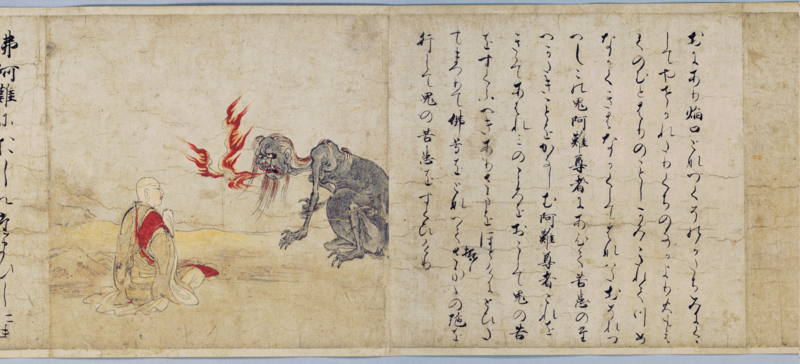
The Hungry Ghost: The concept of hungry ghost is found throughout Buddhist traditions. This is from the Sixth section of the Japanese Hungry Ghosts Scroll located at the Kyoto National Museum. The scroll depicts the world of the hungry ghosts, one of the six realms of Buddhism and contains tales of salvation of the hungry ghosts. This particular section shows Ananda, a disciple of Shakyamuni, teaching an incantation to achieve salvation to a hungry ghost who continuously belches flames from his mouth.
The creation of a Hungry Ghost happens when a person’s death has been exceptionally violent or unhappy. The ghosts are often given quite animalistic traits in the ghost stories and records. Although there are different categories and types of hungry ghosts, one common trait among them are that they are seeking a type of revenge of those who wronged them, or simply those who got in the way.
Although most accounts of Tu Po doesn’t give him animalistic traits like a monster, he definitely sought his revenge on those who wronged him like most vengeful ghosts are looking for, and therefore given the title of a Hungry Ghost.
Before becoming a Ghost – Tu-Po the Emperor’s Minister
Before becoming an ancient ghost, Tu Po used to be an important man in ancient China. The nobleman Tu Po 杜伯 is sometimes translated as Du Bo and he was the Duke of Tangdu. This was a Dukedom situated west of State of Yi Lin around were the Shaanxi province in northwest of China is today.
According to legend, the Tangdu people were descendants of the people living in the State of Tang, a Dukedom destroyed by Zhou Gong Dan that now ruled the empire. They were allowed to form a new State of Du, and became known as Tangdu or Du shi (杜氏).
Tu-Po was not always remembered as a hungry ghost, but was a prominent minister to King Xuan of Zhou (also known as Emperor Hsuan) who reigned from 827-783 B.C. Emperor Hsuan was the eleventh king of the Chinese Zhou Dynasty in a time were the kings words were the law and his minister Tu Po had to pay the ultimate price.
The empire:Map over the Jin (Tang) state during the late Spring and Autumn period as it was called, around the time of Tu-Po’s death and after. This is were he, and his ancestors resided and ruled.//Photo: Hugo Lopez – Wikimedia Commons user: Yug
The king is mostly remembered for fighting the ‘Western Barbarians‘, most probably Xianyun, an ancient nomadic tribe that invaded the Zhou empire on the Huai River. He also meddled in debacles of successions in States of Lu, Wey an Qi and was, according to history, not a popular one. Sima Qian, considered father of Chinese historiography, said: “From this time on, the many lords mostly rebelled against royal commands.” And the way the king ended his reign, is rumoured to be the work of the hungry ghost of Tu Po.
So Tu Po was from a stately and very powerful family and not afraid to speak up for what he believed in, even to the most powerful man in the dynasty. And this would cost him his life and make him a hungry ghost, haunting the earth and seeking revenge.
The Fall From Grace and Becoming a Vengeful Ghost
There are not very many sources detailing what happened before the haunting of Tu Po’s hauntings started. But according to one account, this is what happened.
The King:King Xuan of Zhou (827-783 B.C). Formerly known as Emperor Hsuan or King Suan.
On the ninth year as King, King Xuan of Zhou called all the lords of his empire into a meeting that would seal the fate of Tu Po to discuss an oncoming attack.
A rumor was out that a woman was about to become a danger of the town of Jiangshan for some reason, and the King ordered a mass execution of women. Exactly how this one woman could be considered a danger to an entire town is not really explained.
No matter what the reason behind this mass execution of women, it was seen as a truly horrible act that Tu Po disagreed with. Tu-Po publicly opposed to the order he was given and he spoke against his king in a time when the kings word was the law and anything else considered treason.
This final act of opposition would cost him his life as King Xuan ordered his execution for this as he saw this act of opposition as treason.
Before Tu Po was executed however, King Xuan of Zhou was warned that Tu Po’s ghost would stay in this world even in his afterlife to haunt him as Tu-Po himself said:
“If my majesty kills me without reason, the dead may not know, well that’s it. However, on the other hand, I will avenge myself on him, within three years.”
But despise the warnings, King Xuan went through the execution. Even though he was considered innocent of treason by most, Tu-Po was executed around 786 B.C. But this would not be the last time he was seen.
The Revenge of the Hungry Ghost
Weather Tu Po’s final words were taken seriously, is not mentioned. Three years after the execution however, the King brought his dukes to hunt on his own hunting grounds. There were hundreds of chariots, thousands of escorts following them as well as a ghost that promised he would return for revenge.
Ghost festival: Lotus-shaped lanterns are lit and set afloat in rivers and out onto seas to symbolically guide the lost souls to the afterlife.
At noon, Tu-Po appeared as a ghost, riding a white horse and a cart, wearing a red coat with a red bow and arrow in hand. He took up the chase of King Xuan and shot the king in the heart and broke the king’s spine. At the time, it is reported that no one saw the killing and no one heard it. No matter what the real situation was like, The king fell and Tu Po got his revenge.
If King Xuan really died of an arrow is today a bit unclear. In some accounts it is said that King Xuan died of something else after dreaming that Tu Po shot him to death with an arrow.
In both cases, the innocent and wronged minister got his revenge and King Xuan’s son, was the last of the western Zhou to lead.
The story has gone down in traditional legends, ever since. The Chinese philosopher, Mo Zi (470-391 B.C), said this about ghosts and about Tu-Po’s revenge:
“If from antiquity to the present, and since the beginning of man, there are men who have seen the bodies of ghosts and spirits and heard their voices, how can we say that they do not exist?
If none have heard them and none have seen them, then how can we say they do? But those who deny the existence of the spirits say: “Many in the world have heard and seen something of ghosts and spirits. Since they vary in testimony, who are to be accepted as really having heard and seen them?”
As we are to rely on what many have jointly seen and what many have jointly heard, the case of Tu Po is to be accepted.”
Khonsuemheb and the Ghost is one of the oldest ghost stories we have in written form about a high priests quest to honor the dead whose tomb were disturbed in the Theban Necropolis in ancient Egypt. The question remains: did he actually complete his mission?
When did people start to tell ghost stories? It is difficult to say exactly when as the earliest ghost stories were probably older than our written language and so old that it is lost like any of the first original stories. What we do have though, are fragments of those who were carved in stone and scribbled on the walls. Perhaps human have always told ghost stories and the real question is if we will ever stop.
One of the more ancient ghost stories we have in writing is the story of Khonsuemheb and the Ghost. This ghost legend comes from Egypt, around 1200 B.C during the Ramesside period. The story was found in four pieces of pottery by Ernesto Schiaparelli, and translated in 1915 by Egyptologist, Gaston Maspero (1846-1916).
The Normalising of Ghosts in Ancient Egypt
The ancient Egyptians believed in life after death, and in the book “Book of the Dead”, they wrote down a series of spells they thought would help them reach the afterlife. The people living at the time thought of the afterlife as a sort of continuation of life were it would be paradise to end up in. So why on earth do we still have ghost stories of people that never reach this perfect afterlife?
In ancient Egypt ghosts (called akh) were somewhat similar to their former self, more a piece of the soul of the living person, the immortal and transformed part of the soul. Interactions between ghosts and living people were seen in a lesser supernatural way than in modern depictions, just as the ghost in Khonsuemheb and the Ghost was more of a task to be handled than something unnatural happening.
Anubis God of Lost Souls: is the god of funerary rites, protector of graves, and guide to the underworld, in ancient Egyptian religion, usually depicted as a canine or a man with a canine head. If the family didn’t do the funeral rites correctly or were cheap with the money, the Gods would sort of grant the part of the soul, the akh permission to go back and complain and haunt the family or its grave.
The akh was a consequence of the burial ritual not being right, the tomb being destroyed or so forth. This ritual was important as it was the way into the afterlife. An akh could harm the living, giving them nightmares, feelings of guilt, punish people or sickness. But it could also do good deeds to help their living family members, influencing for the better etc.
As well as coming on their own volition, they could be invoked by prayers or written letters left in the tomb’s offering chapel, just like what happened in Khonsuemheb and the Ghost.
Read Also: If graves or tombs are not well kept, bad things can happen. Read about The Haunted Barbie Doll in The Shrine and how they take care of that ghosts final resting place.
The Story of Khonsuemheb and the Ghost
The beginning of the story is lost forever, as it being a fragment of some pottery. So the full length of it, is nowhere to be found. But it is implied the story is set in Theban Necropolis, a burial place near the Valley of the Kings and Valley of the Queens.
The burial city was built at the west bank of the Nile, near the ancient city of Thebes, which at the time was the capital and the perhaps even the biggest city in the world at that time. The ruins of the city lies within the modern day city, Luxor, in Upper Egypt. At this time in the New Kingdom, Thebes reached new height of prosperity. It was the time right before the decline of the great city, and it would soon fall into unrest, strikes, looting of the Necropolises.
Ruins of Medinet Habu (Arabic: مدينة هابو) is an archaeological locality situated near the foot of the Theban Hills of the River Nile opposite the modern city of Luxor, Egypt. it is the Mortuary Temple of Ramesses III. This is where the ruins of Thebes can be found.
The Servant in the Place of Truth
But before all this, a man had to spend the night next to a tomb in the Theban Necropolis, literally meaning the city of the dead. He is unnamed in the fragment of Khonsuemheb and the Ghost. Perhaps he was just walking by, perhaps he was a looter. Perhaps he was a Servant in the Place of Truth. That was an ancient Egyptian title of the people working in the Necropolis.
The servants in the Place of Truth constructed the eternal dwelling of the kings, and isolated themselves to safeguard their secrets. They lived in the village Set-Maat (Place of truth) in the Holy Land of the Dead, today known as Deir el-Medina. The village that happens to be were the last bit of fragment of the story was found.
A Night at Thebes Necropolis: The man in the story spent the night in the desolated place of Theban Necropolis, a place outside of today’s Luxor in Egypt. //Source: wikimedia
The man was woken by the ghost residing in the tomb. Was he afraid? Perhaps not if he worked there. Perhaps he was terrified, especially if he was a looter, trying to steal the possessions in the tomb. In any case, he went to the High Priest of Amun, Khonsuemheb, and told what happened in the tomb.
The High Priest Invoking the Ghost
The High Priest of Amun, takes matters into his own hands. He stands on his rooftop, calling to the gods to summon the ghost. Invoking the gods of the sky and the gods of the earth, southern, northern, western and eastern, and (the) gods of the underworld, saying to them: “Send me that august spirit.” And it does. “I grew, and I did not see the rays of the sun. I did not breathe the air, but darkness was before me every day, and no one came to find me,” the ghost says (translation by Maspero).
Khonsuemheb asks his name. Nebusemekh, son of Ankhmen and of the lady Tamshas, the ghost answers. So how does one please an ancient egyptian ghost? Khonsuemheb at least offered to rebuild his tomb, making it better with a gildet ziziphus-wood coffin to make peace with the ghost. But the ghost doesn’t trust Khonsuemheb and his intentions. So what do they do?
The Ghost story on the pottery:Ancient Egyptian ostrakon with the beginning of the Ghost story of of Khonsuemheb and the Ghost. Terracotta from Deir el-Medina, 19-20th Dynasty, New Kingdom. Found by Schiaparelli in 1905. Turin, Museo Egizio.
Khonsuemheb sits down with the ghost, starts to cry and shares his unhappy fate. “I will remain here] without eating or drinking, without growing old or becoming young. I will not see sunlight nor will I inhale northerly breezes, but darkness shall be in my sight every day. I will not get up early to depart.”
Then the ghost proceeds to tell about his life on earth, how he was an overseer of the treasuries and a military official under pharaoh Rahotep. When the ghost, Nebusemekh died in the 14th regnal year of pharaoh Mentuhotep, the ruler gave him a canopic set, an alabaster sarcophagus and a ten-cubits shaft tomb.
But time took over the tomb, and over the centuries, the tomb partially collapsed, allowing wind to reach the burial chamber. Nebusemekh also told Khonsuemheb that others before him offered to rebuild his grave, but never did. Khonsuemheb says to the ghost that he will do it and also offers to send ten servants to make daily offerings at his grave. But the ghost says that wouldn’t be necessary or of any use.
Only Fragments of the Ending Left
Here, the text of Khonsuemheb and the Ghost on the pottery breaks, and in the next fragment three men are sent out by Khonsuemheb to search for a proper place for Nebusemekh new tomb. They find it at Deir el-Bahari, near to the causeway of the mortuary temple belonging to pharaoh Mentuhotep the second.
This is the end, the text suddenly ends here. But perhaps Khonsuemheb honored the last wish of Nebusemekh, giving peace in his afterlife the Egyptians were all so desperate at having.
The Afterlife in Ancient Egypt: Egyptian religious doctrines included three afterlife ideologies: belief in an underworld, eternal life, and rebirth of the soul. The path to the afterlife for the deceased was a difficult one with gates, doors and pylons located in Duat, the land of the underworld. Ultimately, the immortality desired by ancient Egyptians was reflected in endless lives. By doing worthy deeds in their current life, they would be granted a second life for all of eternity.
The tale of Khonsuemheb and the Ghost is a piece of fragment, written in another era of time entirely and there are of course dispute how much of it is an historical account of something that happened and a cautionary tale of what could happen if the living didn’t honor the dead. And the details of the tale are still open to interpretations. Particularly the identity of the to pharaohs in Nebusemekh’s time, and in the ghost actually got to rest in peace and finally enjoy paradise in the afterlife.
An online magazine about the paranormal, haunted and macabre. We collect the ghost stories from all around the world as well as review horror and gothic media.