Tag Archives: traditional legend

Huaka’i Pō – The Night Marchers of Hawaii

Advertisements

When the moon peak out after the long and sunny days in Hawaii, there are things to beware in the dark like the Huaka’i Pō. The Hawaiian Night Marchers is legend told for a long time, and will continue to be so.

In sunny Hawaii, the island of Oahu is hot, palms swaying in the wind soaking up the sun during the day. Along the streets, people from all over the streets are walking side by side and no one thinks of these modern marches of the modern people. But there are other types of marches that are still held in high esteem by the locals.

The day time Hawaii is a light place, a sunny place. That is during the day. Then the night comes and darkness prevails. You know, the nights are long, even though they are hot and the ghost walks among us, just as any other place.

A majority of Hawaii residents can tell about a supernatural or at least creepy encounter in their life. But these encounters are not only creepy, they are holy. One of the most popular legend to tell is of the Hawaiian Night Marchers, or the Huaka’i Pō.

Huaka’i Pō The Warriors of the Afterlife

The Hawaiian Night Marchers come in groups as they mark their presence by blowing a conch shell, beating their pahu drums, pounding out a rhythm, keeping everyone in the march in line as they chant an oli, giving everyone around a heads up. Make way, a march is on the way.

Pahu Drum: The Night Marchers comes to the sound of drums.

The locals on the Hawaiian islands claim they are the spirit of warriors coming home from, or more ominous, to a battle. Why are they doing this? What war are they still fighting?

Some claim the Night Marchers are the ancestors reclaiming of lost territory, spirits of warriors from a battle gone wrong or spirits avenging their death. And considering the Hawaiian history, the Hawaiian Night Marchers might consider the battle still ongoing.

The spirits of the Huaka’i Pō are the proud Hawaiian warriors, bound to protect their ali’i in life, and the afterlife. They are also said to be spirits, either going somewhere or welcoming new warriors to their beating band.

More than mere ghosts, the Huaka’i Pō reminds more of the wild hunt from European pagan mythology and folklore.

Marching Through the Night

Although some accounts of the the Hawaiian Night Marchers legend have been reported during the day, most Huaka’i Pō is marching through the night. They are recognized with their torches held high and chanting the same olis over and over again.

Perhaps they at first glance just looks like a group of living human beings are doing a traditional march, but when one looks more closely, one can see their feet are a couple of inches above ground. Local accounts tell that the only remains that the Hawaiian Night Marchers ever marched there, is the mysterious footprints in the soil or sand just after passing.

Pathways for the Huaka’i Pō: Along the highway, deep in the jungle, it doesn’t matter, the the Hawaiian Night Marchers will find their way// Photo by Kehn Hermano on Pexels.com

The Night Marches has been documented by white settlers as far back in 1883 by Captain Cook’s arrival on the islands. Hawaiian language was only a spoken one, so this is one of the first written account. But of course, the marches have been going on, long before any white settler put their foot on the islands. And the stories the locals know about, is the ones that have been passed down for generations.

The reports from Captain Cook though, tells of a mighty phantom army, led by spirit of King Kamehameha, marching angrily over the Big Island of Hawaii. In these account, the night marchers were written down as ‘oi’o.

The Hawaiian Night Marchers to Honor the Ancestors

Over the years the marchers have become somewhat of a boogeyman tale for children. But this is not the origin story of them. The Huaka’i Pō are originally holy processions, a manifestation of Hawaiian gods. The Hawaiian also had a strict caste system were the ali’i (chief) passed, commoners was not to look at them. Consequence of disobeying this rule was death.

Hawaiian storyteller and author that has taken a deep dive into the Hawaiian ghost lore as well as the legends of the Night Marchers, Lopaka Kapanui had this to say to OluKai:

The night marchers’ job wasn’t to terrorize people. It was simply to protect the most sacred, high-ranking chiefs (depending on kapu status, the Chiefs marched in front or behind the procession). The night marchers showed mercy by traveling at night to spare people from harm.

Warriors of Hawaii: Night Marchers of Hawaiian legend is not only ghosts and lingering people of people that have died, but have said to also be ancient warriors or manifestations of the Hawaiian gods. /Flickr/Jai Mansson

It is not all cozy history though, as the Hawaiian Night Marchers have been blamed for many accidents of the road. Especially along he Oahu’s Pali Highway after dark, an established pathway for the marches, and there have been reports about car accidents elsewhere as well. Perhaps a note city planners should keep in mind. Listen to the old lores of the land. In any case, just to be safe: Do not travel alone on these paths at night.

Read Also: More ghost stories about Haunted Roads across the world

How to Show the Huaka’i Pō Respect

But what to do when you are out and about and suddenly the drums and chanting of the marchers are heard. How to act when you are in presence of warrior souls?

According to the warnings you must never interrupt these marchers, they have been going on long before your time, and will continue to do so, long after you’re gone. This is a custom that have been in place, even when the Hawaiian Night Marchers was done by the ancient living warriors. It was so sacred, their mission that they could not be interrupted. This is also a theory as to why the Huaka’i Pō are known to travel at night as well, because they disturb less people then.

If you can’t get out in the way before the marchers are right by you, there are some things to keep in mind: You can’t meet anyone’s eye or look at them. Unless some of your relatives are one of the spirits and acknowledged you, you are most likely dead. It is considered a bad omen and bad luck for you, your friends or family.

A foul scent of decay comes before anything else, before anything is seen. the Hawaiian Night Marchers blow their conch shells and beat their drum to announce their arrival. So what to do? Especially if there is a marching path, right through your house?

To ward off the Huaka’i Pō, Hawaiian people plants Ti plants around their home, to keep them away. But if you don’t have time to cultivate plants? It is advised that the best thing is to run and get the hell out of there. But if it’s too late it is advised to crouch down and play dead. Remember, don’t look at anyone. The Night Marchers already have their destination, don’t let it be to you.

Protection from the Night Marchers: The Ti plant of Hawaii is said to have protective abilities on the Hawaiian Night Marchers. Among a lot of ethnic groups in Austronesia it is regarded as sacred and they believe they can hold souls and thus are useful in healing “soul loss” illnesses and in exorcising against malevolent spirits, their use in ritual attire and ornamentation, and their use as boundary markers. Red and green cultivars also commonly represented dualistic aspects of culture and religion and are used differently in rituals. Red ti plants commonly symbolize blood, war, and the ties between the living and the dead; while green ti plants commonly symbolize peace and healing. / source

Where the Hawaiian Night Marchers have been Observed

There are stories about the Huaka’i Pō marching on most Hawaiian islands, but reports tell mostly about places on Oahu. These are some specific locations were it is said that the Night Marchers have a pathway:

La Perouse Bay (Maui) – The Hawaiian name for this bay is Keoneʻōʻio. It has a a lava landscape that according to legends are and have been visited by night marchers.

Kamehameha Schools Campus (Oahu) – In Kapalama on Oahu. This school is over a hundred years and is said to have been visited by the Huaka’i Pō many times.

Kualoa Ranch (Oahu)– It is said to be housing the remains of hundreds of Hawaiian chiefs and the night marchers have been spotted here several times. This is also a place that the car accidents happening have been because of the Huaka’i Pō.

La’ie (Oahu) – Historically this was a city of refuge. A place where criminals were held were they didn’t get harmed and could get out free after a certain time of service.

Oahu’s Highway (Oahu)– once there was a site for a famous Kamehameha battle. Now there are many road accidents attributed to the Huaka’i Pō that are marching through this area.

Kaunakakai town (Molokai) – a sacred temple site of the Ili’ili’opae Heiau is nearby on this small and tranquil island.

When to see the marching of Huaka’i Pō

Although there are no specific days set that limits the night marchers, there are some days of the calendar that seems more important than other for the Huaka’i Pō. That includes:

Po Kane – Nights of the Hawaiian God Kane, the first of the Gods that created the universe. This day falls on the 27th day of the moon cycle of Kaulana Mahina or the Hawaiian Moon Calendar. This is the main day were they say the Huaka’i Pō is about.

Po Akua – 14th night of the new moon has also been a date were they say the Huaka’i Pō is especially active. This is a night were the spirits of chiefs, warriors and aumakua (guardian spirits) march between sunset and sunrise.

More like this

Newest Posts

Sources

  1. https://www.to-hawaii.com/legends/night-marchers.php
  2. https://www.hawaiinewsnow.com/story/27171113/exploring-the-legend-of-the-night-marchers/
  3. https://olukai.com/blogs/news/legends-hawaiis-night-marchers
  4. https://theculturetrip.com/north-america/usa/hawaii/articles/huakai-po-the-legend-of-the-hawaiian-night-marchers/

The Ghosts of Japan

Advertisements

In Japan, the ghosts are called Yūrei (幽霊). The word means faint or dim and soul or spirit. And as well as language and cultures divides different types of ghost in different categories, so does the Japanese. Here are some of the ghosts of Japan.

There are a lot of creatures, entities that haunts in Japanese culture. But yūrei is probably one of the more classic Ghosts of Japan and its legends and differs slightly from the others entities. They are for example the only ones haunting at a specific time, with the hour of the ox as a preference, which is from 2 to 2:30 am. This is when the veil between the dead and the living, the different worlds is at is thinnest.

The yūrei is also more geographical bound than other entities, and with a specific purpose for the hauntings. Unfinished business or vengeance, being the most common perhaps. The real tragedy is when a spirit can never find peace, because their unfinished business can never be fulfilled.

Onryō

怨霊

The Vengeful Ghost of Japan

The Vengeful Ghost of Japan

The Onryō is probably the most well known type of ghosts in Japanese culture there is. Onryō (怨霊), basically means “vengeful spirit” or “wrathful spirit” in Japanese and is a very iconic image with her white kimono and long black hair in modern ghost stories.

This particular ghost of Japan is driven by rage and consumed by revenge. This Yūrei will do anything to punish those who wronged them in life. Mostly, the spirit never starts out as evil, and wasn’t an evil person when alive. But the circumstances around their life and particularly around their death made them bit by bit as time went on and anger built up.

This type of vengeful spirit are sometimes created from the basis of love, but the jealousy perverted the love so much, it turned to hatred. In both cases, their soul are unable to pass on to be reborn and lingers in the realm of between the living and dead.

Read more about the Onryō at the Moonmausoleum

Onryō — the Vengeful Japanese Spirit

In many cultures, ghosts are put in different categories. Such is the case with Onryō (怨霊 onryō,) It basically means “vengeful spirit” or “wrathful spirit” in Japanese and is a mythological spirit of vengeance from Japanese folklore. They also have ghosts, called yurei, but these differ in the will of the ghost. As opposed to…

Banchō Sarayashiki — the Ghost of Okiku

The tale of Banchō Sarayashiki (番町皿屋敷, The Dish Mansion at Banchō) is a well known Japanese ghost story (kaidan). It was popularized in the kabuki theater tradition, and lives on in popular culture and folklore alike.

Goryō

御霊

The Noble Ghost of Japan

The Noble Ghost of Japan

Is sort of the same av an Onryō and often a Goryō ghost story follows the same pattern. It is vengeful spirits and ghosts in Japanese legends, capable of so much destruction and with a single goal in mind. The main difference from the Onryō, is that the Goryō is mostly a noble man, not a female, and the main goal is often to restore his honour he lost in real life than revenge on those who wronged him.

This Japanese ghost known as Goryō was most often from the aristocratic or royal class when in life. The Kanji 御 (go) actually means honorable while 霊 (ryō) means some sort of soul or spirit. And it is especially the case when those people were martyred or wronged, loosing their honor etc.

Funayūrei

船幽霊

The Sea Ghost of Japan

The Sea Ghost of Japan

The Funayūrei: Boatman and Funayūrei by Kawanabe Kyōsai (河鍋暁斎.

This is the Japanese ghost of those dying at sea. It literally means boat spirit and is the same as an Onryō, only out at sea. Often fishermen, sailors and the likes, people dying in shipwreck and want other to join them in the deep sea.

These types of ghosts in Japanese legends are described as being surrounded by an atmospheric light, so you can see them, even when they turn up on dark, foggy nights, rainy days and under the full or new moon. They can be described as ghost haunting the rivers and lake as well. At times, these ghost are shown as scaly fish-like, and pictures of them might be confused with mermaids or mermen.

UBUME

産女

The Mother Ghost of Japan

The Mother Ghost of Japan

Ubume: うふめ from Bakemono no e (化物之繪, c. 1700), Harry F. Bruning Collection of Japanese Books and Manuscripts, L. Tom Perry Special Collections, Harold B. Lee Library, Brigham Young University. source Date: circa 1700

This is the Japanese ghost of a mother who died in childbirth. It could also come if she died leaving very young children. This ghost differs a lot from the Onryō for example, for its purpose. It is not after revenge, but stays out of compassion, giving sweets and looking after her children she left behind. 

Those seeing her will see what looks like a pregnant woman pass by. Or she will approach you, telling you to hold her child, only for you to realize there isn’t a child, just a bundle of rocks or leaves.

Zashiki-warashi

座敷童子

The Child Ghost of Japan

The Child Ghost of Japan

This is what happens when children becomes ghosts in Japanese legends. They are not really depicted as dangerous, but at times mischievous. They would do pranks, leaving prints in the kitchen and the likes, but it also meant good fortune for them who saw them. But what are these Japanese ghosts? Strange otherworldly child-like creatures, or spirits of children?

It has been theories that they are the spirit of children that were killed when there were too many mouths to feed. It was back in the day a rather gruesome tradition to be killed by a stone and buried in the dirt floor room called doma or in the kitchen.

Fuyūrei and Jibakurei

浮遊霊

The Wandering Ghost of Japan

The Wandering Ghost of Japan

These two Japanese ghosts are very similar to each other. They are both spirit with no purpose, wandering aimlessly around, earthbound, often just going in circle and in a loop. Unable to find peace.

Ikiryō

生き霊

The Living Ghost of Japan

The Living Ghost of Japan

This is a very peculiar one and a bit on the side from the other ghosts in Japanese culture. It is when a part of the living soul or spirit leaves the body to haunt people or a specific place. Often across distances as well.

More like this

Newest Posts

Ghost of Tu-Po — The Hungry Ghost

Advertisements

After the Chinese nobleman Tu Po was betrayed by his own king and fellow nobles, he became a vengeful ghost, or Hungry Ghost as it is known as in Buddhism. Even in his afterlife he sought revenge on those who betrayed him and fought to restore his honor.

The concept of a ghost with unfinished business is found around the globe. In the eastern part of the world they are often known as Hungry Ghosts and they are deadly.

China has such a varied an long history, diverse culture, with different regions, religions and traditions as most ancient countries has. The tales and beliefs changes according to the ebb and flow of time and the legends of the hungry ghosts are many and varied.

Read More about: Chinese Ghosts and Haunted Places

The Hungry Ghost in Chinese Mythology

Before delving into the legend about Tu Po and how he was betrayed by his own king, let us have a closer look at exactly what a Hungry Ghost is.

As much of Chinese folklore and mythology comes from Buddhism, there are many similarities to other Buddhist countries. In any case it has been believed that every living person will become a ghost when we die known as a guǐ 鬼. It will then weaken, and fade away, dying again for a second time.

As mentioned earlier, the Hungry Ghost is not only a Chinese phenomenon, but a Buddhist as well as Asian one. Ghost stories of vengeful ghost can be found also in Japan with the Onryo or Korea with the Virgin Ghost for example.

This concept of the spirit of the deceased weakening before disappearing is seen as only natural and how it is supposed to be. The ancestors are honored, given sacrifices and held in esteem, thinking they have a part in the world as much as the living. Ancestral worship is the original basic of Chinese religions, and it is a core belief there is an existence after death. A deceased person’s soul is made up of yin and yang parts called hun and po. They are not immortal, and need offerings before going to the underworld for eternal rest.

When Revenge is more Important than Peace

The trouble with ghosts however is when that spirit is driven by anger and malice rather than a peaceful afterlife. This is called a Hungry Ghost (餓鬼 èguǐ and quỷ đói) and only happens on rare occasions as most spirits only wants to be at peace.

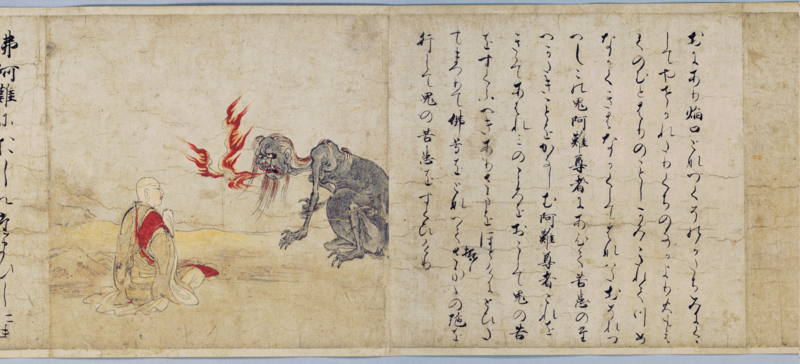
The Hungry Ghost: The concept of hungry ghost is found throughout Buddhist traditions. This is from the Sixth section of the Japanese Hungry Ghosts Scroll located at the Kyoto National Museum. The scroll depicts the world of the hungry ghosts, one of the six realms of Buddhism and contains tales of salvation of the hungry ghosts. This particular section shows Ananda, a disciple of Shakyamuni, teaching an incantation to achieve salvation to a hungry ghost who continuously belches flames from his mouth.

The creation of a Hungry Ghost happens when a person’s death has been exceptionally violent or unhappy. The ghosts are often given quite animalistic traits in the ghost stories and records. Although there are different categories and types of hungry ghosts, one common trait among them are that they are seeking a type of revenge of those who wronged them, or simply those who got in the way.

Although most accounts of Tu Po doesn’t give him animalistic traits like a monster, he definitely sought his revenge on those who wronged him like most vengeful ghosts are looking for, and therefore given the title of a Hungry Ghost.

Before becoming a Ghost – Tu-Po the Emperor’s Minister

Before becoming an ancient ghost, Tu Po used to be an important man in ancient China. The nobleman Tu Po 杜伯 is sometimes translated as Du Bo and he was the Duke of Tangdu. This was a Dukedom situated west of State of Yi Lin around were the Shaanxi province in northwest of China is today.

According to legend, the Tangdu people were descendants of the people living in the State of Tang, a Dukedom destroyed by Zhou Gong Dan that now ruled the empire. They were allowed to form a new State of Du, and became known as Tangdu or Du shi (杜氏).

Tu-Po was not always remembered as a hungry ghost, but was a prominent minister to King Xuan of Zhou (also known as Emperor Hsuan) who reigned from 827-783 B.C. Emperor Hsuan was the eleventh king of the Chinese Zhou Dynasty in a time were the kings words were the law and his minister Tu Po had to pay the ultimate price.

The empire: Map over the Jin (Tang) state during the late Spring and Autumn period as it was called, around the time of Tu-Po’s death and after. This is were he, and his ancestors resided and ruled.//Photo: Hugo Lopez – Wikimedia Commons user: Yug

The king is mostly remembered for fighting the ‘Western Barbarians‘, most probably Xianyun, an ancient nomadic tribe that invaded the Zhou empire on the Huai River. He also meddled in debacles of successions in States of Lu, Wey an Qi and was, according to history, not a popular one. Sima Qian, considered father of Chinese historiography, said: “From this time on, the many lords mostly rebelled against royal commands.” And the way the king ended his reign, is rumoured to be the work of the hungry ghost of Tu Po.

So Tu Po was from a stately and very powerful family and not afraid to speak up for what he believed in, even to the most powerful man in the dynasty. And this would cost him his life and make him a hungry ghost, haunting the earth and seeking revenge.

The Fall From Grace and Becoming a Vengeful Ghost

There are not very many sources detailing what happened before the haunting of Tu Po’s hauntings started. But according to one account, this is what happened.

The King: King Xuan of Zhou (827-783 B.C). Formerly known as Emperor Hsuan or King Suan.

On the ninth year as King, King Xuan of Zhou called all the lords of his empire into a meeting that would seal the fate of Tu Po to discuss an oncoming attack.

A rumor was out that a woman was about to become a danger of the town of Jiangshan for some reason, and the King ordered a mass execution of women. Exactly how this one woman could be considered a danger to an entire town is not really explained.

No matter what the reason behind this mass execution of women, it was seen as a truly horrible act that Tu Po disagreed with. Tu-Po publicly opposed to the order he was given and he spoke against his king in a time when the kings word was the law and anything else considered treason.

This final act of opposition would cost him his life as King Xuan ordered his execution for this as he saw this act of opposition as treason.

Before Tu Po was executed however, King Xuan of Zhou was warned that Tu Po’s ghost would stay in this world even in his afterlife to haunt him as Tu-Po himself said:

“If my majesty kills me without reason, the dead may not know, well that’s it. However, on the other hand, I will avenge myself on him, within three years.”

But despise the warnings, King Xuan went through the execution. Even though he was considered innocent of treason by most, Tu-Po was executed around 786 B.C. But this would not be the last time he was seen.

The Revenge of the Hungry Ghost

Weather Tu Po’s final words were taken seriously, is not mentioned. Three years after the execution however, the King brought his dukes to hunt on his own hunting grounds. There were hundreds of chariots, thousands of escorts following them as well as a ghost that promised he would return for revenge.

Ghost festival: Lotus-shaped lanterns are lit and set afloat in rivers and out onto seas to symbolically guide the lost souls to the afterlife.

At noon, Tu-Po appeared as a ghost, riding a white horse and a cart, wearing a red coat with a red bow and arrow in hand. He took up the chase of King Xuan and shot the king in the heart and broke the king’s spine. At the time, it is reported that no one saw the killing and no one heard it. No matter what the real situation was like, The king fell and Tu Po got his revenge.

If King Xuan really died of an arrow is today a bit unclear. In some accounts it is said that King Xuan died of something else after dreaming that Tu Po shot him to death with an arrow.

In both cases, the innocent and wronged minister got his revenge and King Xuan’s son, was the last of the western Zhou to lead.

The story has gone down in traditional legends, ever since. The Chinese philosopher, Mo Zi (470-391 B.C), said this about ghosts and about Tu-Po’s revenge:

“If from antiquity to the present, and since the beginning of man, there are men who have seen the bodies of ghosts and spirits and heard their voices, how can we say that they do not exist?

If none have heard them and none have seen them, then how can we say they do? But those who deny the existence of the spirits say: “Many in the world have heard and seen something of ghosts and spirits. Since they vary in testimony, who are to be accepted as really having heard and seen them?”

As we are to rely on what many have jointly seen and what many have jointly heard, the case of Tu Po is to be accepted.”

More Like This

Newest Posts

Ghost of Tu-Po — The Hungry Ghost