Tag Archives: taoism

China’s Mystical Writing: Fu Ji (扶乩) – When Spirits Pick Up the Pen

Advertisements

Since ancient times, Fu Ji was a way of communicating with spirits in China. Not only to get in contact with your dearly departed, but also to get medical advice and spiritual guidance from the other side. 

If you thought the Ouija board was the pinnacle of spine-tingling communication with the dead, buckle up—because China had already mastered this art centuries before anyone even whispered “Goodbye” over Parker Brothers’ infamous talking board. 

Read More: Check out all ghost stories from China

Enter Fu Ji (扶乩), an ancient form of “spirit writing” that Taoist monks, mystics, and the spiritually adventurous used to summon messages from beyond. Cryptic, unsettling, and often wrapped in layers of poetic metaphor, Fu Ji was believed to be a direct line to the deceased, celestial beings, and even Taoist deities.

Fu Ji Planchette Writing: Illustration of the fuji technique during the Qing period, in the book China and the Chinese (1869) by John L. Nevius. Under it, the caption “Writing with a forked pen an oracle on sand”. Two mediums hold the pencil over a sand tray, where characters are written allegedly under spiritual guidance.

A Stroke of the Supernatural – The Origins of Fu Ji

Dating as far back as the Song Dynasty (960–1279 AD), though some sources trace it even earlier to the Tang Dynasty. Perhaps going as far back as 400 CE. The Daoist practice was also called Fu-Luan (扶鸾) or Jiang-Bi  (降筆) and is still done in Taoist temples in Taiwan and China. In comparison, automatic writing to contact the dead was perhaps first started in Europe by  the 1600 by those practicing Enochian magic.

Conversely, most spirit-writing altars promoted the syncretic nature of Chinese religious beliefs and ritual practices, combining Confucian morality, Daoist concepts of immortality, and the Buddhist liturgical method for the universal deliverance of the dead.

Read More: Check out all ghost stories from China

Fu Ji was a divination practice that blended mysticism with the written word. The technique involved a suspended wooden or bamboo stylus (often in the shape of a Y or T) held by one or two participants—think of it as an ancient planchette with a mind of its own. The stylus would then be guided across a tray of sand, or later, over sheets of paper, forming symbols, characters, or even full messages allegedly dictated by spirits.

Unlike the Ouija board’s eerie one-letter-at-a-time approach, Fu Ji sometimes delivered entire sentences in intricate calligraphy—because, apparently, ghosts in ancient China had excellent penmanship.

Summoning Lady of the Privy

Planchette writing began as a method for summoning the Lady of the Privy ( 異苑 Yiyuan ) during the Six Dynasties, and flourished in the Tang and Song dynasties. 

She was said to have been a concubine and the head wife hated her, always making her do the hardest and dirtiest jobs. 

Most likely murdered, she died on the fifteenth day of the first month. Every year that day, people honored her by making her an idol and worshiping her in the washroom or beside the pigsty. If the idol they had made her got heavier, it was a sign she was there. People offered her juices, fruits and the idol allegedly started to move. 

She was said to foretell the future and people asked her about their good and bad luck. 

People think that she was the first spirit they tried to contact with planchette writing because there were writings where they only noted down how they worshiped her. Although it started to only be on the 15th of the first month, it ended up being possible to summon her every day. It was used for years in Chinese folk religion before finding its way into Daoist scriptures.

Read the Whole Story: Zigu (紫姑): The Lady of the Latrine – China’s Most Unsettling Restroom Ghost and Goddess 

Who Was on the Other End of the Line?

The belief was that various spirits could communicate through Fu Ji, but not just any wandering ghost could hijack the stylus. Taoist monks and practitioners often summoned:

Celestial beings and Taoist deities – if you were lucky, you might get words of wisdom from an enlightened immortal rather than some spectral troublemaker. This practice was used by a lot of Daoist practitioners to write down important Daoist books and scriptures. Some instructions were even said to have come from the Lady of the Privy. 

Works like the Complete Works of Patriarch Lü ( 呂祖全書序 Lüzu Quanshu Xu ) and Today’s Infinite Precious Repentance of Patriarch Lü ( 呂祖無極寶懺 Lüzu Wuji Baochan ) were some of the scriptures said to have come through automatic writing. 

Deceased ancestors – because sometimes, the family just won’t let you go, even in the afterlife.

Ghosts of the restless dead – this was where things get dicey. Messages could range from heartwarming reassurances to chilling warnings or vengeful curses.

The Ritual – A Delicate Dance with the Dead

Fu Ji was never just a casual game you pulled out at parties—it required a carefully constructed ritual, often performed within Taoist temples for answers, divination and poems. Usually, the séance takes place in the inner sanctuary of the shrine, an area before a central image of the deity, fenced off with a low wooden railing.

“Feiluan xin yu”; in the illustrated magazine Dian shi zhai hua bao (1884-1889). It represents the technique of fuji (pranchette spirit-writing) during the Qing period, also called “descending of the phoenix” (feiluan), with the pencil being held by two mediums over a sand tray, in which characters allegedly directed by the spirits (in the cloud above) are written.

The space was purified, incense burned, and participants (often a medium and a scribe) entered a focused, meditative state. Through chanting, prayers, or specific incantations, the spirit was invited to take control of the stylus. The stylus, seemingly guided by unseen hands, moved fluidly to inscribe messages in sand or ink. A scribe would then transcribe and interpret the cryptic responses.

Once the session ended, the spirit was respectfully dismissed (because you don’t want lingering guests from the afterlife), and the messages were analyzed for deeper meaning.

And if you think people didn’t take this seriously—historical records suggest that Fu Ji was even used in imperial courts to consult the gods on political matters. Yes, there were actual emperors out there making national decisions based on ghostly pen pals.

The Banning of Fu Ji

The Fu Ji has not the same scary connotations like the Ouija Board have today. Things might have been different for the Ouija Board tradition as well hadn’t it been for the movie, the Exorcist and how the church deemed it to be the work of demons. 

The Fu Ji writing however had other issues, as it was outright banned for other reasons. 

For a practice so intertwined with Taoist spirituality and folklore, you’d think Fu Ji would remain a permanent fixture in Chinese culture. But by the late Qing Dynasty (1644–1912), authorities began cracking down on spirit writing, seeing it as a threat to social order. The fear? That people could fake messages from the beyond to manipulate others.

Later, during the Communist era, Fu Ji and other mystical practices were outright banned as superstition. All types of superstition were forbidden, ghost stories, religion and communicating with spirits. After the founding of the People’s Republic in 1949, these sectarian communities were stigmatized as “reactionary secret societies” and forced to desist from all public activities. Therefore, spirit-writing has

long been abolished in mainland China. 

In contrast, spirit-writing altars (jitan 乩壇) or phoenix halls (luantang 鸞堂) still spread across many Chinese communities in Taiwan, Hong Kong, Singapore, and North America with the Chinese diaspora.

Is Fu Ji Still Practiced Today?

While Fu Ji is no longer mainstream, especially after the ban on supernatural practices, remnants of its influence can still be seen in certain Taoist ceremonies and spiritual communities. In Taiwan and Hong Kong, there are reports of practitioners using modified versions of spirit writing to seek divine guidance.

Fu Ji in the modern era

In modern Hong Kong, The Planchette Writings of Marquis Zhuge ( 諸葛武侯乩文 Zhuge Wuhou Jiwen) have been very popular. This was a collection of predictions written down in the 1930s, many thinking a lot of them have come true. Whether it’s true or was mostly vague in meaning is up to debate. 

Final Thoughts – A Message from the Past

Fu Ji wasn’t just a supernatural parlor trick; it was a deeply spiritual practice that people genuinely believed connected them to the beyond. Whether you see it as a fascinating cultural relic, a legitimate mystical art, or just an ancient way to freak yourself out, one thing is certain—China’s mystical writing carries a legacy that refuses to be erased.

So if you ever stumble upon an old Taoist temple with an ink-stained wooden stylus resting eerily still in a tray of sand… maybe think twice before picking it up. After all, some messages are better left unread.

More like this

Newest Posts

References:

TAOIST SORCERY: Chinese Planchette / Spirit Writing – Fu-Ji (扶乩)

The Strange Tale of How China Lost Its Ghost Stories 

Fengdu Ghost City

Advertisements

The Fengdu Ghost City in China is steeped with the paranormal and cultural afterlife as well as being a big tourist attraction. Check out how the afterlife could end up after your death for the cost of a ticked.

In the Chongqing region in China, at the lean for the Tibetan Plateau and along the Yangtze river. Far from the sea, at the heart of the country, the city for the dead is built: Fengdu Ghost City 丰都鬼城, is a sort of Chinese type of Necropolis and its said this is the place where the devil lives according to local folklore. This city dedicated to its demons and ghosts also works as an amusement park for curious tourist wanting a trip to commercialized hell as well.

Read More: Check out all our collection of ghost stories from China

The strange and peculiar nature of Fengdu Ghost City really leaves the question of: How do you really combine the experience of the eternal afterlife at the price of a ticket? Is it more of a philosophical learning experience or more like a warning of what could happen if you don’t lead your mortal life right?

The King of the Underworld: This statue leading into Fengdu Ghost City is in the Guinness world records for being the largest sculpture carved into a mountain, depicting the King of the Underworld and welcomes those visiting the city./source

People in China follows a lot of different religion, even though religion is officially banned in the country. To Chinese folk religion, Confucianism Taoism and Buddhism, the place is steeped in religious practices and perhaps this is why the way to the afterlife is so important.

Read More: Another haunted town in China is The Ghost of Khar Khot, The Black City in the Gobi Desert

The Gates of Hell to Fengdu Ghost City

On the north bank of the Yangtze river, shrouded in smog and clouds, the Ming Mountain peaks out on clear days. At the Ming Mountain, shrines, monasteries and temples have been built in honor of the underworld over centuries with cute names like “Last Glance at Home Tower,” “Nothing-to-be-Done Bridge,” “Ghost Torturing Pass”.

The place were the Fengdu Ghost city is built on today used to be an ancient burial site with its shrines and temples and an ancient town. It had to be rebuilt further and further uphill in the mountains as the water from the Three Gorges Lake kept rising. So what is this place in all its honesty?

Fengdu Ghost City is the Gate of the Hell in traditional Chinese literature and culture. The city itself is mention in the great folk tales of Chinese tradition such as in Journey to the West, Apotheosis of Heroes and Strange Tales of a Lonely Studio, all three works is a big part of Chinese literature and cultural heritage and have a direct reference to the place.

Read More: Take a look at all our ghost stories on Haunted Towns and Cities

To call the Fengdu Ghost city a proper city is perhaps a bit misleading as it mainly function as an amusement park and there is no one living there anymore. Well, except from the ghosts and the demons it is built for of course. When you are entering the city, you are passing statues of the Heibai Wuchang (黑白无常), which are two Chinese mythological deities in charge of escorting the dead to the underworld. Then you are at the mercy of the demons that exists in the underworld and your own effort on getting out of there.

To get into the city you have to get a ticket at the counter ahead and it tended to be around a 100 RMB per ticket. They used to have customers put money into a water-filled basket as they believed that the paper money would float if they were human and sink if they were ghosts.

How Old is the Fengdu Ghost City

To be called a ghost city, the place, the statues and the temples must be pretty old, right? Well, according to legend the location where the city is built certainly has an old story. Today, some of the building have been rebuilt or added on in modern times, and some of the oldest have been there since previous dynasties.

The story of Fengdu Ghost City goes back for nearly 2000 years according to the legend. It is said that the city got its reputation as a place for dead people and the king of hell during the Tang Dynasty (618-907 AD).

The Fengdu Ghost City got it name in the Eastern Han Dynasty period  (206 BC to 220 BC), when two men came to the Ming Mountain to practice Taoism and to live as recluses away from the big society. The two men, Yin Changsheng and Wang Fangping ran away because they were bored of the political life and lived their life practicing taoism at their own accord in the alleged haunted mountains. According to legend they became immortal and the legend of the strange things happening there kept piling up.

Temples of the Ghost City of Fengdu: A classical Chinese building you will find at most historic sites, here are they all built in honor of the dead though. Many of the temples and shrines are built and dedicated to deities, demons and lords of the underworld and afterlife. They are open to visitors and tourists every day.//Source: Flickr

Word soon spread of this no small feat that two men had reach the stage of immortality and people came to seek what they had found. Their two names, Wang and Yin combined means King of hell or King of the Underworld. And this was the beginning of the focus of the underworld, and the building of Fengdu Ghost City started and continues to grow today.

Read More: Another alleged haunted mountain is the story of The Accursed Mountains of Albania

The city we can see and visit today though wasn’t really built into the mountain before the Three Gorges Dam project was started in the early 1900s and built slowly over the course of the century. Because of this massive project they had to build Fengdu Ghost city higher up because of the flooding the dam caused to the area around.

The Ghosts and Demon of Fengdu Ghost City

So what do you do in a city built for ghosts? This particular place could perhaps work for just its vibrant green scenery. Perhaps the main purpose of the park is helping people learn of the old belief system of what comes next after death. One thing at the park at least is testing your living self of the trials the dead spirits can come face to face with in hell.

Ghost Statues: Examples of the ghosts statues one can see in the Fengdu Ghost City. This is the statue of the “wreath-eating ghost” (食蔓鬼). In legend, this ghost was a girl who adorned herself with flower wreaths she stole from statues of the Buddha. After she died, as punishment, she was not allowed to feast on food offerings from living people and could only feed on flower wreaths/source

Walking in the Fengdu Ghost City there are all reference to the afterlife in terms of architecture and decorations in the city. The statues all depicts ghosts and devils, representing what happens to people not leading good lives, and how Chinese people saw, and at times, still picture the afterlife. It also showcases what is considered a good moral.

Women being thrown in boiling cauldrons for their sins, children being spanked after being naughty and people being poked, stabbed, tortured and judged for their crimes is some of the attractions you can observe when visiting. Perhaps you will even be condemned yourself. In many ways, just as fun as Disney World, bring the whole family.

Pictures of punishments are big in this city, and the way the Gods tortures the wicked. The pictures hang side by side of paintings of scary demons and bureaucrats passing judgement over the sinners. The eerie pictures fills the walls, the roofs and the gardens across the whole city of ghosts.

Read More: Check out the story about the Chinese hungry ghost in the story of Ghost of Tu-Po — The Hungry Ghost

Side by side with these ancient traditions and buildings is a rather tacky theme park of a standard haunted house with people in masks, just doing their best to entertain their guests. Can it be something more in this day and age were the idea of the afterlife has become rather vague and in the long unforeseeable future? Because it didn’t start out as an amusement park. It started out as a cultural exploration of what hell is and what the afterlife will look like. In many ways, it still is.

The Three Tests to an Afterlife

In Chinese traditions Diyu is some sort of purgatory that punishes and renews spirits to prepare them for reincarnation to a new life. A similar thing is Naraka, a Buddhist concept of hell similar to Diyu. All dead must pass three tests before crossing over to the next life. And at Fengdu Ghost City you can put yourself to the test of how you would do ass you can reach Youdu from here, which is the capital of the underworld.

The first test the visitors have to overcome is crossing the “Bridge of Helplessness”. The object is a stone bridge testing good and evil people. There are demons blocking the passage, letting only the worthy pass. Those who fail are pushed to the water below. The object of the test is to cross the test in fewest steps, and of course, not to fall into the water below. In the Fengdu Ghost City it is now a fun test to do, but it actually stems from an old taoist practice to have a good fortune. This particular bridge was actually built in the Ming Dynasty between the 1300s and 1600s.

After the “Bridge of Helplessness” the dead must continue to the Ghost-Torturing Pass were they meet Yama or Yanluo Wang who is the King of Hell. He is the one passing judgement. In this area there are a lot of sculptures with demons.

The third and final test takes place at Tianzi Palace on top of the mountain where the dead stands on a special stone on one foot for three minutes. Only virtuous people will manage this while evil people will fail and go to hell. Tianzi Palace is the largest and oldest building and it is about 300 years old.

Tourists in Hell and the Ghost City Sinking

In recent years the Fengdu Ghost City has become a big tourist attraction with boats carrying tourists up the river and taken to the mountain where they can walk among the statutes relating to Diyu and Naraka that symbolizes the underworld or Hell in Chinese mythology and Buddhism. It attracts many tourist, curious foreigners as well as Chinese visitors wanting to learn about ghost culture and the afterlife.

Read More: For more Chinese culture concerning ghost and the paranormal, check out the story of Ghost Marriage — The Chinese Way to Marry the Dead

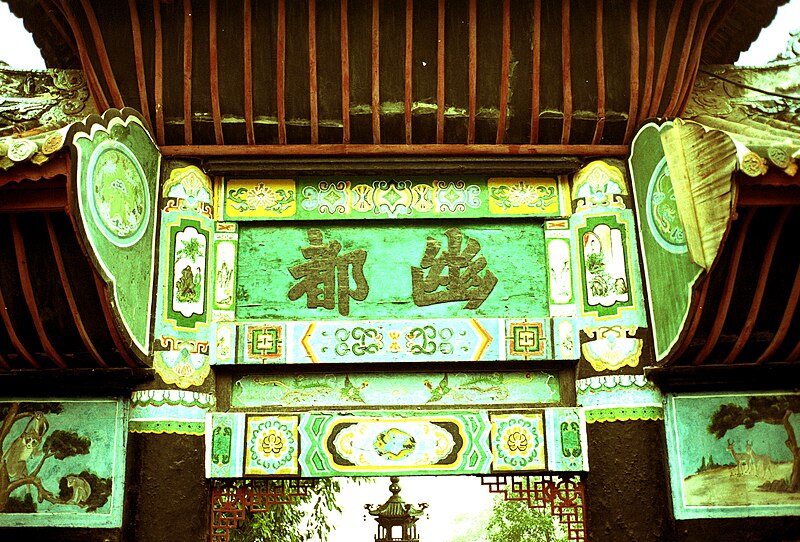
The Capital of Hell: The gate to the capital of the underworld, Youdu (right to left: 幽都). The whole underworld is called Diyu that is displayed in Fengdu Ghost City./source

After the building of Three Gorges Dam is built the Fengdu Ghost City will be an Island of itself, but parts of the city will be submerged in the water. They have also made some recent addition to the city.

In 1985 they built the Last Glance Home Tower, and according to legend, this is where the dead can have one last look back at their home and families before crossing over. Maybe one day, the Fengdu Ghost City itself will be something more of a legend than an actual place.

More like this

Newest Posts

https://www.atlasobscura.com/places/fengdhu-ghost-city