Tag Archives: Romania

The Last Strigoi Hunt: The Vampire Panic of Marotinu de Sus, Romania

Advertisements

In the rural and more superstitious parts of Romania, the fear of the undead is not necessarily something of the past. Although mostly done in secret and as a family business, the hunt for vampires or strigois, still happens. Something the family of Petre Toma experienced when he was accused of haunting extended family after death. 

In the shadowed villages of southern Romania, ancient beliefs about the restless dead linger alongside the hum of modern life. For while the medieval terror of the strigoi, vampires and morois may seem a distant superstition to outsiders, in certain corners of Dolj County, these spectral fears still pulse through the bloodlines of families whose lives are shaped by old-world rites. And if we are to believe some of the comments of the locals, it’s not necessarily that rarely it happens, it’s just not every case that makes it to the newspapers. 

Read More: Check out all ghost stories from Romania

In the tiny village Marotinu de Sus where around 700 people live scattered around in the countryside,  locals gather in the village’s only store and bar for a chat, often drinking hard. If you ask them, they will say they have at least one vampire story in their families and that they have been thought to hunt down and kill vampires, or the strigoi since they were children. One of the most notorious modern vampire cases in Europe occurred not in some fog-drenched, Gothic past, but in February of 2004.

A Haunting in Marotinu de Sus

One dark night that December the year before, Petre Toma, a 76 year old villager had driven in a carriage pulled by his horse through the village southwest in the country close to the Bulgarian border. He was drunk and fell off the carriage, scaring the horse that stomped him dead. He was buried in the local cemetery and his family started their morning process. But it would not be in peace. 

In death, it seemed, he had not severed his connection to the mortal world and became a moroi, an undead. 

Moroi and Strigoi: Strigoi in Romanian mythology are troubled spirits that are said to have risen from the grave. Moroi are often associated with other figures in Romanian folklore, such as strigoi (another type of vampire). In some versions, a moroi is a phantom of a dead person which leaves the grave to draw energy from the living. They are also sometimes referred to in modern stories as the living offspring of two strigoi.

His own sister, Flora Marinescu, started to complain that her daughter-in-law had fallen ill and that it was Petre who was to blame. It was also said that their son and grand daughter became ill. The woman reported terrifying nocturnal visitations: a pale, spectral figure appearing in her room, its face unmistakably that of her deceased uncle.

According to Toma’s neighbour, Mircea Mitrica, she had been shouting: ‘He’s on top of me! He’s eating me! He’s killing me!’ She couldn’t walk and complained about feeling drained, as if something had taken her blood. In Romanian folklore, such occurrences were seen as ominous signs of a strigoi. Fearing this ancient evil had once again returned, Petre’s brother in law and husband to Flora, Gheorghe Marinescu, took decisive — and deeply traditional — action.

The Ritual of the Dead

They could have called for the local Orthodox priest to perform an exorcism, but he would have needed a permit, and they feared it would take too much time. After a couple of nights discussing and drinking, they decided to act themselves. After all, they all knew how to rid themselves of the strigoi according to the old ways. 

The first time Gheorghe Marinescu tried to do the ritual, he ended up drinking too much liquid courage and couldn’t use the shovel. But in his mind, it needed to be done. Marinescu gathered a small group of family members, friends and neighbours and tried again. Also in attendance was his neighbour, Mircea Mitrica. 

And after steadying their nerves with alcohol, the party made their way to the cemetery under the cover of darkness. They exhumed the body of Petre Toma to look for evidence of him being one of the undead. According to those present, they claimed that the man had what looked like fresh blood around his mouth, for them, clear signs of vampirism. 

After confirming their suspicions, they split his ribcage with a pitchfork to remove his heart and staked through the rest of his body for good measure. In some sources they say they sprinkled garlic over it, but this part is rarely mentioned from the sources of those actually in attendance. Many tall tales were added over the years of this mission. The neighbour, Mitrica, claimed that the heart was still pumping when they pulled it out from his chest and that the face of his former neighbour was red and his beard had grown. 

The group put his heart in a plastic bag and put the body back in the grave. According to some sources, they didn’t put it back with care, and left it in a state of filth, earth and decay. They went to a nearby crossroad to start the ritual, where the world of the living and dead meet. 

According to Gheorghe Marinescu, his heart squeaked and tried to jump away when it was burned on the bonfire, also something that happens to a strigoi heart according to legend. This was all to perform an age-old vampire ritual believed to protect the living from the vengeful dead.

According to custom, the heart of a strigoi must be burned. Its ashes are then mixed into water and drunk by those afflicted by the revenant’s haunting, believed to break the malevolent bond between the strigoi and its victims.

This is what they did when they went home and lit a second bonfire to make the mixture. They gave the tincture to the sick woman to drink. A local named Anisoara Constantin who lived there at the time commented in an article: ‘Well, the sick woman got better again, so they must have done something right,’

According to the party, they all went back to see the woman afflicted with the illness they tried to cure the very next day. She was better and could walk and talk without any pain and invited them all to her house to eat, drink and celebrate her recovery. 

The ritual, grisly as it may sound to outsiders, has ancient roots in Eastern European lore. The strigoi were thought to rise from the grave to drain the life force of their relatives, and unless dealt with through fire or staking, would slowly devastate entire families.

Modern Consequences for Ancient Beliefs

The following day, news of the nocturnal disinterment and ritual reached Dolj County police when his daughter complained about the disturbance and desecration of her father’s grave and corpse. 

The six who attended the ritual were arrested and charged with “disturbing the peace of the dead.” Despite their protestations that they had only acted in defense of their loved ones, they were each sentenced to six months’ imprisonment and ordered to pay damages to the family of the deceased.

In the end, they did not end up serving their sentence and had to pay a total of 900 Euro in damages to the family. The case drew widespread media attention, becoming a sensation in Romania and abroad, with international headlines decrying it as evidence of vampire hysteria persisting in 21st-century Europe.

A Legacy of Fear and Precaution

The case left a lingering mark on the region, but if we are to believe the comments of some of the locals, it seems that this case didn’t happen in isolation.  

‘No one is bothered who did it, it’s their own business. This ritual often takes place, but in secret, within the family. The problem comes when the police get involved.’ says 80-year-old Tudor Stoica in an article. 

In the nearby village of Amărăştii de Sus, local custom adapted to meet the lingering fear. Now, as a preventive measure, it’s reported that villagers drive a fire-hardened stake through the heart or belly of the recently deceased, especially those thought to have harbored grudges or strange tendencies in life. In the village where Peter Toma was exhumed, they also do something similar with knitting needles or other sharp objects.

Such rites, though rarely reaching world wide headlines, serve as chilling reminders of how the old beliefs still hold power in places where death is regarded with a wary eye and where the border between the living and the dead remains perilously thin. And most likely, this was not the last Strigoi hunt at all. 

As his sister and wife of the man accused of disturbing his grave, Flora Marinescu said: “What did we do? If they’re right, he was already dead. If we’re right, we killed a vampire and saved three lives. … Is that so wrong?”

Newest Posts

  • The Lady of the Stairs Haunting Ardgillan Castle
    Outside of Dublin overlooking the Irish sea, a white lady is said to be haunting the premise. Seen coming up from the beach and wandering on the castle grounds, the ghost that is called the Lady of the Stairs is just one of the ghosts said to linger at Ardgillan Castle.
  • The Church of San Giuseppe: A Sacred Place Where Rain Still Falls
    In the woodlands on the Hill of the Dead, the Sanctuary of Somazzo or Church of San Giuseppe has been the place of a strange pilgrimage for ages. According to legend, praying to the three girls said to be entombed alive in the church is said to bring rain in times of drought.
  • The White Lady of Duino Castle: A Haunting Beneath the Cliffs by the Castle Ruins
    Frozen in all eternity as a stone below the old castle of Duino on the cliffs. It is said to be haunted by the Lady in White, the former lady of the castle, thrown off the cliffs by her jealous husband. Now she returns to the castle to watch over her child she left behind.
  • The Cursed Forest and Poltergeist of Finnskogen at Välgunaho
    Bordering Norway and Sweden, the mysterious Finnskogen forest, with its deep rooted trees holds ghosts, curses and lingering spirits. Like the poltergeist like ghost at Välgunaho farm, who drove its residents away and left it abandoned for over a century.
  • Alukah: The Vampire of Ancient Text and Folklore
    In Jewish mysticism, the vampiric Alukah from ancient text is still debated and feared today. But where does the demonic spirit really come from?
  • The Haunted National Museum of Ireland: Ghosts of Collins Barracks
    Now, the former barracks has turned into the National Museum of Ireland. If we are to believe the rumours, the ghosts of war from the former Collins Barracks are said to still linger.
  • The Ghosts of Løp Gård North of the Veil
    In the old farm for the rich and the powerful in the northern parts of Norway, Løp Gård is said to hold many of their former inhabitants, even in their death.
  • Darkey Kelly: The Green Lady of the Liberties
    Was she a Witch or Serial Killer with connection to the Hellfire Club that her legends paint her to be? What was the true story behind Darkey Kelley, said to haunt Dublin as the Green Lady of the Liberties.
  • The Limping Ghost of Fossesholm
    After tragedy struck Birthe Svendsdatter, she threw herself from the window and ended up with a limp and a brain injury. Called Halte-Birthe because of her limp, she is said to haunt Fossesholm Manor to this day.
  • The Aufhocker: The Heavy Vampiric Spirit of Germany
    Feeling like a sudden and invisible burden, the life force of wary travellers were long subjected to the terror of the Aufhocker. A creature between the vampire, werewolf and goblin spirits, the legend of the empty road were long haunted by something heavy.
  • Davy Byrne’s Pub: The Ghost of James Joyce Still Raising a Glass
    Said to appear in the mirror of his favorite place for a pint in Dublin, the ghost of James Joyce is rumored to still linger in Davy Byrne’s Pub.
  • The Tragic Ghost of the Maid Haunting Visnes Hotel
    A maid who once worked at the hotel allegedly took her own life at the old Visnes Hotel, deep in the Norwegian fjords. Now it is said she is lingering in the afterlife in the old rooms she once worked in.

References:

How Balkan vampires captured the world’s imagination – Emerging Europe

A village still in thrall to Dracula | World news | The Guardian

Romanian villagers decry police investigation into vampire slaying | McClatchy Washington Bureau

“I dug out his heart with a pitchfork” | Michael Bird Writer & Journalist

I-am scos inima cu o furcă – The Black Sea

VIDEO/ Reportaj în satul unde țăranii au dezgropat un mort și i-au înfipt un țăruș în inimă. Oamenii încă mai cred că l-au împiedicat să devină strigoi și-au salvat o fetiță!

Strigoi – Wikipedia 

The Haunted Corvin Castle: A Journey Through Romania’s Dark History

Advertisements

Is Corvin Castle in Romania haunted by something? Perhaps the ghost of Vlad the Impaler? As one of the biggest castles in Europe it also houses a whole load of ghost stories. Who is hiding in the shadows?

Are you ready to embark on a spine-chilling journey through Romania’s dark history? Join me as we explore the haunted Corvin Castle, a place that has been the subject of countless legends, myths, and tales of horror. Built in the 15th century and considered as one of the Seven Wonders of Romania, this Gothic fortress has witnessed centuries of bloodshed, torture, and tragedy. 

Read More: Check out all ghost stories from Romania

But the ghosts of the past still linger within its walls and as one of Europe’s biggest and old castles overlooking the Ziasti River, it’s bound to have a ghost story or two. 

Corvin Castle: The majestic Corvin Castle, a Gothic fortress steeped in history and legends, located in Hunedoara, Romania. Holding back the Ottoman army for years, it is filled with ghosts and the castle is believed to be some of the most haunted places in Romania. And that is saying something.

History of Corvin Castle

Corvin Castle, also known as Hunyadi Castle, is a Gothic-Renaissance fortress located in the town of Hunedoara, Romania. It was built on top of an old Roman camp in 1446 by John Hunyadi, a Hungarian military leader, and served as a strategic stronghold against the Ottoman Empire. He was a Voivode of Transylvania, the highest ranking official during the 12th and 16th century. Back then, it was a part of the Kingdom of Hungary, a monarchy that existed for nearly a millennium. Over the centuries, the castle has been expanded and renovated by various owners, including the Corvin family, who gave it its current name.

Read More: Check out all haunted castles in the world

Despite its impressive architecture and historical significance, the castle is best known for its dark and twisted past. It has been the site of numerous battles, sieges, and executions, and has been home to some of the most infamous figures in history. 

On 13 April 1854, Corvin Castle was struck by lightning, severely damaged and abandoned until 1869.

The Legend of the Raven: Some historians think John Hunyadi was the illegitimate son of King Sigimund of Luxemburg and an Elizabeth. To protect everyone, this was kept secret. Sigimund gave Elizabeth a gold ring for their son. When John grew up, Elizabeth gave him the ring. One day at lunch, John took off the ring, and a raven tried to steal it. John killed the raven with a bow and arrow and got the ring back. Later, he told the king (possibly his father) this story. Impressed, the king chose a raven with a gold ring for the Hunyadi family crest. The family liked this symbol, which stood for wisdom and longevity, and adopted the name Corvin, from the Latin word “Corvus” meaning Raven. It’s also said that Elizabeth used a raven to send a letter to Matthias when he and his brother were imprisoned, which is why the raven was the symbol of the Hungarian postal service for over a hundred years. The family also had a property called Raven’s Rock.

Dark Tales and Legends of Corvin Castle

The legends surrounding Corvin Castle are as numerous as they are chilling. One of the most famous tales involves Vlad the Impaler, who was imprisoned in the castle’s dungeon for seven years by John Hunyadi. According to legend, Vlad was kept in a small, dark cell and tortured mercilessly by his captors. This is what inspired him to impale his enemies, as it was what he did to the rats he ate alive in his cell. Some say that his ghost still haunts the castle’s halls to this day, seeking revenge against those who wronged him.

Vlad the Impaler: A historical depiction of Vlad the Impaler’s brutal methods of torture and execution, reflecting the dark history of Corvin Castle. Woodcut from the title page of a 1499 pamphlet published by Markus Ayrer in Nuremberg. It depicts Vlad III “the Impaler” (identified as Dracole wayde = Draculea voivode) dining among the impaled corpses of his victims.

If he really was is uncertain and most likely it’s a tall tale, but many of the tour guides of the castle show his holding cell they say he stayed in. Many say that he was imprisoned in 1462, but seeing that John Hunyadi was already dead by then, it carves a dent in the truth of the story. What has been said though, is that Bram Stoker was inspired by the castle, although he apparently had no idea about the Vlad the Impaler connection when he wrote Dracula. 

Haunted sightings and experiences at in the Capistrano Tower

Over the years, there have been numerous reports of paranormal activity at Corvin Castle. Visitors have reported seeing ghostly apparitions, hearing strange noises, and feeling cold spots throughout the castle. Some have even claimed to have been physically touched or pushed by unseen forces.

One such legend talks about a monk haunting the Capistrano Tower. The Capistrano Tower, one of the most significant parts of the construction, was a circular tower and this was used as a prison like many of the other towers of Corvin castle, named of the Franciscan monk, John of Capistrano.

The Towers of Corvin Castle: The towers of the castle was known to be used as prison cells. This is also what fuels the haunted rumors about something not being quite right in one of them. Could the ghost of a monk be haunting one of the towers?

He was said to have been sentenced to death because he was spying on a nobleman in the council room. As punishment he was entombed alive in the brick wall of the tower and slowly died of starvation. To this day it is said his ghost is there, spying on those venturing into his tower. 

Exploring the castle’s architecture and hidden rooms

Despite its dark history, Corvin Castle is a marvel of Gothic architecture and design. From its towering walls and turrets to its ornate carvings and frescoes, the castle is a testament to the skill and craftsmanship of its builders.

One of the most interesting features of the castle is its hidden rooms and secret passages. These were often used by the castle’s inhabitants to escape during times of siege or to hide valuable treasures. Some of the most famous hidden rooms include the Knight’s Hall, which was used to store weapons and armor, and the secret room of John Hunyadi, which was used as a private study and meditation space.

One time though, some tourists got locked in the Corbin Castle after it closed for the day. Some say that they bribed the security guard to let them stay overnight. When the castle opened the next day, they were found, bruised, beaten and terrified. They were unable to explain what had happened to them, but claimed that some unseen force had tortured them throughout the night. 

The torture chamber and its gruesome history

One of the most chilling places in Corvin Castle is the torture chamber, where prisoners were subjected to horrific acts of violence and torture. The chamber is located in the castle’s basement and features a variety of torture devices, including the rack designed to tear a victim in half, the iron maiden that was a spiked iron chamber the prisoner had to sit in, and the Spanish Donkey were the victim was places on a triangle with pointed edges between the legs where the prisoner eventually split in half.

There was also a bear pit that prisoners were thrown into alive to be eaten by the creatures residing there. No wonder that the castle is filled with ghosts. 

The Bottomless Well

Another famous tale involves the castle’s well, which is said to be bottomless and connected to the underworld. Legend has it that the well was dug by three Turkish prisoners who were promised their freedom if they could complete the task of digging after water. However, once they finished digging after ten to fifteen hard labored years, they were thrown into the well and left to die. 

The Well: What will you find at the bottom of the well? The gateway to hell or the skulls of some Turkish prisoners? Source: Stanisław Ludwiński/Flickr

Some say that he held them there, laughed in their face and kept them in the basement until they died. Some think that it was Hunyadi who promised them their freedom, but died while they were working. The one telling them to get back into their cell was his wife, Elizabeth. One of the prisoners allegedly wrote on the wall: You now have water, but no soul/heart. With this, he cursed the castle forever. 

Some say that they were beheaded and hteir skulls thrown into the well, still there to this day. It’s said that their ghosts can still be heard crying out for help from the depths of the well.

Is Corvin Castle really haunted?

While there’s no scientific proof that Corvin Castle is haunted, there’s no denying the countless reports of paranormal activity and ghostly sightings that have been recorded over the years. Whether you believe in ghosts or not, there’s no denying the eerie feeling that permeates the castle’s walls.

Newest Posts

  • The Lady of the Stairs Haunting Ardgillan Castle
    Outside of Dublin overlooking the Irish sea, a white lady is said to be haunting the premise. Seen coming up from the beach and wandering on the castle grounds, the ghost that is called the Lady of the Stairs is just one of the ghosts said to linger at Ardgillan Castle.
  • The Church of San Giuseppe: A Sacred Place Where Rain Still Falls
    In the woodlands on the Hill of the Dead, the Sanctuary of Somazzo or Church of San Giuseppe has been the place of a strange pilgrimage for ages. According to legend, praying to the three girls said to be entombed alive in the church is said to bring rain in times of drought.
  • The White Lady of Duino Castle: A Haunting Beneath the Cliffs by the Castle Ruins
    Frozen in all eternity as a stone below the old castle of Duino on the cliffs. It is said to be haunted by the Lady in White, the former lady of the castle, thrown off the cliffs by her jealous husband. Now she returns to the castle to watch over her child she left behind.
  • The Cursed Forest and Poltergeist of Finnskogen at Välgunaho
    Bordering Norway and Sweden, the mysterious Finnskogen forest, with its deep rooted trees holds ghosts, curses and lingering spirits. Like the poltergeist like ghost at Välgunaho farm, who drove its residents away and left it abandoned for over a century.
  • Alukah: The Vampire of Ancient Text and Folklore
    In Jewish mysticism, the vampiric Alukah from ancient text is still debated and feared today. But where does the demonic spirit really come from?
  • The Haunted National Museum of Ireland: Ghosts of Collins Barracks
    Now, the former barracks has turned into the National Museum of Ireland. If we are to believe the rumours, the ghosts of war from the former Collins Barracks are said to still linger.
  • The Ghosts of Løp Gård North of the Veil
    In the old farm for the rich and the powerful in the northern parts of Norway, Løp Gård is said to hold many of their former inhabitants, even in their death.
  • Darkey Kelly: The Green Lady of the Liberties
    Was she a Witch or Serial Killer with connection to the Hellfire Club that her legends paint her to be? What was the true story behind Darkey Kelley, said to haunt Dublin as the Green Lady of the Liberties.
  • The Limping Ghost of Fossesholm
    After tragedy struck Birthe Svendsdatter, she threw herself from the window and ended up with a limp and a brain injury. Called Halte-Birthe because of her limp, she is said to haunt Fossesholm Manor to this day.
  • The Aufhocker: The Heavy Vampiric Spirit of Germany
    Feeling like a sudden and invisible burden, the life force of wary travellers were long subjected to the terror of the Aufhocker. A creature between the vampire, werewolf and goblin spirits, the legend of the empty road were long haunted by something heavy.
  • Davy Byrne’s Pub: The Ghost of James Joyce Still Raising a Glass
    Said to appear in the mirror of his favorite place for a pint in Dublin, the ghost of James Joyce is rumored to still linger in Davy Byrne’s Pub.
  • The Tragic Ghost of the Maid Haunting Visnes Hotel
    A maid who once worked at the hotel allegedly took her own life at the old Visnes Hotel, deep in the Norwegian fjords. Now it is said she is lingering in the afterlife in the old rooms she once worked in.

References:

The Ghost that Designed Iulia Hasdeu Castle

Advertisements

Through the power of spiritualism, the bereaved father built a castle designed by the ghost of his dead daughter. And today, the Iulia Hasdeu Castle still stands as a mysterious and haunted place. 

Iulia was the beloved daughter of Bogdan Petriceicu Hasdeu (1838-1907) in Romania. He was a Romanian scholar of both history, philology and a great writer. Iulia was somewhat of a prodigy child as well and read by the age of two. Like her father, she was fluent in many languages and spoke French, English and German fluently by the time she was eight. At only 16, she got her degree in philosophy with plans to continue her studies in Latin and Greek Languages at the prestigious University of Sorbonne. 

Advertisements

But then on the 29th of September 1888, just a month before her 19th birthday, she tragically died of tuberculosis, a tragic but common way to die in this time. She left behind her many poems, manuscripts and plays to her father who couldn’t move on with his life. That is when he turned to less common ways to keep in contact with his dead daughter.

The Seances to Get in Touch with her Spirit

He was deeply in grief and turned to spiritualism to get in contact with his beloved and missed daughter. There are recordings of over a hundred summaries of these sessions, saying something about his obsession with it.

The Ghost: Portrait of the young prodigy Iulia Hasdeu.

And after he moved to Câmpina which is a bit further north from Bucharest , he spent the time at seances together with the metropolitan bishop, three generals and a processor. All in hope to get a glimpse of his daughter.

He also built an altar for her in their family vault at the Bellu Cemetery in Bucharest that looks more like a Greek temple to pay tribute to her. But this altar was not enough for him to keep as a memento and after six months of trying to reach her in the spirit world, he made contact, and she gave him instructions to build a castle that would later be known as Iulia Hasdeu Castle. 

Together with his wife, they went to a mansion in Câmpina they decorated as almost a temple to their dead daughter to sort of keep a part of her with them in this world after it was built. He named it Second of July after his two Iulias as his belated daughter was named after his beloved wife.

Then the plans of the castle started to take form. Hasdeu claimed that he had received messages about the building plans for it through the spiritualism seances he took part in. 

The Building Designs of Iulia Hasdeu Castle from Beyond

Work on the Castle began in 1893 and took a lot of Hasdeus’ time, energy as well as wealth. It is more of a folly house than a full fledged castle. She would advise him to use the numbers three and seven, something she considered to be magical numbers. That is why these numbers repeat themselves throughout the building with three underground rooms, three towers and seven steps to every staircase. 

The building was completed in 1896 and has since seen its fair share of tragedy befall it. It required a lot of reparation, even when Hasdeu was alive. During the first world war as well as the second world war, the earthquake in 1977 where it suffered many damages. But the castle fought back. There even is a legend to this that during the second world war, the Germans tried to loot the place, but failed as they were ‘struck by some mysterious force.’

Spiritualism: During the turn of the century, seances and spiritualism was a big thing. This is a Seance scene in the classic German silent film Dr Mabuse (1922). People would get together with a medium in hope to make contact with a spirit beyond the grave.

Today the Iulia Hasdeu Castle is still a sort of altar in Iulias memory. With her personal belongings as well as transcripts of the seances that her father attended. The castle itself is described to have a spooky vibe over it, perhaps because there are entire rooms designed specifically for spiritualists rituals, with seats made for the attending ghosts. A shrine like this was bound to get more sinister rumors about it, and it was claimed that Hasdeu used it to worship Satan rather than memorializing Iuelia. 

The Ghost of Iulia

The Iulia Hasdeu Castle is not the only place she is reported of haunting. Also back at the cemetery in Bucharest, the ghost has been spotted, dressed in all white while walking through the cemetery in Bucharest holding daisies. 

Back In Câmpina at the castle they have also felt her presence. In the night there is the sound of piano playing with the applause and cheering from an old man. So many rumors that the museum itself had troubles finding someone to take the nightshift at the museum. 

Advertisements

More like this

Newest Posts

References

Discover Iulia Hasdeu Castle | Daytrip

Iulia Hasdeu Castle: The Eerie Romanian Castle Designed by a Ghost

Iulia Hasdeu Castle, where mystery and culture go together

Iulia Hasdeu Castle

Iulia Hasdeu Castle: Spiritism, romance and science all in one – The Romania Journal

http://www.muzeulhasdeu.ro/index.php?meniu=71

Hoia Baciu — The Haunted Forest of Transylvania

Advertisements

This haunted forest known to be the Bermuda Triangle of Romania with its eerily coiled trees and whispers of local legends reminds us all that Transylvania is not only haunted by the legend of Dracula and vampires. Take a walk in the Hoia Baciu Forest and hopefully you will get out as well.

Romania has a rich history of the unexplained and lores and legends that will creep into the bones of those listening. This forest is clouded in mystery and is no exception. Strange orbs of lights are said coming from inside the treeline, and rumors of it being a possible gateway to another dimension draws desperate people to try for themselves. The stories of the haunted forest has reached an international reputation now and is on most lists of “most haunted places in the world“.

Read More: Have a look at all our stories about haunted forests: Here

The forest has always had a paranormal undertone whispering in the wind from old legends, but modern lore of the forest being a hotspot for UFOs, missing time and has started to take hold as well. All of these legends are what has given it the nickname the Bermuda Triangle of Romania. The mysterious forest of Hoia Baciu, or Pădurea Hoia as it is in Romanian, has many haunted legends lingering among the trees. 

Hoia Baciu Forest: The Transylvanian forest is shrouded in mystery and intrigue, largely due to its peculiar trees, a dense thicket of gnarled, contorted trees with twisted branches that seem to reach out like spectral fingers. Local legends claim that the trees are imbued with supernatural energy, and many believe that they are gateways to other dimensions or portals to the spirit world.//Source: Wikimedia

The Haunted Forest for Ufology

It’s not only those living close to the Hoia Baciu forest, superstitious people or those seeking ghosts that claim there is something going on in between the trees. Even in academic circles there are those who were intrigued by the strange place and the subject has been dealt with by both national research as well as overseas.  

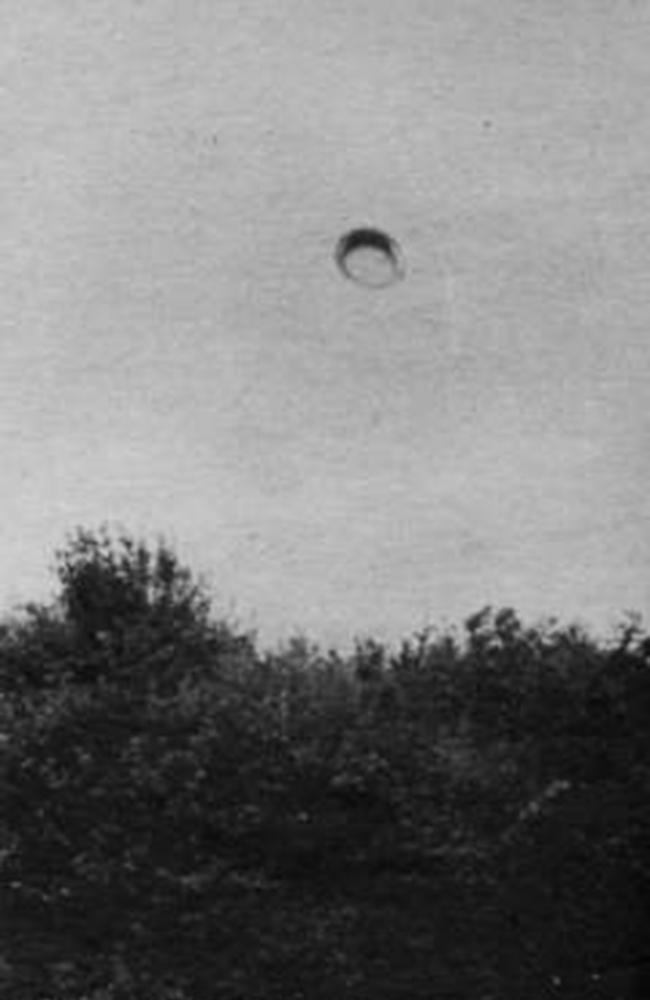
UFO Over the Treetops: This picture is one of the pictures Emil Barnea took of the sky above the forest, now believed to be of more strange origin.

Even some selected professors at the university in the city claim this particular forest is a place where paranormal activity happens, and in the modern world filled with strange disappearance legends, tales of aliens and UFO’s has started becoming a part of the lore of the haunted Hoia Baciu Forest. 

In the late 60’s a biologist named Alexandru Sift came back with pictures from the forest that he claimed were flying UFO’s in the sky over the twisted trees. Sift wandered into the forest to have a closer look at the strange vegetation that can be found in there as part of his research.

These pictures of the alleged UFO’s were published by his chemist friend of Sift, side by side with theories about the paranormal stuff happening in the old forest right outside the city. And what he found and reported off got more people interested in both the paranormal legends that had seemingly always followed Hoia Baciu.

The same claim about seeing a UFO inside of Hoia Baciu came from a military technician named Emil Barnea as well. In 1968 he took some pictures in the western part of the forest while he was camping in the forest. Barnea took a huge hit by publishing the pictures as the communist government at the time looked at tales like ghosts and aliens like madness and superstition. He even lost his job because of the publishing of the pictures.

But what was the truth behind the pictures? What flew in the sky that made people think it had to be aliens? Both of these cases, with what seemingly looked like picture evidence, helped to give the forest a sense of notoriety more than a local place filled with local legends.

When first delving into the local lore since the first trees started growing there, strange occurrences had been reported long before the 60’s and people started talking about UFOs. 

The Bermuda Triangle of Romania

Hoia Baciu Forest is located near the Cluj-Napoca city in the northwestern part of Romania, an old forest still stands only half an hour away from the city by car. The forest is in notorious Transylvania, and for many it is expected that a haunted forest should be placed right here. Although the city close to the forest is free from the Dracula tales of Bran Castle and the tourist attractions one might find in a lot of towns capitalizing on the vampiric lore of the country. But there is a certain eeriness to the trees bending in twisted ways with skeleton-like branches reaching out for the hikers. 

We are away from the bustling modern everyday life from the city and here in Hoia Baciu Forest and the only thing to hear is the falling leaves, whispering as they reach the ground, and the sounds of deer, walking among the trees. Some might say Hoia Baciu is much more scary than Dracula himself.

Strange Lights of Hoia Baciu: Another one of the pictures taken by Barnea in the 60’s showcasing strange lights that has been told legends about in Hoia Baciu throughout the years. What the lights and figures over the forest really was has never been found out, but has been the source of much speculation within the ufology community.

When saying the forest is an old one, it truly is. As in 55 000 year old. With such old places like the mysterious Hoia Baciu, there are old stories that no one really knows when they started or came from. Farmers in the valley claim the forest is haunted to this day, and especially stories about strange disappearances there are plenty of. The story about the strange disappearances are also why the Hoia Baciu forest is also sometimes referred to as: “The Bermuda Triangle of Romania.

The Disappeared Shepherd

One of these disappearance stories from Hoia Baciu tells of a shepherd that went into the Hoia Baciu and vanished with more than 200 of his sheep without a trace, never to return. Perhaps a man could simply vanish in a forest by himself, but 200 sheep? The stories about many people disappearing are odd considering the forest is not that big compared to other places an covers an area of about 3 square kilometers.

Read More: Another forest where people seems to just disappear, check out: Spirited Away in the Forbidden Yawata no Yabushirazu

In some sources it is after the disappeared shepherd that the forest is named Hoia Baciu. The locals are at times afraid to enter the forest because of tales like this that have been handed down for generations. The once brave enough to venture in have also complained about feeling nauseous, itching as well as getting migraines when they are brave enough to enter. 

The Girl Who Vanished

Perhaps the most famous tale from this forest is of the 5 year old girl that wandered into the forest one day and got lost and disappeared from the face of the earth, at least for the rest of the world. Years passed and after five years of being missing she came back out from Hoia Baciu, supposedly in the same clothes she wore on the day of her disappearance, not looking a day older.

When asked where she had been and what had happened, she had no answers. She reappeared in the forest with no memories of where she had been and what happened to her, at least, she didn’t want to share it. For her it had apparently only been a little while, not many years.

Many accounts claim there are many, perhaps as many as thousands of people that have disappeared in this Bermuda Triangle of Romania over the years. But of course, no hard evidence is found of these occurrences. Because they never happened, or merely because they happened so long ago that evidence of this is long gone?

Ghosts Haunting the Forest

There are not only strange legends about people being whisked away for years or forever or pseudo science of UFO and aliens that are told going on inside of the forest. A part of the local legends of the forest also deals with ghosts haunting the trees.

One of the ghost stories tells of the ghosts of Romanian peasants that were murdered in the forest and is believed to still be trapped in the forest, unable to move on.

They are sometimes seen wandering among the trees in Hoia Baciu, observing the people entering their final resting place. Other tales of shadow figures, something looking like ectoplasms as well as hearing strange voices are also told by joggers and hikers. One of the ghosts are supposedly also wearing something that looks like the northern Romanian traditional clothing.

The Poiana Rotunda Inside Hoia Baciu

The Poiana Rotunda: The clearing in the forest were most of the strange happenings is taking place giving the nickname Bermuda Triangle of Romania// Photo: Lajsikonik

Most of the paranormal reporting has now started centering around a supposed vegetative dead zone found inside of Hoia Baciu. This place is called Poiana Rotunda, or ‘Round Meadow’ found west in the forest.

The Poiana Rotunda is a one kilometer area of grassland inside the thick forest and is a close to perfect circle on the ground where no trees grow from the soil, apparently without an explanation.

People claim that they feel nauseous or dizzy when coming close to this place, and most of the strange things that are told about the forest are said to have started or happened around this dead zone.

What happened here has been up for much speculation. Could it be from a UFO landing at this place, could it be a sign of the gateway to the parallel dimension that seems to have spirited away many people throughout the years?

The more earthly and natural reasoning for this mysterious meadow in the middle of the forest could also be caused by natural causes or illegal deforestation the forest is suffering from. Soil samples have been taken from the place, but as of now, we don’t really have a definite explanation for this phenomenon.

A Walk Inside of the most Haunted Forest in the World

No matter what really lies inside the forest, of it really is haunted or some sort of Bermuda Triangle of Romania, it certainly pulls the strangest and darkest things out from people visiting. It is a perfect setting to put on a tv-show, sell books claiming all sorts of stuff. 

Maple groves, gatherings of beech, ash and elm wrap around themselves, contorting to strange shapes that perhaps help the feeling of uneasiness and gives the forest an overall creep factor. Blocking out the sun, leaving us in a sort of eternal shadow below the trees, anything seems possible in Hoia Baciu.

More like this

Newest Posts

References:

Frights and sights in Transylvania: exploring haunted Hoia Baciu | Romania holidays | The Guardian

Haunted Forest – Hoia Baciu Forest

Pădurea Hoia Baciu, de la legendă, la adevăr. De ce copacii au forme atât de ciudate?

Haunted forest Hoia-Baciu – Cluj-Napoca

Solving the Haunted Hoia-Baciu Forest

Hoia Baciu travel guide: Inside the creepiest forest in Transylvania | The Independent 

Halloween Traditions Across the World

Advertisements

In this wide world we have countless customs, holidays and traditions. But the tradition of honoring, and at times, fearing the dead around the dark autumn time, seems to be something we do in all corners of the earth.

Through the modern media we have all grown accustomed to this specific type of Halloween traditions. Carving pumpkins, go trick or treating and dressing up is now a global phenomenon. But the concept of celebrating the dead, souls and spirits during the harvest season has always been something people have done, and probably will continue to do for a while. But although the American style Halloween have monopolised a lot of the celebration, there are still both old and local variation of celebrating this kind of festivity. Here are some of them:

Samhain — Britain

Samhain: Bonfires, offerings to fairies and feasts for the dead was a tradition in the old Samhain celebrations.

The Samhain celebration is probably were the modern Halloween traditions has borrowed most customs and ideas from. It is a Gaelic festival marking the end of harvest season and the beginning of winter. it was usually celebrated from 31. October to 1. November. It was celebrated all throughout Ireland, Scotland and the Isle of Man, with many similar festivals held around the same time around the rest of the Celtic Islands.

According to tradition, bonfires were lit as they were seen to have protective and cleansing power. Offerings to the Aois Sí, the spirits and fairies was made to give them a good harvest and making them last through the winter. There was also held feasts where they made place for the dead at the table, as it was believed that the souls of the dead would visit.

The festival was held because the time was seen as a liminal time, were the boundary between the living and dead were minimal and the crossing between this world and the otherworld were more easily done. A part of the festival also included people dressing up in costume to recite verses for food, called mummers play, or mumming.

Advertisements

All Saints Day — Catholic Church

All Saints Day: This Christian holiday is celebrated many places were there is a Roman catholic or Anglican church.

Within the Catholic Church the celebration of All Saints’ Day or All Souls’ Day is marked November the first and second. It is also called Commemoration of All the Faithful Departed and Day of the Dead. The All Saints Day is a day for celebrating all Saints and Martyrs in the Christian Church. The All Souls Day is mostly for the people still in purgatory to atone for their sins before entering heaven.

This together with Samhain turned into what we now call the modern Halloween with its traditions. Most often, the All Saints’ Day is celebrated within the western christianity, while in the eastern christianity they have celebrated somewhat the same in Saturday of Souls celebrations. It is mostly celebrated by Roman Catholics and Anglicans.

The feast itself is celebrated on November 1. and is mostly a day of prayer and remembering the souls of the dead. On the day there are many ways the practitioners remember the dead, and the traditions vary from church to church, but it generally include lighting candles and praying.

Advertisements

Allantide — Wales

Allan Apples: Apples are important for Allantide as they are a token of good luck.

A Cornish version of Halloween traditions is the Allantide, or Kalan Gwaw, meaning the first day of winter. In the sixth century, Cornwall had a bishop named St Allan, and therefore it is also known as Allan Night and Allan Day. Traditionally it was celebrated on the night of October 31 and the day after.

A lot of common traits with Hollantide celebration in Wales and Isle of Man as well as Halloween itself. To celebrate they rung the church bell to comfort Christian souls on their journey to heaven. They made Jack’o lanterns from turnips. But the most important fruit this feast was red apples. Large, glossy Allan apples were polished and given to friends and family as gift for good luck.

Divination game to read the future was also a part of the festivities. They ere for example throwing walnuts in the fire to predict the fidelity of their partners, or poring molten lead in cold water to find out the job of their future husband. Also some parts of Cornwal, they lit ‘Tindle’ fires to the Coel Coth of Wales.

Advertisements

Day of the Dead — Mexico

Día de Muertos: This day is often recognized for the costumes and makeup.

The Day of the Dead or Día de Muertos in Spanish is a Mexican holiday, well known for their distinctive costumes and face paint. Before the Spanish colonization in the 16th century, the celebration was in the beginning of the summer in Mexico. But it became intertwined with the Christian church and European Halloween traditions and moved to the end of October and beginning of November.

It is a holiday, stretching over several days gathers families and friends to pray for their lost ones and help their way to heaven. According to the Mexican culture, the death is viewed as a naturally part of the human cycle and should therefor not be seen as a day of sadness, but a day of celebrations.

Advertisements

Pchum Ben — Cambodia

Preparing to open the gates of hell: Monks praying and people gifting food and flowers to the ancestors.
Prayers during Pchum Ben. Credit: Maharaja45

The holiday is a fifteen day celebration on the 15th day of the tenth month in the Khmer calendar, at the end of the Buddhist Lent, Vassa. And would in the Gregorian calendar, mostly be in September and October. The translation of Pchum Ben is Ancestor Day, and its a time were many Cambodians pay their respect to the dead family and relatives up to seven generations.

Monks chant the sutta in Pali language without sleeping overnight to prepare the gates of hell opening. This occurs once a year and is a time were manes (spirits) of the ancestors come back. Therefore they put out food offerings that can help them end their time in purgatory.

People give foods like sweet sticky rice and beans wrapped in banana leaves, and visit temples to offer up baskets of flowers as a way to pay respect to their deceased ancestors. It’s also a time for people to celebrate the elderly.

Advertisements

Pangangaluluwa — Philippines

After sundown: In Philippines they light candles and camp out in the cemeteries to honour the ancestors.
Photo by Alexandr Chukashev on Pexels.com

The name of the holiday is from the word kaluluwa, meaning soul or spirit. It is an event that lasts three days at the cemetery with food stands and pop-up stores around the cemetery as the people celebrating the festivities, camp out.

On the first of November people gather in cemetaries to light candles and put flowers on the grave to respect the ancestors. some places in the north they have this old tradition of lighting pinewood next to the graves. In the cemetery there is a priest walking through it to bless all the tombs.

Outside of the emetaries, there are carollers singing through the night, all draped in white blankets. The same tradition is for children as they go door to door and singing hymns to get money.

Today, the local tradition is slowly fading out, merging more and more with the modern Halloween traditions, but out in the provinces, mostly, the old practices is still upheld for now.

Advertisements

Saint Andrew’s Day — Romania

Night of the Wolf: During this night wolves have special powers and can speak.
Photo by David Selbert on Pexels.com

This day is today connected to the Christian saint, but it also have some pagan origins with the Roman celebration of Saturn. In the Dacian Ney Year was an interval when time started up again. On the turn of the night, wolves were allowed to eat the animals they wanted and it was also believed that they spoke as well, although, if you heard it, it meant an early death.

Early on the day, the mothers went into the garden to get branches, especially from apple, pear, cherry trees and rose bush branches. They made a bunch of these branches for each family member, and if a branch bloomed by New Years day, it meant they would be lucky and healthy the following year.

There was also a tradition of girls hiding sweet basil under their pillow to have dreams about their wedding. It was also customary for girls to put 41 grains of wheat under their pillow, and if they dreamt someone stole them, it meant they were going to be wed the next year. This premonition was also done by bringing a candle to a fountain at midnight and ask Saint Andrew himself if he could give them a glimpse of their future husband.

This day was especially good for revealing the future husband by magic, a superstitious belief that was also in Ukraine, Germany, Austria, Slovakia, Poland, Russia as well as in Romania. This was also the day were vampiric activity was at large, all until Saint George’s Eve on the 22. of April.

Advertisements

Dziady — Poland

Dziady: Cemetery on dziady night by Stanisław Bagieński from 1904.

The Dziady is a slavic feast to remember the ancestor long passed. It is sometimes translated to Forefathers Eve. It used to be celebrated both in the spring and in the autumn, but today, it is usually held in the end of October like .

In the feast they eat ritual meals to celebrate the living and the souls. It was either held at the house or at cemeteries, were poring directly on the grave was and still is a thing. In some areas the ancestors also had to bathe, and saunas was prepared for them. They also lit up candles and lights to guide the souls so they wouldn’t get lost and wander off.

There was also a special kind of begger, a beggars-dziady, people thought to be connected to the other words. They were given food and sometimes cash to make them pray for their loved lost ones.

Advertisements

More like this

Newest Posts