Tag Archives: poltergeist

The Drummer of Tedworth

Advertisements

The story of the Drummer of Tedworth has often been called the first poltergeist in England that has been reported on in writing and the mystery surrounding it stands to this day. 

In March 1661 a man named John Mompesson sued a drummer called William Drury whom he meant made money under false pretenses. Drury was a traveling showman, drumming, juggling, dancing and other forms of “hocus pocus” up and down the entire country. 

Mompesson visited Ludgershall in Wiltshire when he met Drury who banged his drums and begged for money, annoying the people in the town so much that Mompesson took the case into his own hands and turned him in.  

He accused Drury for having false documents that allowed him to drum for cash and decided to sue him. Mompesson won the trial and Drury got his drum confiscated, something that Mompesson would regret dearly after. 

Drury was believed to be a sketchy type of man according to the finer folks in town. He was thought to be hanging out with a group of gypsies and there were rumors that he was involved in witchcraft. Something he would be forever remembered as, long after the drumming ended. 

The Haunted Drumming

Mompesson traveled back home and something strange awaited him there. The drum that were confiscated from Drury, ended up at his doorsteps the following April that year. It was then the strange banging noise started to haunt him. During the night he kept hearing the sound of drums and Mompesson was certain it was witchcraft from Drury. 

The drumming came from everywhere, from the walls, the ground, even from the roof. One night, Mompesson drew his pistol, chasing the sound like a madman, sleep deprived and scared of the haunting of his house. 

“The noise of thumping and drumming was very frequent, usually five nights together, and then it would intermit three. It was on the outside of the house, which is most of it board. It constantly came as they were going to sleep, whether early or late. After a month’s disturbance without, it came into the room where the drum lay, four or five nights in seven, within half an hour after they were in bed, continuing almost two. The sign of it, just before it came was … an hurling in the air above the house, and at its going off, the beating of a drum like that at the breaking up of a guard….”

A month passed and the sound of drums seemed to move from the room where the drum was placed into the childrens bedroom. The bedframes of the childrens bed were beaten, and they kept hearing a scratching sound from under their beds, leaving them shaken and frightened in their beds. 

The Drummer of Tedworth: The devil and the drum, from the frontispiece to the third edition of Saducismus Triumphatus (1700).

The only break the family got from the alleged poltergeist was when Monpessons wife was in labor and the house stopped its drumming beat as she gave birth. But afterwards it came back, even more than before. 

It wasn’t just the drumming sound that haunted the house. Lights kept moving around without anybody touching them, staff and family members alike were lifted from their beds, and weird smells of sulfur came from everywhere and nowhere. And it wasn’t even only at nighttime the hauntings occurred either, but even in broad daylight. 

One time a servant claimed to have seen a moving board in the room. He asked the spirit to pass it to him, and the spirit listened. Then, they continued to throw it between them, back and forward around 20 times until the servant stopped after his master ordered him to. 

This continued for the next two years and the sound of drumming grew louder, not only confined to the house, but nearby villagers were woken from the spectacle from the house as well. And even visits from a priest didn’t help with the hauntings in the long run. 

The Drummer William Drury

So what happened to the original drummer, William Drury? He was arrested and sentenced to deportation in 1662. He confessed to the crimes of tormenting Mompesson and his family and being behind the paranormal stuff happening. But before he was deported and could be charged for any more, he escaped deportation and fled. 

But in 1604, he was brought back to court, this time because of witchcraft were he would once again be trialed as The Drummer of Tedworth. He was acquitted because of the lack of evidence, but because of a prior pig stealing debacle he was sentenced for theft and sent to the American colonies, never to be heard of again. 

The Book of Witchcraft

It was not only Mompesson himself that heard these drumming noises, but also his visitors claimed to have been bothered by the sounds. 

Joseph Glanvil published in 1681 a book of witchcraft after his death called Saducismus Triumphatus where the story of the Drummer of Tedworth is detailed. This was a book where he affirmed the existence of witches and dark magic and looked at any skepticism of this like blasphemy. It is also said that this particular book was a big inspiration and influenced the people during the Salem witch trials. 

In 1661 he visited Mompesson’s house in Tedworth in Wiltshire, England and heard the sounds himself. He also claimed to have heard additional scratching noises under a bed in the children’s room. 

Speculations of Fraud

There have been countless people that have tried to debunk the story of The Drummer of Tedworth since it was first heard of. Charles Mackay wrote about it all being a trick of the mind in Extraordinary Popular Delusions and the Madness of Crowds in 1841. Instead of it being a poltergeist at work it was simply Mompesson who was easily deceived by someone holding a grudge, something Drury himself confessed to. 

 In 1881 the American skeptic Amos Norton Craft said this about The Drummer of Tedworth: 

We are to remember also, that the house of Mr. Mompesson contained several servants who doubtless possessed a good degree of human nature; Mr. Mompesson had caused the arrest and imprisonment of a member of a band of gypsies, who were intensely enraged at him

Even Mompesson’s own children were believed to be behind the drumming noises and the culprit of The Drummer of Tedworth, especially his ten year old daughter as much of the mysterious sound came from her bedroom. 

“Mr. Mompesson perceiving that it so much persecuted the little children, he lodged them at a neighbor’s house, taking his eldest daughter, who was about ten years of age, into his own chamber, where it had not been a month before. As soon as she was in bed, the disturbance began there again, continuing three weeks drumming, and making other noises, and it was observed that it would exactly answer in drumming anything that was beaten or called for. After this, the house where the children were lodged out, happening to be full of strangers, they were taken home, and no disturbance having been known in the parlor, they were lodged there, where also their persecutor found them, but then only plucked them by the hair and night clothes without any other disturbance….

The Last Drumming Sound

So how did it all end for the family? Apparently it ended after Drury was sent away to the colonies and the drum burnt to a crisp. And the house, after two years of intense drumming by whoever the The Drummer of Tedworth was, go quiet again. 

More like this

Newest Posts

References

Drummer of Tedworth – Wikipedia 

The Drummer of Tedworth: Britain’s First Poltergeist – Burials & Beyond

The Drummer of Tedworth: a Halloween tale of witchcraft, demons and an extremely noisy ghost | Special Collections and Archives / Casgliadau Arbennig ac Archifau

https://www.jstor.org/stable/1917046?seq=1#page_scan_tab_contents

Drummer of Tedworth | Encyclopedia.com

Curse Of The Demon Drummer Of Tedworth | Spooky Isles

The Poltergeist of Greyfriars Kirkyard

Advertisements

Tucked away in the Old Town of Edinburgh, the Greyfriars Kirkyard houses even the restless spirits of the locals. Even a poltergeist known as George Mackenzie.

Cold spots, white figures behind the graves and knocking noises from below the ground, the reports about Greyfriars Kirkyard being haunted are endless. A haunted cemetary is a must for an old town like Edinburgh and just at the end of George IV Bridge by the Museum of Scotland you will find Edinburgh’s one. At Greyfriars Kirkyard the visitors will leave wondering if it was just the wind or something more. 

The cemetery was built in 1562 by Mary Queen of Scots, also known as Bloody Mary throughout history. It is now one of the main attractions on the many haunted bus rides you can jump on in the old town. For good reason if we believe the locals. 

Advertisements

Even today there is gruesome stuff going on in the Greyfriars Kirkyard. Edinburgh was a notorious place where grave robberies of bodies happened as the demand for fresh flesh for the medical schools were in high demand. Something of the past, there are not many cases of grave robbery as this today. But as recently as 2003 two teenagers were arrested for grave robbery as they cut the head from one of the corpses and used it as a glove puppet. 

Famous Graves

Many famous and notable residents of Edinburgh are buried in this place, including Hames Hutton, Robert Adam as well as perhaps the most famous local, the dog Greyfriars Bobby. 

Greyfriars Bobby: Edinburgh’s most beloved dog, Bobby is laid to rest in the cemetery.

Greyfriars Bobby was a dog so loyal to his master that he never left his side, even in death as he watched over his master’s final resting place for 14 years until he died himself and is now buried beside him in the Greyfriars Kirkyard with the queen’s permission. 

Even if they weren’t famous when they were alive, J.K Rowling made many famous today as she is said to have been inspired by the names on many of the tombstones. 

Many ghosts have been reported on this graveyard from when it was first built, however, today the Mackenzie Poltergeist is perhaps the most famed one. 

This is not the only supposed haunted graveyard we have written about. Check out these ghost stories set in cemeteries as well:

Ghost stories from cemeteries:

Advertisements

Bluidy Mackenzie

In 2000 the spiritualist Colin Grant tried to lay one of the restless spirits to rest in the cemetery. A few weeks later he died of a heart attack. After his death, many attributed this death to be caused by the poltergeist of the cemetery, Bloody Mackenzie. 

Since the 19th century children believed that there was something off with this particular grave at Greyfriars Kirkyard. They used to run up to the keyhole and yell:

“Bluidy Mackenzie, come out if ye daur, Lift the Sneck and draw the bar!”

George Mackenzie was known as Bluidy (Bloody) Mackenzie when he was still living and was not remembered as a kind man. He worked as a lawyer for the King and imprisoned around 1200 protestant rebels that refused to pledge their allegiance to the catholic king. 

Advertisements

The nickname comes from the horrible torture he made the prisoners he held captive in an area in Greyfriars Kirkyard known as the Covenanters Prison. It was an open area closed off by the city wall. Hundreds of people died when they went without water, food and shelter from the weather.

It is said that by 1679 there were only 48 Covenanters left alive with the rest heads on spikes along the gate.  

Although Mackenzie ran away to England and died there, he was sent back after his death. After his death he was laid to rest in a mausoleum located on the same place where so many of his victims met their unfortunate end. 

The Black Mausoleum

Apparently the activity around the mausoleum never seems to rest. Dead animals turns up around it without an obvious cause of death and mysterious fires are also often blamed on the strange activity that seems to happen around the Black Mausoleum in Greyfriars Kirkyard. 

The Black Mausoleum: The tomb of ‘bloody’ George Mackenzie in Greyfriars Churchyard from the 1840s.

The story is that a homeless man seeking shelter from the weather broke into the Mackenzie mausoleum known as the Black Mausoleum and disturbed the spirits there, making a poltergeist angry and releasing its fury. Allegedly as soon as the homeless man placed his hand on the grave the floor opened underneath him and swallowed him whole as it dropped him into a grave of plague victims.  

Another version of the story is a criminal that hid inside the mausoleum for six months. John Hayes had apparently gone mad inside the mausoleum he only left to scavenge for food occasionally. According to him, the coffins in the mausoleum moved all on their own and he could hear Mackenzie turning inside his coffin. 

It was also here the teenagers aged 15 and 17 broke in and desecrated the corpse inside. Apparently they are rumored to even have drunk wine from the skull after they cut off the head. This incident was one of the things that made the cemetery and the Black Mausoleum famous

The Poltergeist of the Cemetery

Since then, reports of scratches, bruises and burns on people that have been there as well as people collapsing for no apparent reason in the cemetery. They claim that between 300 and up to 500 guests from the 90s to 2006 felt like they were attacked by this poltergeist. 

Advertisements

More like this

Newest Posts

References

Featured Image: Harry McGregor/Source

The Most Haunted Places in Edinburgh’s Old Town – Dickins

A Guide to Haunted Edinburgh | Authentic Scotland

Haunted Edinburgh | 23 Mayfield

Meet the Mackenzie Poltergeist of Greyfriars Kirkyard – Icy Sedgwick

Ghost of Tu-Po — The Hungry Ghost

Advertisements

After the Chinese nobleman Tu Po was betrayed by his own king and fellow nobles, he became a vengeful ghost, or Hungry Ghost as it is known as in Buddhism. Even in his afterlife he sought revenge on those who betrayed him and fought to restore his honor.

The concept of a ghost with unfinished business is found around the globe. In the eastern part of the world they are often known as Hungry Ghosts and they are deadly.

China has such a varied an long history, diverse culture, with different regions, religions and traditions as most ancient countries has. The tales and beliefs changes according to the ebb and flow of time and the legends of the hungry ghosts are many and varied.

Read More about: Chinese Ghosts and Haunted Places

The Hungry Ghost in Chinese Mythology

Before delving into the legend about Tu Po and how he was betrayed by his own king, let us have a closer look at exactly what a Hungry Ghost is.

As much of Chinese folklore and mythology comes from Buddhism, there are many similarities to other Buddhist countries. In any case it has been believed that every living person will become a ghost when we die known as a guǐ 鬼. It will then weaken, and fade away, dying again for a second time.

As mentioned earlier, the Hungry Ghost is not only a Chinese phenomenon, but a Buddhist as well as Asian one. Ghost stories of vengeful ghost can be found also in Japan with the Onryo or Korea with the Virgin Ghost for example.

This concept of the spirit of the deceased weakening before disappearing is seen as only natural and how it is supposed to be. The ancestors are honored, given sacrifices and held in esteem, thinking they have a part in the world as much as the living. Ancestral worship is the original basic of Chinese religions, and it is a core belief there is an existence after death. A deceased person’s soul is made up of yin and yang parts called hun and po. They are not immortal, and need offerings before going to the underworld for eternal rest.

When Revenge is more Important than Peace

The trouble with ghosts however is when that spirit is driven by anger and malice rather than a peaceful afterlife. This is called a Hungry Ghost (餓鬼 èguǐ and quỷ đói) and only happens on rare occasions as most spirits only wants to be at peace.

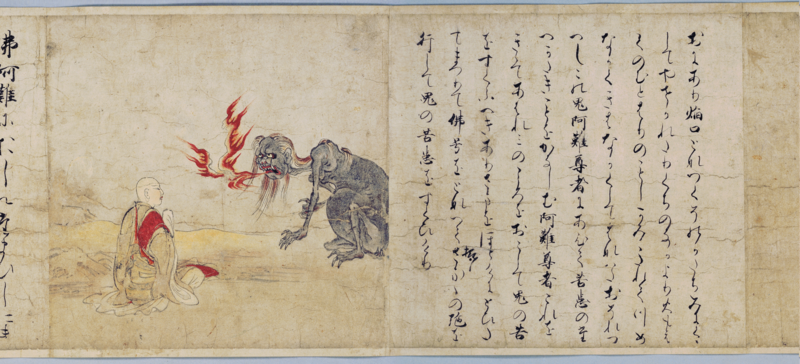
The Hungry Ghost: The concept of hungry ghost is found throughout Buddhist traditions. This is from the Sixth section of the Japanese Hungry Ghosts Scroll located at the Kyoto National Museum. The scroll depicts the world of the hungry ghosts, one of the six realms of Buddhism and contains tales of salvation of the hungry ghosts. This particular section shows Ananda, a disciple of Shakyamuni, teaching an incantation to achieve salvation to a hungry ghost who continuously belches flames from his mouth.

The creation of a Hungry Ghost happens when a person’s death has been exceptionally violent or unhappy. The ghosts are often given quite animalistic traits in the ghost stories and records. Although there are different categories and types of hungry ghosts, one common trait among them are that they are seeking a type of revenge of those who wronged them, or simply those who got in the way.

Although most accounts of Tu Po doesn’t give him animalistic traits like a monster, he definitely sought his revenge on those who wronged him like most vengeful ghosts are looking for, and therefore given the title of a Hungry Ghost.

Before becoming a Ghost – Tu-Po the Emperor’s Minister

Before becoming an ancient ghost, Tu Po used to be an important man in ancient China. The nobleman Tu Po 杜伯 is sometimes translated as Du Bo and he was the Duke of Tangdu. This was a Dukedom situated west of State of Yi Lin around were the Shaanxi province in northwest of China is today.

According to legend, the Tangdu people were descendants of the people living in the State of Tang, a Dukedom destroyed by Zhou Gong Dan that now ruled the empire. They were allowed to form a new State of Du, and became known as Tangdu or Du shi (杜氏).

Tu-Po was not always remembered as a hungry ghost, but was a prominent minister to King Xuan of Zhou (also known as Emperor Hsuan) who reigned from 827-783 B.C. Emperor Hsuan was the eleventh king of the Chinese Zhou Dynasty in a time were the kings words were the law and his minister Tu Po had to pay the ultimate price.

The empire: Map over the Jin (Tang) state during the late Spring and Autumn period as it was called, around the time of Tu-Po’s death and after. This is were he, and his ancestors resided and ruled.//Photo: Hugo Lopez – Wikimedia Commons user: Yug

The king is mostly remembered for fighting the ‘Western Barbarians‘, most probably Xianyun, an ancient nomadic tribe that invaded the Zhou empire on the Huai River. He also meddled in debacles of successions in States of Lu, Wey an Qi and was, according to history, not a popular one. Sima Qian, considered father of Chinese historiography, said: “From this time on, the many lords mostly rebelled against royal commands.” And the way the king ended his reign, is rumoured to be the work of the hungry ghost of Tu Po.

So Tu Po was from a stately and very powerful family and not afraid to speak up for what he believed in, even to the most powerful man in the dynasty. And this would cost him his life and make him a hungry ghost, haunting the earth and seeking revenge.

The Fall From Grace and Becoming a Vengeful Ghost

There are not very many sources detailing what happened before the haunting of Tu Po’s hauntings started. But according to one account, this is what happened.

The King: King Xuan of Zhou (827-783 B.C). Formerly known as Emperor Hsuan or King Suan.

On the ninth year as King, King Xuan of Zhou called all the lords of his empire into a meeting that would seal the fate of Tu Po to discuss an oncoming attack.

A rumor was out that a woman was about to become a danger of the town of Jiangshan for some reason, and the King ordered a mass execution of women. Exactly how this one woman could be considered a danger to an entire town is not really explained.

No matter what the reason behind this mass execution of women, it was seen as a truly horrible act that Tu Po disagreed with. Tu-Po publicly opposed to the order he was given and he spoke against his king in a time when the kings word was the law and anything else considered treason.

This final act of opposition would cost him his life as King Xuan ordered his execution for this as he saw this act of opposition as treason.

Before Tu Po was executed however, King Xuan of Zhou was warned that Tu Po’s ghost would stay in this world even in his afterlife to haunt him as Tu-Po himself said:

“If my majesty kills me without reason, the dead may not know, well that’s it. However, on the other hand, I will avenge myself on him, within three years.”

But despise the warnings, King Xuan went through the execution. Even though he was considered innocent of treason by most, Tu-Po was executed around 786 B.C. But this would not be the last time he was seen.

The Revenge of the Hungry Ghost

Weather Tu Po’s final words were taken seriously, is not mentioned. Three years after the execution however, the King brought his dukes to hunt on his own hunting grounds. There were hundreds of chariots, thousands of escorts following them as well as a ghost that promised he would return for revenge.

Ghost festival: Lotus-shaped lanterns are lit and set afloat in rivers and out onto seas to symbolically guide the lost souls to the afterlife.

At noon, Tu-Po appeared as a ghost, riding a white horse and a cart, wearing a red coat with a red bow and arrow in hand. He took up the chase of King Xuan and shot the king in the heart and broke the king’s spine. At the time, it is reported that no one saw the killing and no one heard it. No matter what the real situation was like, The king fell and Tu Po got his revenge.

If King Xuan really died of an arrow is today a bit unclear. In some accounts it is said that King Xuan died of something else after dreaming that Tu Po shot him to death with an arrow.

In both cases, the innocent and wronged minister got his revenge and King Xuan’s son, was the last of the western Zhou to lead.

The story has gone down in traditional legends, ever since. The Chinese philosopher, Mo Zi (470-391 B.C), said this about ghosts and about Tu-Po’s revenge:

“If from antiquity to the present, and since the beginning of man, there are men who have seen the bodies of ghosts and spirits and heard their voices, how can we say that they do not exist?

If none have heard them and none have seen them, then how can we say they do? But those who deny the existence of the spirits say: “Many in the world have heard and seen something of ghosts and spirits. Since they vary in testimony, who are to be accepted as really having heard and seen them?”

As we are to rely on what many have jointly seen and what many have jointly heard, the case of Tu Po is to be accepted.”

More Like This

Newest Posts

Ghost of Tu-Po — The Hungry Ghost